
Compact Optical Delay Line Based on Scanning Surface
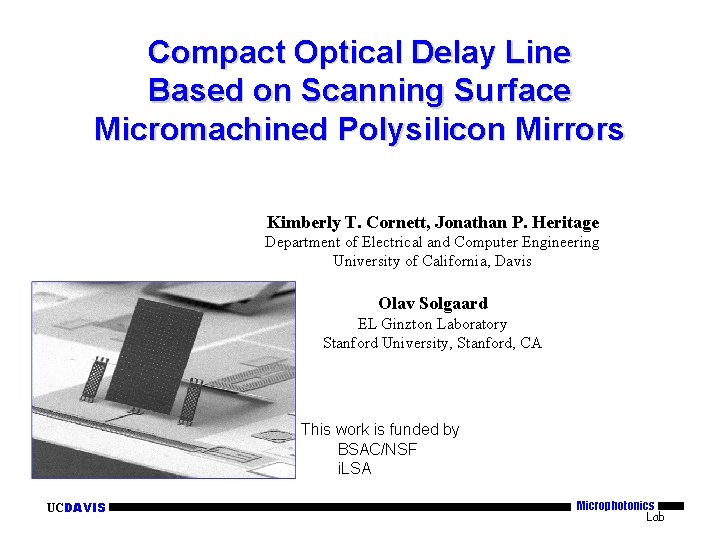
Compact Optical Delay Line Based on Scanning Surface Micromachined Polysilicon Mirrors Kimberly T. Cornett, Jonathan P. Heritage Department of Electrical and Computer Engineering University of California, Davis Olav Solgaard EL Ginzton Laboratory Stanford University, Stanford, CA This work is funded by BSAC/NSF i. LSA UCDAVIS Microphotonics Lab
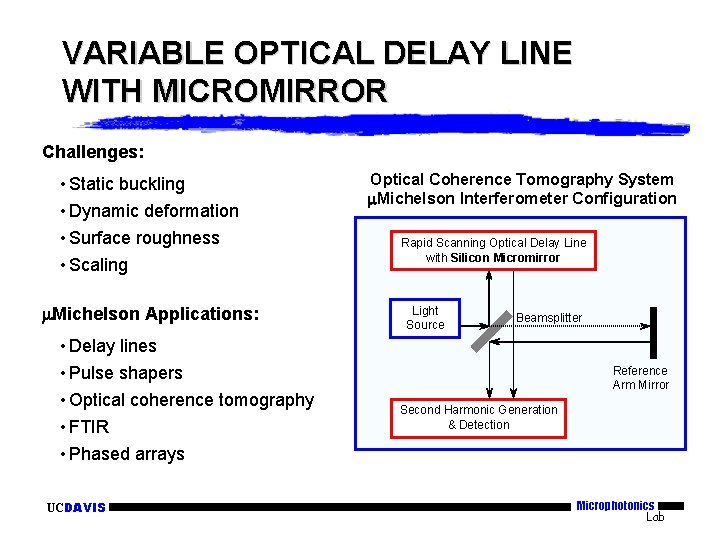
VARIABLE OPTICAL DELAY LINE WITH MICROMIRROR Challenges: • Static buckling • Dynamic deformation • Surface roughness • Scaling m. Michelson Applications: • Delay lines • Pulse shapers • Optical coherence tomography • FTIR • Phased arrays UCDAVIS Optical Coherence Tomography System m. Michelson Interferometer Configuration Rapid Scanning Optical Delay Line with Silicon Micromirror Light Source Beamsplitter Reference Arm Mirror Second Harmonic Generation & Detection Microphotonics Lab
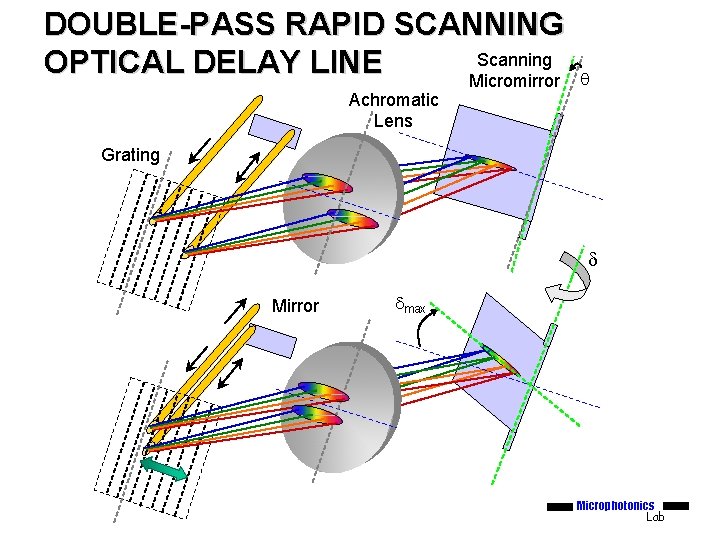
DOUBLE-PASS RAPID SCANNING Scanning OPTICAL DELAY LINE Micromirror q Achromatic Lens Grating d Mirror dmax Microphotonics Lab
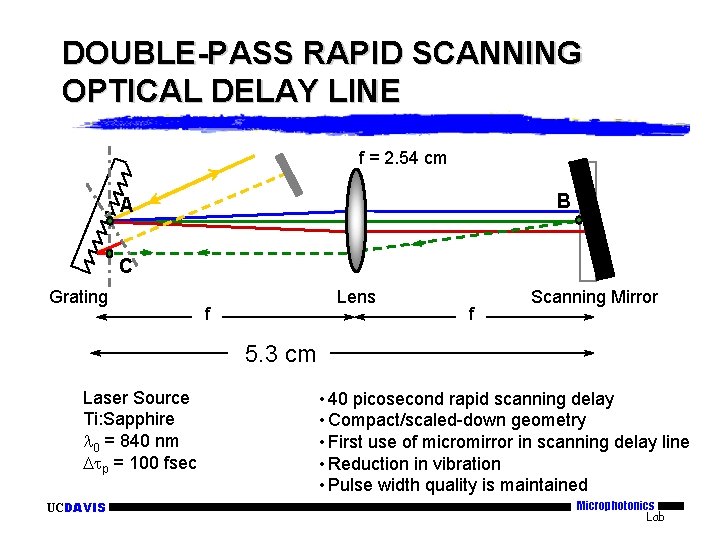
DOUBLE-PASS RAPID SCANNING OPTICAL DELAY LINE f = 2. 54 cm B A C Grating Lens f f Scanning Mirror 5. 3 cm Laser Source Ti: Sapphire l 0 = 840 nm Dtp = 100 fsec UCDAVIS • 40 picosecond rapid scanning delay • Compact/scaled-down geometry • First use of micromirror in scanning delay line • Reduction in vibration • Pulse width quality is maintained Microphotonics Lab
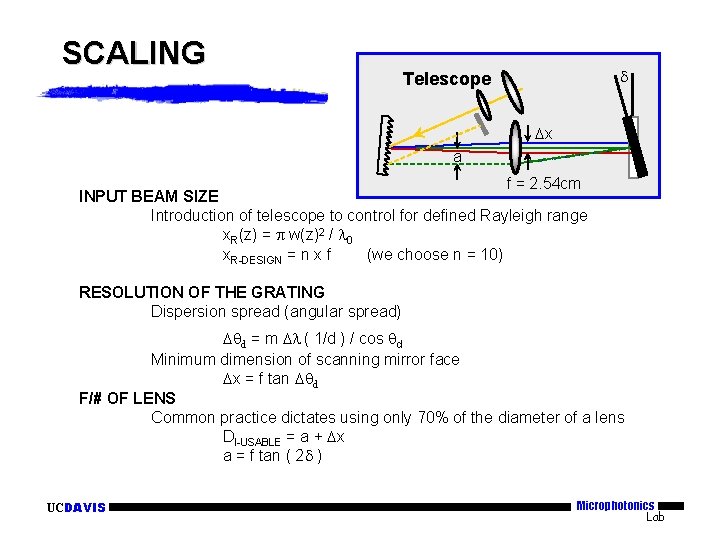
SCALING d Telescope Dx a f = 2. 54 cm INPUT BEAM SIZE Introduction of telescope to control for defined Rayleigh range x. R(z) = p w(z)2 / l 0 x. R-DESIGN = n x f (we choose n = 10) RESOLUTION OF THE GRATING Dispersion spread (angular spread) Dqd = m Dl ( 1/d ) / cos qd Minimum dimension of scanning mirror face Dx = f tan Dqd F/# OF LENS Common practice dictates using only 70% of the diameter of a lens Dl-USABLE = a + Dx a = f tan ( 2 d ) UCDAVIS Microphotonics Lab
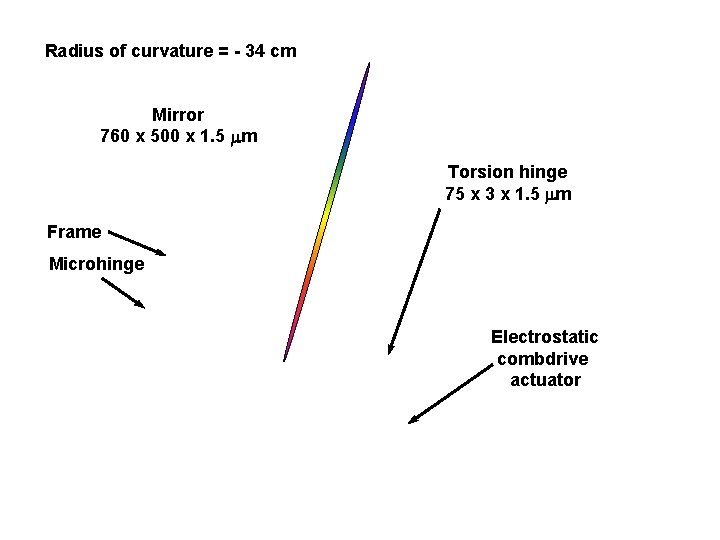
Radius of curvature = - 34 cm Mirror 760 x 500 x 1. 5 mm Torsion hinge 75 x 3 x 1. 5 mm Frame Microhinge Electrostatic combdrive actuator
![Mirror static deflection[deg] MECHANICAL CHARACTERIZATION OF SCANNING MICROMIRROR Optical deflection [deg] 10 1 10](http://slidetodoc.com/presentation_image_h2/6902390bfc9ecd0f39fb7860e8aa6b81/image-7.jpg "Mirror static deflection[deg] MECHANICAL CHARACTERIZATION OF SCANNING MICROMIRROR Optical deflection [deg] 10 1 10")
Mirror static deflection[deg] MECHANICAL CHARACTERIZATION OF SCANNING MICROMIRROR Optical deflection [deg] 10 1 10 -2 1 10 1000 Frequency [Hz] Mirror Frequency Response 16 14 12 10 8 6 4 2 0 -2 0 0. 2 0. 4 0. 6 0. 8 1. 0 1. 2 1. 4 1. 6 1. 8 2. 0 Squared voltage [V 2 x 10⁴ ] Static Mirror Deflection (Optical Angle) UCDAVIS Microphotonics Lab

MEASURED STATIC TIME DELAY Optical Angle, 2 d (deg) -6 Cross-Correlation Signal (Normalized) -8 -4 -2 0 2 4 8 6 1. 0 0. 8 0. 6 0. 4 0. 2 0. 0 -20 -10 0 10 20 Time Delay (psec) Time window ~ 40 picoseconds UCDAVIS Microphotonics Lab
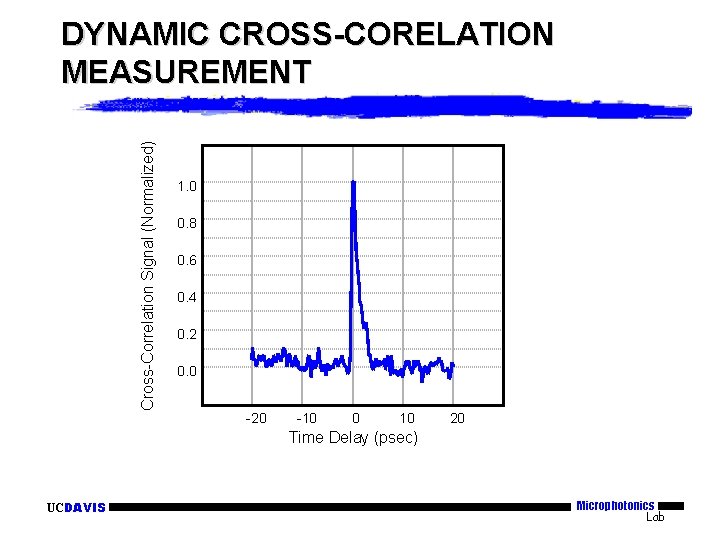
Cross-Correlation Signal (Normalized) DYNAMIC CROSS-CORELATION MEASUREMENT 1. 0 0. 8 0. 6 0. 4 0. 2 0. 0 -20 -10 0 10 20 Time Delay (psec) UCDAVIS Microphotonics Lab
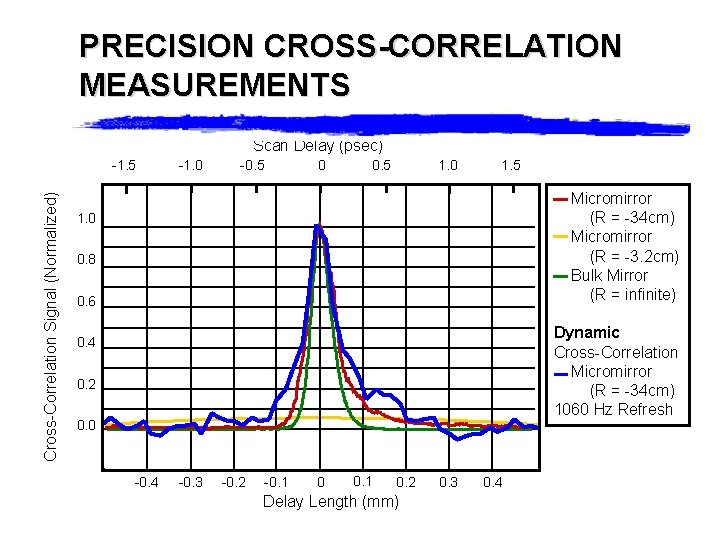
PRECISION CROSS-CORRELATION MEASUREMENTS Scan Delay (psec) Cross-Correlation Signal (Normalized) -1. 5 -1. 0 -0. 5 0 0. 5 1. 0 1. 5 Micromirror (R = -34 cm) Micromirror (R = -3. 2 cm) Bulk Mirror (R = infinite) 1. 0 0. 8 0. 6 Dynamic Cross-Correlation Micromirror (R = -34 cm) 1060 Hz Refresh 0. 4 0. 2 0. 0 -0. 4 -0. 3 -0. 2 -0. 1 0. 2 Delay Length (mm) 0. 3 0. 4
CONCLUSIONS • Micromirror scanning optical delay line • • 40 picosecond time window 1060 Hz refresh rate compact geometry - 5. 3 cm total length Pulse quality maintained • Improvements • Faster scanning and flatter micromirror • Expand design with integration of micromirror phased array • Optical delay lines enable • • UCDAVIS Optical coherence tomography FTIR Phased Array Antennas ……. Microphotonics Lab
- Slides: 11