
Compact Muon Solenoid STFC RAL Extended Introduction to
![STFC RAL Measured Endcap Deformation at 3. 8 T [mm] SLM 1 SLM 2](https://slidetodoc.com/presentation_image_h2/7f3e19540b60c3325430178b0a5ab92b/image-13.jpg "STFC RAL Measured Endcap Deformation at 3. 8 T [mm] SLM 1 SLM 2")
![STFC Pixel commissioning in CRAFT r [cm] RAL Z [cm] Barrel aligned at module](https://slidetodoc.com/presentation_image_h2/7f3e19540b60c3325430178b0a5ab92b/image-18.jpg "STFC Pixel commissioning in CRAFT r [cm] RAL Z [cm] Barrel aligned at module")
- Slides: 45
Compact Muon Solenoid STFC RAL • • Extended Introduction to CMS Magnet Tracking System Electromagnetic Calorimeter Hadronic Calorimeter Muon System Trigger & Data Acquisition Summary Ken Bell – Rutherford Appleton Laboratory CMS Ken Bell 1
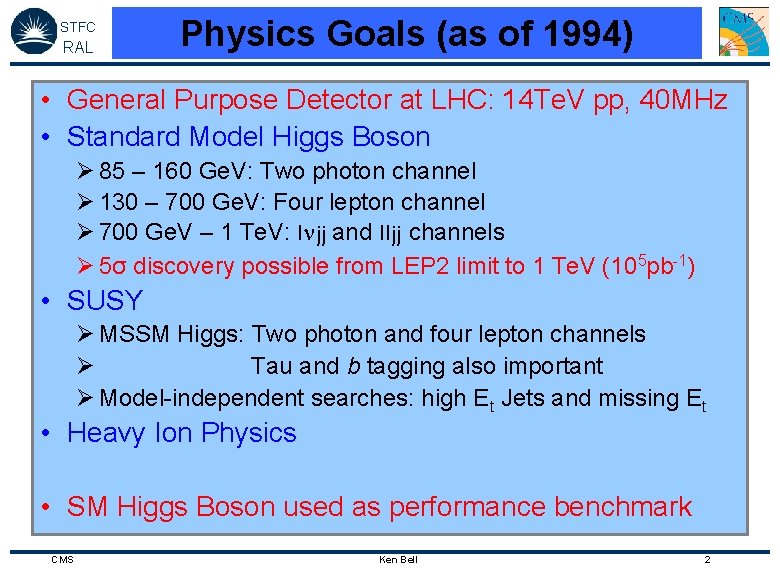
STFC RAL Physics Goals (as of 1994) • General Purpose Detector at LHC: 14 Te. V pp, 40 MHz • Standard Model Higgs Boson Ø 85 – 160 Ge. V: Two photon channel Ø 130 – 700 Ge. V: Four lepton channel Ø 700 Ge. V – 1 Te. V: l jj and lljj channels Ø 5σ discovery possible from LEP 2 limit to 1 Te. V (105 pb-1) • SUSY Ø MSSM Higgs: Two photon and four lepton channels Ø Tau and b tagging also important Ø Model-independent searches: high Et Jets and missing Et • Heavy Ion Physics • SM Higgs Boson used as performance benchmark CMS Ken Bell 2
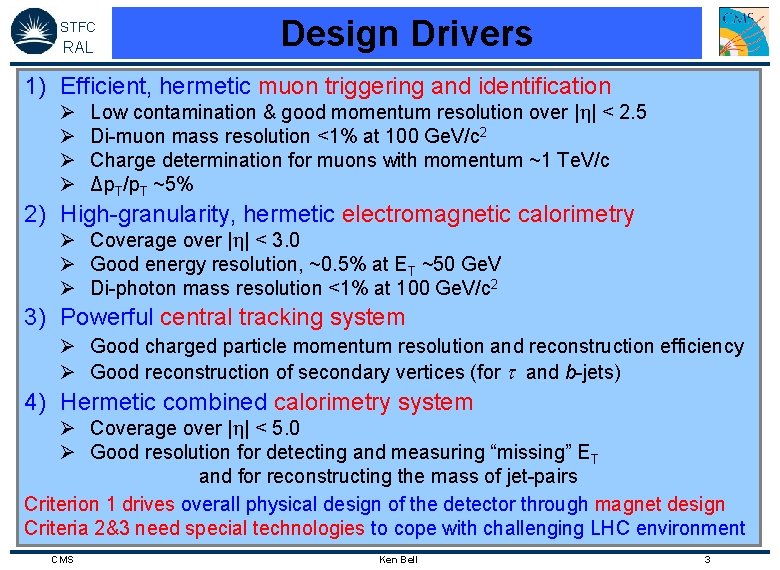
STFC RAL Design Drivers 1) Efficient, hermetic muon triggering and identification Ø Ø Low contamination & good momentum resolution over | | < 2. 5 Di-muon mass resolution <1% at 100 Ge. V/c 2 Charge determination for muons with momentum ~1 Te. V/c Δp. T/p. T ~5% 2) High-granularity, hermetic electromagnetic calorimetry Ø Coverage over | | < 3. 0 Ø Good energy resolution, ~0. 5% at ET ~50 Ge. V Ø Di-photon mass resolution <1% at 100 Ge. V/c 2 3) Powerful central tracking system Ø Good charged particle momentum resolution and reconstruction efficiency Ø Good reconstruction of secondary vertices (for and b-jets) 4) Hermetic combined calorimetry system Ø Coverage over | | < 5. 0 Ø Good resolution for detecting and measuring “missing” ET and for reconstructing the mass of jet-pairs Criterion 1 drives overall physical design of the detector through magnet design Criteria 2&3 need special technologies to cope with challenging LHC environment CMS Ken Bell 3
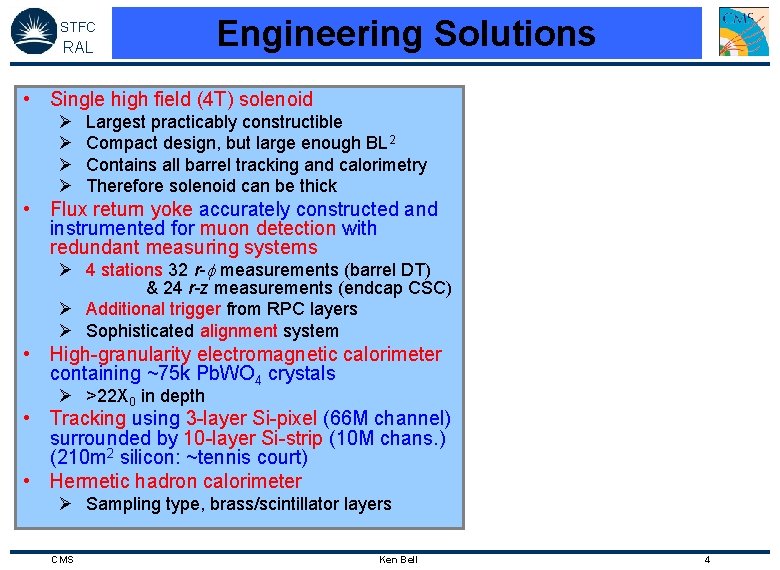
STFC RAL Engineering Solutions • Single high field (4 T) solenoid Ø Ø Largest practicably constructible Compact design, but large enough BL 2 Contains all barrel tracking and calorimetry Therefore solenoid can be thick • Flux return yoke accurately constructed and instrumented for muon detection with redundant measuring systems Ø 4 stations 32 r- measurements (barrel DT) & 24 r-z measurements (endcap CSC) Ø Additional trigger from RPC layers Ø Sophisticated alignment system • High-granularity electromagnetic calorimeter containing ~75 k Pb. WO 4 crystals Ø >22 X 0 in depth • Tracking using 3 -layer Si-pixel (66 M channel) surrounded by 10 -layer Si-strip (10 M chans. ) (210 m 2 silicon: ~tennis court) • Hermetic hadron calorimeter Ø Sampling type, brass/scintillator layers CMS Ken Bell 4
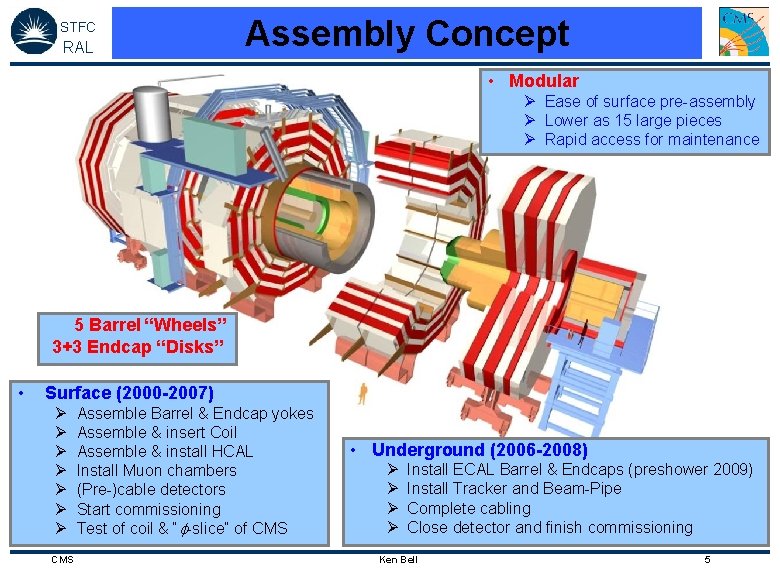
STFC RAL Assembly Concept • Modular Ø Ease of surface pre-assembly Ø Lower as 15 large pieces Ø Rapid access for maintenance 5 Barrel “Wheels” 3+3 Endcap “Disks” • Surface (2000 -2007) Ø Ø Ø Ø CMS Assemble Barrel & Endcap yokes Assemble & insert Coil Assemble & install HCAL Install Muon chambers (Pre-)cable detectors Start commissioning Test of coil & “ -slice” of CMS • Underground (2006 -2008) Ø Ø Install ECAL Barrel & Endcaps (preshower 2009) Install Tracker and Beam-Pipe Complete cabling Close detector and finish commissioning Ken Bell 5
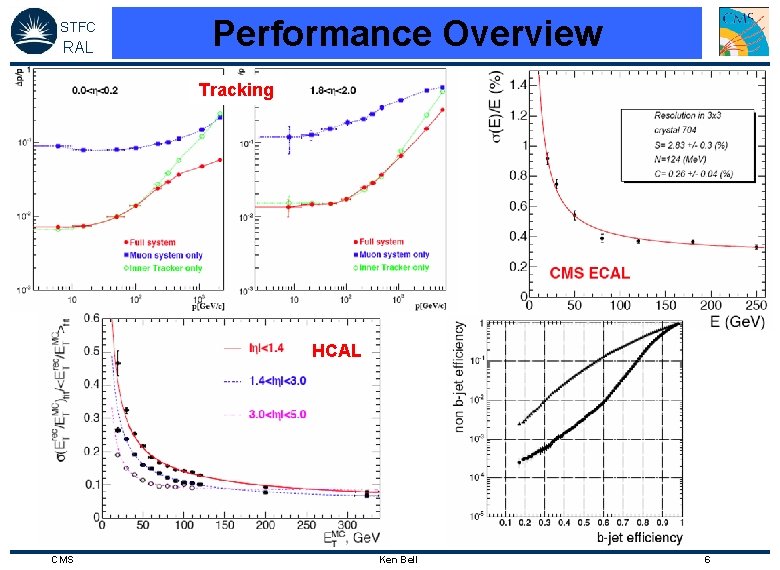
STFC RAL Performance Overview Tracking HCAL CMS Ken Bell 6
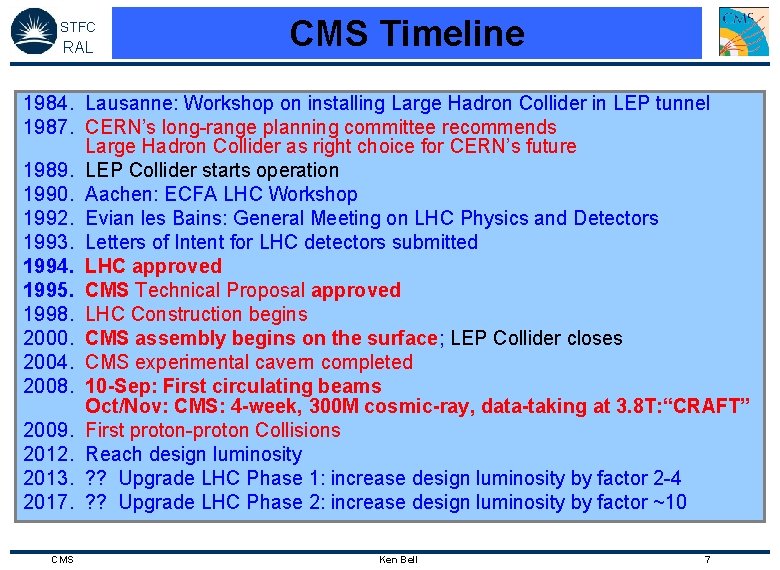
STFC RAL CMS Timeline 1984. Lausanne: Workshop on installing Large Hadron Collider in LEP tunnel 1987. CERN’s long-range planning committee recommends Large Hadron Collider as right choice for CERN’s future 1989. LEP Collider starts operation 1990. Aachen: ECFA LHC Workshop 1992. Evian les Bains: General Meeting on LHC Physics and Detectors 1993. Letters of Intent for LHC detectors submitted 1994. LHC approved 1995. CMS Technical Proposal approved 1998. LHC Construction begins 2000. CMS assembly begins on the surface; LEP Collider closes 2004. CMS experimental cavern completed 2008. 10 -Sep: First circulating beams Oct/Nov: CMS: 4 -week, 300 M cosmic-ray, data-taking at 3. 8 T: “CRAFT” 2009. First proton-proton Collisions 2012. Reach design luminosity 2013. ? ? Upgrade LHC Phase 1: increase design luminosity by factor 2 -4 2017. ? ? Upgrade LHC Phase 2: increase design luminosity by factor ~10 CMS Ken Bell 7
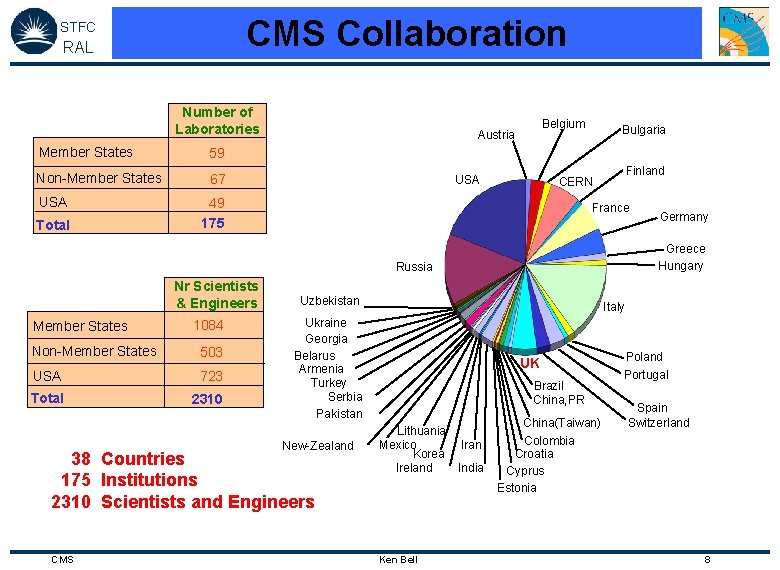
CMS Collaboration STFC RAL Number of Laboratories Member States 59 Non-Member States 67 USA Total Belgium Austria USA Bulgaria Finland CERN 49 175 France Greece Hungary Russia Nr Scientists & Engineers Member States 1084 Non-Member States 503 USA 723 Total 2310 Uzbekistan 38 Countries 175 Institutions 2310 Scientists and Engineers CMS Italy Ukraine Georgia Belarus Armenia Turkey Serbia Pakistan New-Zealand Germany UK Brazil China, PR Lithuania Mexico Iran Korea Ireland India Ken Bell China(Taiwan) Poland Portugal Spain Switzerland Colombia Croatia Cyprus Estonia 8
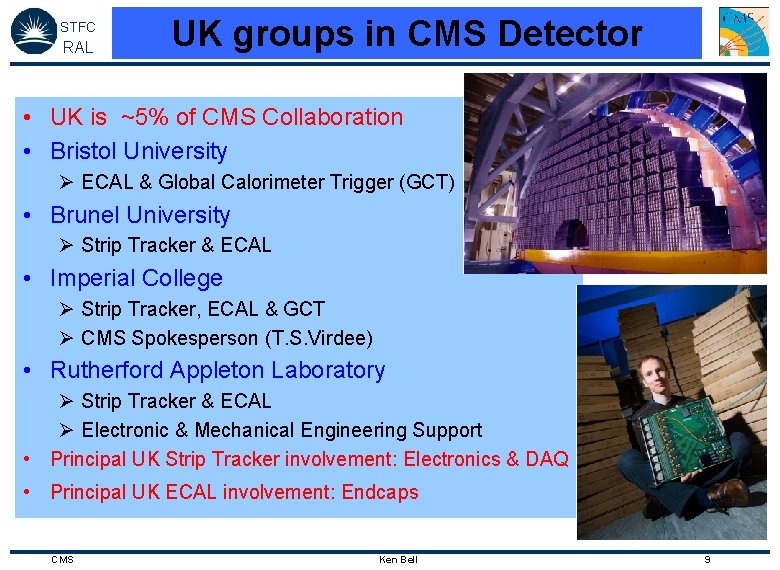
STFC RAL UK groups in CMS Detector • UK is ~5% of CMS Collaboration • Bristol University Ø ECAL & Global Calorimeter Trigger (GCT) • Brunel University Ø Strip Tracker & ECAL • Imperial College Ø Strip Tracker, ECAL & GCT Ø CMS Spokesperson (T. S. Virdee) • Rutherford Appleton Laboratory Ø Strip Tracker & ECAL Ø Electronic & Mechanical Engineering Support • Principal UK Strip Tracker involvement: Electronics & DAQ • Principal UK ECAL involvement: Endcaps CMS Ken Bell 9
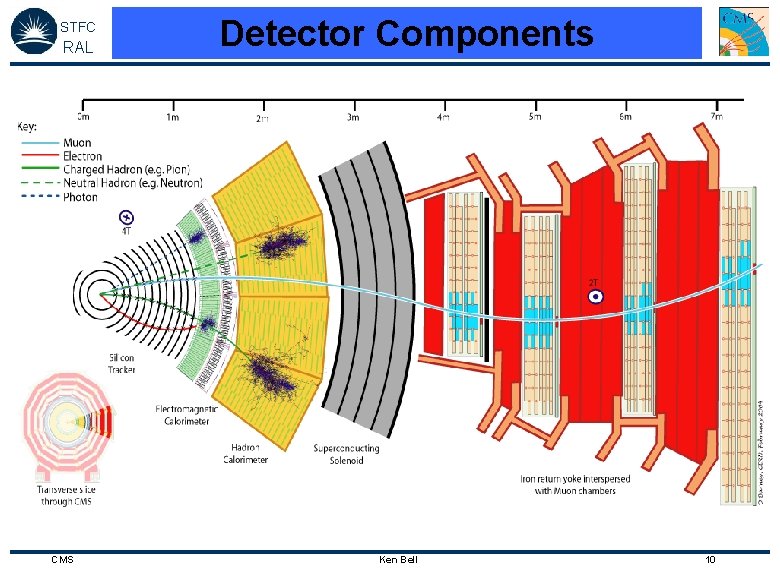
STFC RAL CMS Detector Components Ken Bell 10
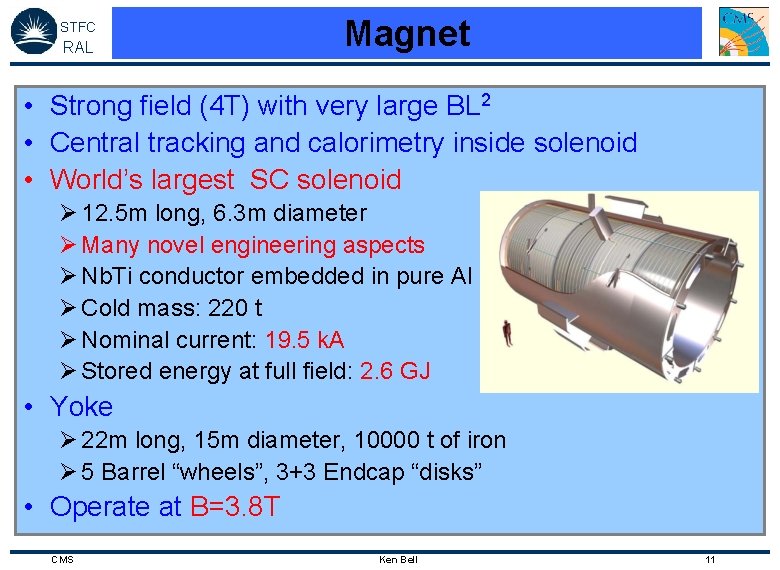
STFC RAL Magnet • Strong field (4 T) with very large BL 2 • Central tracking and calorimetry inside solenoid • World’s largest SC solenoid Ø 12. 5 m long, 6. 3 m diameter Ø Many novel engineering aspects Ø Nb. Ti conductor embedded in pure Al Ø Cold mass: 220 t Ø Nominal current: 19. 5 k. A Ø Stored energy at full field: 2. 6 GJ • Yoke Ø 22 m long, 15 m diameter, 10000 t of iron Ø 5 Barrel “wheels”, 3+3 Endcap “disks” • Operate at B=3. 8 T CMS Ken Bell 11
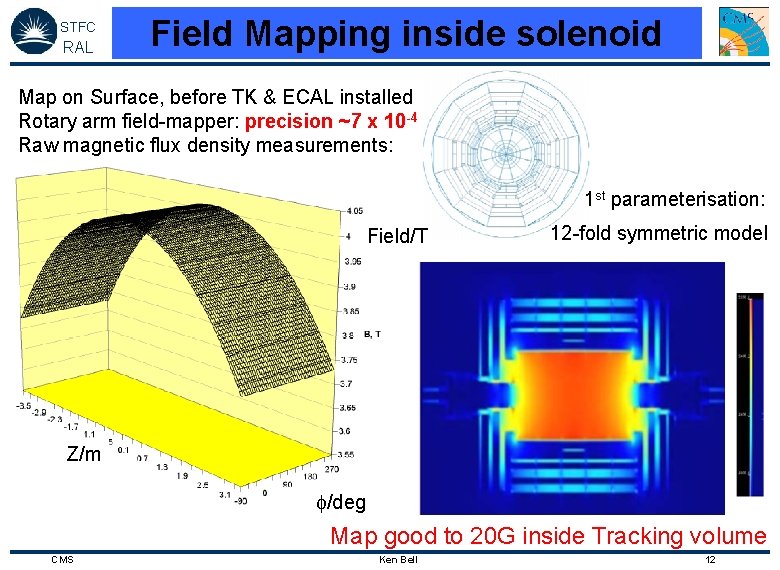
STFC RAL Field Mapping inside solenoid Map on Surface, before TK & ECAL installed Rotary arm field-mapper: precision ~7 x 10 -4 Raw magnetic flux density measurements: 1 st parameterisation: Field/T 12 -fold symmetric model Z/m /deg Map good to 20 G inside Tracking volume CMS Ken Bell 12
STFC RAL Measured Endcap Deformation at 3. 8 T [mm] SLM 1 SLM 2 SLM 3 3 Straight Line Monitor (SLM) Laser Lines per Muon Endcap Station 10 optical CCD sensors per SLM CMS Radial distance along SLM [mm] Measured ~15 mm deformation agrees well with FEA prediction Ken Bell 13
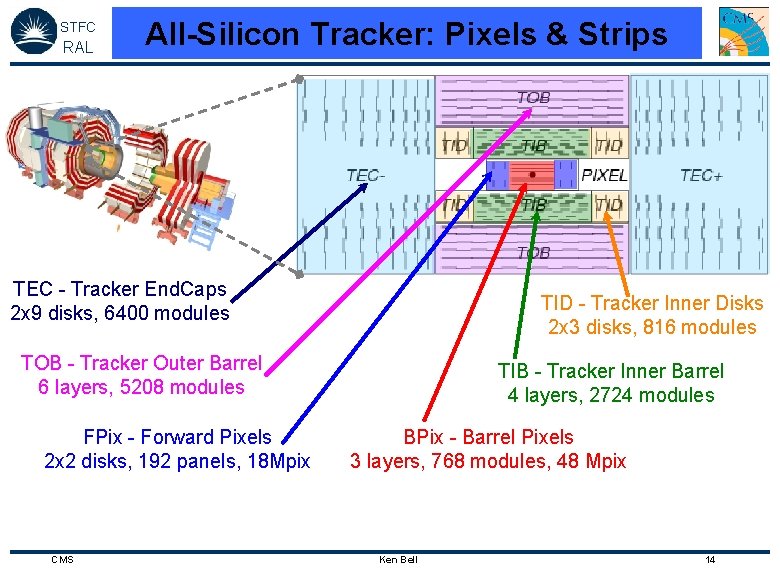
STFC RAL All-Silicon Tracker: Pixels & Strips TEC - Tracker End. Caps 2 x 9 disks, 6400 modules TID - Tracker Inner Disks 2 x 3 disks, 816 modules TOB - Tracker Outer Barrel 6 layers, 5208 modules FPix - Forward Pixels 2 x 2 disks, 192 panels, 18 Mpix CMS TIB - Tracker Inner Barrel 4 layers, 2724 modules BPix - Barrel Pixels 3 layers, 768 modules, 48 Mpix Ken Bell 14
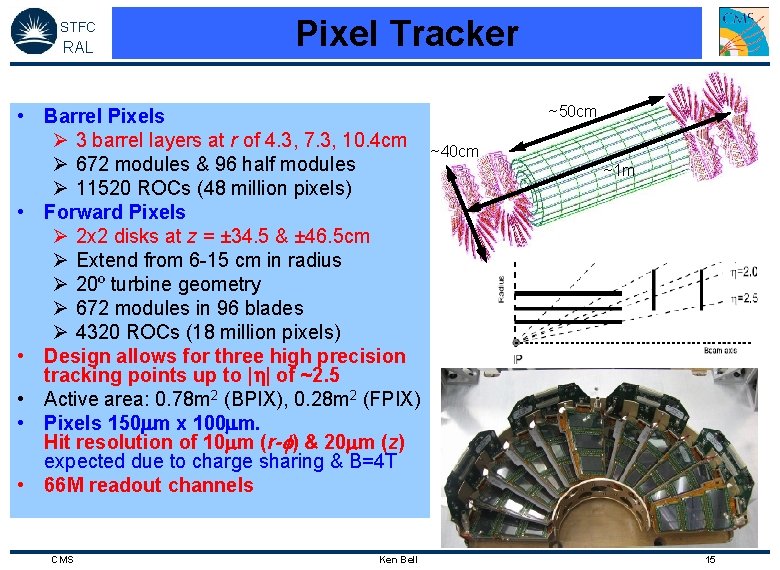
STFC RAL Pixel Tracker • Barrel Pixels Ø 3 barrel layers at r of 4. 3, 7. 3, 10. 4 cm Ø 672 modules & 96 half modules Ø 11520 ROCs (48 million pixels) • Forward Pixels Ø 2 x 2 disks at z = ± 34. 5 & ± 46. 5 cm Ø Extend from 6 -15 cm in radius Ø 20º turbine geometry Ø 672 modules in 96 blades Ø 4320 ROCs (18 million pixels) • Design allows for three high precision tracking points up to | | of ~2. 5 • Active area: 0. 78 m 2 (BPIX), 0. 28 m 2 (FPIX) • Pixels 150 m x 100 m. Hit resolution of 10 m (r- ) & 20 m (z) expected due to charge sharing & B=4 T • 66 M readout channels CMS Ken Bell ~50 cm ~40 cm ~1 m 15
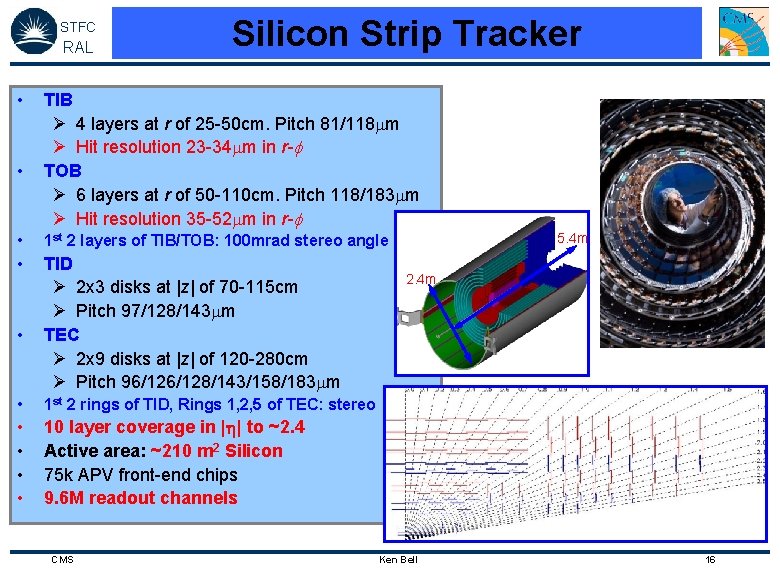
STFC RAL • • Silicon Strip Tracker TIB Ø 4 layers at r of 25 -50 cm. Pitch 81/118 m Ø Hit resolution 23 -34 m in r- TOB Ø 6 layers at r of 50 -110 cm. Pitch 118/183 m Ø Hit resolution 35 -52 m in r- • 1 st 2 layers of TIB/TOB: 100 mrad stereo angle • TID Ø 2 x 3 disks at |z| of 70 -115 cm Ø Pitch 97/128/143 m TEC Ø 2 x 9 disks at |z| of 120 -280 cm Ø Pitch 96/128/143/158/183 m • • 1 st 2 rings of TID, Rings 1, 2, 5 of TEC: stereo • • 10 layer coverage in | | to ~2. 4 Active area: ~210 m 2 Silicon 75 k APV front-end chips 9. 6 M readout channels CMS 5. 4 m 2. 4 m Ken Bell 16
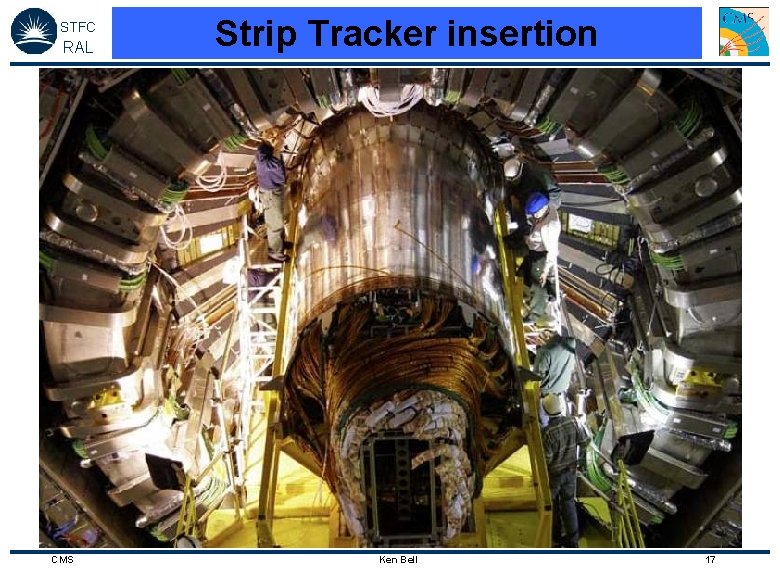
STFC RAL CMS Strip Tracker insertion Ken Bell 17
STFC Pixel commissioning in CRAFT r [cm] RAL Z [cm] Barrel aligned at module level (200 -300 hits, 89% aligned) Pixel occupancy map CMS Ken Bell 18
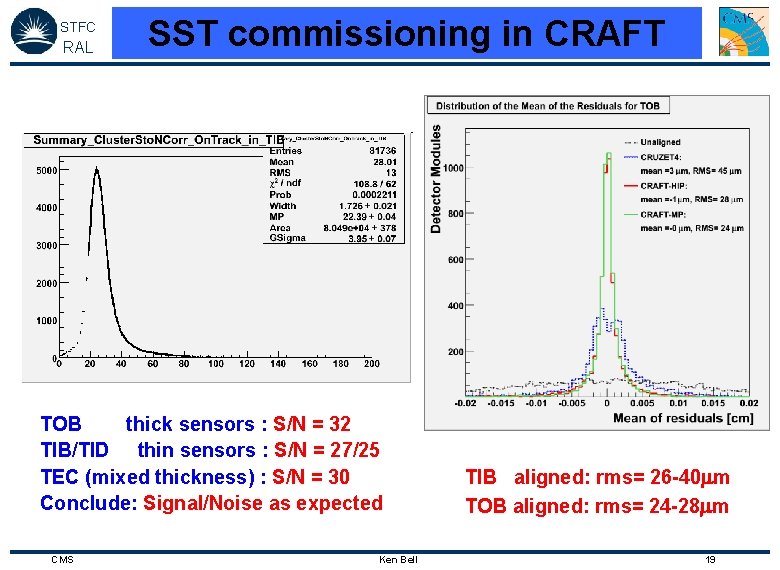
STFC RAL SST commissioning in CRAFT TOB thick sensors : S/N = 32 TIB/TID thin sensors : S/N = 27/25 TEC (mixed thickness) : S/N = 30 Conclude: Signal/Noise as expected CMS Ken Bell TIB aligned: rms= 26 -40 m TOB aligned: rms= 24 -28 m 19
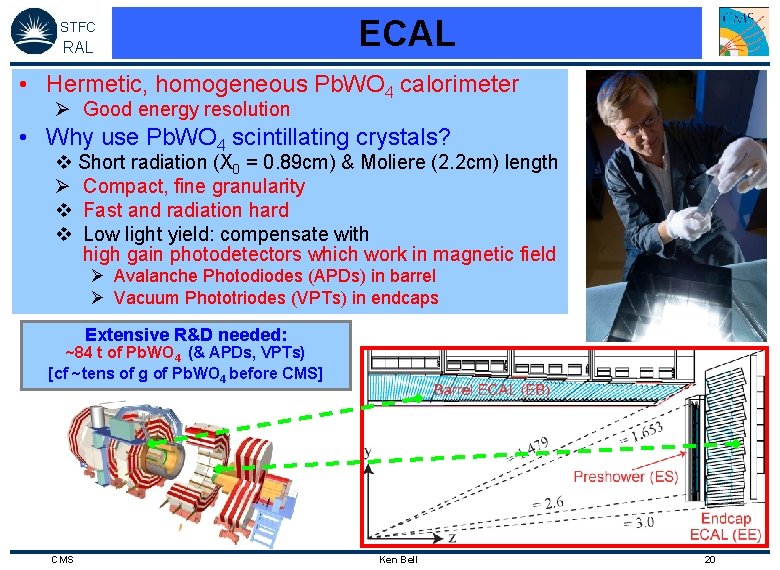
STFC RAL ECAL • Hermetic, homogeneous Pb. WO 4 calorimeter Ø Good energy resolution • Why use Pb. WO 4 scintillating crystals? v Short radiation (X 0 = 0. 89 cm) & Moliere (2. 2 cm) length Ø Compact, fine granularity v Fast and radiation hard v Low light yield: compensate with high gain photodetectors which work in magnetic field Ø Avalanche Photodiodes (APDs) in barrel Ø Vacuum Phototriodes (VPTs) in endcaps Extensive R&D needed: ~84 t of Pb. WO 4 (& APDs, VPTs) [cf ~tens of g of Pb. WO 4 before CMS] CMS Ken Bell 20
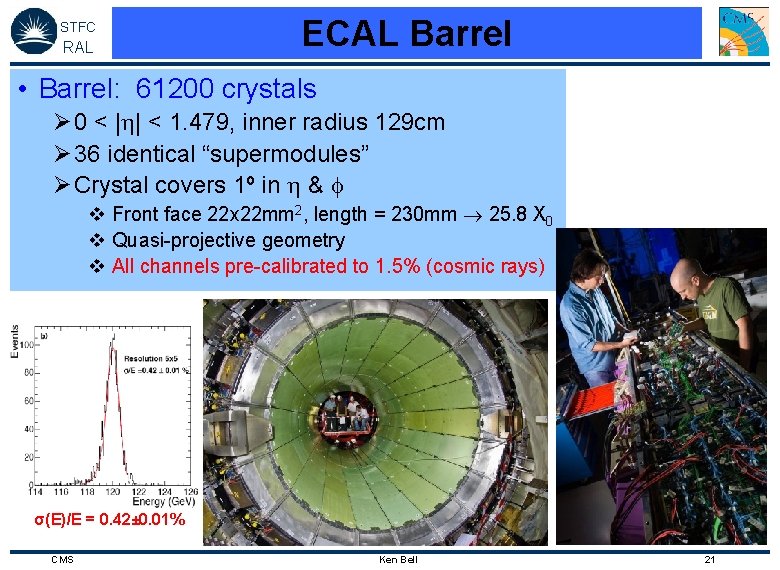
STFC RAL ECAL Barrel • Barrel: 61200 crystals Ø 0 < | | < 1. 479, inner radius 129 cm Ø 36 identical “supermodules” Ø Crystal covers 1º in & v Front face 22 x 22 mm 2, length = 230 mm 25. 8 X 0 v Quasi-projective geometry v All channels pre-calibrated to 1. 5% (cosmic rays) σ(E)/E = 0. 42± 0. 01% CMS Ken Bell 21
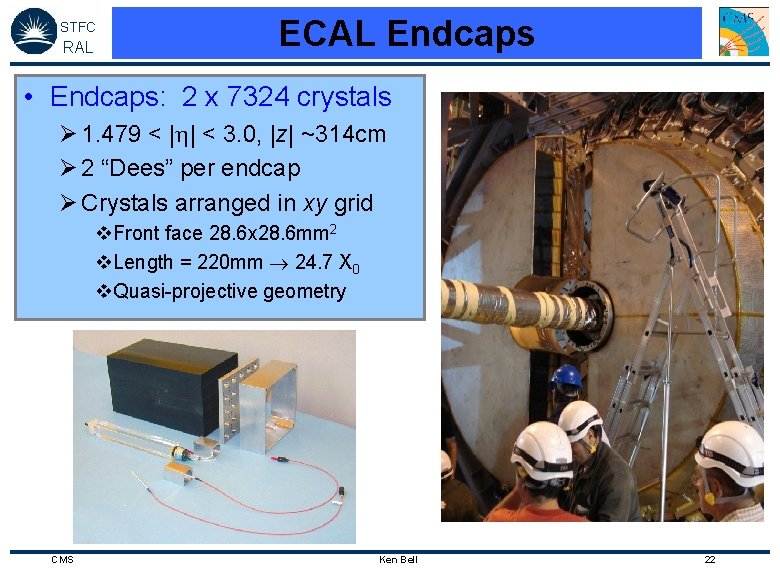
STFC RAL ECAL Endcaps • Endcaps: 2 x 7324 crystals Ø 1. 479 < | | < 3. 0, |z| ~314 cm Ø 2 “Dees” per endcap Ø Crystals arranged in xy grid v. Front face 28. 6 x 28. 6 mm 2 v. Length = 220 mm 24. 7 X 0 v. Quasi-projective geometry CMS Ken Bell 22
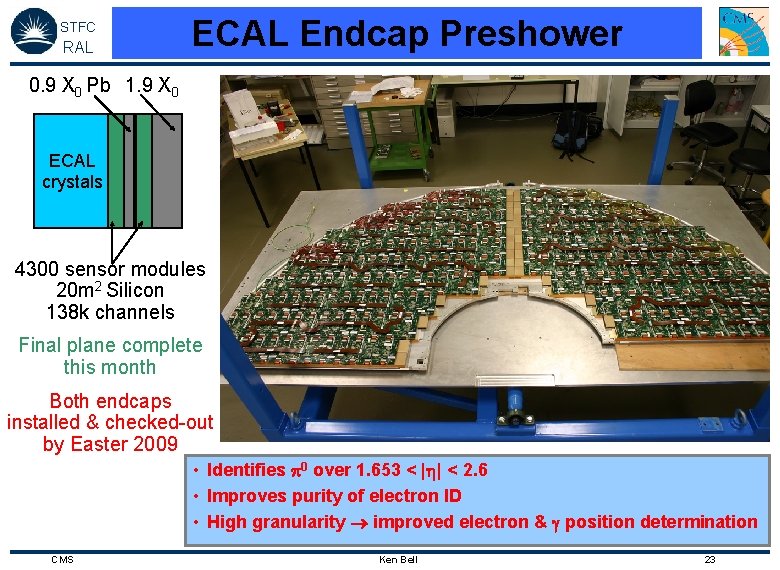
STFC RAL ECAL Endcap Preshower 0. 9 X 0 Pb 1. 9 X 0 ECAL crystals 4300 sensor modules 20 m 2 Silicon 138 k channels Final plane complete this month Both endcaps installed & checked-out by Easter 2009 • Identifies 0 over 1. 653 < | | < 2. 6 • Improves purity of electron ID • High granularity improved electron & position determination CMS Ken Bell 23
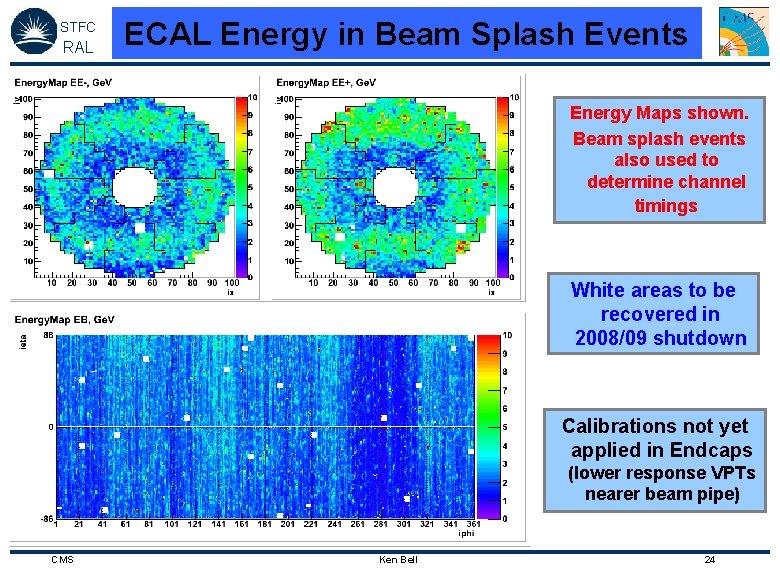
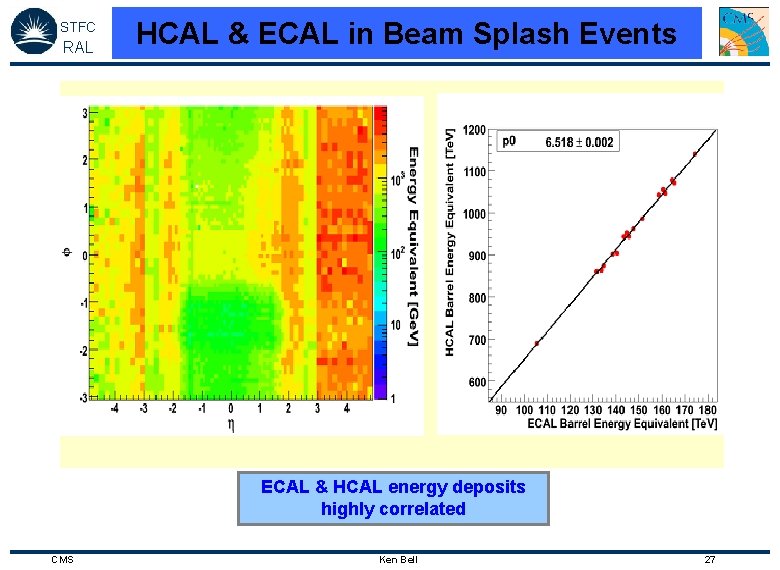
STFC RAL ECAL Energy in Beam Splash Events Energy Maps shown. Beam splash events also used to determine channel timings White areas to be recovered in 2008/09 shutdown Calibrations not yet applied in Endcaps (lower response VPTs nearer beam pipe) CMS Ken Bell 24
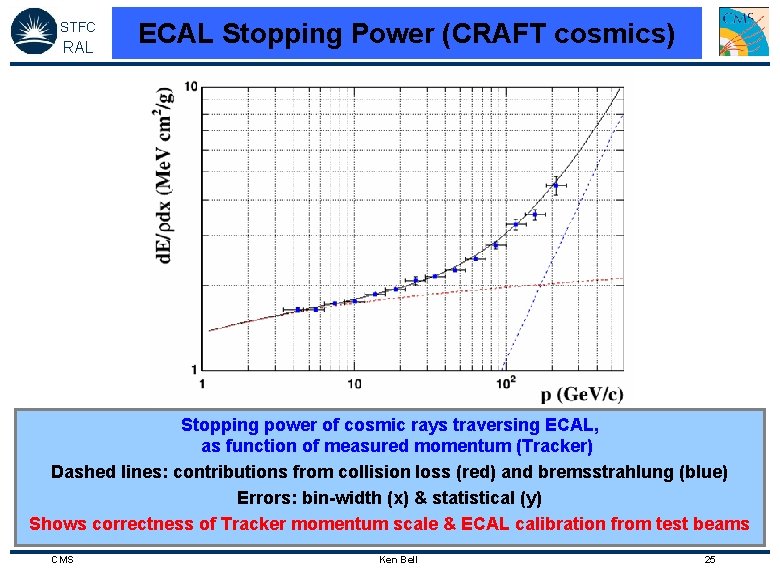
STFC RAL ECAL Stopping Power (CRAFT cosmics) Stopping power of cosmic rays traversing ECAL, as function of measured momentum (Tracker) Dashed lines: contributions from collision loss (red) and bremsstrahlung (blue) Errors: bin-width (x) & statistical (y) Shows correctness of Tracker momentum scale & ECAL calibration from test beams CMS Ken Bell 25
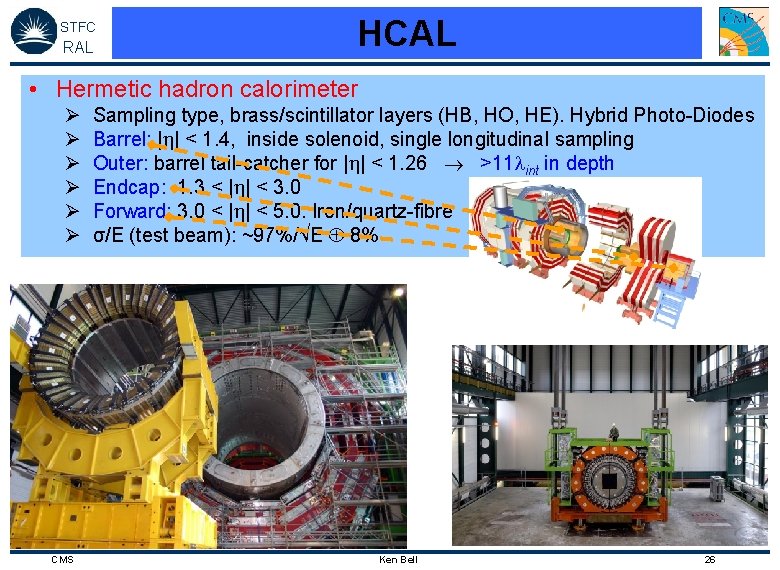
STFC RAL HCAL • Hermetic hadron calorimeter Ø Ø Ø CMS Sampling type, brass/scintillator layers (HB, HO, HE). Hybrid Photo-Diodes Barrel: | | < 1. 4, inside solenoid, single longitudinal sampling Outer: barrel tail-catcher for | | < 1. 26 >11 int in depth Endcap: 1. 3 < | | < 3. 0 Forward: 3. 0 < | | < 5. 0: Iron/quartz-fibre σ/E (test beam): ~97%/√E 8% Ken Bell 26
STFC RAL HCAL & ECAL in Beam Splash Events ECAL & HCAL energy deposits highly correlated CMS Ken Bell 27
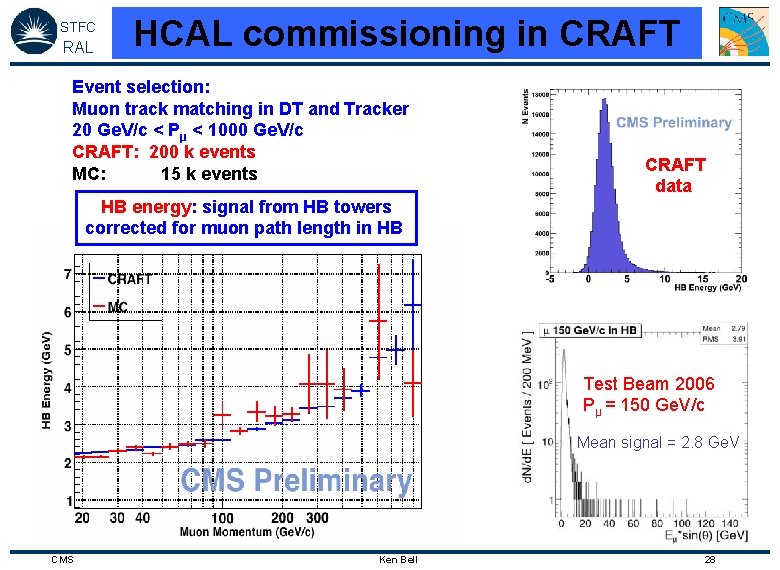
STFC RAL HCAL commissioning in CRAFT Event selection: Muon track matching in DT and Tracker 20 Ge. V/c < Pµ < 1000 Ge. V/c CRAFT: 200 k events MC: 15 k events CRAFT data HB energy: signal from HB towers corrected for muon path length in HB Test Beam 2006 Pµ = 150 Ge. V/c Mean signal = 2. 8 Ge. V CMS Ken Bell 28
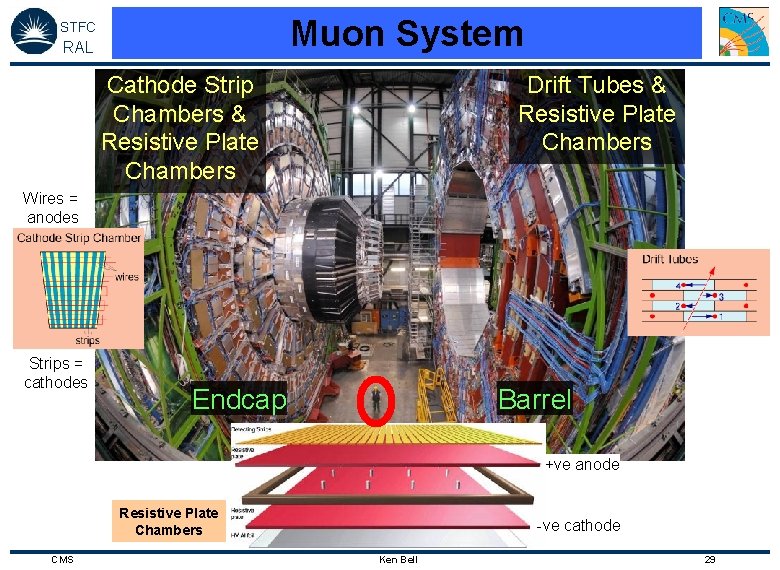
Muon System STFC RAL Cathode Strip Chambers & Resistive Plate Chambers Drift Tubes & Resistive Plate Chambers Wires = anodes Strips = cathodes Endcap Barrel Endcap Resistive Plate Chambers CMS +ve anode -ve cathode Ken Bell 29
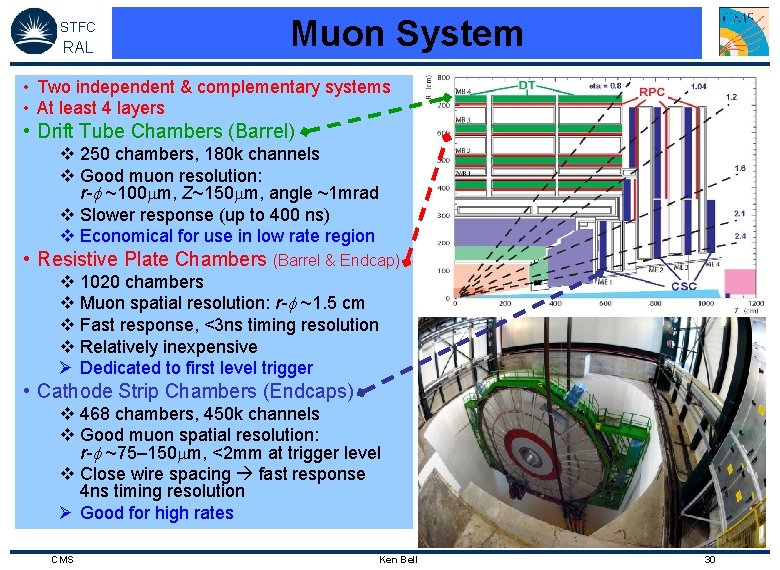
STFC RAL Muon System • Two independent & complementary systems • At least 4 layers • Drift Tube Chambers (Barrel) v 250 chambers, 180 k channels v Good muon resolution: r- ~100 m, Z~150 m, angle ~1 mrad v Slower response (up to 400 ns) v Economical for use in low rate region • Resistive Plate Chambers (Barrel & Endcap) v 1020 chambers v Muon spatial resolution: r- ~1. 5 cm v Fast response, <3 ns timing resolution v Relatively inexpensive Ø Dedicated to first level trigger • Cathode Strip Chambers (Endcaps) v 468 chambers, 450 k channels v Good muon spatial resolution: r- ~75– 150 m, <2 mm at trigger level v Close wire spacing fast response 4 ns timing resolution Ø Good for high rates CMS Ken Bell 30
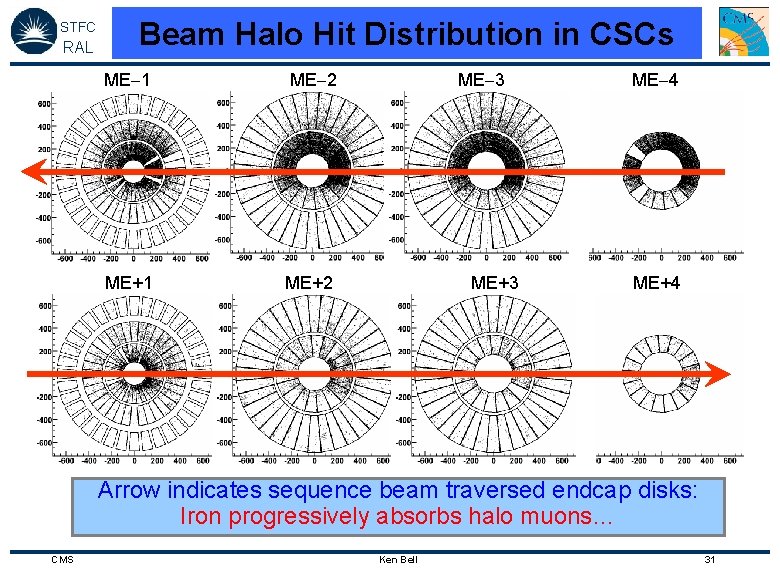
STFC RAL Beam Halo Hit Distribution in CSCs ME 1 ME 2 ME+1 ME+2 ME 3 ME+3 ME 4 ME+4 Arrow indicates sequence beam traversed endcap disks: Iron progressively absorbs halo muons… CMS Ken Bell 31
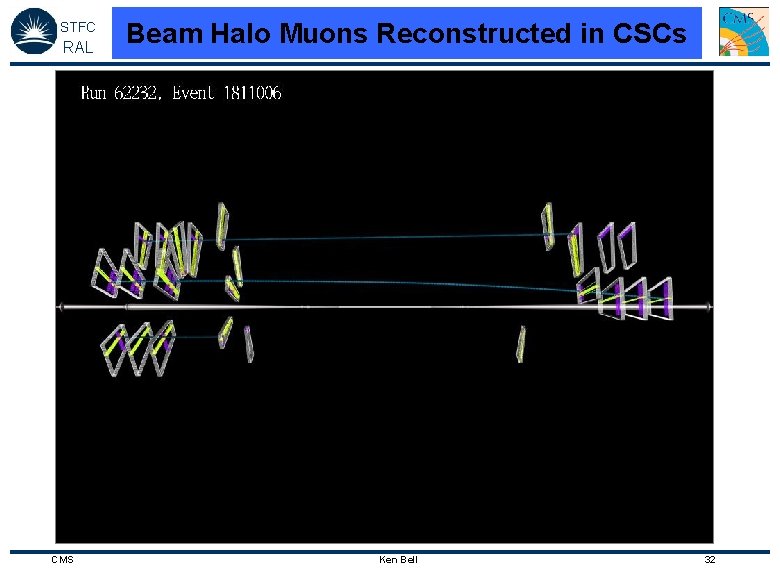
STFC RAL CMS Beam Halo Muons Reconstructed in CSCs Ken Bell 32
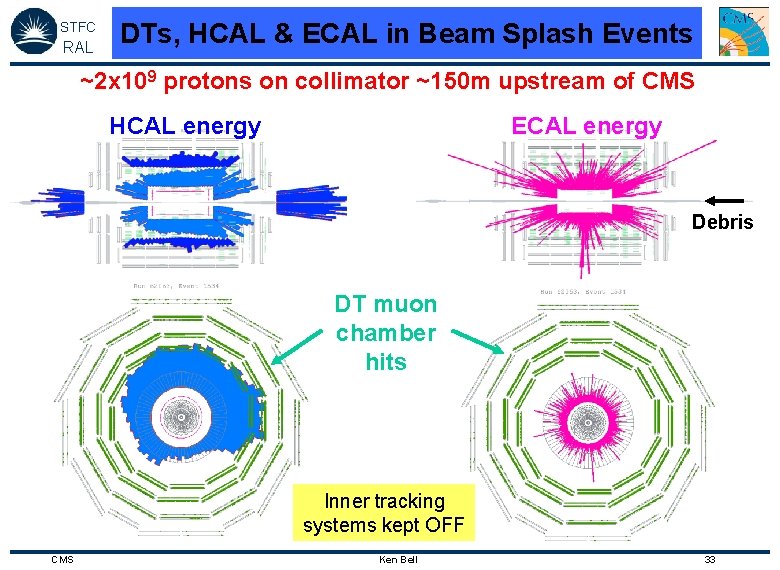
STFC RAL DTs, HCAL & ECAL in Beam Splash Events ~2 x 10⁹ protons on collimator ~150 m upstream of CMS HCAL energy ECAL energy Debris DT muon chamber hits Inner tracking systems kept OFF CMS Ken Bell 33
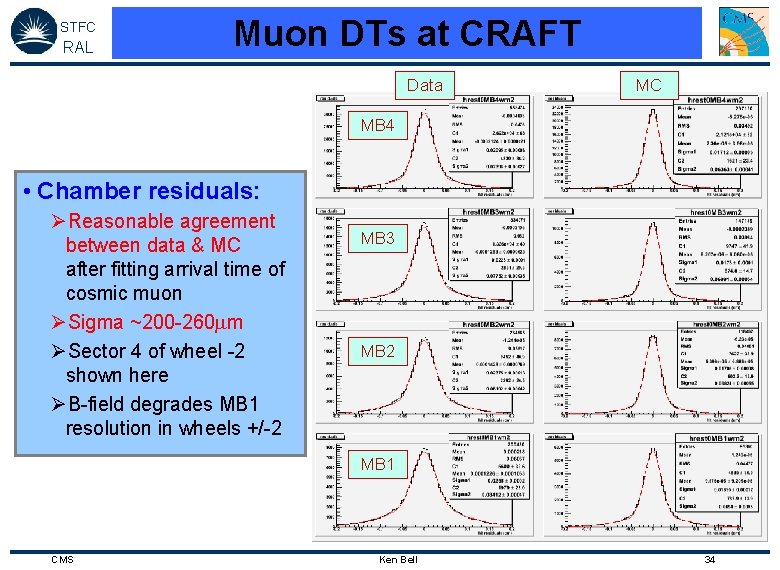
STFC RAL Muon DTs at CRAFT Data MC MB 4 • Chamber residuals: ØReasonable agreement between data & MC after fitting arrival time of cosmic muon ØSigma ~200 -260 m ØSector 4 of wheel -2 shown here ØB-field degrades MB 1 resolution in wheels +/-2 MB 3 MB 2 MB 1 CMS Ken Bell 34
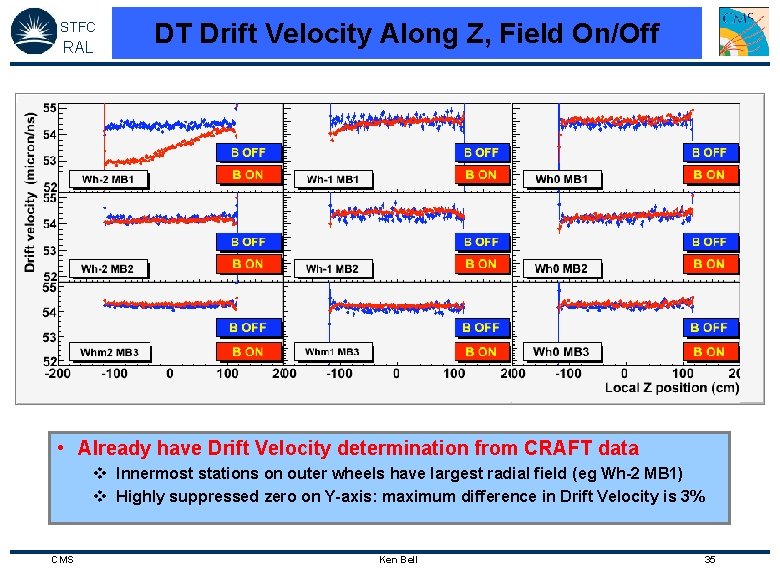
STFC RAL DT Drift Velocity Along Z, Field On/Off • Already have Drift Velocity determination from CRAFT data v Innermost stations on outer wheels have largest radial field (eg Wh-2 MB 1) v Highly suppressed zero on Y-axis: maximum difference in Drift Velocity is 3% CMS Ken Bell 35
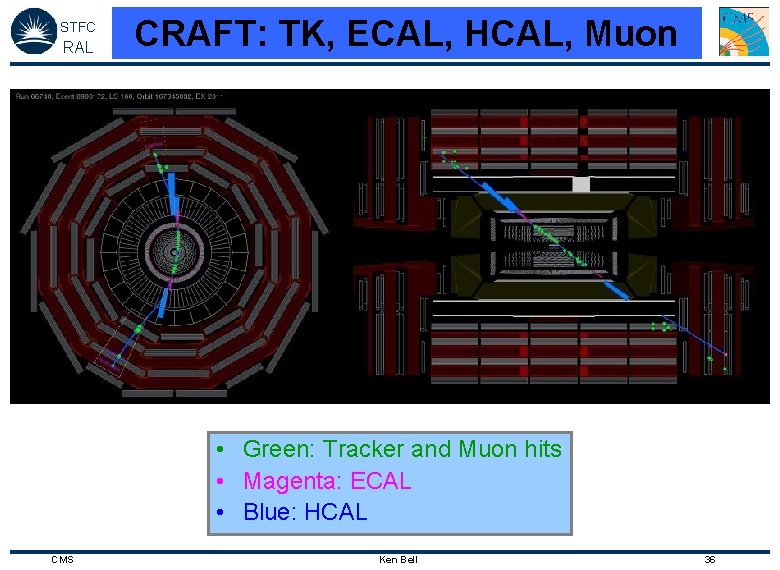
STFC RAL CRAFT: TK, ECAL, HCAL, Muon • Green: Tracker and Muon hits • Magenta: ECAL • Blue: HCAL CMS Ken Bell 36
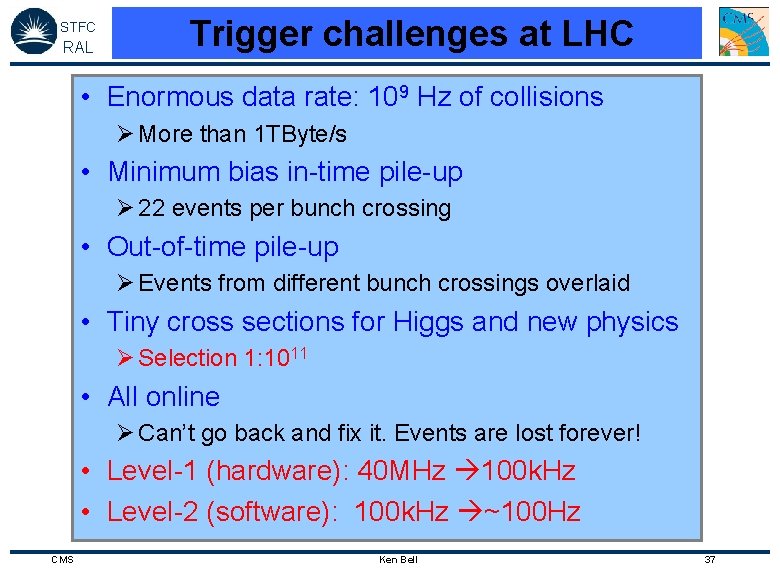
STFC RAL Trigger challenges at LHC • Enormous data rate: 109 Hz of collisions Ø More than 1 TByte/s • Minimum bias in-time pile-up Ø 22 events per bunch crossing • Out-of-time pile-up Ø Events from different bunch crossings overlaid • Tiny cross sections for Higgs and new physics Ø Selection 1: 1011 • All online Ø Can’t go back and fix it. Events are lost forever! • Level-1 (hardware): 40 MHz 100 k. Hz • Level-2 (software): 100 k. Hz ~100 Hz CMS Ken Bell 37
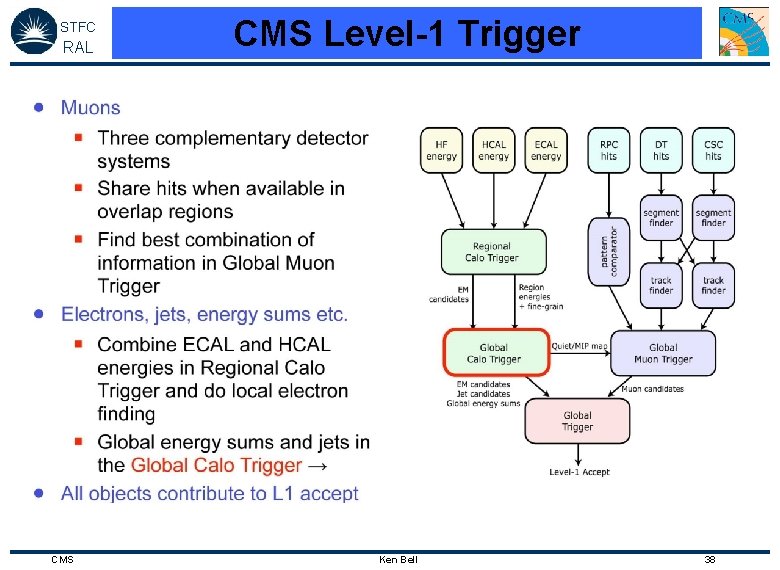
STFC RAL CMS Level-1 Trigger Ken Bell 38
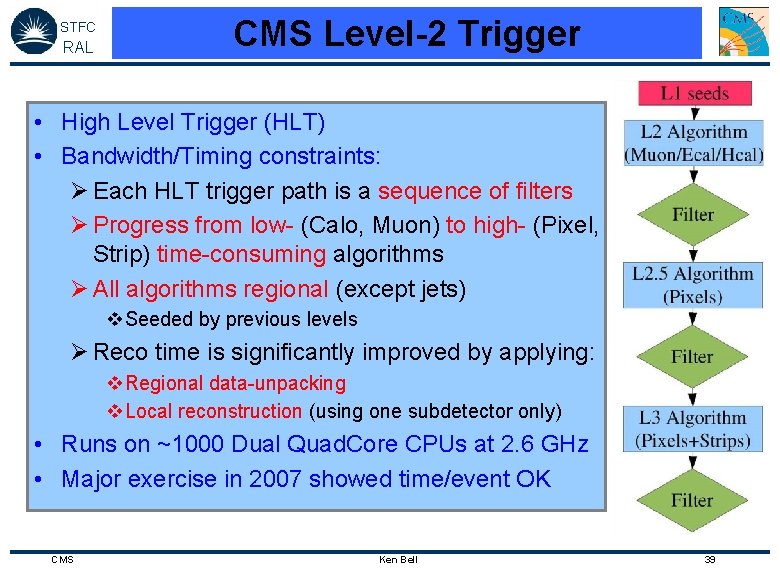
STFC RAL CMS Level-2 Trigger • High Level Trigger (HLT) • Bandwidth/Timing constraints: Ø Each HLT trigger path is a sequence of filters Ø Progress from low- (Calo, Muon) to high- (Pixel, Strip) time-consuming algorithms Ø All algorithms regional (except jets) v. Seeded by previous levels Ø Reco time is significantly improved by applying: v. Regional data-unpacking v. Local reconstruction (using one subdetector only) • Runs on ~1000 Dual Quad. Core CPUs at 2. 6 GHz • Major exercise in 2007 showed time/event OK CMS Ken Bell 39
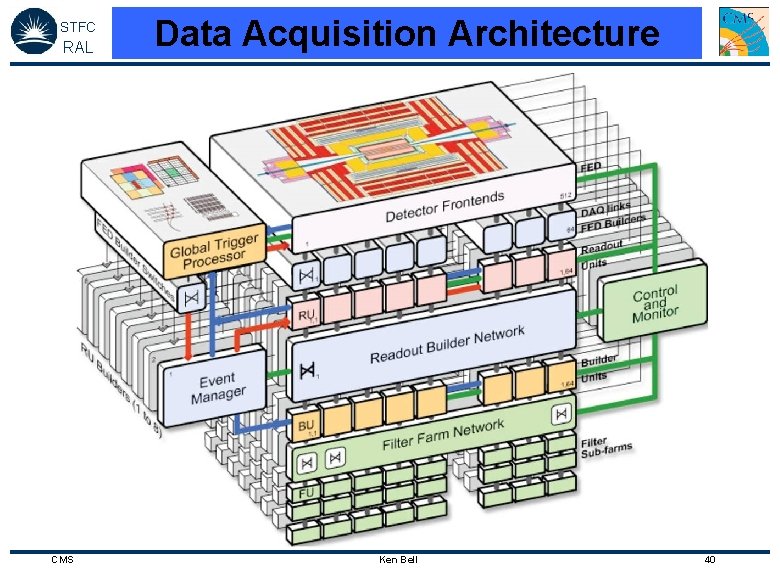
STFC RAL CMS Data Acquisition Architecture Ken Bell 40
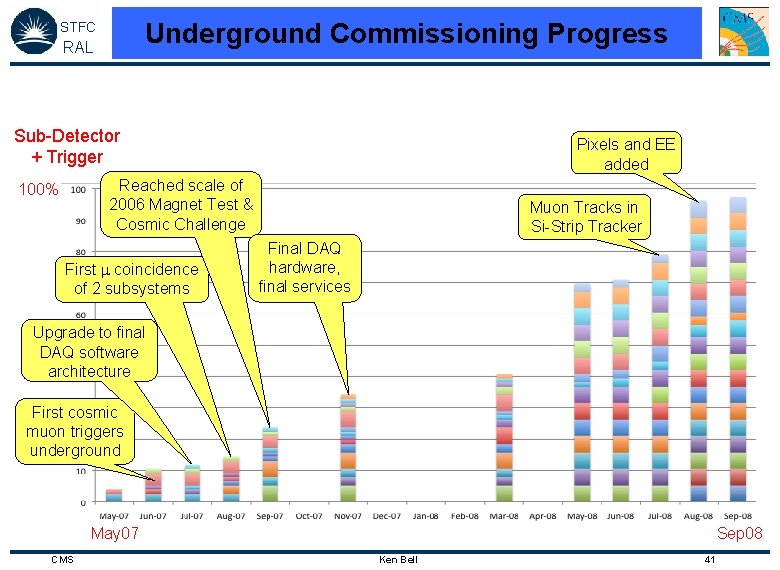
Underground Commissioning Progress STFC RAL Sub-Detector + Trigger Pixels and EE added Reached scale of 2006 Magnet Test & Cosmic Challenge 100% First coincidence of 2 subsystems Muon Tracks in Si-Strip Tracker Final DAQ hardware, final services Upgrade to final DAQ software architecture First cosmic muon triggers underground May 07 CMS Sep 08 Ken Bell 41
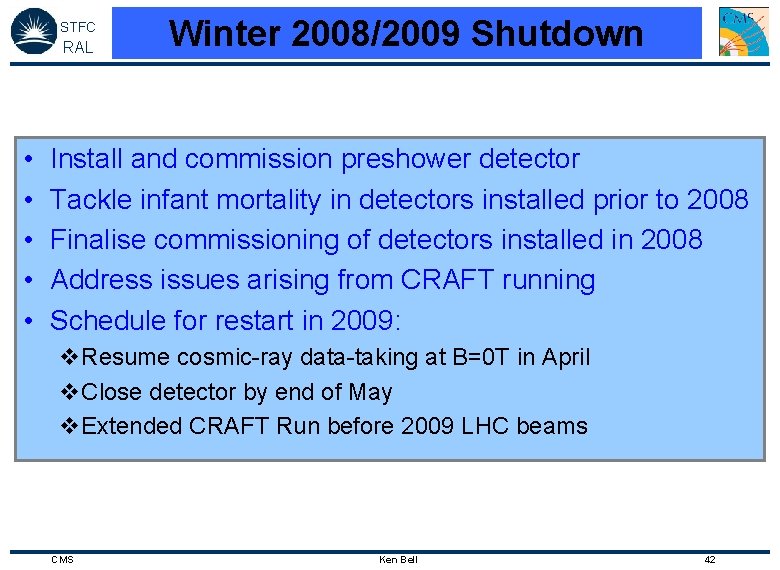
STFC RAL • • • Winter 2008/2009 Shutdown Install and commission preshower detector Tackle infant mortality in detectors installed prior to 2008 Finalise commissioning of detectors installed in 2008 Address issues arising from CRAFT running Schedule for restart in 2009: v. Resume cosmic-ray data-taking at B=0 T in April v. Close detector by end of May v. Extended CRAFT Run before 2009 LHC beams CMS Ken Bell 42
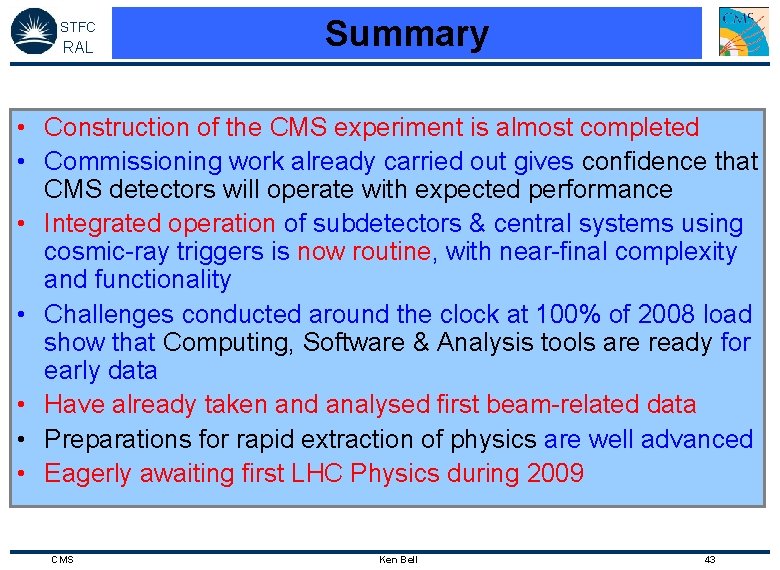
STFC RAL Summary • Construction of the CMS experiment is almost completed • Commissioning work already carried out gives confidence that CMS detectors will operate with expected performance • Integrated operation of subdetectors & central systems using cosmic-ray triggers is now routine, with near-final complexity and functionality • Challenges conducted around the clock at 100% of 2008 load show that Computing, Software & Analysis tools are ready for early data • Have already taken and analysed first beam-related data • Preparations for rapid extraction of physics are well advanced • Eagerly awaiting first LHC Physics during 2009 CMS Ken Bell 43
STFC RAL Back-Up CMS Ken Bell 44
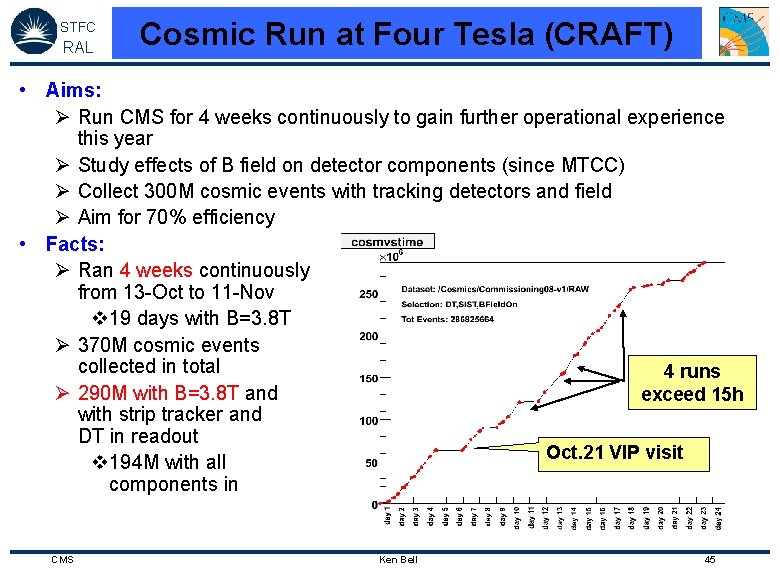
STFC RAL Cosmic Run at Four Tesla (CRAFT) • Aims: Ø Run CMS for 4 weeks continuously to gain further operational experience this year Ø Study effects of B field on detector components (since MTCC) Ø Collect 300 M cosmic events with tracking detectors and field Ø Aim for 70% efficiency • Facts: Ø Ran 4 weeks continuously from 13 -Oct to 11 -Nov v 19 days with B=3. 8 T Ø 370 M cosmic events collected in total 4 runs Ø 290 M with B=3. 8 T and exceed 15 h with strip tracker and DT in readout Oct. 21 VIP visit v 194 M with all components in CMS Ken Bell 45