
Compact Graphical Representation of Spatial Time Series Data
- Slides: 6
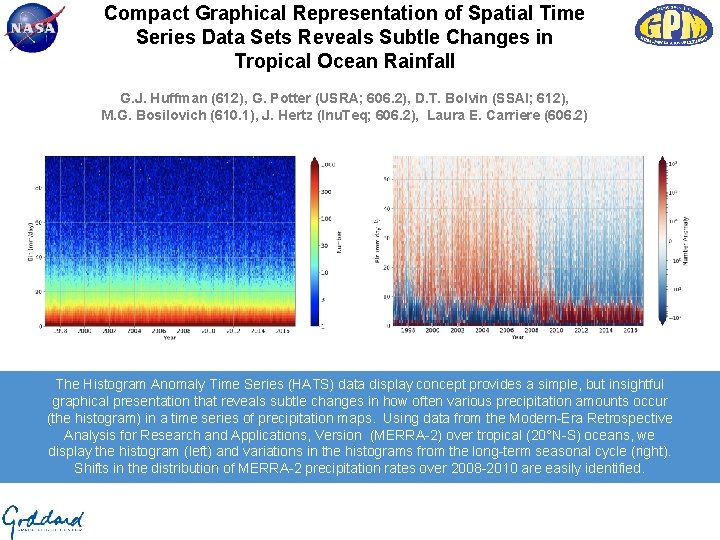
Compact Graphical Representation of Spatial Time Series Data Sets Reveals Subtle Changes in Tropical Ocean Rainfall G. J. Huffman (612), G. Potter (USRA; 606. 2), D. T. Bolvin (SSAI; 612), M. G. Bosilovich (610. 1), J. Hertz (Inu. Teq; 606. 2), Laura E. Carriere (606. 2) The Histogram Anomaly Time Series (HATS) data display concept provides a simple, but insightful graphical presentation that reveals subtle changes in how often various precipitation amounts occur (the histogram) in a time series of precipitation maps. Using data from the Modern-Era Retrospective Analysis for Research and Applications, Version (MERRA-2) over tropical (20°N-S) oceans, we display the histogram (left) and variations in the histograms from the long-term seasonal cycle (right). Shifts in the distribution of MERRA-2 precipitation rates over 2008 -2010 are easily identified.
Name: George J. Huffman, NASA/GSFC, Code 612 E-mail: george. j. huffman@nasa. gov Phone: 301 -614 -6308 References: Potter, G. J. Huffman, D. T. Bolvin, M. G. Bosilovich, J. Hertz, Laura E. Carriere, 2020: Histogram Anomaly Time Series: A Compact Graphical Representation of Spatial Time Series Data Sets. Bull. Amer. Meteor. Soc. , early release, doi: 10. 1175/BAMS-D-20 -0130. Data Sources: The Modern-Era Retrospective Analysis for Research and Applications, Version 2 (MERRA-2); the Global Precipitation Climatology Project (GPCP) One-Degree Daily (1 DD) precipitation dataset. Technical Description of Figures: The display begins by accumulating the numbers of various precipitation rates in each map into a histogram. Second, each map’s histogram is colorized as a column of data, and this is repeated for all the maps in the time period (left figure, October 1996 to December 2016, computed over oceans, 20°N-S from the Modern-Era Retrospective Analysis for Research and Applications, Version 2, MERRA-2). Third, the average annual cycle is computed over the entire time period for the number of occurrences in each precipitation rate separately. Fourth, the difference of the actual counts from this climatology is plotted and lightly smoothed to reduce noise (right figure). The color bar in both figures is logarithmic because there are so many small values compared to the relatively rare large precipitation values. Scientific significance, societal relevance, and relationships to future missions: Long-term global precipitation datasets are a key tool for understanding the global water cycle and facilitating a wide range of water-related applications, including flood and landslide analysis, water resource management, agricultural forecasting, microinsurance, and transportation. Many of these applications are sensitive to whether the precipitation occurs in a few heavy events or many lighter events, so it is important to understand fluctuations over time in the histogram. Before HATS, these fluctuations were uncovered with a somewhat hunt-and-peck computation of histograms for various periods of time. With HATS, the entire record of histogram fluctuations is readily observed. HATS can be used to display histograms accumulated over whatever region the researcher wishes, and the native time resolution of the maps is likewise at the researcher’s discretion. Finally, the current work applies a light polynomial filter to reduce distracting noise, but a heavier, lighter, or no filter can be applied. Essentially every global precipitation dataset is constructed from a heterogenous collection of input data (both surface- and satellite-based). One of the key steps in these algorithms is to minimize the jumps that occur when the different data sources contribute to the analysis. As such, the resulting precipitation time series contains both natural and artificial variations. HATS permits researchers to visually identify breakpoints in the histogram time series, which can then be analyzed in more depth to determine whether they are real or artificial. The display is sufficiently easy to create that the focus can be on finding times/regions of consistent behavior that can then be used for computing statistics of interest. This initial work has been done with precipitation data, but it is equally applicable to histograms of other data fields, such as temperature, water vapor, or aerosol content. The main change would be to shift the color bar from logarithmic to linear for fields with a more equitable distribution of small and large values. Earth Sciences Division - Atmospheres
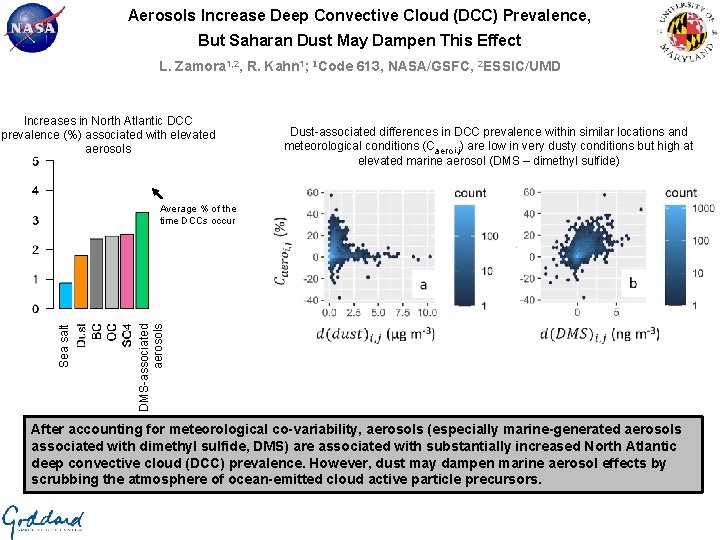
Aerosols Increase Deep Convective Cloud (DCC) Prevalence, But Saharan Dust May Dampen This Effect L. Zamora 1, 2, R. Kahn 1; 1 Code 613, NASA/GSFC, 2 ESSIC/UMD Increases in North Atlantic DCC prevalence (%) associated with elevated aerosols Dust-associated differences in DCC prevalence within similar locations and meteorological conditions (Caero i, j) are low in very dusty conditions but high at elevated marine aerosol (DMS – dimethyl sulfide) DMS-associated aerosols Sea salt Average % of the time DCCs occur After accounting for meteorological co-variability, aerosols (especially marine-generated aerosols associated with dimethyl sulfide, DMS) are associated with substantially increased North Atlantic deep convective cloud (DCC) prevalence. However, dust may dampen marine aerosol effects by scrubbing the atmosphere of ocean-emitted cloud active particle precursors.
Name: Lauren Zamora, NASA/GSFC, Code 613 and ESSIC/UMD E-mail: lauren. m. zamora@nasa. gov Phone: 301 -614 -6353 References: Zamora, L. M. , and R. A. Kahn. 2020. "Saharan Dust Aerosols Change Deep Convective Cloud Prevalence, Possibly by Inhibiting Marine New Particle Formation. " Journal of Climate, 33 (21): 9467 -9480, doi: 10. 1175/jcli-d-20 -0083. 1. Data Sources: NASA AIRS, CALIPSO, and Cloud. Sat remote sensing products, and NASA MERRA-2 reanalysis products. The authors were supported by the NASA Aerosol-Cloud Modeling and Analysis Program under Richard Eckman, and the Climate and Radiation program under Hal Maring. Technical Description of Figures: Figure 1 (left): Deep convective clouds (DCCs) occur ~4% of the time over the tropical North Atlantic. After accounting for meteorological co-variability, we find that aerosols are associated with substantially increased North Atlantic DCC prevalence especially for marine-generated aerosols associated with dimethyl sulfide (DMS). The data shown here are for DCCs observed between 3 -4 km above mean sea level. The study includes all DCCs at least 4 km in depth having bases within 4 km of the surface. Figure 2 (right): a) Comparing observations within similar locations and meteorological conditions over an extended period (2007 -2010), we found that dust-associated increases in DCC prevalence are actually smaller at higher dust concentrations. b) In contrast, high DMS levels are associated with more prevalent DCCs (and in fact, DMS is more predictive of these increases than any other aerosol or meteorological factor we tested, see Zamora and Kahn, 2020). This suggests that dust may scrub the atmosphere of ocean-emitted cloud condensation nuclei (CCN) precursors, thus dampening marine aerosol effects on DCC prevalence, a process that has been hypothesized theoretically. Scientific significance, societal relevance, and relationships to future missions: DCCs strongly influence tropical and subtropical climate, precipitation, and atmospheric chemistry; aerosol impacts on DCC prevalence are critical for modeling these effects. Our observation-based, advanced statistical method accounts for strong meteorological co-variability, and quantifies the aerosol impacts over large spatial and temporal scales without requiring knowledge of the underlying microphysics or cloudactive aerosol concentrations, which are highly uncertain. Our approach, demonstrated in a region where corroborating measurements are relatively abundant, can be applied in future studies to better understand quantify aerosol–cloud interactions in other regions and with other cloud types, thus contributing to a major focus area of the Decadal Survey. Earth Sciences Division - Atmospheres
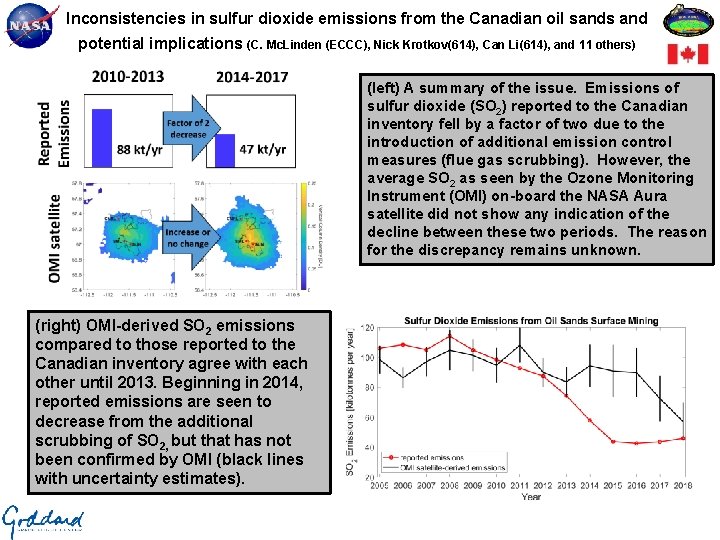
Inconsistencies in sulfur dioxide emissions from the Canadian oil sands and potential implications (C. Mc. Linden (ECCC), Nick Krotkov(614), Can Li(614), and 11 others) (left) A summary of the issue. Emissions of sulfur dioxide (SO 2) reported to the Canadian inventory fell by a factor of two due to the introduction of additional emission control measures (flue gas scrubbing). However, the average SO 2 as seen by the Ozone Monitoring Instrument (OMI) on-board the NASA Aura satellite did not show any indication of the decline between these two periods. The reason for the discrepancy remains unknown. (right) OMI-derived SO 2 emissions compared to those reported to the Canadian inventory agree with each other until 2013. Beginning in 2014, reported emissions are seen to decrease from the additional scrubbing of SO 2, but that has not been confirmed by OMI (black lines with uncertainty estimates).
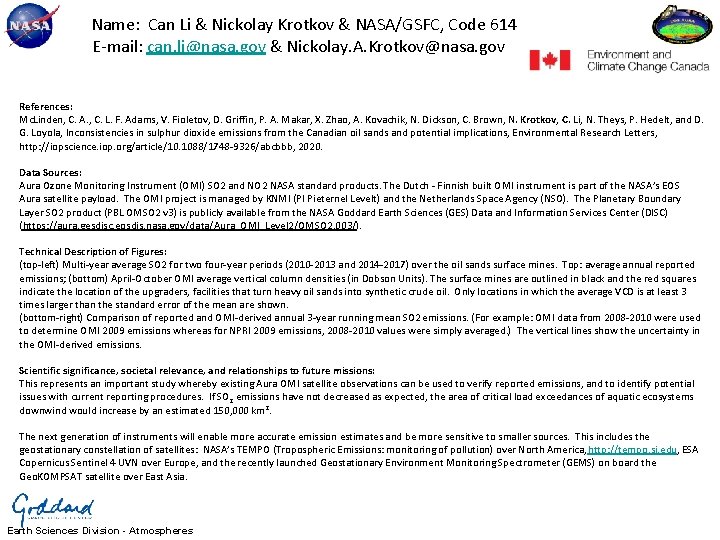
Name: Can Li & Nickolay Krotkov & NASA/GSFC, Code 614 E-mail: can. li@nasa. gov & Nickolay. A. Krotkov@nasa. gov References: Mc. Linden, C. A. , C. L. F. Adams, V. Fioletov, D. Griffin, P. A. Makar, X. Zhao, A. Kovachik, N. Dickson, C. Brown, N. Krotkov, C. Li, N. Theys, P. Hedelt, and D. G. Loyola, Inconsistencies in sulphur dioxide emissions from the Canadian oil sands and potential implications, Environmental Research Letters, http: //iopscience. iop. org/article/10. 1088/1748 -9326/abcbbb, 2020. Data Sources: Aura Ozone Monitoring Instrument (OMI) SO 2 and NO 2 NASA standard products. The Dutch - Finnish built OMI instrument is part of the NASA’s EOS Aura satellite payload. The OMI project is managed by KNMI (PI Pieternel Levelt) and the Netherlands Space Agency (NSO). The Planetary Boundary Layer SO 2 product (PBL OMSO 2 v 3) is publicly available from the NASA Goddard Earth Sciences (GES) Data and Information Services Center (DISC) (https: //aura. gesdisc. eosdis. nasa. gov/data/Aura_OMI_Level 2/OMSO 2. 003/). Technical Description of Figures: (top-left) Multi-year average SO 2 for two four-year periods (2010 -2013 and 2014 -2017) over the oil sands surface mines. Top: average annual reported emissions; (bottom) April-October OMI average vertical column densities (in Dobson Units). The surface mines are outlined in black and the red squares indicate the location of the upgraders, facilities that turn heavy oil sands into synthetic crude oil. Only locations in which the average VCD is at least 3 times larger than the standard error of the mean are shown. (bottom-right) Comparison of reported and OMI-derived annual 3 -year running mean SO 2 emissions. (For example: OMI data from 2008 -2010 were used to determine OMI 2009 emissions whereas for NPRI 2009 emissions, 2008 -2010 values were simply averaged. ) The vertical lines show the uncertainty in the OMI-derived emissions. Scientific significance, societal relevance, and relationships to future missions: This represents an important study whereby existing Aura OMI satellite observations can be used to verify reported emissions, and to identify potential issues with current reporting procedures. If SO 2 emissions have not decreased as expected, the area of critical load exceedances of aquatic ecosystems downwind would increase by an estimated 150, 000 km 2. The next generation of instruments will enable more accurate emission estimates and be more sensitive to smaller sources. This includes the geostationary constellation of satellites: NASA’s TEMPO (Tropospheric Emissions: monitoring of pollution) over North America, http: //tempo. si. edu, ESA Copernicus Sentinel 4 UVN over Europe, and the recently launched Geostationary Environment Monitoring Spectrometer (GEMS) on board the Geo. KOMPSAT satellite over East Asia. Earth Sciences Division - Atmospheres