
Comp Sci 230 Software Construction Course Information S
- Slides: 11
Comp. Sci 230 Software Construction Course Information S 1 2015 V 1. 1 of 2015 -03 -02: corrected due-date for A 4
Overview In Stage 1, you learned how to write programs to solve small problems. Large software systems have many stakeholders. Can we describe the design of a complex software system, accurately and succinctly? Can we be sure that a complex system will do what it is designed to do, and that it will not do anything unintended? In Comp. Sci 230, you will learn some incomplete answers to these difficult questions. 2 What will its users want? Can we describe user requirements, accurately and succinctly? Large software systems are very complex. In Comp. Sci 230, we teach programming “in the large”. I will also attempt to teach you how to “learn how to learn” the technical skills you will need in the future – as a competent computer professional. Comp. Sci 230
Syllabus Four Themes: The object-oriented programming paradigm Frameworks 3 Inversion of control, AWT/Swing and JUnit – because many important “sub -problems” have already been solved: these solutions should be re-used! Software quality Object-orientation, object-oriented programming concepts and programming language constructs – because, for many important problems, OO design is a convenient way to express the problem and its solution in software. Testing, inspection, documentation – because large teams are designing, implementing, debugging, maintaining, revising, and supporting complex software. Application-level concurrent programming Multithreading concepts, language primitives and abstractions – because Comp. Sci 230
Lecturers & Tutors Lecturers Clark Thomborson (Coordinator) Diana Kirk 4 W 1 -4: OO design in Java; W 5 -6: Frameworks; W 11 -12: Concurrency Email: cthombor@cs. auckland. ac. nz Office hour: Fri 3 -4, in 810. 845 Phone: (09) 3737 599 x 85753 W 7 -9: Software Quality; W 10: Concurrency Email: dianakirk@gmail. com Office hrs: tbc Tutors (TBC) Comp. Sci 230
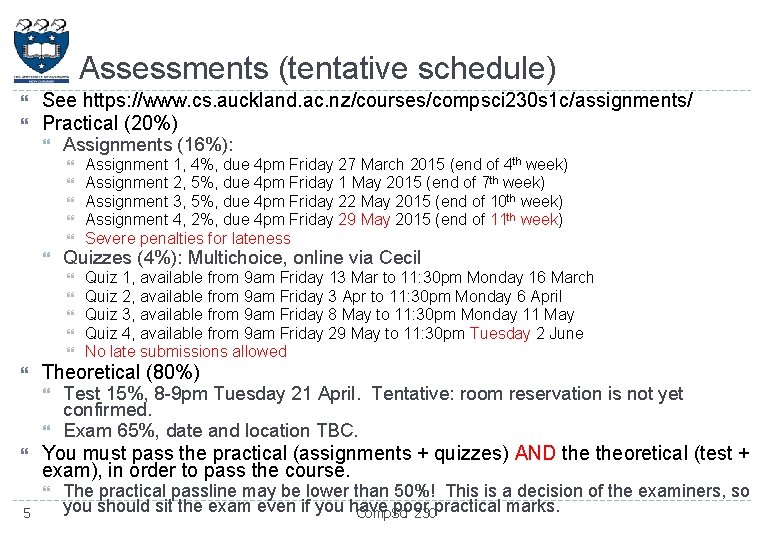
Assessments (tentative schedule) See https: //www. cs. auckland. ac. nz/courses/compsci 230 s 1 c/assignments/ Practical (20%) Assignments (16%): Quizzes (4%): Multichoice, online via Cecil Test 15%, 8 -9 pm Tuesday 21 April. Tentative: room reservation is not yet confirmed. Exam 65%, date and location TBC. You must pass the practical (assignments + quizzes) AND theoretical (test + exam), in order to pass the course. 5 Quiz 1, available from 9 am Friday 13 Mar to 11: 30 pm Monday 16 March Quiz 2, available from 9 am Friday 3 Apr to 11: 30 pm Monday 6 April Quiz 3, available from 9 am Friday 8 May to 11: 30 pm Monday 11 May Quiz 4, available from 9 am Friday 29 May to 11: 30 pm Tuesday 2 June No late submissions allowed Theoretical (80%) Assignment 1, 4%, due 4 pm Friday 27 March 2015 (end of 4 th week) Assignment 2, 5%, due 4 pm Friday 1 May 2015 (end of 7 th week) Assignment 3, 5%, due 4 pm Friday 22 May 2015 (end of 10 th week) Assignment 4, 2%, due 4 pm Friday 29 May 2015 (end of 11 th week) Severe penalties for lateness The practical passline may be lower than 50%! This is a decision of the examiners, so you should sit the exam even if you have poor practical marks. Comp. Sci 230
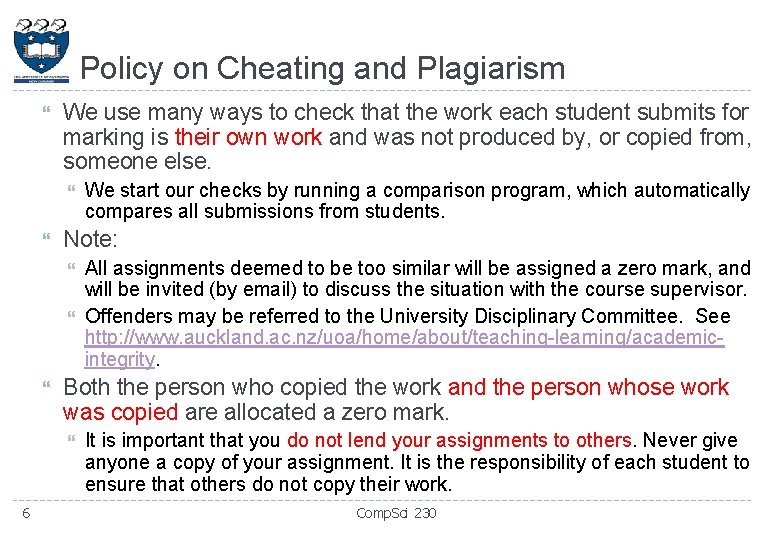
Policy on Cheating and Plagiarism We use many ways to check that the work each student submits for marking is their own work and was not produced by, or copied from, someone else. Note: All assignments deemed to be too similar will be assigned a zero mark, and will be invited (by email) to discuss the situation with the course supervisor. Offenders may be referred to the University Disciplinary Committee. See http: //www. auckland. ac. nz/uoa/home/about/teaching-learning/academicintegrity. Both the person who copied the work and the person whose work was copied are allocated a zero mark. 6 We start our checks by running a comparison program, which automatically compares all submissions from students. It is important that you do not lend your assignments to others. Never give anyone a copy of your assignment. It is the responsibility of each student to ensure that others do not copy their work. Comp. Sci 230
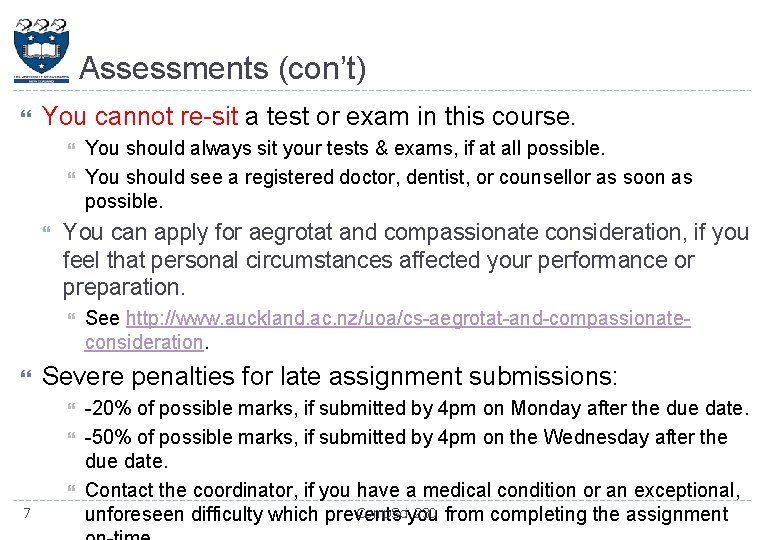
Assessments (con’t) You cannot re-sit a test or exam in this course. You can apply for aegrotat and compassionate consideration, if you feel that personal circumstances affected your performance or preparation. See http: //www. auckland. ac. nz/uoa/cs-aegrotat-and-compassionateconsideration. Severe penalties for late assignment submissions: 7 You should always sit your tests & exams, if at all possible. You should see a registered doctor, dentist, or counsellor as soon as possible. -20% of possible marks, if submitted by 4 pm on Monday after the due date. -50% of possible marks, if submitted by 4 pm on the Wednesday after the due date. Contact the coordinator, if you have a medical condition or an exceptional, Comp. Sci 230 unforeseen difficulty which prevents you from completing the assignment
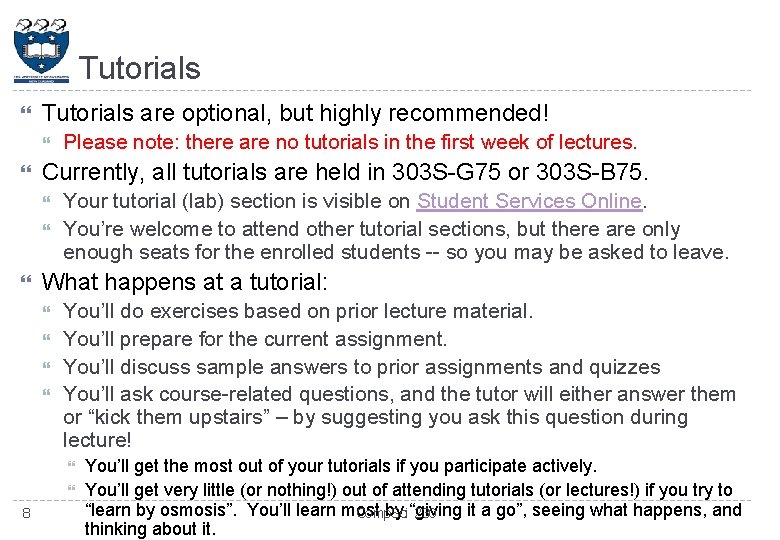
Tutorials are optional, but highly recommended! Currently, all tutorials are held in 303 S-G 75 or 303 S-B 75. Please note: there are no tutorials in the first week of lectures. Your tutorial (lab) section is visible on Student Services Online. You’re welcome to attend other tutorial sections, but there are only enough seats for the enrolled students -- so you may be asked to leave. What happens at a tutorial: You’ll do exercises based on prior lecture material. You’ll prepare for the current assignment. You’ll discuss sample answers to prior assignments and quizzes You’ll ask course-related questions, and the tutor will either answer them or “kick them upstairs” – by suggesting you ask this question during lecture! 8 You’ll get the most out of your tutorials if you participate actively. You’ll get very little (or nothing!) out of attending tutorials (or lectures!) if you try to “learn by osmosis”. You’ll learn most by “giving it a go”, seeing what happens, and Comp. Sci 230 thinking about it.
Quizzes are run online through Cecil. You MUST sit each quiz during the time period and you MAY use any computer in any lab or at home as long as there is a network connection (no slower than 64 K) to the Cecil website. Each quiz has 4 to 8 questions, and contributes 1% to the your total marks. You may make up to three attempts at each quiz, with your best mark being counted. 9 Best strategy: test yourself after you do the reading. Read some more after you complete the test. Form (or join) a study group to discuss similar problems. Terrible strategy: randomly guess. Worst strategy: memorise the answers to the quiz questions. This would be a complete waste of time – you won’t pass the exam! Comp. Sci 230 Answers will be revealed after the closing date.
Need Help? Required readings are online, mostly from The Java Tutorials Recommended readings are available in the library or online. The course website has lecture notes, examples, and some other useful resources, including links to software such as Eclipse. Website: http: //www. cs. auckland. ac. nz/compsci 230 s 1 c/. Visible via Cecil. Don’t hesitate to ask your tutors and lecturers for help if you’re “stuck”! 10 Start today! Read about Object-Oriented Programming Concepts, at http: //docs. oracle. com/javase/tutorial/java/concepts/index. html If you know Python, read http: //fpl. cs. depaul. edu/jriely/java 4 python/. My primary goal is to help you “learn how to learn technical material. ” If you merely listen to lectures, you’ll learn very little. But… there are only a few of us, and hundreds of students. Response may be slow. Unlike in stage-1 papers, we will not spoon-feed you with solutions. You are expected to explore. Discover your own solutions to your own problems! If you’re not making mistakes, you’re not learning!! (Can you Comp. Sci 230 recognize a mistake? )
Reading assignment #1 Before lecture on Thursday: 1. 2. 3. 4. 11 About the Java. Technology, in the Getting Started trail of the Java Tutorials; The first two sections (on classes and objects) in the Classes and Objects lesson of the Learning the Java Language trail; Section 2 (on ‘Getting Started’) in java 4 python v 3; The first five subsections (to ‘Import’) of Section 3 in java 4 python v 3. This isn’t “leisure reading” – you won’t remember much, and you won’t be able to do anything with what you remember, unless you are reading to discover an answer to your questions! For starters: “What is X? ” Comp. Sci 230 “Why should I care about X? ”