
Comp Sci 102 Discrete Math for Computer Science
- Slides: 80
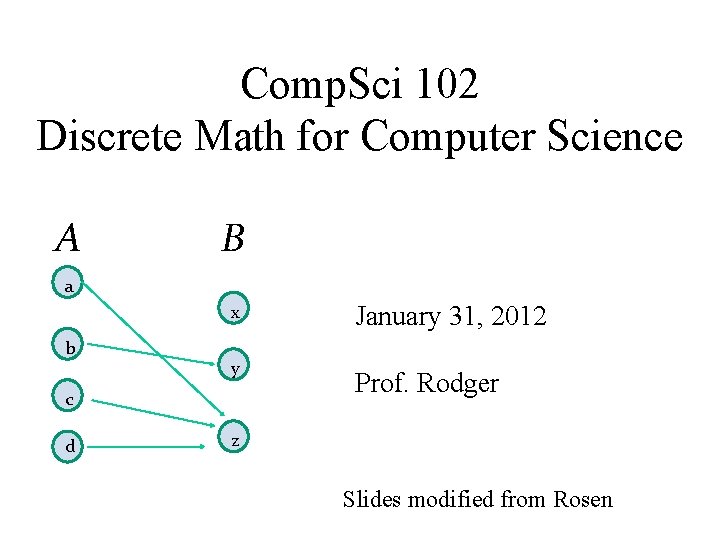
Comp. Sci 102 Discrete Math for Computer Science A B a x b y c d January 31, 2012 Prof. Rodger z Slides modified from Rosen
Announcements • • These slides on Chapt 2. 3 -2. 4 Read for next time Chap 13. 3 Homework 2 due on Thursday Recitation on Friday this week
Functions • Section 2. 3
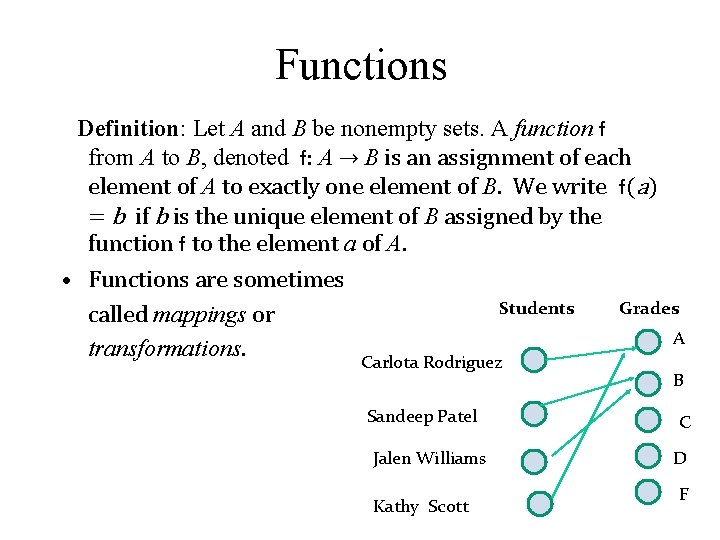
Functions Definition: Let A and B be nonempty sets. A function f from A to B, denoted f: A → B is an assignment of each element of A to exactly one element of B. We write f(a) = b if b is the unique element of B assigned by the function f to the element a of A. • Functions are sometimes called mappings or transformations. Students Grades A Carlota Rodriguez Sandeep Patel Jalen Williams Kathy Scott B C D F
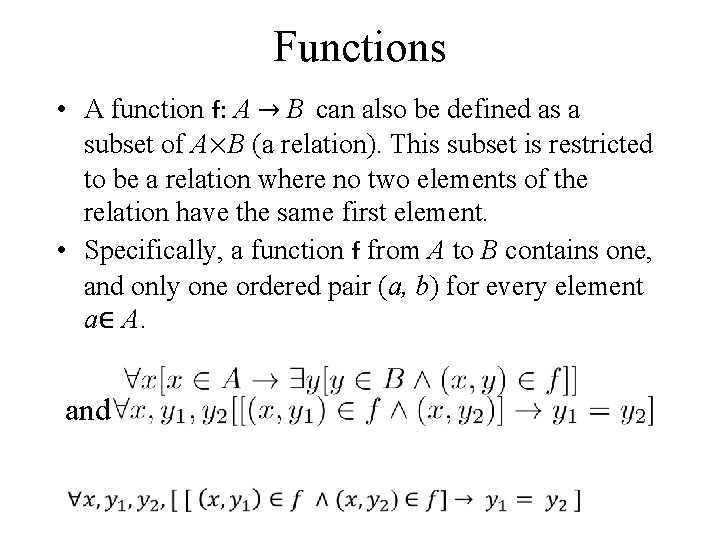
Functions • A function f: A → B can also be defined as a subset of A×B (a relation). This subset is restricted to be a relation where no two elements of the relation have the same first element. • Specifically, a function f from A to B contains one, and only one ordered pair (a, b) for every element a∈ A. and
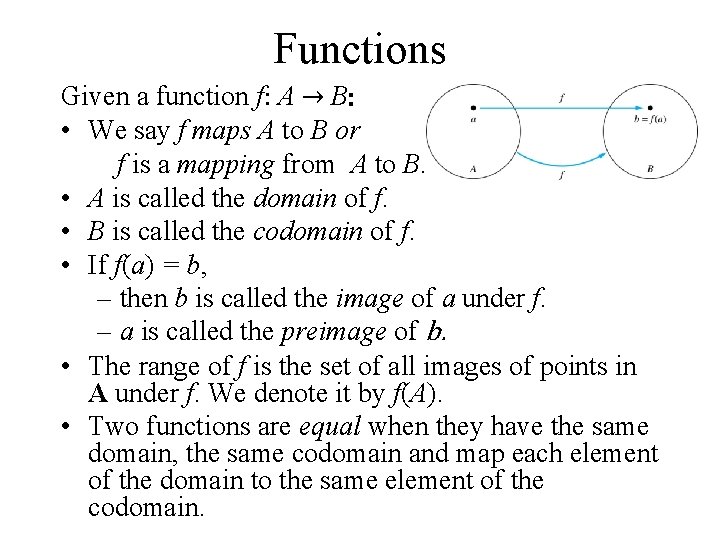
Functions Given a function f: A → B: • We say f maps A to B or f is a mapping from A to B. • A is called the domain of f. • B is called the codomain of f. • If f(a) = b, – then b is called the image of a under f. – a is called the preimage of b. • The range of f is the set of all images of points in A under f. We denote it by f(A). • Two functions are equal when they have the same domain, the same codomain and map each element of the domain to the same element of the codomain.
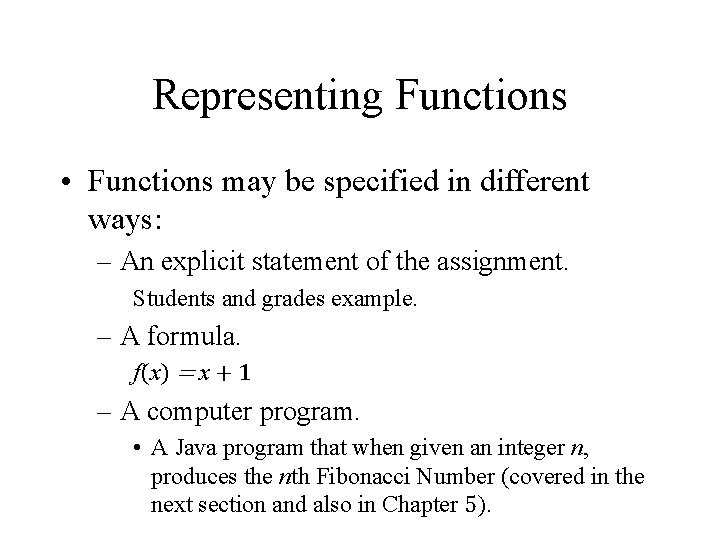
Representing Functions • Functions may be specified in different ways: – An explicit statement of the assignment. Students and grades example. – A formula. f(x) = x + 1 – A computer program. • A Java program that when given an integer n, produces the nth Fibonacci Number (covered in the next section and also in Chapter 5).
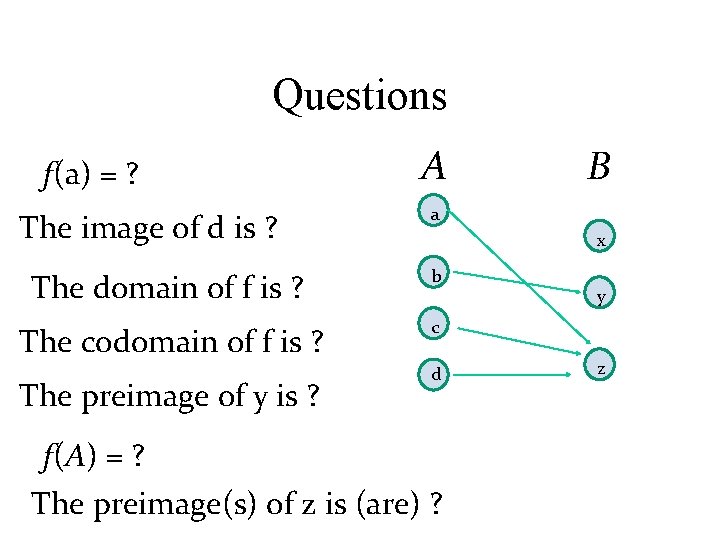
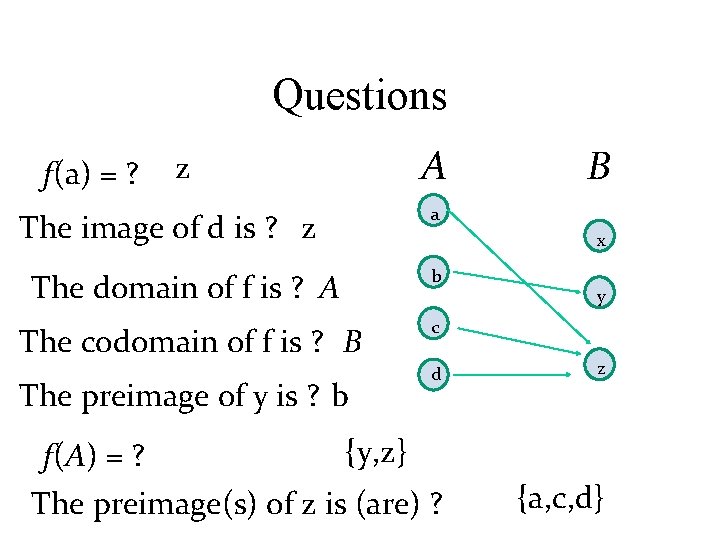
Questions f(a) = ? The image of d is ? A a x The domain of f is ? b The codomain of f is ? c The preimage of y is ? B d f(A) = ? The preimage(s) of z is (are) ? y z
Questions f(a) = ? A z B a The image of d is ? z x The domain of f is ? A b The codomain of f is ? B c y d z The preimage(s) of z is (are) ? {a, c, d} The preimage of y is ? b f(A) = ? {y, z}
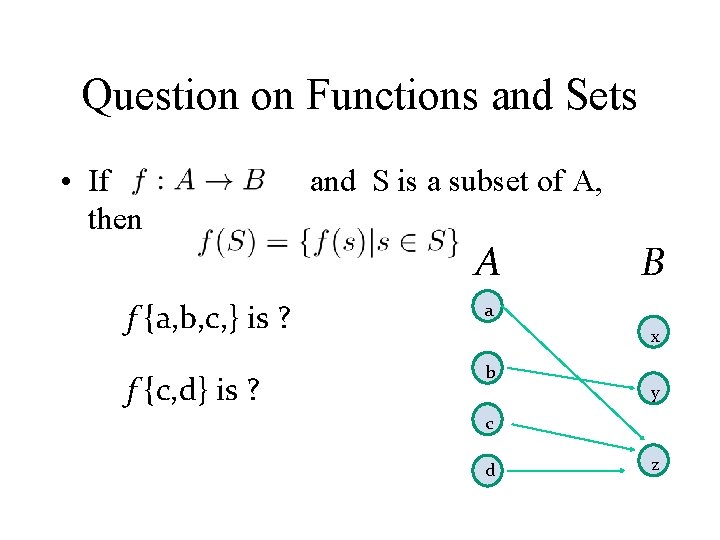
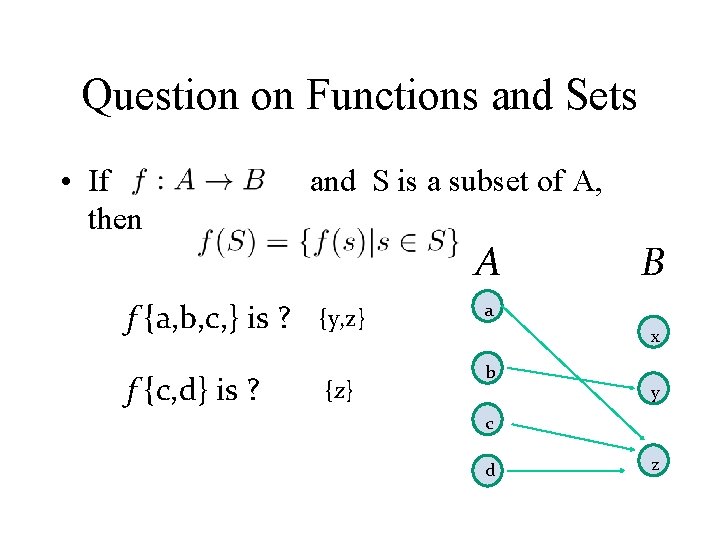
Question on Functions and Sets • If then and S is a subset of A, A f {a, b, c, } is ? f {c, d} is ? {y, z} {z} B a x b y c d z
Question on Functions and Sets • If then and S is a subset of A, A f {a, b, c, } is ? f {c, d} is ? {y, z} {z} B a x b y c d z
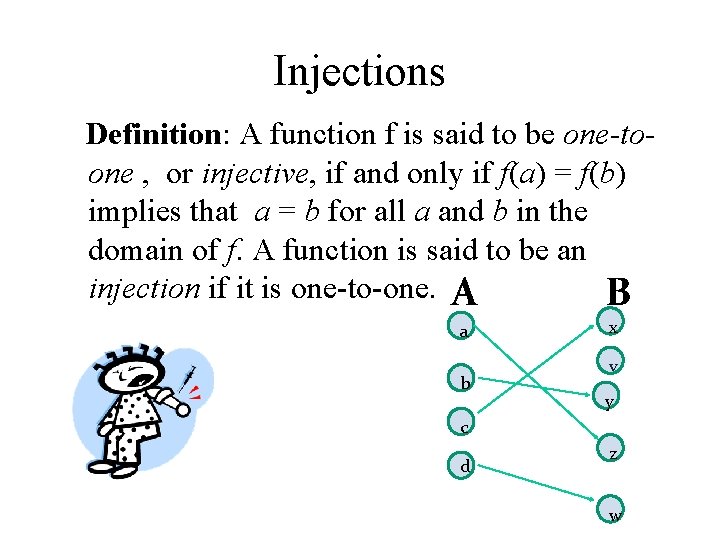
Injections Definition: A function f is said to be one-toone , or injective, if and only if f(a) = f(b) implies that a = b for all a and b in the domain of f. A function is said to be an injection if it is one-to-one. A B a b x v y c d z w
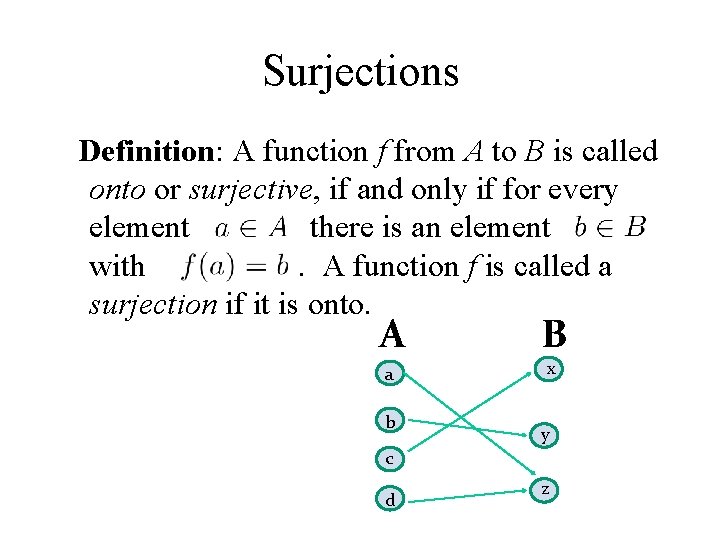
Surjections Definition: A function f from A to B is called onto or surjective, if and only if for every element there is an element with. A function f is called a surjection if it is onto. A a b B x y c d z
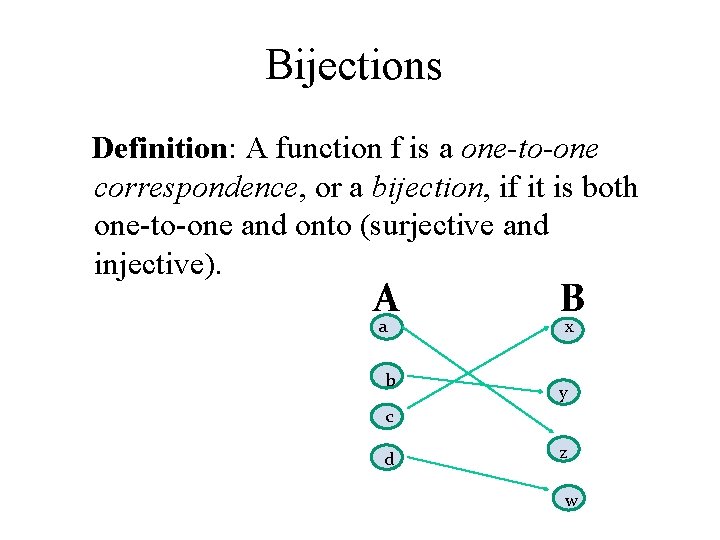
Bijections Definition: A function f is a one-to-one correspondence, or a bijection, if it is both one-to-one and onto (surjective and injective). A a b B x y c d z w
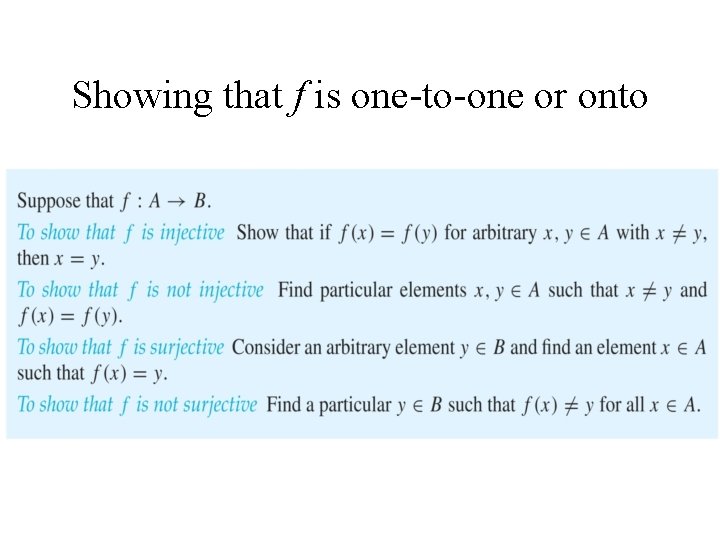
Showing that f is one-to-one or onto
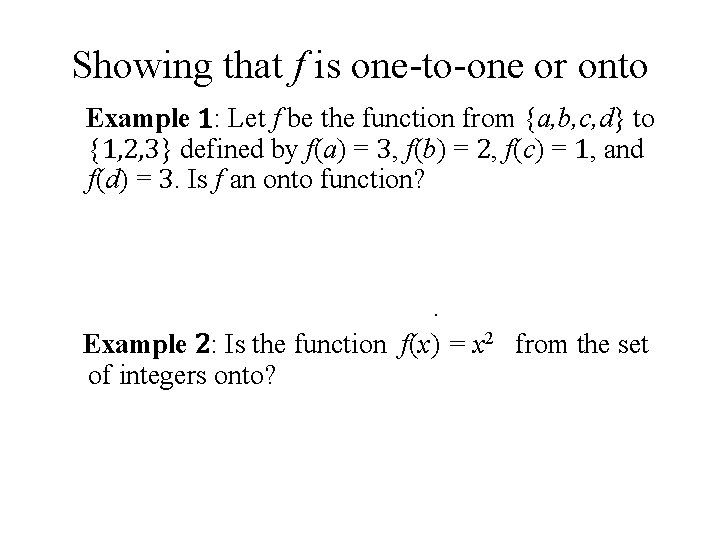
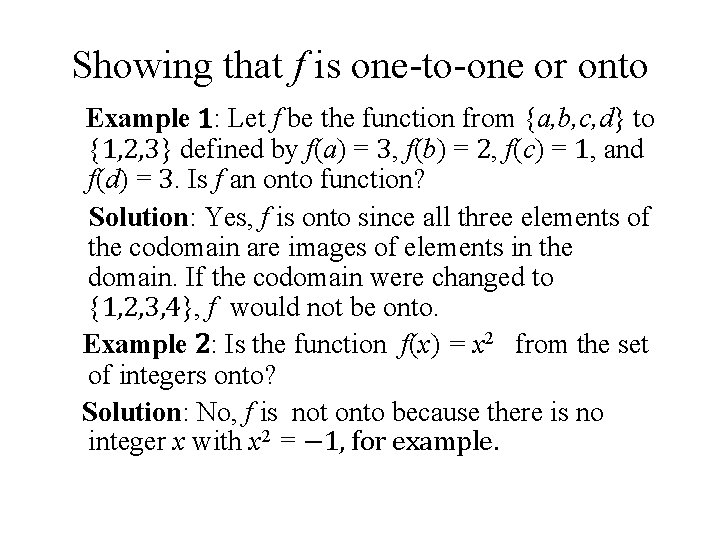
Showing that f is one-to-one or onto Example 1: Let f be the function from {a, b, c, d} to {1, 2, 3} defined by f(a) = 3, f(b) = 2, f(c) = 1, and f(d) = 3. Is f an onto function? Solution: Yes, f is onto since all three elements of the codomain are images of elements in the domain. If the codomain were changed to {1, 2, 3, 4}, f would not be onto. Example 2: Is the function f(x) = x 2 from the set of integers onto? Solution: No, f is not onto because there is no integer x with x 2 = − 1, for example.
Showing that f is one-to-one or onto Example 1: Let f be the function from {a, b, c, d} to {1, 2, 3} defined by f(a) = 3, f(b) = 2, f(c) = 1, and f(d) = 3. Is f an onto function? Solution: Yes, f is onto since all three elements of the codomain are images of elements in the domain. If the codomain were changed to {1, 2, 3, 4}, f would not be onto. Example 2: Is the function f(x) = x 2 from the set of integers onto? Solution: No, f is not onto because there is no integer x with x 2 = − 1, for example.
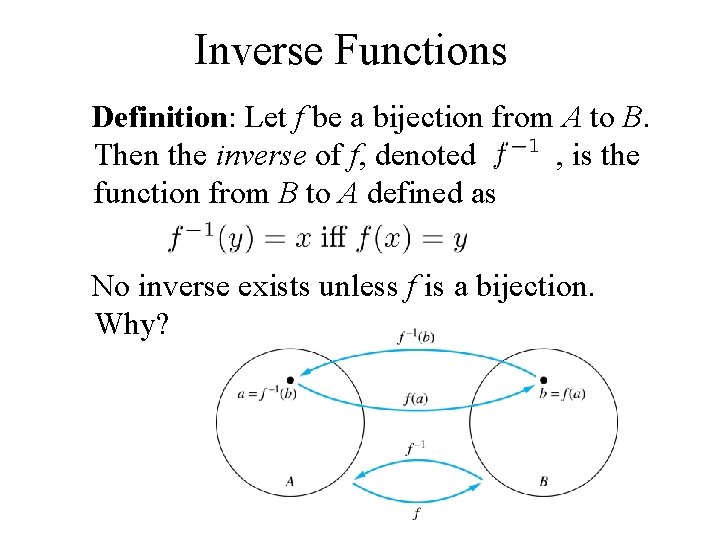
Inverse Functions Definition: Let f be a bijection from A to B. Then the inverse of f, denoted , is the function from B to A defined as No inverse exists unless f is a bijection. Why?
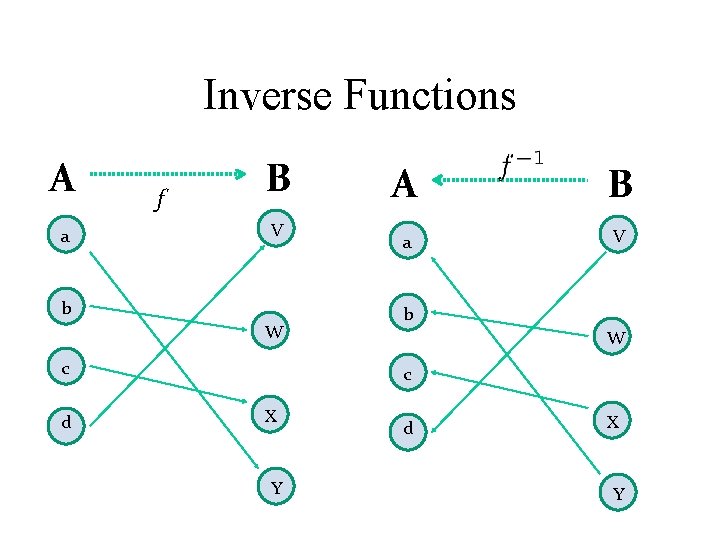
Inverse Functions A a f B V b W c d A B a V b W c X Y d X Y
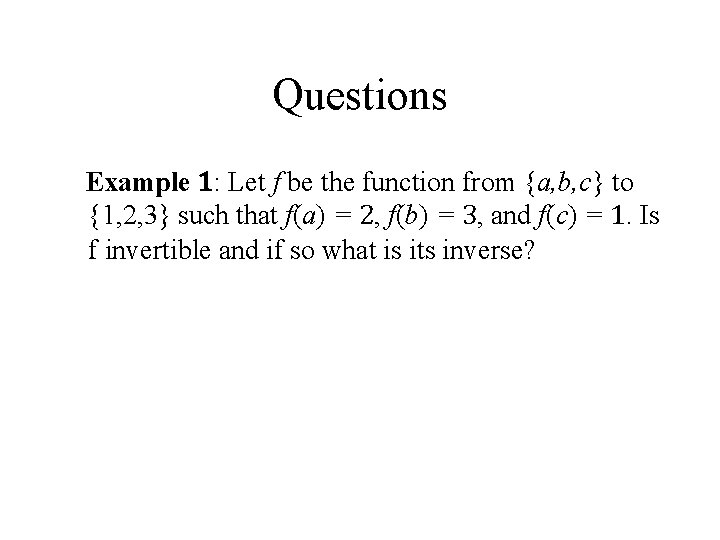
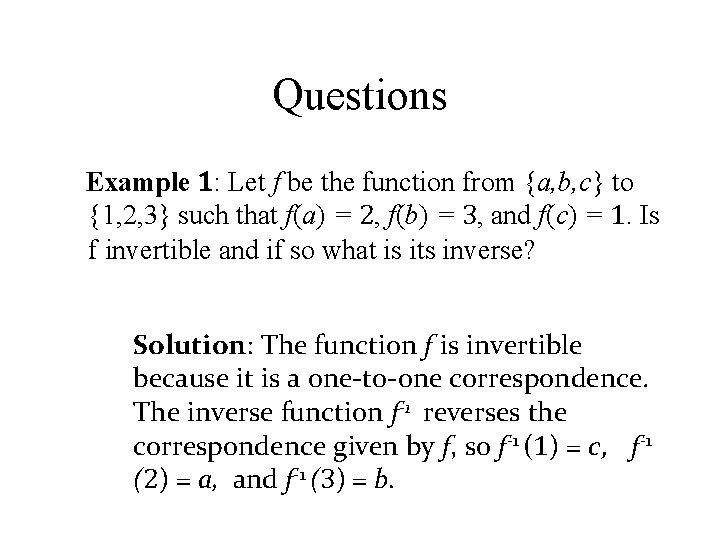
Questions Example 1: Let f be the function from {a, b, c} to {1, 2, 3} such that f(a) = 2, f(b) = 3, and f(c) = 1. Is f invertible and if so what is its inverse? Solution: The function f is invertible because it is a one-to-one correspondence. The inverse function f-1 reverses the correspondence given by f, so f-1 (1) = c, f-1 (2) = a, and f-1 (3) = b.
Questions Example 1: Let f be the function from {a, b, c} to {1, 2, 3} such that f(a) = 2, f(b) = 3, and f(c) = 1. Is f invertible and if so what is its inverse? Solution: The function f is invertible because it is a one-to-one correspondence. The inverse function f-1 reverses the correspondence given by f, so f-1 (1) = c, f-1 (2) = a, and f-1 (3) = b.
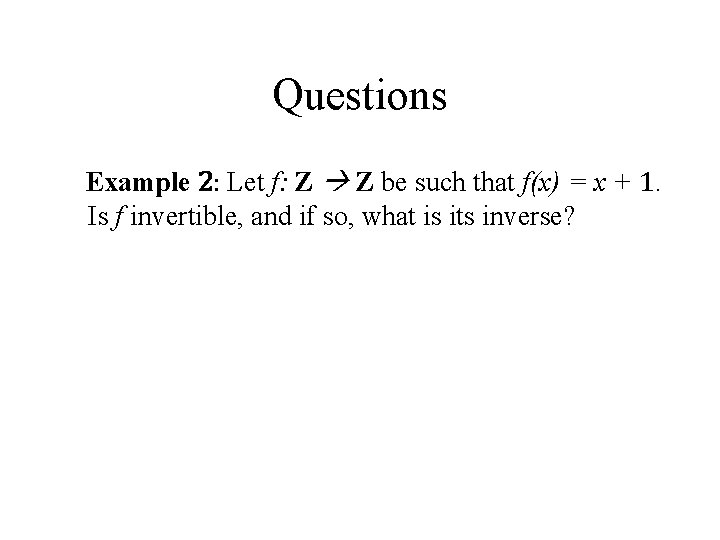
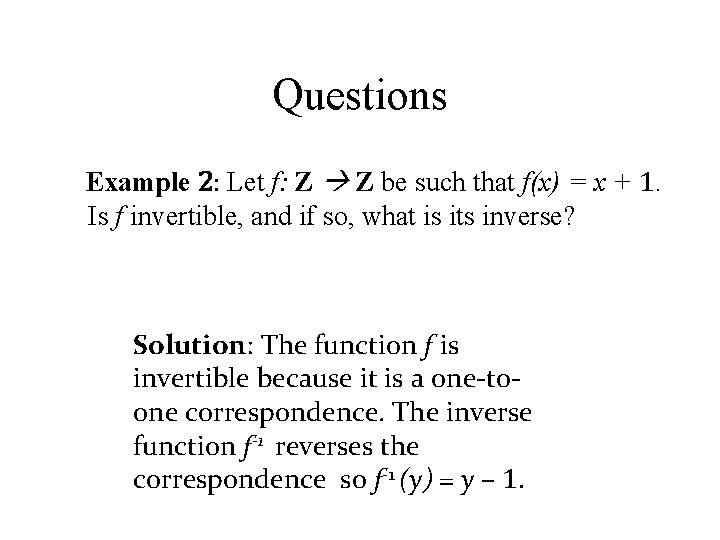
Questions Example 2: Let f: Z Z be such that f(x) = x + 1. Is f invertible, and if so, what is its inverse? Solution: The function f is invertible because it is a one-toone correspondence. The inverse function f-1 reverses the correspondence so f-1 (y) = y – 1.
Questions Example 2: Let f: Z Z be such that f(x) = x + 1. Is f invertible, and if so, what is its inverse? Solution: The function f is invertible because it is a one-toone correspondence. The inverse function f-1 reverses the correspondence so f-1 (y) = y – 1.
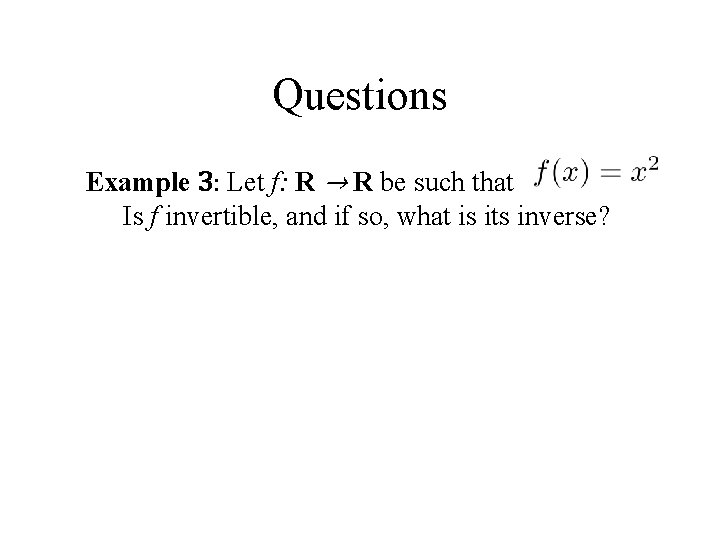
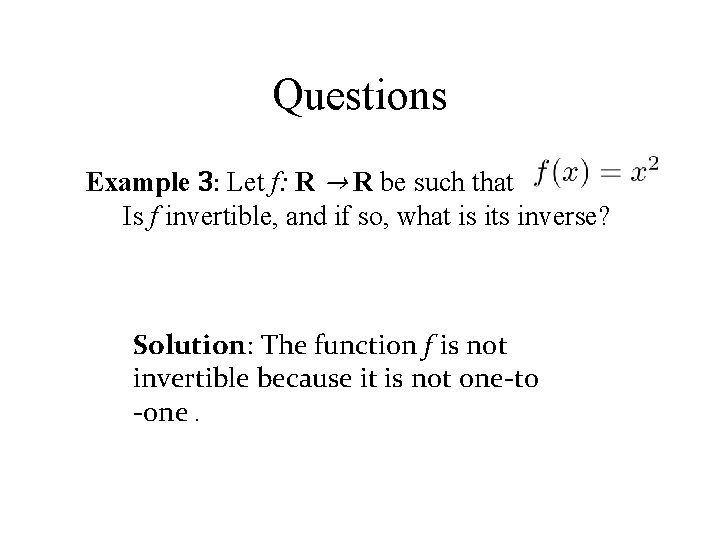
Questions Example 3: Let f: R → R be such that. Is f invertible, and if so, what is its inverse? Solution: The function f is not invertible because it is not one-to -one.
Questions Example 3: Let f: R → R be such that. Is f invertible, and if so, what is its inverse? Solution: The function f is not invertible because it is not one-to -one.
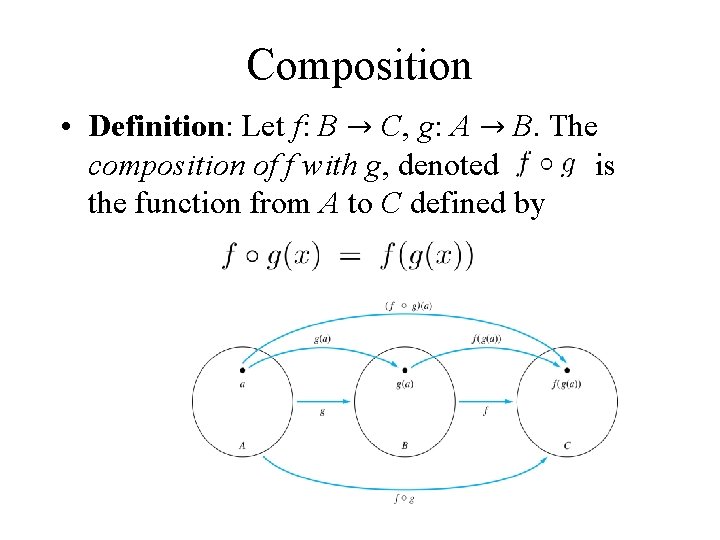
Composition • Definition: Let f: B → C, g: A → B. The composition of f with g, denoted is the function from A to C defined by
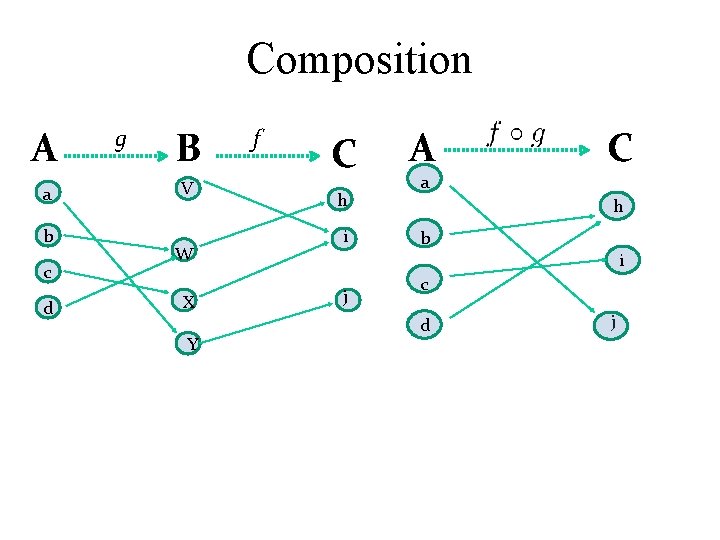
Composition A a b c d g B V W X Y f C h i A a C h b i j c d j
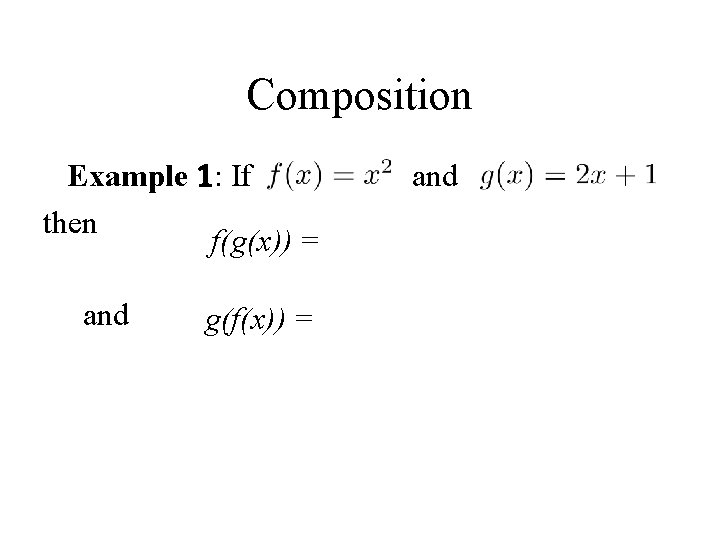
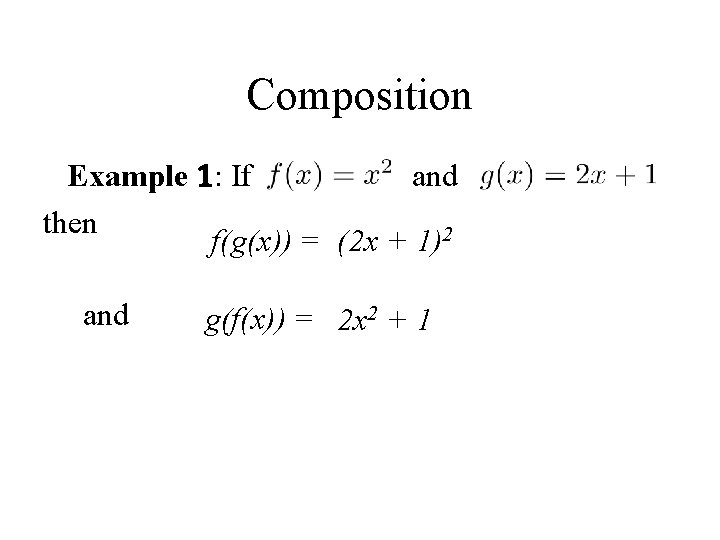
Composition Example 1: If and then f(g(x)) = (2 x + 1)2 and g(f(x)) = 2 x 2 + 1
Composition Example 1: If and then f(g(x)) = (2 x + 1)2 and g(f(x)) = 2 x 2 + 1
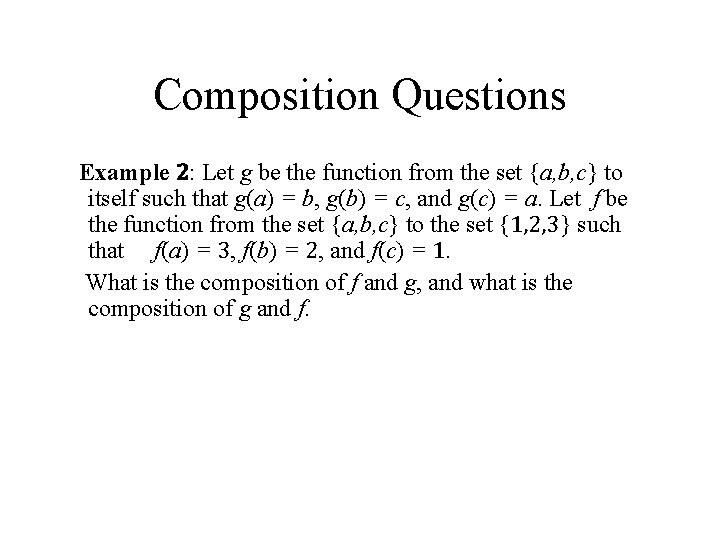
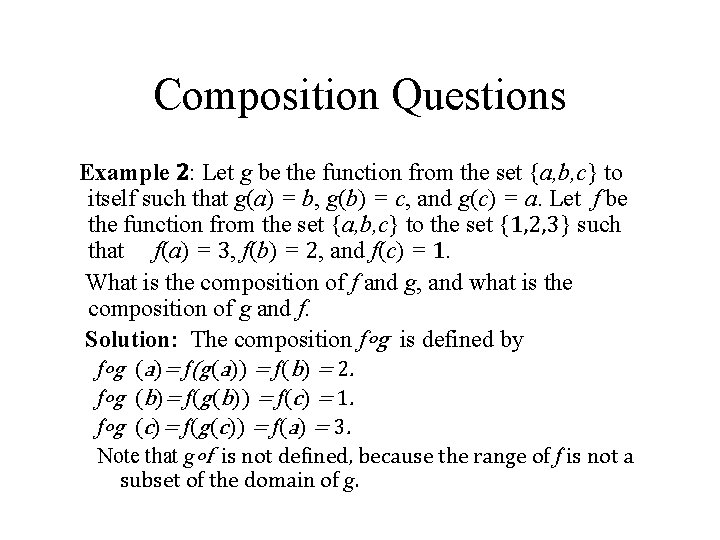
Composition Questions Example 2: Let g be the function from the set {a, b, c} to itself such that g(a) = b, g(b) = c, and g(c) = a. Let f be the function from the set {a, b, c} to the set {1, 2, 3} such that f(a) = 3, f(b) = 2, and f(c) = 1. What is the composition of f and g, and what is the composition of g and f. Solution: The composition f∘g is defined by f∘g (a)= f(g(a)) = f(b) = 2. f∘g (b)= f(g(b)) = f(c) = 1. f∘g (c)= f(g(c)) = f(a) = 3. Note that g∘f is not defined, because the range of f is not a subset of the domain of g.
Composition Questions Example 2: Let g be the function from the set {a, b, c} to itself such that g(a) = b, g(b) = c, and g(c) = a. Let f be the function from the set {a, b, c} to the set {1, 2, 3} such that f(a) = 3, f(b) = 2, and f(c) = 1. What is the composition of f and g, and what is the composition of g and f. Solution: The composition f∘g is defined by f∘g (a)= f(g(a)) = f(b) = 2. f∘g (b)= f(g(b)) = f(c) = 1. f∘g (c)= f(g(c)) = f(a) = 3. Note that g∘f is not defined, because the range of f is not a subset of the domain of g.
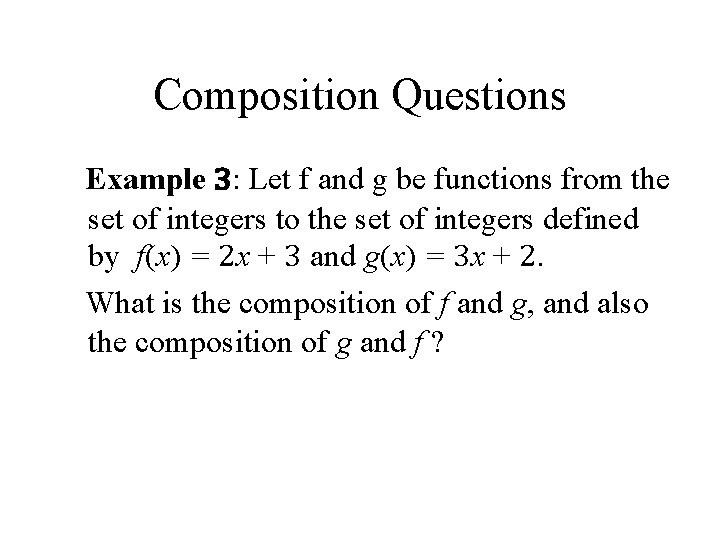
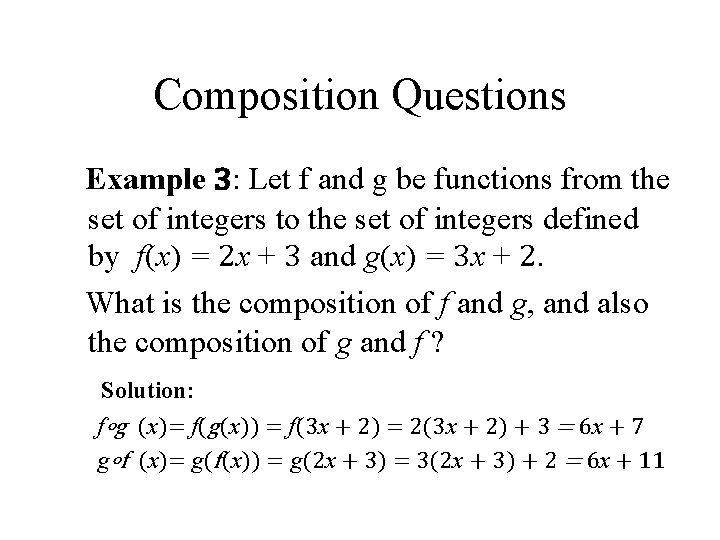
Composition Questions Example 3: Let f and g be functions from the set of integers to the set of integers defined by f(x) = 2 x + 3 and g(x) = 3 x + 2. What is the composition of f and g, and also the composition of g and f ? Solution: f∘g (x)= f(g(x)) = f(3 x + 2) = 2(3 x + 2) + 3 = 6 x + 7 g∘f (x)= g(f(x)) = g(2 x + 3) = 3(2 x + 3) + 2 = 6 x + 11
Composition Questions Example 3: Let f and g be functions from the set of integers to the set of integers defined by f(x) = 2 x + 3 and g(x) = 3 x + 2. What is the composition of f and g, and also the composition of g and f ? Solution: f∘g (x)= f(g(x)) = f(3 x + 2) = 2(3 x + 2) + 3 = 6 x + 7 g∘f (x)= g(f(x)) = g(2 x + 3) = 3(2 x + 3) + 2 = 6 x + 11
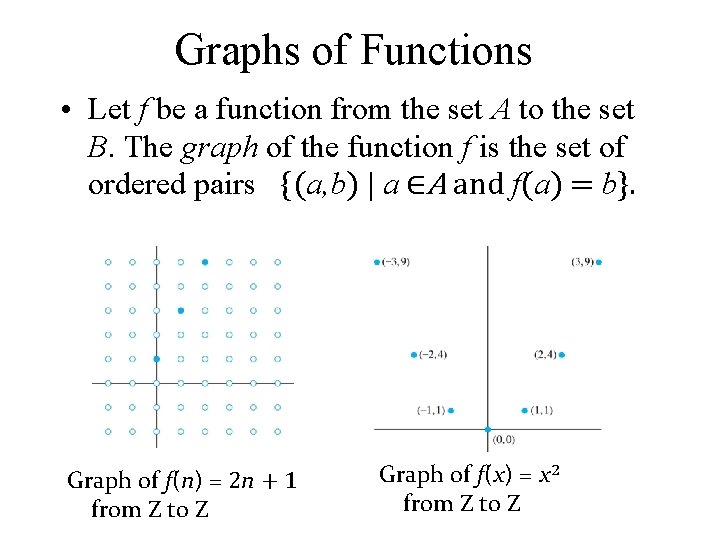
Graphs of Functions • Let f be a function from the set A to the set B. The graph of the function f is the set of ordered pairs {(a, b) | a ∈A and f(a) = b}. Graph of f(n) = 2 n + 1 from Z to Z Graph of f(x) = x 2 from Z to Z
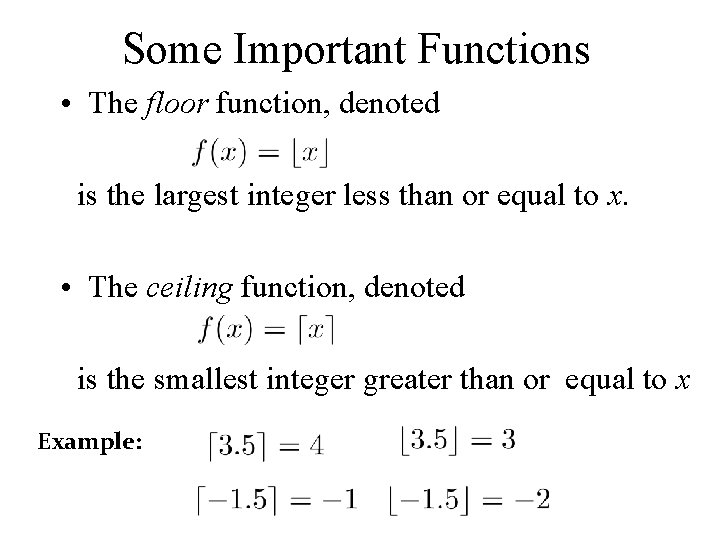
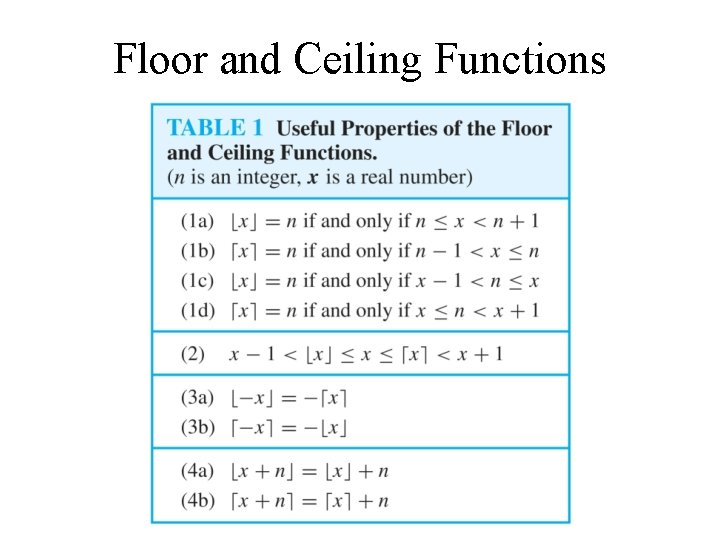
Some Important Functions • The floor function, denoted is the largest integer less than or equal to x. • The ceiling function, denoted is the smallest integer greater than or equal to x Example:
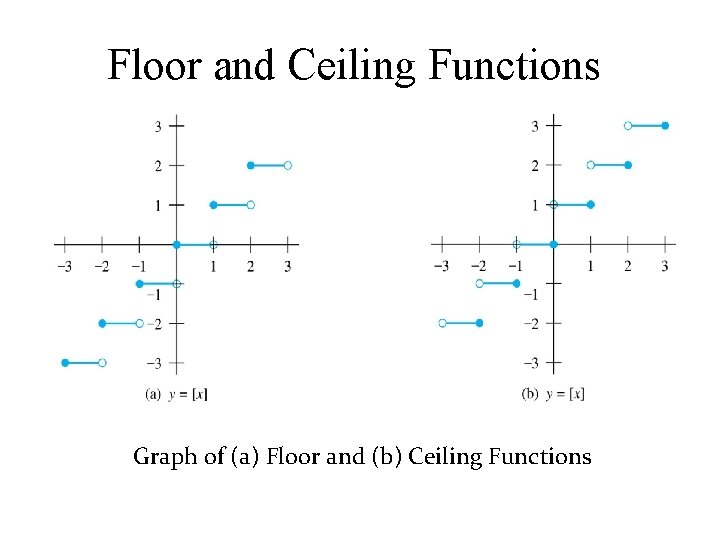
Floor and Ceiling Functions Graph of (a) Floor and (b) Ceiling Functions
Floor and Ceiling Functions
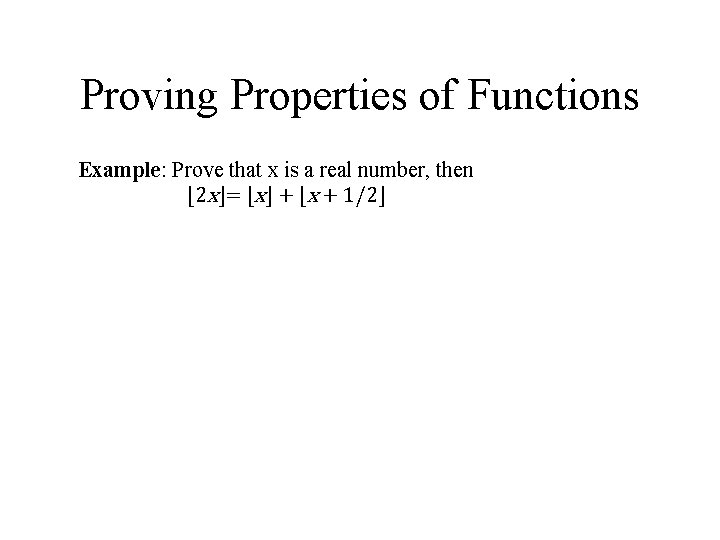
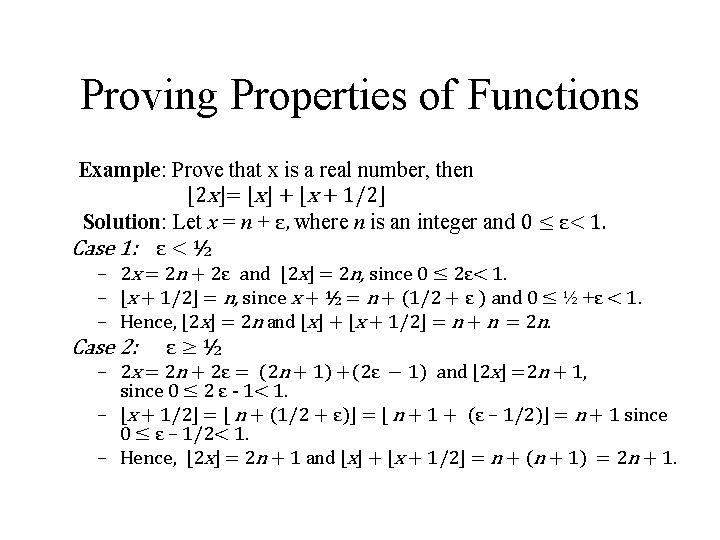
Proving Properties of Functions Example: Prove that x is a real number, then ⌊2 x⌋= ⌊x⌋ + ⌊x + 1/2⌋ Solution: Let x = n + ε, where n is an integer and 0 ≤ ε< 1. Case 1: ε < ½ – 2 x = 2 n + 2ε and ⌊2 x⌋ = 2 n, since 0 ≤ 2ε< 1. – ⌊x + 1/2⌋ = n, since x + ½ = n + (1/2 + ε ) and 0 ≤ ½ +ε < 1. – Hence, ⌊2 x⌋ = 2 n and ⌊x⌋ + ⌊x + 1/2⌋ = n + n = 2 n. Case 2: ε ≥ ½ – 2 x = 2 n + 2ε = (2 n + 1) +(2ε − 1) and ⌊2 x⌋ =2 n + 1, since 0 ≤ 2 ε - 1< 1. – ⌊x + 1/2⌋ = ⌊ n + (1/2 + ε)⌋ = ⌊ n + 1 + (ε – 1/2)⌋ = n + 1 since 0 ≤ ε – 1/2< 1. – Hence, ⌊2 x⌋ = 2 n + 1 and ⌊x⌋ + ⌊x + 1/2⌋ = n + (n + 1) = 2 n + 1.
Proving Properties of Functions Example: Prove that x is a real number, then ⌊2 x⌋= ⌊x⌋ + ⌊x + 1/2⌋ Solution: Let x = n + ε, where n is an integer and 0 ≤ ε< 1. Case 1: ε < ½ – 2 x = 2 n + 2ε and ⌊2 x⌋ = 2 n, since 0 ≤ 2ε< 1. – ⌊x + 1/2⌋ = n, since x + ½ = n + (1/2 + ε ) and 0 ≤ ½ +ε < 1. – Hence, ⌊2 x⌋ = 2 n and ⌊x⌋ + ⌊x + 1/2⌋ = n + n = 2 n. Case 2: ε ≥ ½ – 2 x = 2 n + 2ε = (2 n + 1) +(2ε − 1) and ⌊2 x⌋ =2 n + 1, since 0 ≤ 2 ε - 1< 1. – ⌊x + 1/2⌋ = ⌊ n + (1/2 + ε)⌋ = ⌊ n + 1 + (ε – 1/2)⌋ = n + 1 since 0 ≤ ε – 1/2< 1. – Hence, ⌊2 x⌋ = 2 n + 1 and ⌊x⌋ + ⌊x + 1/2⌋ = n + (n + 1) = 2 n + 1.
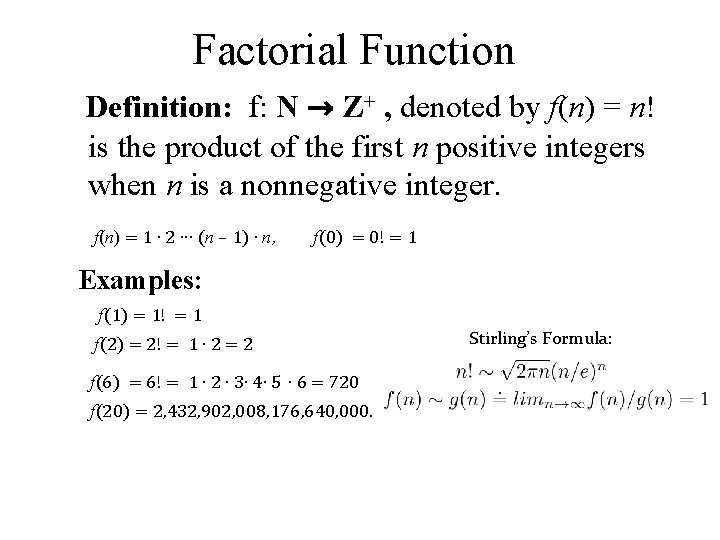
Factorial Function Definition: f: N → Z+ , denoted by f(n) = n! is the product of the first n positive integers when n is a nonnegative integer. f(n) = 1 ∙ 2 ∙∙∙ (n – 1) ∙ n, f(0) = 0! = 1 Examples: f(1) = 1! = 1 f(2) = 2! = 1 ∙ 2 = 2 f(6) = 6! = 1 ∙ 2 ∙ 3∙ 4∙ 5 ∙ 6 = 720 f(20) = 2, 432, 902, 008, 176, 640, 000. Stirling’s Formula:
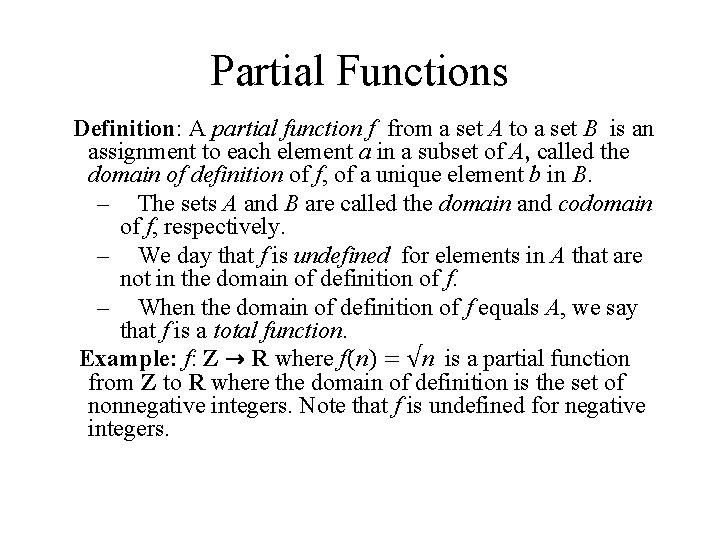
Partial Functions Definition: A partial function f from a set A to a set B is an assignment to each element a in a subset of A, called the domain of definition of f, of a unique element b in B. – The sets A and B are called the domain and codomain of f, respectively. – We day that f is undefined for elements in A that are not in the domain of definition of f. – When the domain of definition of f equals A, we say that f is a total function. Example: f: Z → R where f(n) = √n is a partial function from Z to R where the domain of definition is the set of nonnegative integers. Note that f is undefined for negative integers.
Sequences and Summations • Section 2. 4
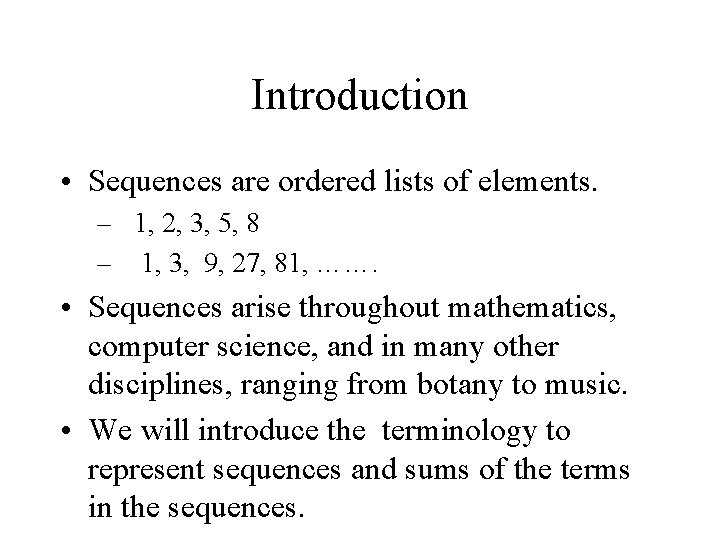
Introduction • Sequences are ordered lists of elements. – 1, 2, 3, 5, 8 – 1, 3, 9, 27, 81, ……. • Sequences arise throughout mathematics, computer science, and in many other disciplines, ranging from botany to music. • We will introduce the terminology to represent sequences and sums of the terms in the sequences.
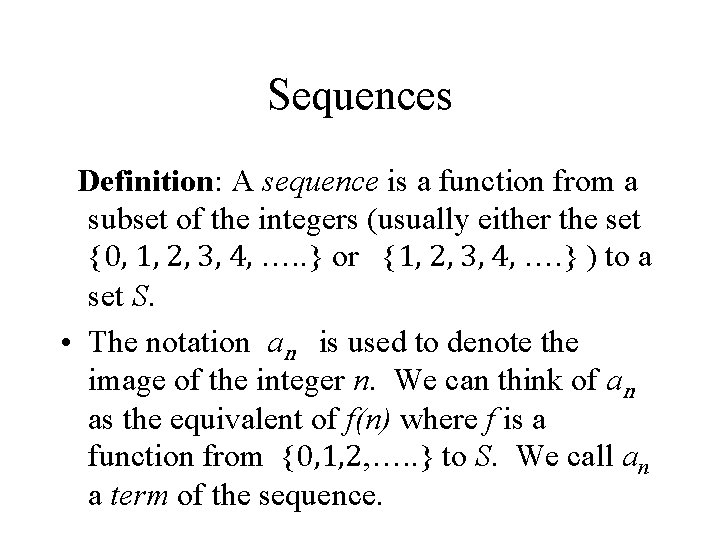
Sequences Definition: A sequence is a function from a subset of the integers (usually either the set {0, 1, 2, 3, 4, …. . } or {1, 2, 3, 4, …. } ) to a set S. • The notation an is used to denote the image of the integer n. We can think of an as the equivalent of f(n) where f is a function from {0, 1, 2, …. . } to S. We call an a term of the sequence.
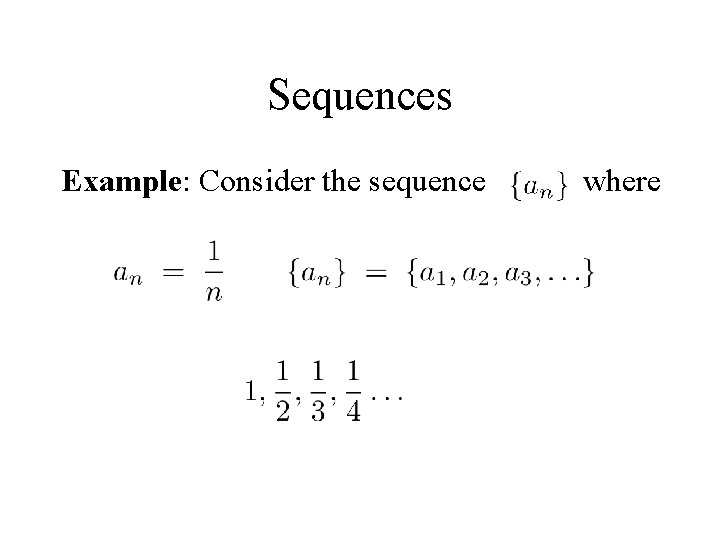
Sequences Example: Consider the sequence where
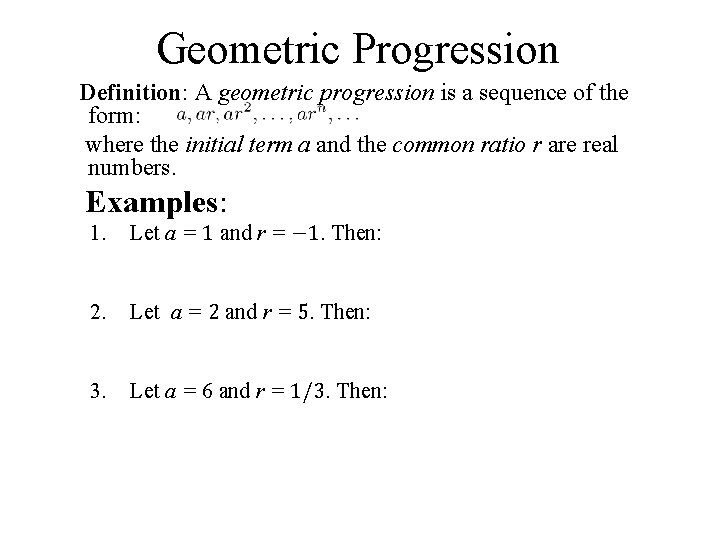
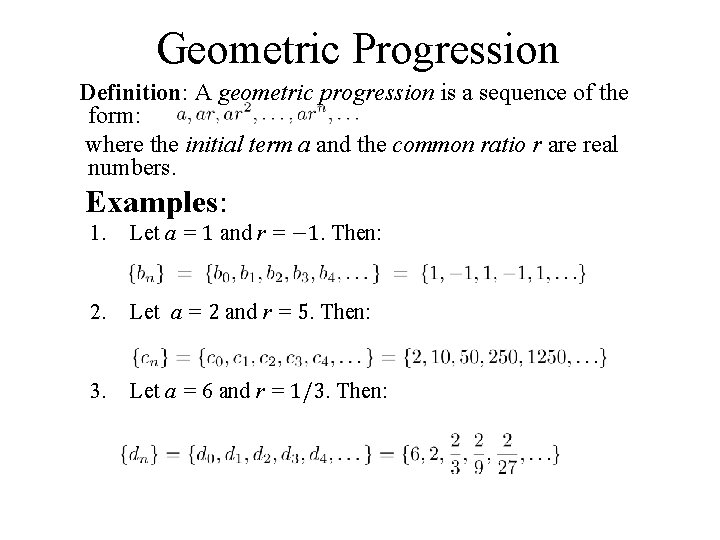
Geometric Progression Definition: A geometric progression is a sequence of the form: where the initial term a and the common ratio r are real numbers. Examples: 1. Let a = 1 and r = − 1. Then: 2. Let a = 2 and r = 5. Then: 3. Let a = 6 and r = 1/3. Then:
Geometric Progression Definition: A geometric progression is a sequence of the form: where the initial term a and the common ratio r are real numbers. Examples: 1. Let a = 1 and r = − 1. Then: 2. Let a = 2 and r = 5. Then: 3. Let a = 6 and r = 1/3. Then:
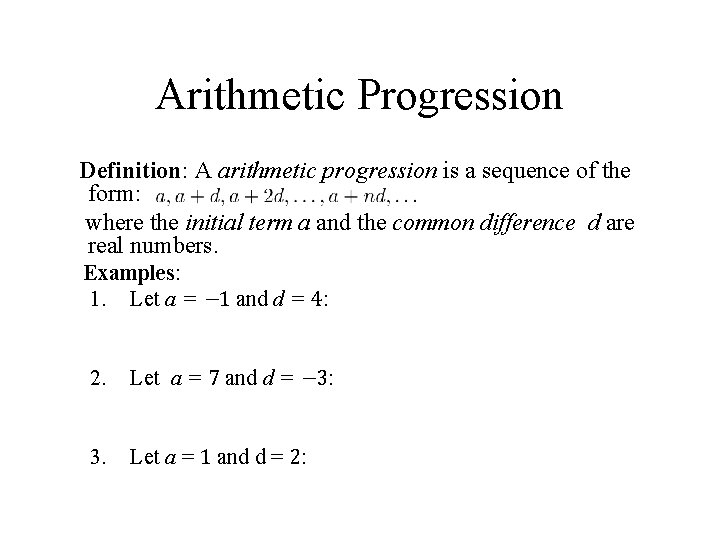
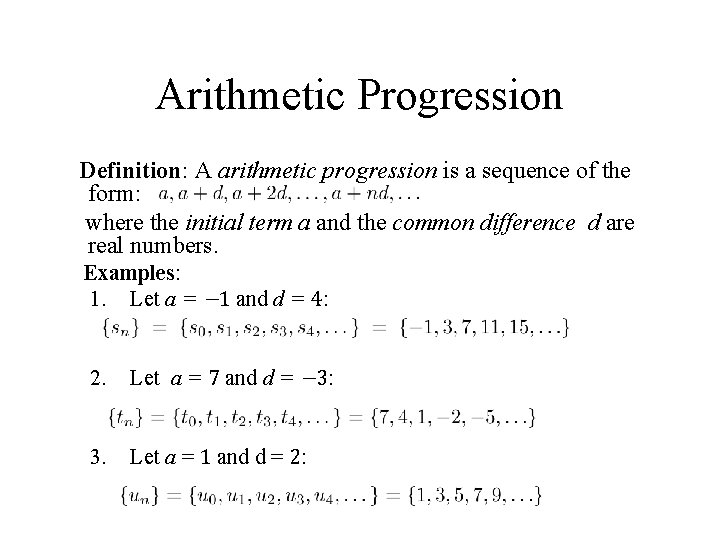
Arithmetic Progression Definition: A arithmetic progression is a sequence of the form: where the initial term a and the common difference d are real numbers. Examples: 1. Let a = − 1 and d = 4: 2. Let a = 7 and d = − 3: 3. Let a = 1 and d = 2:
Arithmetic Progression Definition: A arithmetic progression is a sequence of the form: where the initial term a and the common difference d are real numbers. Examples: 1. Let a = − 1 and d = 4: 2. Let a = 7 and d = − 3: 3. Let a = 1 and d = 2:
Strings Definition: A string is a finite sequence of characters from a finite set (an alphabet). • Sequences of characters or bits are important in computer science. • The empty string is represented by λ. • The string abcde has length 5.
Recurrence Relations Definition: A recurrence relation for the sequence {an} is an equation that expresses an in terms of one or more of the previous terms of the sequence, namely, a 0, a 1, …, an-1, for all integers n with n ≥ n 0, where n 0 is a nonnegative integer. • A sequence is called a solution of a recurrence relation if its terms satisfy the recurrence relation. • The initial conditions for a sequence specify the terms that precede the first term where the recurrence relation takes effect.
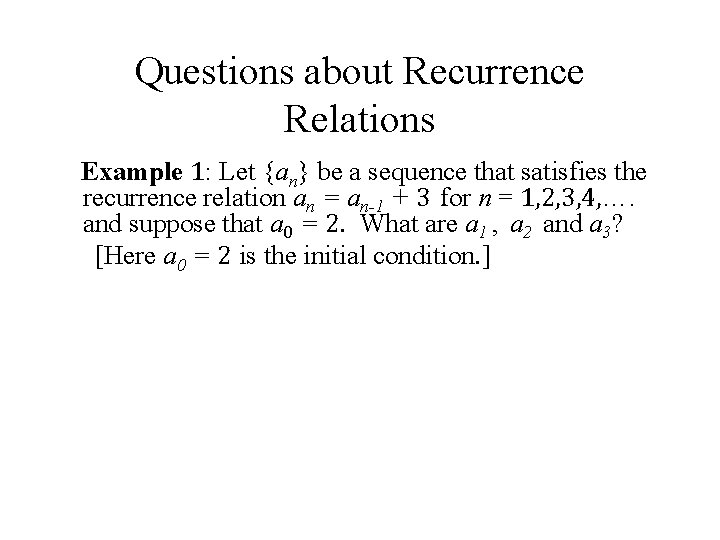
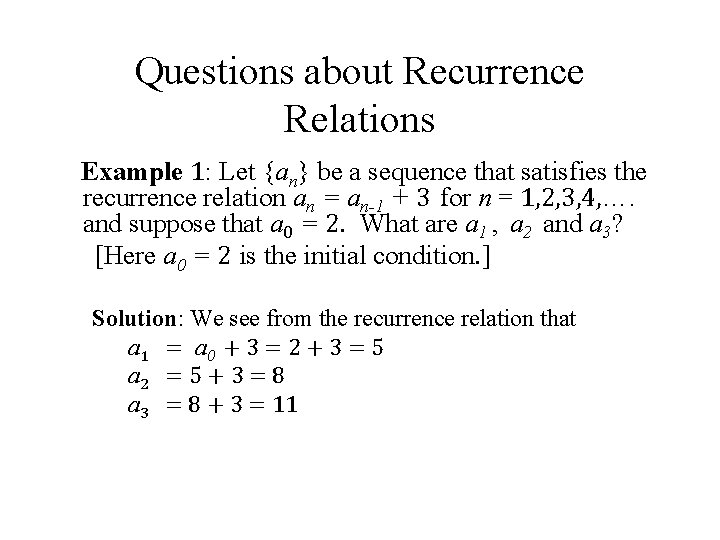
Questions about Recurrence Relations Example 1: Let {an} be a sequence that satisfies the recurrence relation an = an-1 + 3 for n = 1, 2, 3, 4, …. and suppose that a 0 = 2. What are a 1 , a 2 and a 3? [Here a 0 = 2 is the initial condition. ] Solution: We see from the recurrence relation that a 1 = a 0 + 3 = 2 + 3 = 5 a 2 = 5 + 3 = 8 a 3 = 8 + 3 = 11
Questions about Recurrence Relations Example 1: Let {an} be a sequence that satisfies the recurrence relation an = an-1 + 3 for n = 1, 2, 3, 4, …. and suppose that a 0 = 2. What are a 1 , a 2 and a 3? [Here a 0 = 2 is the initial condition. ] Solution: We see from the recurrence relation that a 1 = a 0 + 3 = 2 + 3 = 5 a 2 = 5 + 3 = 8 a 3 = 8 + 3 = 11
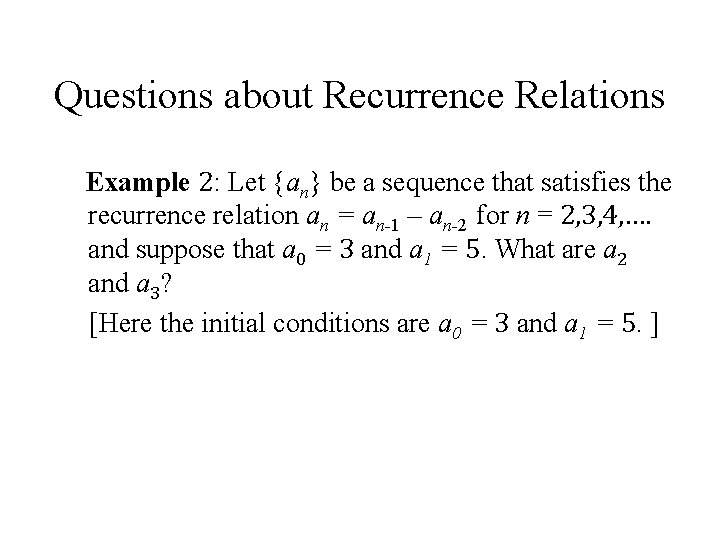
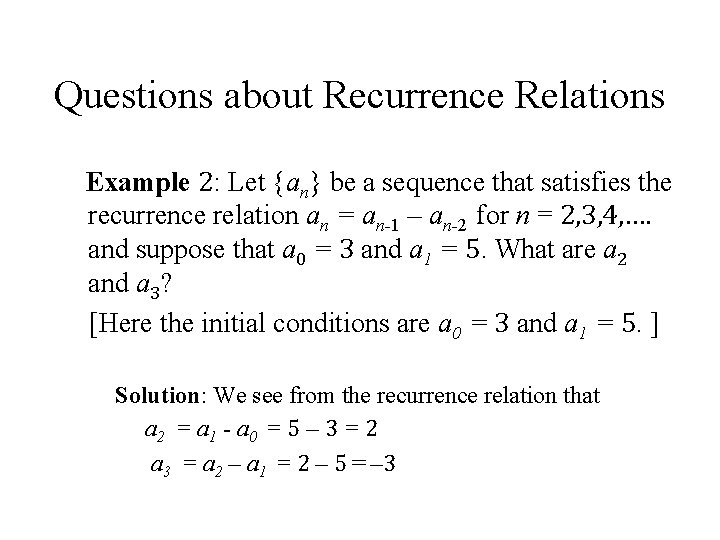
Questions about Recurrence Relations Example 2: Let {an} be a sequence that satisfies the recurrence relation an = an-1 – an-2 for n = 2, 3, 4, …. and suppose that a 0 = 3 and a 1 = 5. What are a 2 and a 3? [Here the initial conditions are a 0 = 3 and a 1 = 5. ] Solution: We see from the recurrence relation that a 2 = a 1 - a 0 = 5 – 3 = 2 a 3 = a 2 – a 1 = 2 – 5 = – 3
Questions about Recurrence Relations Example 2: Let {an} be a sequence that satisfies the recurrence relation an = an-1 – an-2 for n = 2, 3, 4, …. and suppose that a 0 = 3 and a 1 = 5. What are a 2 and a 3? [Here the initial conditions are a 0 = 3 and a 1 = 5. ] Solution: We see from the recurrence relation that a 2 = a 1 - a 0 = 5 – 3 = 2 a 3 = a 2 – a 1 = 2 – 5 = – 3
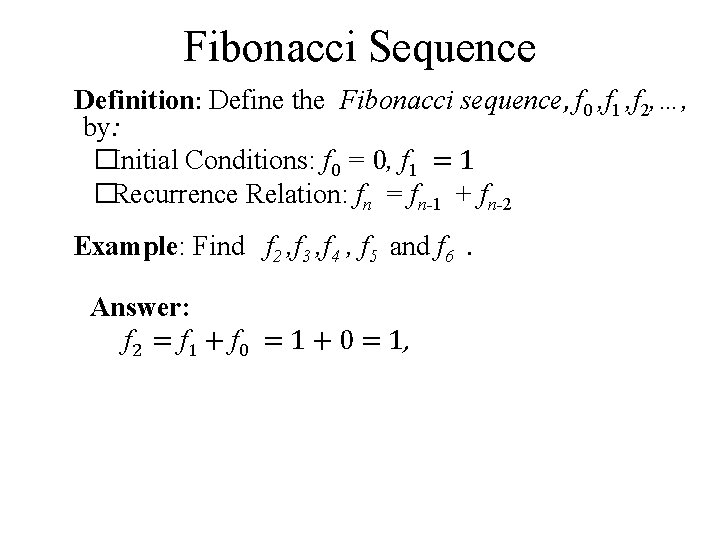
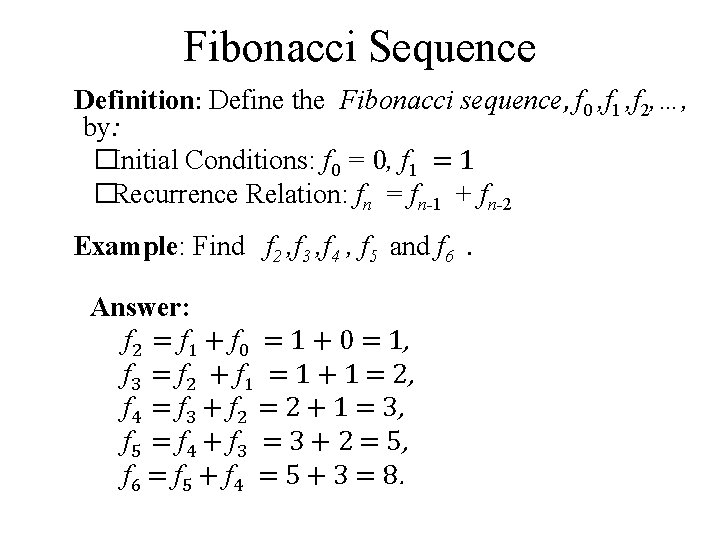
Fibonacci Sequence Definition: Define the Fibonacci sequence, f 0 , f 1 , f 2, …, by: �Initial Conditions: f 0 = 0, f 1 = 1 �Recurrence Relation: fn = fn-1 + fn-2 Example: Find f 2 , f 3 , f 4 , f 5 and f 6. Answer: f 2 = f 1 + f 0 = 1 + 0 = 1 , f 3 = f 2 + f 1 = 1 + 1 = 2 , f 4 = f 3 + f 2 = 2 + 1 = 3 , f 5 = f 4 + f 3 = 3 + 2 = 5 , f 6 = f 5 + f 4 = 5 + 3 = 8.
Fibonacci Sequence Definition: Define the Fibonacci sequence, f 0 , f 1 , f 2, …, by: �Initial Conditions: f 0 = 0, f 1 = 1 �Recurrence Relation: fn = fn-1 + fn-2 Example: Find f 2 , f 3 , f 4 , f 5 and f 6. Answer: f 2 = f 1 + f 0 = 1 + 0 = 1 , f 3 = f 2 + f 1 = 1 + 1 = 2 , f 4 = f 3 + f 2 = 2 + 1 = 3 , f 5 = f 4 + f 3 = 3 + 2 = 5 , f 6 = f 5 + f 4 = 5 + 3 = 8.
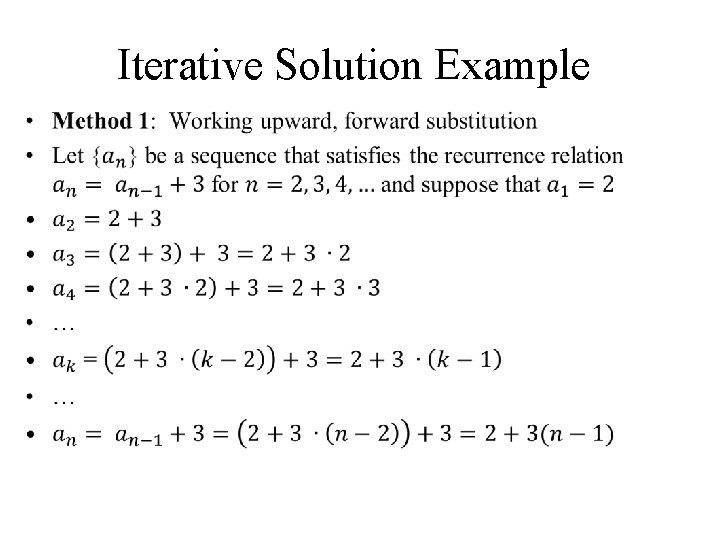
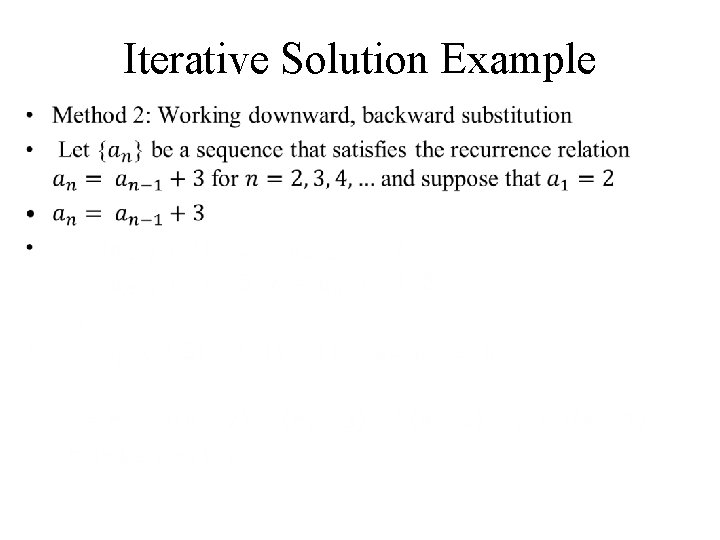
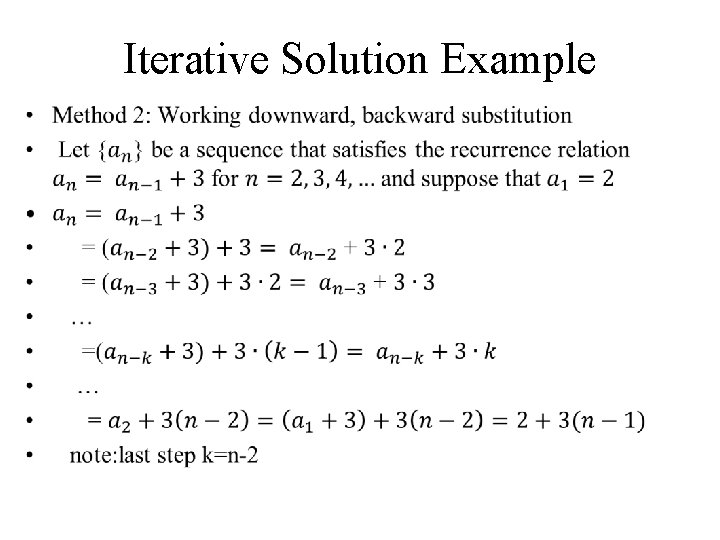
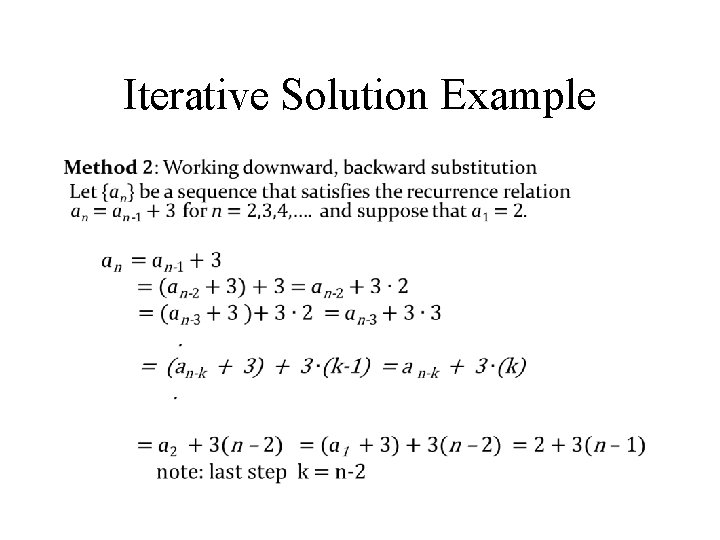
Solving Recurrence Relations �Finding a formula for the nth term of the sequence generated by a recurrence relation is called solving the recurrence relation. �Such a formula is called a closed formula. �Various methods for solving recurrence relations will be covered in Chapter 8 where recurrence relations will be studied in greater depth. �Here we illustrate by example the method of iteration in which we need to guess the formula. The guess can be proved correct by the method of induction (Chapter 5).
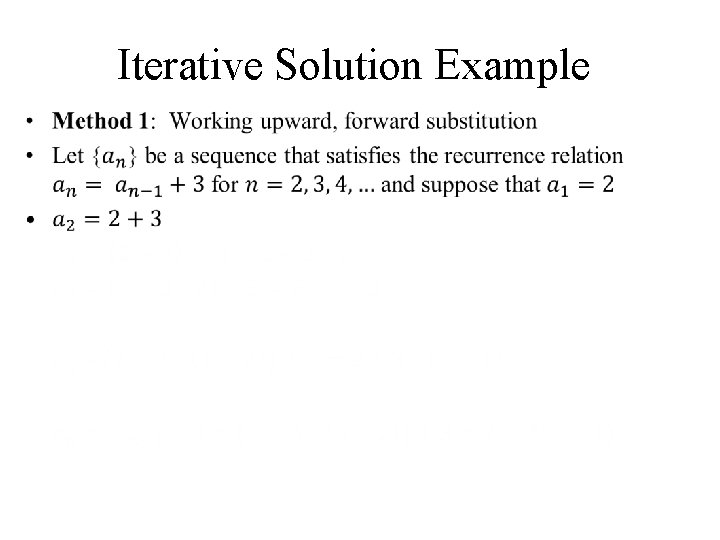
Iterative Solution Example •
Iterative Solution Example •
Iterative Solution Example •
Iterative Solution Example •
Iterative Solution Example •
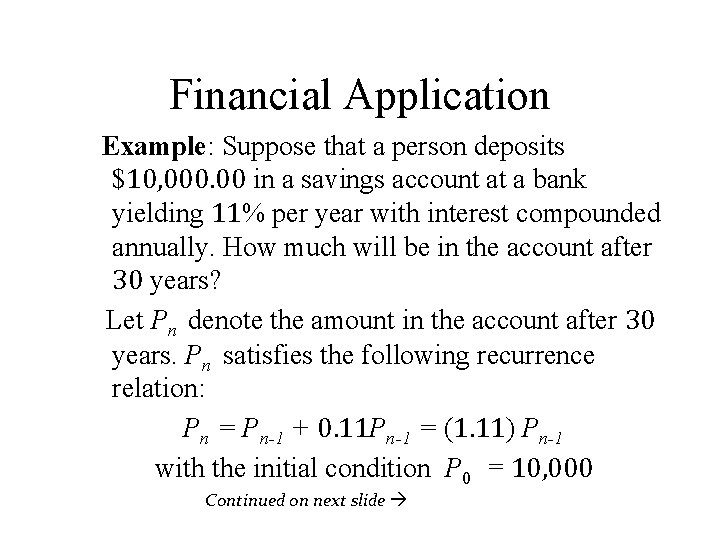
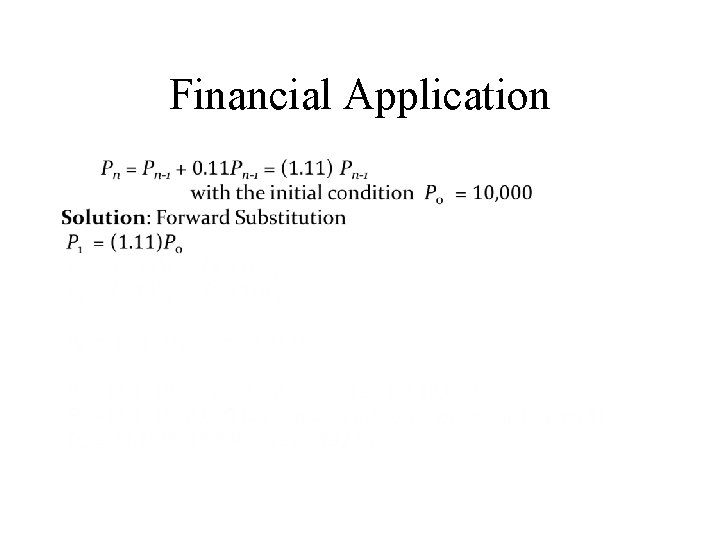
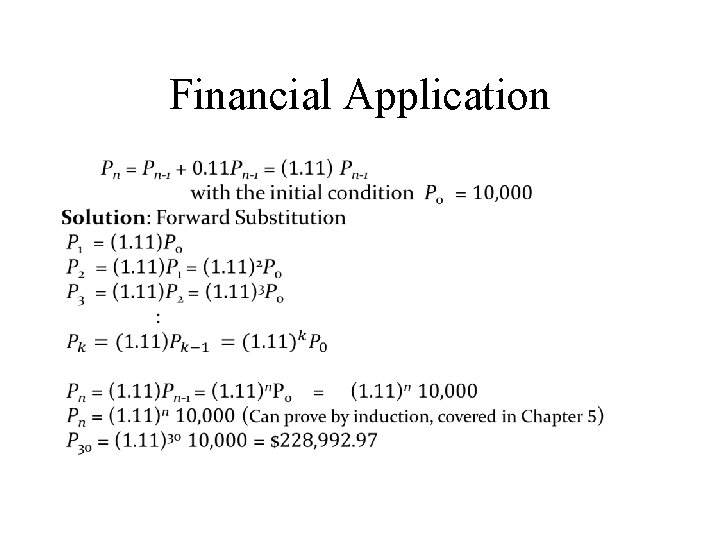
Financial Application Example: Suppose that a person deposits $10, 000. 00 in a savings account at a bank yielding 11% per year with interest compounded annually. How much will be in the account after 30 years? Let Pn denote the amount in the account after 30 years. Pn satisfies the following recurrence relation: Pn = Pn-1 + 0. 11 Pn-1 = (1. 11) Pn-1 with the initial condition P 0 = 10, 000 Continued on next slide
Financial Application •
Financial Application •
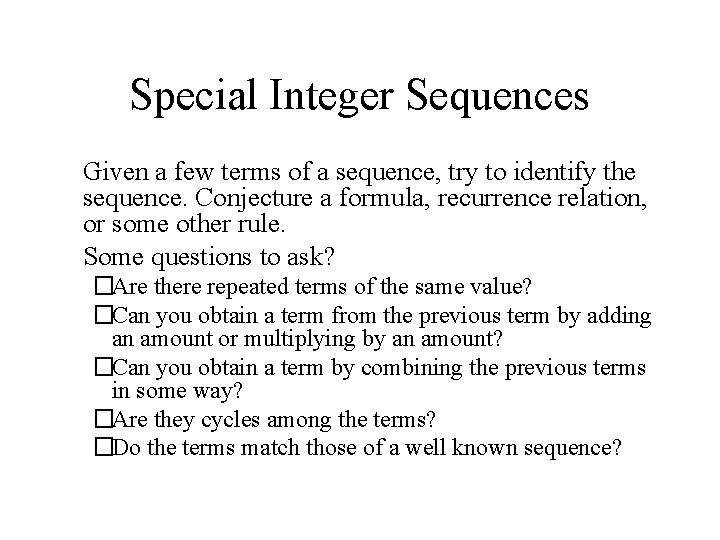
Special Integer Sequences �Given a few terms of a sequence, try to identify the sequence. Conjecture a formula, recurrence relation, or some other rule. �Some questions to ask? �Are there repeated terms of the same value? �Can you obtain a term from the previous term by adding an amount or multiplying by an amount? �Can you obtain a term by combining the previous terms in some way? �Are they cycles among the terms? �Do the terms match those of a well known sequence?
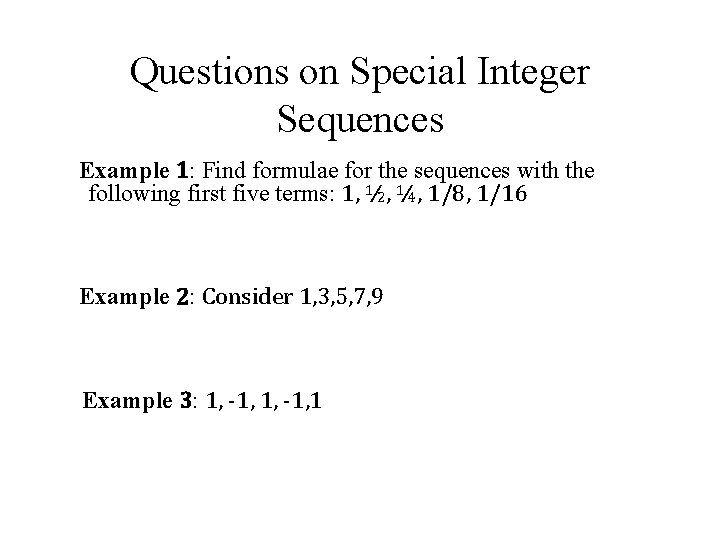
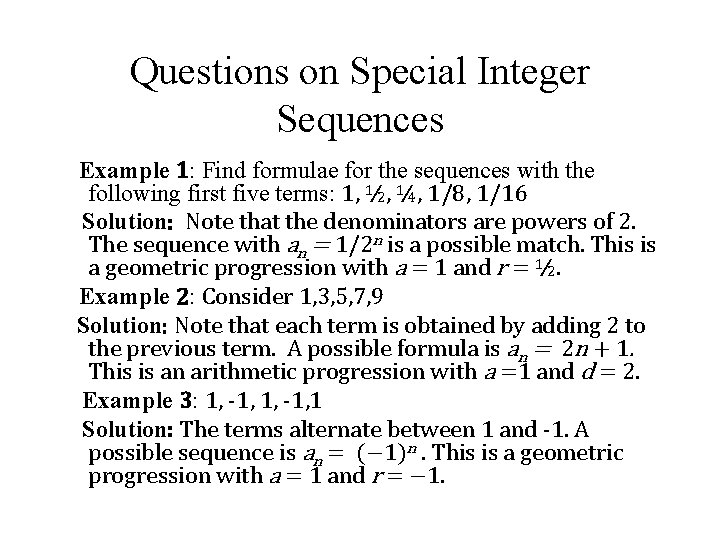
Questions on Special Integer Sequences Example 1: Find formulae for the sequences with the following first five terms: 1, ½, ¼, 1/8, 1/16 Solution: Note that the denominators are powers of 2. The sequence with an = 1/2 n is a possible match. This is a geometric progression with a = 1 and r = ½. Example 2: Consider 1, 3, 5, 7, 9 Solution: Note that each term is obtained by adding 2 to the previous term. A possible formula is an = 2 n + 1. This is an arithmetic progression with a =1 and d = 2. Example 3: 1, -1, 1 Solution: The terms alternate between 1 and -1. A possible sequence is an = (− 1)n. This is a geometric progression with a = 1 and r = − 1.
Questions on Special Integer Sequences Example 1: Find formulae for the sequences with the following first five terms: 1, ½, ¼, 1/8, 1/16 Solution: Note that the denominators are powers of 2. The sequence with an = 1/2 n is a possible match. This is a geometric progression with a = 1 and r = ½. Example 2: Consider 1, 3, 5, 7, 9 Solution: Note that each term is obtained by adding 2 to the previous term. A possible formula is an = 2 n + 1. This is an arithmetic progression with a =1 and d = 2. Example 3: 1, -1, 1 Solution: The terms alternate between 1 and -1. A possible sequence is an = (− 1)n. This is a geometric progression with a = 1 and r = − 1.
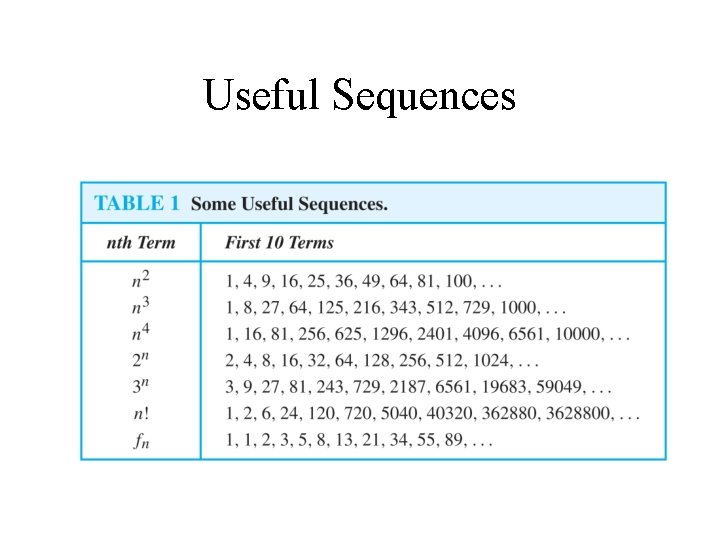
Useful Sequences
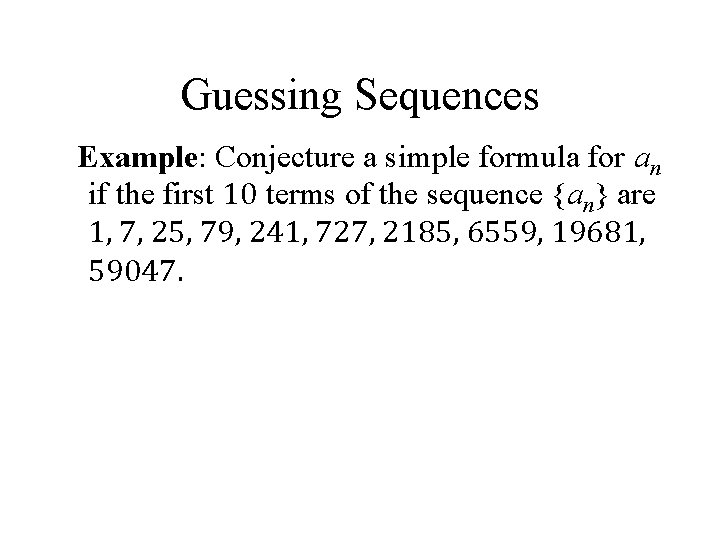
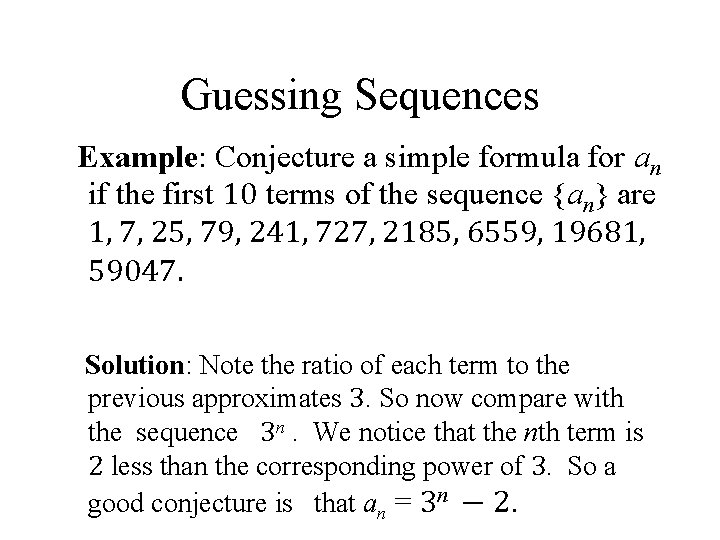
Guessing Sequences Example: Conjecture a simple formula for an if the first 10 terms of the sequence {an} are 1, 7, 25, 79, 241, 727, 2185, 6559, 19681, 59047. Solution: Note the ratio of each term to the previous approximates 3. So now compare with the sequence 3 n. We notice that the nth term is 2 less than the corresponding power of 3. So a good conjecture is that an
Guessing Sequences Example: Conjecture a simple formula for an if the first 10 terms of the sequence {an} are 1, 7, 25, 79, 241, 727, 2185, 6559, 19681, 59047. Solution: Note the ratio of each term to the previous approximates 3. So now compare with the sequence 3 n. We notice that the nth term is 2 less than the corresponding power of 3. So a good conjecture is that an = 3 n − 2.
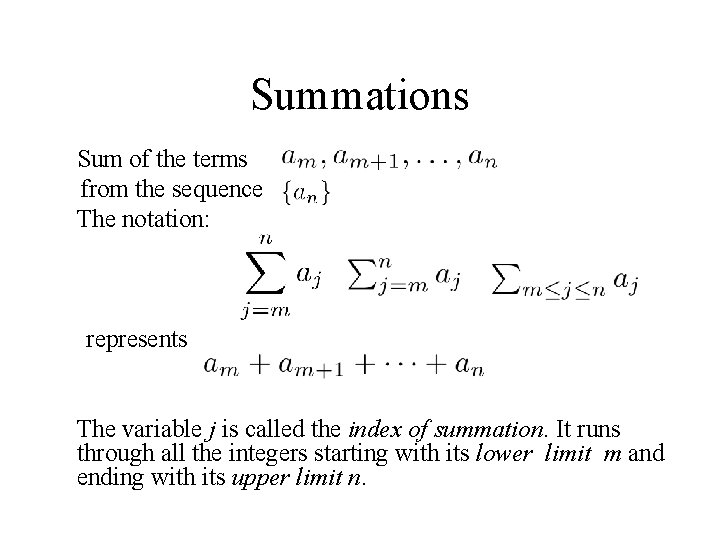
Summations �Sum of the terms from the sequence �The notation: represents �The variable j is called the index of summation. It runs through all the integers starting with its lower limit m and ending with its upper limit n.
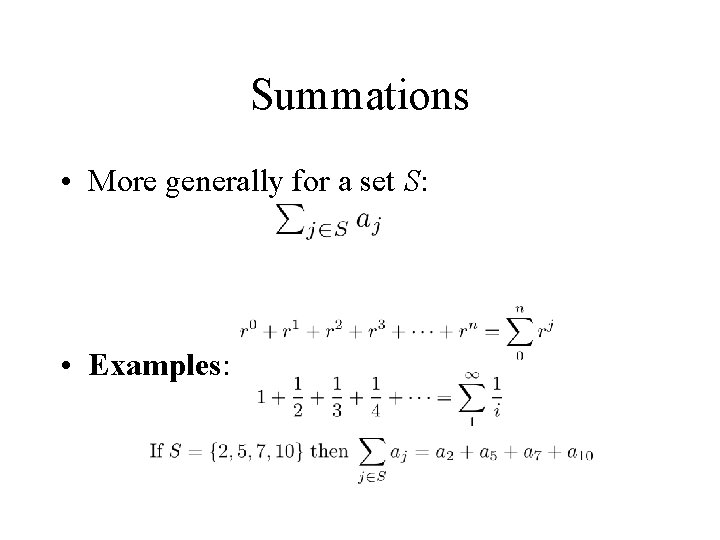
Summations • More generally for a set S: • Examples:
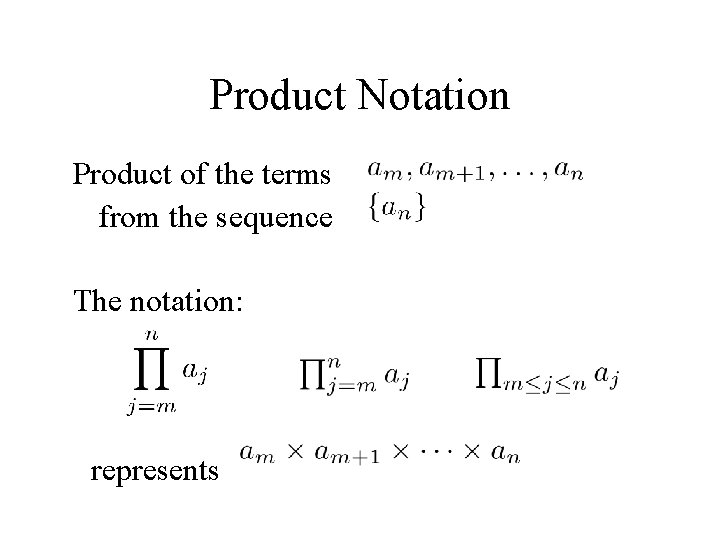
Product Notation �Product of the terms from the sequence �The notation: represents
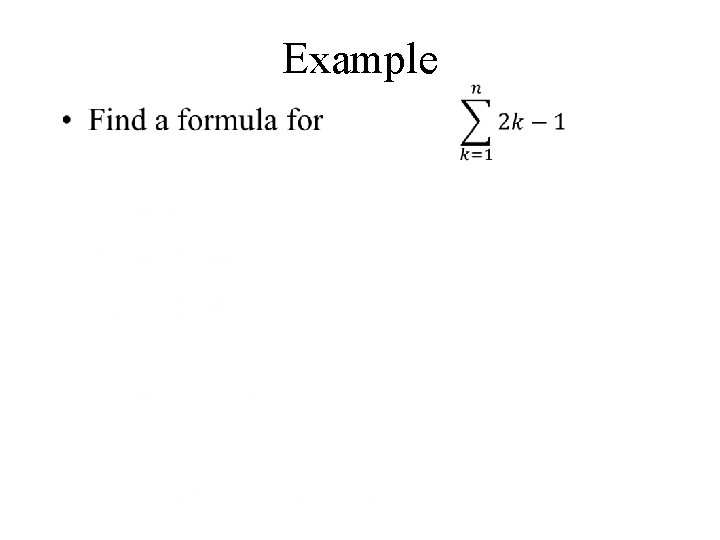
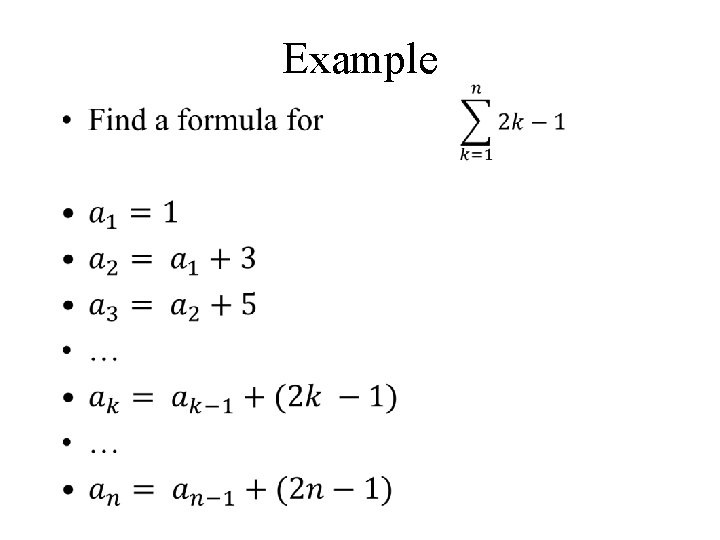
Example •
Example •
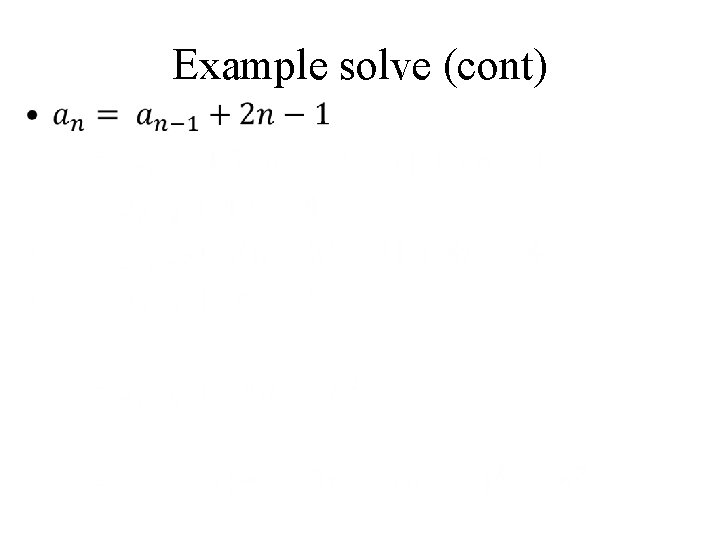
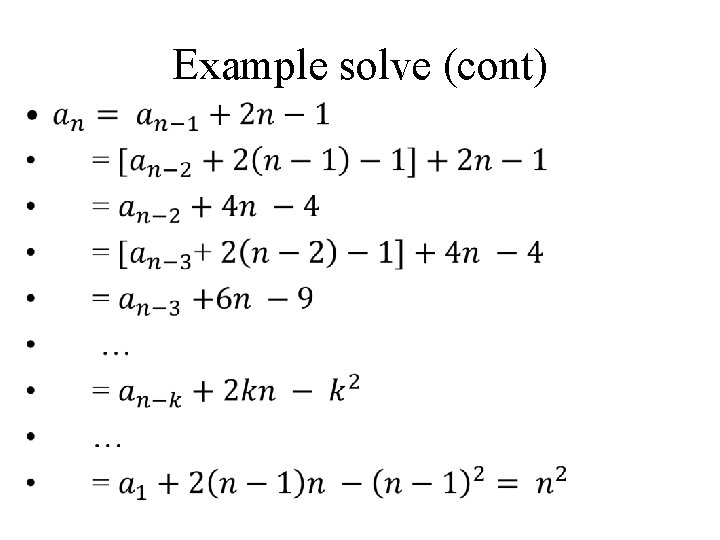
Example solve (cont) •
Example solve (cont) •
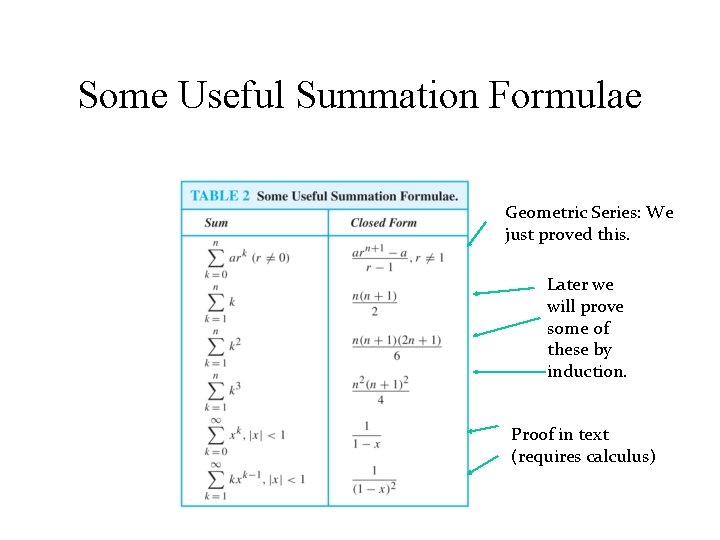
Some Useful Summation Formulae Geometric Series: We just proved this. Later we will prove some of these by induction. Proof in text (requires calculus)