
Comp Sci 101 Introduction to Computer Science October

Comp. Sci 101 Introduction to Computer Science October 9, 2014 Prof. Rodger Thanks to Prof. Azhar and Yossra Hamid for giving this lecture!

Announcements • Reading for next time on calendar page – RQ • APT 4 is due today – APT 5 is out today • Exam 1 was handed out Tuesday, grades are on Sakai, you will need to see Prof. Rodger next week to get your test back • Today Sets • Prof. Rodger is at a conference this week
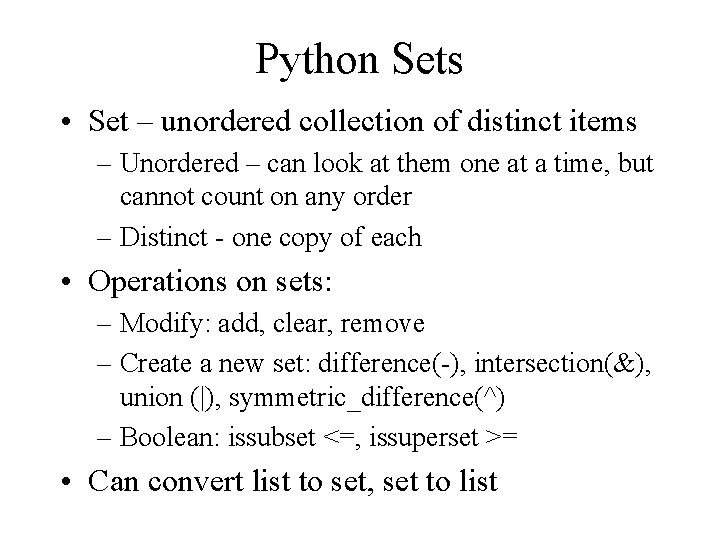
Python Sets • Set – unordered collection of distinct items – Unordered – can look at them one at a time, but cannot count on any order – Distinct - one copy of each • Operations on sets: – Modify: add, clear, remove – Create a new set: difference(-), intersection(&), union (|), symmetric_difference(^) – Boolean: issubset <=, issuperset >= • Can convert list to set, set to list
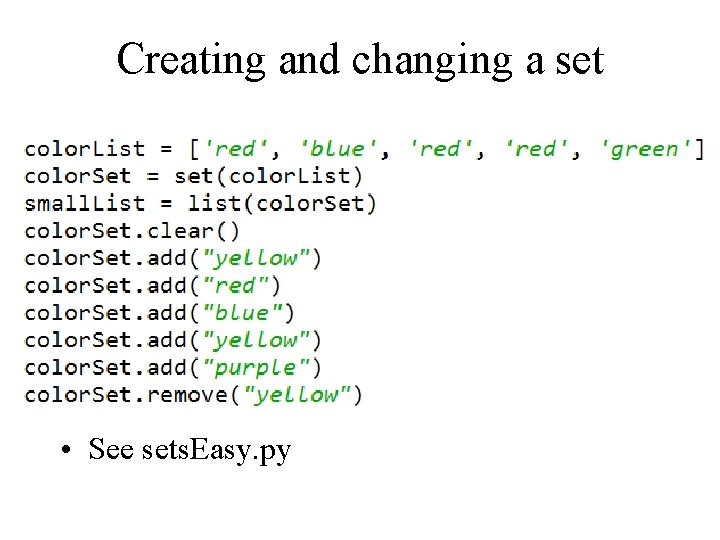
Creating and changing a set • See sets. Easy. py
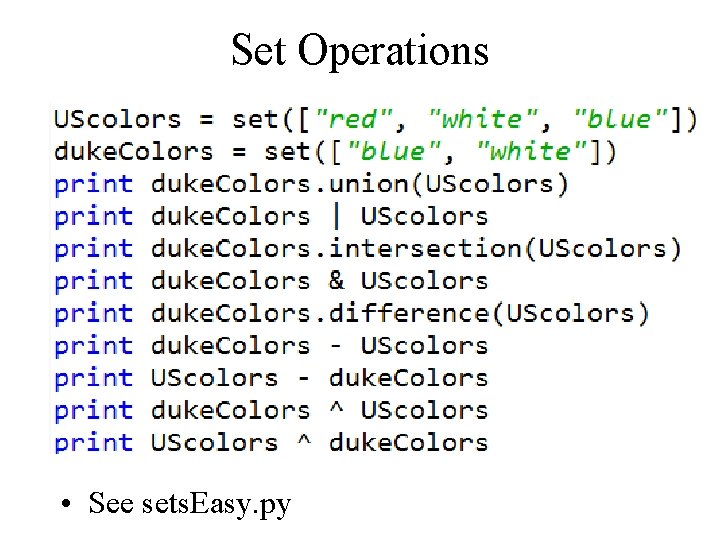
Set Operations • See sets. Easy. py
![Set Examples bit. ly/101 fall 14 -1009 -01 polo. Club = set(['Mary', 'Laura', 'Dell'])](http://slidetodoc.com/presentation_image_h2/0b27dccbd067ecaeee557ea7ae7c266f/image-6.jpg "Set Examples bit. ly/101 fall 14 -1009 -01 polo. Club = set(['Mary', 'Laura', 'Dell'])")
Set Examples bit. ly/101 fall 14 -1009 -01 polo. Club = set(['Mary', 'Laura', 'Dell']) rugby. Club = set(['Fred', 'Sue', 'Mary']) Question 1: print [w for w in polo. Club. intersection(rugby. Club)] Question 2: print [w for w in polo. Club. union(rugby. Club)]
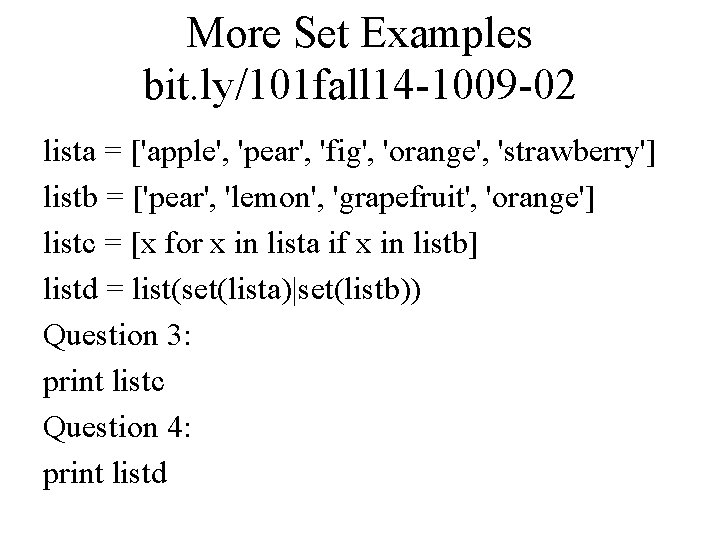
More Set Examples bit. ly/101 fall 14 -1009 -02 lista = ['apple', 'pear', 'fig', 'orange', 'strawberry'] listb = ['pear', 'lemon', 'grapefruit', 'orange'] listc = [x for x in lista if x in listb] listd = list(set(lista)|set(listb)) Question 3: print listc Question 4: print listd
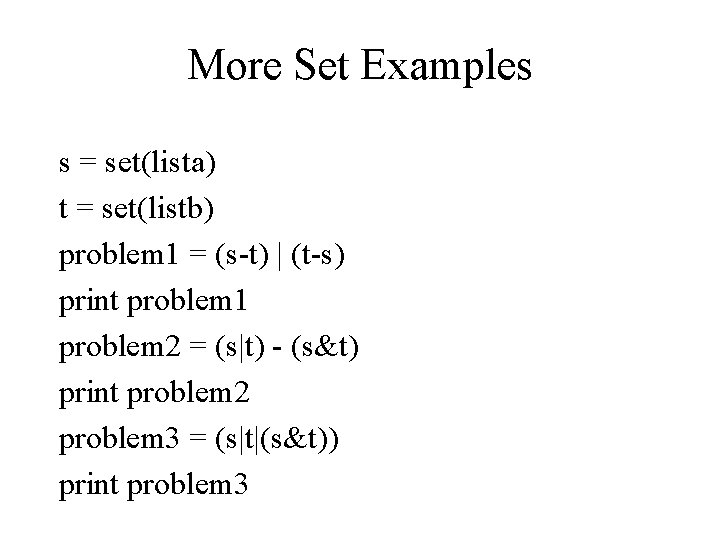
More Set Examples s = set(lista) t = set(listb) problem 1 = (s-t) | (t-s) print problem 1 problem 2 = (s|t) - (s&t) print problem 2 problem 3 = (s|t|(s&t)) print problem 3
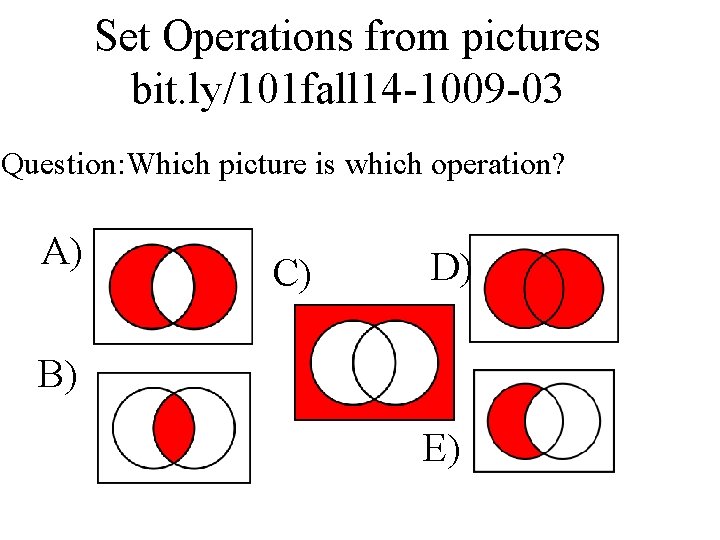
Set Operations from pictures bit. ly/101 fall 14 -1009 -03 Question: Which picture is which operation? A) C) D) B) E)
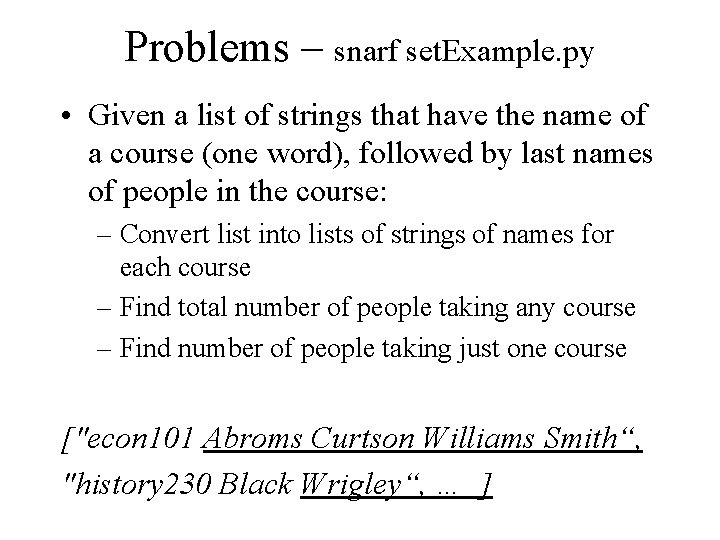
Problems – snarf set. Example. py • Given a list of strings that have the name of a course (one word), followed by last names of people in the course: – Convert list into lists of strings of names for each course – Find total number of people taking any course – Find number of people taking just one course ["econ 101 Abroms Curtson Williams Smith“, "history 230 Black Wrigley“, … ]
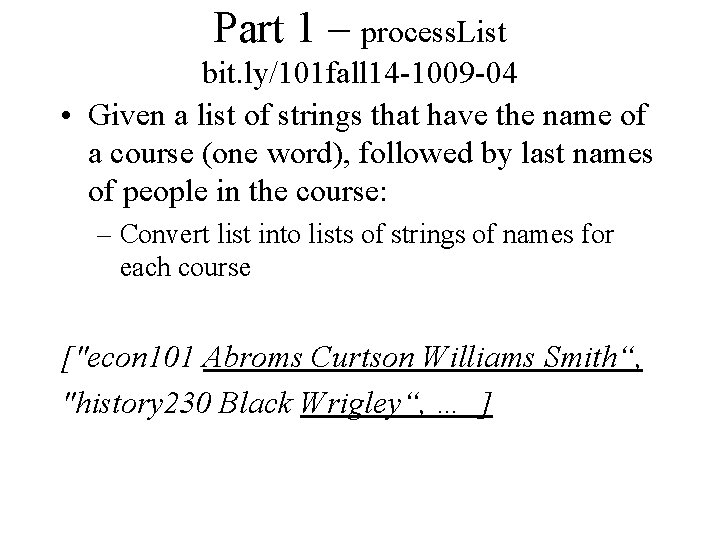
Part 1 – process. List bit. ly/101 fall 14 -1009 -04 • Given a list of strings that have the name of a course (one word), followed by last names of people in the course: – Convert list into lists of strings of names for each course ["econ 101 Abroms Curtson Williams Smith“, "history 230 Black Wrigley“, … ]
Part 2 – people. Taking. Courses bit. ly/101 fall 14 -1009 -05 • Given a list of strings that have the name of a course (one word), followed by last names of people in the course: – Find total number of people taking any course ["econ 101 Abroms Curtson Williams Smith“, "history 230 Black Wrigley“, … ]
Part 3 – union. All. Sets. But. Me bit. ly/101 fall 14 -1009 -06 • Given a list of strings that have the name of a course (one word), followed by last names of people in the course: – Find number of people taking just one course • BUT FIRST, lets write this helper method ["econ 101 Abroms Curtson Williams Smith“, "history 230 Black Wrigley“, … ]
Part 4 – people. Taking. Only. One. Course bit. ly/101 fall 14 -1009 -07 • Given a list of strings that have the name of a course (one word), followed by last names of people in the course: – Find number of people taking just one course ["econ 101 Abroms Curtson Williams Smith“, "history 230 Black Wrigley“, … ]
APT - Unique. Zoo • How do you solve this problem? • How is it similar to the problem we just solved
- Slides: 15