
Comp Sci 101 Introduction to Computer Science Feb

Comp. Sci 101 Introduction to Computer Science Feb 28, 2017 Prof. Rodger cps 101 spring 2017 1
You can see your Exam 1… on Gradescope • Solutions posted – regrades til March 3 – Ask for regrade on gradescope • Try working problem you missed first – Then look at solution • Once you think you understand – Get blank sheet of paper – try again • Understand all solutions compsci 101 spring 2017 2
Announcements • • Reading and RQ due next time Assignment 5 out today APT 4 due today, APT 5 out Lab 6 this week – Read APT Anagramfree and Assignment 5 before going to lab! • Today: – Focus on problem solving with sets, list comprehensions cps 101 spring 2017 3
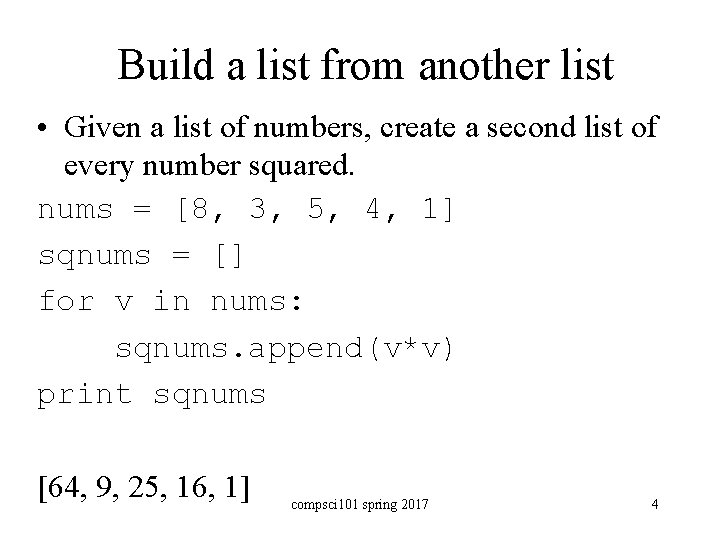
Build a list from another list • Given a list of numbers, create a second list of every number squared. nums = [8, 3, 5, 4, 1] sqnums = [] for v in nums: sqnums. append(v*v) print sqnums [64, 9, 25, 16, 1] compsci 101 spring 2017 4
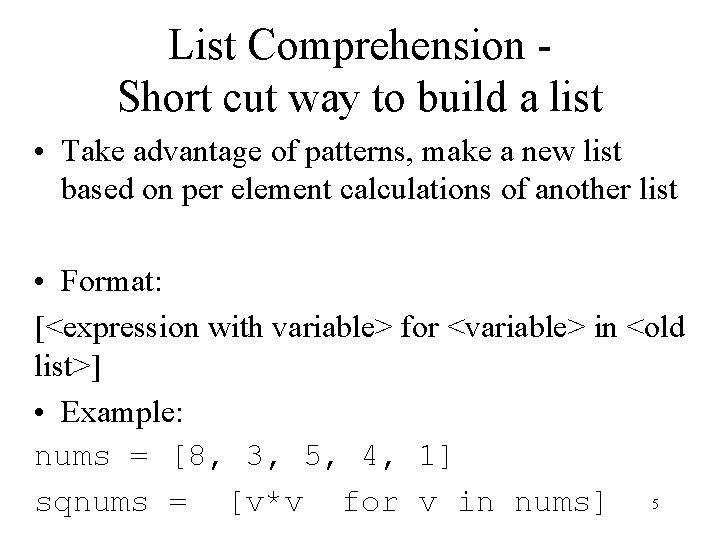
List Comprehension Short cut way to build a list • Take advantage of patterns, make a new list based on per element calculations of another list • Format: [<expression with variable> for <variable> in <old list>] • Example: nums = [8, 3, 5, 4, 1] sqnums = [v*v for v in nums] 5
![These result in the same list! nums = [8, 3, 5, 4, 1] 1)](http://slidetodoc.com/presentation_image_h2/1d361d007ad700a4f48da20e18819176/image-6.jpg "These result in the same list! nums = [8, 3, 5, 4, 1] 1)")
These result in the same list! nums = [8, 3, 5, 4, 1] 1) 2) sqnums = [] for v in nums: sqnums. append(v*v) sqnums = [v*v for v in nums] cps 101 spring 2017 6
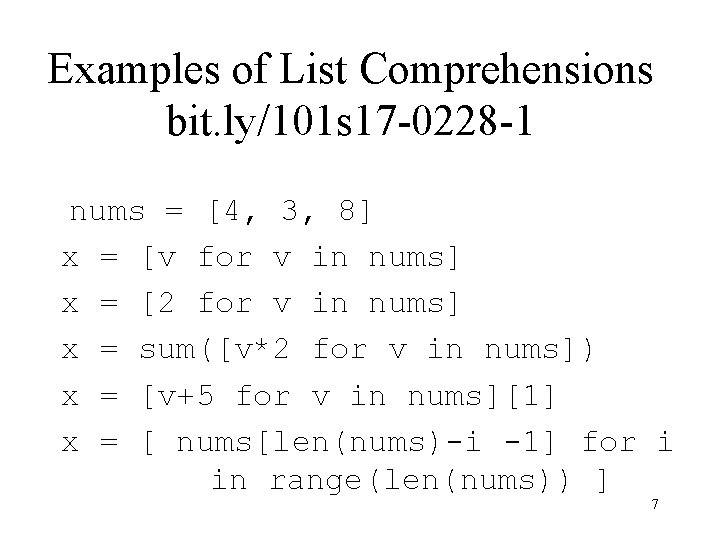
Examples of List Comprehensions bit. ly/101 s 17 -0228 -1 nums = [4, 3, 8] x = [v for v in nums] x = [2 for v in nums] x = sum([v*2 for v in nums]) x = [v+5 for v in nums][1] x = [ nums[len(nums)-i -1] for i in range(len(nums)) ] 7
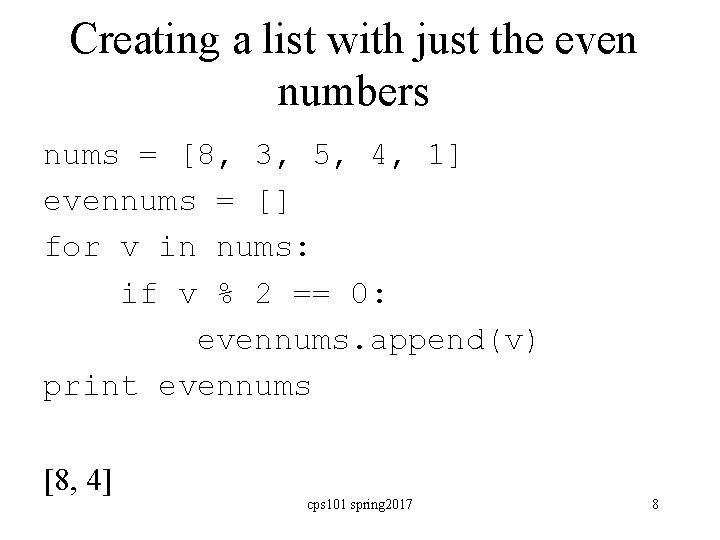
Creating a list with just the even numbers nums = [8, 3, 5, 4, 1] evennums = [] for v in nums: if v % 2 == 0: evennums. append(v) print evennums [8, 4] cps 101 spring 2017 8
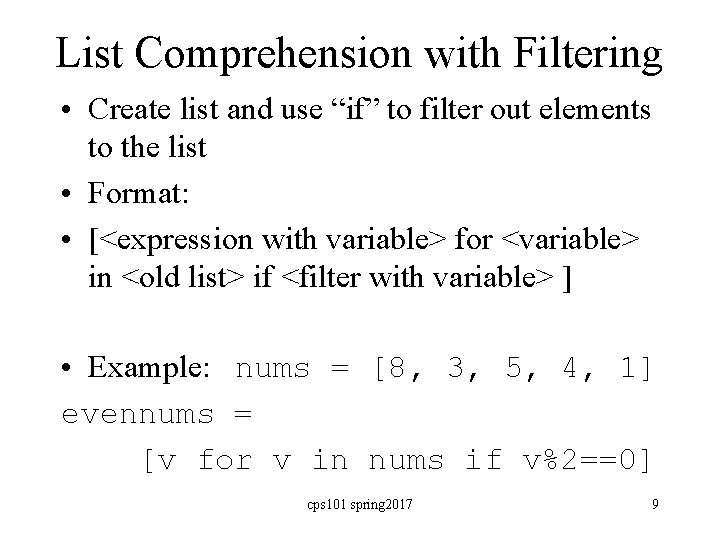
List Comprehension with Filtering • Create list and use “if” to filter out elements to the list • Format: • [<expression with variable> for <variable> in <old list> if <filter with variable> ] • Example: nums = [8, 3, 5, 4, 1] evennums = [v for v in nums if v%2==0] cps 101 spring 2017 9
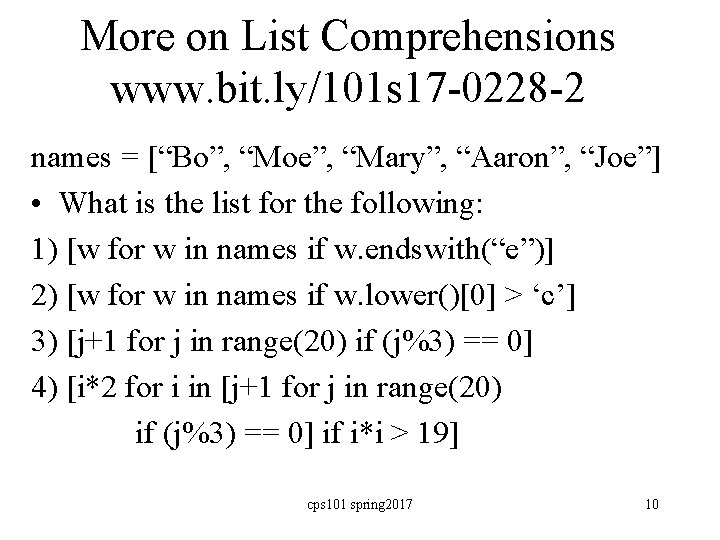
More on List Comprehensions www. bit. ly/101 s 17 -0228 -2 names = [“Bo”, “Moe”, “Mary”, “Aaron”, “Joe”] • What is the list for the following: 1) [w for w in names if w. endswith(“e”)] 2) [w for w in names if w. lower()[0] > ‘c’] 3) [j+1 for j in range(20) if (j%3) == 0] 4) [i*2 for i in [j+1 for j in range(20) if (j%3) == 0] if i*i > 19] cps 101 spring 2017 10
More on List Comprehensions bit. ly/101 s 17 -1028 -3 • Problem: Given a list of strings, return the longest string. If there are more than one of that length, return the first such one. fruit = [‘kiwi’, ‘plum’, ‘orange’, ‘lemon’, ‘banana’] Use a list comprehension for this problem cps 101 spring 2017 11
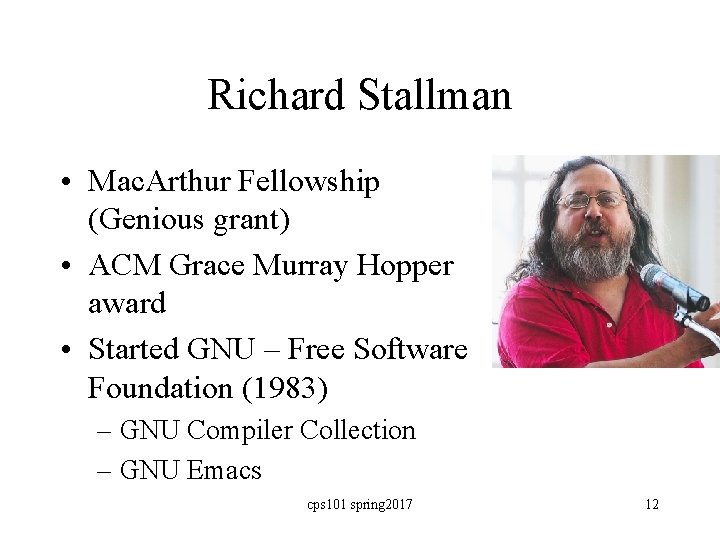
Richard Stallman • Mac. Arthur Fellowship (Genious grant) • ACM Grace Murray Hopper award • Started GNU – Free Software Foundation (1983) – GNU Compiler Collection – GNU Emacs cps 101 spring 2017 12
Python Sets • Set – unordered collection of distinct items – Unordered – can look at them one at a time, but cannot count on any order – Distinct - one copy of each • Operations on sets: – Modify: add, clear, remove – Create a new set: difference(-), intersection(&), union (|), symmetric_difference(^) – Boolean: issubset <=, issuperset >= • Can convert list to set, set to list – Great to get rid of duplicates in a list 13
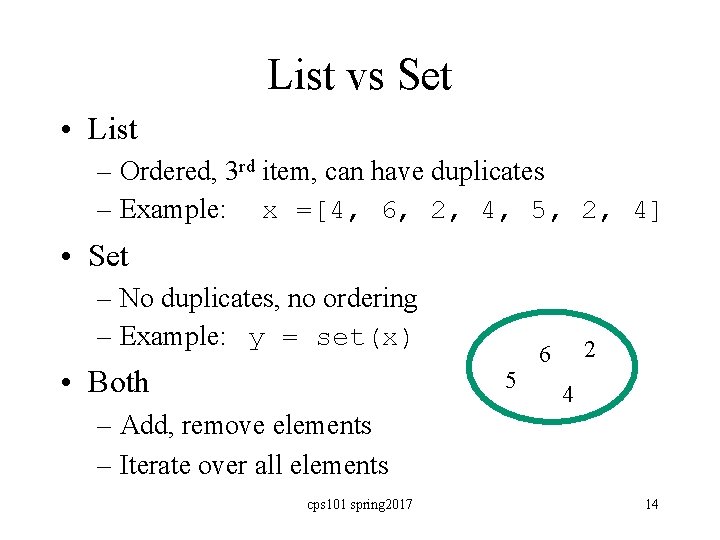
List vs Set • List – Ordered, 3 rd item, can have duplicates – Example: x =[4, 6, 2, 4, 5, 2, 4] • Set – No duplicates, no ordering – Example: y = set(x) • Both 5 2 6 4 – Add, remove elements – Iterate over all elements cps 101 spring 2017 14
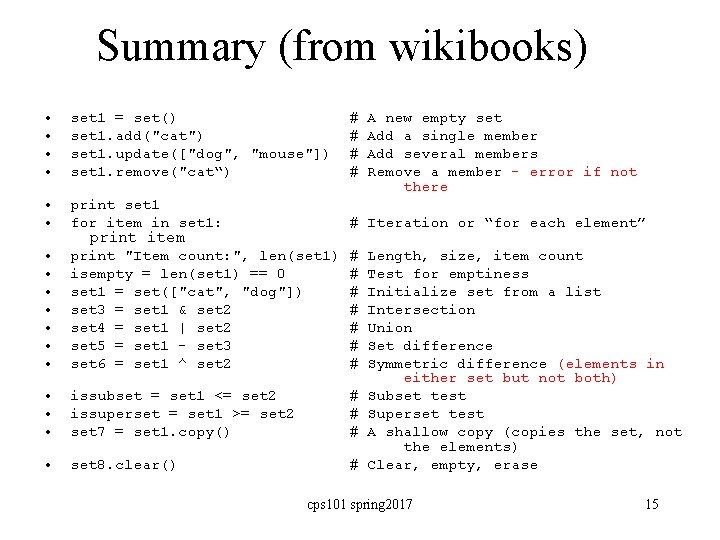
Summary (from wikibooks) • • set 1 = set() set 1. add("cat") set 1. update(["dog", "mouse"]) set 1. remove("cat“) # # • • print set 1 for item in set 1: # Iteration or “for each element” • • print "Item count: ", len(set 1) isempty = len(set 1) == 0 set 1 = set(["cat", "dog"]) set 3 = set 1 & set 2 set 4 = set 1 | set 2 set 5 = set 1 - set 3 set 6 = set 1 ^ set 2 # # # # • • • issubset = set 1 <= set 2 issuperset = set 1 >= set 2 set 7 = set 1. copy() # # # • set 8. clear() # print item A new empty set Add a single member Add several members Remove a member - error if not there Length, size, item count Test for emptiness Initialize set from a list Intersection Union Set difference Symmetric difference (elements in either set but not both) Subset test Superset test A shallow copy (copies the set, not the elements) Clear, empty, erase cps 101 spring 2017 15
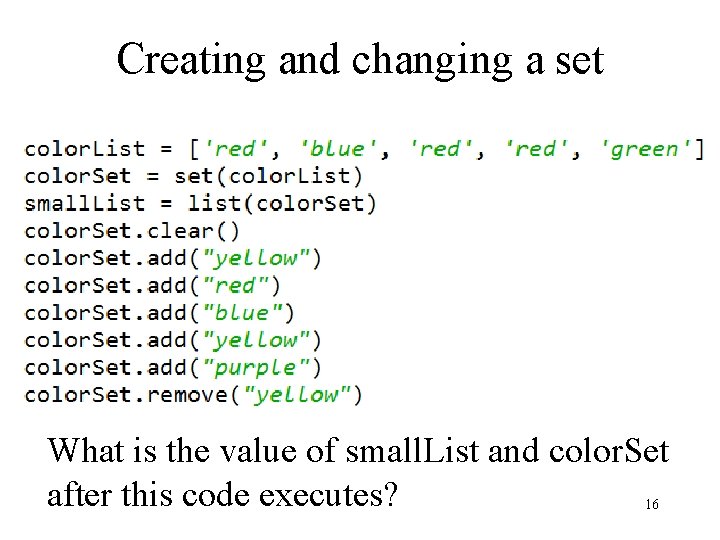
Creating and changing a set What is the value of small. List and color. Set after this code executes? 16
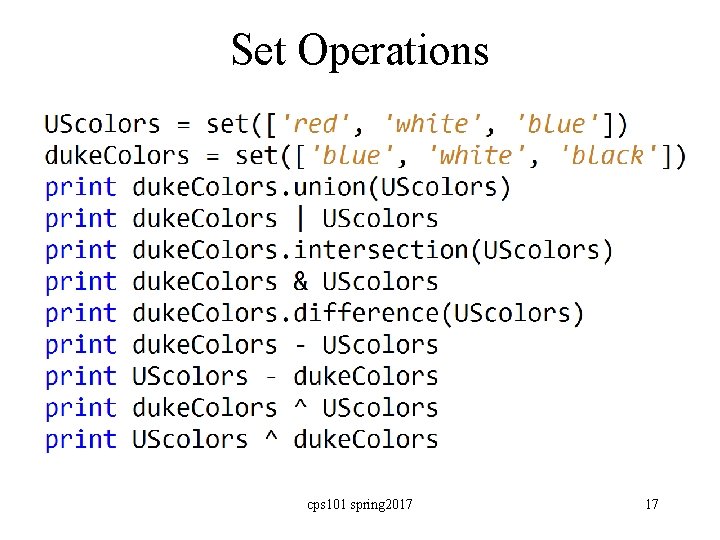
Set Operations cps 101 spring 2017 17
![Set Examples bit. ly/101 s 17 -0228 -4 polo. Club = set(['Mary', 'Laura', 'Dell'])](http://slidetodoc.com/presentation_image_h2/1d361d007ad700a4f48da20e18819176/image-18.jpg "Set Examples bit. ly/101 s 17 -0228 -4 polo. Club = set(['Mary', 'Laura', 'Dell'])")
Set Examples bit. ly/101 s 17 -0228 -4 polo. Club = set(['Mary', 'Laura', 'Dell']) rugby. Club = set(['Fred', 'Sue', 'Mary']) Questions: print [w for w in polo. Club. intersection(rugby. Club)] print polo. Club. intersection(rugby. Club) print [w for w in polo. Club. union(rugby. Club)] print polo. Club. union(rugby. Club) cps 101 spring 2017 18
![Set Examples (cont) lista = ['apple', 'pear', 'fig', 'orange', 'strawberry'] listb = ['pear', 'lemon',](http://slidetodoc.com/presentation_image_h2/1d361d007ad700a4f48da20e18819176/image-19.jpg "Set Examples (cont) lista = ['apple', 'pear', 'fig', 'orange', 'strawberry'] listb = ['pear', 'lemon',")
Set Examples (cont) lista = ['apple', 'pear', 'fig', 'orange', 'strawberry'] listb = ['pear', 'lemon', 'grapefruit', 'orange'] listc = [x for x in lista if x in listb] listd = list(set(lista)|set(listb)) cps 101 spring 2017 19
Assignment 5 - Hangman • Guess a word given the number of letters. – Guess a letter – see if it is in the word and where. • Demo • Will start in lab cps 101 spring 2017 20
![APT Anagram. Free words = ["creation", "sentence", "reaction", "sneak", "star", "rats", "snake"] Returns: 4](http://slidetodoc.com/presentation_image_h2/1d361d007ad700a4f48da20e18819176/image-21.jpg "APT Anagram. Free words = [\"creation\", \"sentence\", \"reaction\", \"sneak\", \"star\", \"rats\", \"snake\"] Returns: 4")
APT Anagram. Free words = ["creation", "sentence", "reaction", "sneak", "star", "rats", "snake"] Returns: 4 “star” “rats” “snake” “sneak” “creation” “reaction” “sentence” both have letters: a r t s cps 101 spring 2017 21
- Slides: 21