
COMP 9313 Big Data Management Lecturer Xin Cao
COMP 9313: Big Data Management Lecturer: Xin Cao Course web site: http: //www. cse. unsw. edu. au/~cs 9313/
Chapter 6: Spark 6. 2
Part 1: Spark Introduction 6. 3
Motivation of Spark n Map. Reduce greatly simplified big data analysis on large, unreliable clusters. It is great at one-pass computation. n But as soon as it got popular, users wanted more: l More complex, multi-pass analytics (e. g. ML, graph) l More interactive ad-hoc queries l More real-time stream processing n All 3 need faster data sharing across parallel jobs l One reaction: specialized models for some of these apps, e. g. , 4 Pregel (graph processing) 4 Storm (stream processing) 6. 4

Limitations of Map. Reduce Benefits of data flow: runtime can decide where to run tasks and can automatically recover from failures n As a general programming model: l It is more suitable for one-pass computation on a large dataset l Hard to compose and nest multiple operations l No means of expressing iterative operations n As implemented in Hadoop l All datasets are read from disk, then stored back on to disk l All data is (usually) triple-replicated for reliability l Not easy to write Map. Reduce programs using Java 6. 5
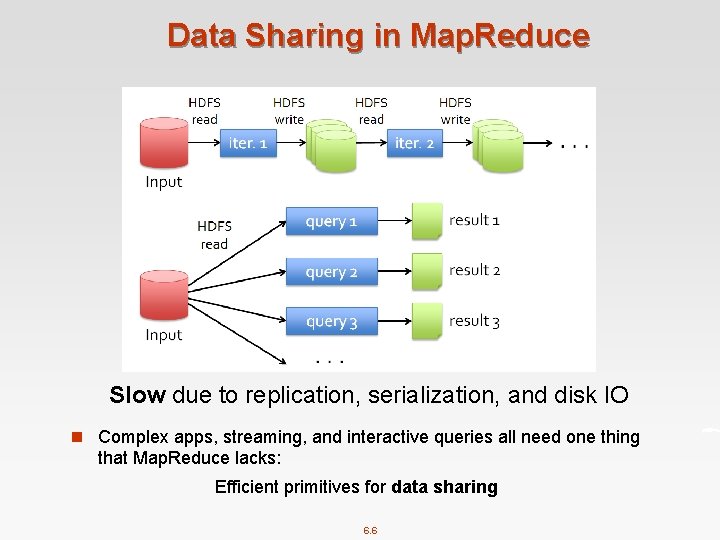
Data Sharing in Map. Reduce Slow due to replication, serialization, and disk IO n Complex apps, streaming, and interactive queries all need one thing that Map. Reduce lacks: Efficient primitives for data sharing 6. 6
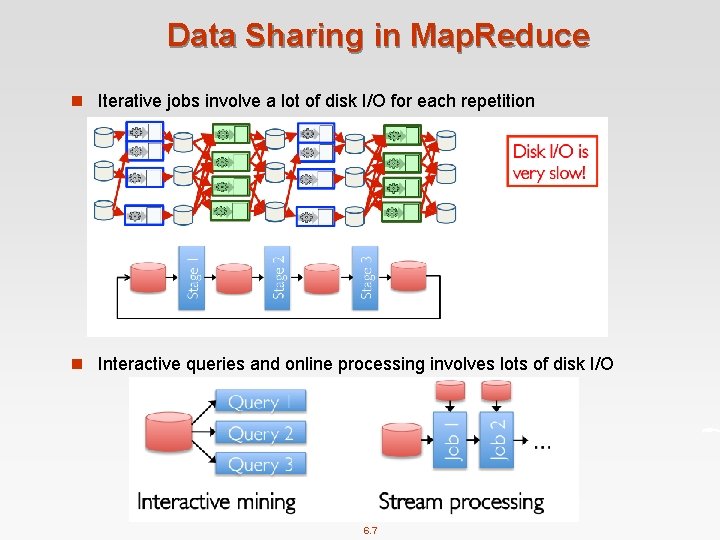
Data Sharing in Map. Reduce n Iterative jobs involve a lot of disk I/O for each repetition n Interactive queries and online processing involves lots of disk I/O 6. 7
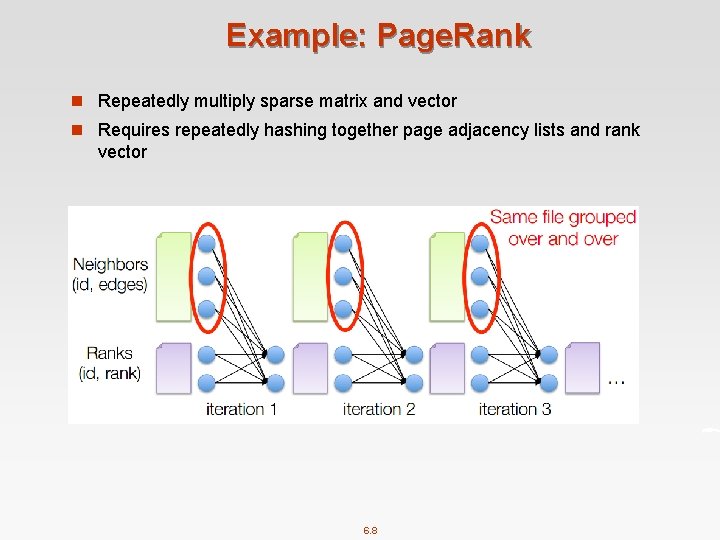
Example: Page. Rank n Repeatedly multiply sparse matrix and vector n Requires repeatedly hashing together page adjacency lists and rank vector 6. 8
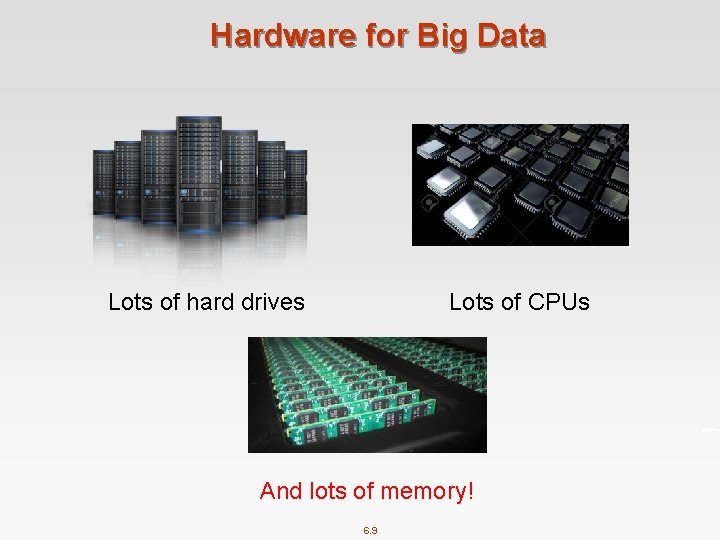
Hardware for Big Data Lots of hard drives Lots of CPUs And lots of memory! 6. 9
Goals of Spark n Keep more data in-memory to improve the performance! n Extend the Map. Reduce model to better support two common classes of analytics apps: l Iterative algorithms (machine learning, graphs) l Interactive data mining n Enhance programmability: l Integrate into Scala programming language l Allow interactive use from Scala interpreter 6. 10
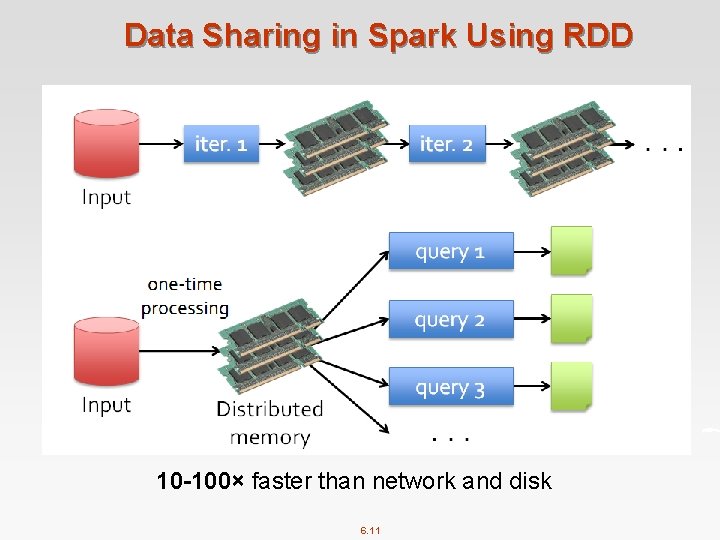
Data Sharing in Spark Using RDD 10 -100× faster than network and disk 6. 11
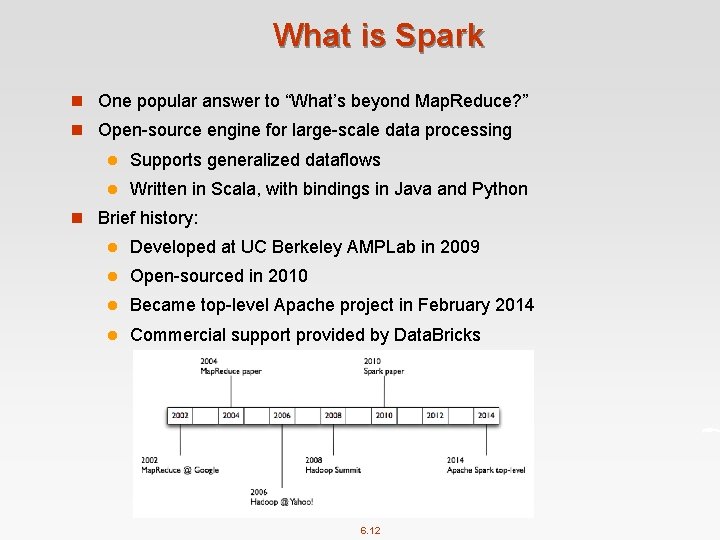
What is Spark n One popular answer to “What’s beyond Map. Reduce? ” n Open-source engine for large-scale data processing l Supports generalized dataflows l Written in Scala, with bindings in Java and Python n Brief history: l Developed at UC Berkeley AMPLab in 2009 l Open-sourced in 2010 l Became top-level Apache project in February 2014 l Commercial support provided by Data. Bricks 6. 12
What is Spark n Fast and expressive cluster computing system interoperable with Apache Hadoop n Improves efficiency through: l In-memory computing primitives l General computation graphs Up to 100× faster (10× on disk) n Improves usability through: n l Rich APIs in Scala, Java, Python l Interactive shell Often 5× less code Spark is not l a modified version of Hadoop l dependent on Hadoop because it has its own cluster management l Spark uses Hadoop for storage purpose only 6. 13
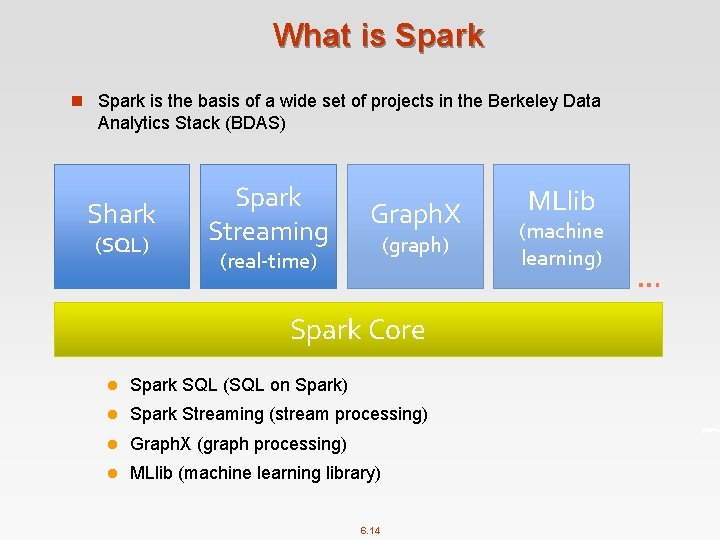
What is Spark n Spark is the basis of a wide set of projects in the Berkeley Data Analytics Stack (BDAS) Shark (SQL) Spark Streaming Graph. X (graph) (real-time) Spark Core l Spark SQL (SQL on Spark) l Spark Streaming (stream processing) l Graph. X (graph processing) l MLlib (machine learning library) 6. 14 MLlib (machine learning) …
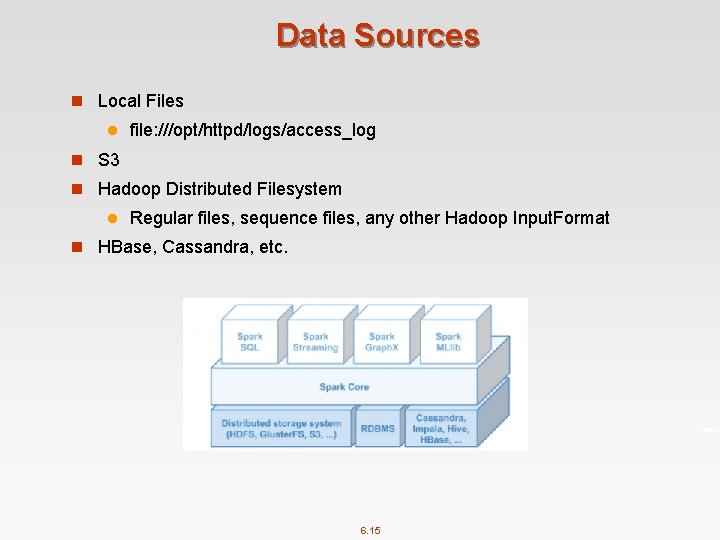
Data Sources n Local Files l file: ///opt/httpd/logs/access_log n S 3 n Hadoop Distributed Filesystem l Regular files, sequence files, any other Hadoop Input. Format n HBase, Cassandra, etc. 6. 15
Spark Ideas n Expressive computing system, not limited to map-reduce model n Facilitate system memory l avoid saving intermediate results to disk l cache data for repetitive queries (e. g. for machine learning) n Layer an in-memory system on top of Hadoop. n Achieve fault-tolerance by re-execution instead of replication 6. 16
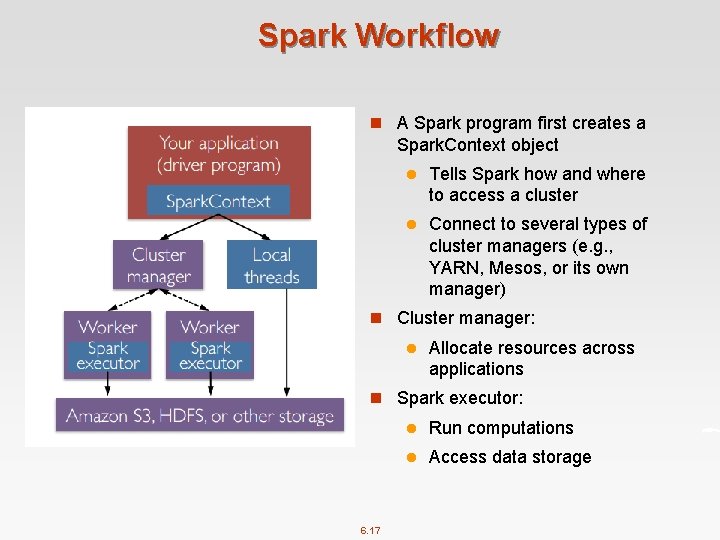
Spark Workflow n A Spark program first creates a Spark. Context object l Tells Spark how and where to access a cluster l Connect to several types of cluster managers (e. g. , YARN, Mesos, or its own manager) n Cluster manager: l Allocate resources across applications n Spark executor: 6. 17 l Run computations l Access data storage
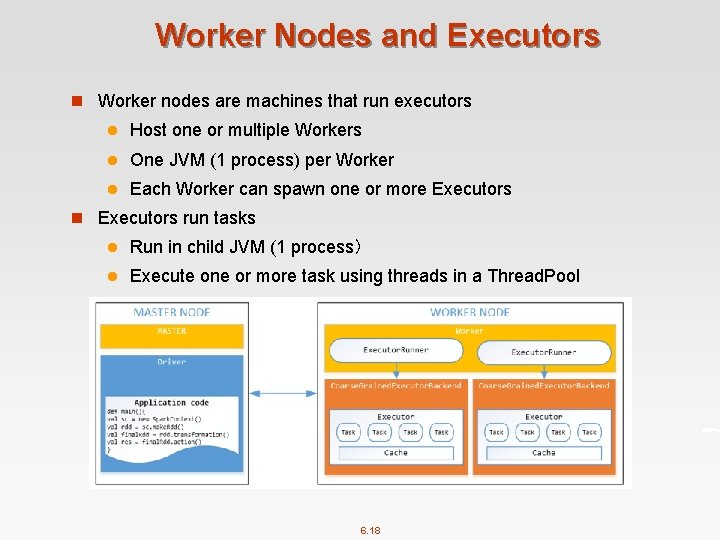
Worker Nodes and Executors n Worker nodes are machines that run executors l Host one or multiple Workers l One JVM (1 process) per Worker l Each Worker can spawn one or more Executors n Executors run tasks l Run in child JVM (1 process) l Execute one or more task using threads in a Thread. Pool 6. 18
Challenge n Existing Systems l Existing in-memory storage systems have interfaces based on fine -grained updates 4 Reads 4 E. g. , l and writes to cells in a table databases, key-value stores, distributed memory Requires replicating data or logs across nodes for fault tolerance -> expensive! 4 10 -100 x slower than memory write n How to design a distributed memory abstraction that is both fault- tolerant and efficient? 6. 19
Part 2: RDD Introduction 6. 20
Solution: Resilient Distributed Datasets n Resilient Distributed Datasets (RDDs) l Distributed collections of objects that can be cached in memory across cluster l Manipulated through parallel operators l Automatically recomputed on failure based on lineage n RDDs can express many parallel algorithms, and capture many current programming models l Data flow models: Map. Reduce, SQL, … l Specialized models for iterative apps: Pregel, … 6. 21
What is RDD n Resilient Distributed Datasets: A Fault-Tolerant Abstraction for In- Memory Cluster Computing. Matei Zaharia, et al. NSDI’ 12 l RDD is a distributed memory abstraction that lets programmers perform in-memory computations on large clusters in a faulttolerant manner. n Resilient l Fault-tolerant, is able to recompute missing or damaged partitions due to node failures. n Distributed l Data residing on multiple nodes in a cluster. n Dataset l A collection of partitioned elements, e. g. tuples or other objects (that represent records of the data you work with). n RDD is the primary data abstraction in Apache Spark and the core of Spark. It enables operations on collection of elements in parallel. 6. 22
RDD Traits n In-Memory, i. e. data inside RDD is stored in memory as much (size) and long (time) as possible. n Immutable or Read-Only, i. e. it does not change once created and can only be transformed using transformations to new RDDs. n Lazy evaluated, i. e. the data inside RDD is not available or transformed until an action is executed that triggers the execution. n Cacheable, i. e. you can hold all the data in a persistent "storage" like memory (default and the most preferred) or disk (the least preferred due to access speed). n Parallel, i. e. process data in parallel. n Typed, i. e. values in a RDD have types, e. g. RDD[Long] or RDD[(Int, String)]. n Partitioned, i. e. the data inside a RDD is partitioned (split into partitions) and then distributed across nodes in a cluster (one partition per JVM that may or may not correspond to a single node). 6. 23
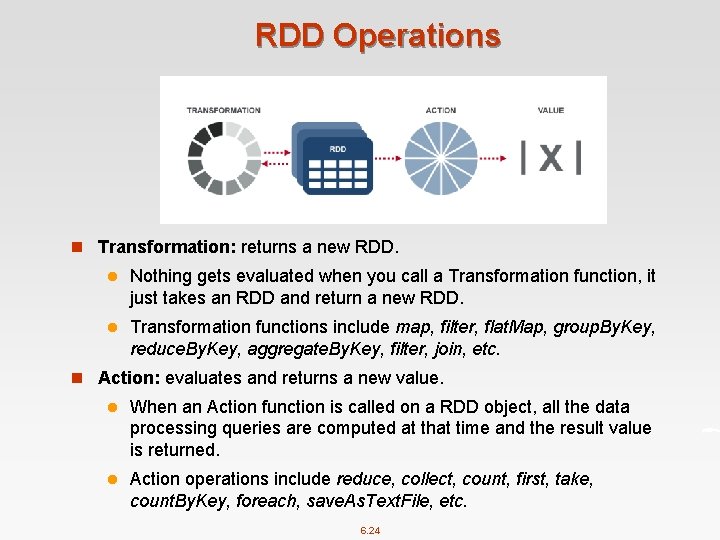
RDD Operations n Transformation: returns a new RDD. l Nothing gets evaluated when you call a Transformation function, it just takes an RDD and return a new RDD. l Transformation functions include map, filter, flat. Map, group. By. Key, reduce. By. Key, aggregate. By. Key, filter, join, etc. n Action: evaluates and returns a new value. l When an Action function is called on a RDD object, all the data processing queries are computed at that time and the result value is returned. l Action operations include reduce, collect, count, first, take, count. By. Key, foreach, save. As. Text. File, etc. 6. 24
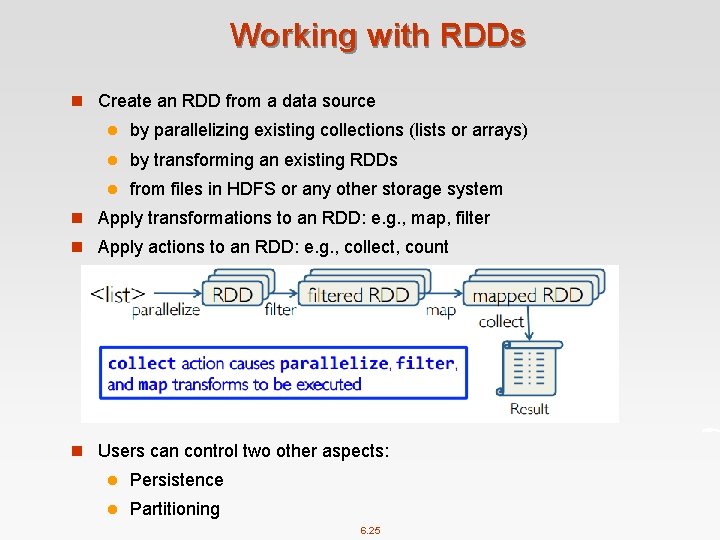
Working with RDDs n Create an RDD from a data source l by parallelizing existing collections (lists or arrays) l by transforming an existing RDDs l from files in HDFS or any other storage system n Apply transformations to an RDD: e. g. , map, filter n Apply actions to an RDD: e. g. , collect, count n Users can control two other aspects: l Persistence l Partitioning 6. 25
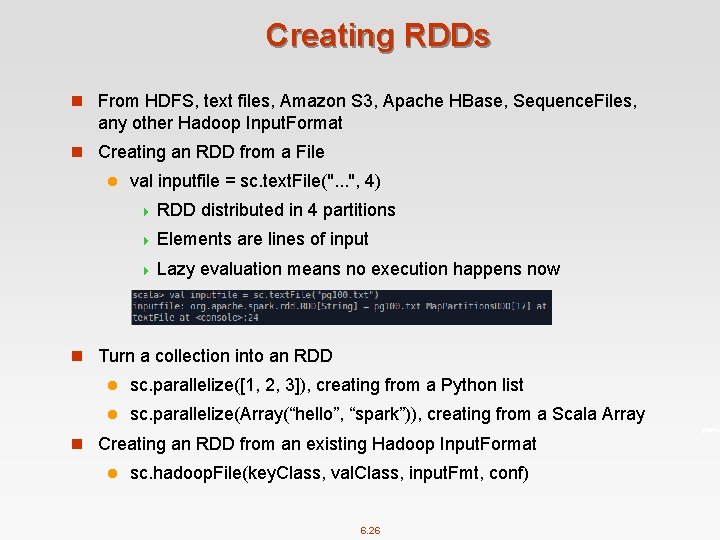
Creating RDDs n From HDFS, text files, Amazon S 3, Apache HBase, Sequence. Files, any other Hadoop Input. Format n Creating an RDD from a File l val inputfile = sc. text. File(". . . ", 4) 4 RDD distributed in 4 partitions 4 Elements 4 Lazy are lines of input evaluation means no execution happens now n Turn a collection into an RDD l sc. parallelize([1, 2, 3]), creating from a Python list l sc. parallelize(Array(“hello”, “spark”)), creating from a Scala Array n Creating an RDD from an existing Hadoop Input. Format l sc. hadoop. File(key. Class, val. Class, input. Fmt, conf) 6. 26
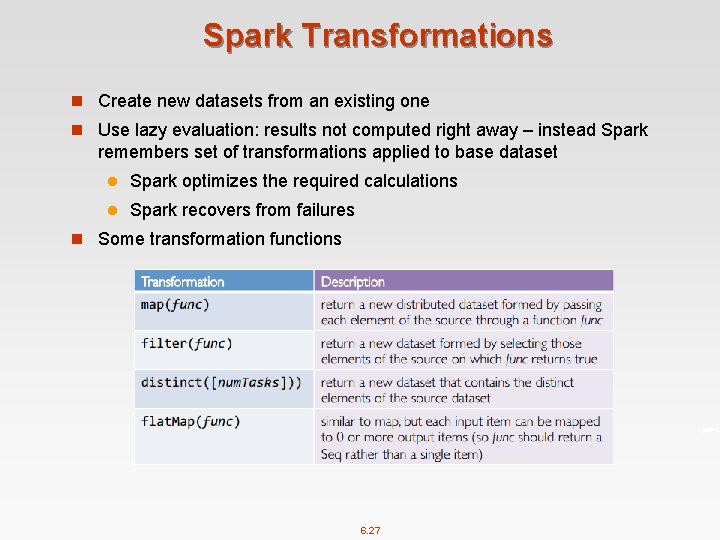
Spark Transformations n Create new datasets from an existing one n Use lazy evaluation: results not computed right away – instead Spark remembers set of transformations applied to base dataset l Spark optimizes the required calculations l Spark recovers from failures n Some transformation functions 6. 27
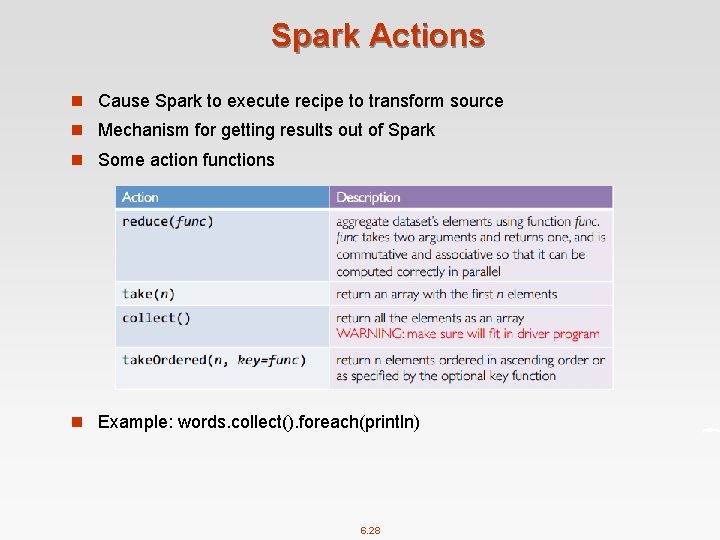
Spark Actions n Cause Spark to execute recipe to transform source n Mechanism for getting results out of Spark n Some action functions n Example: words. collect(). foreach(println) 6. 28
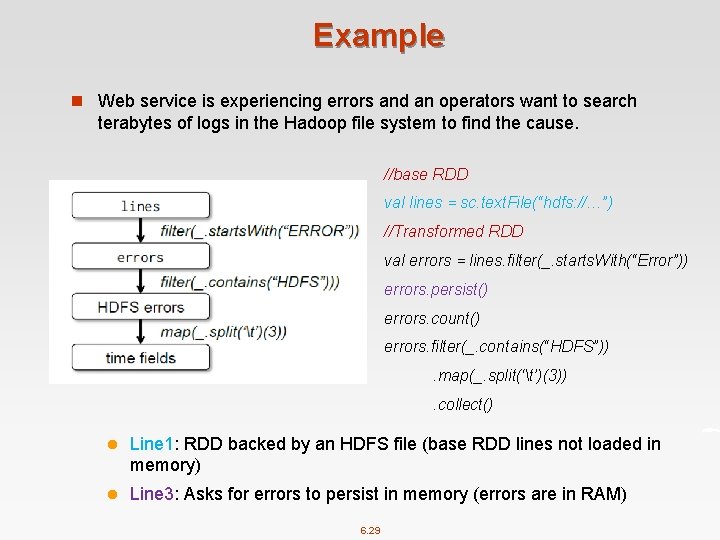
Example n Web service is experiencing errors and an operators want to search terabytes of logs in the Hadoop file system to find the cause. //base RDD val lines = sc. text. File(“hdfs: //…”) //Transformed RDD val errors = lines. filter(_. starts. With(“Error”)) errors. persist() errors. count() errors. filter(_. contains(“HDFS”)). map(_. split(‘t’)(3)). collect() l Line 1: RDD backed by an HDFS file (base RDD lines not loaded in memory) l Line 3: Asks for errors to persist in memory (errors are in RAM) 6. 29
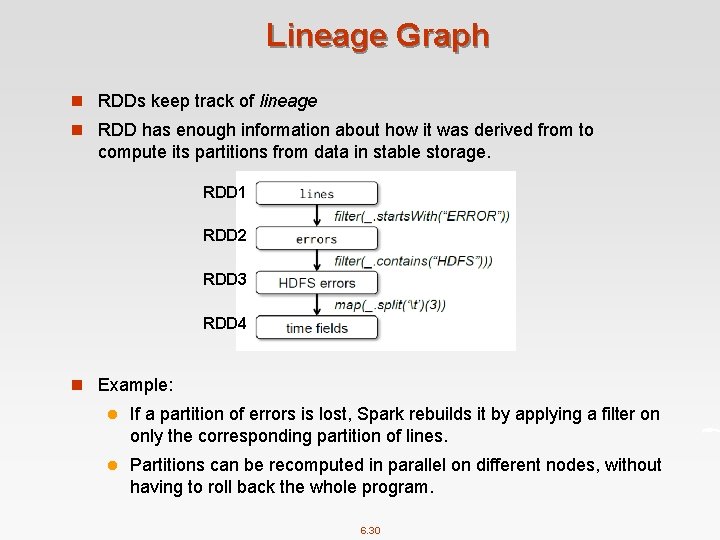
Lineage Graph n RDDs keep track of lineage n RDD has enough information about how it was derived from to compute its partitions from data in stable storage. RDD 1 RDD 2 RDD 3 RDD 4 n Example: l If a partition of errors is lost, Spark rebuilds it by applying a filter on only the corresponding partition of lines. l Partitions can be recomputed in parallel on different nodes, without having to roll back the whole program. 6. 30
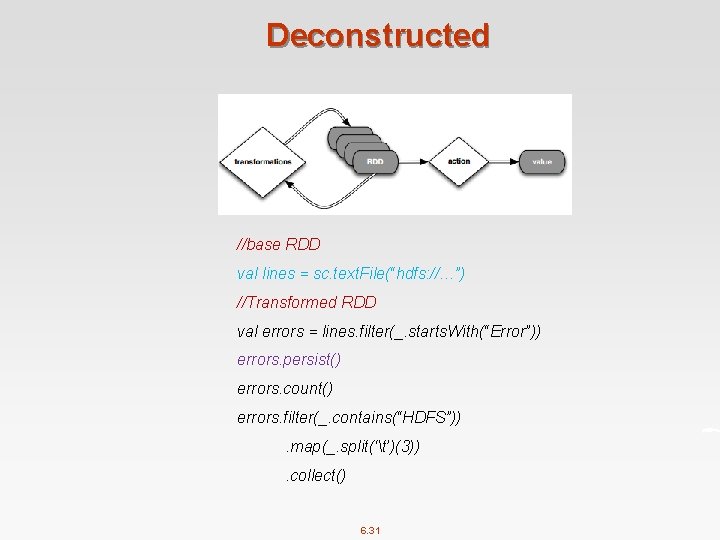
Deconstructed //base RDD val lines = sc. text. File(“hdfs: //…”) //Transformed RDD val errors = lines. filter(_. starts. With(“Error”)) errors. persist() errors. count() errors. filter(_. contains(“HDFS”)). map(_. split(‘t’)(3)). collect() 6. 31
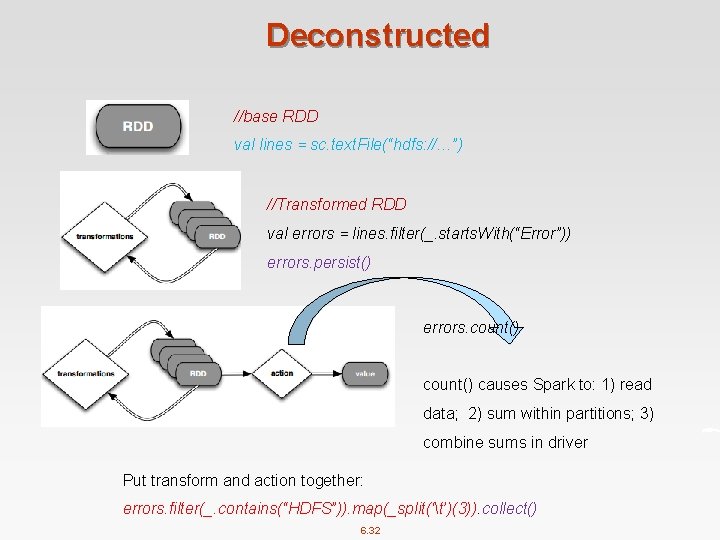
Deconstructed //base RDD val lines = sc. text. File(“hdfs: //…”) //Transformed RDD val errors = lines. filter(_. starts. With(“Error”)) errors. persist() errors. count() causes Spark to: 1) read data; 2) sum within partitions; 3) combine sums in driver Put transform and action together: errors. filter(_. contains(“HDFS”)). map(_split(‘t’)(3)). collect() 6. 32
Spark. Context n Spark. Context is the entry point to Spark for a Spark application. n Once a Spark. Context instance is created you can use it to l Create RDDs l Create accumulators l Create broadcast variables l access Spark services and run jobs n A Spark context is essentially a client of Spark’s execution environment and acts as the master of your Spark application n The first thing a Spark program must do is to create a Spark. Context object, which tells Spark how to access a cluster n In the Spark shell, a special interpreter-aware Spark. Context is already created for you, in the variable called sc 6. 33
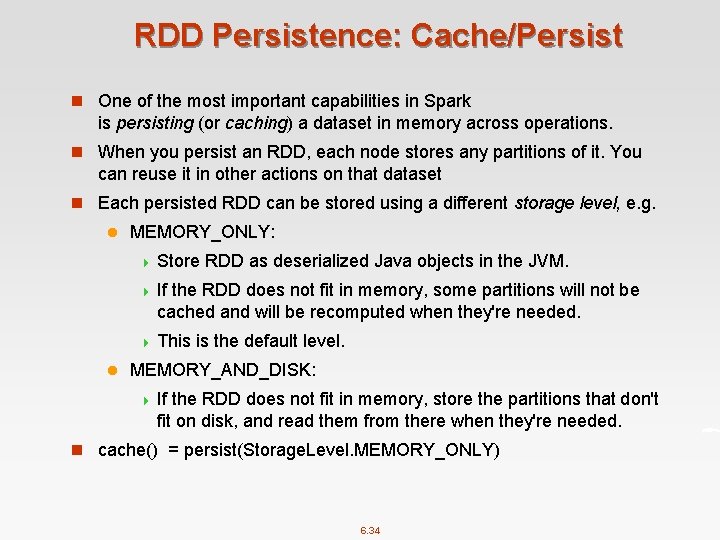
RDD Persistence: Cache/Persist n One of the most important capabilities in Spark is persisting (or caching) a dataset in memory across operations. n When you persist an RDD, each node stores any partitions of it. You can reuse it in other actions on that dataset n Each persisted RDD can be stored using a different storage level, e. g. l MEMORY_ONLY: 4 Store RDD as deserialized Java objects in the JVM. 4 If the RDD does not fit in memory, some partitions will not be cached and will be recomputed when they're needed. 4 This l is the default level. MEMORY_AND_DISK: 4 If the RDD does not fit in memory, store the partitions that don't fit on disk, and read them from there when they're needed. n cache() = persist(Storage. Level. MEMORY_ONLY) 6. 34
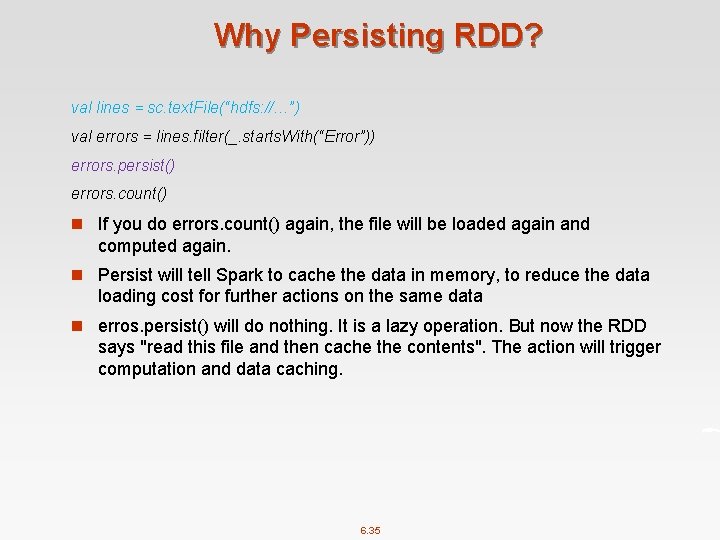
Why Persisting RDD? val lines = sc. text. File(“hdfs: //…”) val errors = lines. filter(_. starts. With(“Error”)) errors. persist() errors. count() n If you do errors. count() again, the file will be loaded again and computed again. n Persist will tell Spark to cache the data in memory, to reduce the data loading cost for further actions on the same data n erros. persist() will do nothing. It is a lazy operation. But now the RDD says "read this file and then cache the contents". The action will trigger computation and data caching. 6. 35
Part 3: Scala Introduction 6. 36
Scala (Scalable language) n Scala is a general-purpose programming language designed to express common programming patterns in a concise, elegant, and type-safe way � n Scala supports both Object Oriented Programming and Functional Programming � n Scala is Practical l Can be used as drop-in replacement for Java 4 Mixed Scala/Java projects l Use existing Java libraries l Use existing Java tools (Ant, Maven, JUnit, etc…) l Decent IDE Support (Net. Beans, Intelli. J, Eclipse) 6. 37
Why Scala n Scala supports object-oriented programming. Conceptually, every value is an object and every operation is a method-call. The language supports advanced component architectures through classes and traits � n Scala is also a functional language. Supports functions, immutable data structures and preference for immutability over mutation � n Seamlessly integrated with Java � n Being used heavily for Big data, e. g. , Spark, etc. 6. 38
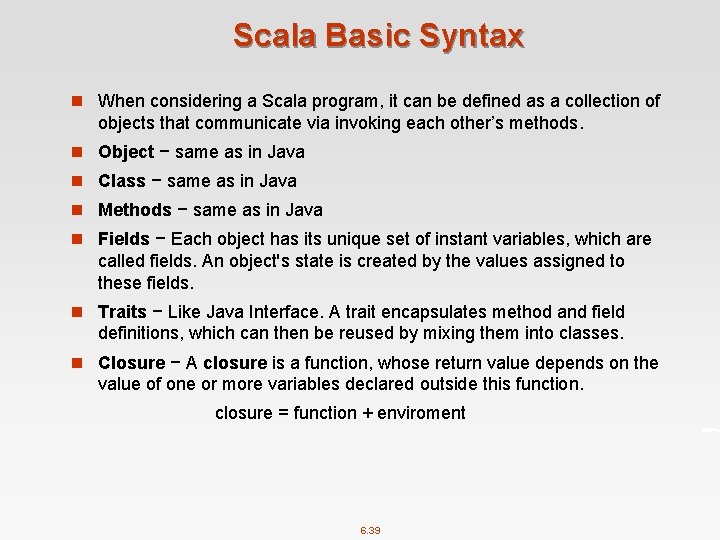
Scala Basic Syntax n When considering a Scala program, it can be defined as a collection of objects that communicate via invoking each other’s methods. n Object − same as in Java n Class − same as in Java n Methods − same as in Java n Fields − Each object has its unique set of instant variables, which are called fields. An object's state is created by the values assigned to these fields. n Traits − Like Java Interface. A trait encapsulates method and field definitions, which can then be reused by mixing them into classes. n Closure − A closure is a function, whose return value depends on the value of one or more variables declared outside this function. closure = function + enviroment 6. 39
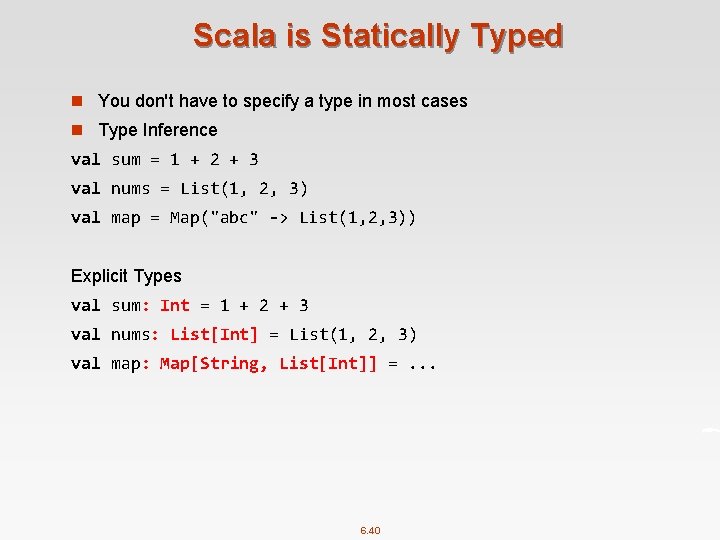
Scala is Statically Typed n You don't have to specify a type in most cases n Type Inference val sum = 1 + 2 + 3 val nums = List(1, 2, 3) val map = Map("abc" -> List(1, 2, 3)) Explicit Types val sum: Int = 1 + 2 + 3 val nums: List[Int] = List(1, 2, 3) val map: Map[String, List[Int]] =. . . 6. 40
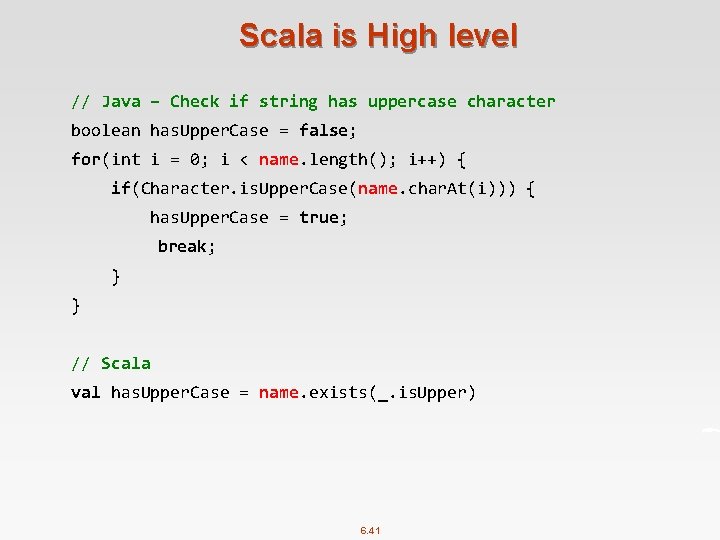
Scala is High level // Java – Check if string has uppercase character boolean has. Upper. Case = false; for(int i = 0; i < name. length(); i++) { if(Character. is. Upper. Case(name. char. At(i))) { has. Upper. Case = true; break; } } // Scala val has. Upper. Case = name. exists(_. is. Upper) 6. 41
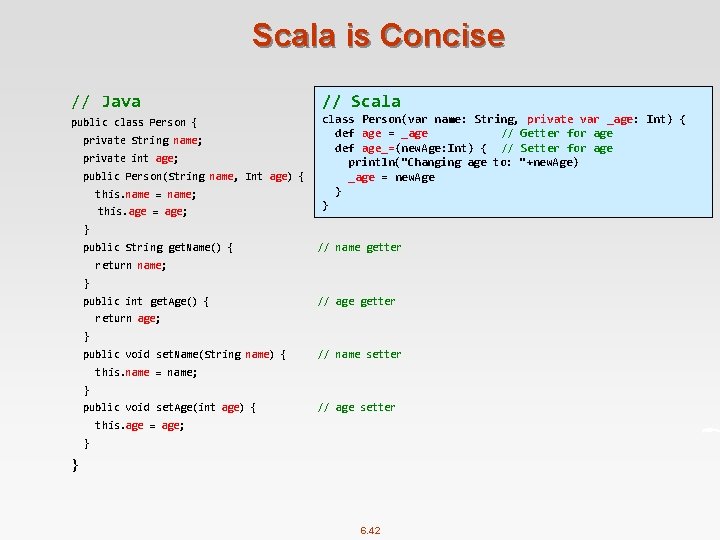
Scala is Concise // Java // Scala public class Person { class Person(var name: String, private var _age: Int) { def age = _age // Getter for age def age_=(new. Age: Int) { // Setter for age println("Changing age to: "+new. Age) _age = new. Age } } private String name; private int age; public Person(String name, Int age) { this. name = name; this. age = age; } public String get. Name() { // name getter return name; } public int get. Age() { // age getter return age; } public void set. Name(String name) { // name setter this. name = name; } public void set. Age(int age) { // age setter this. age = age; } } 6. 42
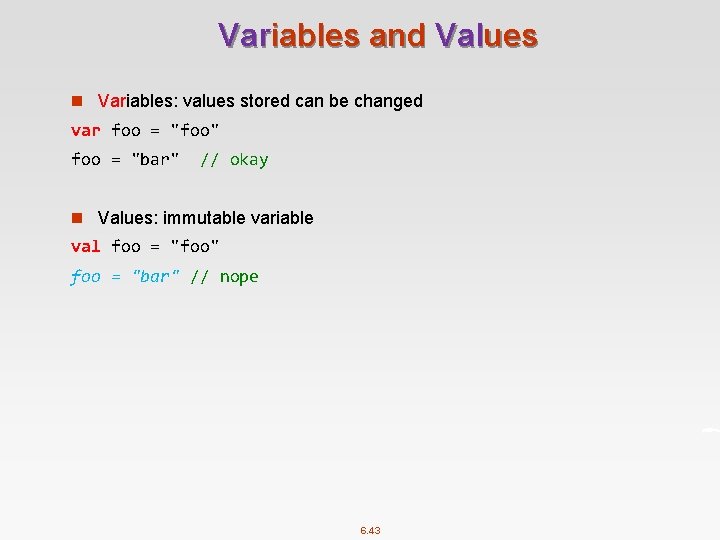
Variables and Values n Variables: values stored can be changed var foo = "foo" foo = "bar" // okay n Values: immutable variable val foo = "foo" foo = "bar" // nope 6. 43
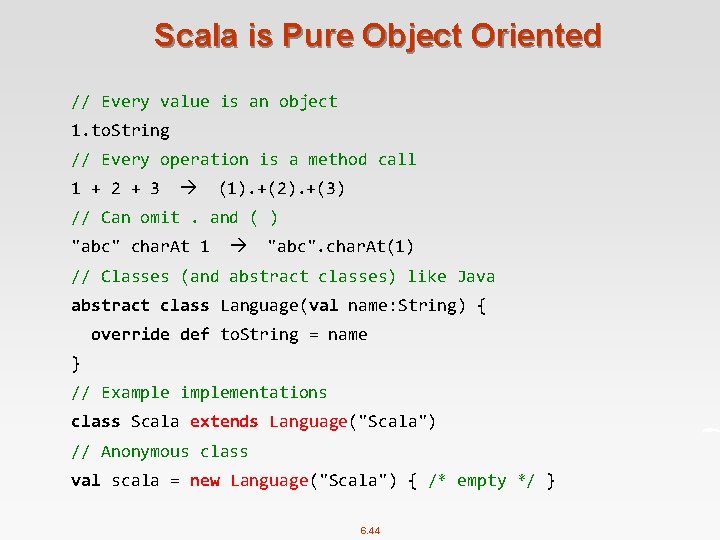
Scala is Pure Object Oriented // Every value is an object 1. to. String // Every operation is a method call 1 + 2 + 3 (1). +(2). +(3) // Can omit. and ( ) "abc" char. At 1 "abc". char. At(1) // Classes (and abstract classes) like Java abstract class Language(val name: String) { override def to. String = name } // Example implementations class Scala extends Language("Scala") // Anonymous class val scala = new Language("Scala") { /* empty */ } 6. 44
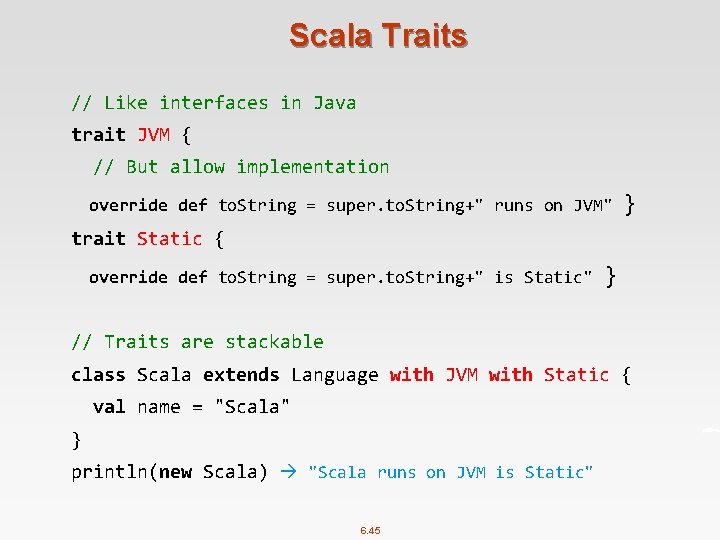
Scala Traits // Like interfaces in Java trait JVM { // But allow implementation override def to. String = super. to. String+" runs on JVM" } trait Static { override def to. String = super. to. String+" is Static" } // Traits are stackable class Scala extends Language with JVM with Static { val name = "Scala" } println(new Scala) "Scala runs on JVM is Static" 6. 45
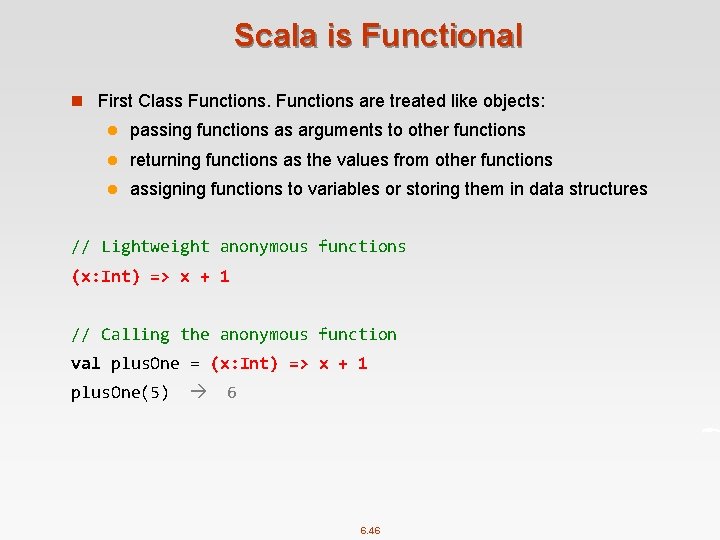
Scala is Functional n First Class Functions are treated like objects: l passing functions as arguments to other functions l returning functions as the values from other functions l assigning functions to variables or storing them in data structures // Lightweight anonymous functions (x: Int) => x + 1 // Calling the anonymous function val plus. One = (x: Int) => x + 1 plus. One(5) 6 6. 46
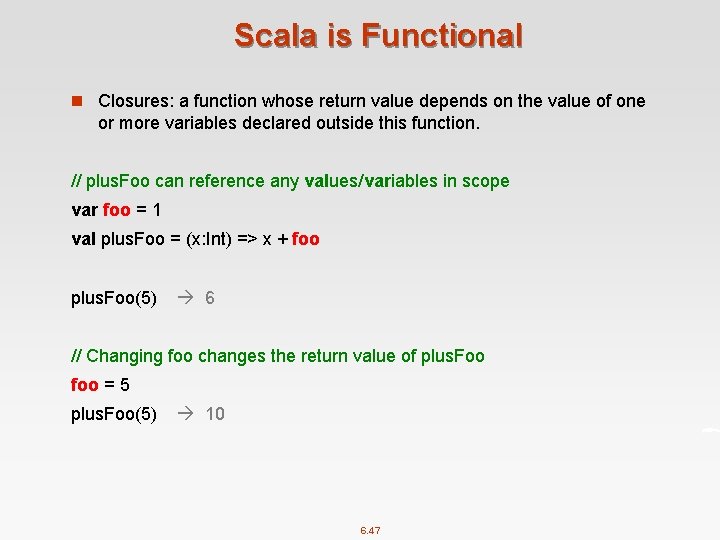
Scala is Functional n Closures: a function whose return value depends on the value of one or more variables declared outside this function. // plus. Foo can reference any values/variables in scope var foo = 1 val plus. Foo = (x: Int) => x + foo plus. Foo(5) 6 // Changing foo changes the return value of plus. Foo foo = 5 plus. Foo(5) 10 6. 47
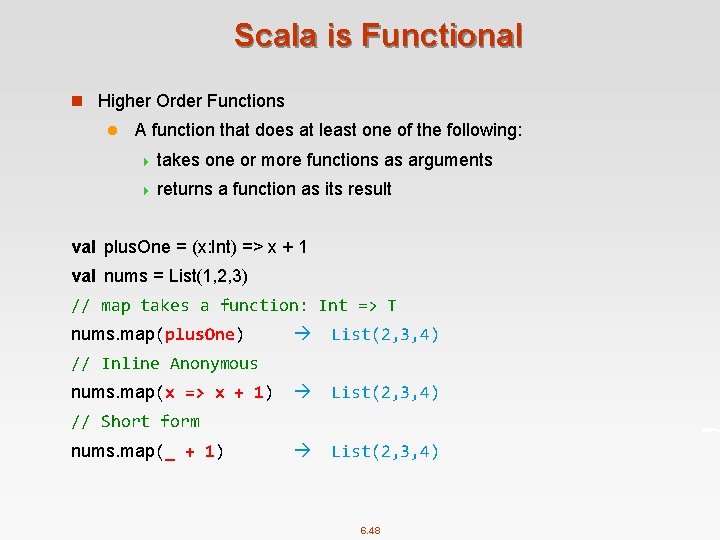
Scala is Functional n Higher Order Functions l A function that does at least one of the following: 4 takes one or more functions as arguments 4 returns a function as its result val plus. One = (x: Int) => x + 1 val nums = List(1, 2, 3) // map takes a function: Int => T nums. map(plus. One) List(2, 3, 4) // Inline Anonymous nums. map(x => x + 1) // Short form nums. map(_ + 1) 6. 48
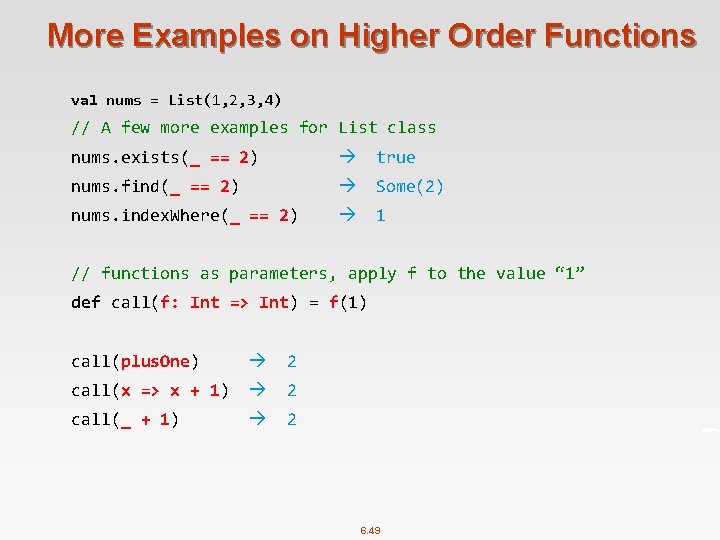
More Examples on Higher Order Functions val nums = List(1, 2, 3, 4) // A few more examples for List class nums. exists(_ == 2) true nums. find(_ == 2) Some(2) nums. index. Where(_ == 2) 1 // functions as parameters, apply f to the value “ 1” def call(f: Int => Int) = f(1) call(plus. One) 2 call(x => x + 1) 2 call(_ + 1) 2 6. 49
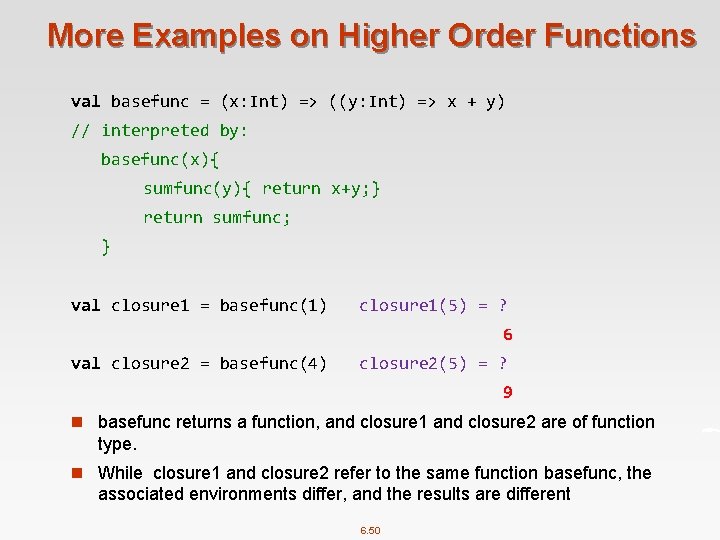
More Examples on Higher Order Functions val basefunc = (x: Int) => ((y: Int) => x + y) // interpreted by: basefunc(x){ sumfunc(y){ return x+y; } return sumfunc; } val closure 1 = basefunc(1) closure 1(5) = ? 6 val closure 2 = basefunc(4) closure 2(5) = ? 9 n basefunc returns a function, and closure 1 and closure 2 are of function type. n While closure 1 and closure 2 refer to the same function basefunc, the associated environments differ, and the results are different 6. 50
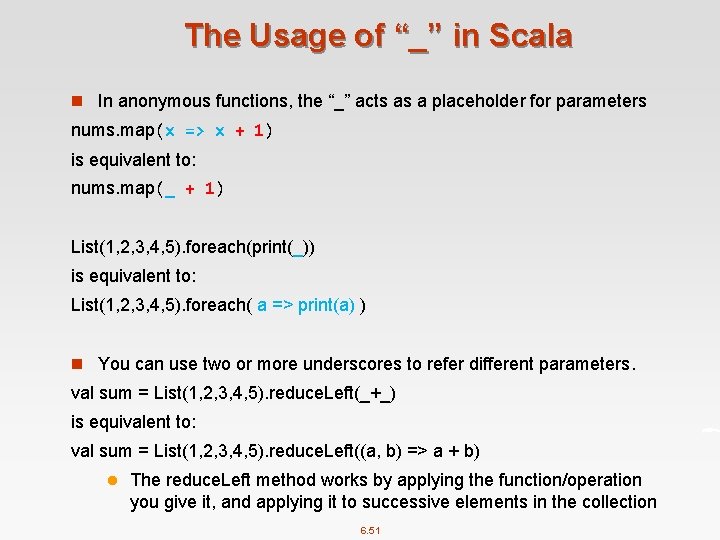
The Usage of “_” in Scala n In anonymous functions, the “_” acts as a placeholder for parameters nums. map(x => x + 1) is equivalent to: nums. map(_ + 1) List(1, 2, 3, 4, 5). foreach(print(_)) is equivalent to: List(1, 2, 3, 4, 5). foreach( a => print(a) ) n You can use two or more underscores to refer different parameters. val sum = List(1, 2, 3, 4, 5). reduce. Left(_+_) is equivalent to: val sum = List(1, 2, 3, 4, 5). reduce. Left((a, b) => a + b) l The reduce. Left method works by applying the function/operation you give it, and applying it to successive elements in the collection 6. 51
Part 4: Spark Programming Model 6. 52
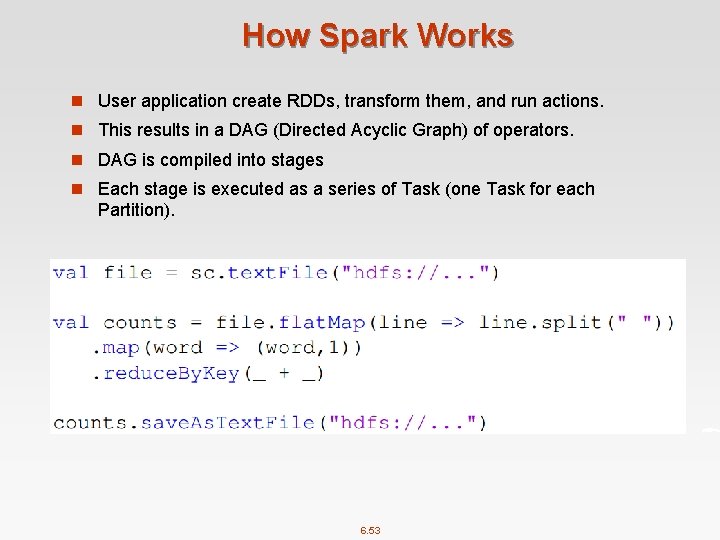
How Spark Works n User application create RDDs, transform them, and run actions. n This results in a DAG (Directed Acyclic Graph) of operators. n DAG is compiled into stages n Each stage is executed as a series of Task (one Task for each Partition). 6. 53
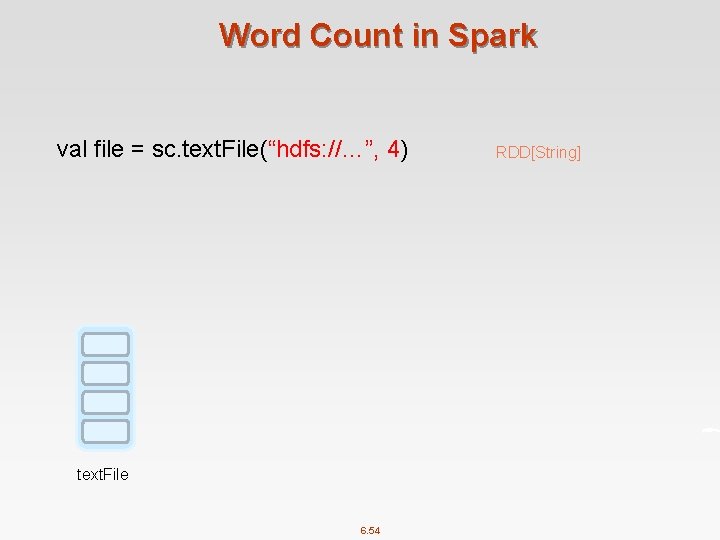
Word Count in Spark val file = sc. text. File(“hdfs: //…”, 4) text. File 6. 54 RDD[String]
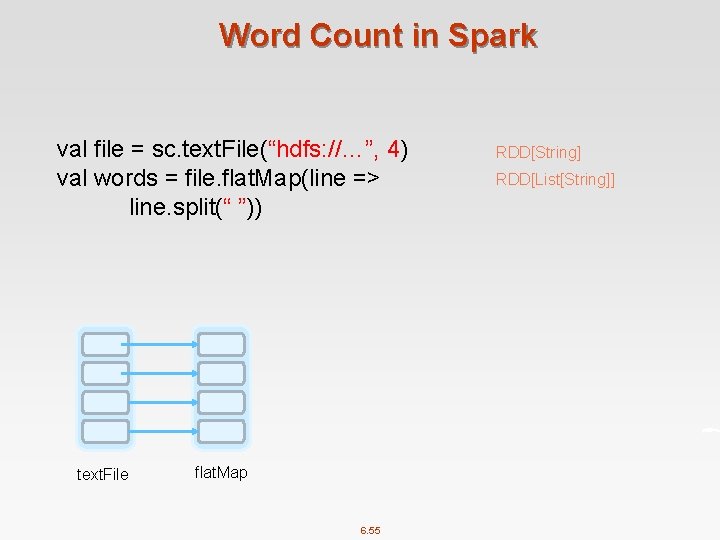
Word Count in Spark val file = sc. text. File(“hdfs: //…”, 4) val words = file. flat. Map(line => line. split(“ ”)) text. File flat. Map 6. 55 RDD[String] RDD[List[String]]
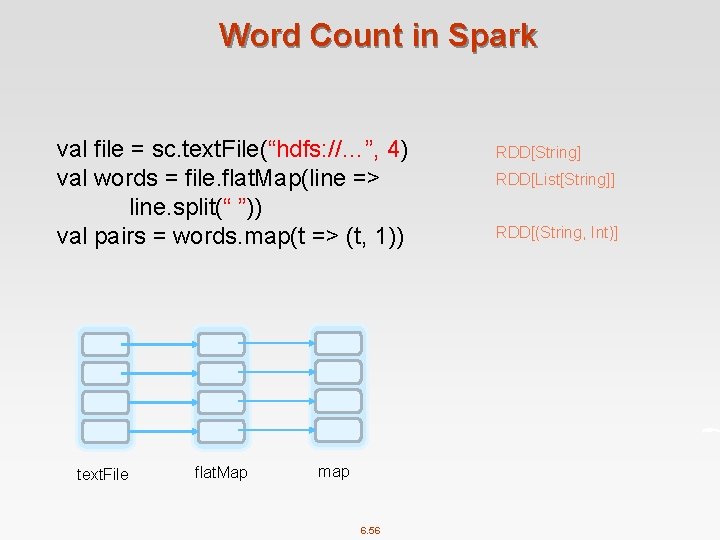
Word Count in Spark val file = sc. text. File(“hdfs: //…”, 4) val words = file. flat. Map(line => line. split(“ ”)) val pairs = words. map(t => (t, 1)) text. File flat. Map map 6. 56 RDD[String] RDD[List[String]] RDD[(String, Int)]
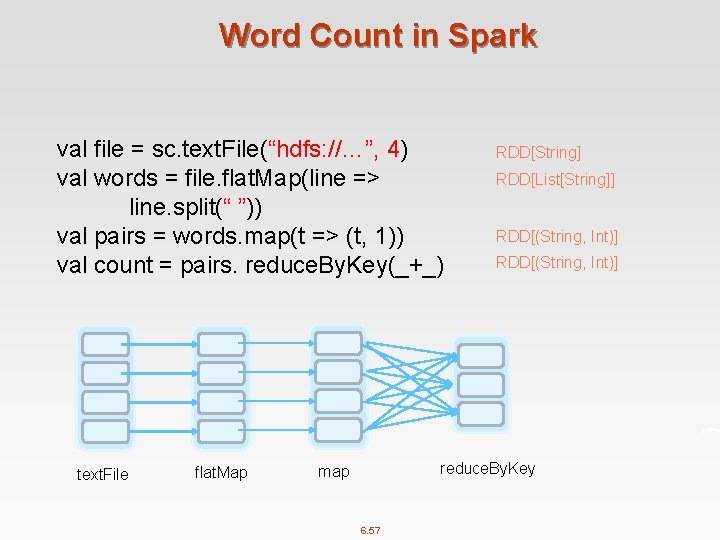
Word Count in Spark val file = sc. text. File(“hdfs: //…”, 4) val words = file. flat. Map(line => line. split(“ ”)) val pairs = words. map(t => (t, 1)) val count = pairs. reduce. By. Key(_+_) text. File flat. Map RDD[String] RDD[List[String]] RDD[(String, Int)] reduce. By. Key map 6. 57
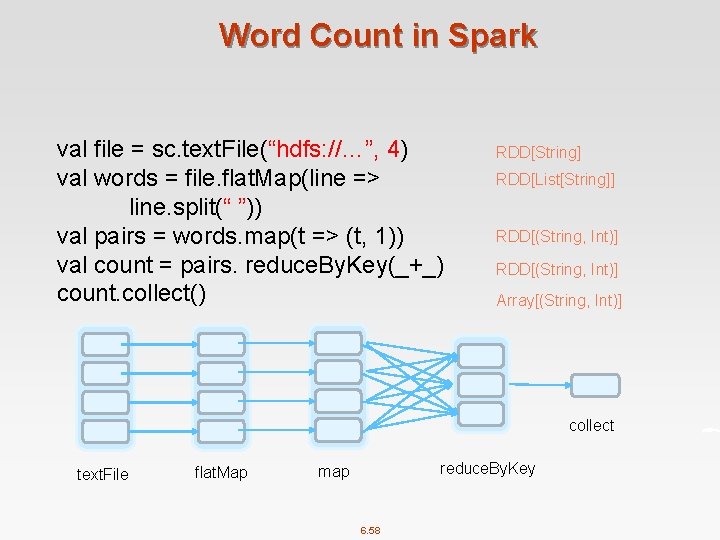
Word Count in Spark val file = sc. text. File(“hdfs: //…”, 4) val words = file. flat. Map(line => line. split(“ ”)) val pairs = words. map(t => (t, 1)) val count = pairs. reduce. By. Key(_+_) count. collect() RDD[String] RDD[List[String]] RDD[(String, Int)] Array[(String, Int)] collect text. File flat. Map reduce. By. Key map 6. 58
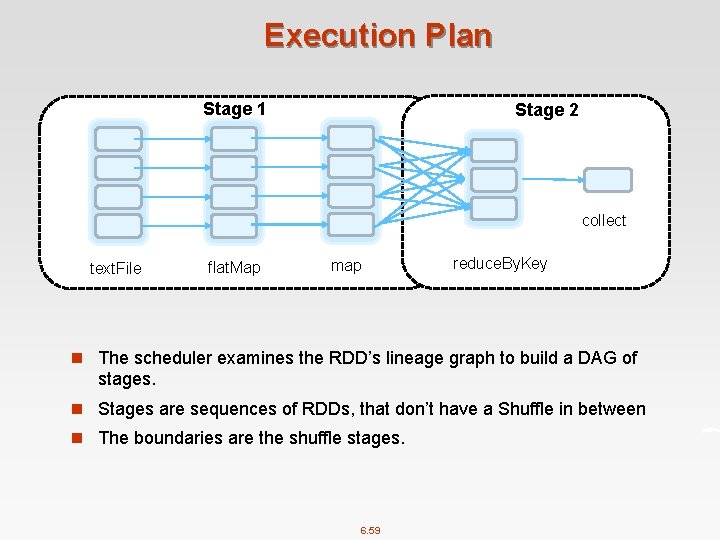
Execution Plan Stage 1 Stage 2 collect text. File flat. Map map reduce. By. Key n The scheduler examines the RDD’s lineage graph to build a DAG of stages. n Stages are sequences of RDDs, that don’t have a Shuffle in between n The boundaries are the shuffle stages. 6. 59
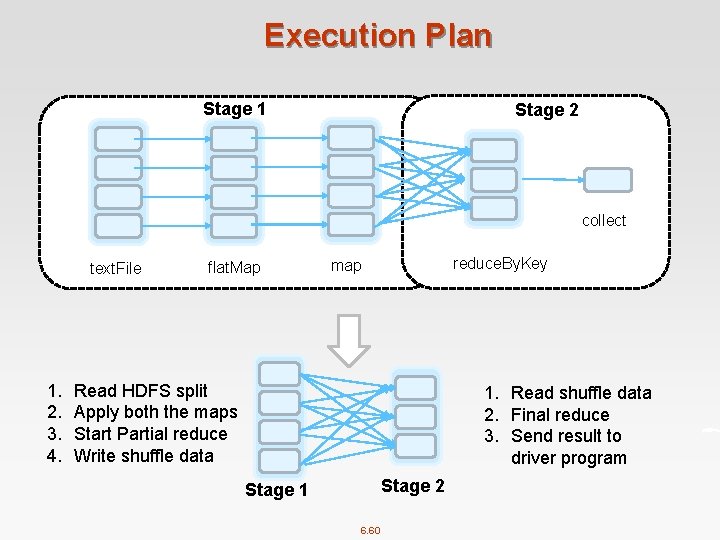
Execution Plan Stage 1 Stage 2 collect text. File 1. 2. 3. 4. flat. Map reduce. By. Key map Read HDFS split Apply both the maps Start Partial reduce Write shuffle data 1. Read shuffle data 2. Final reduce 3. Send result to driver program Stage 2 Stage 1 6. 60
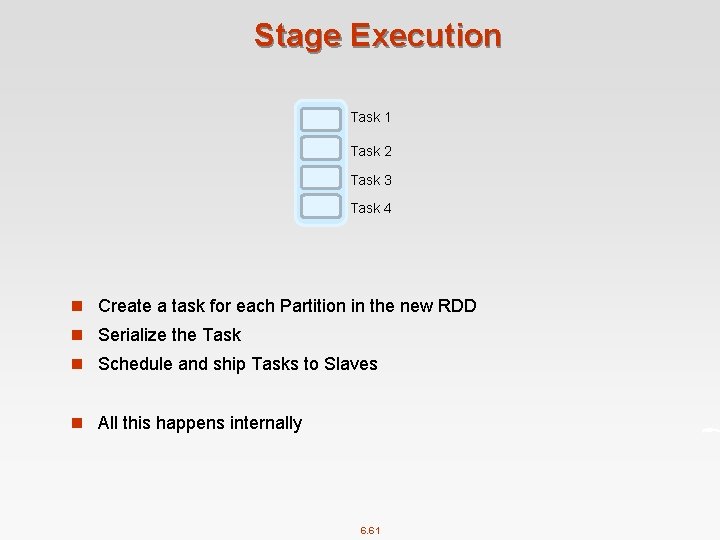
Stage Execution Task 1 Task 2 Task 3 Task 4 n Create a task for each Partition in the new RDD n Serialize the Task n Schedule and ship Tasks to Slaves n All this happens internally 6. 61
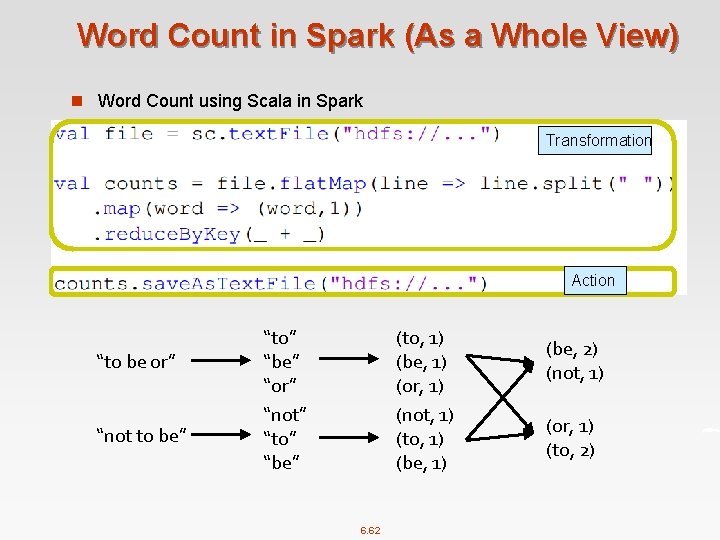
Word Count in Spark (As a Whole View) n Word Count using Scala in Spark Transformation Action “to be or” “not to be” “to” “be” “or” “not” “to” “be” (to, 1) (be, 1) (or, 1) (not, 1) (to, 1) (be, 1) 6. 62 (be, 2) (not, 1) (or, 1) (to, 2)
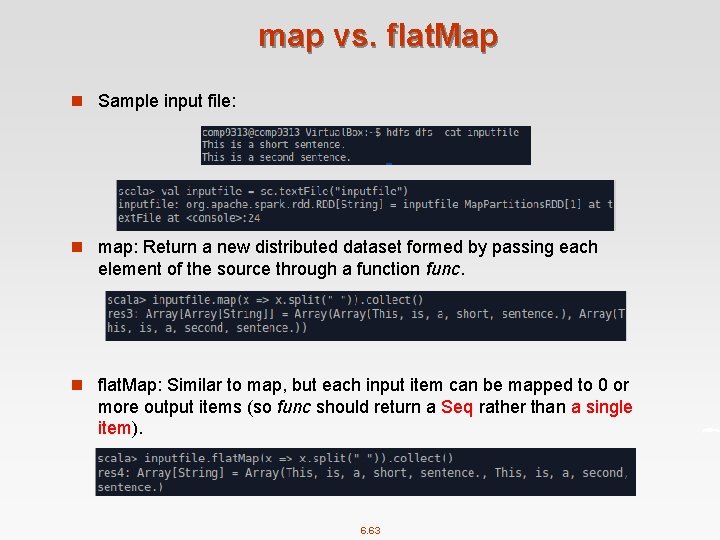
map vs. flat. Map n Sample input file: n map: Return a new distributed dataset formed by passing each element of the source through a function func. n flat. Map: Similar to map, but each input item can be mapped to 0 or more output items (so func should return a Seq rather than a single item). 6. 63
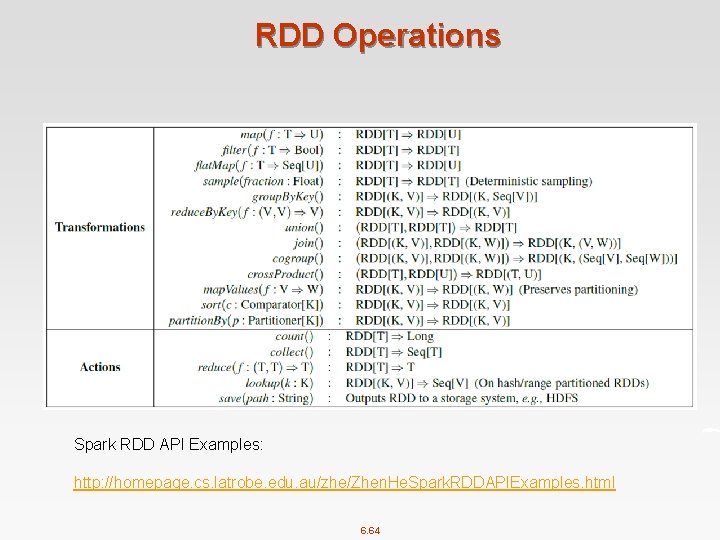
RDD Operations Spark RDD API Examples: http: //homepage. cs. latrobe. edu. au/zhe/Zhen. He. Spark. RDDAPIExamples. html 6. 64
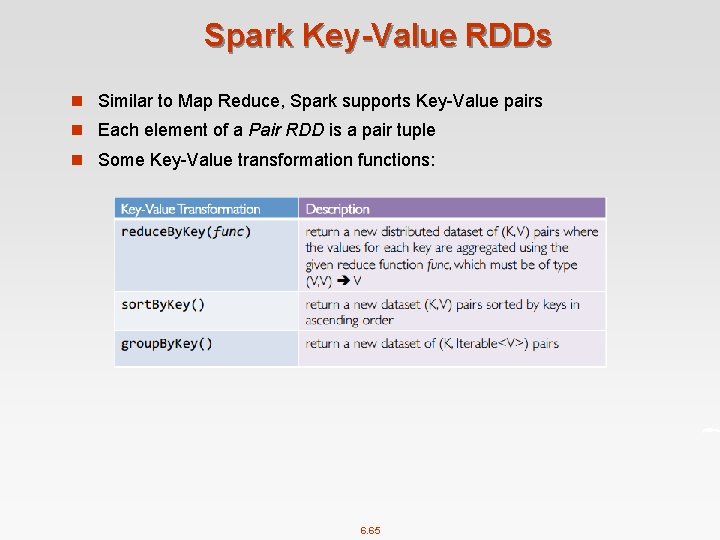
Spark Key-Value RDDs n Similar to Map Reduce, Spark supports Key-Value pairs n Each element of a Pair RDD is a pair tuple n Some Key-Value transformation functions: 6. 65
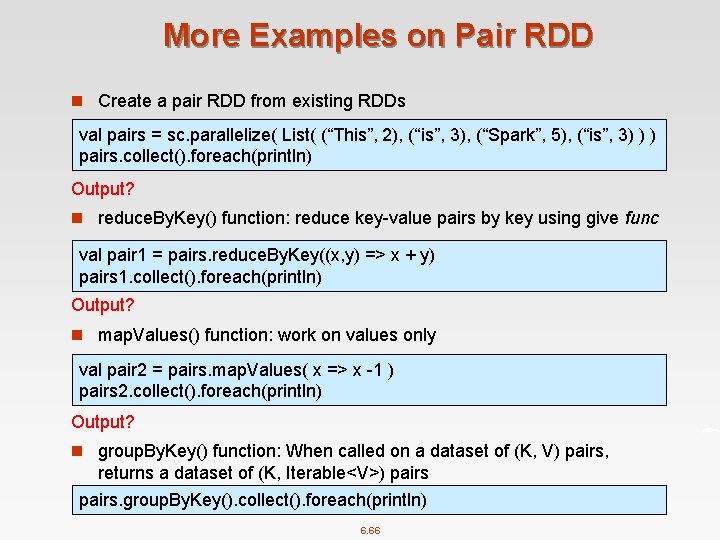
More Examples on Pair RDD n Create a pair RDD from existing RDDs val pairs = sc. parallelize( List( (“This”, 2), (“is”, 3), (“Spark”, 5), (“is”, 3) ) ) pairs. collect(). foreach(println) Output? n reduce. By. Key() function: reduce key-value pairs by key using give func val pair 1 = pairs. reduce. By. Key((x, y) => x + y) pairs 1. collect(). foreach(println) Output? n map. Values() function: work on values only val pair 2 = pairs. map. Values( x => x -1 ) pairs 2. collect(). foreach(println) Output? n group. By. Key() function: When called on a dataset of (K, V) pairs, returns a dataset of (K, Iterable<V>) pairs. group. By. Key(). collect(). foreach(println) 6. 66
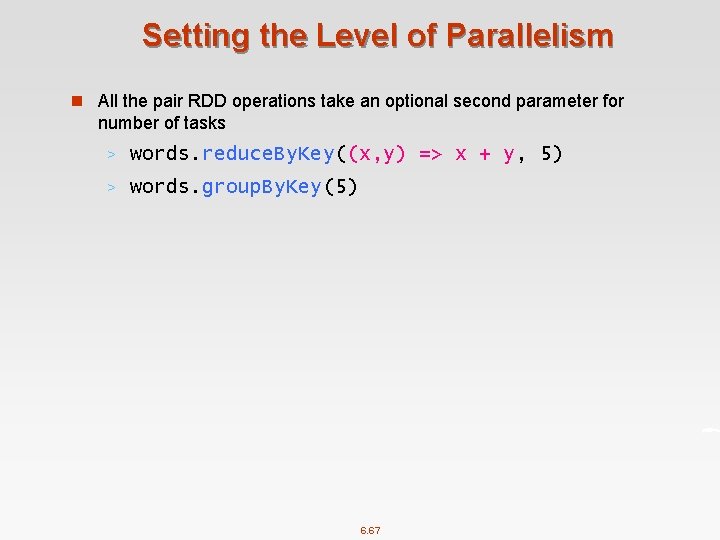
Setting the Level of Parallelism n All the pair RDD operations take an optional second parameter for number of tasks > words. reduce. By. Key((x, y) => x + y, 5) > words. group. By. Key(5) 6. 67
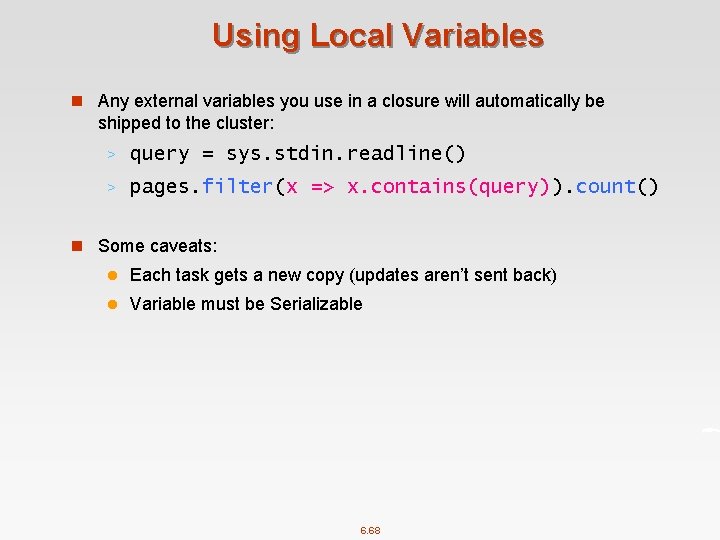
Using Local Variables n Any external variables you use in a closure will automatically be shipped to the cluster: > query = sys. stdin. readline() > pages. filter(x => x. contains(query)). count() n Some caveats: l Each task gets a new copy (updates aren’t sent back) l Variable must be Serializable 6. 68
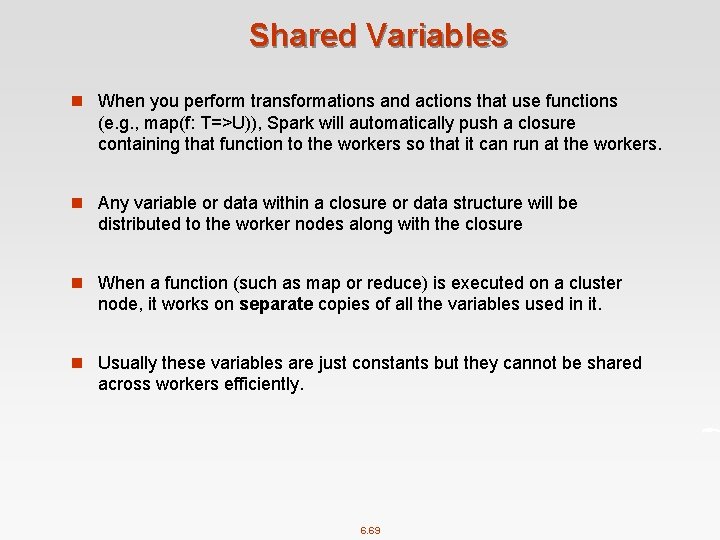
Shared Variables n When you perform transformations and actions that use functions (e. g. , map(f: T=>U)), Spark will automatically push a closure containing that function to the workers so that it can run at the workers. n Any variable or data within a closure or data structure will be distributed to the worker nodes along with the closure n When a function (such as map or reduce) is executed on a cluster node, it works on separate copies of all the variables used in it. n Usually these variables are just constants but they cannot be shared across workers efficiently. 6. 69
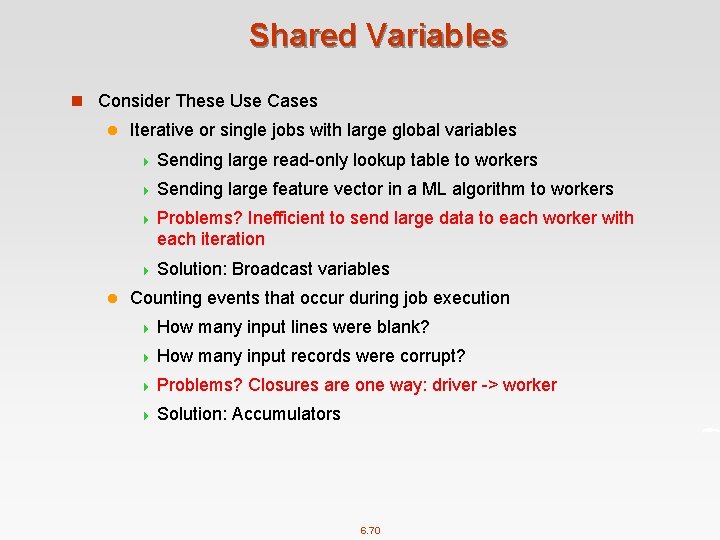
Shared Variables n Consider These Use Cases l Iterative or single jobs with large global variables 4 Sending large read-only lookup table to workers 4 Sending large feature vector in a ML algorithm to workers 4 Problems? Inefficient to send large data to each worker with each iteration 4 Solution: l Broadcast variables Counting events that occur during job execution 4 How many input lines were blank? 4 How many input records were corrupt? 4 Problems? 4 Solution: Closures are one way: driver -> worker Accumulators 6. 70
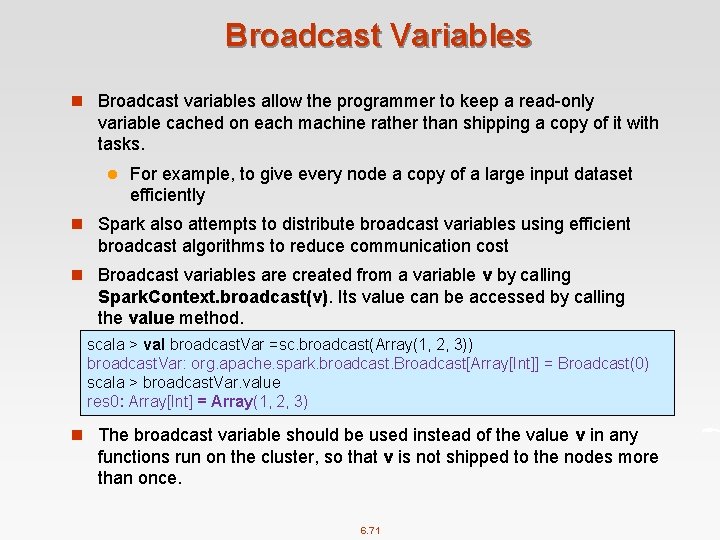
Broadcast Variables n Broadcast variables allow the programmer to keep a read-only variable cached on each machine rather than shipping a copy of it with tasks. l For example, to give every node a copy of a large input dataset efficiently n Spark also attempts to distribute broadcast variables using efficient broadcast algorithms to reduce communication cost n Broadcast variables are created from a variable v by calling Spark. Context. broadcast(v). Its value can be accessed by calling the value method. scala > val broadcast. Var =sc. broadcast(Array(1, 2, 3)) broadcast. Var: org. apache. spark. broadcast. Broadcast[Array[Int]] = Broadcast(0) scala > broadcast. Var. value res 0: Array[Int] = Array(1, 2, 3) n The broadcast variable should be used instead of the value v in any functions run on the cluster, so that v is not shipped to the nodes more than once. 6. 71
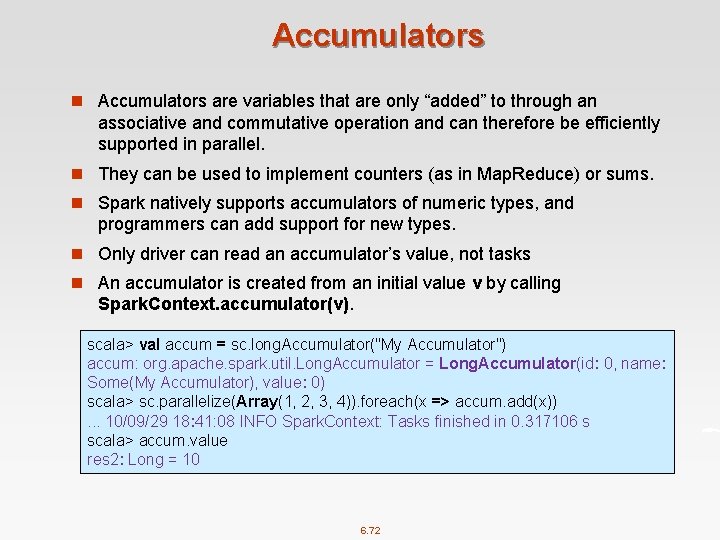
Accumulators n Accumulators are variables that are only “added” to through an associative and commutative operation and can therefore be efficiently supported in parallel. n They can be used to implement counters (as in Map. Reduce) or sums. n Spark natively supports accumulators of numeric types, and programmers can add support for new types. n Only driver can read an accumulator’s value, not tasks n An accumulator is created from an initial value v by calling Spark. Context. accumulator(v). scala> val accum = sc. long. Accumulator("My Accumulator") accum: org. apache. spark. util. Long. Accumulator = Long. Accumulator(id: 0, name: Some(My Accumulator), value: 0) scala> sc. parallelize(Array(1, 2, 3, 4)). foreach(x => accum. add(x)). . . 10/09/29 18: 41: 08 INFO Spark. Context: Tasks finished in 0. 317106 s scala> accum. value res 2: Long = 10 6. 72
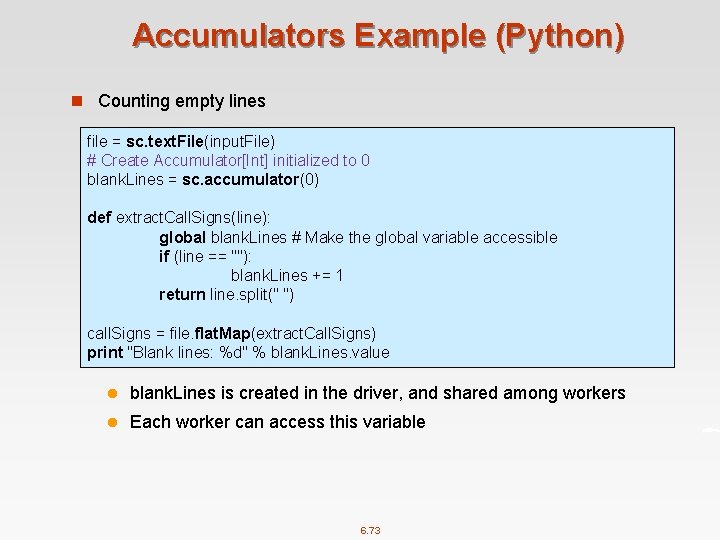
Accumulators Example (Python) n Counting empty lines file = sc. text. File(input. File) # Create Accumulator[Int] initialized to 0 blank. Lines = sc. accumulator(0) def extract. Call. Signs(line): global blank. Lines # Make the global variable accessible if (line == ""): blank. Lines += 1 return line. split(" ") call. Signs = file. flat. Map(extract. Call. Signs) print "Blank lines: %d" % blank. Lines. value l blank. Lines is created in the driver, and shared among workers l Each worker can access this variable 6. 73
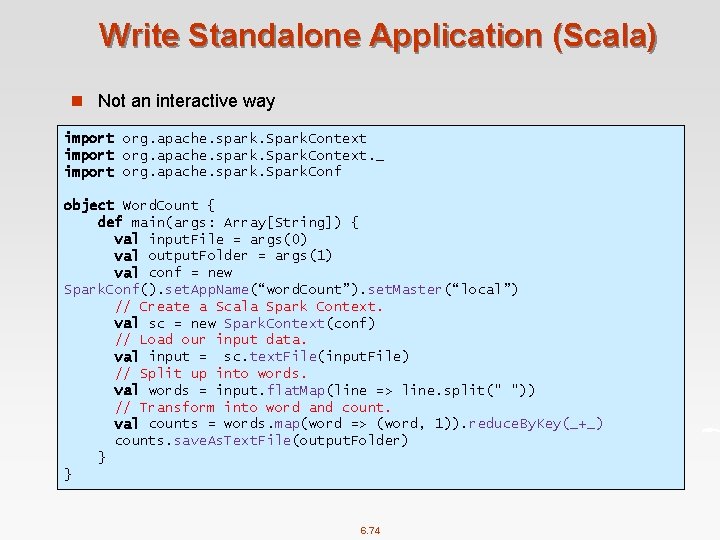
Write Standalone Application (Scala) n Not an interactive way import org. apache. spark. Spark. Context. _ import org. apache. spark. Spark. Conf object Word. Count { def main(args: Array[String]) { val input. File = args(0) val output. Folder = args(1) val conf = new Spark. Conf(). set. App. Name(“word. Count”). set. Master(“local”) // Create a Scala Spark Context. val sc = new Spark. Context(conf) // Load our input data. val input = sc. text. File(input. File) // Split up into words. val words = input. flat. Map(line => line. split(" ")) // Transform into word and count. n You to create a Spark. Context object 1)). reduce. By. Key(_+_) first valneed counts = words. map(word => (word, counts. save. As. Text. File(output. Folder) } } 6. 74
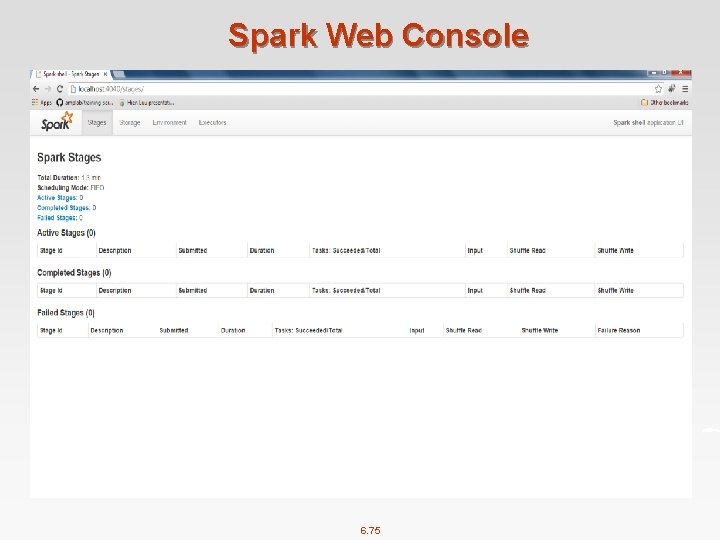
Spark Web Console 6. 75
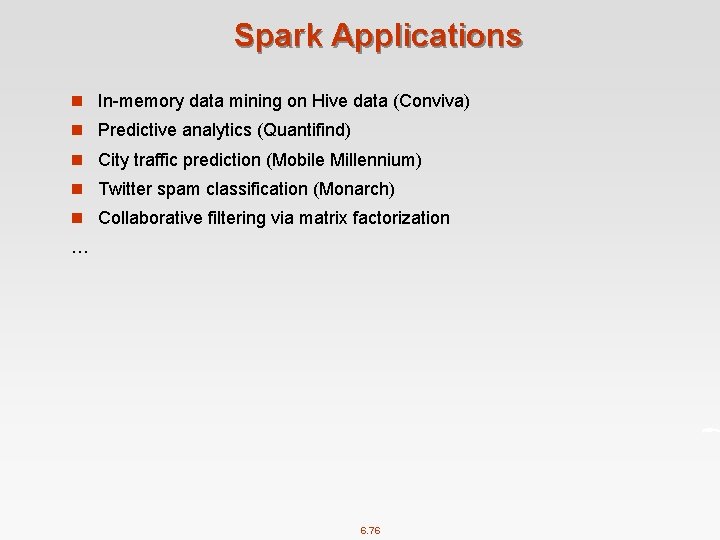
Spark Applications n In-memory data mining on Hive data (Conviva) n Predictive analytics (Quantifind) n City traffic prediction (Mobile Millennium) n Twitter spam classification (Monarch) n Collaborative filtering via matrix factorization … 6. 76
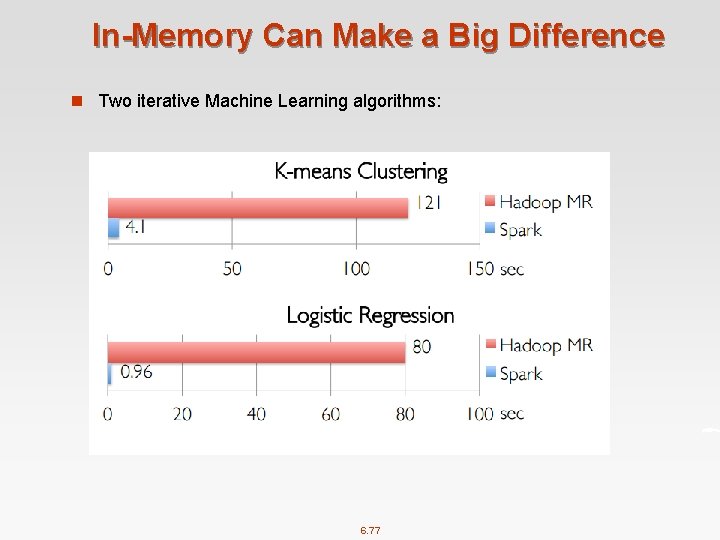
In-Memory Can Make a Big Difference n Two iterative Machine Learning algorithms: 6. 77
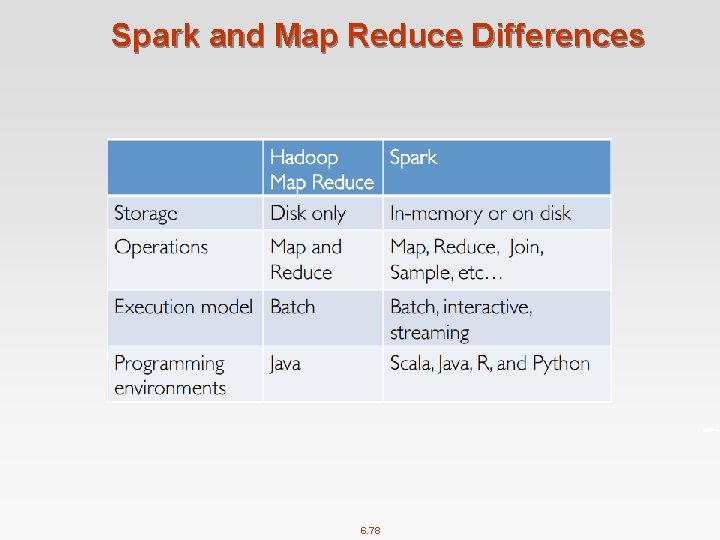
Spark and Map Reduce Differences 6. 78
References n http: //spark. apache. org/docs/latest/index. html n http: //www. scala-lang. org/documentation/ n http: //www. scala-lang. org/docu/files/Scala. By. Example. pdf n A Brief Intro to Scala, by Tim Underwood. 6. 79
End of Chapter 7
- Slides: 80