
COMP 430 Intro to Database Systems SQL from
COMP 430 Intro. to Database Systems SQL from application code
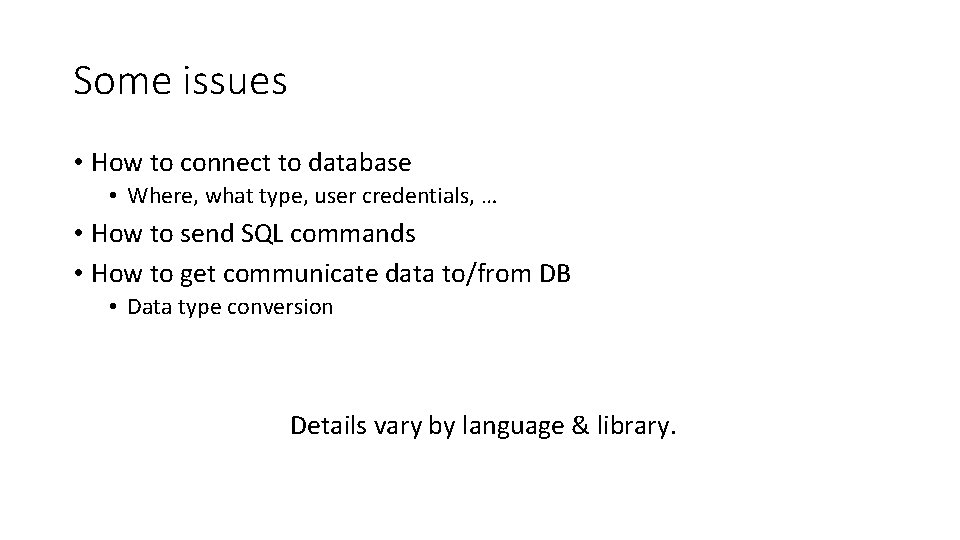
Some issues • How to connect to database • Where, what type, user credentials, … • How to send SQL commands • How to get communicate data to/from DB • Data type conversion Details vary by language & library.
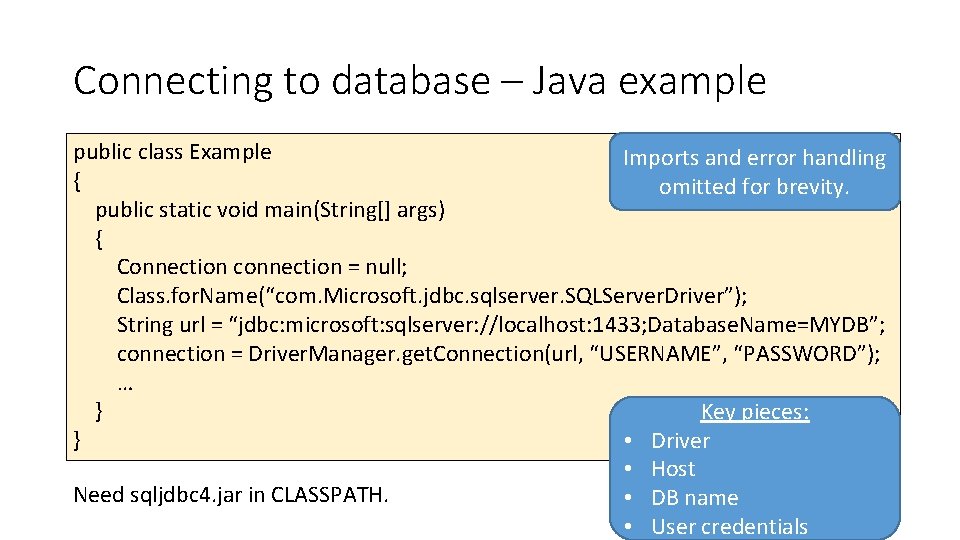
Connecting to database – Java example public class Example Imports and error handling { omitted for brevity. public static void main(String[] args) { Connection connection = null; Class. for. Name(“com. Microsoft. jdbc. sqlserver. SQLServer. Driver”); String url = “jdbc: microsoft: sqlserver: //localhost: 1433; Database. Name=MYDB”; connection = Driver. Manager. get. Connection(url, “USERNAME”, “PASSWORD”); … } Key pieces: } • Driver • Host Need sqljdbc 4. jar in CLASSPATH. • DB name • User credentials

Connecting to database – Python + SQLAlchemy example String split for readability. engine = create_engine(“mssql+pyodbc: //USERNAME: PASSWORD@localhost/MYDB” + “driver=SQL+Server+Native+Client+10. 0”) • • Key pieces: Driver Host DB name User credentials

Connecting to database Those connection strings share a standard syntax, although some arguments can be specified separately by library.

Commands & data often strings connection = …; Statement stmt 1 = connection. create. Statement(); stmt 1. execute. Update(“CREATE TABLE Student” + “(id INT, first VARCHAR(50), last VARCHAR(50))”); … Statement stmt 2 = connection. create. Statement(); Result. Set result = stmt 2. execute. Query(“SELECT id FROM Student”); …
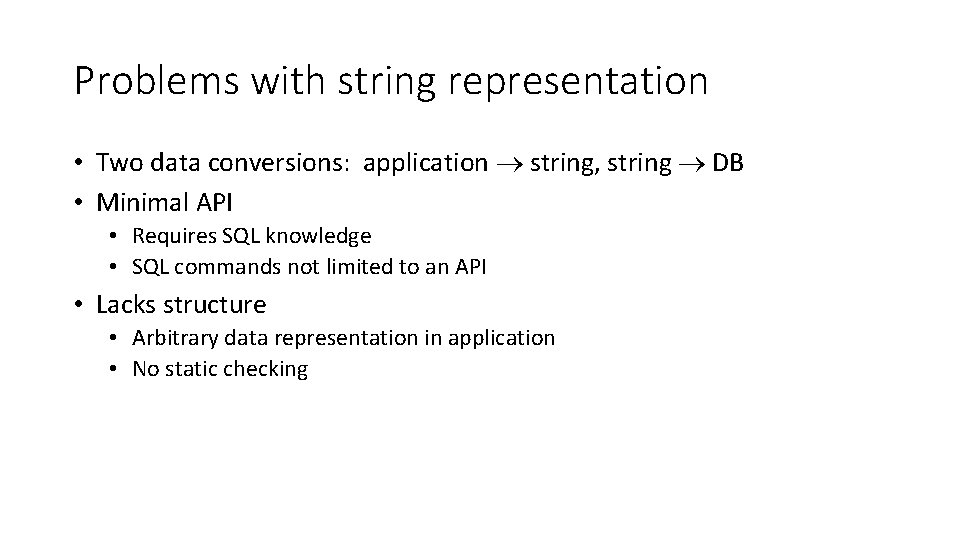
Problems with string representation • Two data conversions: application string, string DB • Minimal API • Requires SQL knowledge • SQL commands not limited to an API • Lacks structure • Arbitrary data representation in application • No static checking
Plain strings allows SQL injection attacks
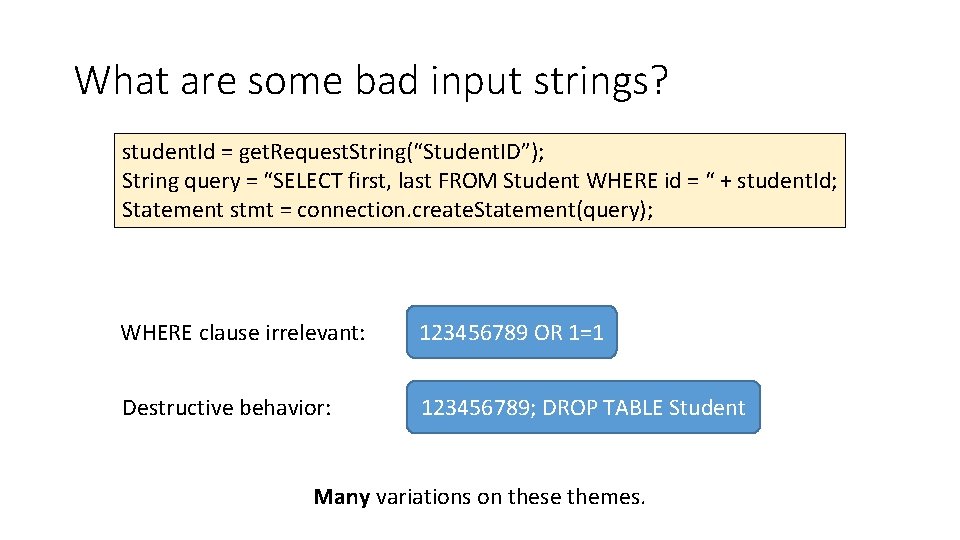
What are some bad input strings? student. Id = get. Request. String(“Student. ID”); String query = “SELECT first, last FROM Student WHERE id = “ + student. Id; Statement stmt = connection. create. Statement(query); WHERE clause irrelevant: 123456789 OR 1=1 Destructive behavior: 123456789; DROP TABLE Student Many variations on these themes.
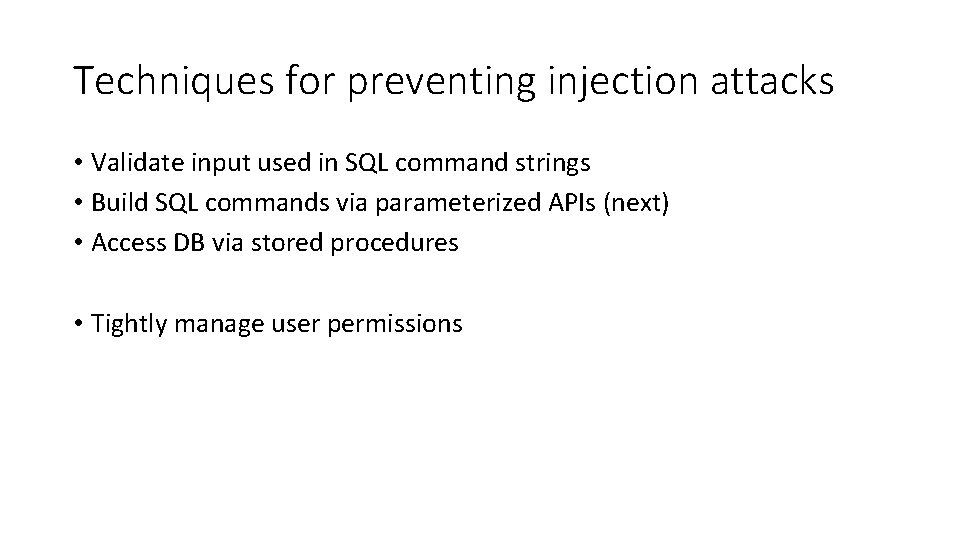
Techniques for preventing injection attacks • Validate input used in SQL command strings • Build SQL commands via parameterized APIs (next) • Access DB via stored procedures • Tightly manage user permissions
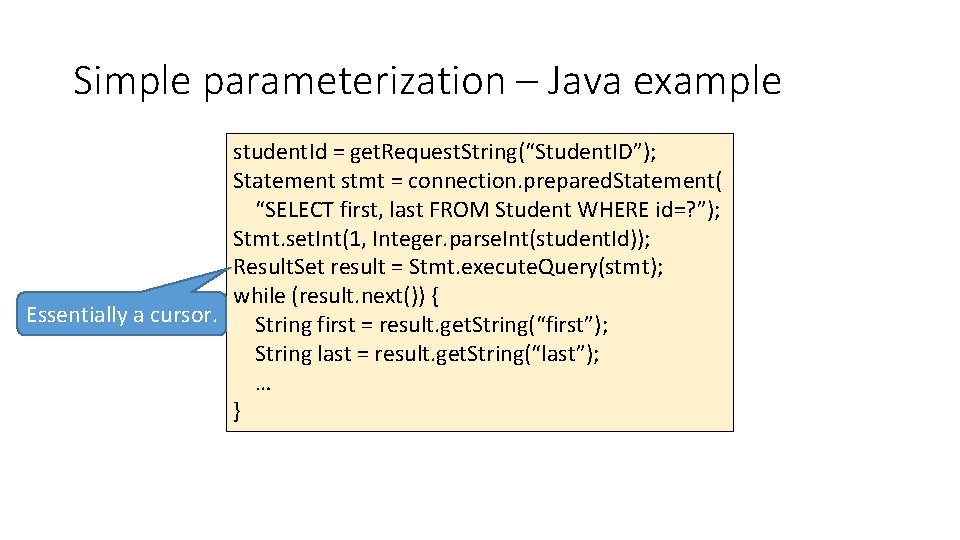
Simple parameterization – Java example student. Id = get. Request. String(“Student. ID”); Statement stmt = connection. prepared. Statement( “SELECT first, last FROM Student WHERE id=? ”); Stmt. set. Int(1, Integer. parse. Int(student. Id)); Result. Set result = Stmt. execute. Query(stmt); while (result. next()) { Essentially a cursor. String first = result. get. String(“first”); String last = result. get. String(“last”); … }
Object-Relational Mapping (ORM) A high-level overview
Primary goal – persistent objects • DB viewed as a tool for implementing persistent objects. • Relational DB assumed for practical or legacy reasons. • But, DB isn’t organized in terms of objects. • Programmer think in terms of application & objects. • Specify which objects persistent • Interaction with DB largely(? ) hidden

Focus on data
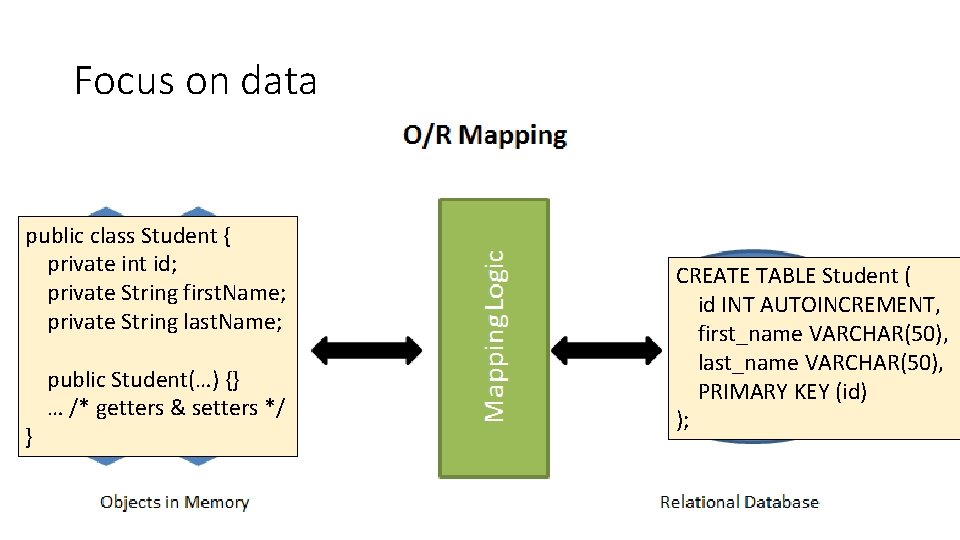
Focus on data public class Student { private int id; private String first. Name; private String last. Name; } public Student(…) {} … /* getters & setters */ CREATE TABLE Student ( id INT AUTOINCREMENT, first_name VARCHAR(50), last_name VARCHAR(50), PRIMARY KEY (id) );
What an ORM can provide • Generate code for simple object/table-record mapping • API for OO-style CRUD (Create-Read-Update-Delete) of objects • API for OO-style queries • Manage how & when data is moved
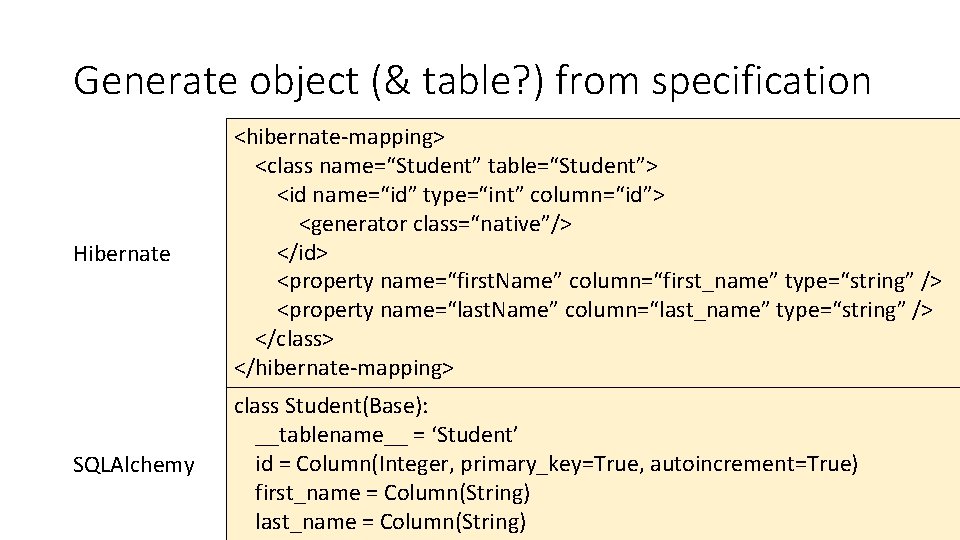
Generate object (& table? ) from specification Hibernate <hibernate-mapping> <class name=“Student” table=“Student”> <id name=“id” type=“int” column=“id”> <generator class=“native”/> </id> <property name=“first. Name” column=“first_name” type=“string” /> <property name=“last. Name” column=“last_name” type=“string” /> </class> </hibernate-mapping> SQLAlchemy class Student(Base): __tablename__ = ‘Student’ id = Column(Integer, primary_key=True, autoincrement=True) first_name = Column(String) last_name = Column(String)
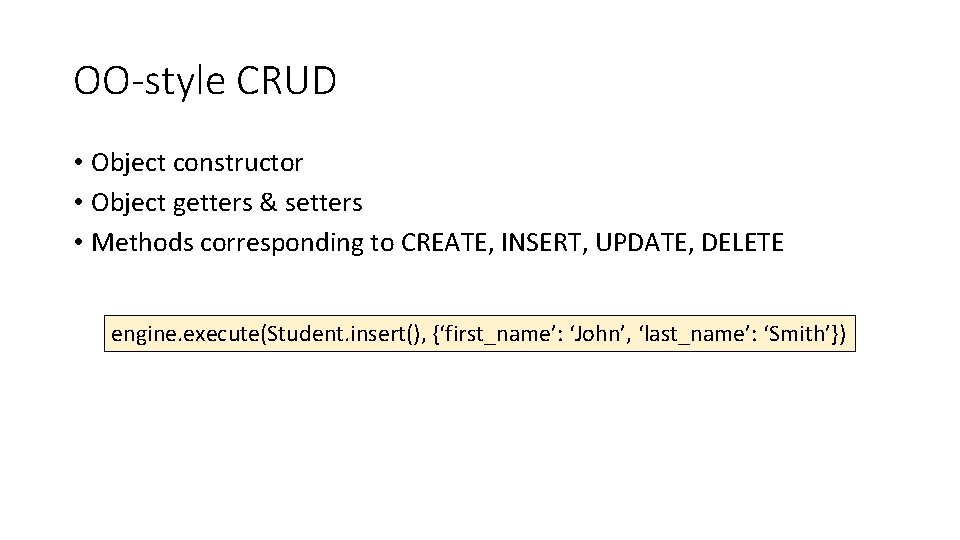
OO-style CRUD • Object constructor • Object getters & setters • Methods corresponding to CREATE, INSERT, UPDATE, DELETE engine. execute(Student. insert(), {‘first_name’: ‘John’, ‘last_name’: ‘Smith’})
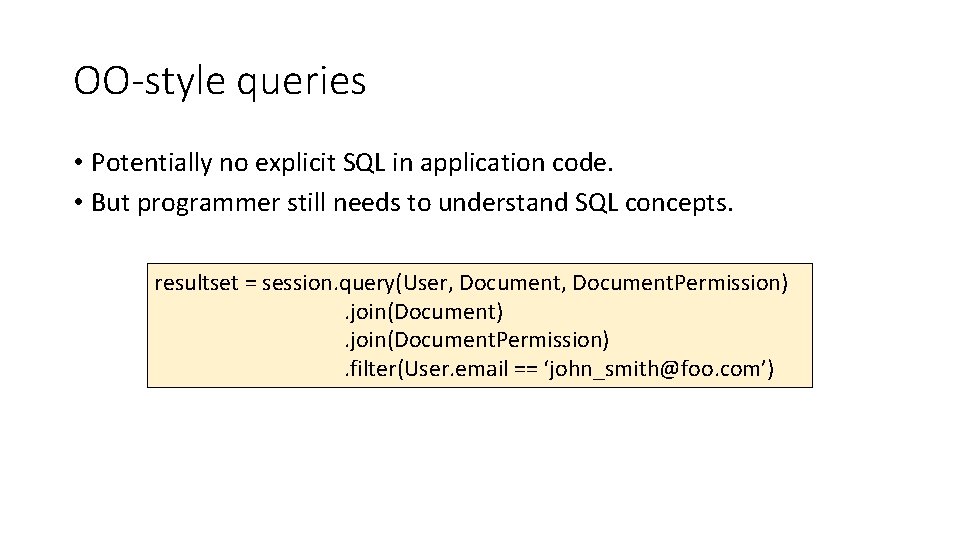
OO-style queries • Potentially no explicit SQL in application code. • But programmer still needs to understand SQL concepts. resultset = session. query(User, Document. Permission). join(Document. Permission). filter(User. email == ‘john_smith@foo. com’)
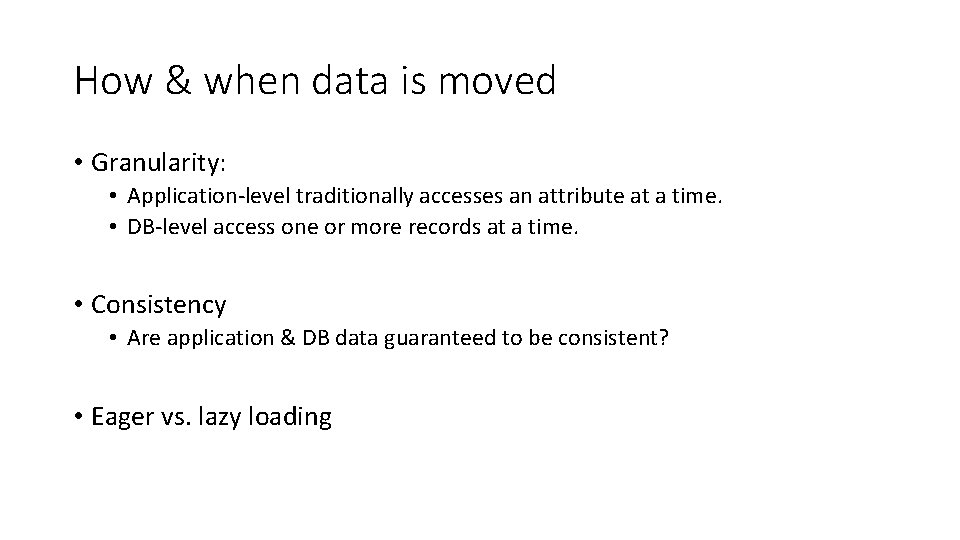
How & when data is moved • Granularity: • Application-level traditionally accesses an attribute at a time. • DB-level access one or more records at a time. • Consistency • Are application & DB data guaranteed to be consistent? • Eager vs. lazy loading
Some ORM problems • Complicated • Hard to learn • Some would say bloated • Fragmented • Many frameworks, many standards • Hard to move from one to another • Only partially successful
- Slides: 21