
COMP 412 FALL 2010 The Procedure Abstraction Part
COMP 412 FALL 2010 The Procedure Abstraction, Part III Storage Layout & Addressability Comp 412 Copyright 2010, Keith D. Cooper & Linda Torczon, all rights reserved. Students enrolled in Comp 412 at Rice University have explicit permission to make copies of these materials for their personal use. Faculty from other educational institutions may use these materials for nonprofit educational purposes, provided this copyright notice is preserved.
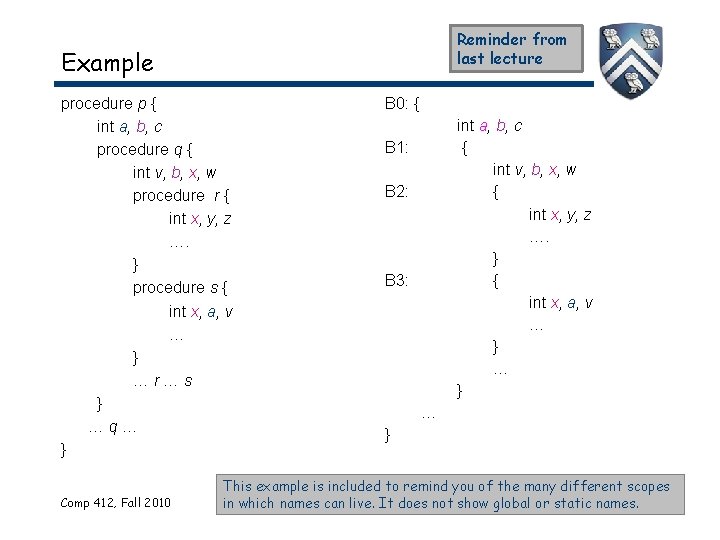
Reminder from last lecture Example procedure p { int a, b, c procedure q { int v, b, x, w procedure r { int x, y, z …. } procedure s { int x, a, v … } …r…s } …q… } Comp 412, Fall 2010 B 0: { int a, b, c { int v, b, x, w { int x, y, z …. } { int x, a, v … } B 1: B 2: B 3: … } This example is included to remind you of the many different scopes in which names can live. It does not show global or static names. 1
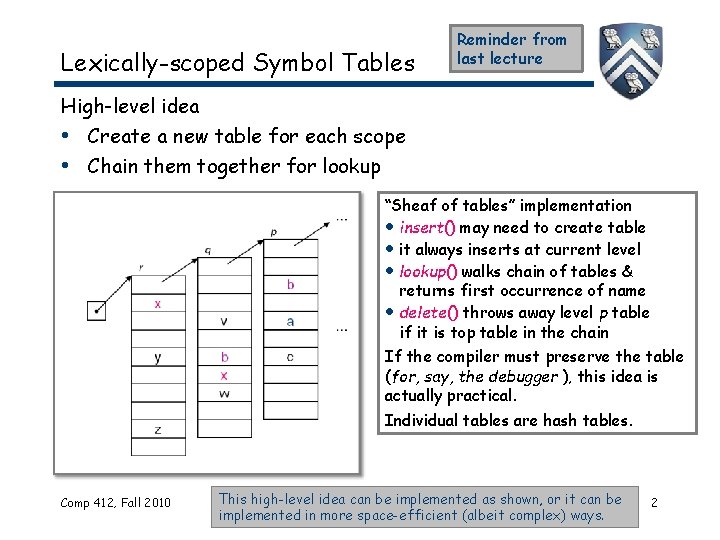
Lexically-scoped Symbol Tables Reminder from last lecture High-level idea • Create a new table for each scope • Chain them together for lookup “Sheaf of tables” implementation insert() may need to create table it always inserts at current level lookup() walks chain of tables & returns first occurrence of name delete() throws away level p table if it is top table in the chain If the compiler must preserve the table (for, say, the debugger ), this idea is actually practical. Individual tables are hash tables. Comp 412, Fall 2010 This high-level idea can be implemented as shown, or it can be implemented in more space-efficient (albeit complex) ways. 2
Where Do Local Variables Live? A Simplistic Model (the obvious model ) • Allocate a data area for each distinct scope • One data area per “sheaf” in scoped table What about recursion? • Need a data area per invocation (or activation) of a scope • We call this data area the scope’s activation record • The compiler can also store control information there ! More complex scheme • One activation record (AR) per procedure instance • All the procedure’s scopes share a single AR (may share space) • Static relationship between scopes in single procedure Comp 412, Fall 2010 Used this way, “static” means knowable at compile time (and, therefore, fixed). 3
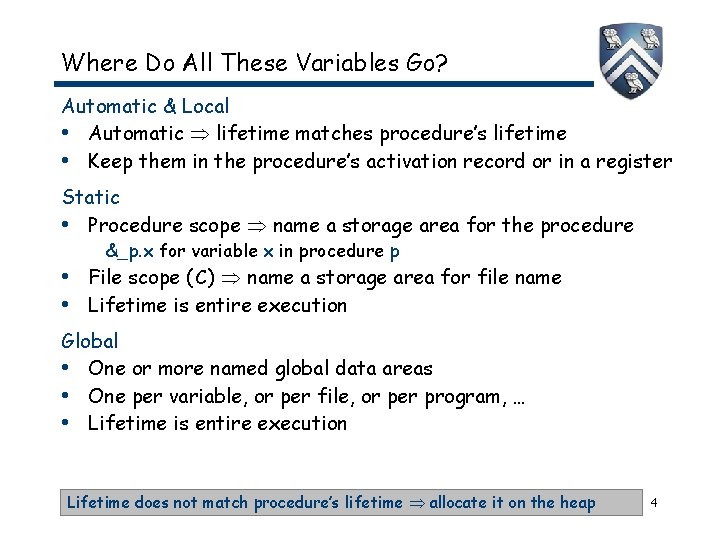
Where Do All These Variables Go? Automatic & Local • Automatic lifetime matches procedure’s lifetime • Keep them in the procedure’s activation record or in a register Static • Procedure scope name a storage area for the procedure &_p. x for variable x in procedure p • File scope ( C ) name a storage area for file name • Lifetime is entire execution Global • One or more named global data areas • One per variable, or per file, or per program, … • Lifetime is entire execution Comp 412, Falldoes 2010 not Lifetime match procedure’s lifetime allocate it on the heap 4
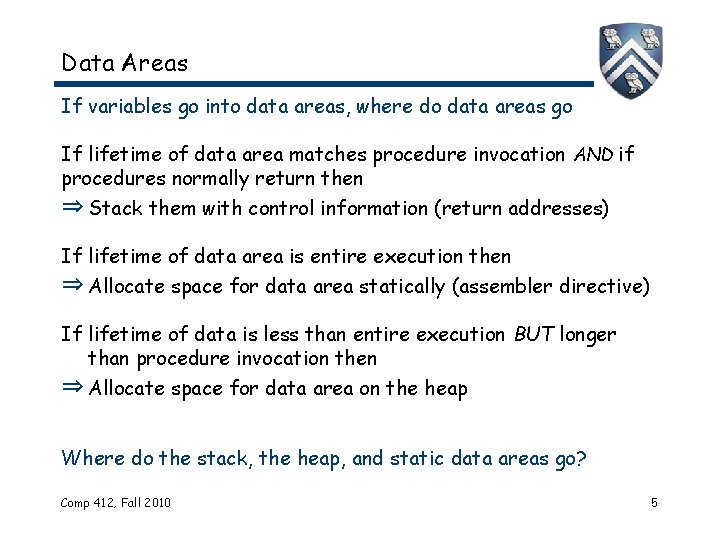
Data Areas If variables go into data areas, where do data areas go If lifetime of data area matches procedure invocation AND if procedures normally return then ⇒ Stack them with control information (return addresses) If lifetime of data area is entire execution then ⇒ Allocate space for data area statically (assembler directive) If lifetime of data is less than entire execution BUT longer than procedure invocation then ⇒ Allocate space for data area on the heap Where do the stack, the heap, and static data areas go? Comp 412, Fall 2010 5
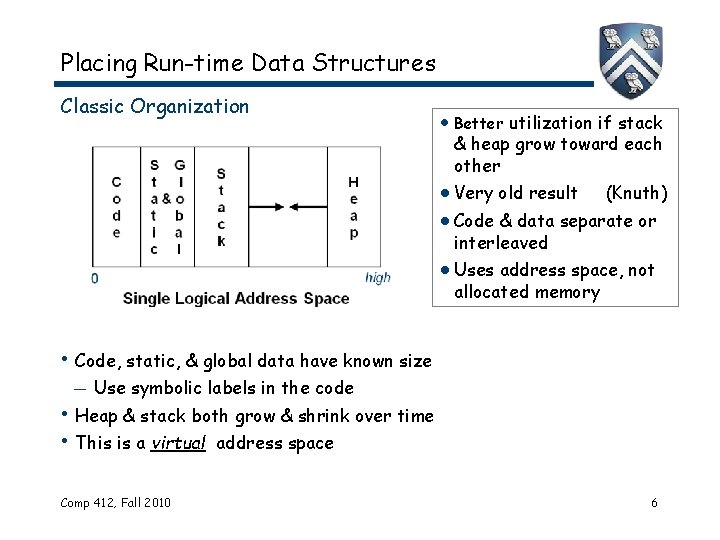
Placing Run-time Data Structures Classic Organization Better utilization if stack & heap grow toward each other Very old result (Knuth) Code & data separate or interleaved Uses address space, not allocated memory • Code, static, & global data have known size — Use symbolic labels in the code • Heap & stack both grow & shrink over time • This is a virtual address space Comp 412, Fall 2010 6
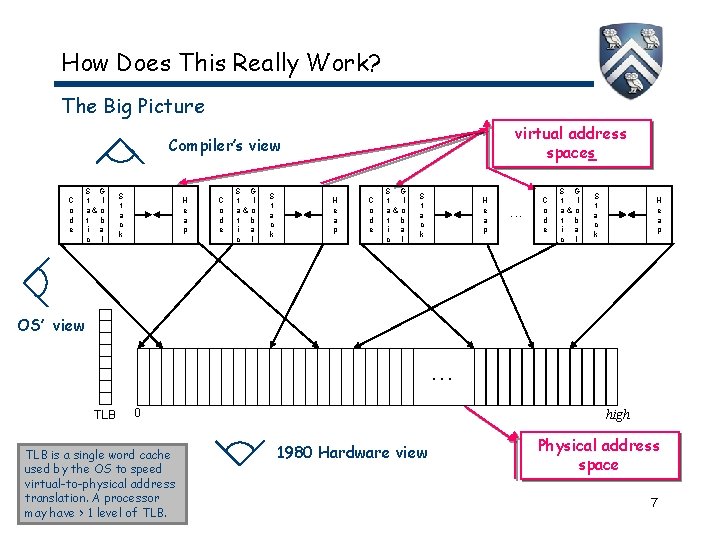
How Does This Really Work? The Big Picture virtual address spaces Compiler’s view C o d e S G t l a&o t b i a c l S t a c k H e a p . . . C o d e S G t l a&o t b i a c l S t a c k H e a p OS’ view . . . TLB 0 TLB is a single word cache used by the OS to speed virtual-to-physical address translation. processor Comp A 412, Fall 2010 may have > 1 level of TLB. high 1980 Hardware view Physical address space 7
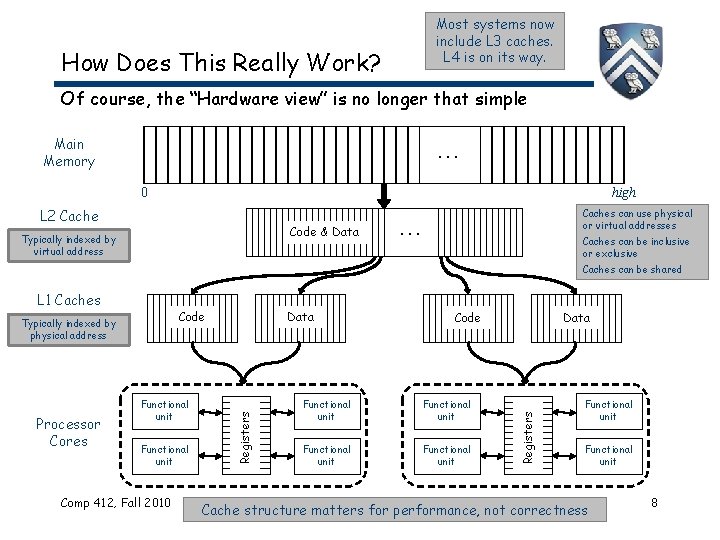
Most systems now include L 3 caches. L 4 is on its way. How Does This Really Work? Of course, the “Hardware view” is no longer that simple . . . Main Memory 0 high L 2 Cache Code & Data Typically indexed by virtual address Caches can use physical or virtual addresses . . . Caches can be inclusive or exclusive Caches can be shared Processor Cores Functional unit Comp 412, Fall 2010 Data Registers Code Typically indexed by physical address Code Functional unit Data Registers L 1 Caches Functional unit Cache structure matters for performance, not correctness 8
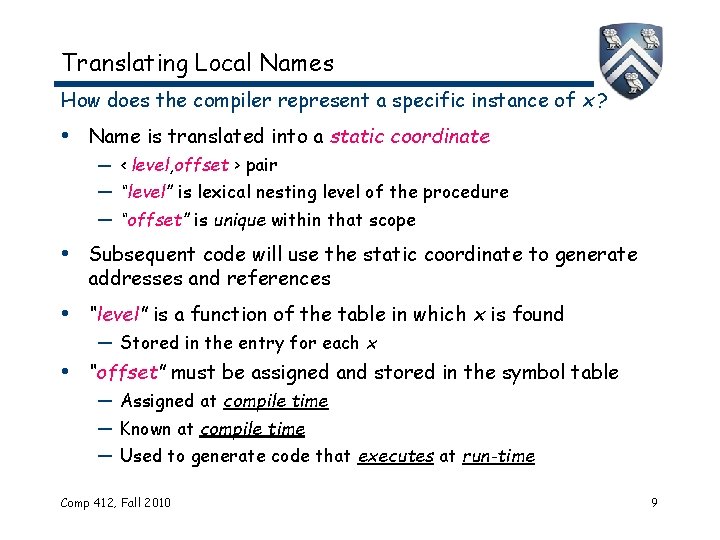
Translating Local Names How does the compiler represent a specific instance of x ? • Name is translated into a static coordinate — < level, offset > pair — “level” is lexical nesting level of the procedure — “offset” is unique within that scope • Subsequent code will use the static coordinate to generate addresses and references • “level” is a function of the table in which x is found — Stored in the entry for each x • “offset” must be assigned and stored in the symbol table — Assigned at compile time — Known at compile time — Used to generate code that executes at run-time Comp 412, Fall 2010 9
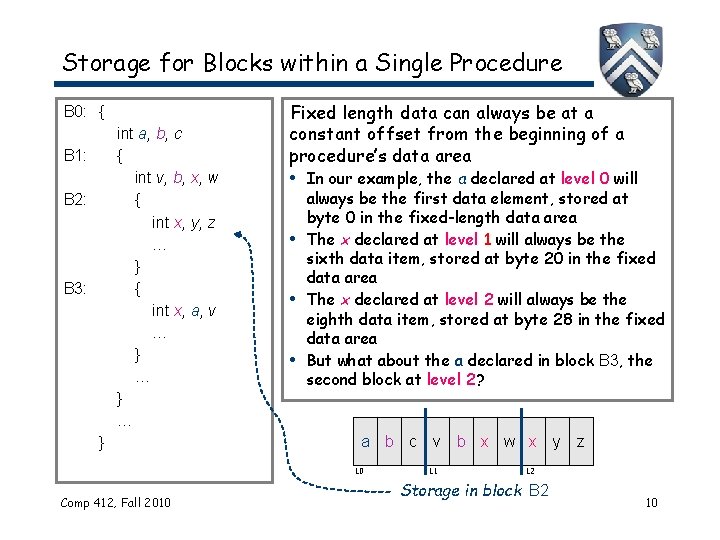
Storage for Blocks within a Single Procedure B 0: { int a, b, c { int v, b, x, w { int x, y, z … } { int x, a, v … } … B 1: B 2: B 3: } Fixed length data can always be at a constant offset from the beginning of a procedure’s data area • In our example, the a declared at level 0 will • • • always be the first data element, stored at byte 0 in the fixed-length data area The x declared at level 1 will always be the sixth data item, stored at byte 20 in the fixed data area The x declared at level 2 will always be the eighth data item, stored at byte 28 in the fixed data area But what about the a declared in block B 3, the second block at level 2? a b c L 0 Comp 412, Fall 2010 v b x w x L 1 y z L 2 Storage in block B 2 10
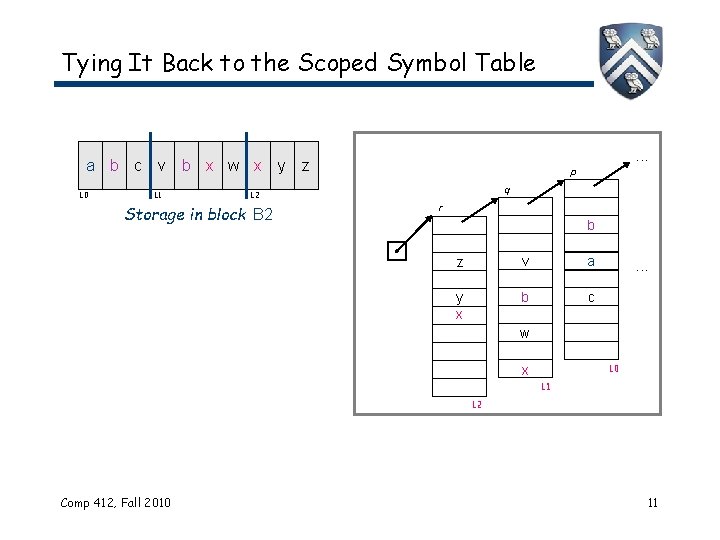
Tying It Back to the Scoped Symbol Table a b c L 0 v b x w x L 1 y . . . z p q L 2 r Storage in block B 2 b • z v a y x b c . . . w L 0 x L 1 L 2 Comp 412, Fall 2010 11
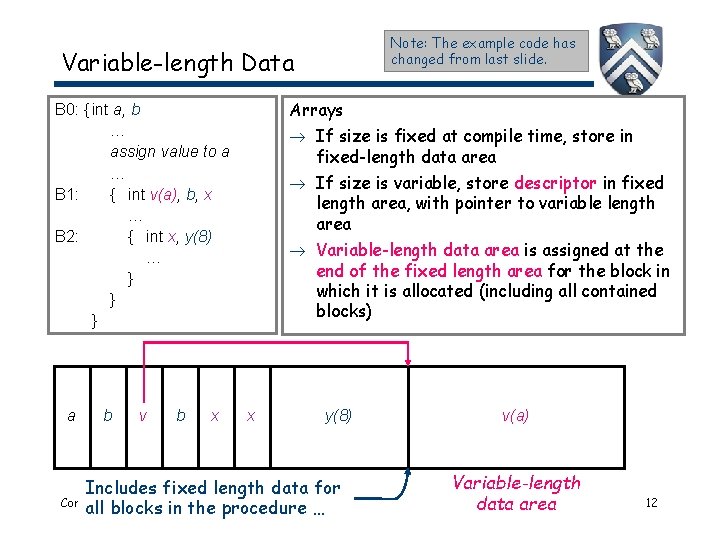
Note: The example code has changed from last slide. Variable-length Data Arrays B 0: { int a, b … assign value to a … B 1: { int v(a), b, x … B 2: { int x, y(8) … } } } a b v b x If size is fixed at compile time, store in fixed-length data area If size is variable, store descriptor in fixed length area, with pointer to variable length area Variable-length data area is assigned at the end of the fixed length area for the block in which it is allocated (including all contained blocks) x y(8) Includes fixed length data for Comp 412, Fall 2010 all blocks in the procedure … v(a) Variable-length data area 12
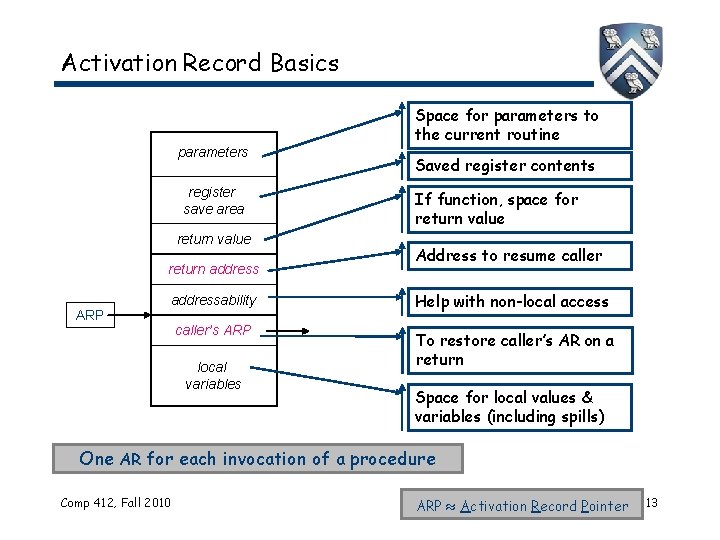
Activation Record Basics parameters register save area return value return address ARP Space for parameters to the current routine Saved register contents If function, space for return value Address to resume caller addressability Help with non-local access caller’s ARP To restore caller’s AR on a return local variables Space for local values & variables (including spills) One AR for each invocation of a procedure Comp 412, Fall 2010 ARP Activation Record Pointer 13
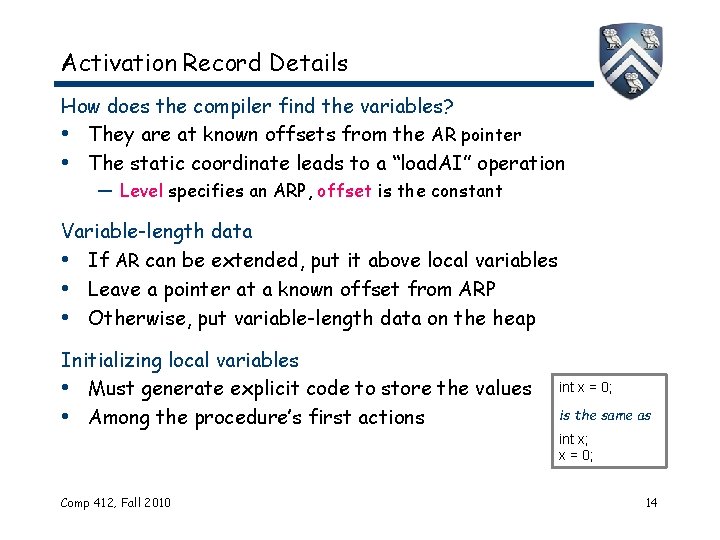
Activation Record Details How does the compiler find the variables? • They are at known offsets from the AR pointer • The static coordinate leads to a “load. AI” operation — Level specifies an ARP, offset is the constant Variable-length data • If AR can be extended, put it above local variables • Leave a pointer at a known offset from ARP • Otherwise, put variable-length data on the heap Initializing local variables • Must generate explicit code to store the values • Among the procedure’s first actions int x = 0; is the same as int x; x = 0; Comp 412, Fall 2010 14
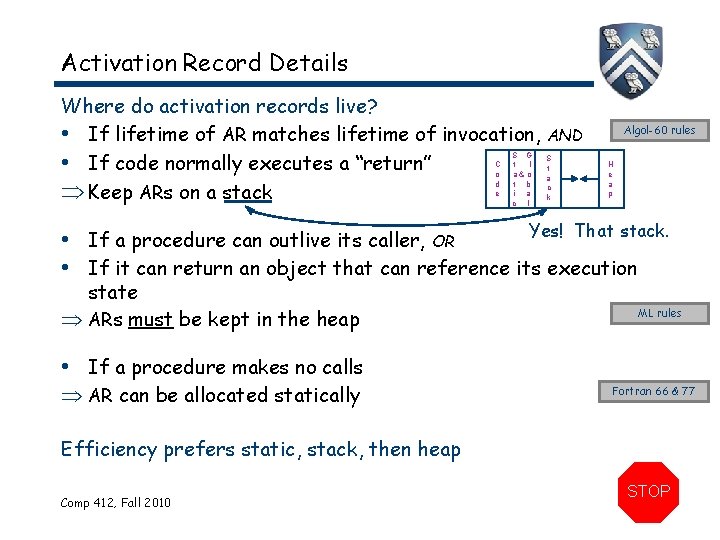
Activation Record Details Where do activation records live? • If lifetime of AR matches lifetime of invocation, • If code normally executes a “return” Keep ARs on a stack C o d e S G t l a&o t b i a c l Algol-60 rules AND S t a c k H e a p Yes! That stack. • If a procedure can outlive its caller, OR • If it can return an object that can reference its execution state ARs must be kept in the heap ML rules • If a procedure makes no calls AR can be allocated statically Fortran 66 & 77 Efficiency prefers static, stack, then heap Comp 412, Fall 2010 STOP 15
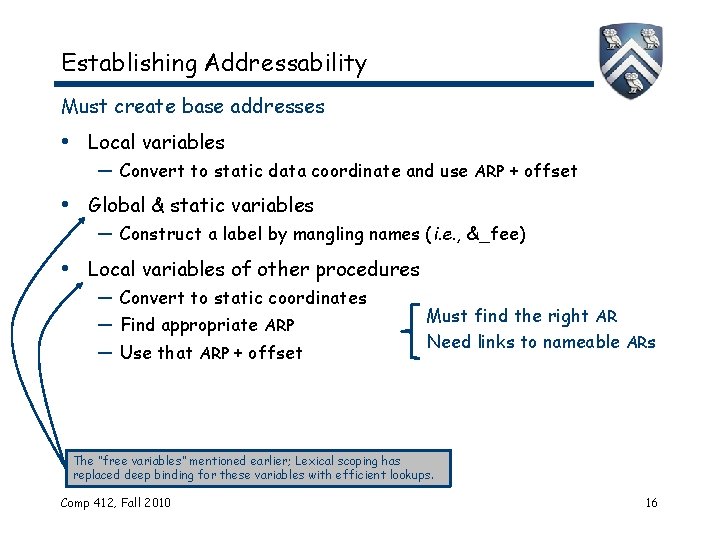
Establishing Addressability Must create base addresses • Local variables — Convert to static data coordinate and use ARP + offset • Global & static variables — Construct a label by mangling names (i. e. , &_fee) • Local variables of other procedures — Convert to static coordinates — Find appropriate ARP — Use that ARP + offset Must find the right AR Need links to nameable ARs The “free variables” mentioned earlier; Lexical scoping has replaced deep binding for these variables with efficient lookups. Comp 412, Fall 2010 16
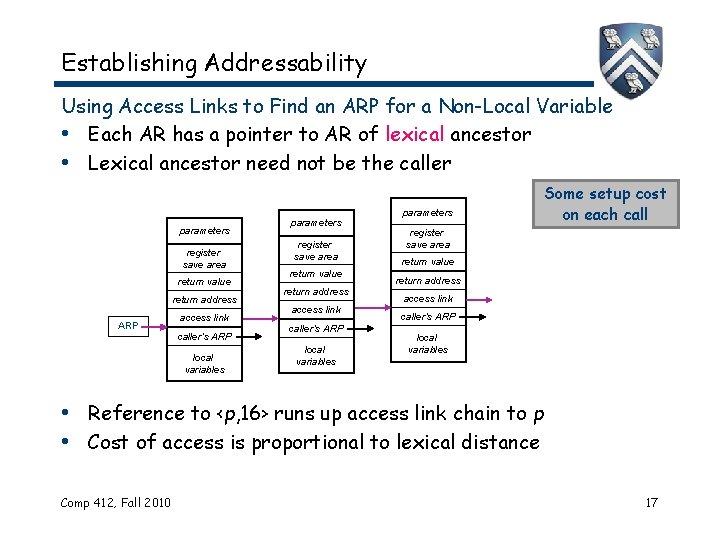
Establishing Addressability Using Access Links to Find an ARP for a Non-Local Variable • Each AR has a pointer to AR of lexical ancestor • Lexical ancestor need not be the caller parameters register save area return value return address ARP access link caller’s ARP local variables parameters register save area return value return address access link caller’s ARP local variables parameters Some setup cost on each call register save area return value return address access link caller’s ARP local variables • Reference to <p, 16> runs up access link chain to p • Cost of access is proportional to lexical distance Comp 412, Fall 2010 17
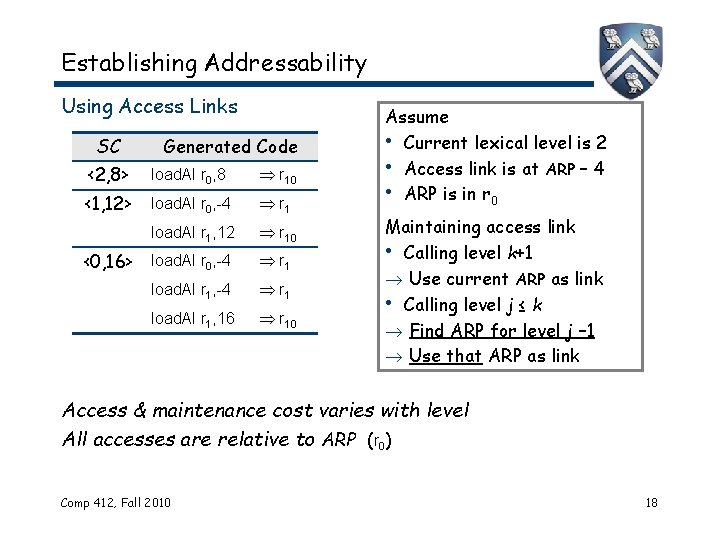
Establishing Addressability Using Access Links SC Generated Code <2, 8> load. AI r 0, 8 r 10 <1, 12> load. AI r 0, -4 r 1 load. AI r 1, 12 r 10 load. AI r 0, -4 r 1 load. AI r 1, 16 r 10 <0, 16> Assume • Current lexical level is 2 • Access link is at ARP – 4 • ARP is in r 0 Maintaining access link • Calling level k+1 Use current ARP as link • Calling level j ≤ k Find ARP for level j – 1 Use that ARP as link Access & maintenance cost varies with level All accesses are relative to ARP (r 0) Comp 412, Fall 2010 18
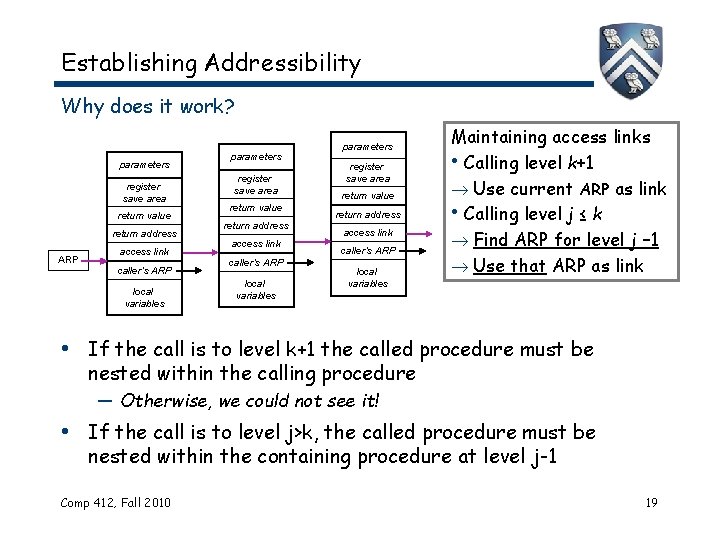
Establishing Addressibility Why does it work? parameters register save area return value return address ARP access link caller’s ARP local variables parameters register save area return value return address access link caller’s ARP local variables Maintaining access links • Calling level k+1 Use current ARP as link • Calling level j ≤ k Find ARP for level j – 1 Use that ARP as link • If the call is to level k+1 the called procedure must be nested within the calling procedure — Otherwise, we could not see it! • If the call is to level j>k, the called procedure must be nested within the containing procedure at level j-1 Comp 412, Fall 2010 19
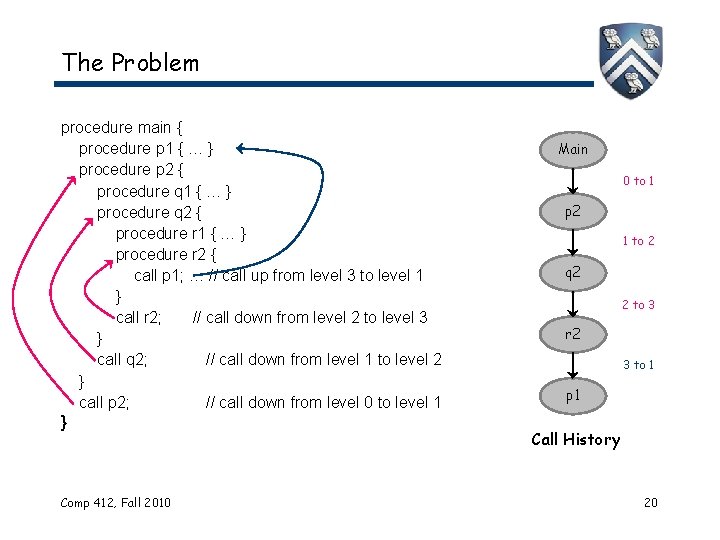
The Problem procedure main { procedure p 1 { … } procedure p 2 { procedure q 1 { … } procedure q 2 { procedure r 1 { … } procedure r 2 { call p 1; … // call up from level 3 to level 1 } call r 2; // call down from level 2 to level 3 } call q 2; // call down from level 1 to level 2 } call p 2; // call down from level 0 to level 1 } Comp 412, Fall 2010 Main 0 to 1 p 2 1 to 2 q 2 2 to 3 r 2 3 to 1 p 1 Call History 20
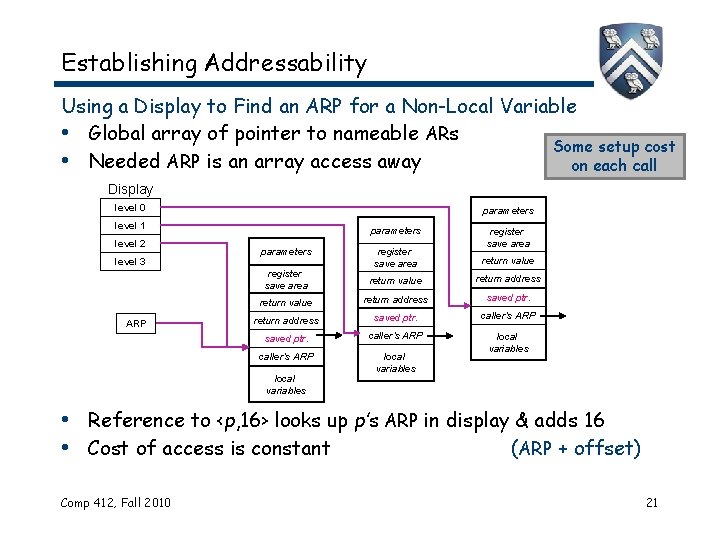
Establishing Addressability Using a Display to Find an ARP for a Non-Local Variable • Global array of pointer to nameable ARs Some setup cost • Needed ARP is an array access away on each call Display level 0 parameters level 1 level 2 level 3 ARP parameters register save area return value return address saved ptr. caller’s ARP local variables • Reference to <p, 16> looks up p’s ARP in display & adds 16 • Cost of access is constant (ARP + offset) Comp 412, Fall 2010 21
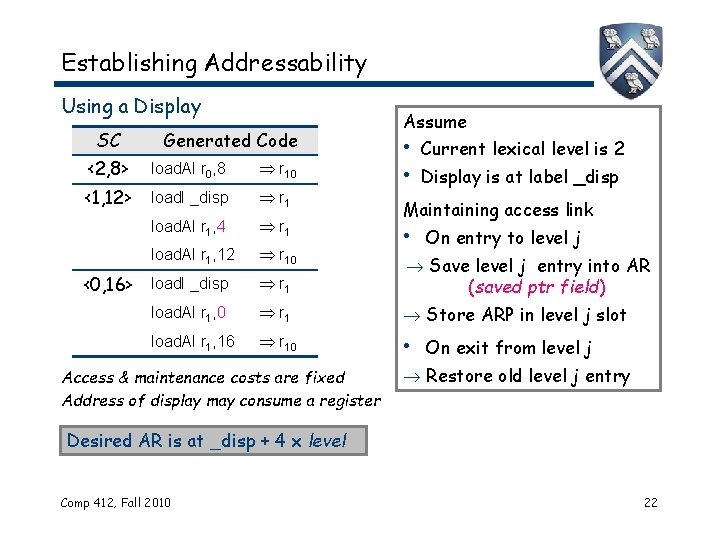
Establishing Addressability Using a Display SC Generated Code Assume • Current lexical level is 2 • Display is at label _disp <2, 8> load. AI r 0, 8 r 10 <1, 12> load. I _disp r 1 load. AI r 1, 4 r 1 load. AI r 1, 12 r 10 load. I _disp r 1 load. AI r 1, 0 r 1 Store ARP in level j slot load. AI r 1, 16 r 10 • On exit from level j <0, 16> Access & maintenance costs are fixed Address of display may consume a register Maintaining access link • On entry to level j Save level j entry into AR (saved ptr field) Restore old level j entry Desired AR is at _disp + 4 x level Comp 412, Fall 2010 22
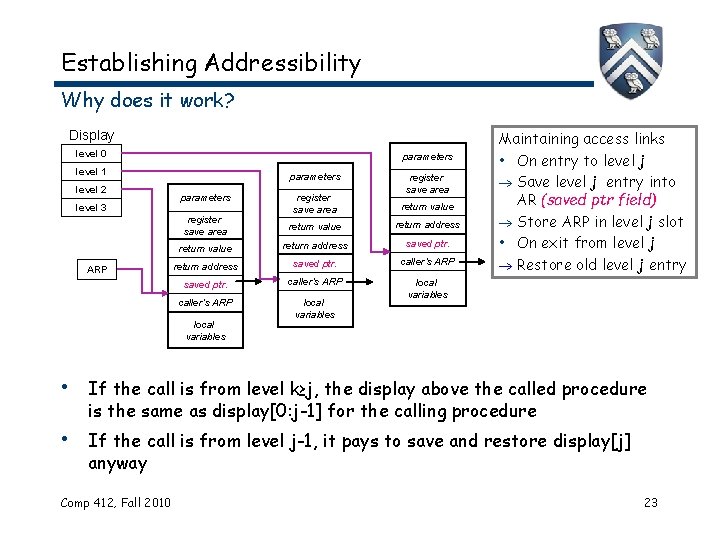
Establishing Addressibility Why does it work? Display level 0 parameters level 1 level 2 level 3 ARP parameters register save area return value return address saved ptr. caller’s ARP local variables Maintaining access links • On entry to level j Save level j entry into AR (saved ptr field) Store ARP in level j slot • On exit from level j Restore old level j entry • If the call is from level k≥j, the display above the called procedure is the same as display[0: j-1] for the calling procedure • If the call is from level j-1, it pays to save and restore display[j] anyway Comp 412, Fall 2010 23
Establishing Addressability Access Links Versus Display • Each adds some overhead to each call • Access links costs vary with level of reference — Overhead only incurred on references & calls — If ARs outlive the procedure, access links still work • Display costs are fixed for all references — References & calls must load display address — Typically, this requires a register (rematerialization) Your mileage will vary • Depends on ratio of non-local accesses to calls • Extra register can make a difference in overall speed For either scheme to work, the compiler must insert code into each procedure call & return Comp 412, Fall 2010 24
Creating and Destroying Activation Records All three parts of the procedure abstraction leave state in the activation record • How are ARs created and destroyed? — Procedure call must allocate & initialize (preserve caller’s world) — Return must dismantle environment (and restore caller’s world) • Caller & callee must collaborate on the problem — Caller alone knows some of the necessary state Return address, parameter values, access to other scopes — Callee alone knows the rest Size of local data area (with spills), registers it will use Their collaboration takes the form of a linkage convention Comp 412, Fall 2010 25
Procedure Linkages How do procedure calls actually work? At compile time, callee may not be available for inspection • Different calls may be in different compilation units • Compiler may not know system code from user code • All calls must use the same protocol Compiler must use a standard sequence of operations • Enforces control & data abstractions • Divides responsibility between caller & callee Usually a system-wide agreement, to allow interoperability Comp 412, Fall 2010 26
Saving Registers Who saves the registers? Caller or callee? • Arguments for saving on each side of the call — Caller knows which values are LIVE across the call — Callee knows which registers it will use • Conventional wisdom: divide registers into three sets — Caller saves registers Caller targets values that are not LIVE across the call — Callee saves registers Callee only uses these AFTER filling caller saves registers — Registers reserved for the linkage convention ARP, return address (if in a register), … Where are they stored? In one of the ARs … Comp 412, Fall 2010 27
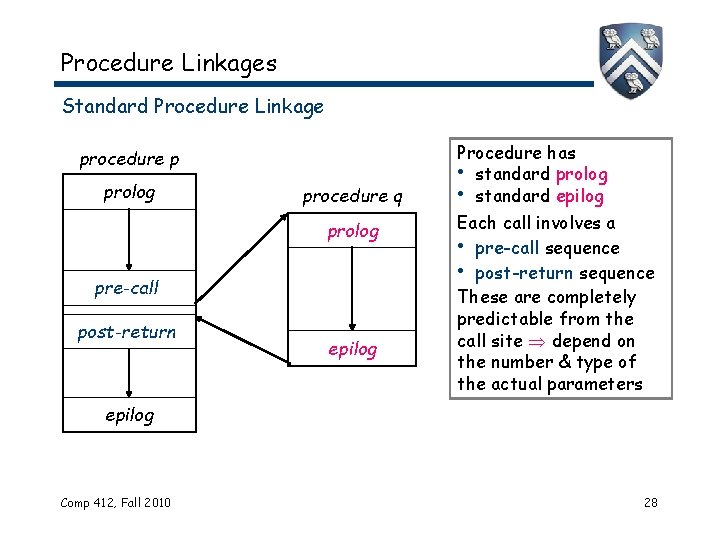
Procedure Linkages Standard Procedure Linkage procedure p prolog procedure q prolog pre-call post-return epilog Procedure has • standard prolog • standard epilog Each call involves a • pre-call sequence • post-return sequence These are completely predictable from the call site depend on the number & type of the actual parameters epilog Comp 412, Fall 2010 28
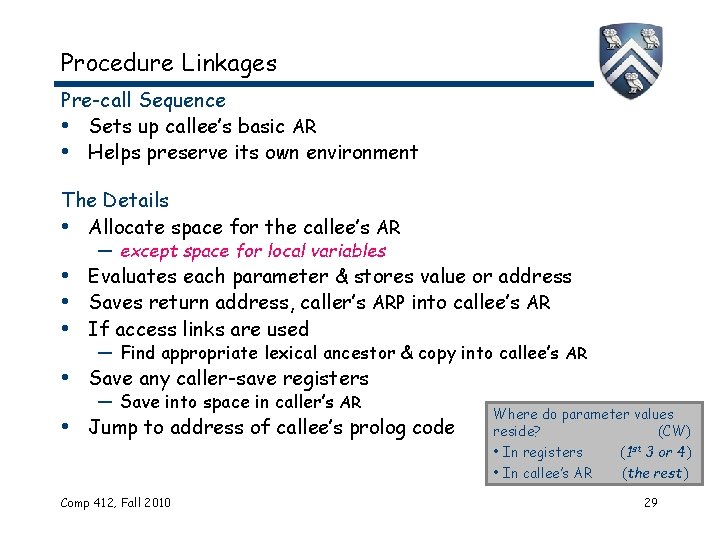
Procedure Linkages Pre-call Sequence • Sets up callee’s basic AR • Helps preserve its own environment The Details • Allocate space for the callee’s AR — except space for local variables • Evaluates each parameter & stores value or address • Saves return address, caller’s ARP into callee’s AR • If access links are used — Find appropriate lexical ancestor & copy into callee’s AR • Save any caller-save registers — Save into space in caller’s AR • Jump to address of callee’s prolog code Comp 412, Fall 2010 Where do parameter values reside? (CW) • In registers (1 st 3 or 4 ) • In callee’s AR (the rest ) 29
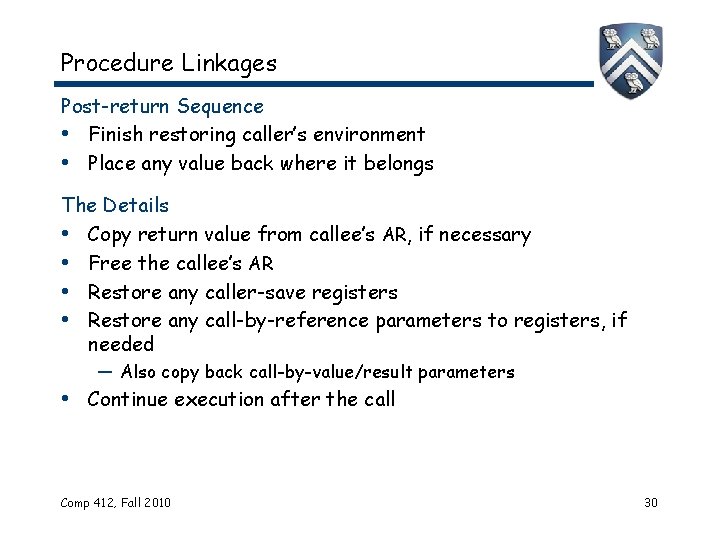
Procedure Linkages Post-return Sequence • Finish restoring caller’s environment • Place any value back where it belongs The Details • Copy return value from callee’s AR, if necessary • Free the callee’s AR • Restore any caller-save registers • Restore any call-by-reference parameters to registers, if needed — Also copy back call-by-value/result parameters • Continue execution after the call Comp 412, Fall 2010 30
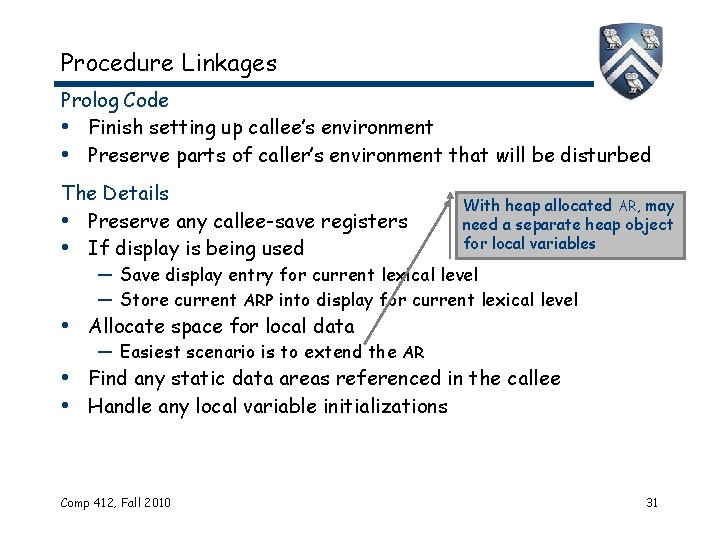
Procedure Linkages Prolog Code • Finish setting up callee’s environment • Preserve parts of caller’s environment that will be disturbed The Details • Preserve any callee-save registers • If display is being used With heap allocated AR, may need a separate heap object for local variables — Save display entry for current lexical level — Store current ARP into display for current lexical level • Allocate space for local data — Easiest scenario is to extend the AR • Find any static data areas referenced in the callee • Handle any local variable initializations Comp 412, Fall 2010 31
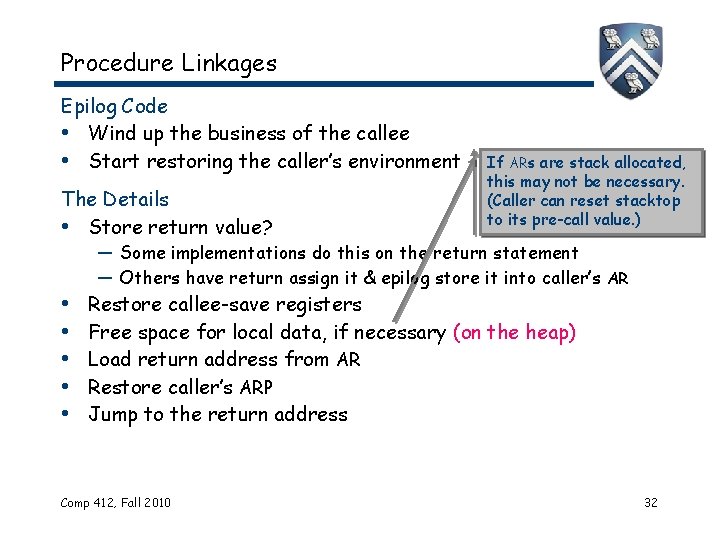
Procedure Linkages Epilog Code • Wind up the business of the callee • Start restoring the caller’s environment The Details • Store return value? • • • If ARs are stack allocated, this may not be necessary. (Caller can reset stacktop to its pre-call value. ) — Some implementations do this on the return statement — Others have return assign it & epilog store it into caller’s AR Restore callee-save registers Free space for local data, if necessary (on the heap) Load return address from AR Restore caller’s ARP Jump to the return address Comp 412, Fall 2010 32
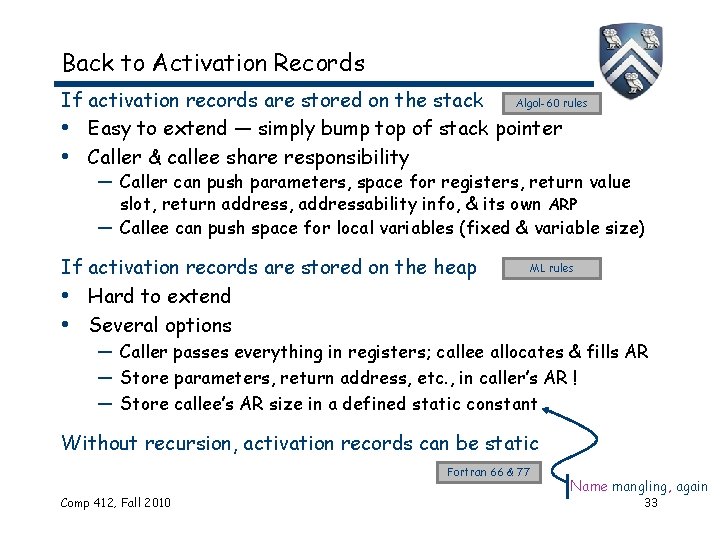
Back to Activation Records If activation records are stored on the stack Algol-60 rules • Easy to extend — simply bump top of stack pointer • Caller & callee share responsibility — Caller can push parameters, space for registers, return value slot, return address, addressability info, & its own ARP — Callee can push space for local variables (fixed & variable size) If activation records are stored on the heap • Hard to extend • Several options ML rules — Caller passes everything in registers; callee allocates & fills AR — Store parameters, return address, etc. , in caller’s AR ! — Store callee’s AR size in a defined static constant Without recursion, activation records can be static Fortran 66 & 77 Comp 412, Fall 2010 Name mangling, again 33
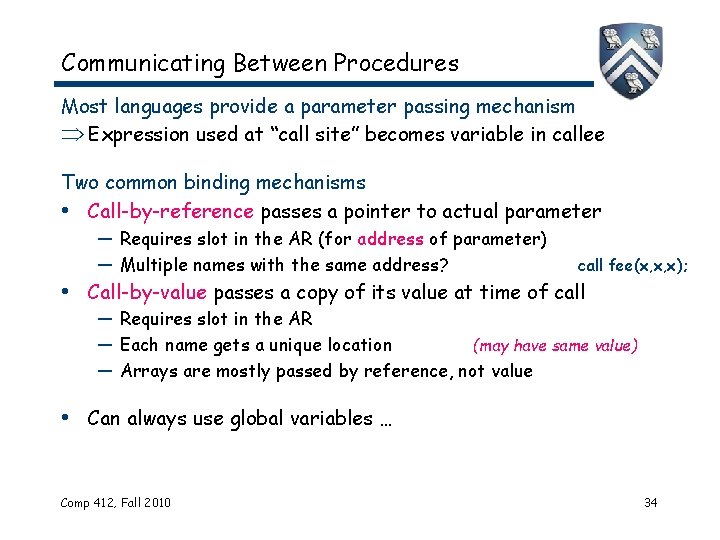
Communicating Between Procedures Most languages provide a parameter passing mechanism Expression used at “call site” becomes variable in callee Two common binding mechanisms • Call-by-reference passes a pointer to actual parameter — Requires slot in the AR (for address of parameter) — Multiple names with the same address? call fee(x, x, x); • Call-by-value passes a copy of its value at time of call — Requires slot in the AR — Each name gets a unique location (may have same value) — Arrays are mostly passed by reference, not value • Can always use global variables … Comp 412, Fall 2010 34
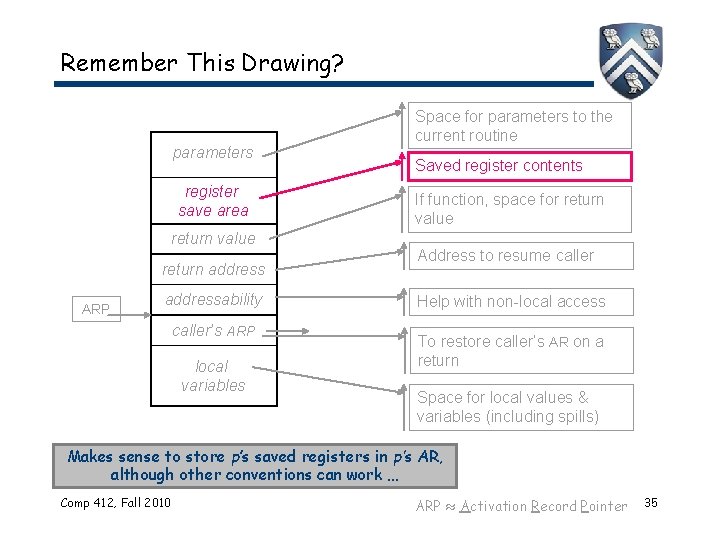
Remember This Drawing? parameters register save area return value return address ARP addressability caller’s ARP local variables Space for parameters to the current routine Saved register contents If function, space for return value Address to resume caller Help with non-local access To restore caller’s AR on a return Space for local values & variables (including spills) Makes sense to store p’s saved registers in p’s AR, although other conventions can work … Comp 412, Fall 2010 ARP Activation Record Pointer 35
More Thoughts on Register Save Code Both memory access costs and number of registers are rising • Cost of register save is rising (time, code space, data space ) • Worth exploring alternatives Register Windows • Register windows were a hot idea in the late 1980 s • Worked well for shallow calls with high register pressure • Register stack overflows, leaf procedures hurt A Software Approach • • Store caller saves & callee saves together Use library routine for save & restore Caller stores mask in callee’s AR Callee stores its mask, a return address, and jumps to routine Saves code space & allows for customization Comp 412, Fall 2010 36
Back to Activation Records If activation records are stored on the stack • Easy to extend — simply bump top of stack pointer • Caller & callee share responsibility — Caller can push parameters, space for registers, return value slot, return address, addressability info, & its own ARP — Callee can push space for local variables (fixed & variable size) If activation records are stored on the heap • Hard to extend an allocated AR • Either defer AR allocation into callee Requires one extra register — Caller passes everything it can in registers — Callee allocates AR & stores register contents into it Extra parameters stored in caller’s AR ! • Or, callee allocates a local data area on the heap Static (e. g. , non-recursive) is easy and inexpensive Comp 412, Fall 2010 37
- Slides: 38