
COMP 3000 ObjectOriented Programming for Engineers and Scientists
COMP 3000 Object-Oriented Programming for Engineers and Scientists Strings (part 2) Dr. Xiao Qin Auburn University http: //www. eng. auburn. edu/~xqin@auburn. edu These slides are adapted from notes by Dr. Walter Savitch (UCSD)
C-String Output • Can output with insertion operator, << • As we’ve been doing already: cout << news << " Wow. n"; – Where news is a c-string variable • Possible because << operator is overloaded for c-strings! 9 -2 Copyright © 2010 Pearson Addison. Wesley. All
![Exercise 1 • What C-string will be stored in my. String? char my. String[30]](http://slidetodoc.com/presentation_image/7728c56b88ede56479e7bbfff8a1f2af/image-3.jpg "Exercise 1 • What C-string will be stored in my. String? char my. String[30]")
Exercise 1 • What C-string will be stored in my. String? char my. String[30] = “Hello”; strcat(my. String, “ world!”); 9 -3
![Exercise 2 • What is wrong with the following code? char course. String[] =](http://slidetodoc.com/presentation_image/7728c56b88ede56479e7bbfff8a1f2af/image-4.jpg "Exercise 2 • What is wrong with the following code? char course. String[] =")
Exercise 2 • What is wrong with the following code? char course. String[] = “comp 3000”; strcat(course. String, “ programming”); 9 -4
![Exercise 3 • What is the output? char photo[30] = “beautiful”; Char myphoto[30]; strcpy(myphoto,](http://slidetodoc.com/presentation_image/7728c56b88ede56479e7bbfff8a1f2af/image-5.jpg "Exercise 3 • What is the output? char photo[30] = “beautiful”; Char myphoto[30]; strcpy(myphoto,")
Exercise 3 • What is the output? char photo[30] = “beautiful”; Char myphoto[30]; strcpy(myphoto, photo); strcat(myphoto, “ picture!”); Cout << myphoto << endl; 9 -5
C-String Input (demo: cstring. cpp) • Can input with extraction operator, >> – Issues exist, however • Whitespace is "delimiter" – Tab, space, line breaks are "skipped" – Input reading "stops" at delimiter • Watch size of c-string • Must be large enough to hold entered string! • C++ gives no warnings of such issues! 9 -6
![Exercise 4 What is the output? • char a[80], b[80]; cout << "Enter input:](http://slidetodoc.com/presentation_image/7728c56b88ede56479e7bbfff8a1f2af/image-7.jpg "Exercise 4 What is the output? • char a[80], b[80]; cout << \"Enter input:")
Exercise 4 What is the output? • char a[80], b[80]; cout << "Enter input: "; cin >> a >> b; cout << a << b << "END OF OUTPUTn"; • Dialogue offered: Enter input: Do be do to you! Dobe. END OF OUTPUT – Note: Underlined portion typed at keyboard • C-string a receives: “Do" • C-string b receives: "be" 9 -7
C-String Line Input Demo: getline. cpp • Can receive entire line into c-string • Use getline(), a predefined member function: char a[80]; cout << "Enter input: "; cin. getline(a, 80); cout << a << "END OF OUTPUTn"; – Dialogue: Enter input: Do be do to you!END OF INPUT 9 -8 Copyright © 2010 Pearson Addison. Wesley. All
![More getline() • Can explicitly tell length to receive: char short. String[5]; cout <<](http://slidetodoc.com/presentation_image/7728c56b88ede56479e7bbfff8a1f2af/image-9.jpg "More getline() • Can explicitly tell length to receive: char short. String[5]; cout <<")
More getline() • Can explicitly tell length to receive: char short. String[5]; cout << "Enter input: "; cin. getline(short. String, 5); cout << short. String << "END OF OUTPUTn"; – Results: Enter input: dobedowap dobe. END OF OUTPUT – Forces FOUR characters only be read • Recall need for null character! 9 -9 Copyright © 2010 Pearson Addison. Wesley. All
Example: Command Line Arguments • Programs invoked from the command line (e. g. a UNIX shell, DOS command prompt) can be sent arguments – Example: COPY C: FOO. TXT D: FOO 2. TXT • This runs the program named “COPY” and sends in two C-String parameters, “C: FOO. TXT” and “D: FOO 2. TXT” • It is up to the COPY program to process the inputs presented to it; i. e. actually copy the files • Arguments are passed as an array of C-Strings to the main function 9 -10
![Example: Command Line Arguments • Header for main – int main(int argc, char *argv[])](http://slidetodoc.com/presentation_image/7728c56b88ede56479e7bbfff8a1f2af/image-11.jpg "Example: Command Line Arguments • Header for main – int main(int argc, char *argv[])")
Example: Command Line Arguments • Header for main – int main(int argc, char *argv[]) – argc specifies how many arguments are supplied. The name of the program counts, so argc will be at least 1. – argv is an array of C-Strings. • • argv[0] holds the name of the program that is invoked argv[1] holds the name of the first parameter argv[2] holds the name of the second parameter Etc. 9 -11 Copyright © 2010 Pearson Addison. Wesley. All
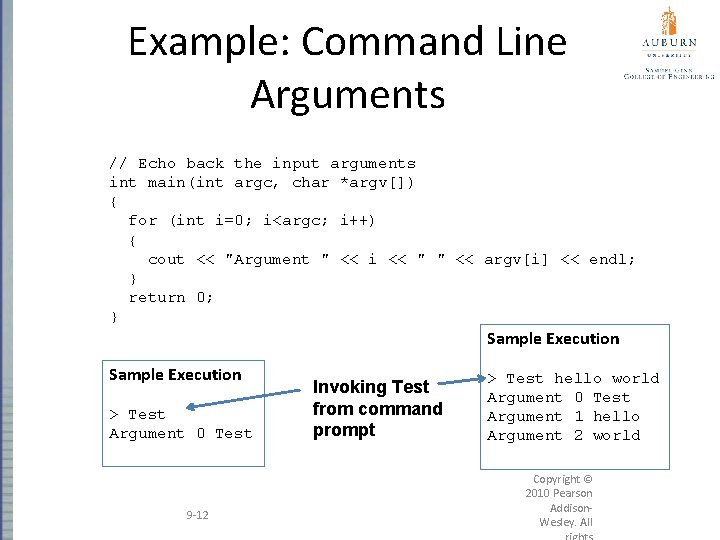
Example: Command Line Arguments // Echo back the input arguments int main(int argc, char *argv[]) { for (int i=0; i<argc; i++) { cout << "Argument " << i << " " << argv[i] << endl; } return 0; } Sample Execution > Test Argument 0 Test 9 -12 Invoking Test from command prompt > Test hello world Argument 0 Test Argument 1 hello Argument 2 world Copyright © 2010 Pearson Addison. Wesley. All

Character I/O • Input and output data – ALL treated as character data – e. g. , number 10 outputted as "1" and "0" – Conversion done automatically • Uses low-level utilities • Can use same low-level utilities ourselves as well 9 -13 Copyright © 2010 Pearson Addison. Wesley. All

Member Function get() • Reads one char at a time • Member function of cin object: char next. Symbol; cin. get(next. Symbol); – Reads next char & puts in variable next. Symbol – Argument must be char type • Not "string"! 9 -14
Member Function put() • Outputs one character at a time • Member function of cout object: • Examples: cout. put("a"); – Outputs letter "a" to screen char my. String[10] = "Hello"; cout. put(my. String[1]); – Outputs letter "e" to screen 9 -15 Copyright © 2010 Pearson Addison. Wesley. All
More Member Functions • putback() – Once read, might need to "put back" – cin. putback(last. Char); • peek() – Returns next char, but leaves it there – peek. Char = cin. peek(); • ignore() – Skip input, up to designated character – cin. ignore(1000, "n"); • Skips at most 1000 characters until "n" 9 -16 Copyright © 2010 Pearson Addison. Wesley. All

Character-Manipulating Functions: Display 9. 3 Some Functions in <cctype> (1 of 3) Copyright © 2010 Pearson Addison-Wesley. All rights reserved. 9 -17

Character-Manipulating Functions: Display 9. 3 Some Functions in <cctype> (2 of 3) Copyright © 2010 Pearson Addison-Wesley. All rights reserved. 9 -18

Character-Manipulating Functions: Display 9. 3 Some Functions in <cctype> (3 of 3) Copyright © 2010 Pearson Addison-Wesley. All rights reserved. 9 -19
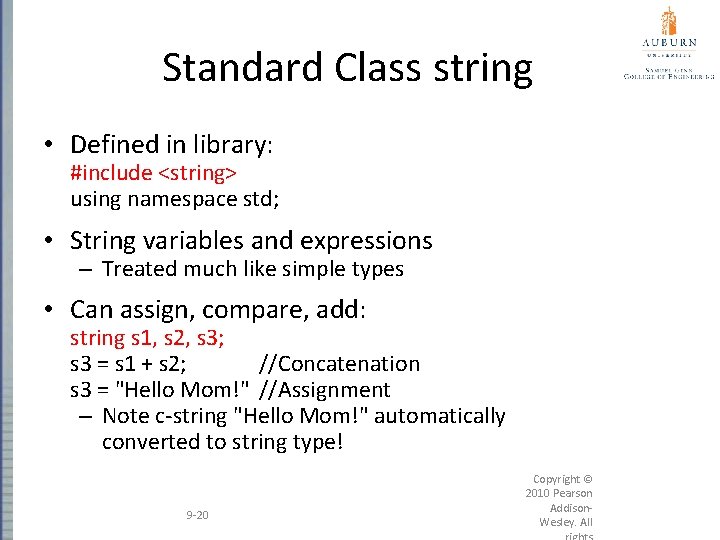
Standard Class string • Defined in library: #include <string> using namespace std; • String variables and expressions – Treated much like simple types • Can assign, compare, add: string s 1, s 2, s 3; s 3 = s 1 + s 2; //Concatenation s 3 = "Hello Mom!" //Assignment – Note c-string "Hello Mom!" automatically converted to string type! 9 -20 Copyright © 2010 Pearson Addison. Wesley. All

Display 9. 4 Program Using the Class string Copyright © 2010 Pearson Addison-Wesley. All rights reserved. 9 -21
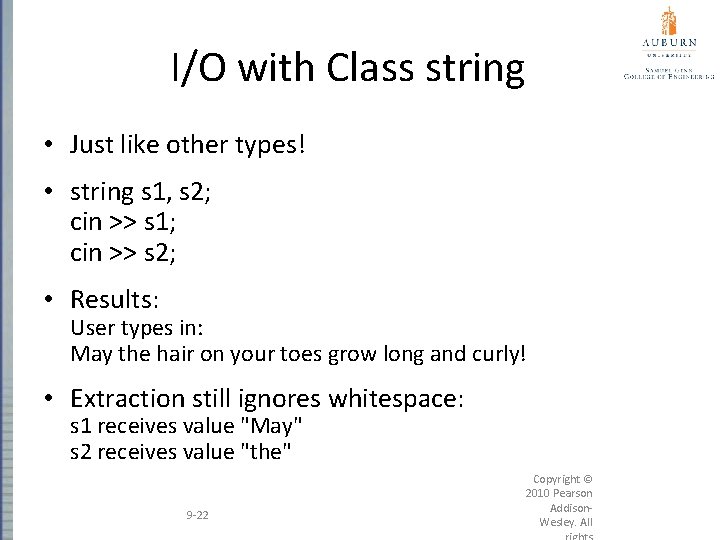
I/O with Class string • Just like other types! • string s 1, s 2; cin >> s 1; cin >> s 2; • Results: User types in: May the hair on your toes grow long and curly! • Extraction still ignores whitespace: s 1 receives value "May" s 2 receives value "the" 9 -22 Copyright © 2010 Pearson Addison. Wesley. All

getline() with Class string • For complete lines: string line; cout << "Enter a line of input: "; getline(cin, line); cout << line << "END OF OUTPUT"; • Dialogue produced: Enter a line of input: Do be do to you!END OF INPUT – Similar to c-string’s usage of getline() 9 -23 Copyright © 2010 Pearson Addison. Wesley. All
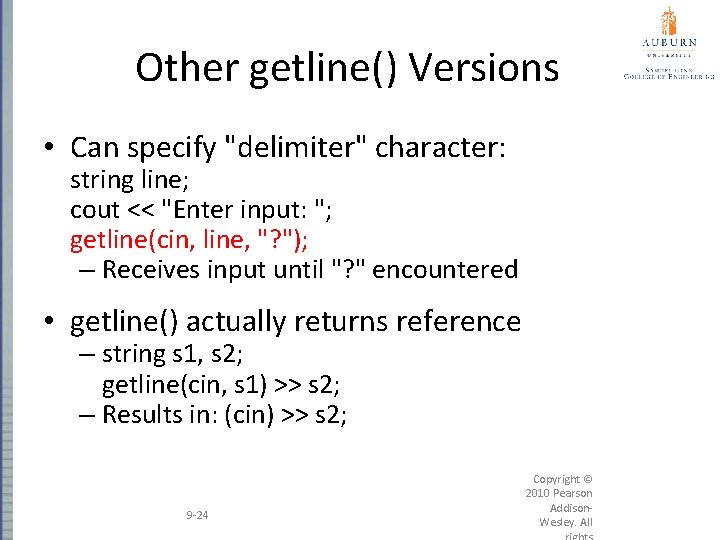
Other getline() Versions • Can specify "delimiter" character: string line; cout << "Enter input: "; getline(cin, line, "? "); – Receives input until "? " encountered • getline() actually returns reference – string s 1, s 2; getline(cin, s 1) >> s 2; – Results in: (cin) >> s 2; 9 -24 Copyright © 2010 Pearson Addison. Wesley. All

Pitfall: Mixing Input Methods • Be careful mixing cin >> var and getline – int n; string line; cin >> n; getline(cin, line); – If input is: 42 Hello hitchhiker. • Variable n set to 42 • line set to empty string! – cin >> n skipped leading whitespace, leaving "n" on stream for getline()! 9 -25 Copyright © 2010 Pearson Addison. Wesley. All

Class string Processing • Same operations available as c-strings • And more! – Over 100 members of standard string class • Some member functions: –. length() • Returns length of string variable –. at(i) • Returns reference to char at position i 9 -26 Copyright © 2010 Pearson Addison. Wesley. All

Display 9. 7 Member Functions of the Standard Class string (1 of 2) Copyright © 2010 Pearson Addison-Wesley. All rights reserved. 9 -27
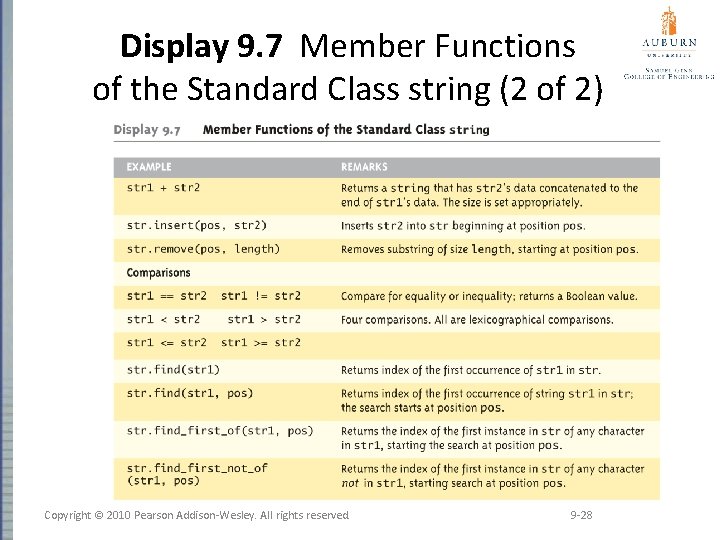
Display 9. 7 Member Functions of the Standard Class string (2 of 2) Copyright © 2010 Pearson Addison-Wesley. All rights reserved. 9 -28
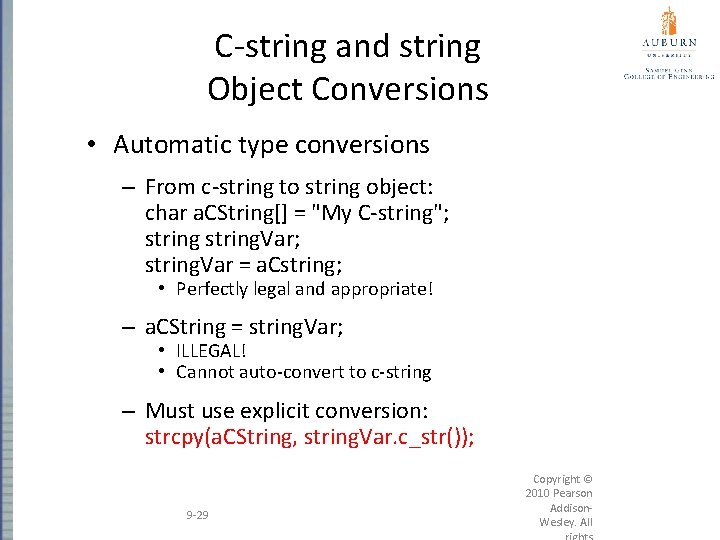
C-string and string Object Conversions • Automatic type conversions – From c-string to string object: char a. CString[] = "My C-string"; string. Var; string. Var = a. Cstring; • Perfectly legal and appropriate! – a. CString = string. Var; • ILLEGAL! • Cannot auto-convert to c-string – Must use explicit conversion: strcpy(a. CString, string. Var. c_str()); 9 -29 Copyright © 2010 Pearson Addison. Wesley. All
Summary • C-string variable is "array of characters" – With addition of null character, "" • C-strings act like arrays – Cannot assign, compare like simple variables • Libraries <cctype> & <string> have useful manipulating functions • cin. get() reads next single character • getline() versions allow full line reading • Class string objects are better-behaved than c-strings 9 -30 Copyright © 2010 Pearson Addison. Wesley. All
- Slides: 30