
COMP 2710 Software Construction Inheritance Dr Xiao Qin
- Slides: 17
COMP 2710 Software Construction Inheritance Dr. Xiao Qin Auburn University http: //www. eng. auburn. edu/~xqin@auburn. edu These slides are adapted from notes by Dr. Walter Savitch (UCSD)
Introduction to Inheritance • Object-oriented programming – Powerful programming technique – Provides abstraction dimension called inheritance • General form of class is defined – Specialized versions then inherit properties of general class – And add to it/modify it’s functionality for it’s appropriate use Copyright © 2010 Pearson Addison-Wesley. All rights reserved. 14 -2
Inheritance Terminology • Common to simulate family relationships • Parent class – Refers to base class • Child class – Refers to derived class • Ancestor class – Class that’s a parent of a parent … • Descendant class – Opposite of ancestor Copyright © 2010 Pearson Addison-Wesley. All rights reserved. 14 -3
Inheritance Basics • New class inherited from another class • Base class – "General" class from which others derive • Derived class – New class – Automatically has base class’s: • Member variables • Member functions – Can then additional member functions and variables Copyright © 2010 Pearson Addison-Wesley. All rights reserved. 14 -4
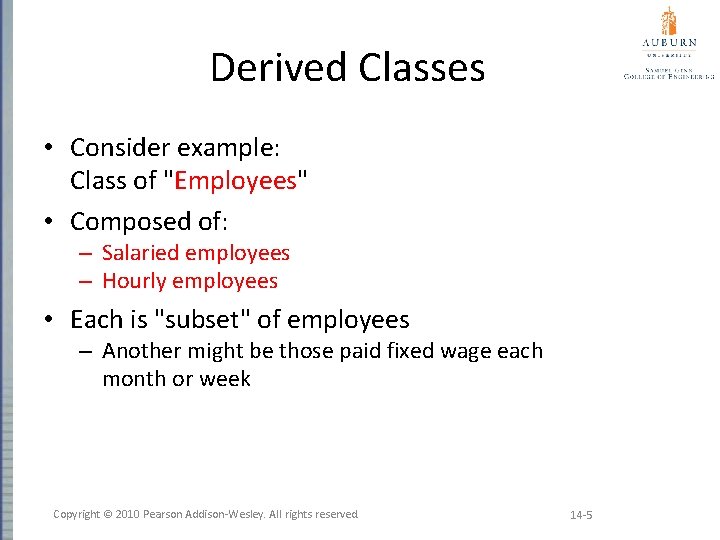
Derived Classes • Consider example: Class of "Employees" • Composed of: – Salaried employees – Hourly employees • Each is "subset" of employees – Another might be those paid fixed wage each month or week Copyright © 2010 Pearson Addison-Wesley. All rights reserved. 14 -5
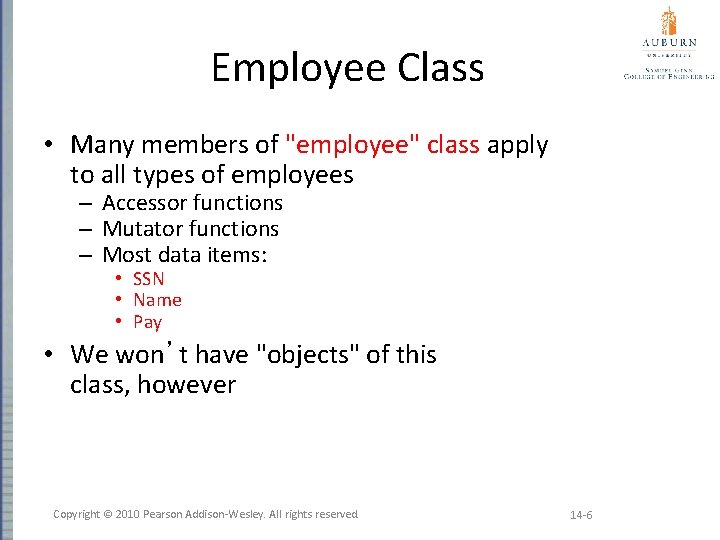
Employee Class • Many members of "employee" class apply to all types of employees – Accessor functions – Mutator functions – Most data items: • SSN • Name • Pay • We won’t have "objects" of this class, however Copyright © 2010 Pearson Addison-Wesley. All rights reserved. 14 -6
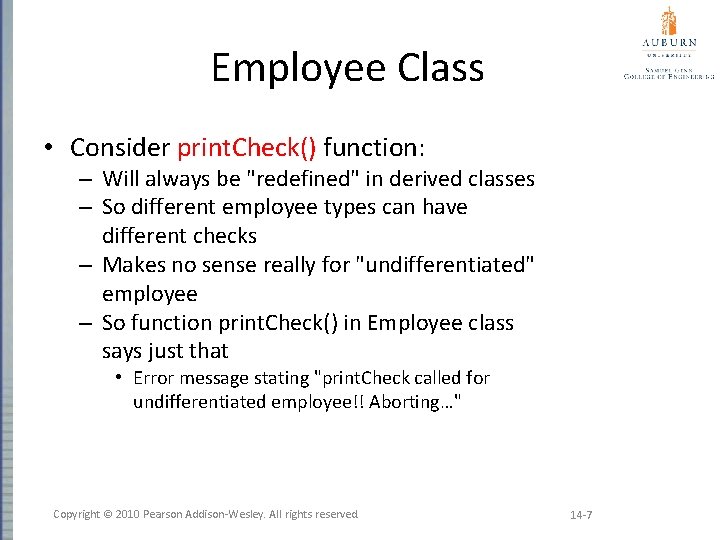
Employee Class • Consider print. Check() function: – Will always be "redefined" in derived classes – So different employee types can have different checks – Makes no sense really for "undifferentiated" employee – So function print. Check() in Employee class says just that • Error message stating "print. Check called for undifferentiated employee!! Aborting…" Copyright © 2010 Pearson Addison-Wesley. All rights reserved. 14 -7
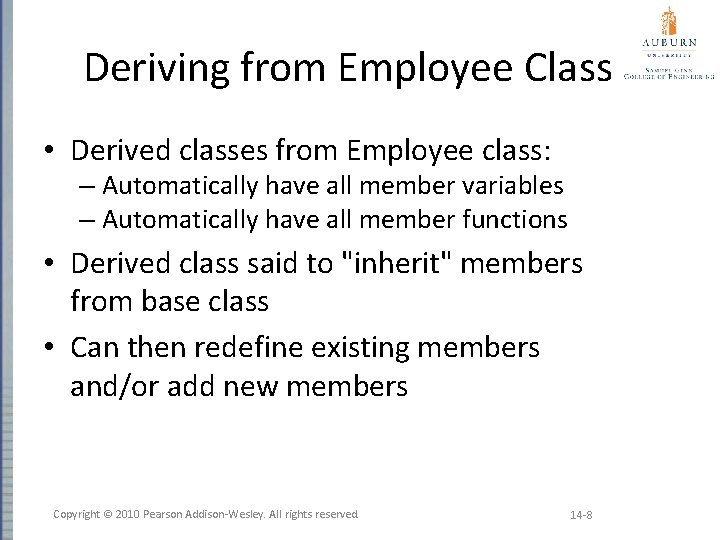
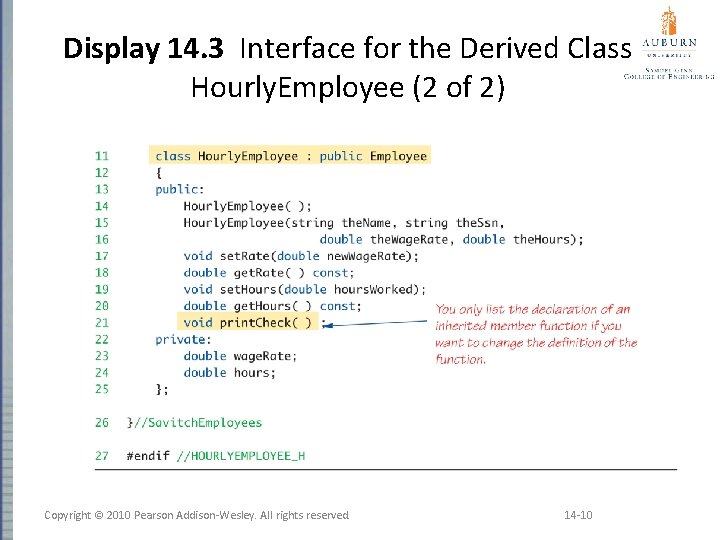
Deriving from Employee Class • Derived classes from Employee class: – Automatically have all member variables – Automatically have all member functions • Derived class said to "inherit" members from base class • Can then redefine existing members and/or add new members Copyright © 2010 Pearson Addison-Wesley. All rights reserved. 14 -8
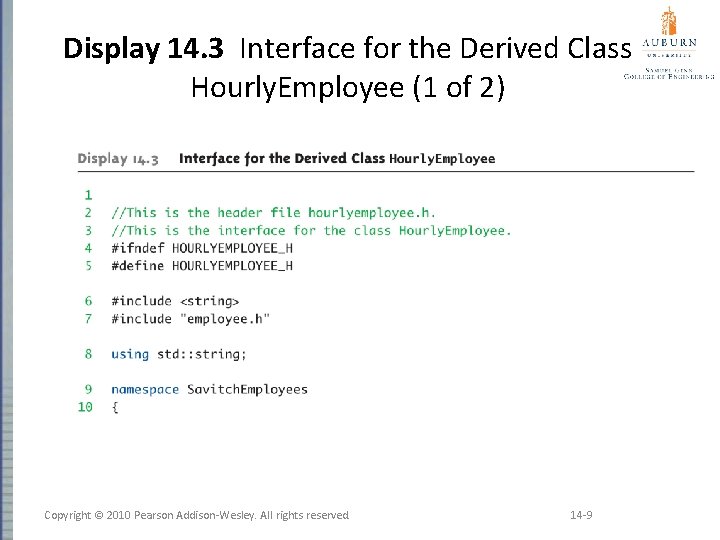
Display 14. 3 Interface for the Derived Class Hourly. Employee (1 of 2) Copyright © 2010 Pearson Addison-Wesley. All rights reserved. 14 -9
Display 14. 3 Interface for the Derived Class Hourly. Employee (2 of 2) Copyright © 2010 Pearson Addison-Wesley. All rights reserved. 14 -10
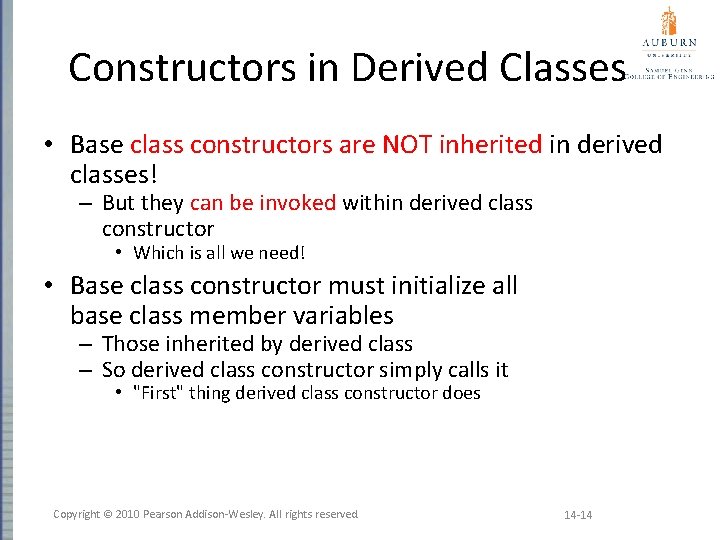
Constructors in Derived Classes • Base class constructors are NOT inherited in derived classes! – But they can be invoked within derived class constructor • Which is all we need! • Base class constructor must initialize all base class member variables – Those inherited by derived class – So derived class constructor simply calls it • "First" thing derived class constructor does Copyright © 2010 Pearson Addison-Wesley. All rights reserved. 14 -14
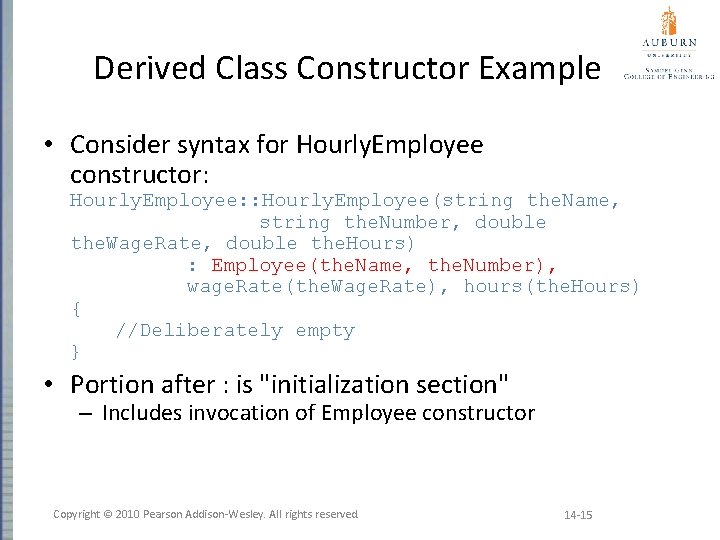
Derived Class Constructor Example • Consider syntax for Hourly. Employee constructor: Hourly. Employee: : Hourly. Employee(string the. Name, string the. Number, double the. Wage. Rate, double the. Hours) : Employee(the. Name, the. Number), wage. Rate(the. Wage. Rate), hours(the. Hours) { //Deliberately empty } • Portion after : is "initialization section" – Includes invocation of Employee constructor Copyright © 2010 Pearson Addison-Wesley. All rights reserved. 14 -15
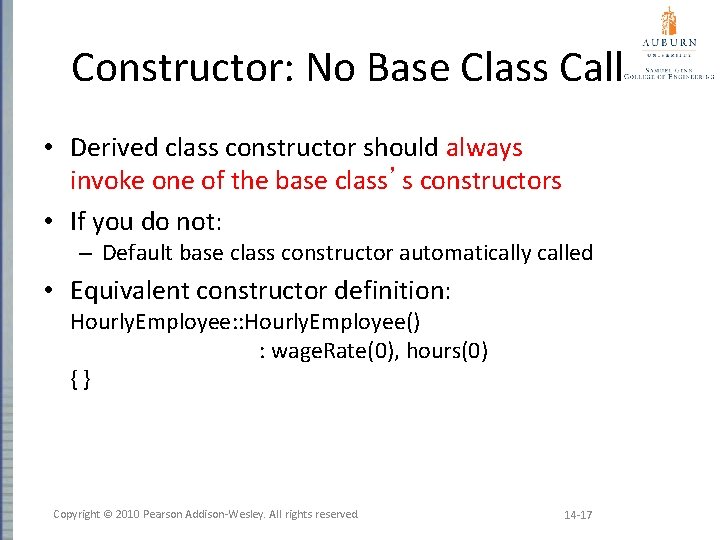
Constructor: No Base Class Call • Derived class constructor should always invoke one of the base class’s constructors • If you do not: – Default base class constructor automatically called • Equivalent constructor definition: Hourly. Employee: : Hourly. Employee() : wage. Rate(0), hours(0) {} Copyright © 2010 Pearson Addison-Wesley. All rights reserved. 14 -17
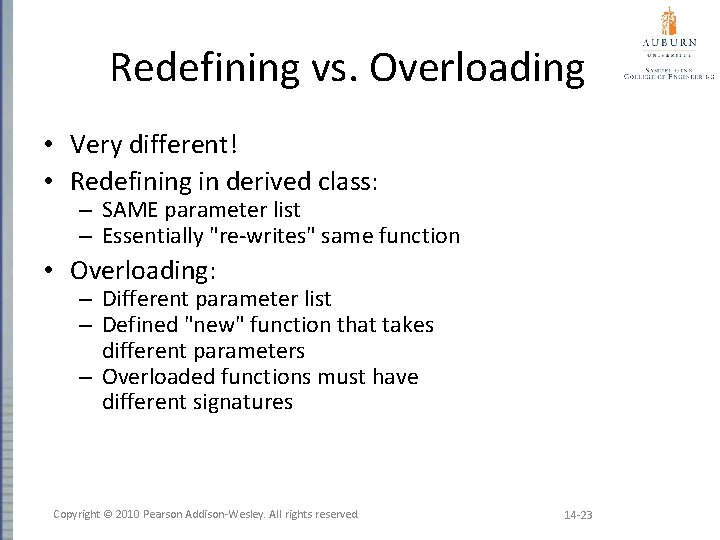
Redefining vs. Overloading • Very different! • Redefining in derived class: – SAME parameter list – Essentially "re-writes" same function • Overloading: – Different parameter list – Defined "new" function that takes different parameters – Overloaded functions must have different signatures Copyright © 2010 Pearson Addison-Wesley. All rights reserved. 14 -23
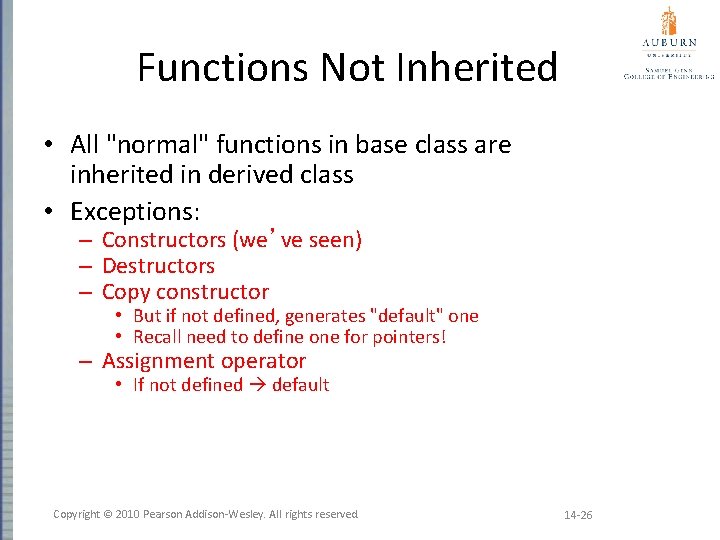
Functions Not Inherited • All "normal" functions in base class are inherited in derived class • Exceptions: – Constructors (we’ve seen) – Destructors – Copy constructor • But if not defined, generates "default" one • Recall need to define one for pointers! – Assignment operator • If not defined default Copyright © 2010 Pearson Addison-Wesley. All rights reserved. 14 -26
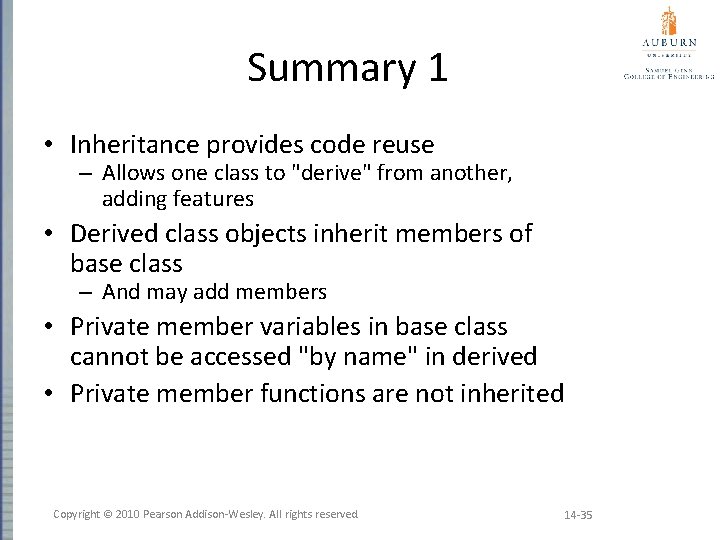
Summary 1 • Inheritance provides code reuse – Allows one class to "derive" from another, adding features • Derived class objects inherit members of base class – And may add members • Private member variables in base class cannot be accessed "by name" in derived • Private member functions are not inherited Copyright © 2010 Pearson Addison-Wesley. All rights reserved. 14 -35
Summary 2 • Can redefine inherited member functions – To perform differently in derived class • Protected members in base class: – Can be accessed "by name" in derived class member functions • Overloaded assignment operator not inherited – But can be invoked from derived class • Constructors are not inherited – Are invoked from derived class’s constructor Copyright © 2010 Pearson Addison-Wesley. All rights reserved. 14 -36