
COMP 211 Computer Logic Design Lecture 2 Logic
- Slides: 33
COMP 211 Computer Logic Design Lecture 2. Logic Gates Prof. Taeweon Suh Computer Science Education Korea University
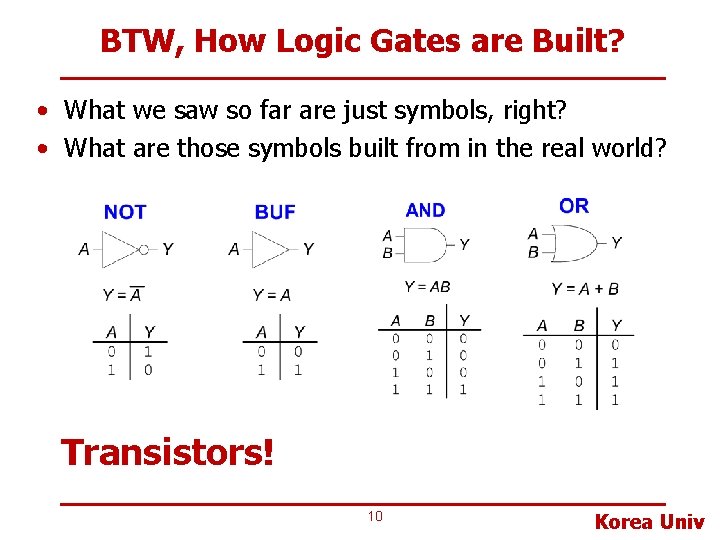
Logic Gates • Logic gates are simple digital circuits that take one or more binary inputs and produce a binary output § Single-input logic gates • Inverter, Buffer § Two-input logic gates • AND, OR, XOR, NAND, NOR, XNOR etc § Multiple-input logic gates • AND, OR, XOR, NAND, NOR, XNOR etc • Logic gates are prepared for you in the library of Computer-Aided Design (CAD) tools 2 Korea Univ
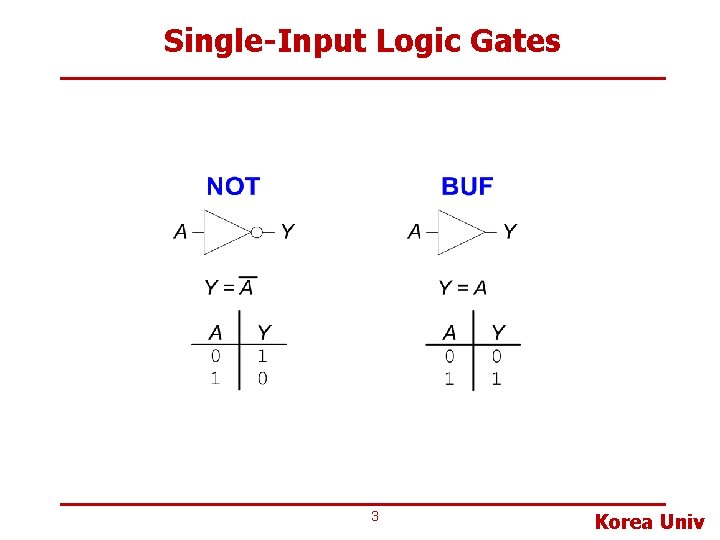
Single-Input Logic Gates 3 Korea Univ
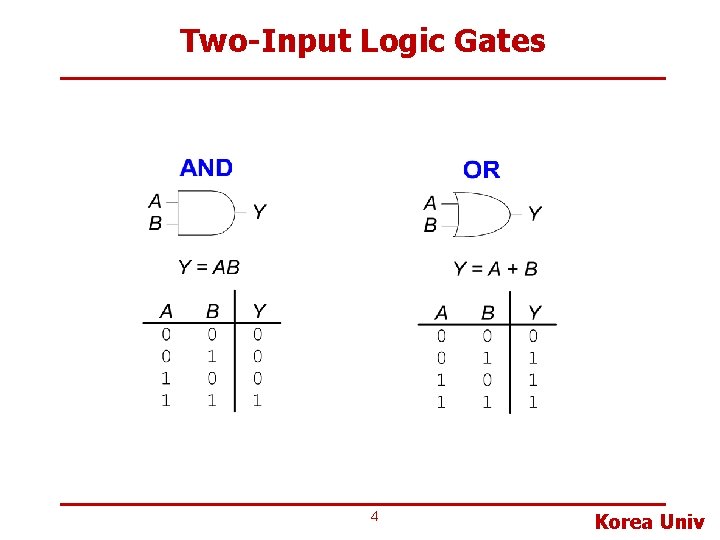
Two-Input Logic Gates 4 Korea Univ
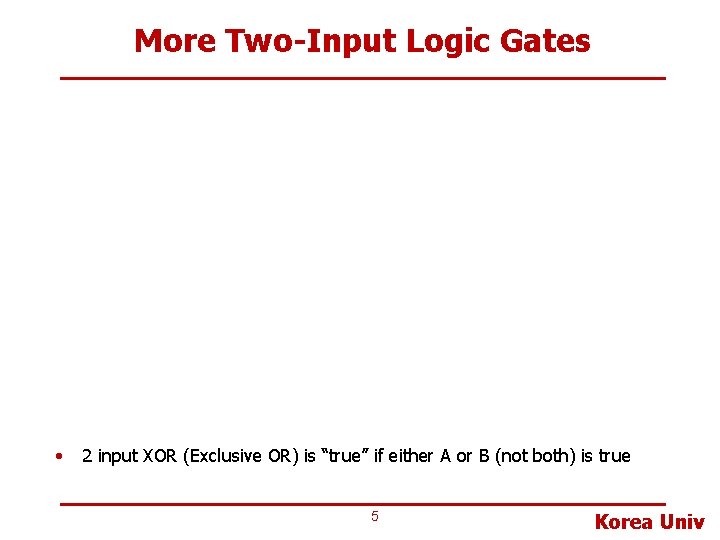
More Two-Input Logic Gates • 2 input XOR (Exclusive OR) is “true” if either A or B (not both) is true 5 Korea Univ
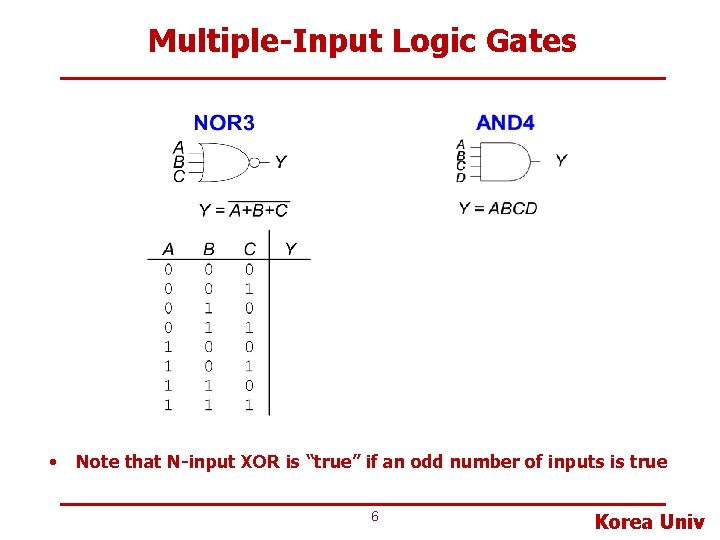
Multiple-Input Logic Gates • Note that N-input XOR is “true” if an odd number of inputs is true 6 Korea Univ
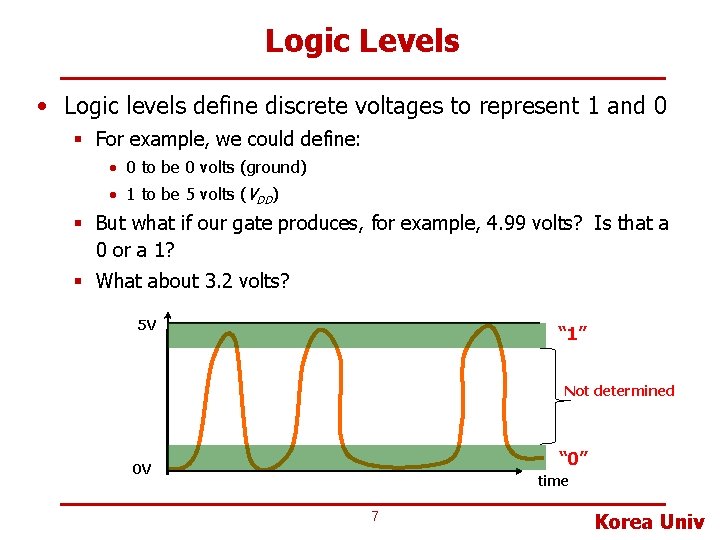
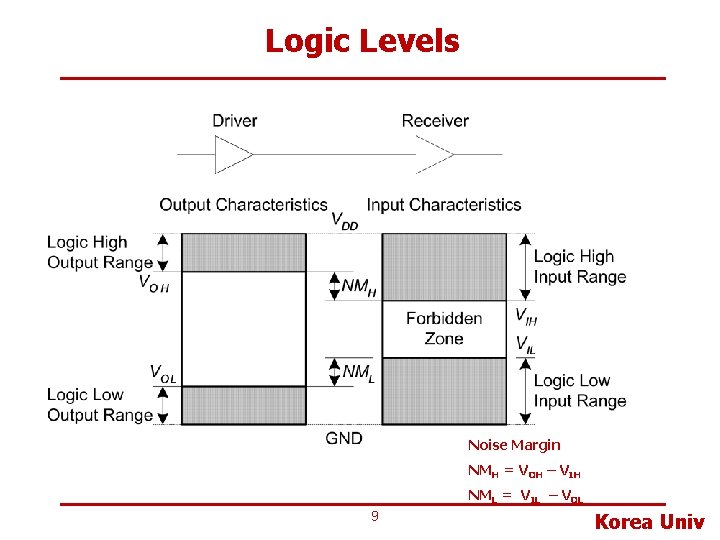
Logic Levels • Logic levels define discrete voltages to represent 1 and 0 § For example, we could define: • 0 to be 0 volts (ground) • 1 to be 5 volts (VDD) § But what if our gate produces, for example, 4. 99 volts? Is that a 0 or a 1? § What about 3. 2 volts? 5 V “ 1” Not determined “ 0” 0 V time 7 Korea Univ
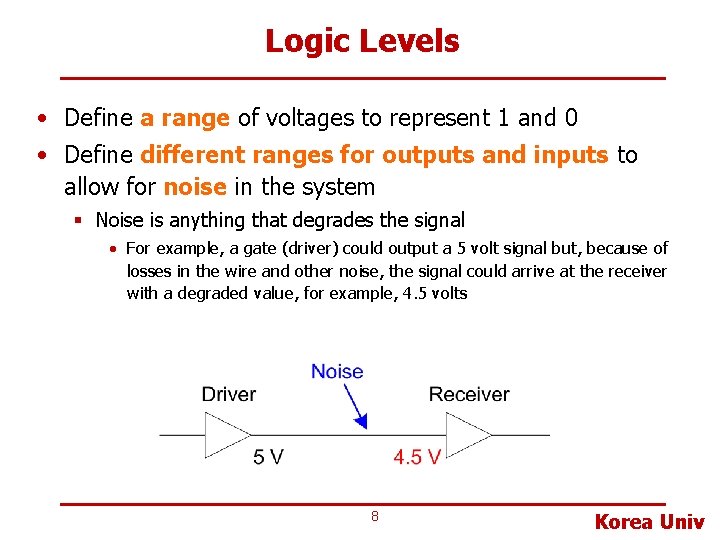
Logic Levels • Define a range of voltages to represent 1 and 0 • Define different ranges for outputs and inputs to allow for noise in the system § Noise is anything that degrades the signal • For example, a gate (driver) could output a 5 volt signal but, because of losses in the wire and other noise, the signal could arrive at the receiver with a degraded value, for example, 4. 5 volts 8 Korea Univ
Logic Levels Noise Margin NMH = VOH – VIH NML = VIL – VOL 9 Korea Univ
BTW, How Logic Gates are Built? • What we saw so far are just symbols, right? • What are those symbols built from in the real world? Transistors! 10 Korea Univ
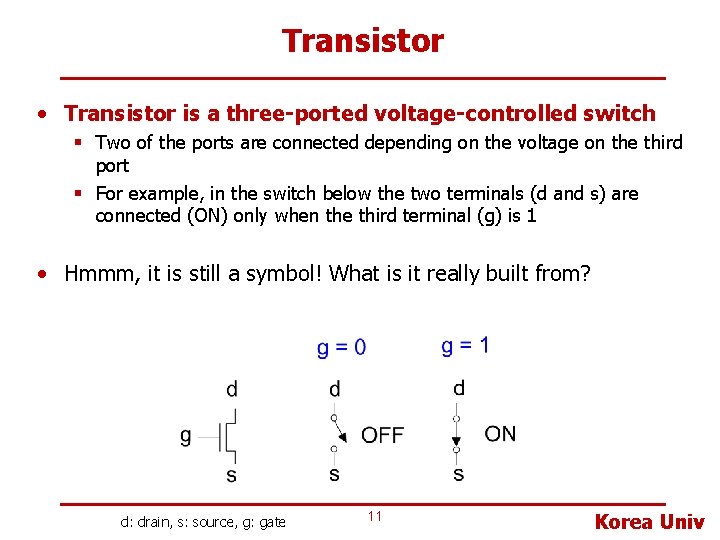
Transistor • Transistor is a three-ported voltage-controlled switch § Two of the ports are connected depending on the voltage on the third port § For example, in the switch below the two terminals (d and s) are connected (ON) only when the third terminal (g) is 1 • Hmmm, it is still a symbol! What is it really built from? d: drain, s: source, g: gate 11 Korea Univ
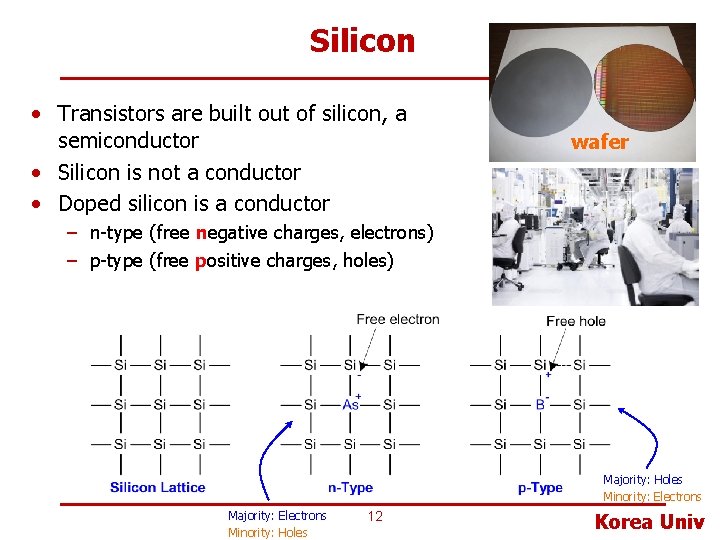
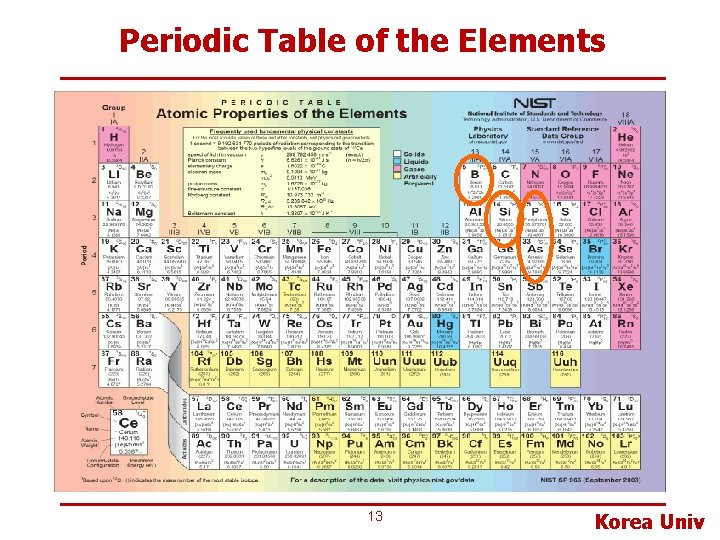
Silicon • Transistors are built out of silicon, a semiconductor • Silicon is not a conductor • Doped silicon is a conductor wafer – n-type (free negative charges, electrons) – p-type (free positive charges, holes) Majority: Holes Minority: Electrons Majority: Electrons Minority: Holes 12 Korea Univ
Periodic Table of the Elements 13 Korea Univ
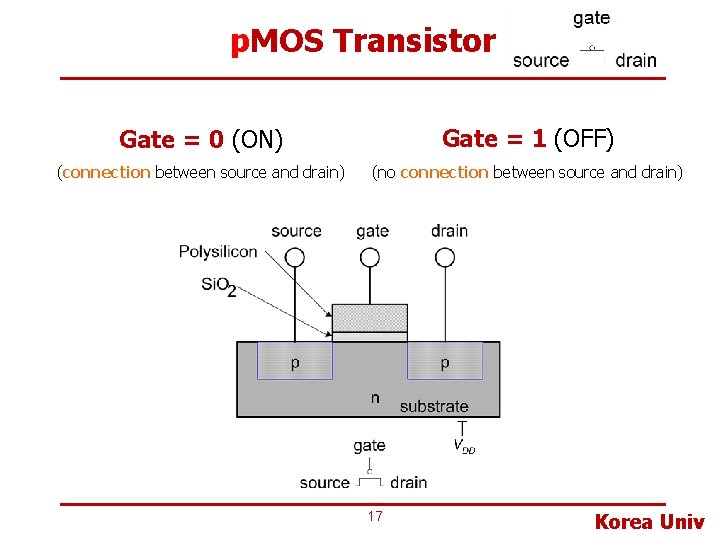
MOS Transistors • Metal oxide silicon (MOS) transistors: – Polysilicon (used to be Metal) gate – Oxide (silicon dioxide) insulator – Doped Silicon substrate and wells 14 Korea Univ
MOS Transistors • The MOS sandwich acts as a capacitor (two conductors with insulator between them) • When voltage is applied to the gate, the opposite charge is attracted to the semiconductor on the other side of the insulator, which could form a channel of charge 15 Korea Univ
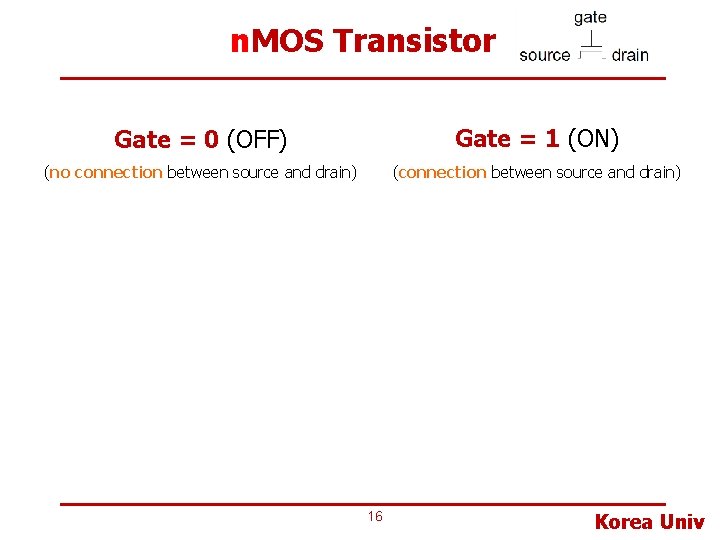
n. MOS Transistor Gate = 0 (OFF) Gate = 1 (ON) (no connection between source and drain) (connection between source and drain) 16 Korea Univ
p. MOS Transistor Gate = 0 (ON) Gate = 1 (OFF) (connection between source and drain) (no connection between source and drain) 17 Korea Univ
Transistor Function 18 Korea Univ
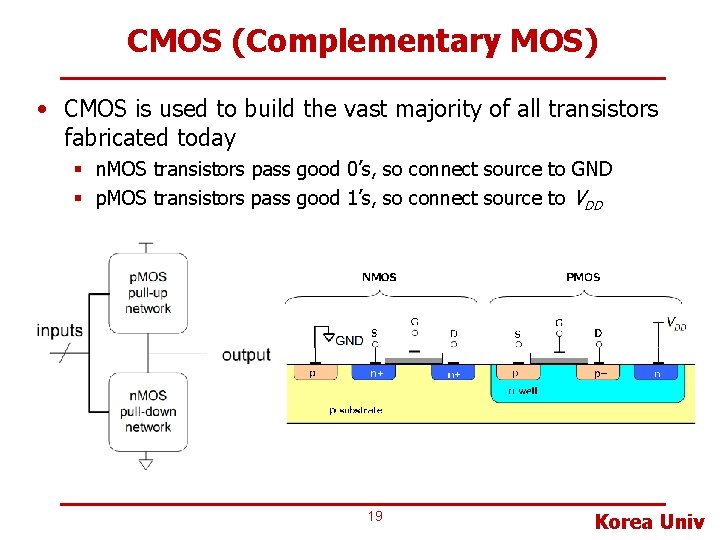
CMOS (Complementary MOS) • CMOS is used to build the vast majority of all transistors fabricated today § n. MOS transistors pass good 0’s, so connect source to GND § p. MOS transistors pass good 1’s, so connect source to VDD 19 Korea Univ
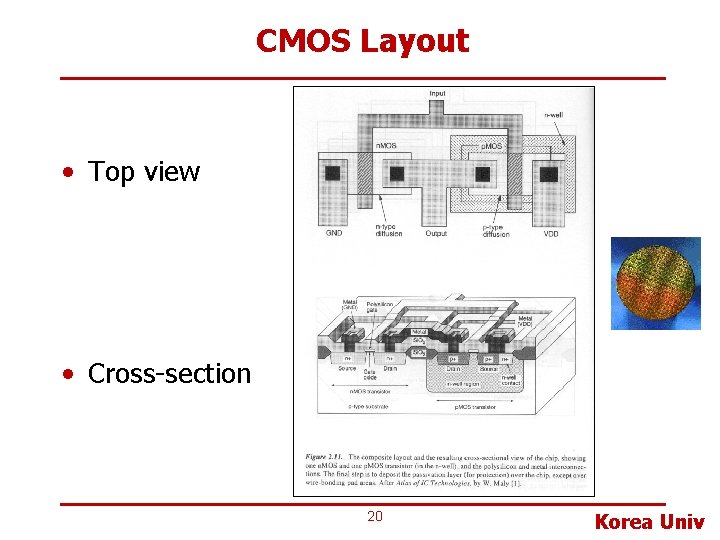
CMOS Layout • Top view • Cross-section 20 Korea Univ
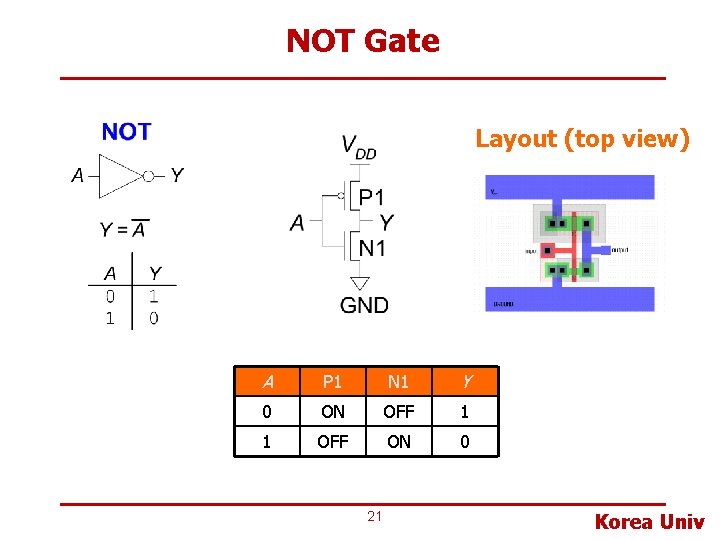
NOT Gate Layout (top view) A P 1 N 1 Y 0 ON OFF 1 1 OFF ON 0 21 Korea Univ
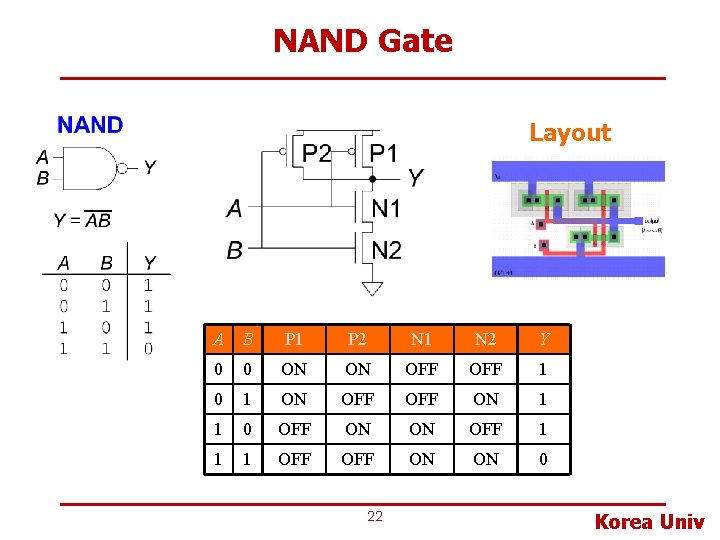
NAND Gate Layout A B P 1 P 2 N 1 N 2 Y 0 0 ON ON OFF 1 0 1 ON OFF ON 1 1 0 OFF ON ON OFF 1 1 1 OFF ON ON 0 22 Korea Univ
3 -Input NAND Gate • How do you build a three-input NAND gate? 23 Korea Univ
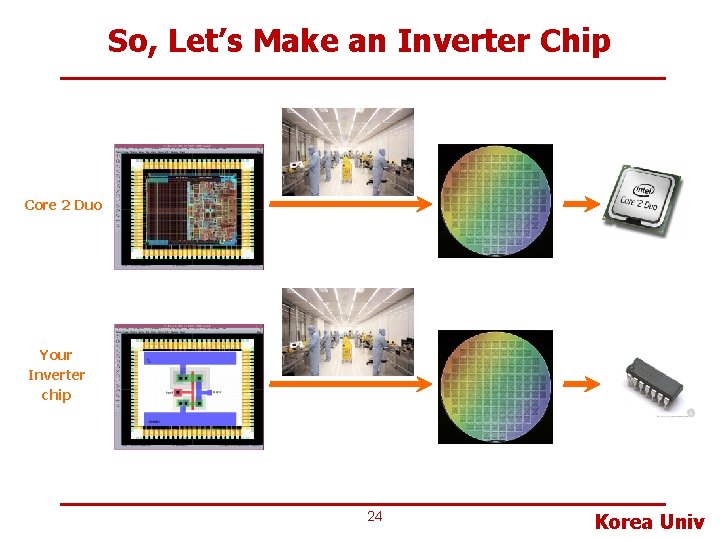
So, Let’s Make an Inverter Chip Core 2 Duo Your Inverter chip 24 Korea Univ
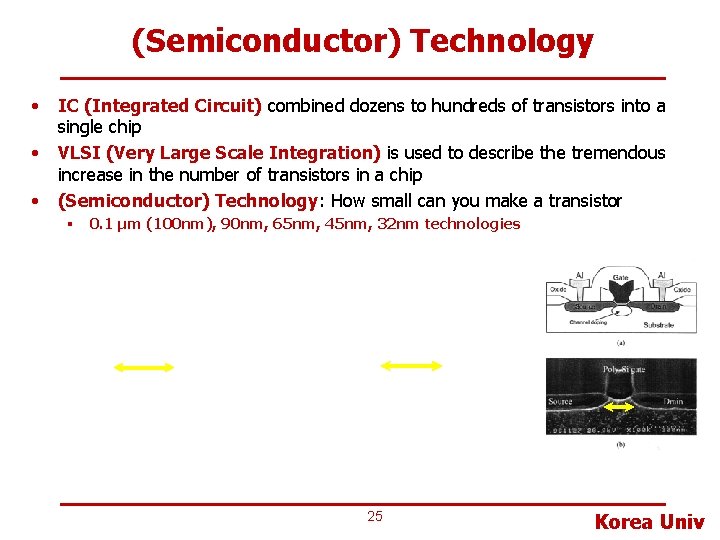
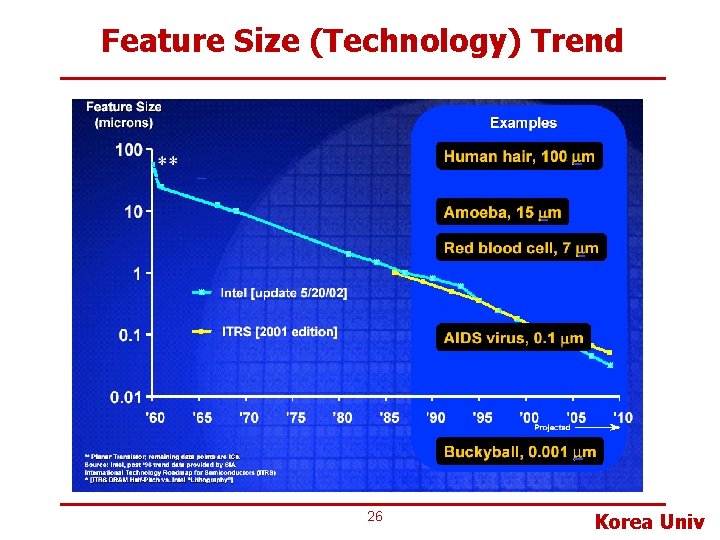
(Semiconductor) Technology • • • IC (Integrated Circuit) combined dozens to hundreds of transistors into a single chip VLSI (Very Large Scale Integration) is used to describe the tremendous increase in the number of transistors in a chip (Semiconductor) Technology: How small can you make a transistor § 0. 1 µm (100 nm), 90 nm, 65 nm, 45 nm, 32 nm technologies 25 Korea Univ
Feature Size (Technology) Trend 26 Korea Univ
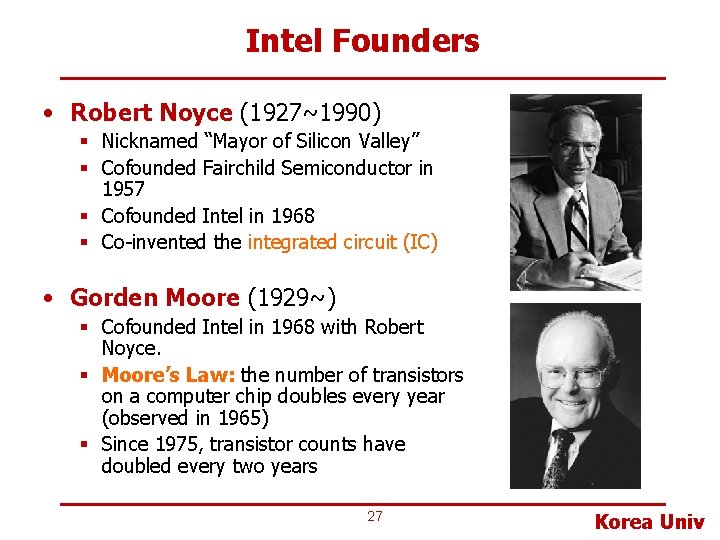
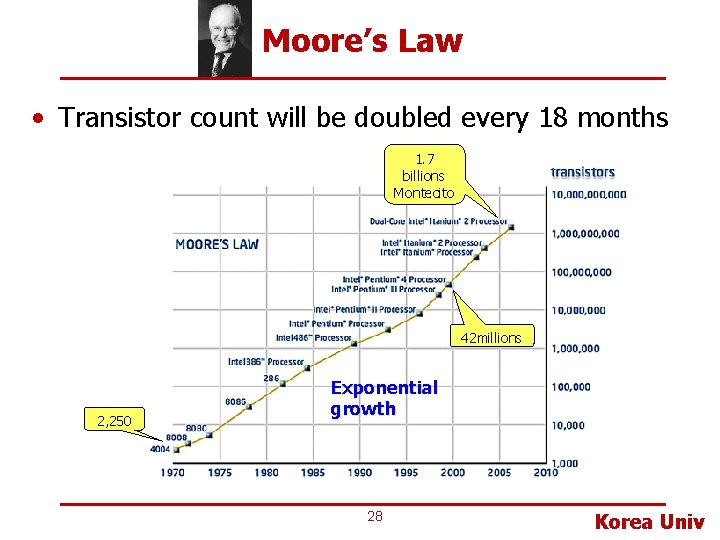
Intel Founders • Robert Noyce (1927~1990) § Nicknamed “Mayor of Silicon Valley” § Cofounded Fairchild Semiconductor in 1957 § Cofounded Intel in 1968 § Co-invented the integrated circuit (IC) • Gorden Moore (1929~) § Cofounded Intel in 1968 with Robert Noyce. § Moore’s Law: the number of transistors on a computer chip doubles every year (observed in 1965) § Since 1975, transistor counts have doubled every two years 27 Korea Univ
Moore’s Law • Transistor count will be doubled every 18 months 1. 7 billions Montecito 42 millions 2, 250 Exponential growth 28 Korea Univ
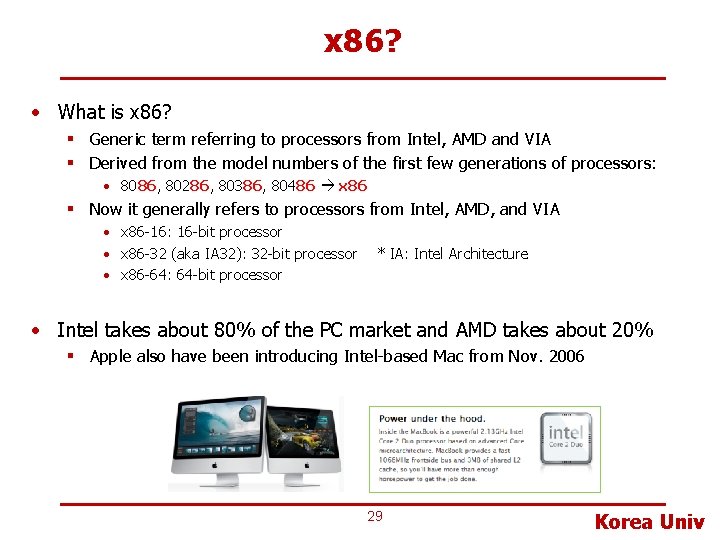
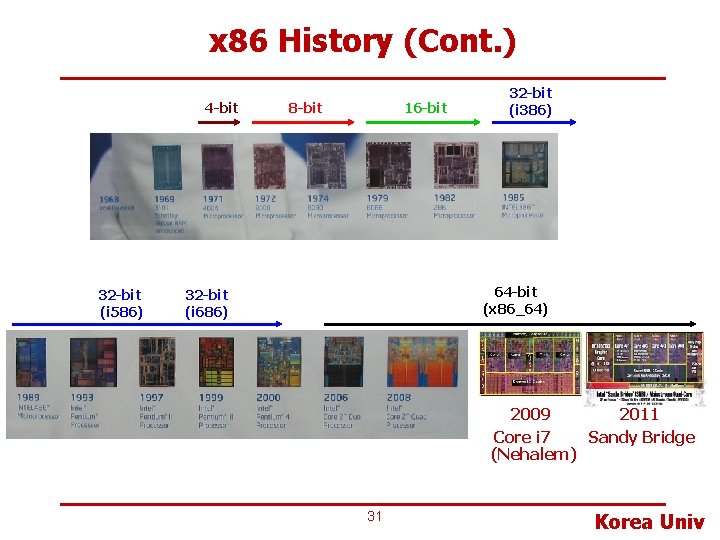
x 86? • What is x 86? § Generic term referring to processors from Intel, AMD and VIA § Derived from the model numbers of the first few generations of processors: • 8086, 80286, 80386, 80486 x 86 § Now it generally refers to processors from Intel, AMD, and VIA • x 86 -16: 16 -bit processor • x 86 -32 (aka IA 32): 32 -bit processor • x 86 -64: 64 -bit processor * IA: Intel Architecture • Intel takes about 80% of the PC market and AMD takes about 20% § Apple also have been introducing Intel-based Mac from Nov. 2006 29 Korea Univ
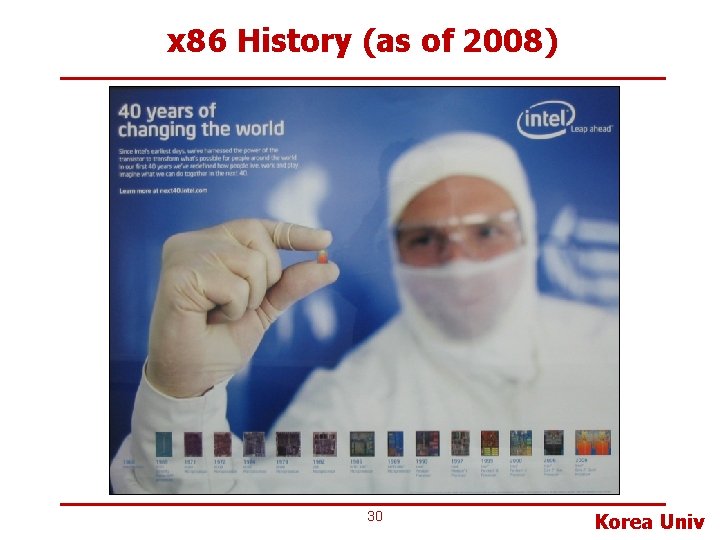
x 86 History (as of 2008) 30 Korea Univ
x 86 History (Cont. ) 4 -bit 32 -bit (i 586) 8 -bit 16 -bit 32 -bit (i 386) 64 -bit (x 86_64) 32 -bit (i 686) 2009 2011 Core i 7 Sandy Bridge (Nehalem) 31 Korea Univ
Backup Slides 32 Korea Univ
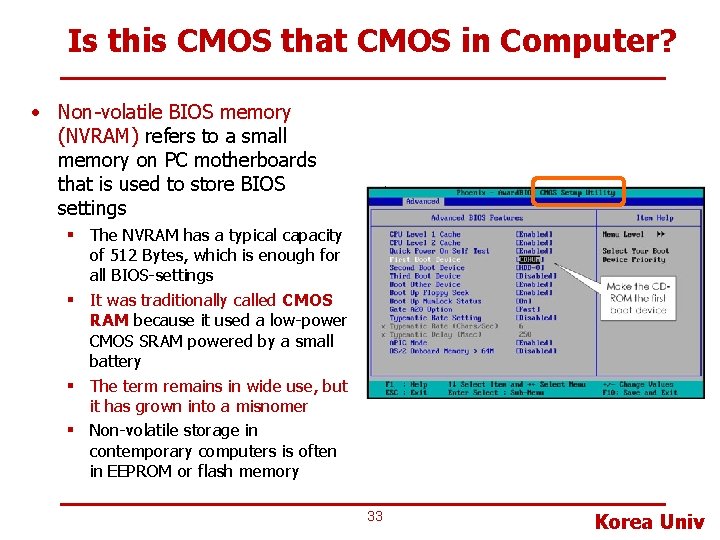
Is this CMOS that CMOS in Computer? • Non-volatile BIOS memory (NVRAM) refers to a small memory on PC motherboards that is used to store BIOS settings § The NVRAM has a typical capacity of 512 Bytes, which is enough for all BIOS-settings § It was traditionally called CMOS RAM because it used a low-power CMOS SRAM powered by a small battery § The term remains in wide use, but it has grown into a misnomer § Non-volatile storage in contemporary computers is often in EEPROM or flash memory 33 Korea Univ