
COMP 205 IMPERATIVE LANGUAGES 7 COMPOUND HIGHER LEVEL
![typedef struct date { int day; char month[9]; int year; } DATE_T, *DATE_PTR_T; void](https://slidetodoc.com/presentation_image/1bf23d6aa765ce9b18f53c7acb837f44/image-14.jpg "typedef struct date { int day; char month[9]; int year; } DATE_T, *DATE_PTR_T; void")
![typedef struct date { int day; char month[9]; int year; } DATE_T, *DATE_PTR_T; void](https://slidetodoc.com/presentation_image/1bf23d6aa765ce9b18f53c7acb837f44/image-20.jpg "typedef struct date { int day; char month[9]; int year; } DATE_T, *DATE_PTR_T; void")
- Slides: 21
COMP 205 IMPERATIVE LANGUAGES 7. COMPOUND (HIGHER LEVEL) DATA TYPES III 1) Enumerated types 2) 3) 4) 5) 6) Records and structures Accessing fields in records/structures Operations on records/structures Variant records Dynamic and static arrays of records/structures
Standard High Level Types (Reminder): 1) Arrays 2) Strings 3) Enumerated types 4) Records/Structures 5) Unions
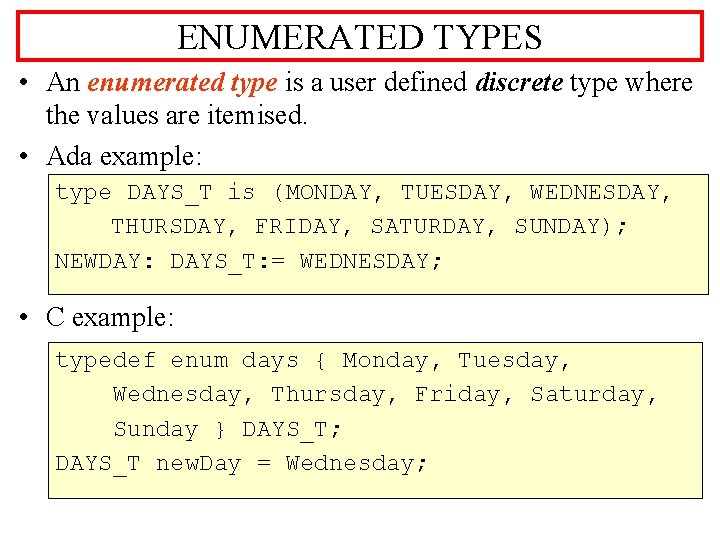
ENUMERATED TYPES • An enumerated type is a user defined discrete type where the values are itemised. • Ada example: type DAYS_T is (MONDAY, TUESDAY, WEDNESDAY, THURSDAY, FRIDAY, SATURDAY, SUNDAY); NEWDAY: DAYS_T: = WEDNESDAY; • C example: typedef enum days { Monday, Tuesday, Wednesday, Thursday, Friday, Saturday, Sunday } DAYS_T; DAYS_T new. Day = Wednesday;
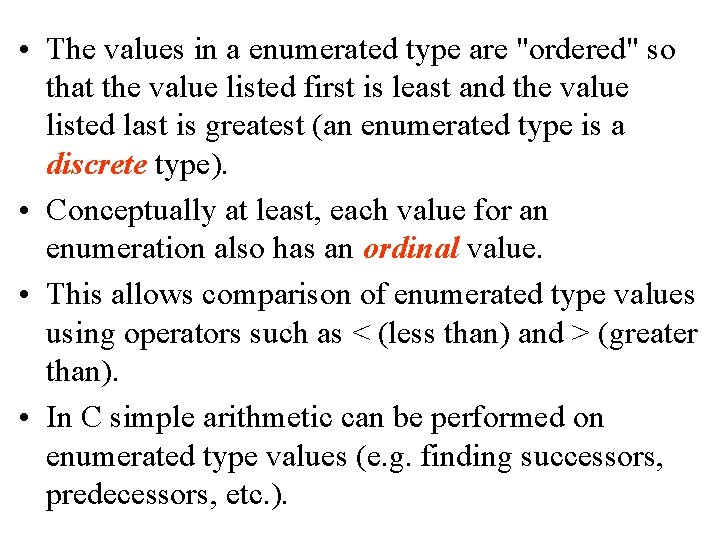
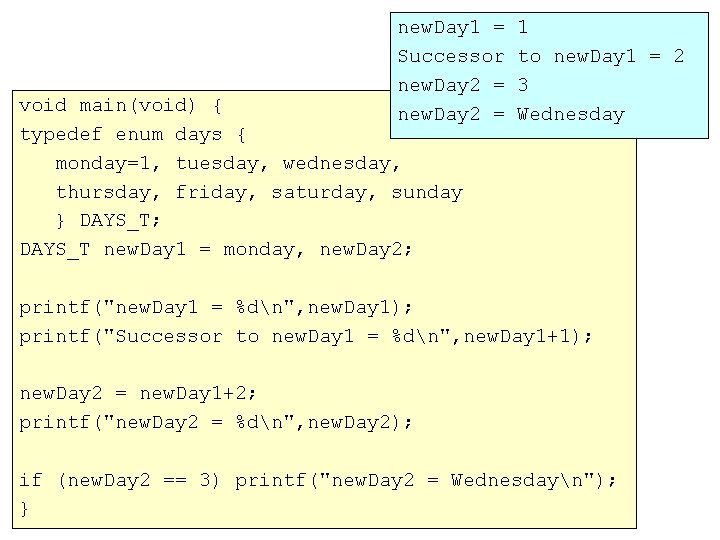
• The values in a enumerated type are "ordered" so that the value listed first is least and the value listed last is greatest (an enumerated type is a discrete type). • Conceptually at least, each value for an enumeration also has an ordinal value. • This allows comparison of enumerated type values using operators such as < (less than) and > (greater than). • In C simple arithmetic can be performed on enumerated type values (e. g. finding successors, predecessors, etc. ).
new. Day 1 = Successor new. Day 2 = void main(void) { typedef enum days { monday=1, tuesday, wednesday, thursday, friday, saturday, sunday } DAYS_T; DAYS_T new. Day 1 = monday, new. Day 2; 1 to new. Day 1 = 2 3 Wednesday printf("new. Day 1 = %dn", new. Day 1); printf("Successor to new. Day 1 = %dn", new. Day 1+1); new. Day 2 = new. Day 1+2; printf("new. Day 2 = %dn", new. Day 2); if (new. Day 2 == 3) printf("new. Day 2 = Wednesdayn"); }
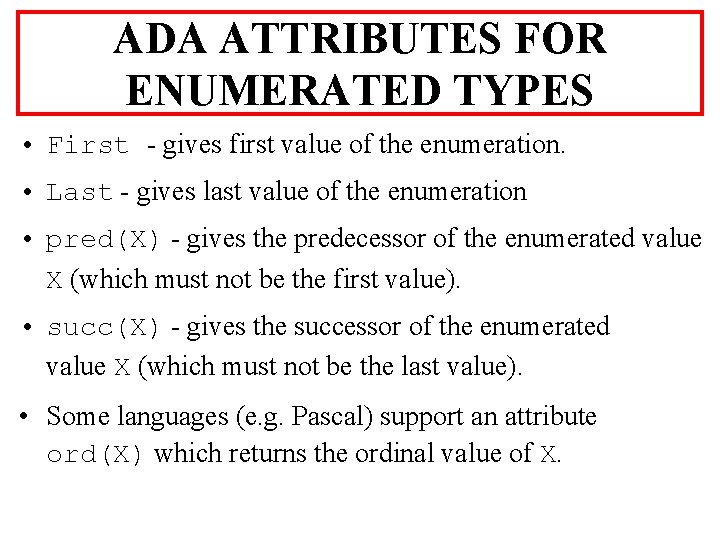
ADA ATTRIBUTES FOR ENUMERATED TYPES • First - gives first value of the enumeration. • Last - gives last value of the enumeration • pred(X) - gives the predecessor of the enumerated value X (which must not be the first value). • succ(X) - gives the successor of the enumerated value X (which must not be the last value). • Some languages (e. g. Pascal) support an attribute ord(X) which returns the ordinal value of X.
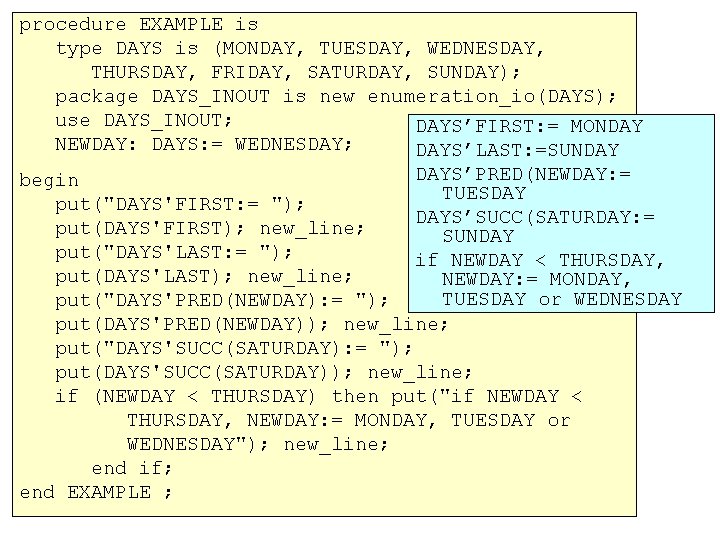
procedure EXAMPLE is type DAYS is (MONDAY, TUESDAY, WEDNESDAY, THURSDAY, FRIDAY, SATURDAY, SUNDAY); package DAYS_INOUT is new enumeration_io(DAYS); use DAYS_INOUT; DAYS’FIRST: = MONDAY NEWDAY: DAYS: = WEDNESDAY; DAYS’LAST: =SUNDAY DAYS’PRED(NEWDAY: = begin TUESDAY put("DAYS'FIRST: = "); DAYS’SUCC(SATURDAY: = put(DAYS'FIRST); new_line; SUNDAY put("DAYS'LAST: = "); if NEWDAY < THURSDAY, put(DAYS'LAST); new_line; NEWDAY: = MONDAY, TUESDAY or WEDNESDAY put("DAYS'PRED(NEWDAY): = "); put(DAYS'PRED(NEWDAY)); new_line; put("DAYS'SUCC(SATURDAY): = "); put(DAYS'SUCC(SATURDAY)); new_line; if (NEWDAY < THURSDAY) then put("if NEWDAY < THURSDAY, NEWDAY: = MONDAY, TUESDAY or WEDNESDAY"); new_line; end if; end EXAMPLE ;
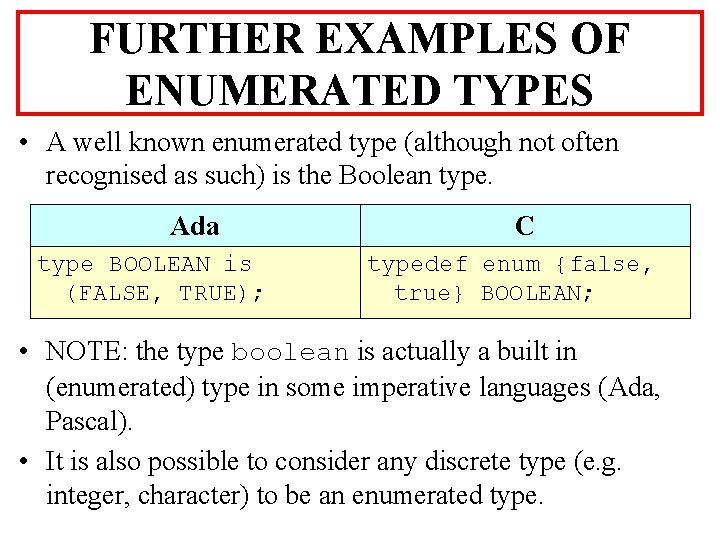
FURTHER EXAMPLES OF ENUMERATED TYPES • A well known enumerated type (although not often recognised as such) is the Boolean type. Ada type BOOLEAN is (FALSE, TRUE); C typedef enum {false, true} BOOLEAN; • NOTE: the type boolean is actually a built in (enumerated) type in some imperative languages (Ada, Pascal). • It is also possible to consider any discrete type (e. g. integer, character) to be an enumerated type.
RECORDS and STRUCTURES 1) Overview 2) Accessing fields in records and structures 3) Operations on records and structures 4) Examples in C and Ada 5) Variant records 6) Dynamic and static arrays of records and structures
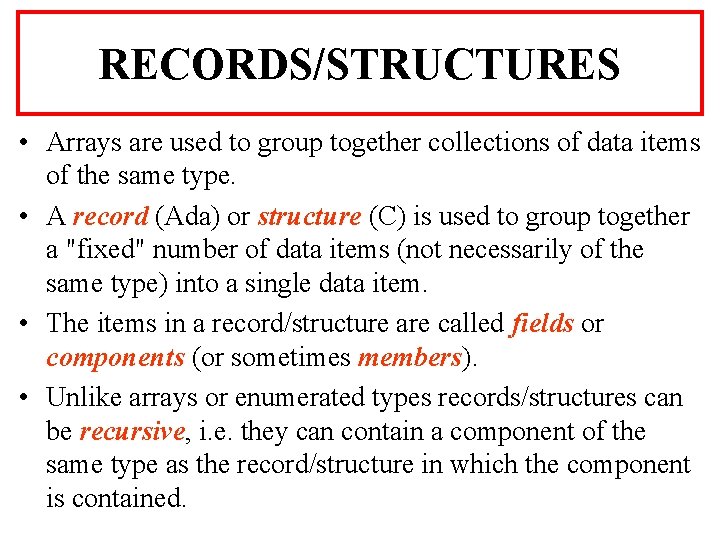
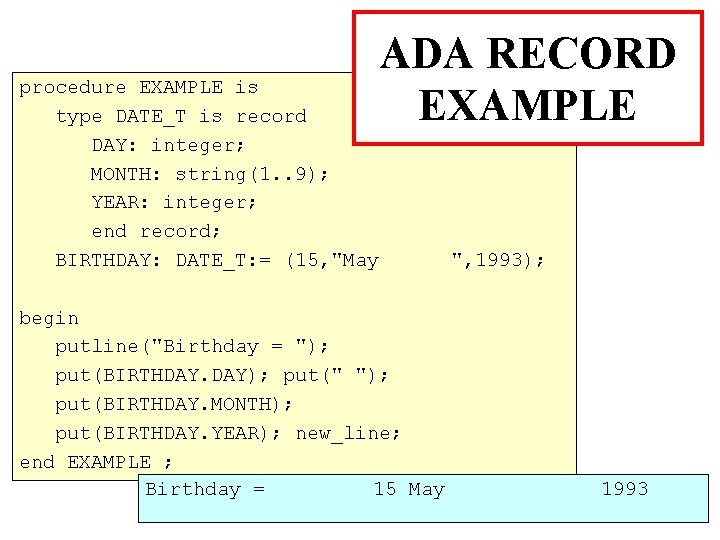
RECORDS/STRUCTURES • Arrays are used to group together collections of data items of the same type. • A record (Ada) or structure (C) is used to group together a "fixed" number of data items (not necessarily of the same type) into a single data item. • The items in a record/structure are called fields or components (or sometimes members). • Unlike arrays or enumerated types records/structures can be recursive, i. e. they can contain a component of the same type as the record/structure in which the component is contained.
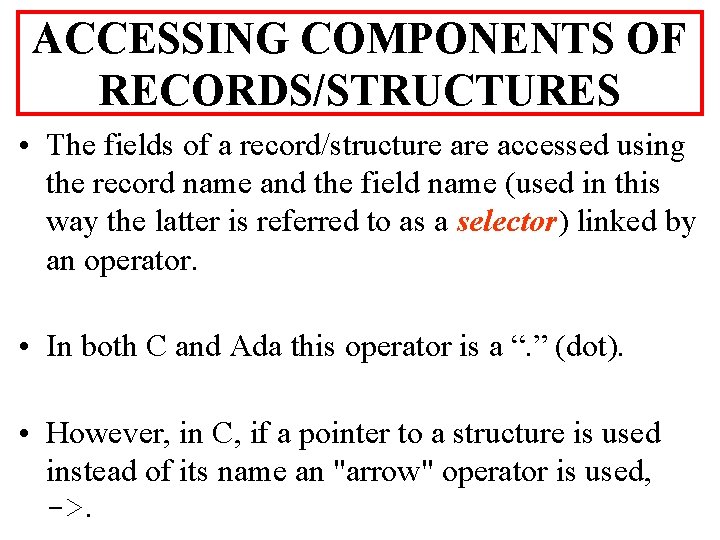
ACCESSING COMPONENTS OF RECORDS/STRUCTURES • The fields of a record/structure accessed using the record name and the field name (used in this way the latter is referred to as a selector) linked by an operator. • In both C and Ada this operator is a “. ” (dot). • However, in C, if a pointer to a structure is used instead of its name an "arrow" operator is used, ->.
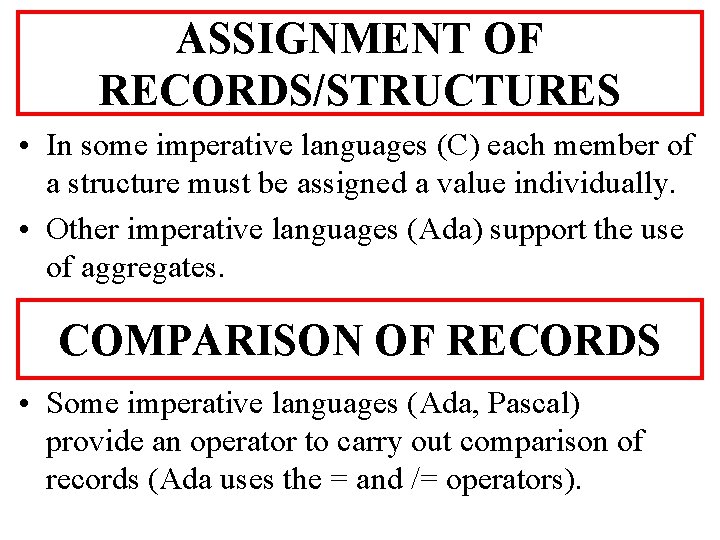
ASSIGNMENT OF RECORDS/STRUCTURES • In some imperative languages (C) each member of a structure must be assigned a value individually. • Other imperative languages (Ada) support the use of aggregates. COMPARISON OF RECORDS • Some imperative languages (Ada, Pascal) provide an operator to carry out comparison of records (Ada uses the = and /= operators).
procedure EXAMPLE is type DATE_T is record DAY: integer; MONTH: string(1. . 9); YEAR: integer; end record; BIRTHDAY: DATE_T: = (15, "May ADA RECORD EXAMPLE begin putline("Birthday = "); put(BIRTHDAY. DAY); put(" "); put(BIRTHDAY. MONTH); put(BIRTHDAY. YEAR); new_line; end EXAMPLE ; Birthday = 15 May ", 1993); 1993
typedef struct date { int day; char month[9]; int year; } DATE_T, *DATE_PTR_T; void output_structure(DATE_PTR_T); void main(void) { DATE_T st. Patricks. Day; C STRUCTURE EXAMPLE st. Patricks. Day. day = 17; strcpy(st. Patricks. Day. month, "March"); st. Patricks. Day. year = 1996; output_structure(&st. Patricks. Day); } void output_structure(DATE_PTR_T date. Ptr) { printf("%d, ", date. Ptr->day); printf("%s, ", date. Ptr->month); printf("%dn", date. Ptr->year); }
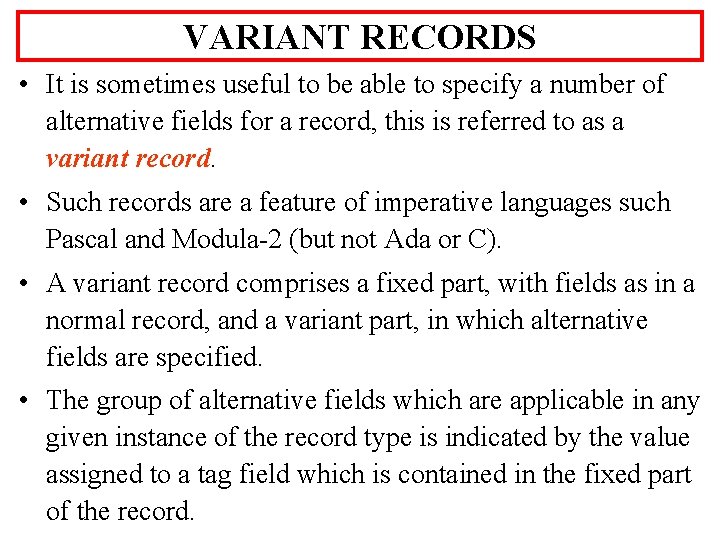
VARIANT RECORDS • It is sometimes useful to be able to specify a number of alternative fields for a record, this is referred to as a variant record. • Such records are a feature of imperative languages such Pascal and Modula-2 (but not Ada or C). • A variant record comprises a fixed part, with fields as in a normal record, and a variant part, in which alternative fields are specified. • The group of alternative fields which are applicable in any given instance of the record type is indicated by the value assigned to a tag field which is contained in the fixed part of the record.
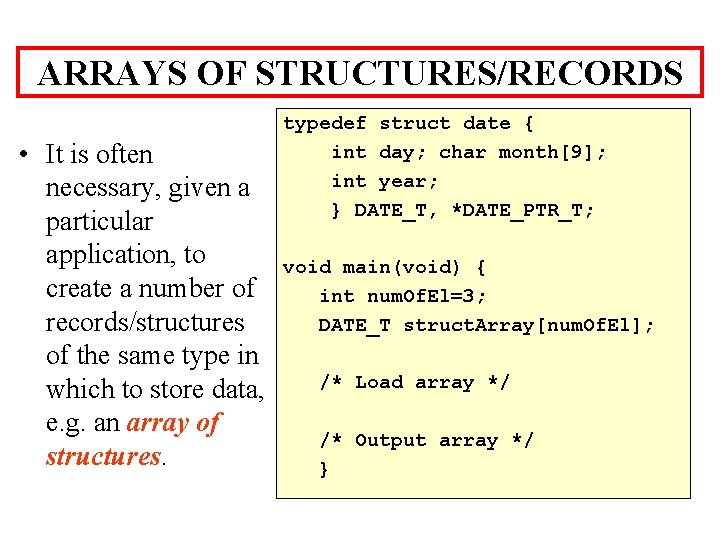
ARRAYS OF STRUCTURES/RECORDS • It is often necessary, given a particular application, to create a number of records/structures of the same type in which to store data, e. g. an array of structures. typedef struct date { int day; char month[9]; int year; } DATE_T, *DATE_PTR_T; void main(void) { int num. Of. El=3; DATE_T struct. Array[num. Of. El]; /* Load array */ /* Output array */ }
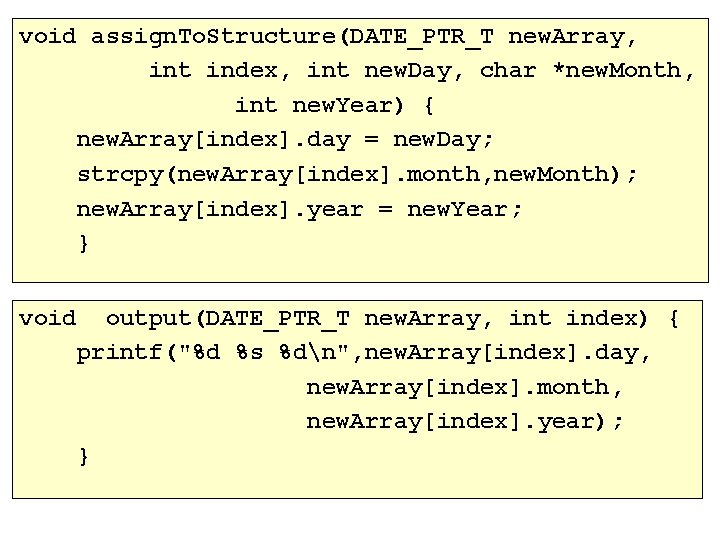
void assign. To. Structure(DATE_PTR_T new. Array, int index, int new. Day, char *new. Month, int new. Year) { new. Array[index]. day = new. Day; strcpy(new. Array[index]. month, new. Month); new. Array[index]. year = new. Year; } void output(DATE_PTR_T new. Array, int index) { printf("%d %s %dn", new. Array[index]. day, new. Array[index]. month, new. Array[index]. year); }
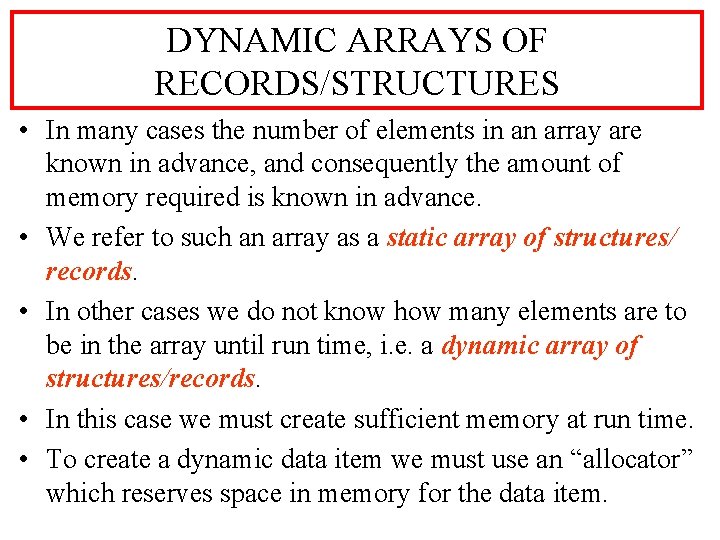
DYNAMIC ARRAYS OF RECORDS/STRUCTURES • In many cases the number of elements in an array are known in advance, and consequently the amount of memory required is known in advance. • We refer to such an array as a static array of structures/ records. • In other cases we do not know how many elements are to be in the array until run time, i. e. a dynamic array of structures/records. • In this case we must create sufficient memory at run time. • To create a dynamic data item we must use an “allocator” which reserves space in memory for the data item.
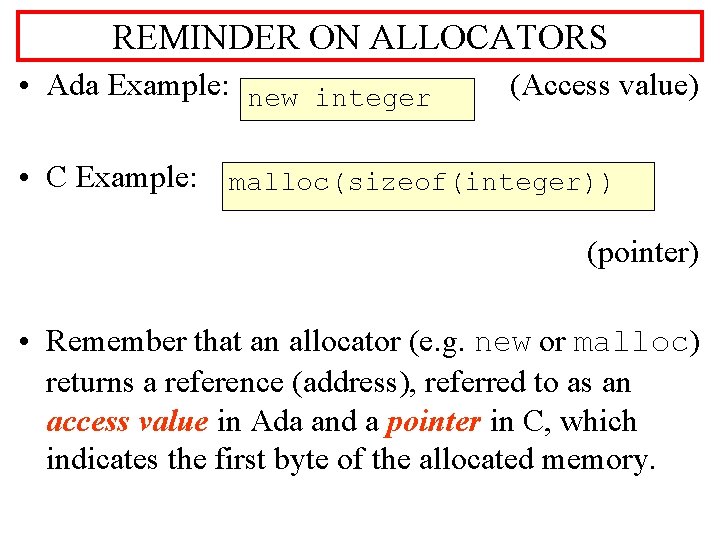
REMINDER ON ALLOCATORS • Ada Example: new integer (Access value) • C Example: malloc(sizeof(integer)) (pointer) • Remember that an allocator (e. g. new or malloc) returns a reference (address), referred to as an access value in Ada and a pointer in C, which indicates the first byte of the allocated memory.
typedef struct date { int day; char month[9]; int year; } DATE_T, *DATE_PTR_T; void main(void) { int num. Of. El; DATE_PTR_T struct. Array; printf("Enter number of structures "); scanf("%d", &num. Of. El); if ((struct. Array = (DATE_PTR_T) (malloc(sizeof(DATE_T) * num. Of. El))) == NULL) { printf("Insufficient spacen"); exit(-1); } --- Rest of code here ---
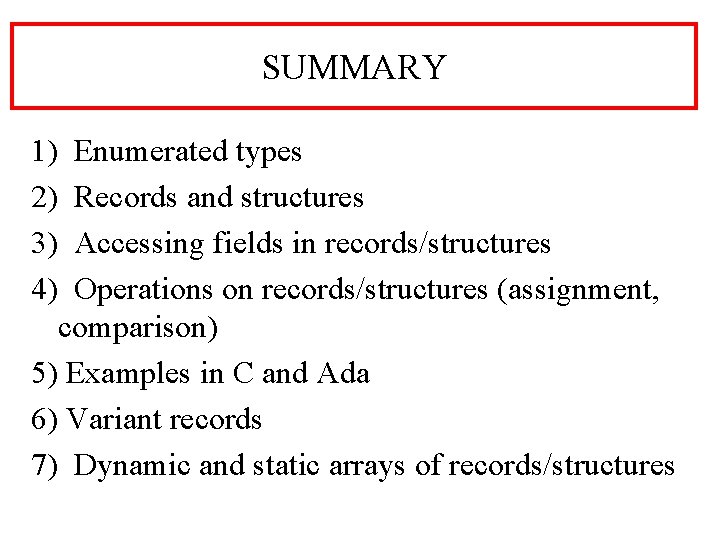
SUMMARY 1) 2) 3) 4) Enumerated types Records and structures Accessing fields in records/structures Operations on records/structures (assignment, comparison) 5) Examples in C and Ada 6) Variant records 7) Dynamic and static arrays of records/structures