
COMP 2000 Object Oriented Design DAVID J STUCKI

COMP 2000 Object. Oriented Design DAVID J STUCKI OTTERBEIN UNIVERSITY
ALERTS ◦ Read Head First Design Patterns, Chapters 1 -3 ◦ Lab 10 is due Thursday before 11: 59 pm ◦ Lab 11 a will be available Thursday morning; Lab 11 b will be available as soon as everyone has turned in Lab 10 ◦ Questions?
Strategy Pattern (HFDP, chapter 1) § Design an interface to represent an algorithm that may vary § § The algorithm itself is abstract The interface represents the strategy § For each concrete variation, define a class that implements the interface's methods § The client supplies its concrete object to a supplier class § The supplier will invoke correct behavior through polymorphism
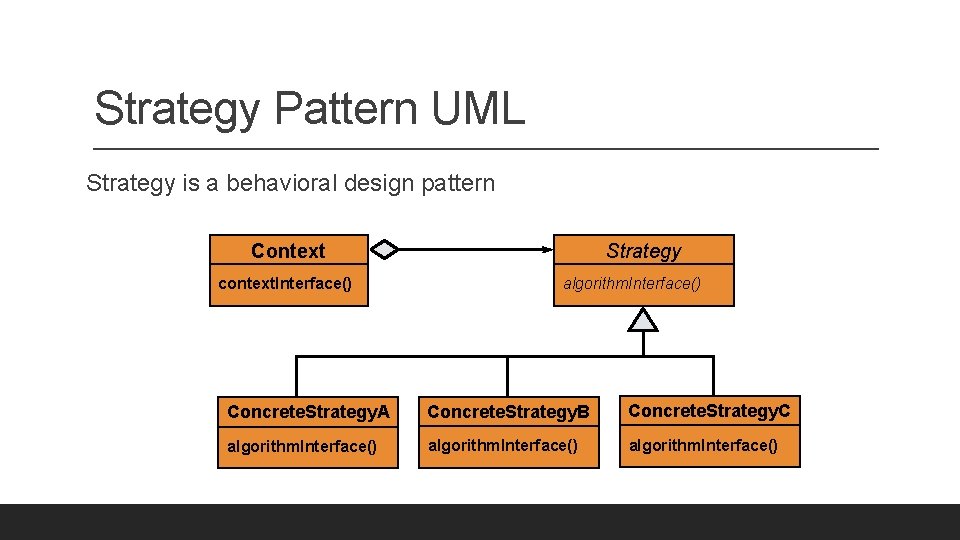
Strategy Pattern UML Strategy is a behavioral design pattern Context context. Interface() Strategy algorithm. Interface() Concrete. Strategy. A Concrete. Strategy. B Concrete. Strategy. C algorithm. Interface()
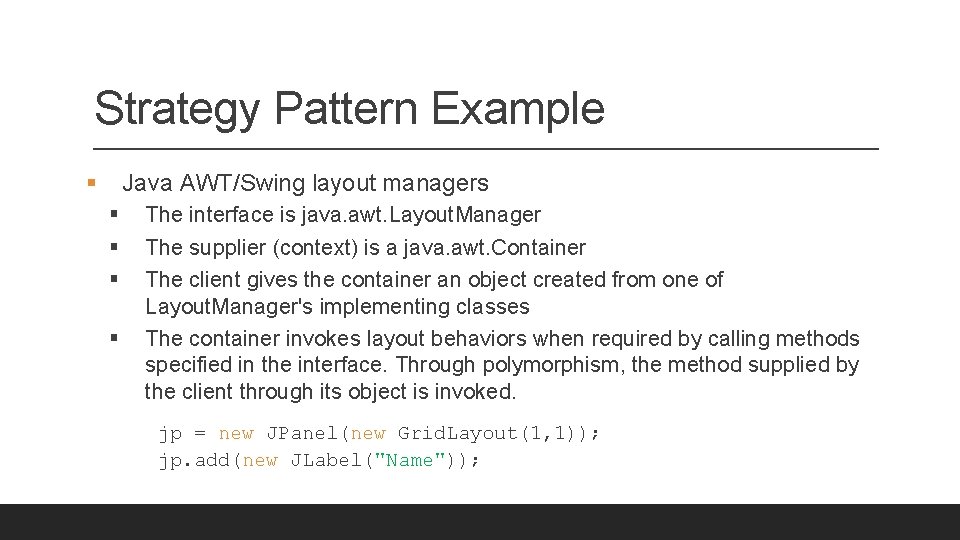
Strategy Pattern Example § Java AWT/Swing layout managers § § The interface is java. awt. Layout. Manager The supplier (context) is a java. awt. Container The client gives the container an object created from one of Layout. Manager's implementing classes The container invokes layout behaviors when required by calling methods specified in the interface. Through polymorphism, the method supplied by the client through its object is invoked. jp = new JPanel(new Grid. Layout(1, 1)); jp. add(new JLabel("Name"));

Strategy Pattern Example § Backtracking: the strategy of trying to reach a goal by a sequence of chosen positions, with re-tracing in reverse order of positions that cannot lead to the goal § Can you think of examples of situations (contexts) where backtracking would be a useful strategy? § What is the abstraction here? § The idea of backtracking doesn't change (is invariant) with the context. It is the context that is abstract.
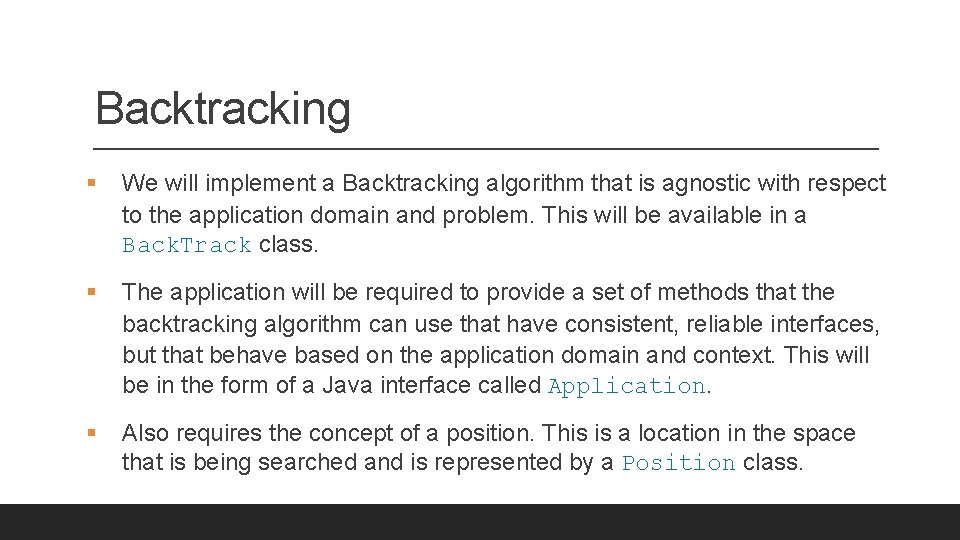
Backtracking § We will implement a Backtracking algorithm that is agnostic with respect to the application domain and problem. This will be available in a Back. Track class. § The application will be required to provide a set of methods that the backtracking algorithm can use that have consistent, reliable interfaces, but that behave based on the application domain and context. This will be in the form of a Java interface called Application. § Also requires the concept of a position. This is a location in the space that is being searched and is represented by a Position class.
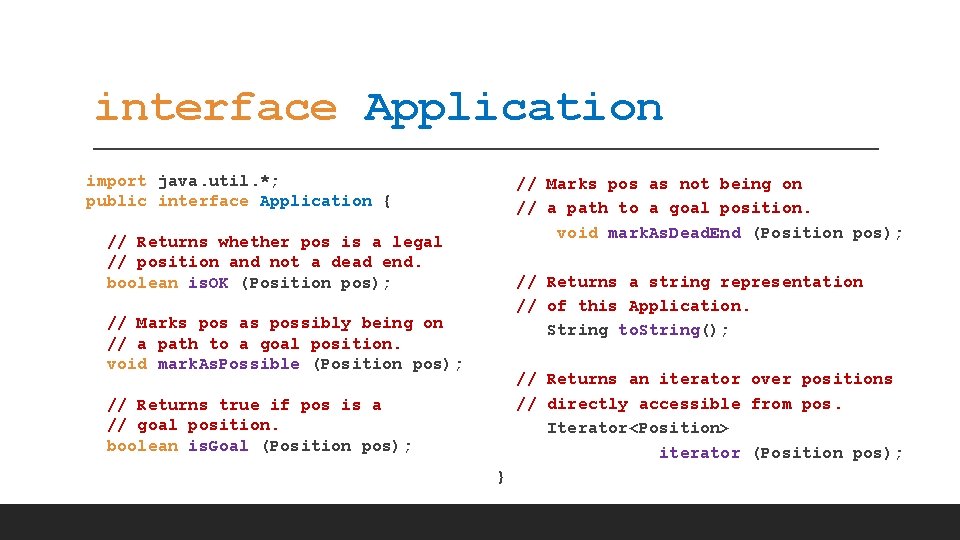
interface Application import java. util. *; public interface Application { // Marks pos as not being on // a path to a goal position. void mark. As. Dead. End (Position pos); // Returns whether pos is a legal // position and not a dead end. boolean is. OK (Position pos); // Returns a string representation // of this Application. String to. String(); // Marks pos as possibly being on // a path to a goal position. void mark. As. Possible (Position pos); // Returns an iterator over positions // directly accessible from pos. Iterator<Position> iterator (Position pos); // Returns true if pos is a // goal position. boolean is. Goal (Position pos); }
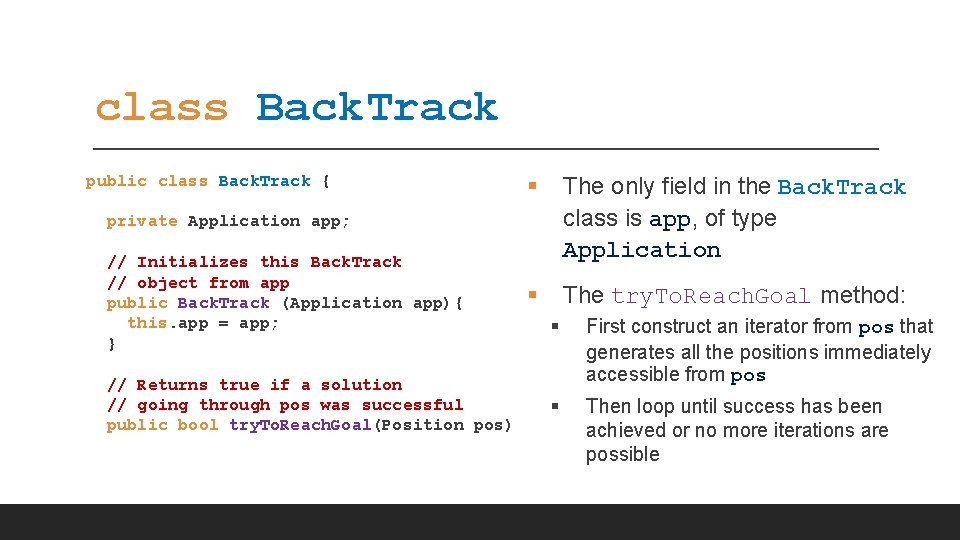
class Back. Track public class Back. Track { § The only field in the Back. Track class is app, of type Application § The try. To. Reach. Goal method: private Application app; // Initializes this Back. Track // object from app public Back. Track (Application app){ this. app = app; } // Returns true if a solution // going through pos was successful public bool try. To. Reach. Goal(Position pos) § First construct an iterator from pos that generates all the positions immediately accessible from pos § Then loop until success has been achieved or no more iterations are possible
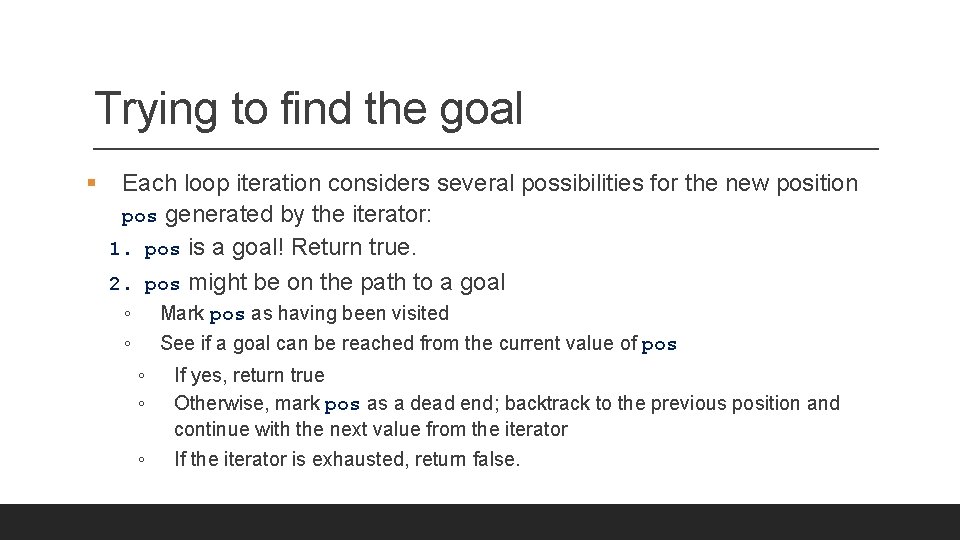
Trying to find the goal § Each loop iteration considers several possibilities for the new position pos generated by the iterator: 1. pos is a goal! Return true. 2. pos might be on the path to a goal ◦ ◦ Mark pos as having been visited See if a goal can be reached from the current value of pos ◦ ◦ ◦ If yes, return true Otherwise, mark pos as a dead end; backtrack to the previous position and continue with the next value from the iterator If the iterator is exhausted, return false.
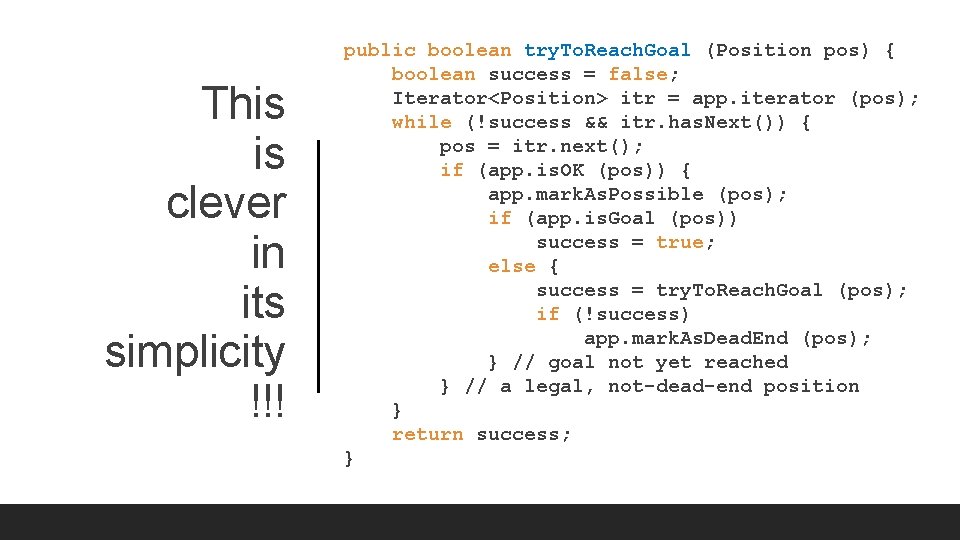
This is clever in its simplicity !!! public boolean try. To. Reach. Goal (Position pos) { boolean success = false; Iterator<Position> itr = app. iterator (pos); while (!success && itr. has. Next()) { pos = itr. next(); if (app. is. OK (pos)) { app. mark. As. Possible (pos); if (app. is. Goal (pos)) success = true; else { success = try. To. Reach. Goal (pos); if (!success) app. mark. As. Dead. End (pos); } // goal not yet reached } // a legal, not-dead-end position } return success; }
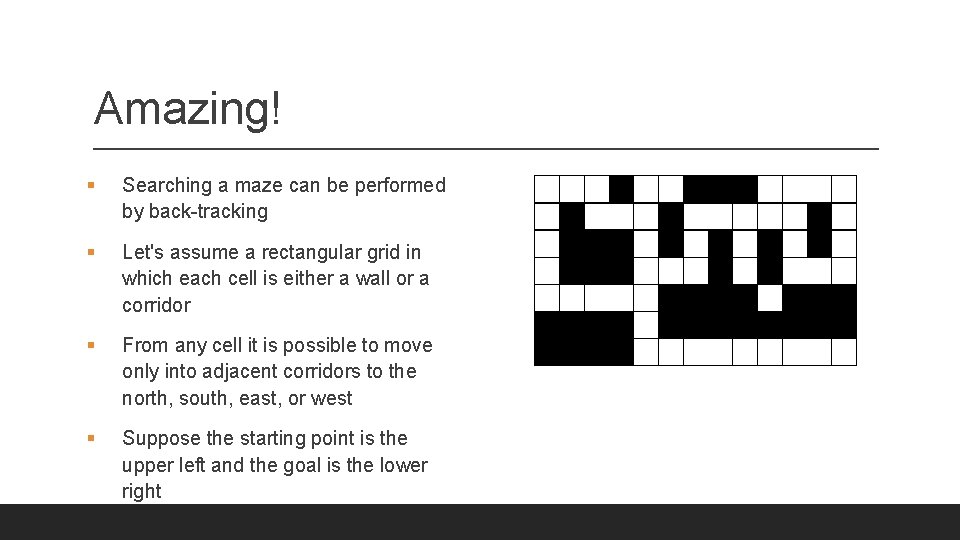
Amazing! § Searching a maze can be performed by back-tracking § Let's assume a rectangular grid in which each cell is either a wall or a corridor § From any cell it is possible to move only into adjacent corridors to the north, south, east, or west § Suppose the starting point is the upper left and the goal is the lower right
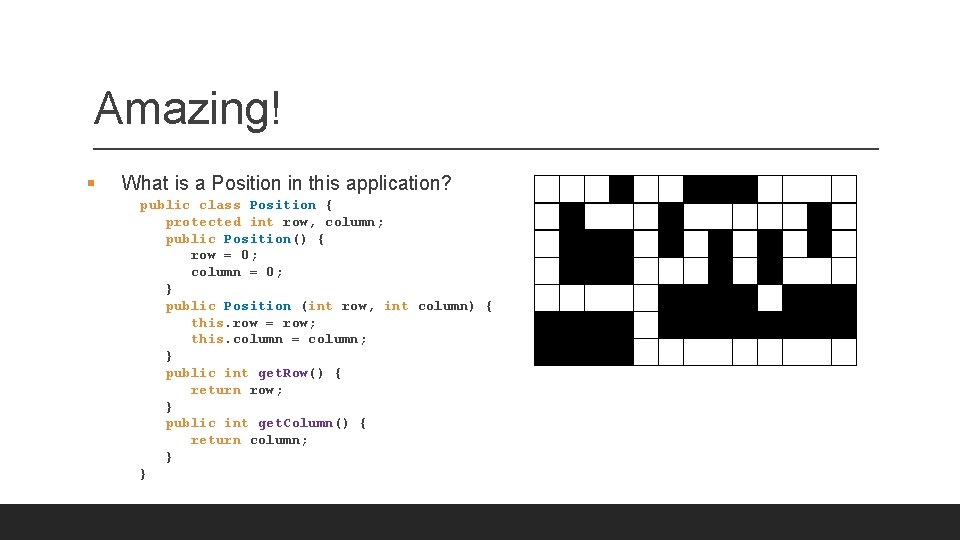
Amazing! § What is a Position in this application? public class Position { protected int row, column; public Position() { row = 0; column = 0; } public Position (int row, int column) { this. row = row; this. column = column; } public int get. Row() { return row; } public int get. Column() { return column; } }
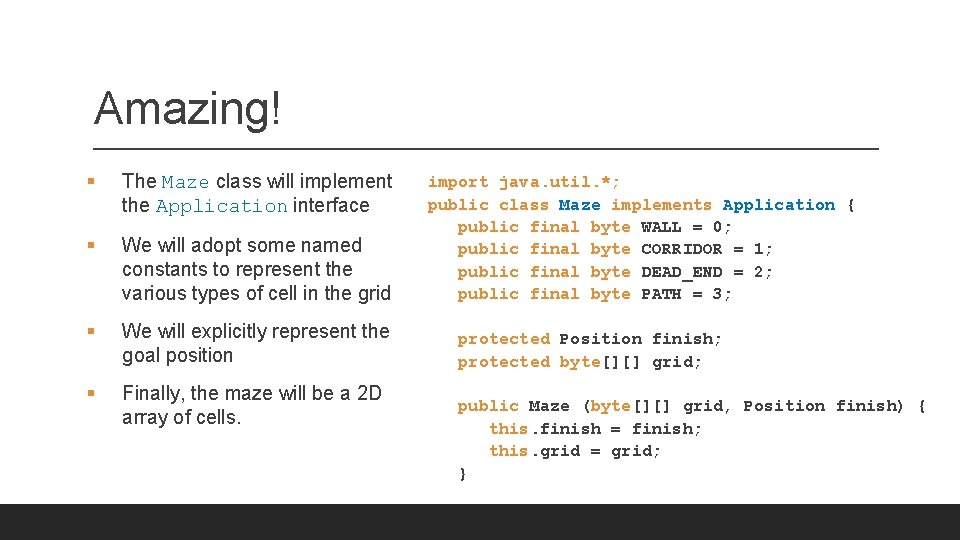
Amazing! § The Maze class will implement the Application interface § We will adopt some named constants to represent the various types of cell in the grid § We will explicitly represent the goal position § Finally, the maze will be a 2 D array of cells. import java. util. *; public class Maze implements Application { public final byte WALL = 0; public final byte CORRIDOR = 1; public final byte DEAD_END = 2; public final byte PATH = 3; protected Position finish; protected byte[][] grid; public Maze (byte[][] grid, Position finish) { this. finish = finish; this. grid = grid; }
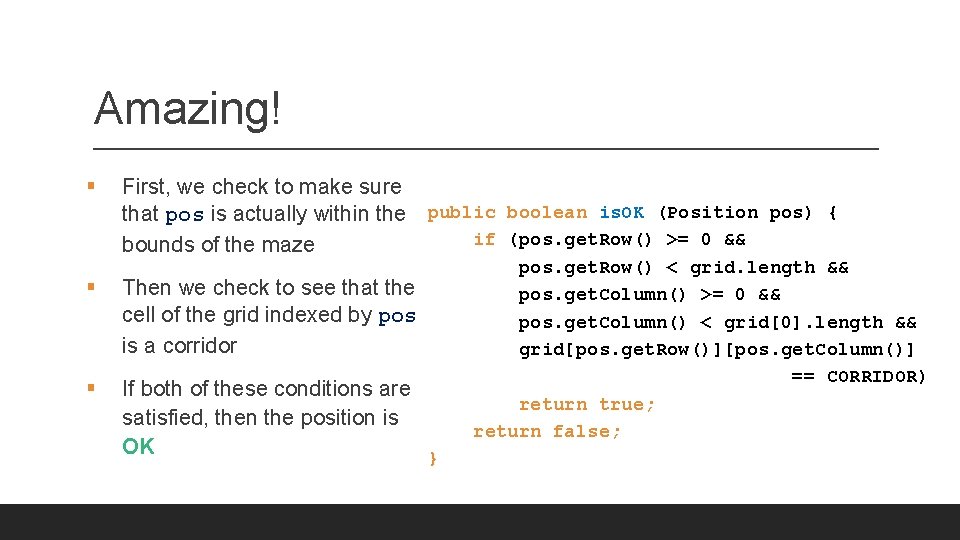
Amazing! § First, we check to make sure that pos is actually within the public boolean is. OK (Position pos) { if (pos. get. Row() >= 0 && bounds of the maze § Then we check to see that the cell of the grid indexed by pos is a corridor § If both of these conditions are satisfied, then the position is OK } pos. get. Row() < grid. length && pos. get. Column() >= 0 && pos. get. Column() < grid[0]. length && grid[pos. get. Row()][pos. get. Column()] == CORRIDOR) return true; return false;
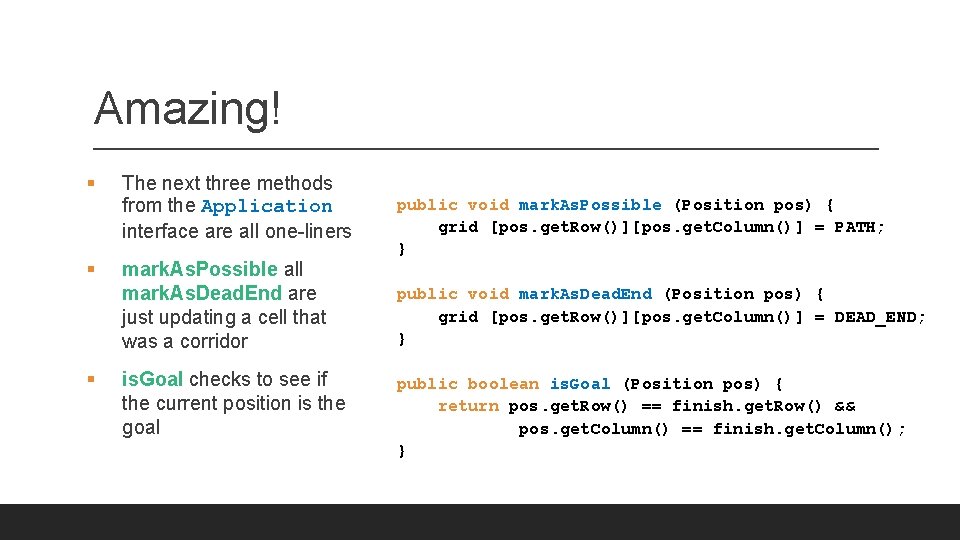
Amazing! § § § The next three methods from the Application interface are all one-liners mark. As. Possible all mark. As. Dead. End are just updating a cell that was a corridor is. Goal checks to see if the current position is the goal public void mark. As. Possible (Position pos) { grid [pos. get. Row()][pos. get. Column()] = PATH; } public void mark. As. Dead. End (Position pos) { grid [pos. get. Row()][pos. get. Column()] = DEAD_END; } public boolean is. Goal (Position pos) { return pos. get. Row() == finish. get. Row() && pos. get. Column() == finish. get. Column(); }
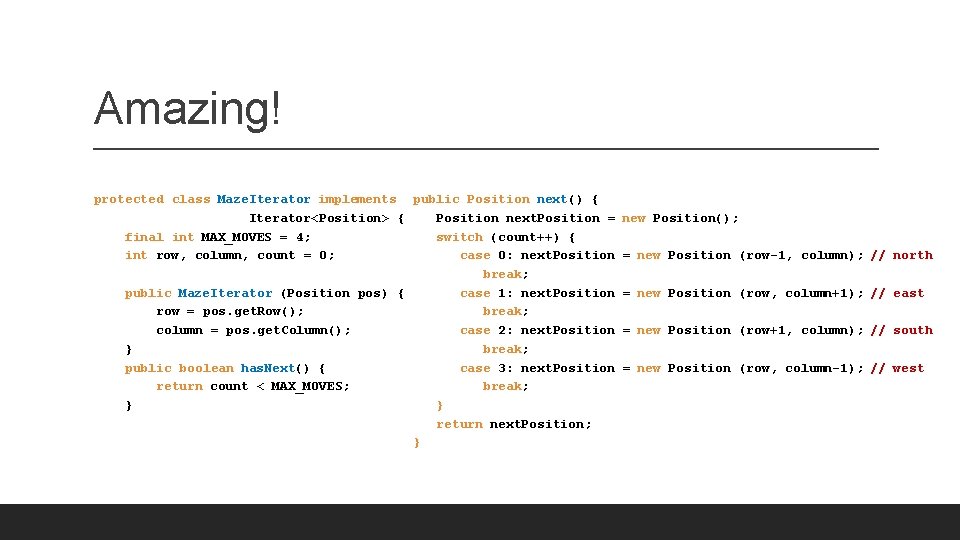
Amazing! protected class Maze. Iterator implements public Position next() { Position next. Position = Iterator<Position> { switch (count++) { final int MAX_MOVES = 4; case 0: next. Position int row, column, count = 0; break; case 1: next. Position public Maze. Iterator (Position pos) { break; row = pos. get. Row(); case 2: next. Position column = pos. get. Column(); break; } case 3: next. Position public boolean has. Next() { break; return count < MAX_MOVES; } } return next. Position; } new Position(); = new Position (row-1, column); // north = new Position (row, column+1); // east = new Position (row+1, column); // south = new Position (row, column-1); // west
Next Time. . . The Observer Pattern
- Slides: 18