
Comp 15 Usability Human Factors Unit 8 a
Comp 15 - Usability & Human Factors Unit 8 a - Approaches to Design This material was developed by Columbia University, funded by the Department of Health and Human Services, Office of the National Coordinator for Health Information Technology under Award Number 1 U 24 OC 000003.
Overview • Interaction Design • User-Centered Design • Lifecycle Models of Software Engineering – Usability engineering lifecycle • Prototypes • A case study of participatory design • Heuristic design principles Component 15/Unit 8 a Health IT Workforce Curriculum 2. 0/Spring 2011 Version 2
Design • A plan or scheme conceived in mind and intended for subsequent execution • Tradeoffs balancing conflicting requirements • Generating alternatives • Use representations – Diagrams, prototypes Component 15/Unit 8 a Health IT Workforce Curriculum 2. 0/Spring 2011 Version 3
Interaction Design • Focus on Users • Specific Targets – Usability – Experience • Iteration • Key Question: How to optimize the users’ interactions with a system so they support and extend users’ activities in effective, useful and usable ways Component 15/Unit 8 a Health IT Workforce Curriculum 2. 0/Spring 2011 Version 4
Why all the Fuss About Design? • Documented usability problems in healthcare and their consequences • Clinical information systems present problems in implementation & beyond • Many systems do not adequately address customer specifications • Fixing a problem in development phase costs 10 times more than in design phase Component 15/Unit 8 a Health IT Workforce Curriculum 2. 0/Spring 2011 Version 5
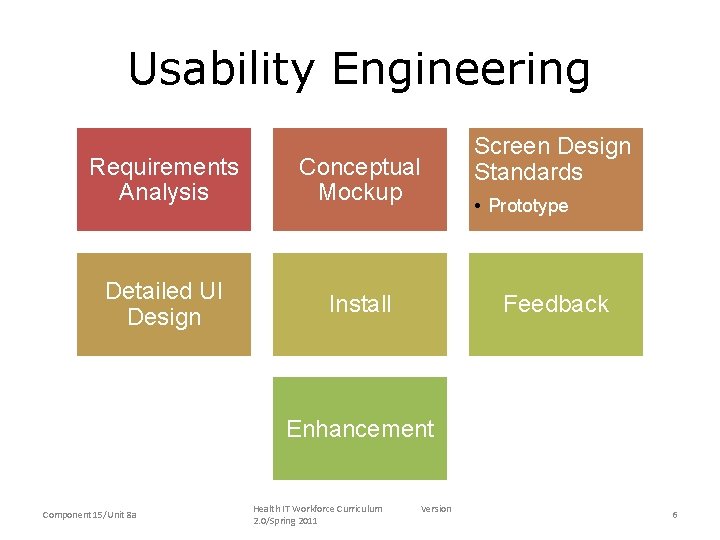
Usability Engineering Requirements Analysis Conceptual Mockup Detailed UI Design Install Screen Design Standards • Prototype Feedback Enhancement Component 15/Unit 8 a Health IT Workforce Curriculum 2. 0/Spring 2011 Version 6
A User-Centered Approach Early focus on users and task • Cognitive, behavioral & attitudinal characteristics • Nature of tasks performed Empirical measurement • Study of users Iterative Design • Design and development are responsive to user problems • Cyclical process Component 15/Unit 8 a Health IT Workforce Curriculum 2. 0/Spring 2011 Version 7
Focus on Users and Tasks • Users’ tasks and goals drive development • Focus on user behavior and context of use – System designed to support them • Capture characteristics of users (capabilities & constraints) • Users are involved from the inception through cycles of iterative development • All design decisions taken within context of users, their work and environment Component 15/Unit 8 a Health IT Workforce Curriculum 2. 0/Spring 2011 Version 8
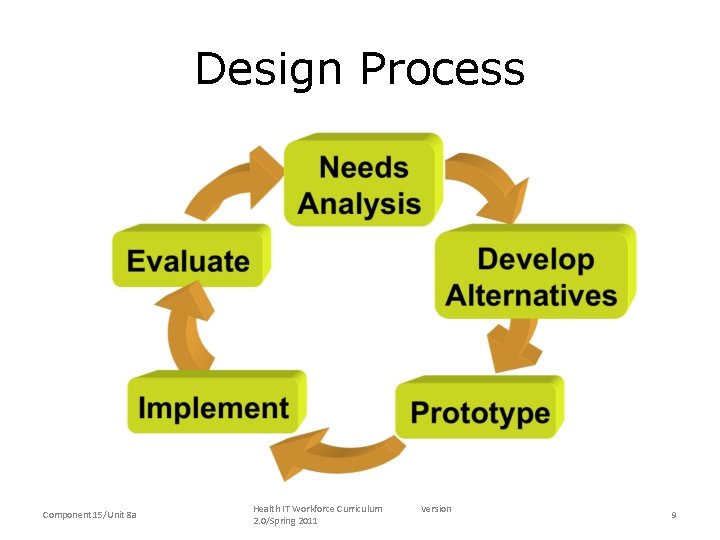
Design Process Component 15/Unit 8 a Health IT Workforce Curriculum 2. 0/Spring 2011 Version 9
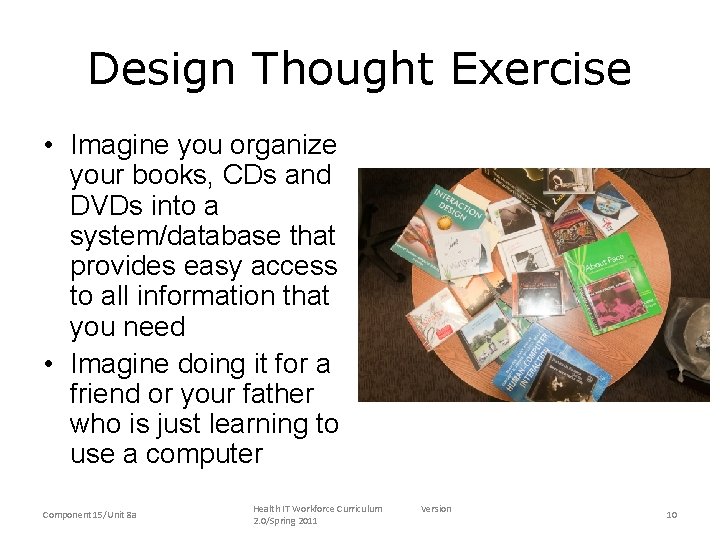
Design Thought Exercise • Imagine you organize your books, CDs and DVDs into a system/database that provides easy access to all information that you need • Imagine doing it for a friend or your father who is just learning to use a computer Component 15/Unit 8 a Health IT Workforce Curriculum 2. 0/Spring 2011 Version 10
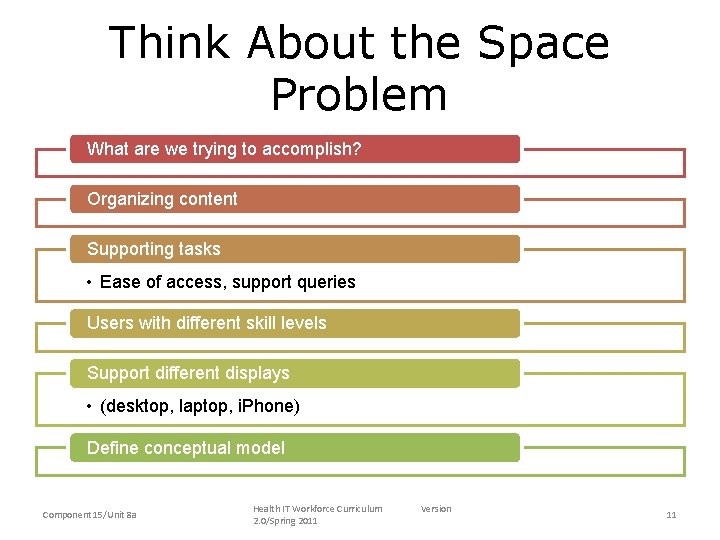
Think About the Space Problem What are we trying to accomplish? Organizing content Supporting tasks • Ease of access, support queries Users with different skill levels Support different displays • (desktop, laptop, i. Phone) Define conceptual model Component 15/Unit 8 a Health IT Workforce Curriculum 2. 0/Spring 2011 Version 11
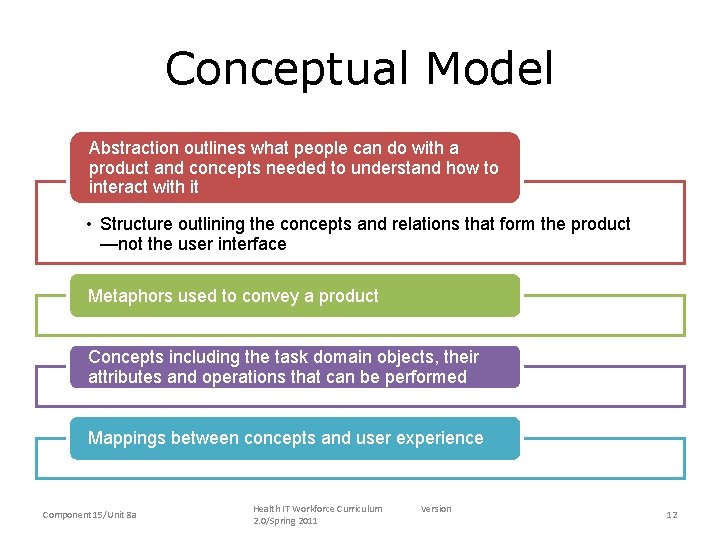
Conceptual Model Abstraction outlines what people can do with a product and concepts needed to understand how to interact with it • Structure outlining the concepts and relations that form the product —not the user interface Metaphors used to convey a product Concepts including the task domain objects, their attributes and operations that can be performed Mappings between concepts and user experience Component 15/Unit 8 a Health IT Workforce Curriculum 2. 0/Spring 2011 Version 12
Visicalc Component 15/Unit 8 a Health IT Workforce Curriculum 2. 0/Spring 2011 Version 13
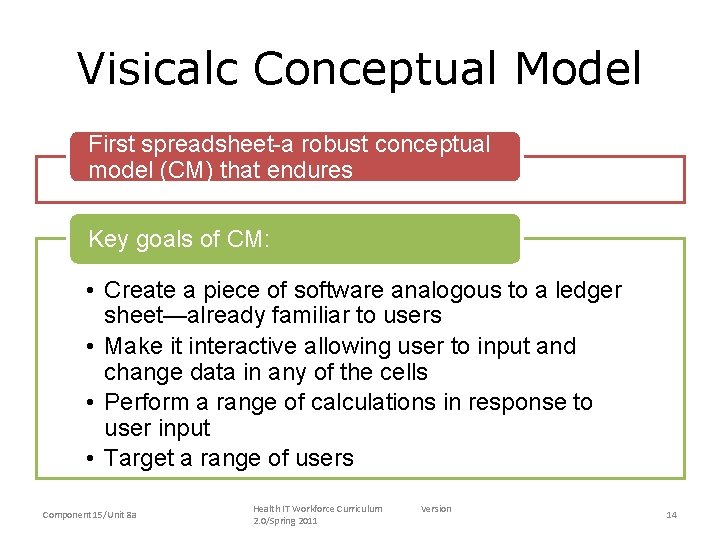
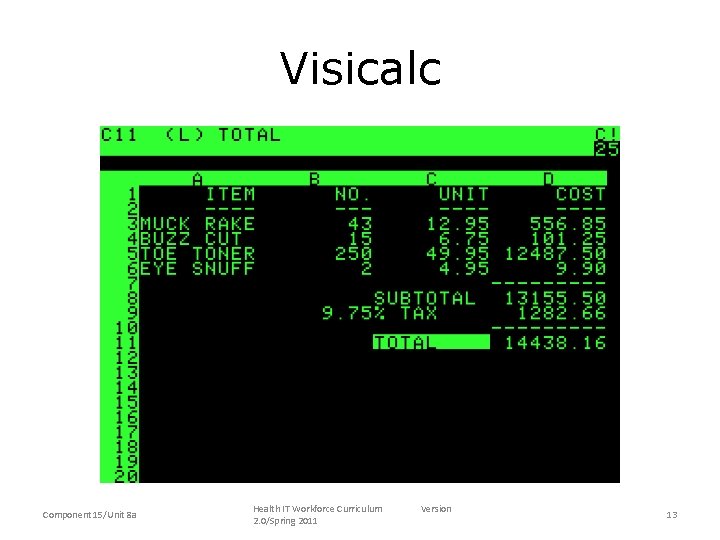
Visicalc Conceptual Model First spreadsheet-a robust conceptual model (CM) that endures Key goals of CM: • Create a piece of software analogous to a ledger sheet—already familiar to users • Make it interactive allowing user to input and change data in any of the cells • Perform a range of calculations in response to user input • Target a range of users Component 15/Unit 8 a Health IT Workforce Curriculum 2. 0/Spring 2011 Version 14
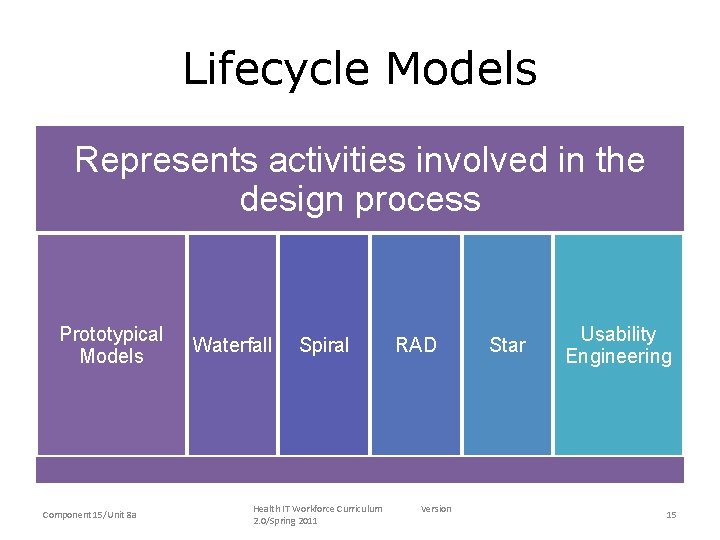
Lifecycle Models Represents activities involved in the design process Prototypical Models Component 15/Unit 8 a Waterfall Spiral Health IT Workforce Curriculum 2. 0/Spring 2011 RAD Version Star Usability Engineering 15
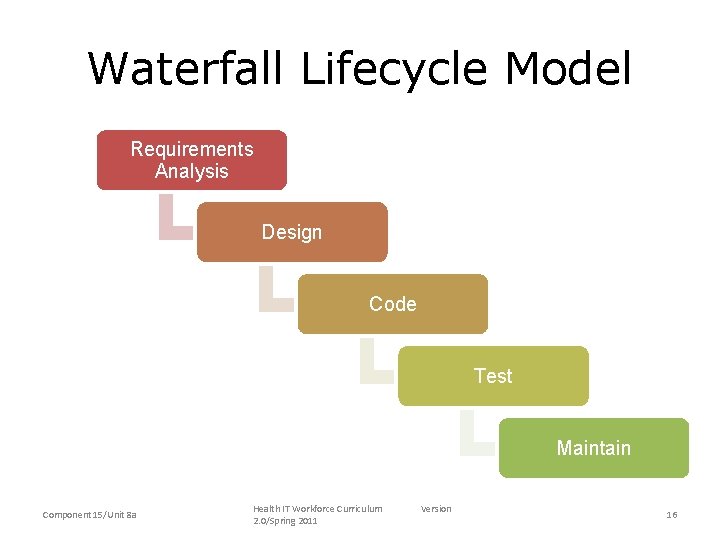
Waterfall Lifecycle Model Requirements Analysis Design Code Test Maintain Component 15/Unit 8 a Health IT Workforce Curriculum 2. 0/Spring 2011 Version 16
Waterfall Model • • The original model for software engineering Linear model with clearly delineated tasks Problems No central role for users/no iteration and limited feedback • Too rigid—not responsive to requirement changes • Inconsistent with designers inherently nonlinear work practices Component 15/Unit 8 a Health IT Workforce Curriculum 2. 0/Spring 2011 Version 17
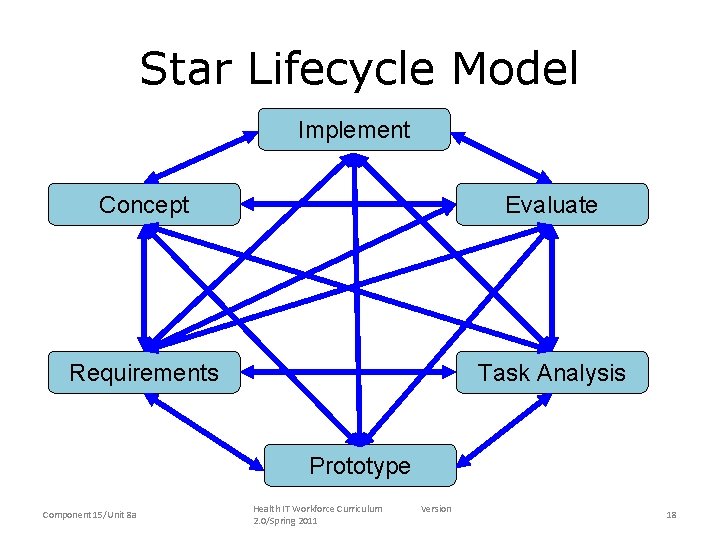
Star Lifecycle Model Implement Concept Evaluate Requirements Task Analysis Prototype Component 15/Unit 8 a Health IT Workforce Curriculum 2. 0/Spring 2011 Version 18
Star Lifecycle Model (cont. ) • Inherently nonlinear—does not specify ordering of activities • Accentuates bottom-up, free thinking and creative practices of designer • Evaluation is viewed as integral to all stages and continuous • Problem: Too much flexibility, lack of systematic coordination and process is underspecified Component 15/Unit 8 a Health IT Workforce Curriculum 2. 0/Spring 2011 Version 19
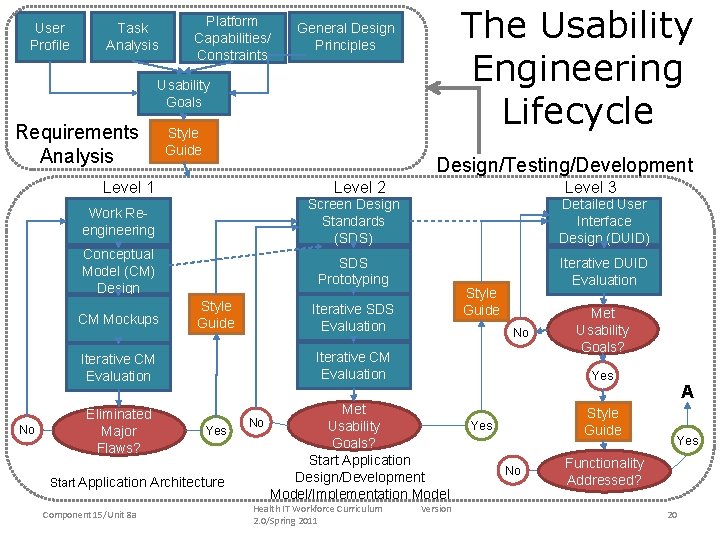
User Profile Task Analysis Platform Capabilities/ Constraints The Usability Engineering Lifecycle General Design Principles Usability Goals Requirements Analysis Style Guide Design/Testing/Development Level 1 Work Reengineering Screen Design Standards (SDS) Detailed User Interface Design (DUID) Conceptual Model (CM) Design SDS Prototyping Iterative DUID Evaluation CM Mockups Style Guide Eliminated Major Flaws? No Iterative CM Evaluation Yes Start Application Architecture Component 15/Unit 8 a Style Guide Iterative SDS Evaluation Iterative CM Evaluation No Level 3 Level 2 No Yes Met Usability Goals? Start Application Design/Development Model/Implementation Model Health IT Workforce Curriculum 2. 0/Spring 2011 Met Usability Goals? Version A Style Guide Yes No Yes Functionality Addressed? 20
Usability Engineering Lifecycle (UEL) • Developed by Mayhew (1999) with the goal of thoroughly integrating usability considerations into all phases of design • Core aspects/superordinate phases: – Requirements analysis – Design/testing/development – Decomposed into levels & detailed subprocesses Component 15/Unit 8 a Health IT Workforce Curriculum 2. 0/Spring 2011 Version 21
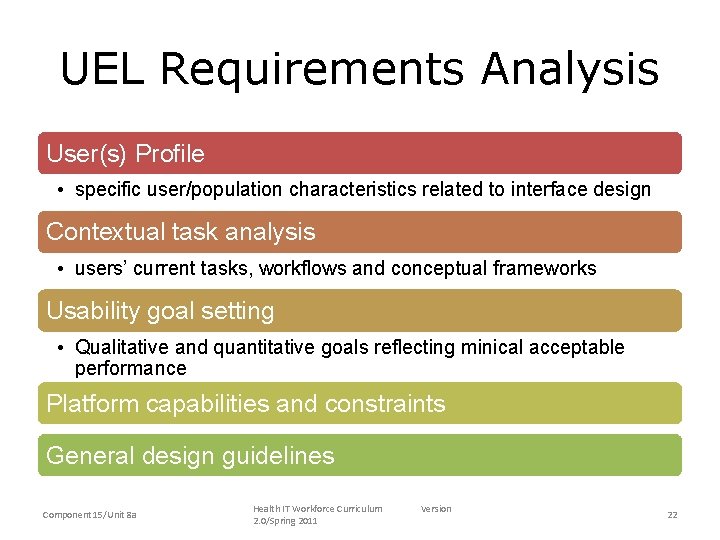
UEL Requirements Analysis User(s) Profile • specific user/population characteristics related to interface design Contextual task analysis • users’ current tasks, workflows and conceptual frameworks Usability goal setting • Qualitative and quantitative goals reflecting minical acceptable performance Platform capabilities and constraints General design guidelines Component 15/Unit 8 a Health IT Workforce Curriculum 2. 0/Spring 2011 Version 22
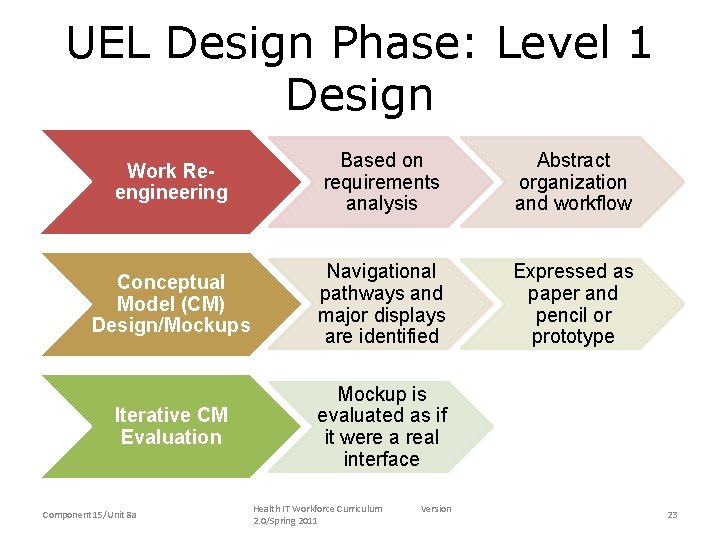
UEL Design Phase: Level 1 Design Work Reengineering Based on requirements analysis Abstract organization and workflow Conceptual Model (CM) Design/Mockups Navigational pathways and major displays are identified Expressed as paper and pencil or prototype Iterative CM Evaluation Mockup is evaluated as if it were a real interface Component 15/Unit 8 a Health IT Workforce Curriculum 2. 0/Spring 2011 Version 23
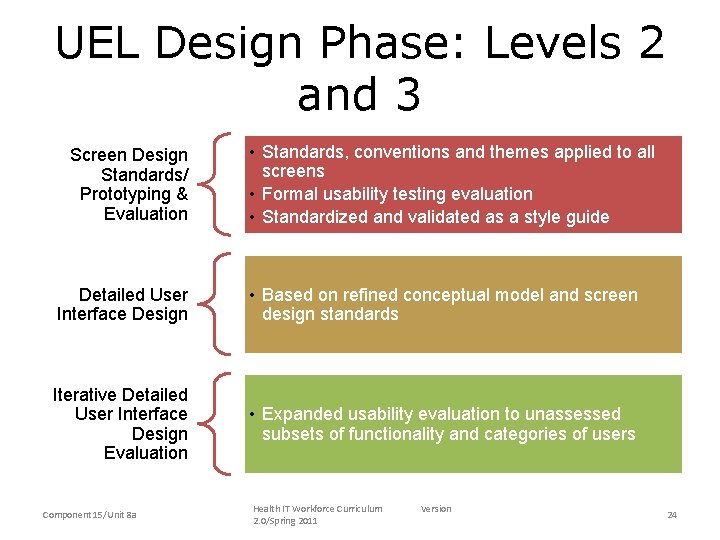
UEL Design Phase: Levels 2 and 3 Screen Design Standards/ Prototyping & Evaluation • Standards, conventions and themes applied to all screens • Formal usability testing evaluation • Standardized and validated as a style guide Detailed User Interface Design • Based on refined conceptual model and screen design standards Iterative Detailed User Interface Design Evaluation • Expanded usability evaluation to unassessed subsets of functionality and categories of users Component 15/Unit 8 a Health IT Workforce Curriculum 2. 0/Spring 2011 Version 24
- Slides: 24