
COMP 1321 Digital Infrastructure Richard Henson University of
- Slides: 26
COMP 1321 Digital Infrastructure Richard Henson University of Worcester September 2012
What is a computer? n In small groups… Ø Four attributes of a computer… Ø What is it? Ø What does it do? Ø 10 minutes
Are these computers? n Abacus Bathroom scales Thermostat Pocket calculator DVD player Typewriter Car speedometer Stonehenge Person Microphone
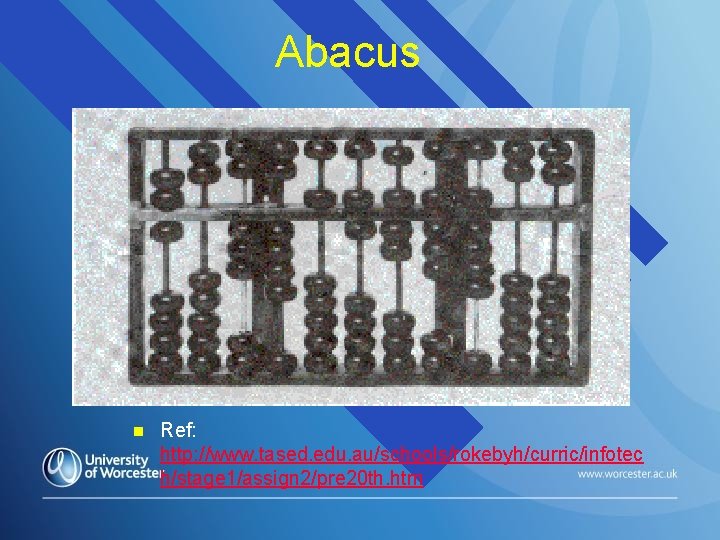
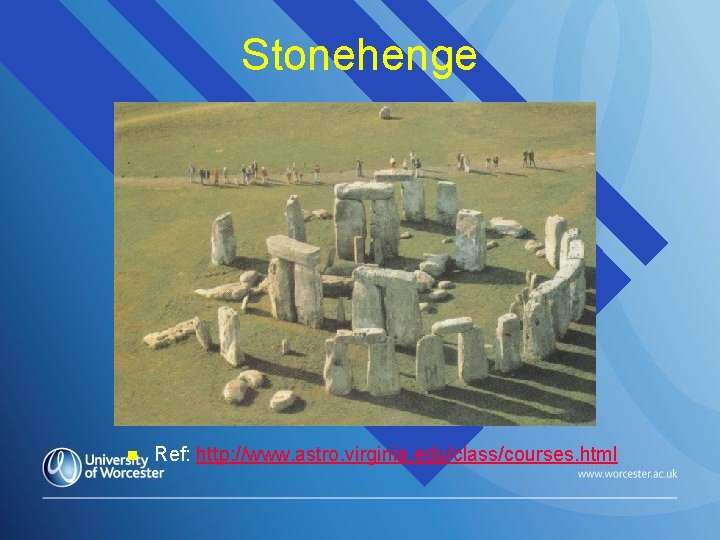
History of Computing (Origins) n 3400 BC: counting in tens (Egypt) 2600 BC: Abacus (China) 1900 -1600 BC: Stonehenge completed 260 BC: base-20 counting – including zero (Maya – Central America)
Abacus n Ref: http: //www. tased. edu. au/schools/rokebyh/curric/infotec h/stage 1/assign 2/pre 20 th. htm
Stonehenge n Ref: http: //www. astro. virginia. edu/class/courses. html
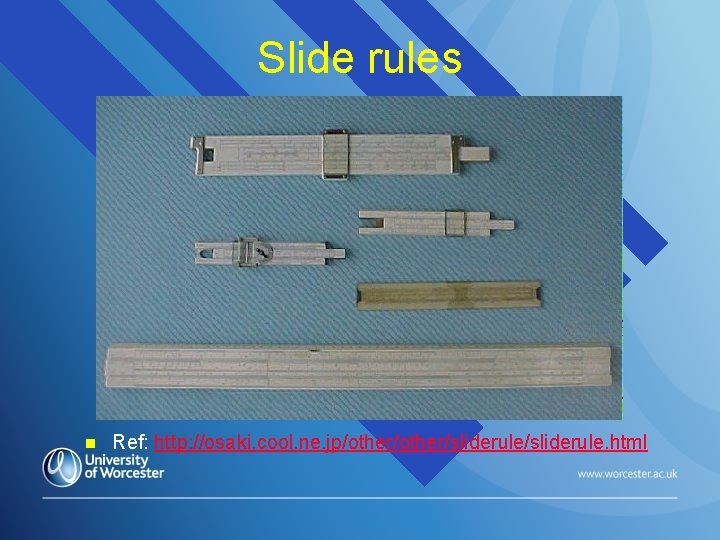
History of Computing (Europe) 967 AD: Zero in the eastern hemisphere (Muhammad Bin Ahmad) n Around 1500: Design of mechanical calculator (Leonardo da Vinci) n 1614: Logarithms (John Napier) n 1621: Slide rule (Edmund Gunter, William Oughtred) n
Slide rules n Ref: http: //osaki. cool. ne. jp/other/sliderule. html
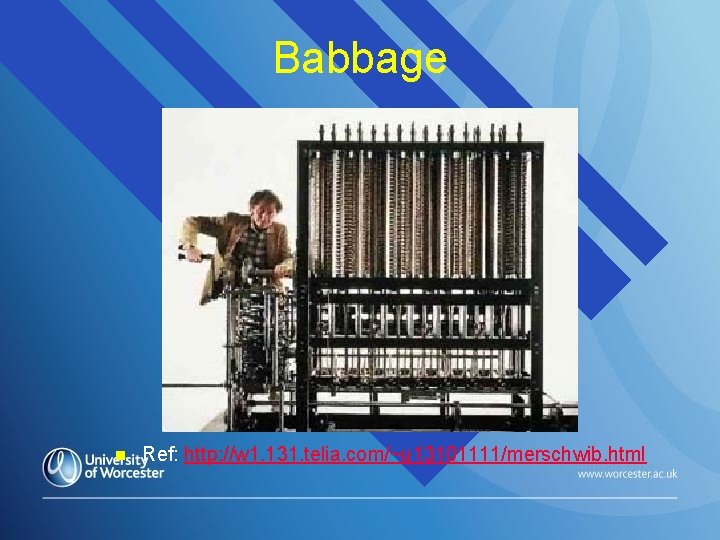
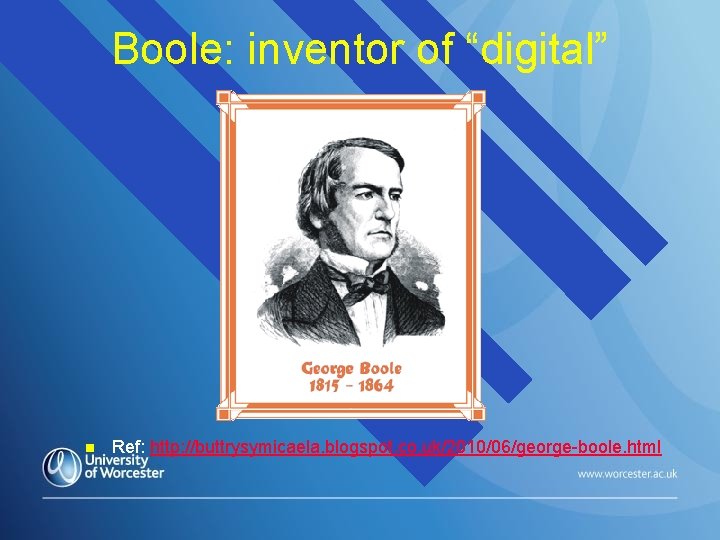
History of Computing (Europeans – continued) n 1642: Adding machine (Blaise Pascal) 1679: Binary arithmetic (Gottfried Leibnitz) 1820 s and 1830 s: Charles Babbage’s Difference Engine and Analytical Engine 1840 s George Boole: Boolean Algebra – algebra using just 0 and 1
Babbage n Ref: http: //w 1. 131. telia. com/~u 13101111/merschwib. html
Boole: inventor of “digital” n Ref: http: //buttrysymicaela. blogspot. co. uk/2010/06/george-boole. html
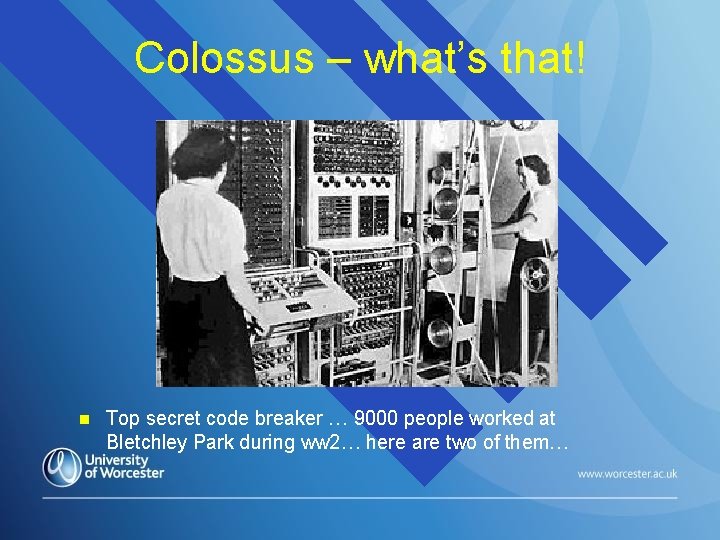
European Domination (mostly British) n n n 1843: The idea of Computer Programming (Ada Lovelace (Byron)) 1904: Vacuum tubes (“valves”) birth of electronics (John – not Alexander - Fleming) The Second World War Ø 1936: Programmable computer (Konrad Zuse, Germany) Ø 1943: Colossus – won the war?
Colossus – what’s that! n Top secret code breaker … 9000 people worked at Bletchley Park during ww 2… here are two of them…
Post-war: US domination n n n 1947: Transistors (John Bardeen, Walter Brattain & William Shockley) 1949: ENIAC First commercial computer 1960 s: First minicomputer, the DEC PDP-1 (Program, Data, Processor) 1969: Internet begins with 4 mainframes 1971: Floppy disks (IBM: Alan Shugart et al. ) 1981: IBM PC launched with Microsoft Operating system, MS-DOS
Development of Infrastructure Input-output extended through dumb terminals (Wang, 1970 s) n Linked together n ØPeer-peer networks (Internet…) n Networks evolve into client-server (1980 s) Øclient-end usable by non-specialists
European Comeback? n 1988: ARM CPU chip (Acorn) Øused in many mobile phones n 1991: World Wide Web founded at EU research facility, CERN, under the Swiss Alps (Sir Tim Berners-Lee)
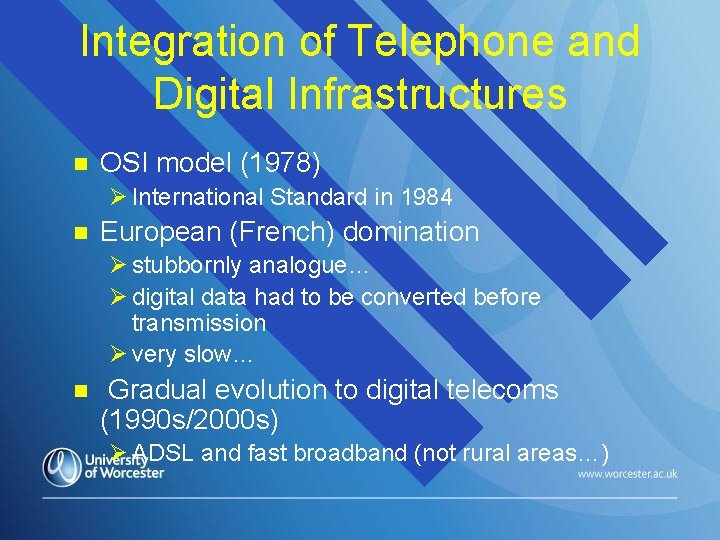
Integration of Telephone and Digital Infrastructures n OSI model (1978) Ø International Standard in 1984 n European (French) domination Ø stubbornly analogue… Ø digital data had to be converted before transmission Ø very slow… n Gradual evolution to digital telecoms (1990 s/2000 s) Ø ADSL and fast broadband (not rural areas…)
More US domination n n n Mobile phone i-player, i-phone, i-pad Smart phone Mobile apps Cloud computing What next? …
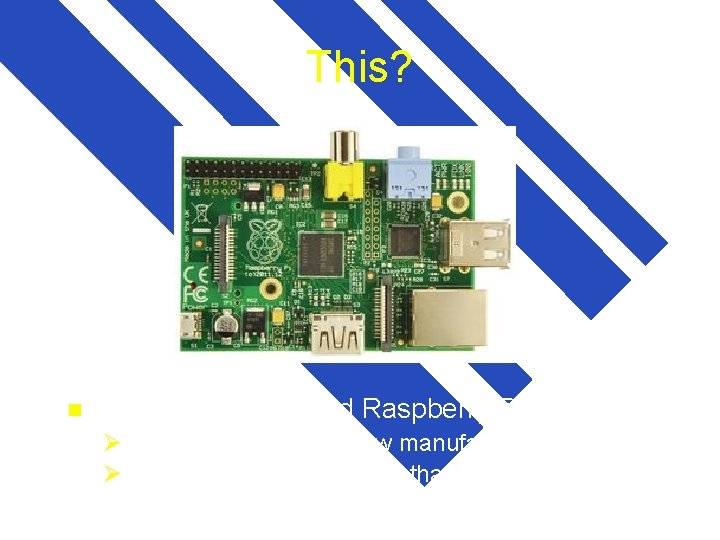
This? n The credit card sized Raspberry Pi… Ø designed in UK, and now manufactured in UK! Ø available for resale at less than £ 30
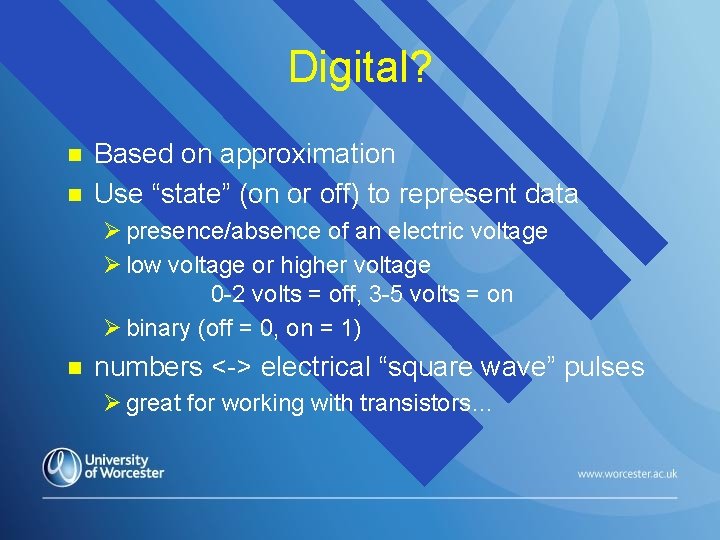
Digital? n n Based on approximation Use “state” (on or off) to represent data Ø presence/absence of an electric voltage Ø low voltage or higher voltage 0 -2 volts = off, 3 -5 volts = on Ø binary (off = 0, on = 1) n numbers <-> electrical “square wave” pulses Ø great for working with transistors…
Digits n from http: //www. dribbleglass. com/Toes/uglyt oes-2. htm
Digital multimeter n Ref: http: //www. universalradio. com/catalog/fm_txvrs/03850208. ht ml
Analogue n Uses physical entities to represent data e. g. the size of an electric voltage, the frequency of a signal, etc.
Analogue multimeter n Ref: http: //www. kpsec. freeuk. com/ multimtr. htm
Analogue and Digital n The real world has always been analogue… n Digital World = post-war human invention n Discussion: Øanalogue or digital… which is best
Summary n n n No fuzziness in digital: exact value No fractions in digital: precision of value limited to last digit Electronics easier with digital Precision of instruction is crucial: “A computer will do what you tell it to do, but that may be very different from what you had in mind. ” (Joseph Weizenbaum) Computers don’t need tea-breaks (!)