
COMP 121 Week 14 Queues Objectives Learn how
COMP 121 Week 14: Queues
Objectives Learn how to represent a queue n Learn how to use the methods in the Queue interface n Understand how to implement the Queue interface n ¨ Double-linked list ¨ Single-linked list ¨ Circular array
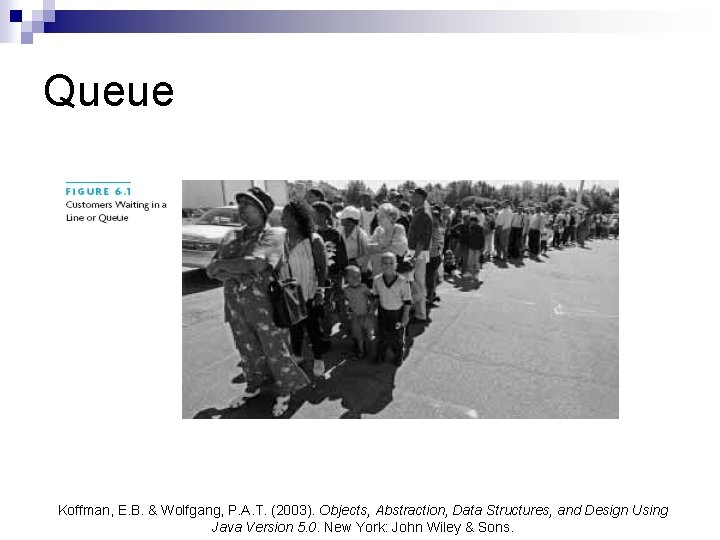
Queue Koffman, E. B. & Wolfgang, P. A. T. (2003). Objects, Abstraction, Data Structures, and Design Using Java Version 5. 0. New York: John Wiley & Sons.
Queue Abstract Data Type A First-In, First-Out (FIFO) data structure n Can visualize a queue as a line of customers waiting for service n The next person to be served is the one who has waited the longest n New elements (people) are placed at the end of the line n Koffman, E. B. & Wolfgang, P. A. T. (2003). Objects, Abstraction, Data Structures, and Design Using Java Version 5. 0. New York: John Wiley & Sons.
A Print Queue n Operating systems use queues to: ¨ Keep track of tasks waiting for a scarce resource ¨ Ensure that the tasks are carried out in the order that they were generated n Print queue ¨ Printing is slower than the process of selecting pages or documents to print ¨ Queue is used to store documents for printing ¨ Documents are printed in the order they were added to the queue (unless a priority scheme is used) Koffman, E. B. & Wolfgang, P. A. T. (2003). Objects, Abstraction, Data Structures, and Design Using Java Version 5. 0. New York: John Wiley & Sons.

A Print Queue (continued) Koffman, E. B. & Wolfgang, P. A. T. (2003). Objects, Abstraction, Data Structures, and Design Using Java Version 5. 0. New York: John Wiley & Sons.
Question: Why not use a Stack to hold documents for printing?
Answer: Stacks are last-in, first-out (LIFO) n The most recently selected document would be the next to print n Unless the printer queue is empty, your print job may never get executed if others are issuing print jobs n
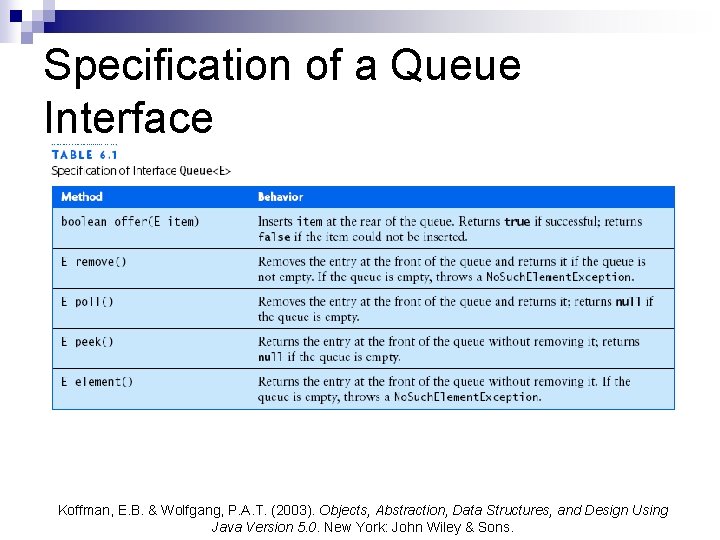
Specification of a Queue Interface Koffman, E. B. & Wolfgang, P. A. T. (2003). Objects, Abstraction, Data Structures, and Design Using Java Version 5. 0. New York: John Wiley & Sons.
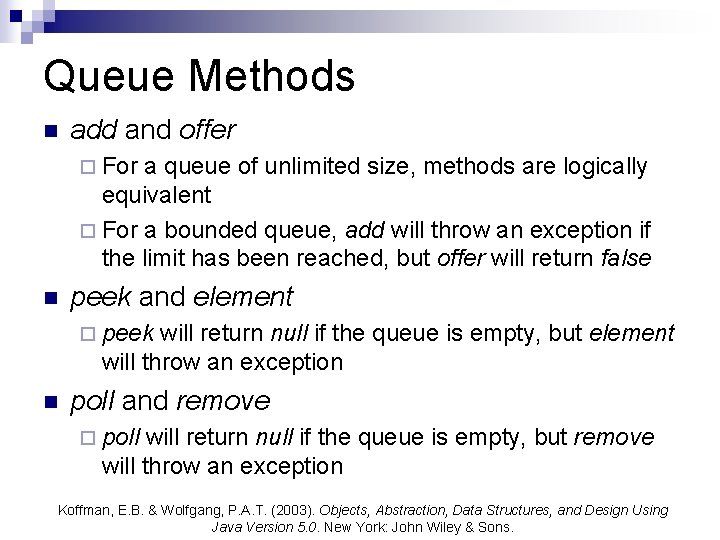
Queue Methods n add and offer ¨ For a queue of unlimited size, methods are logically equivalent ¨ For a bounded queue, add will throw an exception if the limit has been reached, but offer will return false n peek and element ¨ peek will return null if the queue is empty, but element will throw an exception n poll and remove ¨ poll will return null if the queue is empty, but remove will throw an exception Koffman, E. B. & Wolfgang, P. A. T. (2003). Objects, Abstraction, Data Structures, and Design Using Java Version 5. 0. New York: John Wiley & Sons.
Linked. List Class and Queue Interface Linked. List class provides methods for inserting and removing elements at either end of a double-linked list n The Java 5. 0 Linked. List class implements the Queue interface n Koffman, E. B. & Wolfgang, P. A. T. (2003). Objects, Abstraction, Data Structures, and Design Using Java Version 5. 0. New York: John Wiley & Sons.
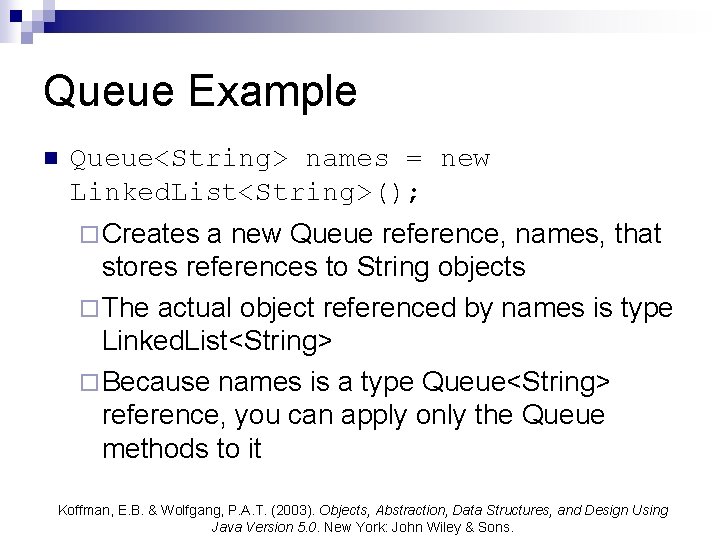
Queue Example n Queue<String> names = new Linked. List<String>(); ¨ Creates a new Queue reference, names, that stores references to String objects ¨ The actual object referenced by names is type Linked. List<String> ¨ Because names is a type Queue<String> reference, you can apply only the Queue methods to it Koffman, E. B. & Wolfgang, P. A. T. (2003). Objects, Abstraction, Data Structures, and Design Using Java Version 5. 0. New York: John Wiley & Sons.
Using a Linked. List to Implement the Queue Interface Insertion and removal from either end of a double-linked list is O(1) so either end can be the front (or rear) of the queue n In the Java 5. 0 implementation, designers decided to make the head of the linked list the front of the queue and the tail the rear of the queue n Koffman, E. B. & Wolfgang, P. A. T. (2003). Objects, Abstraction, Data Structures, and Design Using Java Version 5. 0. New York: John Wiley & Sons.
Using a Linked. List to Implement the Queue Interface (continued) n Because Linked. List implements Queue, it is possible to apply other Linked. List methods to a Queue (in addition to the ones required by the Queue interface) Koffman, E. B. & Wolfgang, P. A. T. (2003). Objects, Abstraction, Data Structures, and Design Using Java Version 5. 0. New York: John Wiley & Sons.
Question: What design pattern could be used to create a better design for a Queue?
Answer: Adapter Pattern n A better approach would be to create a new class that wrappers a Linked. List and implements the Queue interface ¨ Only Queue methods would be available ¨ Queue methods would be implemented by calling methods on the Linked. List ¨ Encapsulation would hide linked list implementation from clients
Using a Single-Linked List to Implement a Queue Can implement a queue using a singlelinked list n Class List. Queue contains a collection of Node<E> objects n Insertions are at the rear of a queue and removals are from the front n Need a reference to the last list node n Number of elements in the queue is changed by offer, poll, and remove n Koffman, E. B. & Wolfgang, P. A. T. (2003). Objects, Abstraction, Data Structures, and Design Using Java Version 5. 0. New York: John Wiley & Sons.
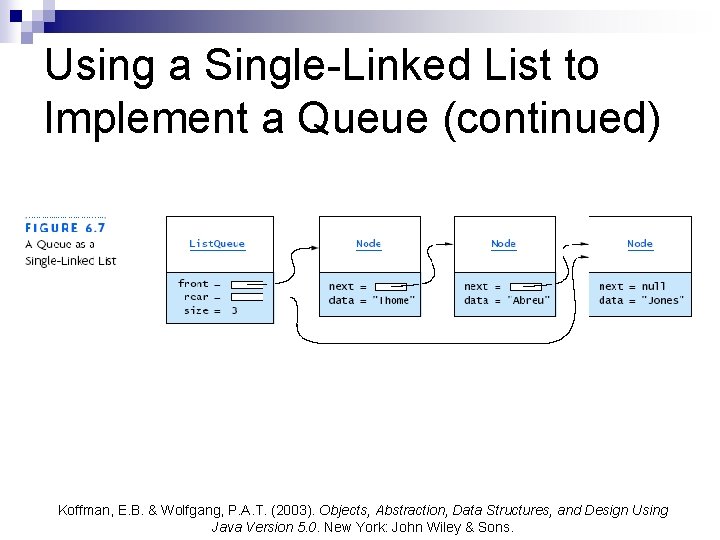
Using a Single-Linked List to Implement a Queue (continued) Koffman, E. B. & Wolfgang, P. A. T. (2003). Objects, Abstraction, Data Structures, and Design Using Java Version 5. 0. New York: John Wiley & Sons.
Implementing a Queue Using a Circular Array n Time efficiency of using a single- or double -linked list to implement a queue is acceptable ¨ n However there are some space inefficiencies Storage space is increased when using a linked list due to references stored at each list node Koffman, E. B. & Wolfgang, P. A. T. (2003). Objects, Abstraction, Data Structures, and Design Using Java Version 5. 0. New York: John Wiley & Sons.
Implementing a Queue Using a Circular Array (continued) n Array Implementation ¨ Insertion at rear of array is constant time ¨ Removal from the front is linear time ¨ Removal from rear of array is constant time ¨ Insertion at the front is linear time n Circular Array Implementation ¨ Both time insertions and removals are constant Koffman, E. B. & Wolfgang, P. A. T. (2003). Objects, Abstraction, Data Structures, and Design Using Java Version 5. 0. New York: John Wiley & Sons.
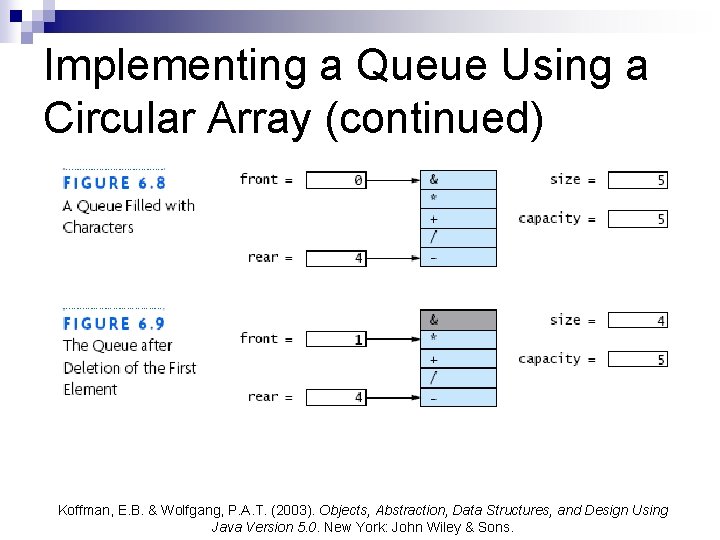
Implementing a Queue Using a Circular Array (continued) Koffman, E. B. & Wolfgang, P. A. T. (2003). Objects, Abstraction, Data Structures, and Design Using Java Version 5. 0. New York: John Wiley & Sons.
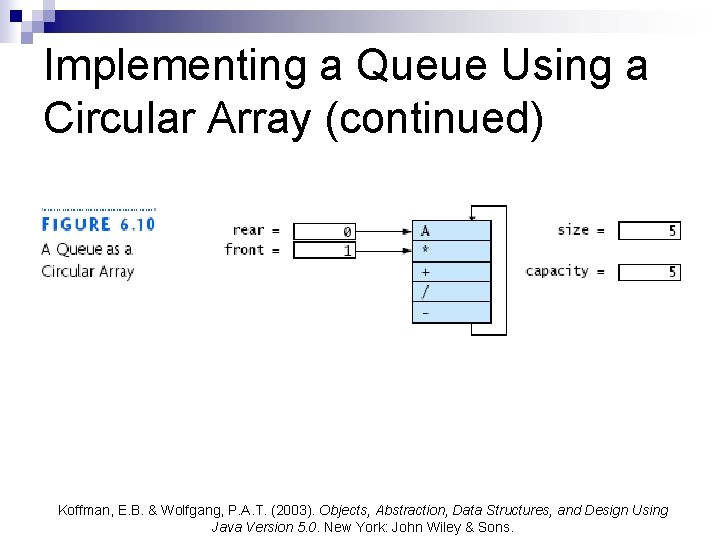
Implementing a Queue Using a Circular Array (continued) Koffman, E. B. & Wolfgang, P. A. T. (2003). Objects, Abstraction, Data Structures, and Design Using Java Version 5. 0. New York: John Wiley & Sons.
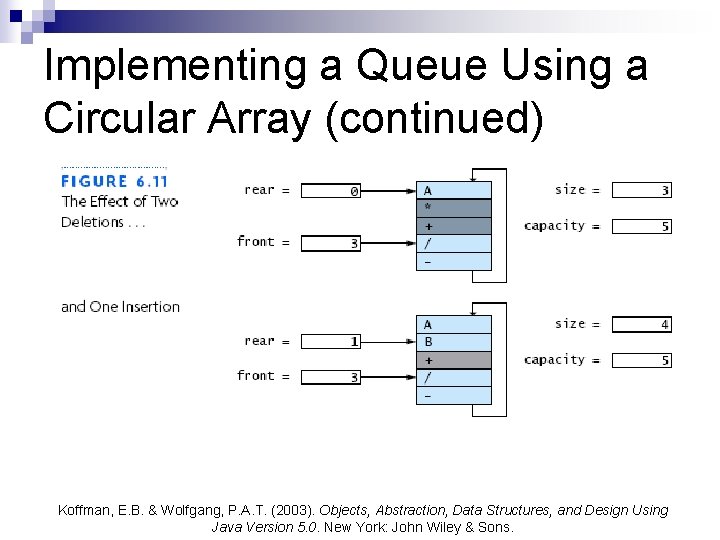
Implementing a Queue Using a Circular Array (continued) Koffman, E. B. & Wolfgang, P. A. T. (2003). Objects, Abstraction, Data Structures, and Design Using Java Version 5. 0. New York: John Wiley & Sons.
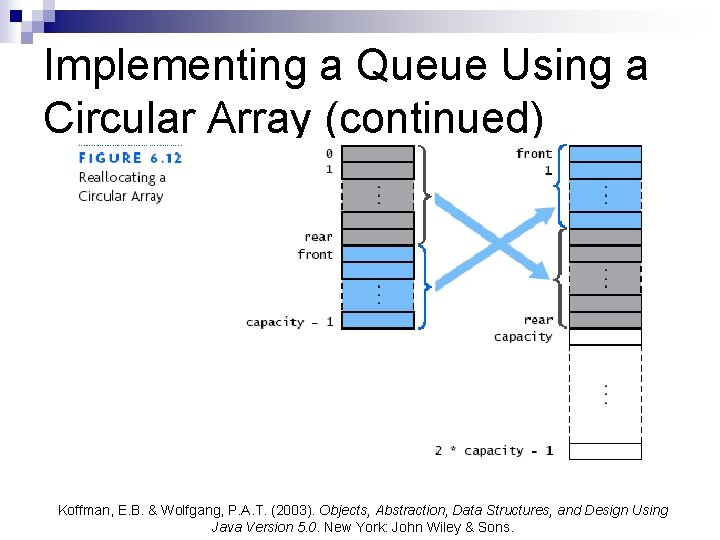
Implementing a Queue Using a Circular Array (continued) Koffman, E. B. & Wolfgang, P. A. T. (2003). Objects, Abstraction, Data Structures, and Design Using Java Version 5. 0. New York: John Wiley & Sons.
Comparing the Implementations n All three implementations are comparable in terms of computation time ¨ All n operations are O(1) Linked-list implementations require more storage because of the extra space required for the links ¨ Each node for a single-linked list would store a total of two references ¨ Each node for a double-linked list would store a total of three references Koffman, E. B. & Wolfgang, P. A. T. (2003). Objects, Abstraction, Data Structures, and Design Using Java Version 5. 0. New York: John Wiley & Sons.
Comparing the Implementations (continued) A circular array that is filled to capacity would require half the storage of a singlelinked list to store the same number of elements n A circular array that was just reallocated would be half empty and require the same amount of storage as a single-linked list n Koffman, E. B. & Wolfgang, P. A. T. (2003). Objects, Abstraction, Data Structures, and Design Using Java Version 5. 0. New York: John Wiley & Sons.
Simulating Waiting Lines Using Queues Simulation is used to study the performance of a physical system by using a physical, mathematical, or computer model of the system n Simulation allows designers of a new system to estimate the expected performance before building it n Koffman, E. B. & Wolfgang, P. A. T. (2003). Objects, Abstraction, Data Structures, and Design Using Java Version 5. 0. New York: John Wiley & Sons.
Simulating Waiting Lines Using Queues (continued) Simulation can lead to changes in the design that will improve the expected performance of the new system n Useful when the real system would be too expensive to build or too dangerous to experiment with after its construction n Koffman, E. B. & Wolfgang, P. A. T. (2003). Objects, Abstraction, Data Structures, and Design Using Java Version 5. 0. New York: John Wiley & Sons.
Simulating Waiting Lines Using Queues (continued) n System designers often use computer models to simulate physical systems ¨ Airline n check-in counter for example A special branch of mathematics called queuing theory has been developed to study such problems Koffman, E. B. & Wolfgang, P. A. T. (2003). Objects, Abstraction, Data Structures, and Design Using Java Version 5. 0. New York: John Wiley & Sons.
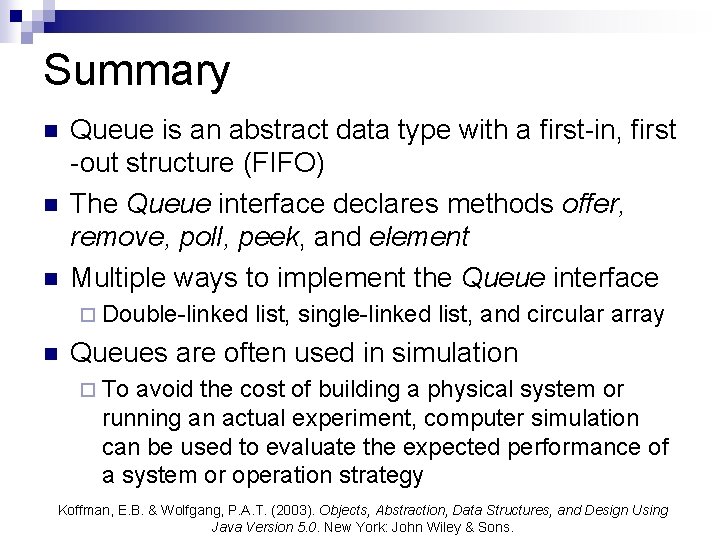
Summary n n n Queue is an abstract data type with a first-in, first -out structure (FIFO) The Queue interface declares methods offer, remove, poll, peek, and element Multiple ways to implement the Queue interface ¨ Double-linked n list, single-linked list, and circular array Queues are often used in simulation ¨ To avoid the cost of building a physical system or running an actual experiment, computer simulation can be used to evaluate the expected performance of a system or operation strategy Koffman, E. B. & Wolfgang, P. A. T. (2003). Objects, Abstraction, Data Structures, and Design Using Java Version 5. 0. New York: John Wiley & Sons.
Any Questions?
- Slides: 31