
CommunityBased Participatory Research and Obesity among Pacific Islander
Community-Based Participatory Research and Obesity among Pacific Islander Youth Vaka Faletau, MS Los Angeles County, Dept of Children & Family Services Sora Park Tanjasiri, Dr. PH, MPH California State University, Fullerton Asian Pacific Islander Obesity Prevention Alliance May 20, 2010
Disparities in Diabetes Mortality in California Denotes Healthy People 2010 Target (45. 0 per 100, 000) * Data from the California Department of Health Services, Sentinel Health Indicators for California’s Multicultural Populations, 1991 -2001, CA: Center for Health Statistics, May 2004.
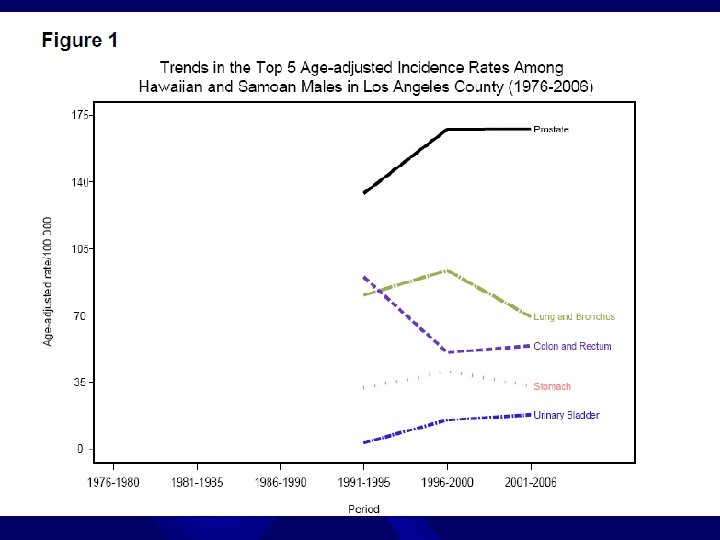
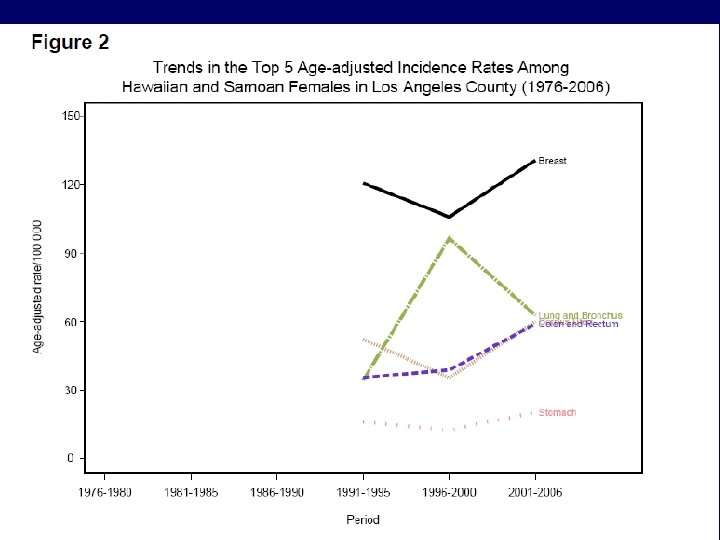
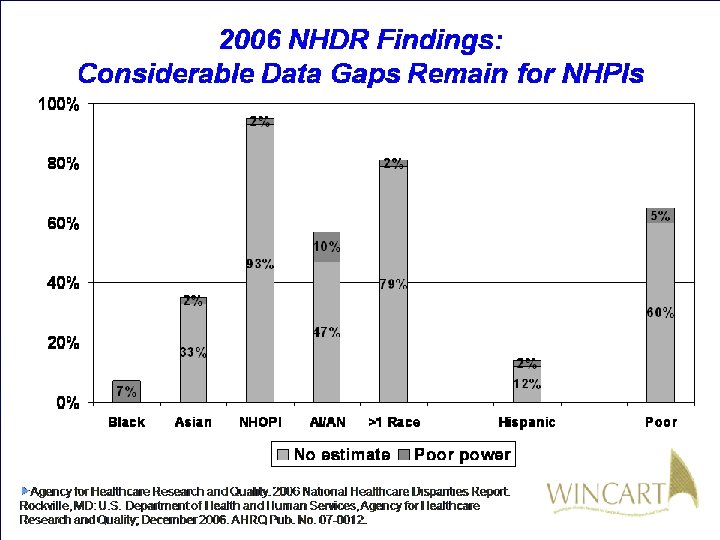
2006 NHDR Findings: Considerable Data Gaps Remain for NHPIs Agency for Healthcare Research and Quality. 2006 National Healthcare Disparities Report. Rockville, MD: U. S. Department of Health and Human Services, Agency for Healthcare Research and Quality; December 2006. AHRQ Pub. No. 07 -0012.
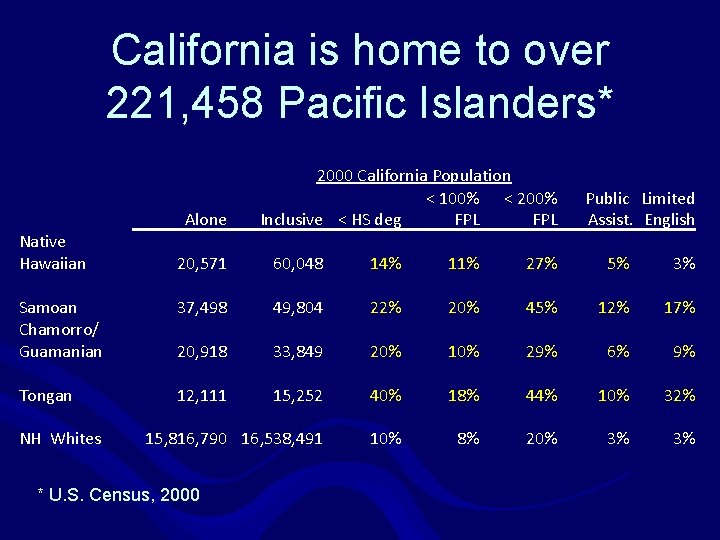
California is home to over 221, 458 Pacific Islanders* Alone Native Hawaiian 2000 California Population < 100% < 200% Inclusive < HS deg FPL Public Limited Assist. English 20, 571 60, 048 14% 11% 27% 5% 3% Samoan Chamorro/ Guamanian 37, 498 49, 804 22% 20% 45% 12% 17% 20, 918 33, 849 20% 10% 29% 6% 9% Tongan 12, 111 15, 252 40% 18% 44% 10% 32% 15, 816, 790 16, 538, 491 10% 8% 20% 3% 3% NH Whites * U. S. Census, 2000
• NCI Community Network Program (U 01 CA 114591) • Five year effort to increase cancer education, research and training for Pacific Islanders in Southern California
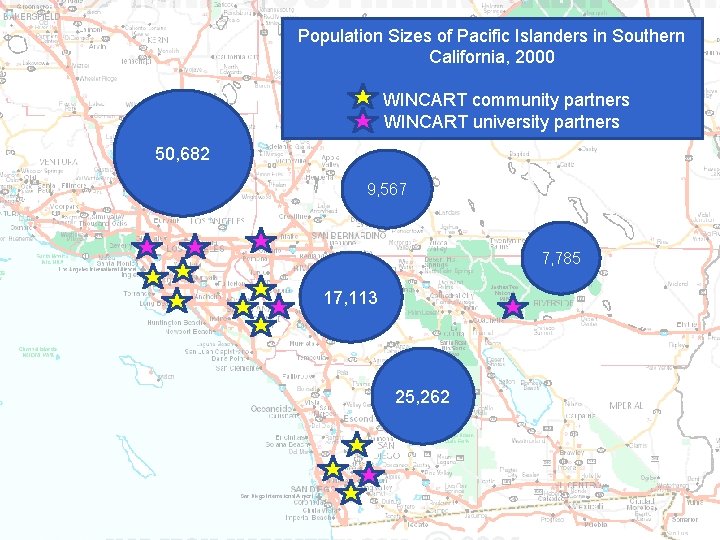
Population Sizes of Pacific Islanders in Southern California, 2000 WINCART community partners WINCART university partners 50, 682 9, 567 7, 785 17, 113 25, 262
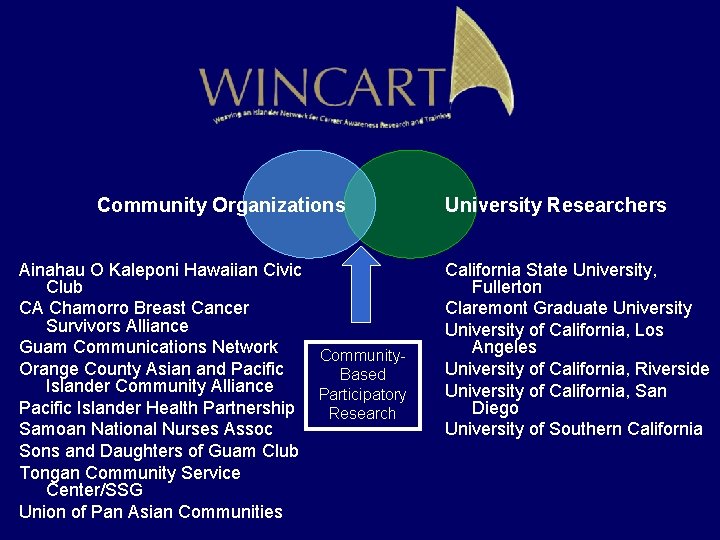
Community Organizations Ainahau O Kaleponi Hawaiian Civic Club CA Chamorro Breast Cancer Survivors Alliance Guam Communications Network Community. Orange County Asian and Pacific Based Islander Community Alliance Participatory Pacific Islander Health Partnership Research Samoan National Nurses Assoc Sons and Daughters of Guam Club Tongan Community Service Center/SSG Union of Pan Asian Communities University Researchers California State University, Fullerton Claremont Graduate University of California, Los Angeles University of California, Riverside University of California, San Diego University of Southern California
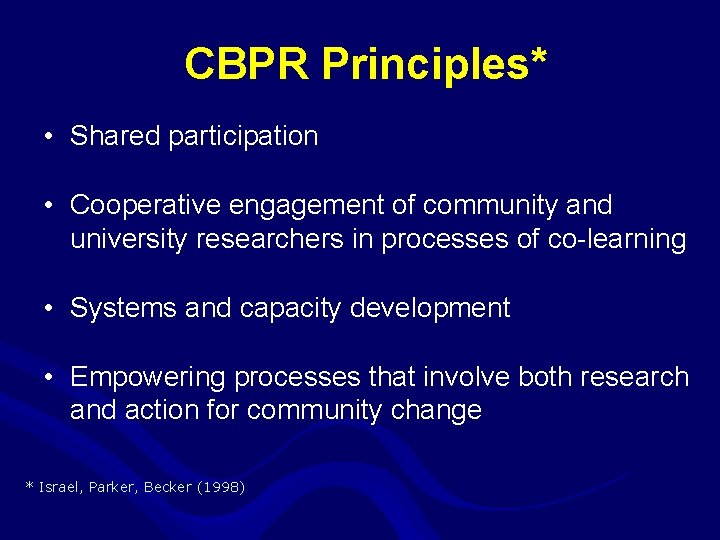
CBPR Principles* • Shared participation • Cooperative engagement of community and university researchers in processes of co-learning • Systems and capacity development • Empowering processes that involve both research and action for community change * Israel, Parker, Becker (1998)
Physical Activity and Nutrition among Pacific Islander Youth (PANPY) • 2 year study to assess the feasibility of a CBPR collaborative to identify obesity risk factors among Marshallese, Samoan and Tongan youth in Southern California • Funded by the National Institute on Child Health and Human Development (NICHD)
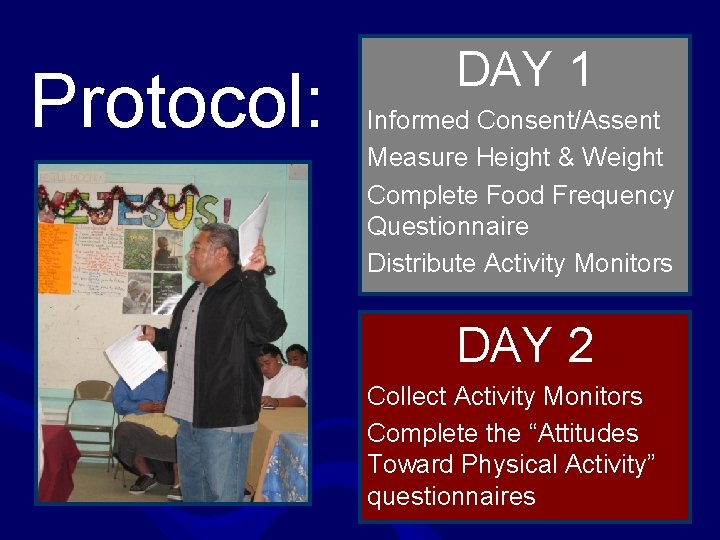
Protocol: DAY 1 Informed Consent/Assent Measure Height & Weight Complete Food Frequency Questionnaire Distribute Activity Monitors DAY 2 Collect Activity Monitors Complete the “Attitudes Toward Physical Activity” questionnaires
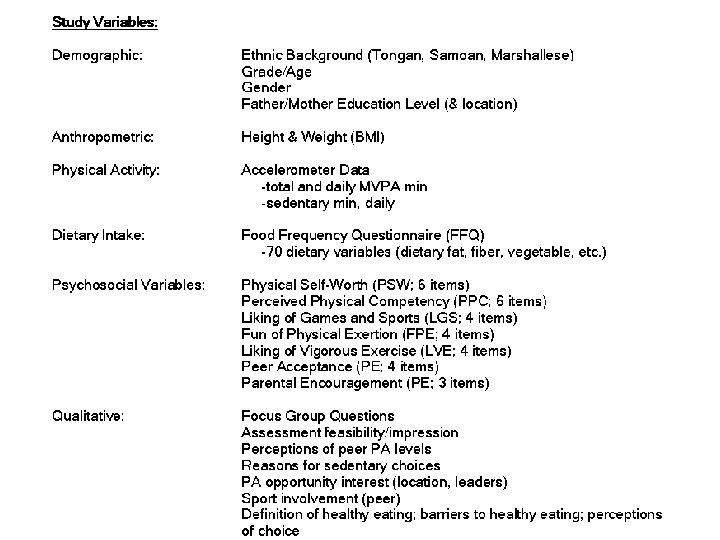
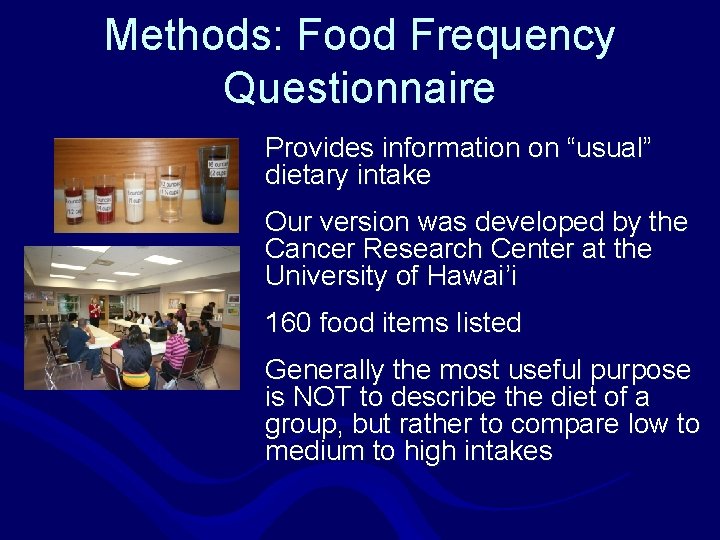
Methods: Food Frequency Questionnaire Provides information on “usual” dietary intake Our version was developed by the Cancer Research Center at the University of Hawai’i 160 food items listed Generally the most useful purpose is NOT to describe the diet of a group, but rather to compare low to medium to high intakes

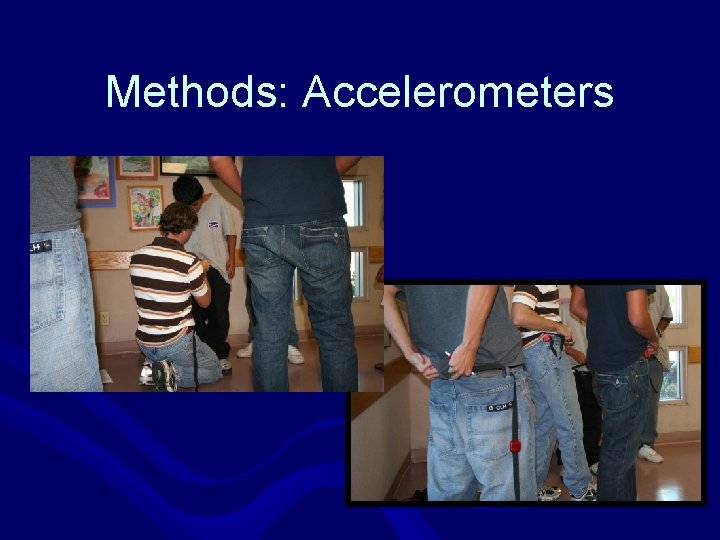
Methods: Accelerometers
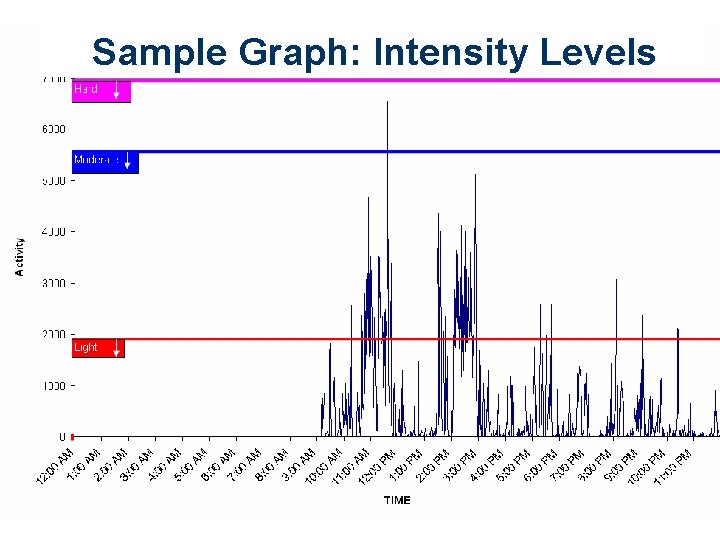
Sample Graph: Intensity Levels
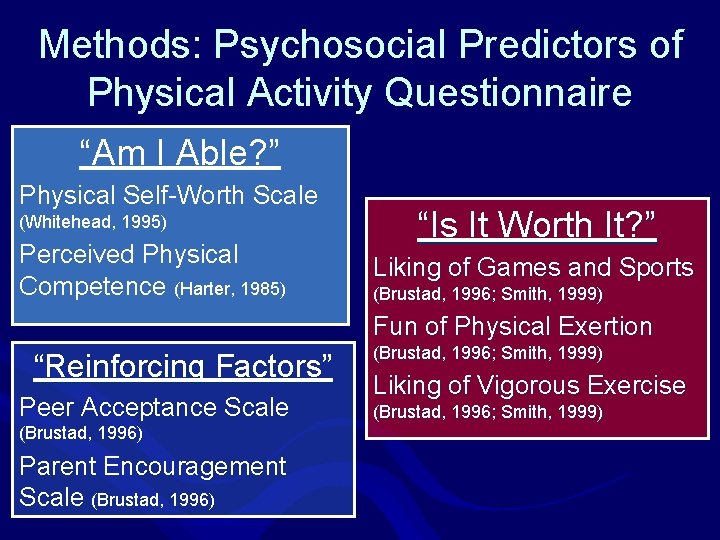
Methods: Psychosocial Predictors of Physical Activity Questionnaire “Am I Able? ” Physical Self-Worth Scale (Whitehead, 1995) Perceived Physical Competence (Harter, 1985) “Is It Worth It? ” Liking of Games and Sports (Brustad, 1996; Smith, 1999) Fun of Physical Exertion “Reinforcing Factors” Peer Acceptance Scale (Brustad, 1996) Parent Encouragement Scale (Brustad, 1996) (Brustad, 1996; Smith, 1999) Liking of Vigorous Exercise (Brustad, 1996; Smith, 1999)
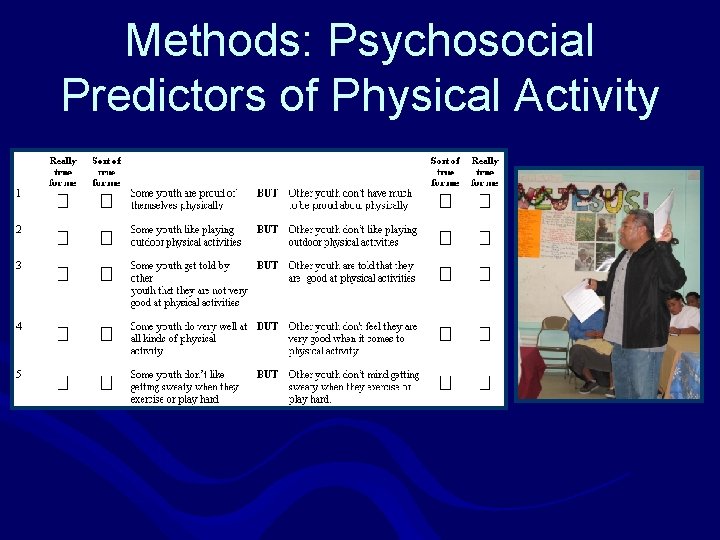
Methods: Psychosocial Predictors of Physical Activity
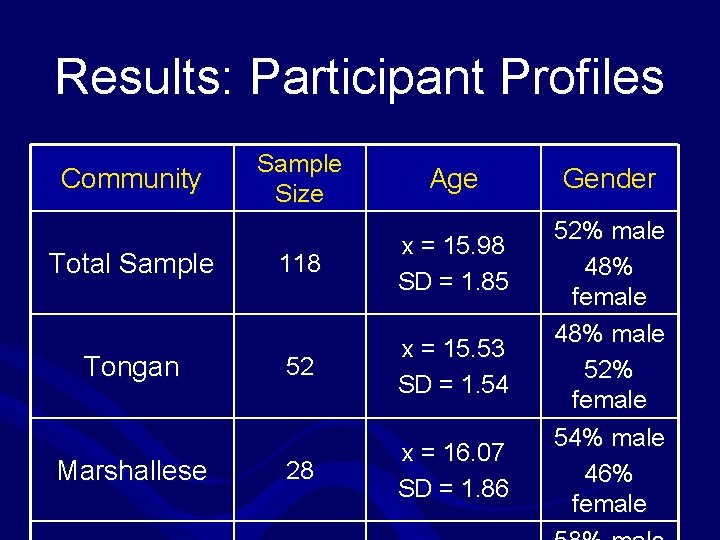
Results: Participant Profiles Community Total Sample Tongan Marshallese Sample Size Age 118 x = 15. 98 SD = 1. 85 52 x = 15. 53 SD = 1. 54 28 x = 16. 07 SD = 1. 86 Gender 52% male 48% female 48% male 52% female 54% male 46% female
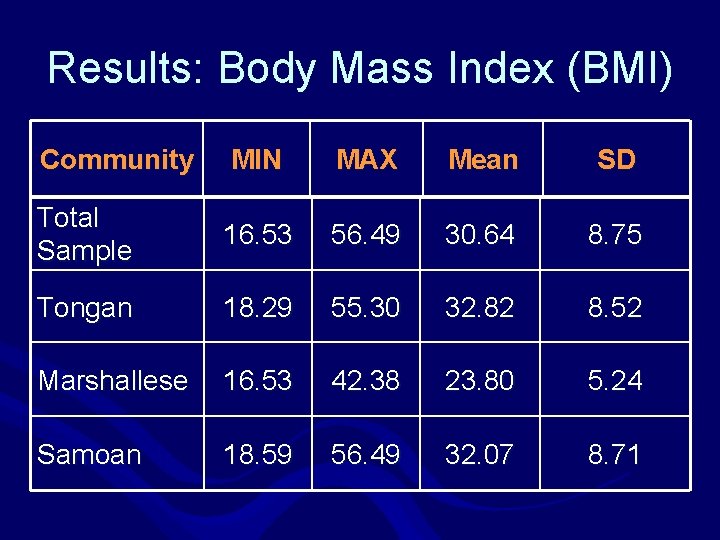
Results: Body Mass Index (BMI) Community MIN MAX Mean SD Total Sample 16. 53 56. 49 30. 64 8. 75 Tongan 18. 29 55. 30 32. 82 8. 52 Marshallese 16. 53 42. 38 23. 80 5. 24 Samoan 18. 59 56. 49 32. 07 8. 71
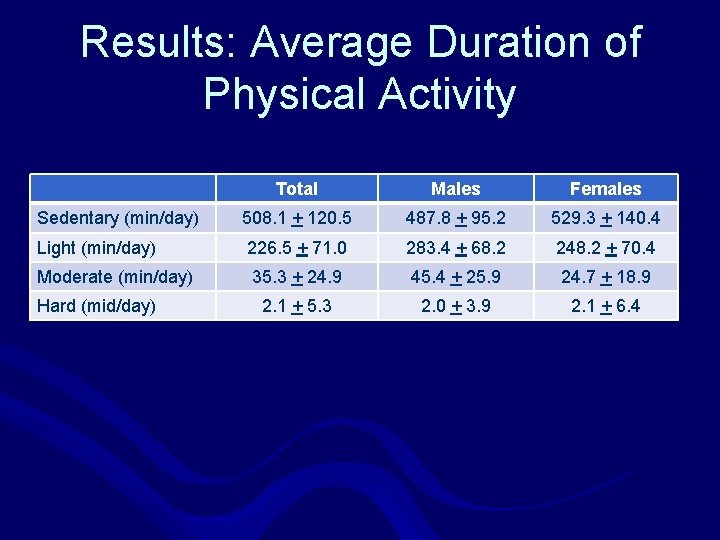
Results: Average Duration of Physical Activity Total Males Females Sedentary (min/day) 508. 1 + 120. 5 487. 8 + 95. 2 529. 3 + 140. 4 Light (min/day) 226. 5 + 71. 0 283. 4 + 68. 2 248. 2 + 70. 4 Moderate (min/day) 35. 3 + 24. 9 45. 4 + 25. 9 24. 7 + 18. 9 2. 1 + 5. 3 2. 0 + 3. 9 2. 1 + 6. 4 Hard (mid/day)

Results: Food Frequency Questionnaire
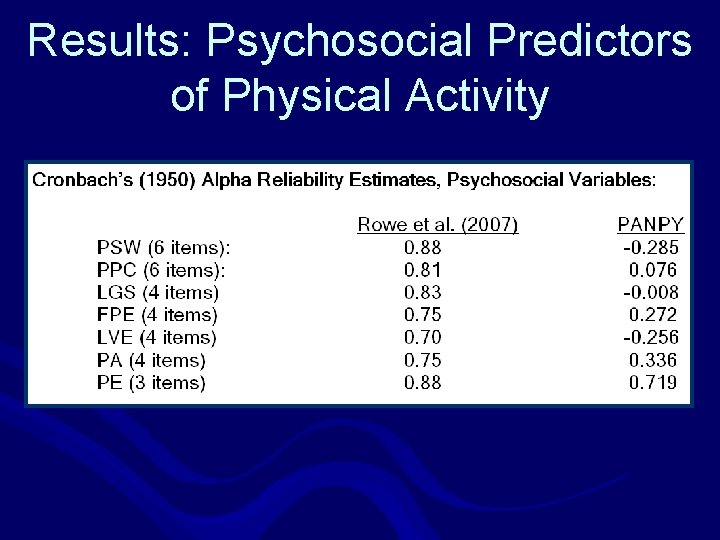
Results: Psychosocial Predictors of Physical Activity
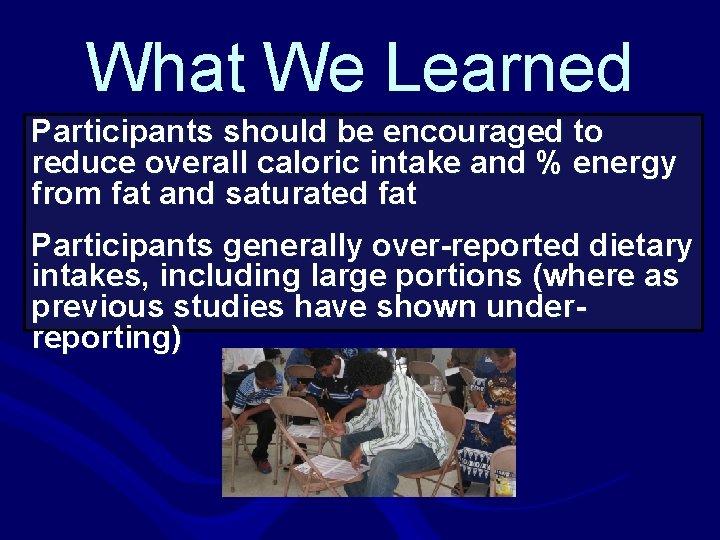
What We Learned Participants should be encouraged to reduce overall caloric intake and % energy from fat and saturated fat Participants generally over-reported dietary intakes, including large portions (where as previous studies have shown underreporting)
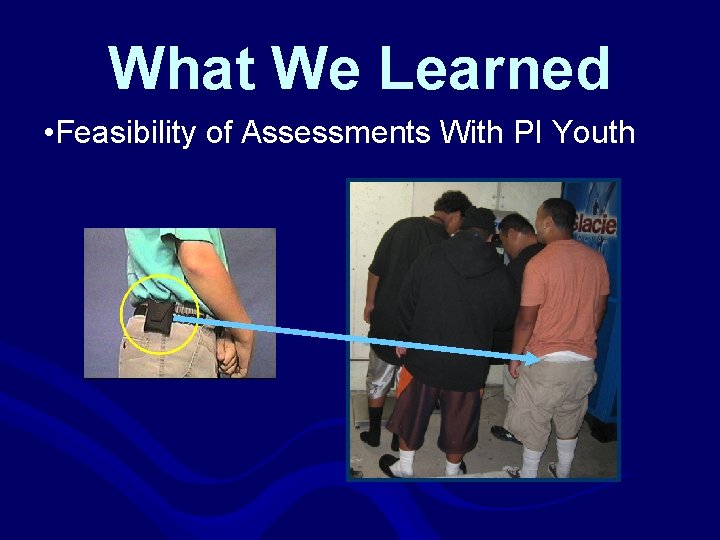
What We Learned • Feasibility of Assessments With PI Youth
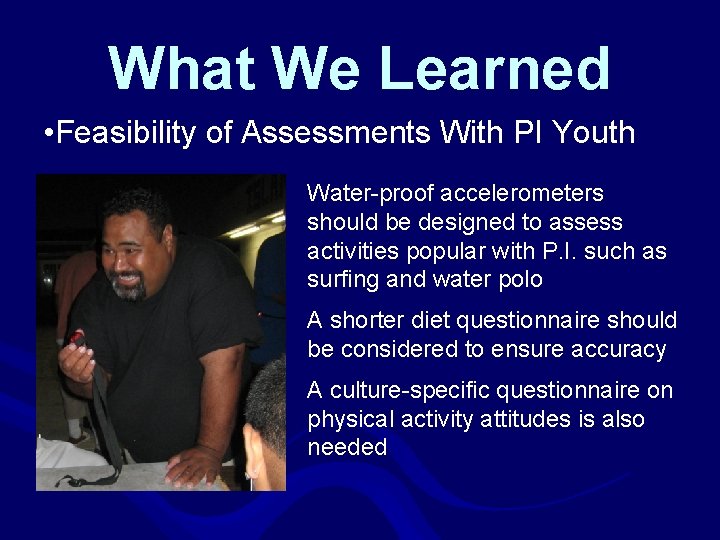
What We Learned • Feasibility of Assessments With PI Youth Water-proof accelerometers should be designed to assess activities popular with P. I. such as surfing and water polo A shorter diet questionnaire should be considered to ensure accuracy A culture-specific questionnaire on physical activity attitudes is also needed
What We Learned • Barriers to Physical Activity Involvement Limited access to SAFE, open areas Transportation is a barrier to getting places after school “We watch TV ‘cause it’s there…” Include physical activity at cultural or church events (volleyball, football, etc. ) PI youth respect dedicated individuals, regardless of background Many PI youth are embarrassed by their body size (males)
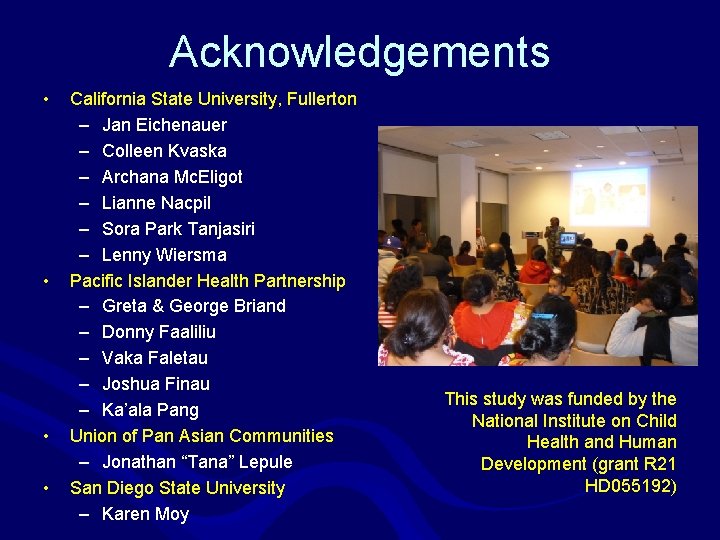
Acknowledgements • • California State University, Fullerton – Jan Eichenauer – Colleen Kvaska – Archana Mc. Eligot – Lianne Nacpil – Sora Park Tanjasiri – Lenny Wiersma Pacific Islander Health Partnership – Greta & George Briand – Donny Faaliliu – Vaka Faletau – Joshua Finau – Ka’ala Pang Union of Pan Asian Communities – Jonathan “Tana” Lepule San Diego State University – Karen Moy This study was funded by the National Institute on Child Health and Human Development (grant R 21 HD 055192)
Thank you!
- Slides: 30