
Communitybased flood risk management experiences and challenges in
Community-based flood risk management: experiences and challenges in Malawi Robert Sakic Trogrlic 1 Dr Grant Wright 1, Prof Adebayo Adeloye 1, Dr Melanie Duncan 2 & Dr Faidess Mwale 3 1 Heriot-Watt University, UK 2 British Geological Survey (NERC), UK 3 Polytechnic Blantyre, Malawi

Presentation outline • • • Flooding and Malawi Community-based approaches in DRR Research aims Research methodology Results Conclusions

Flooding and Malawi �� Country prone to multiple hazards �� Floods and droughts cause 1. 7 % GDP losses annually (Pauw et al. 2011) �� Agro-based economy and majority of population in rural areas �� Livelihoods dependant on subsidence farming �� Floods occur annually �� January and February 2015: one of the largest floods on the record �� Decentralised institutional system for DRR �� NGOs lead FRM in the Districts, implementing community-based disaster risk reduction approaches
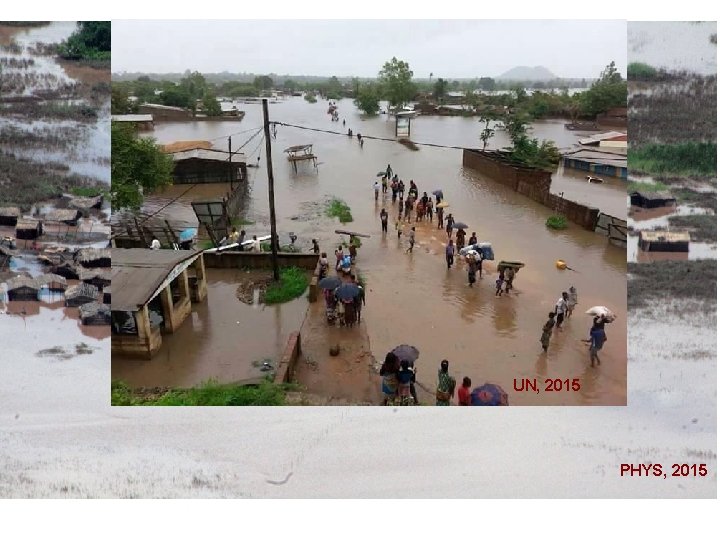
Example: floods 2015 FACTS ü January and February 2015 ü 1. 1 million people affected ü More than 170 lives lost ü Estimated losses of US$335 million ü 15 + 2 affected districts UN, 2015 Figure: Flooding on Jan. 18. 2015 Government of Malawi (2015) Global Flood Monitoring System, University of Maryland (2015) PHYS, 2015

Flooding in the Lower Shire Valley • Chikwawa and Nsanje Districts • Most flood prone area of the country • River flooding and flash flooding • Contributing factors to flood hazard: location, siltation of river beds, topography, rainfall characteristics, hydrology, soil structure, land use and land cover change • Flood vulnerability shaped by socio-economic and environmental susceptibility

Community-based flood risk management (CB-FRM) • A part of the wider family of community-based disaster risk reduction (CB-DRR) approaches Local resources Resilience capacities Participation knowledge Community-Based Disaster Risk Reduction Empowerment Preparedness & Sustainability mitigation Part of the process • Challenges for CB-DRR: limited and/or inadequate community involvement, not incorporated in policy levels, underlying causes of vulnerability not tackled
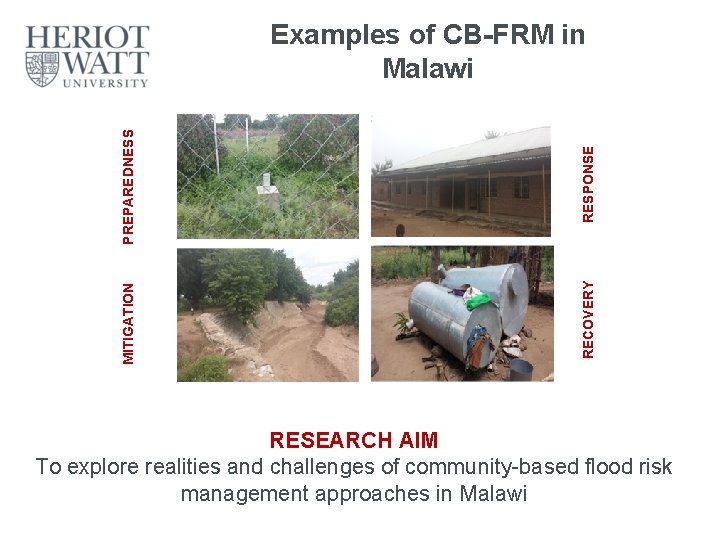
PREPAREDNESS RESPONSE MITIGATION RECOVERY Examples of CB-FRM in Malawi RESEARCH AIM To explore realities and challenges of community-based flood risk management approaches in Malawi
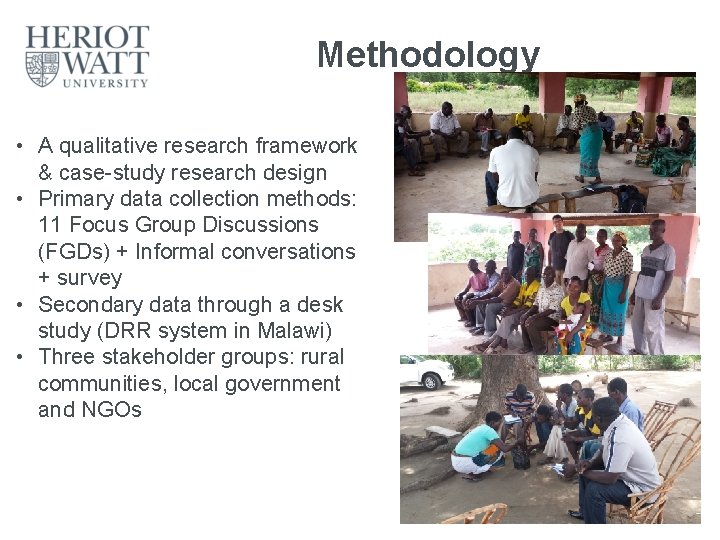
Methodology • A qualitative research framework & case-study research design • Primary data collection methods: 11 Focus Group Discussions (FGDs) + Informal conversations + survey • Secondary data through a desk study (DRR system in Malawi) • Three stakeholder groups: rural communities, local government and NGOs
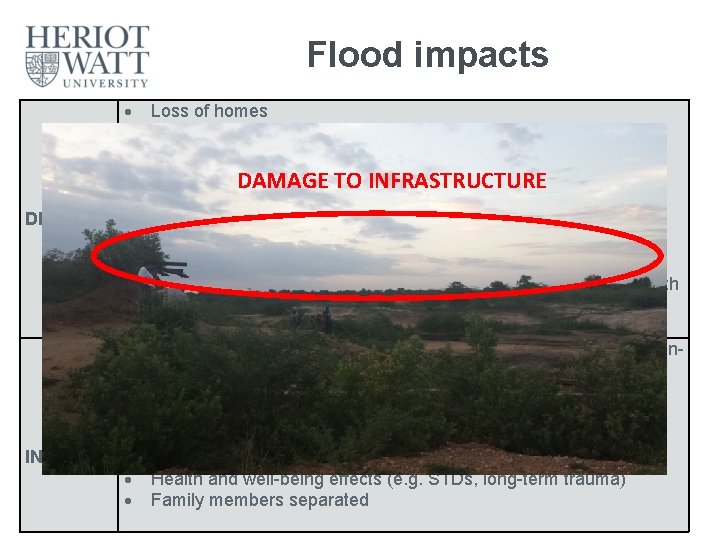
Flood impacts DIRECT INDIRECT Loss of homes Loss of crops Loss of livestock Damage to infrastructure (e. g. roads, bridges, schools) DAMAGE TO INFRASTRUCTURE Loss of life Health and well-being effects (e. g. occurrence of cholera) Psychological effects Displacement of people and livestock Limited or total lack of access to services (e. g. sanitation, health care) Increased population pressure on boreholes leading to nonfunctioning Violation of cultural values Disruption to educational system Crocodile attacks Hunger Health and well-being effects (e. g. STDs, long-term trauma) Family members separated
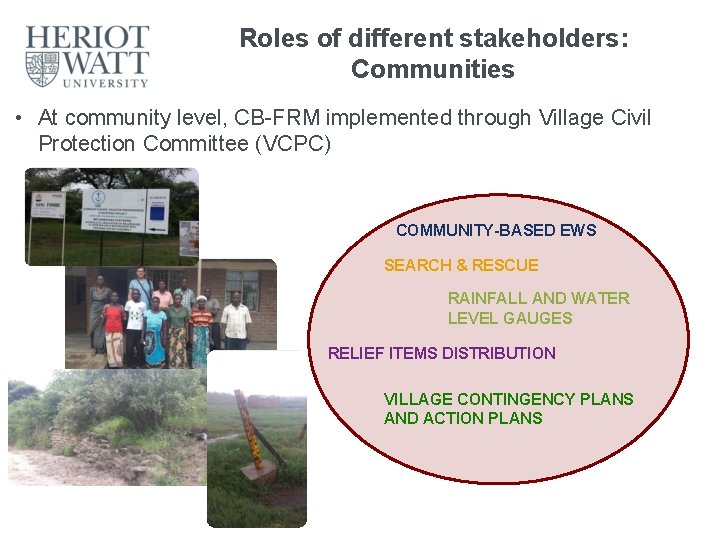
Roles of different stakeholders: Communities • At community level, CB-FRM implemented through Village Civil Protection Committee (VCPC) COMMUNITY-BASED EWS SEARCH & RESCUE RAINFALL AND WATER LEVEL GAUGES RELIEF ITEMS DISTRIBUTION VILLAGE CONTINGENCY PLANS AND ACTION PLANS
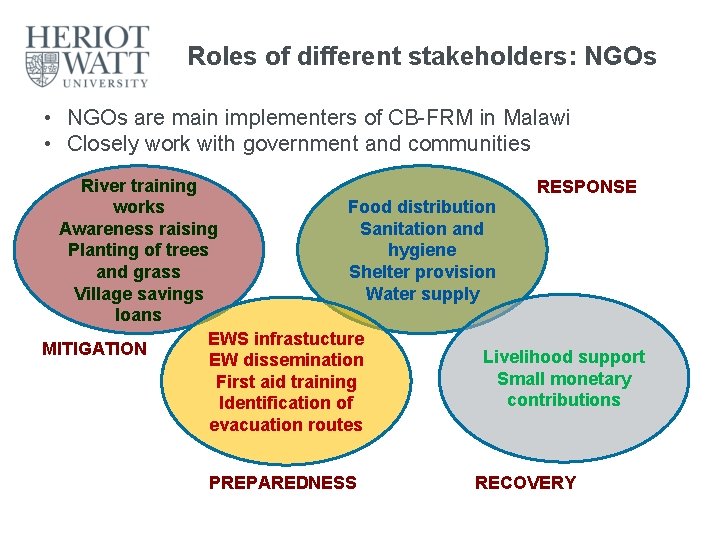
Roles of different stakeholders: NGOs • NGOs are main implementers of CB-FRM in Malawi • Closely work with government and communities River training RESPONSE Food distribution works Sanitation and Awareness raising hygiene Planting of trees Shelter provision and grass Water supply Village savings loans EWS infrastucture MITIGATION Livelihood support EW dissemination Small monetary First aid training contributions Identification of evacuation routes PREPAREDNESS RECOVERY
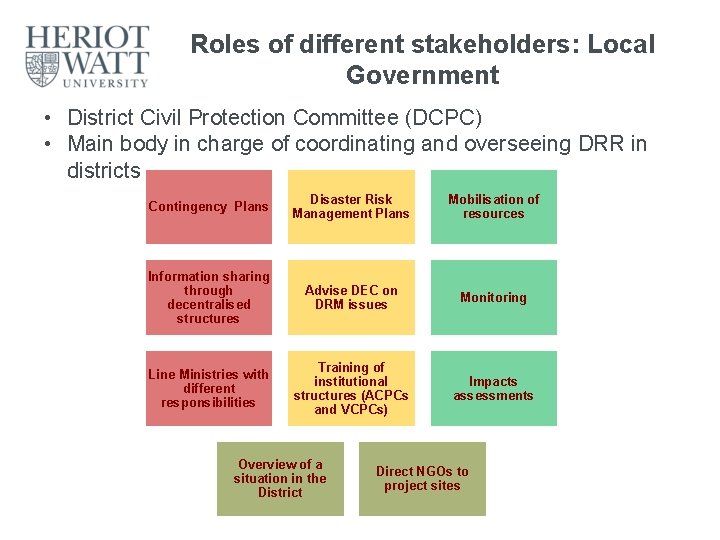
Roles of different stakeholders: Local Government • District Civil Protection Committee (DCPC) • Main body in charge of coordinating and overseeing DRR in districts Contingency Plans Disaster Risk Management Plans Mobilisation of resources Information sharing through decentralised structures Advise DEC on DRM issues Monitoring Line Ministries with different responsibilities Training of institutional structures (ACPCs and VCPCs) Impacts assessments Overview of a situation in the District Direct NGOs to project sites
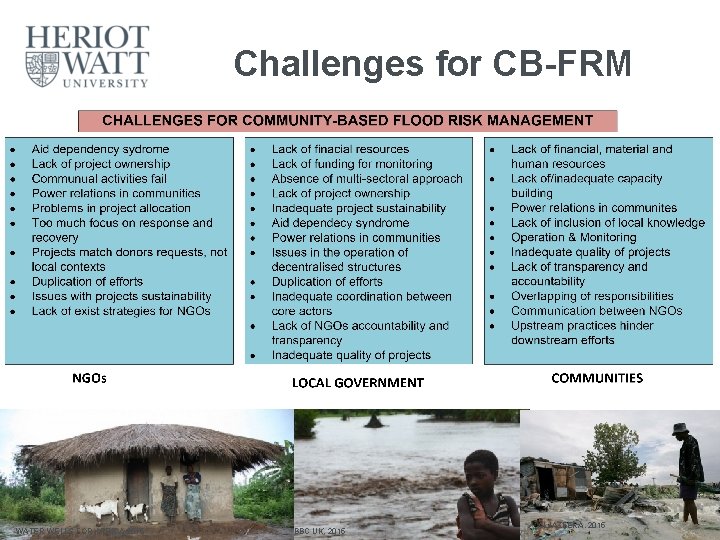
Challenges for CB-FRM WATER WELLS FOR AFRICA 2015 BBC UK, 2015 ALJAZEERA, 2015
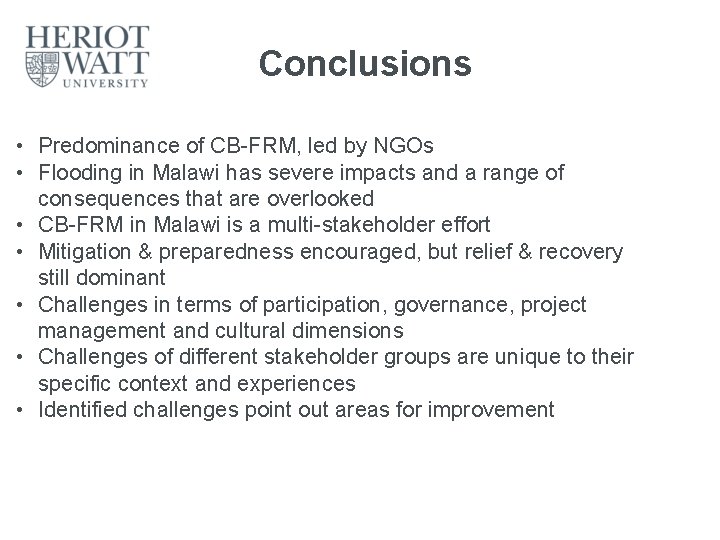
Conclusions • Predominance of CB-FRM, led by NGOs • Flooding in Malawi has severe impacts and a range of consequences that are overlooked • CB-FRM in Malawi is a multi-stakeholder effort • Mitigation & preparedness encouraged, but relief & recovery still dominant • Challenges in terms of participation, governance, project management and cultural dimensions • Challenges of different stakeholder groups are unique to their specific context and experiences • Identified challenges point out areas for improvement

Thank you for your kind attention!
- Slides: 15