
Community Wealth Building A New Paradigm of Community
Community Wealth Building: A New Paradigm of Community Economic Development Presentation for: MSU CCED Institute Webinar March 26, 2013 Ted Howard The Democracy Collaborative
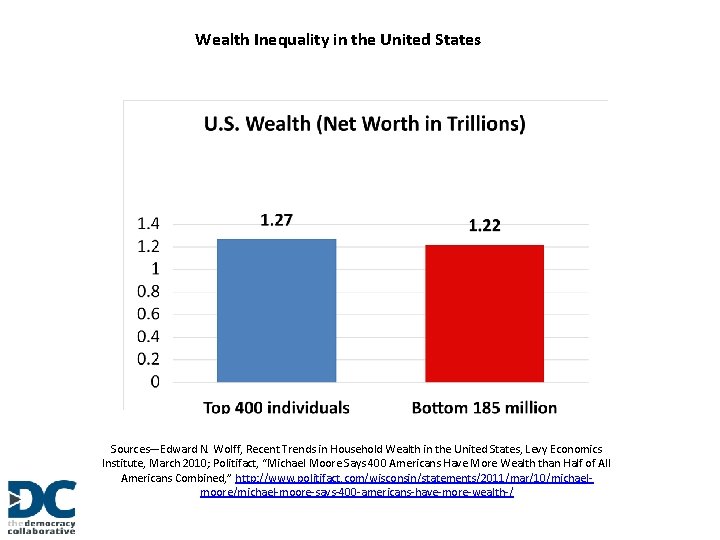
Wealth Inequality in the United States Sources—Edward N. Wolff, Recent Trends in Household Wealth in the United States, Levy Economics Institute, March 2010; Politifact, “Michael Moore Says 400 Americans Have More Wealth than Half of All Americans Combined, ” http: //www. politifact. com/wisconsin/statements/2011/mar/10/michaelmoore/michael-moore-says-400 -americans-have-more-wealth-/
The Prevailing Economic Development Paradigm • Subsidies and tax breaks to entice corporations to relocate • Workforce training not linked to actual jobs • Regional trickle down strategies that don’t reach low- and moderate-income neighborhoods • Low-wage (non-living wage) job creation, often without benefits • Exclusion of ex-offenders and others with barriers to employment • Gentrification and disbursal of traditional residents • “Throwaway cities” and their infrastructure
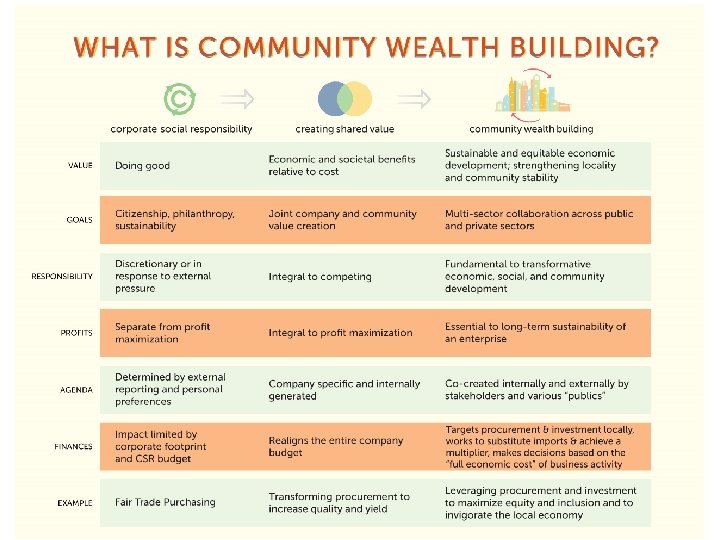
A New Approach to Economic Development that: • • Promotes broader ownership of capital Anchors jobs locally Stops the leakage of dollars from communities What is the Community Wealth Building Supports individual and family wealth building Paradigm? Reinforces stewardship Generates revenues to finance public services Leverages anchor institutions for community benefit • Contributes to local economic stability
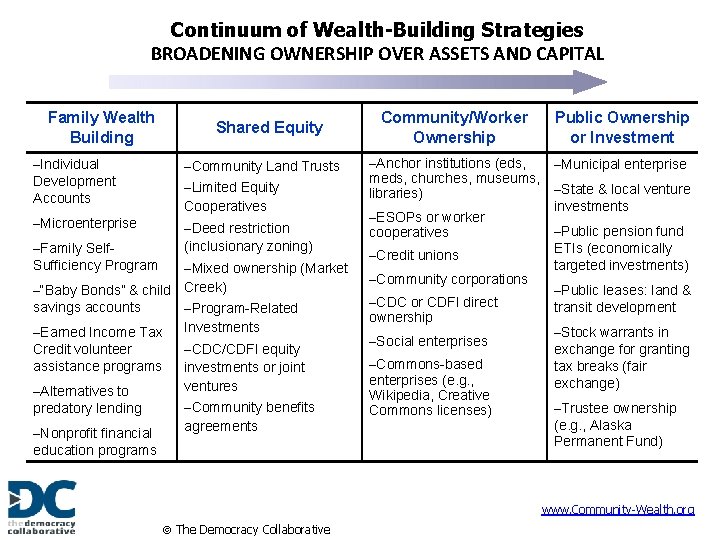
Continuum of Wealth-Building Strategies BROADENING OWNERSHIP OVER ASSETS AND CAPITAL Family Wealth Building Shared Equity –Individual Development Accounts –Community Land Trusts –Microenterprise –Deed restriction (inclusionary zoning) –Family Self. Sufficiency Program –Limited Equity Cooperatives –Mixed ownership (Market –“Baby Bonds” & child Creek) savings accounts –Program-Related Investments –Earned Income Tax Credit volunteer assistance programs –Alternatives to predatory lending –Nonprofit financial education programs –CDC/CDFI equity investments or joint ventures –Community benefits agreements Community/Worker Ownership Public Ownership or Investment –Anchor institutions (eds, –Municipal enterprise meds, churches, museums, –State & local venture libraries) investments –ESOPs or worker –Public pension fund cooperatives ETIs (economically –Credit unions targeted investments) –Community corporations –Public leases: land & –CDC or CDFI direct transit development ownership –Stock warrants in –Social enterprises exchange for granting –Commons-based tax breaks (fair enterprises (e. g. , exchange) Wikipedia, Creative –Trustee ownership Commons licenses) (e. g. , Alaska Permanent Fund) www. Community-Wealth. org The Democracy Collaborative
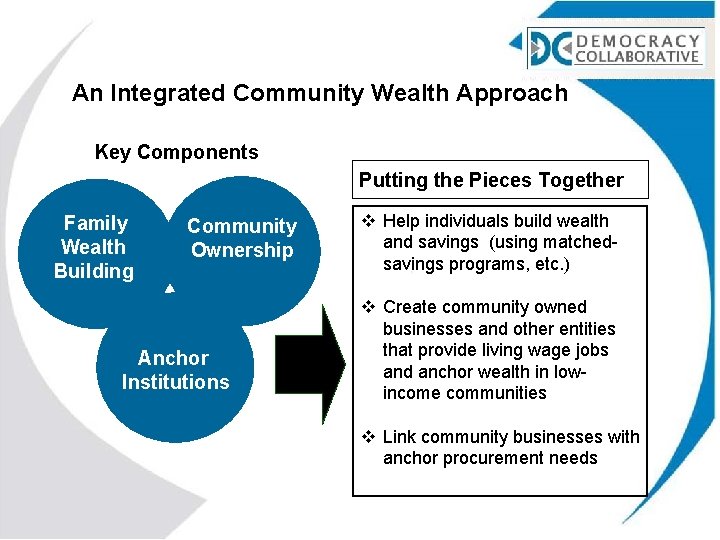
An Integrated Community Wealth Approach Key Components Putting the Pieces Together Family Wealth Building Community Ownership Anchor Institutions v Help individuals build wealth and savings (using matchedsavings programs, etc. ) v Create community owned businesses and other entities that provide living wage jobs and anchor wealth in lowincome communities v Link community businesses with anchor procurement needs
Strategy #1: Community-Based Business Ownership New Communities CDC (Newark, NJ) • • • Founded in 1968 by Monsignor William Linder, then a young parish priest Employs 1, 300 neighborhood residents Manages 2, 000 units of affordable housing Developed a shopping center that houses communityowned businesses and services Assets exceed $500 M Proceeds help support day-care and after-school programs, health services, and a Youth Automotive Training Center that trains auto technicians
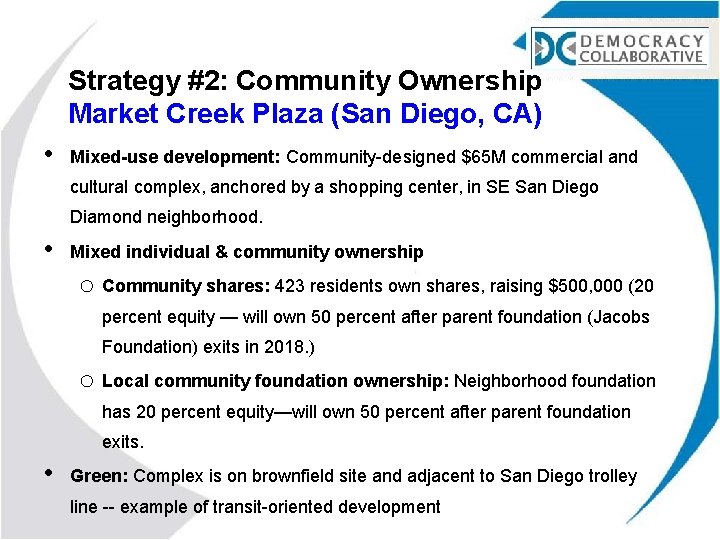
Strategy #2: Community Ownership Market Creek Plaza (San Diego, CA) • Mixed-use development: Community-designed $65 M commercial and cultural complex, anchored by a shopping center, in SE San Diego Diamond neighborhood. • Mixed individual & community ownership o Community shares: 423 residents own shares, raising $500, 000 (20 percent equity — will own 50 percent after parent foundation (Jacobs Foundation) exits in 2018. ) o Local community foundation ownership: Neighborhood foundation has 20 percent equity—will own 50 percent after parent foundation exits. • Green: Complex is on brownfield site and adjacent to San Diego trolley line -- example of transit-oriented development
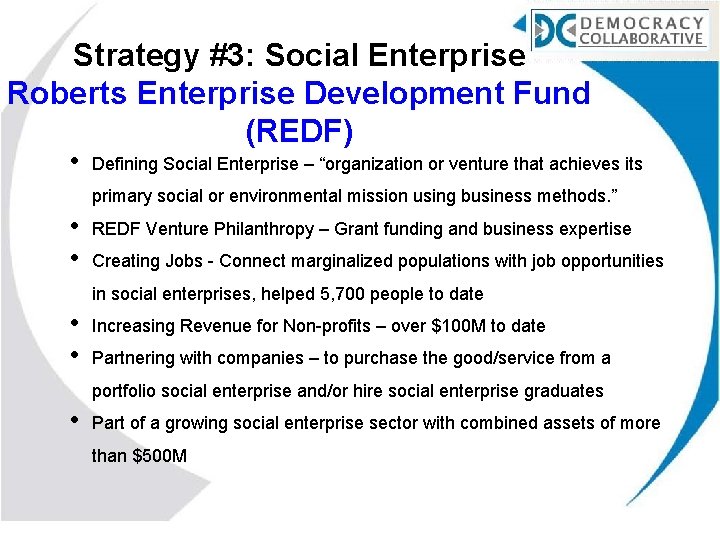
Strategy #3: Social Enterprise Roberts Enterprise Development Fund (REDF) • Defining Social Enterprise – “organization or venture that achieves its • Defining Social Enterprise – “organization or venture that achieves its primary social or environmental mission using business methods. ” • REDF Venture Philanthropy – Grant funding and business expertise • Creating - Connect marginalized populations with job • Creating. Jobs - Connect marginalized populations with job opportunities in social enterprises, helped 5, 700 people to date • Increasing over$100 M date • Increasing. Revenuefor for. Non-profits ––over to to date • Partnering purchasethe thegood/service from • Partneringwithcompanies – – to to purchase from a a portfolio social hiresocialenterprise graduates portfolio socialenterprise and/or hire graduates • Part of of a growing sectorwithcombined assets of • Part a growingsocialenterprise sector assets of more than $500 M
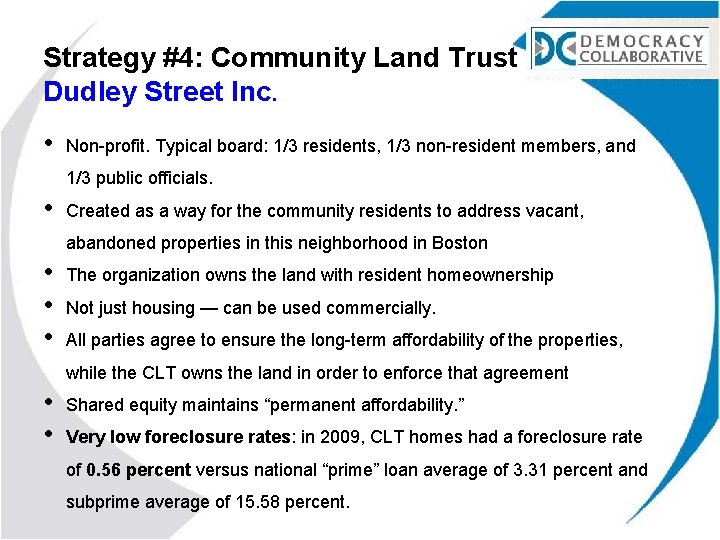
Strategy #4: Community Land Trust Dudley Street Inc. • • Non-profit. Typical board: 1/3 residents, 1/3 non-resident members, and 1/3 public officials. • • Created for the communityresidentstoto address vacant, Created as as aa way for address vacant, abandoned properties inproperties this neighborhood in Boston abandoned in this neighborhood in Boston Theorganization owns • • The owns thelandwithresidenthomeownership Notjust housing — • • Not — can be beusedcommercially. parties agree to of of thethe properties, while the • • Allparties to ensurethe thelong-termaffordability properties, CLT owns the land in order to enforce that agreement • while the CLT owns the land in order to enforce that agreement Shared equity maintains “permanent affordability. ” • Shared equity maintains “permanent affordability. ” • Very low foreclosure rates: in 2009, CLT homes had a foreclosure rate of 0. 56 • Very low foreclosure rates: in 2009, CLT homes had a foreclosure rate percent versus national “prime” loan average of 3. 31 percent and subprime ofaverage 0. 56 percent national “prime” loan average of 3. 31 percent and of 15. 58 versus percent. subprime average of 15. 58 percent.
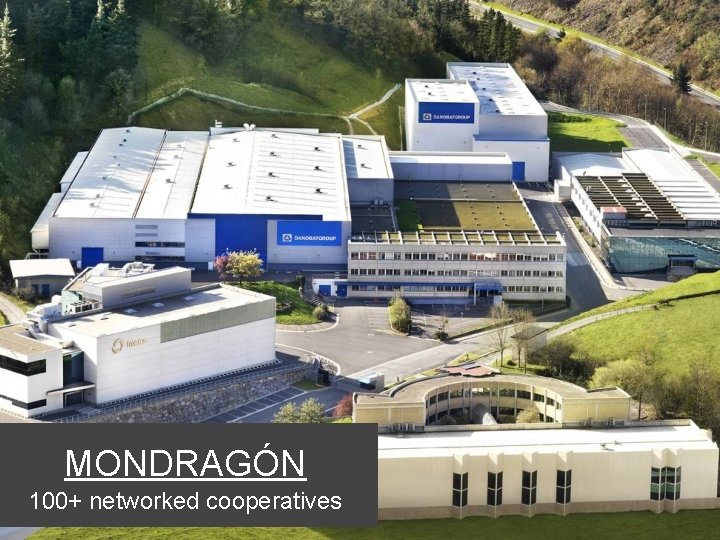
MONDRAGÓN 100+ networked cooperatives
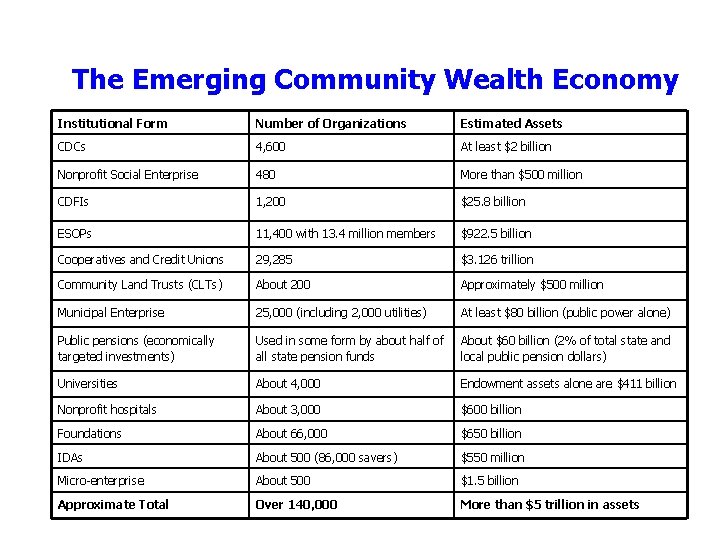
The Emerging Community Wealth Economy Institutional Form Number of Organizations Estimated Assets CDCs 4, 600 At least $2 billion Nonprofit Social Enterprise 480 More than $500 million CDFIs 1, 200 $25. 8 billion ESOPs 11, 400 with 13. 4 million members $922. 5 billion Cooperatives and Credit Unions 29, 285 $3. 126 trillion Community Land Trusts (CLTs) About 200 Approximately $500 million Municipal Enterprise 25, 000 (including 2, 000 utilities) At least $80 billion (public power alone) Public pensions (economically targeted investments) Used in some form by about half of all state pension funds About $60 billion (2% of total state and local public pension dollars) Universities About 4, 000 Endowment assets alone are $411 billion Nonprofit hospitals About 3, 000 $600 billion Foundations About 66, 000 $650 billion IDAs About 500 (86, 000 savers) $550 million Micro-enterprise About 500 $1. 5 billion Approximate Total Over 140, 000 More than $5 trillion in assets
For more information: www. Community-Wealth. org thoward 1@umd. edu
- Slides: 15