
Community Survey Method Community Research Design NOR AFIAH
- Slides: 34
Community Survey Method : Community Research Design NOR AFIAH MOHD ZULKEFLI DEPT OF COMMUNITY HEALTH
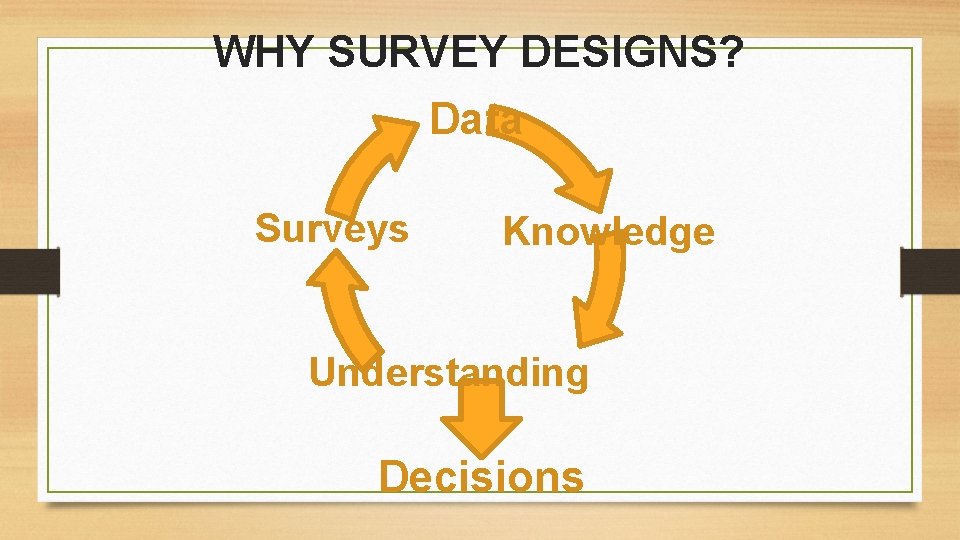
WHY SURVEY DESIGNS? Data Surveys Knowledge Understanding Decisions
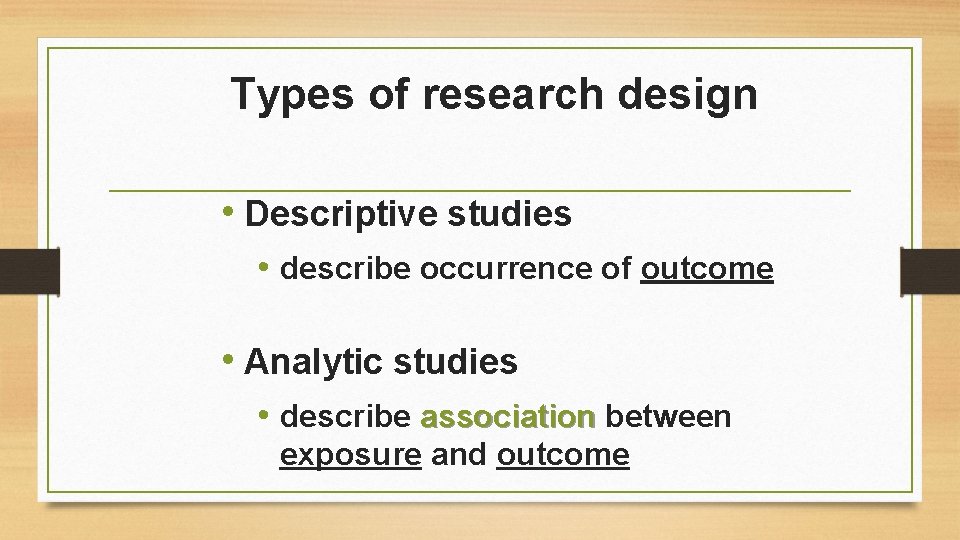
Types of research design • Descriptive studies • describe occurrence of outcome • Analytic studies • describe association between exposure and outcome
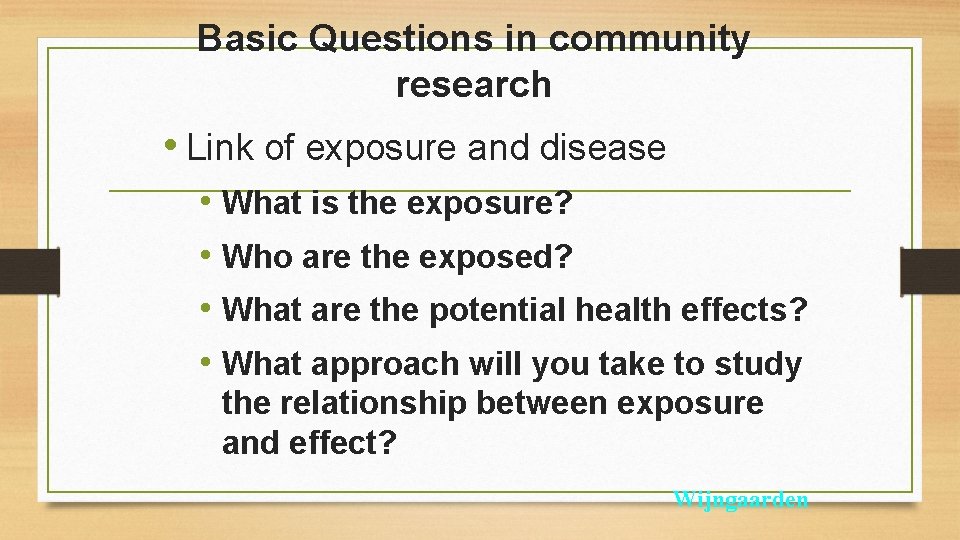
Basic Questions in community research • Link of exposure and disease • What is the exposure? • Who are the exposed? • What are the potential health effects? • What approach will you take to study the relationship between exposure and effect? Wijngaarden
Basic Research Study Designs
Aims • To prevent and control disease
What designs exist to identify and investigate factors in disease?
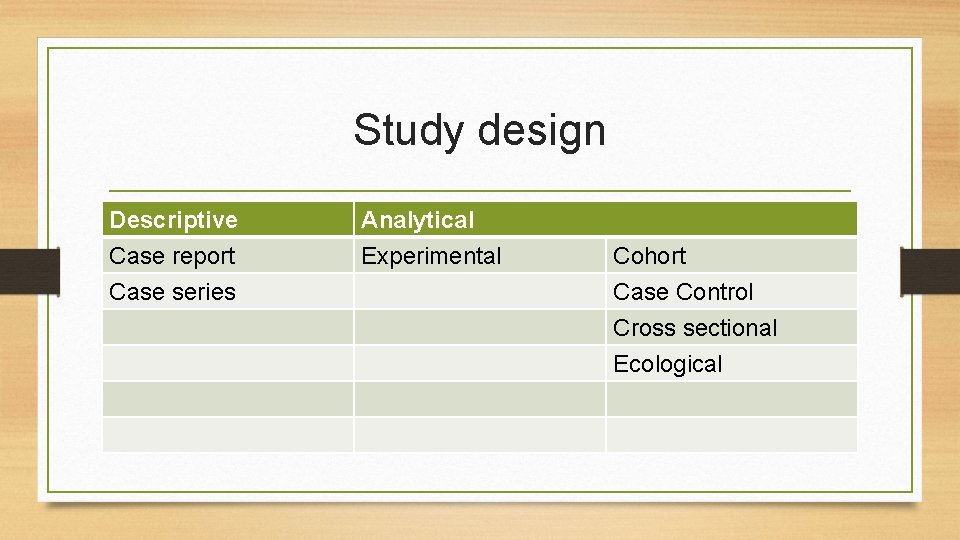
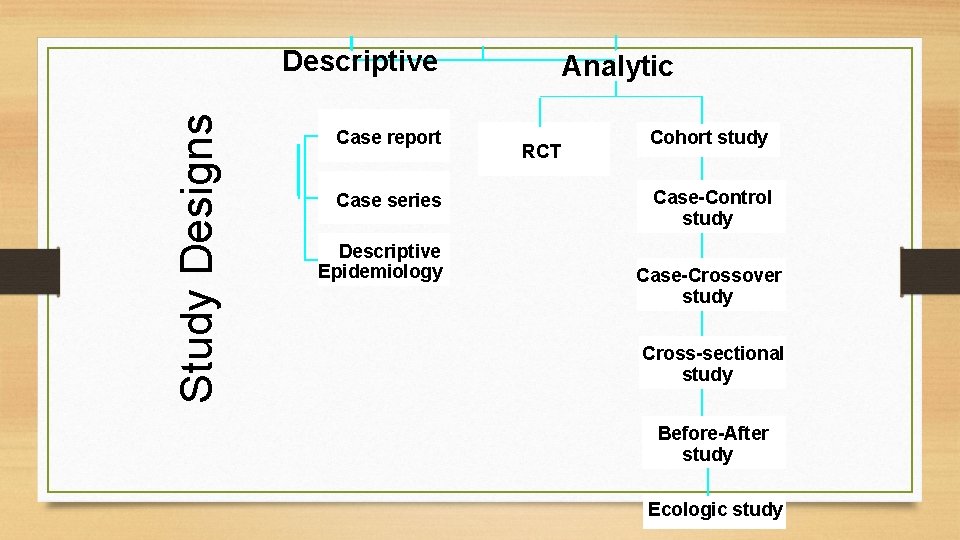
Study design Descriptive Case report Case series Analytical Experimental Cohort Case Control Cross sectional Ecological
Study Designs Descriptive Case report Case series Descriptive Epidemiology Analytic RCT Cohort study Case-Control study Case-Crossover study Cross-sectional study Before-After study Ecologic study
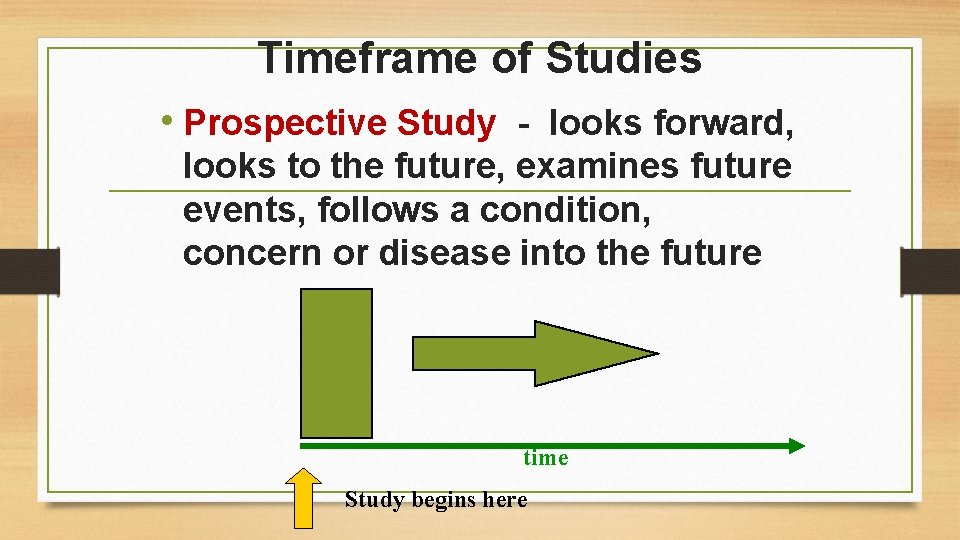
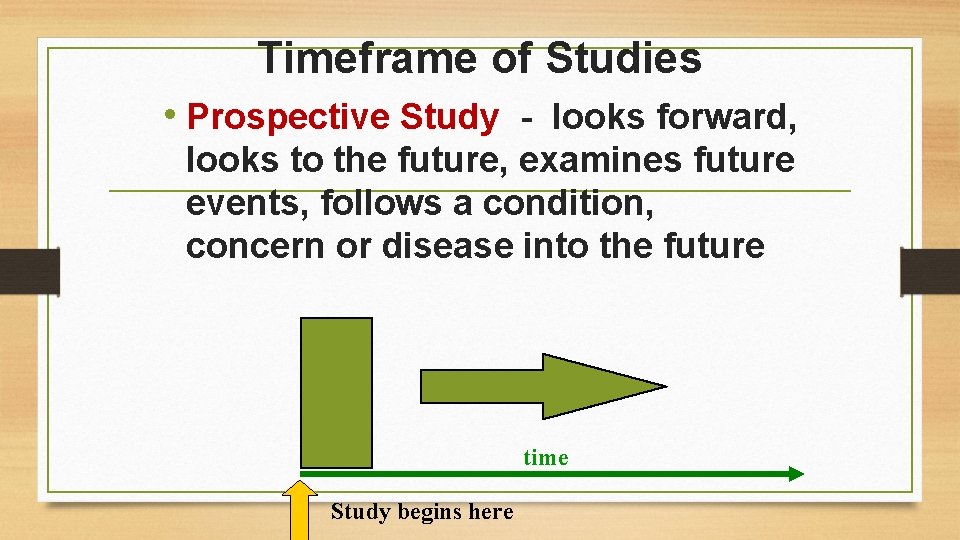
Timeframe of Studies • Prospective Study - looks forward, looks to the future, examines future events, follows a condition, concern or disease into the future time Study begins here
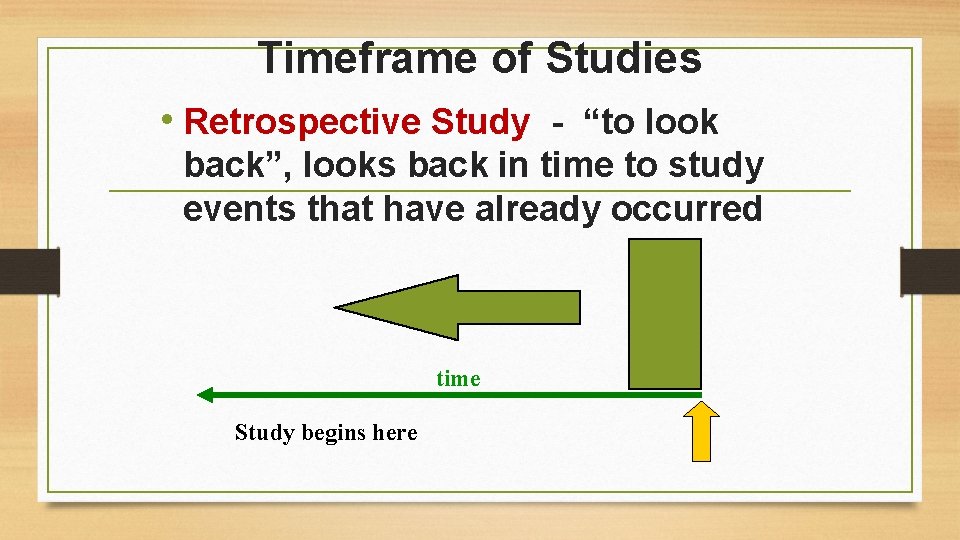
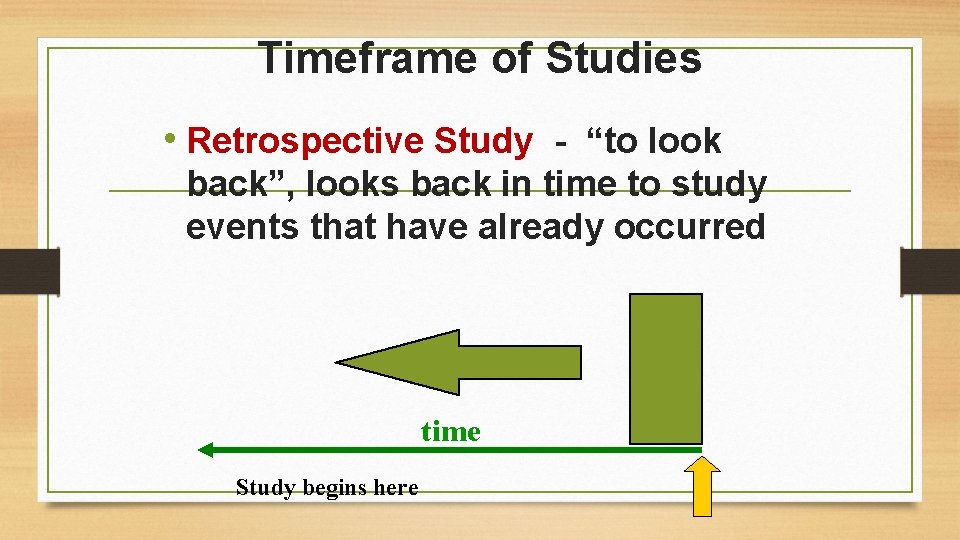
Timeframe of Studies • Retrospective Study - “to look back”, looks back in time to study events that have already occurred time Study begins here
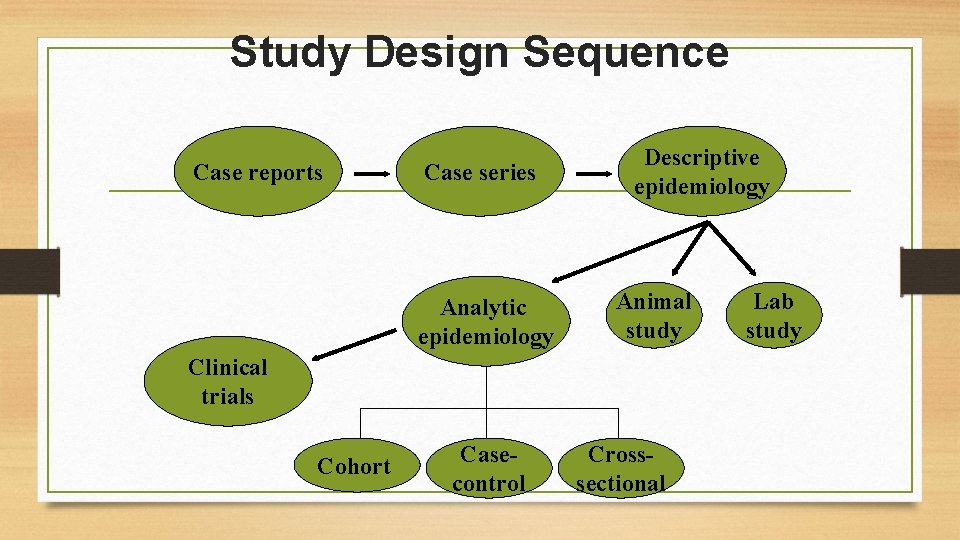
Study Design Sequence Case reports Case series Analytic epidemiology Descriptive epidemiology Animal study Clinical trials Cohort Casecontrol Crosssectional Lab study
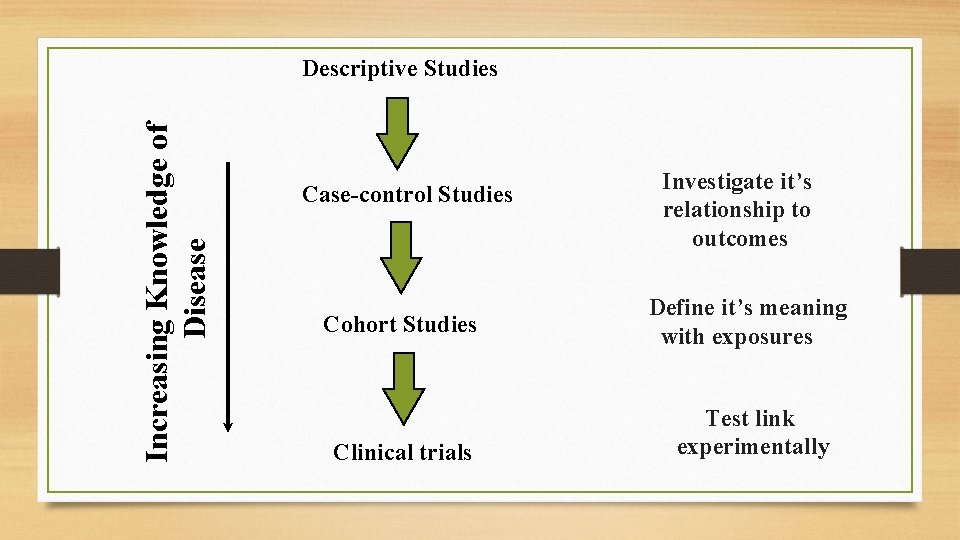
Increasing Knowledge of Disease Descriptive Studies Case-control Studies Investigate it’s relationship to outcomes Cohort Studies Define it’s meaning with exposures Clinical trials Test link experimentally
Descriptive Studies
Case Reports • Detailed presentation of a single case or handful of cases • Generally report a new or unique finding • e. g. previous undescribed disease • e. g. unexpected link between diseases
Case Series • Experience of a group of patients with a similar diagnosis • Assesses prevalent disease • Cases may be identified from a single or multiple sources • Generally report on new/unique condition
Case Series • Advantages • Useful for hypothesis generation • Informative for very rare disease with few established risk factors • Characterizes averages for disorder • Disadvantages • Cannot study cause and effect relationships • Cannot assess disease frequency
Analytical Studies
Observational Studies • non-experimental • observational because there is no individual intervention • treatment and exposures occur in a “non-controlled” environment • individuals can be observed prospectively, retrospectively, or currently
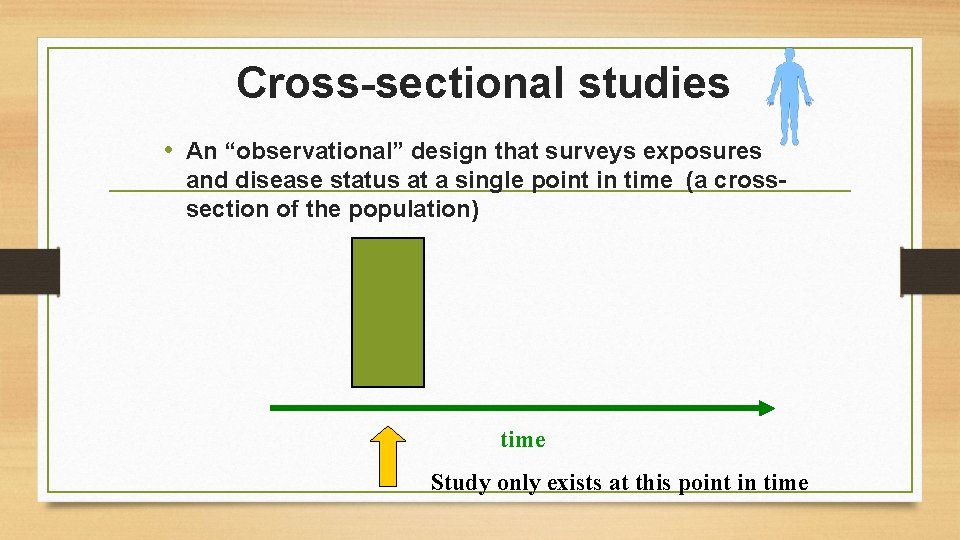
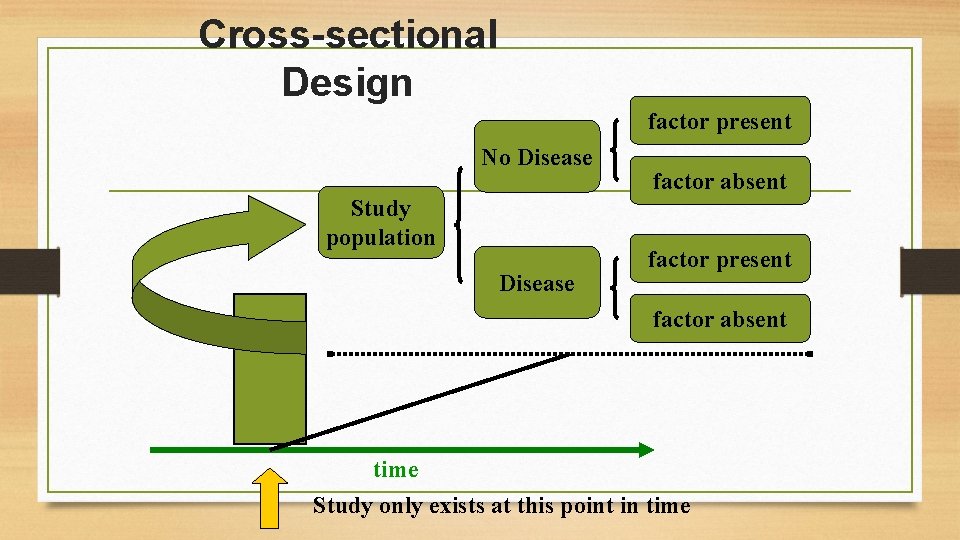
Cross-sectional studies • An “observational” design that surveys exposures and disease status at a single point in time (a crosssection of the population) time Study only exists at this point in time
Cross-sectional Design factor present No Disease Study population Disease factor absent factor present factor absent time Study only exists at this point in time
Cross-sectional Studies • Often used to study conditions that are relatively frequent with long duration of expression (nonfatal, chronic conditions) • It measures prevalence • Example: community surveys • Not suitable for studying rare or highly fatal diseases or a disease with short duration of expression
Cross-sectional studies • Disadvantages • Weakest observational design, • The temporal sequence of exposure and effect may be difficult or impossible to determine • Usually don’t know when disease occurred • Rare events a problem. Quickly emerging diseases a problem
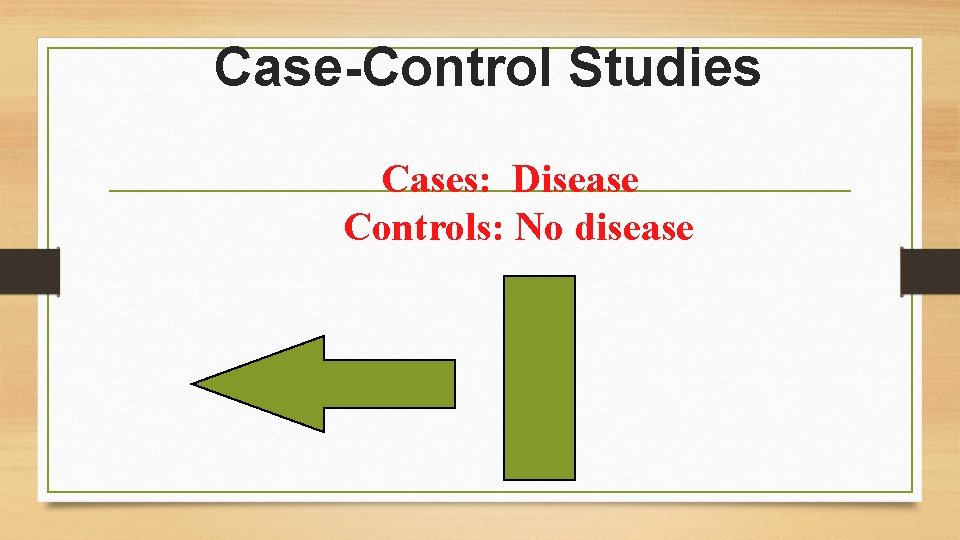
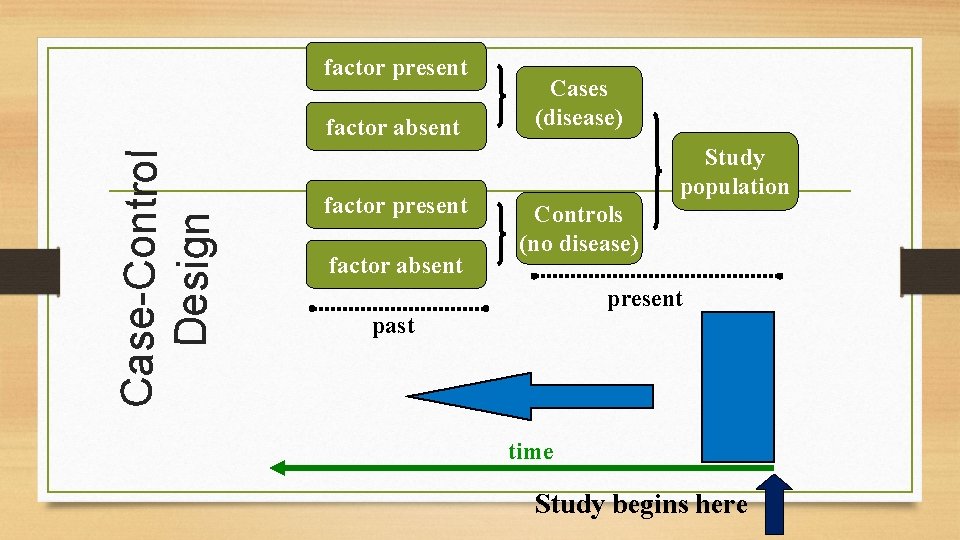
Case-Control Studies • an “observational” design comparing exposures in disease cases vs. healthy controls from same population • exposure data collected retrospectively • most feasible design where disease outcomes are rare
Case-Control Studies Cases: Disease Controls: No disease
factor present Case-Control Design factor absent factor present factor absent Cases (disease) Study population Controls (no disease) present past time Study begins here
Case-Control Study • Strengths • Less expensive and time consuming • Efficient for studying rare diseases • Limitations • Inappropriate when disease outcome for a specific exposure is not known at start of study • Exposure measurements taken after disease occurrence • Disease status can influence selection of subjects
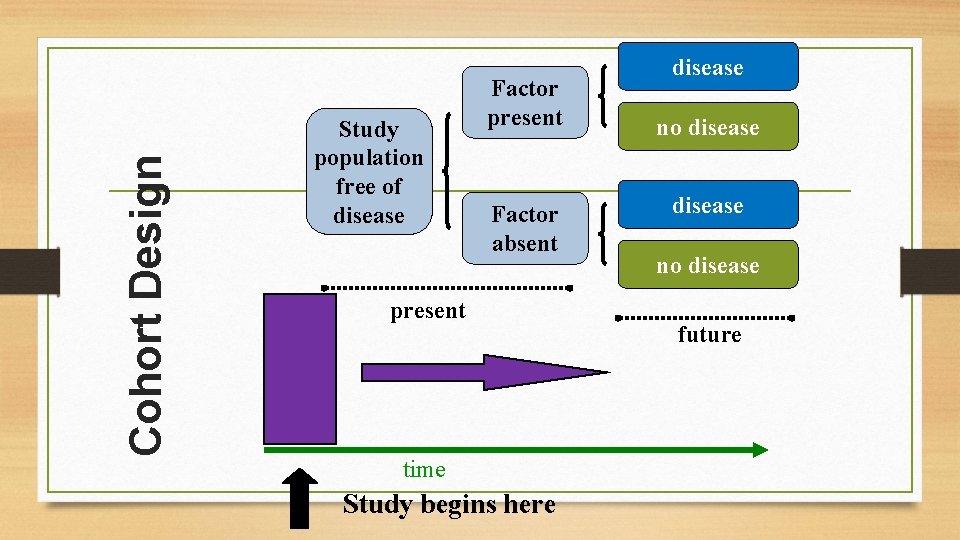
Cohort Studies • an “observational” design comparing individuals with a known risk factor or exposure with others without the risk factor or exposure • looking for a difference in the risk (incidence) of a disease over time • best observational design • data usually collected prospectively (some retrospective)
Cohort Design Study population free of disease Factor present Factor absent present time Study begins here disease no disease future
Timeframe of Studies • Prospective Study - looks forward, looks to the future, examines future events, follows a condition, concern or disease into the future time Study begins here
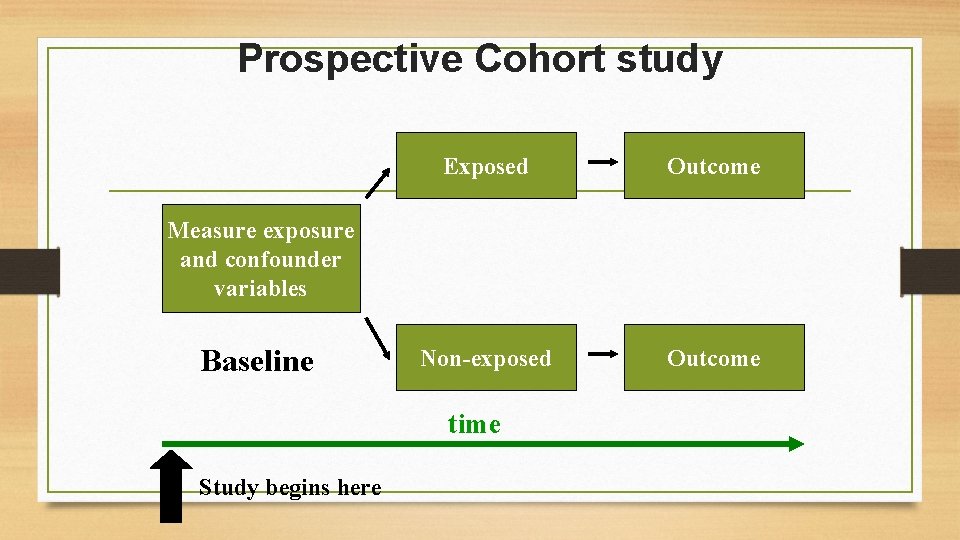
Prospective Cohort study Exposed Outcome Non-exposed Outcome Measure exposure and confounder variables Baseline time Study begins here
Timeframe of Studies • Retrospective Study - “to look back”, looks back in time to study events that have already occurred time Study begins here
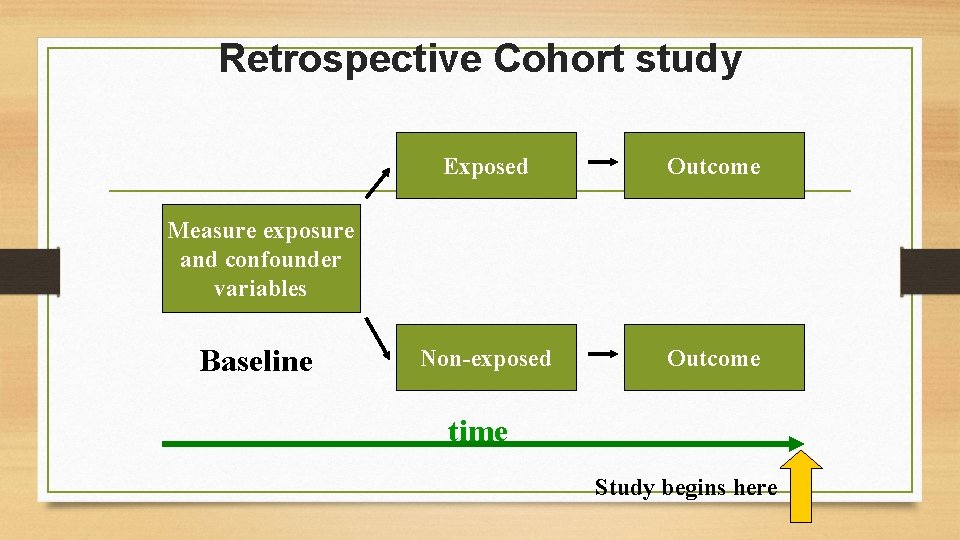
Retrospective Cohort study Exposed Outcome Non-exposed Outcome Measure exposure and confounder variables Baseline time Study begins here
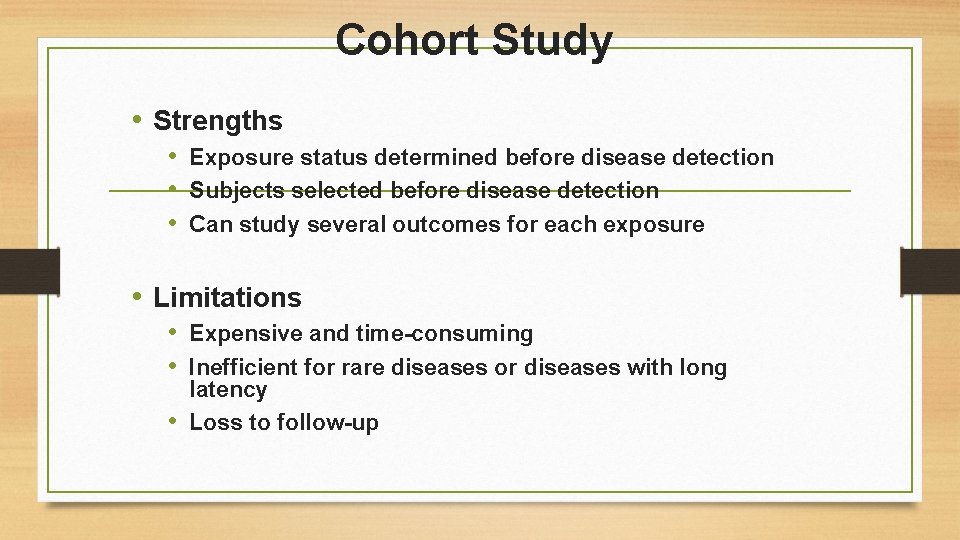
Cohort Study • Strengths • Exposure status determined before disease detection • Subjects selected before disease detection • Can study several outcomes for each exposure • Limitations • Expensive and time-consuming • Inefficient for rare diseases or diseases with long latency • Loss to follow-up