
Community Risk Reduction CRR for Fire Department Leaders
- Slides: 93
Community Risk Reduction (CRR) for Fire Department Leaders
Community Risk Reduction Part I: Introduction
CRR - Introduction Definition – Community Risk Reduction (CRR) An approach for fulfilling the mission of the fire department through strategies designed and implemented at the community level that target and reduce key risks of that particular community.
CRR - Introduction Characteristics of CRR § § § § Proactive Systematic Prevention-oriented Community-based (ideally fire station-based) Data-driven Effective Responsive to resource constraints (efficient)
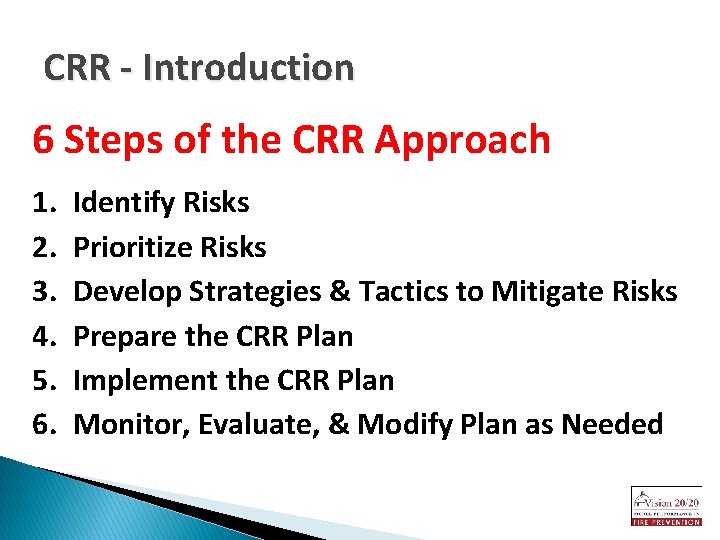
CRR - Introduction 6 Steps of the CRR Approach 1. 2. 3. 4. 5. 6. Identify Risks Prioritize Risks Develop Strategies & Tactics to Mitigate Risks Prepare the CRR Plan Implement the CRR Plan Monitor, Evaluate, & Modify Plan as Needed
CRR - Introduction ACTIVITY 1: Participant Introductions Introduce yourself & report 2 items about yourself: 1. What is your #1 responsibility as a fire officer? OR: What is your responsibility in meeting the mission of your organization? 2. What is your experience with CRR?
CRR -Introduction History of CRR: CRR is not a new concept Implemented in UK, AU, & NZ for several years now with much success Also been done in the US – although sporadically and on a much smaller scale.
CRR - Introduction Great Example of CRR at work: Merseyside Fire & Rescue, UK Merseyside has been doing CRR for X years now (called IRM there) Nationally mandated for the last X years Strategy includes home visits and referrals to other health and social services. Experiencing 40% reduction in fire loss? ? ?
CRR – Introduction ACTIVITY 2: Merseyside Fire and Rescue, Video
Community Risk Reduction Participant Exercise Instructions # Britain Case Study § Split into groups § Take 10 minutes to read the case study and answer the questions assigned § Report back to class by reading your assigned question and briefly providing your answer.
Community Risk Reduction II. CRR Lesson Goals & Objectives
CRR – Lesson Goals & Objectives Lesson GOALs: § introduce CRR as a strategy for fire departments § introduce how to prepare a CRR station plan § develop positive attitudes about CRR § motivate audience to learn more about CRR Target Audience: Fire officers and chief officers in the fire and emergency response community with little or no knowledge of community risk management.
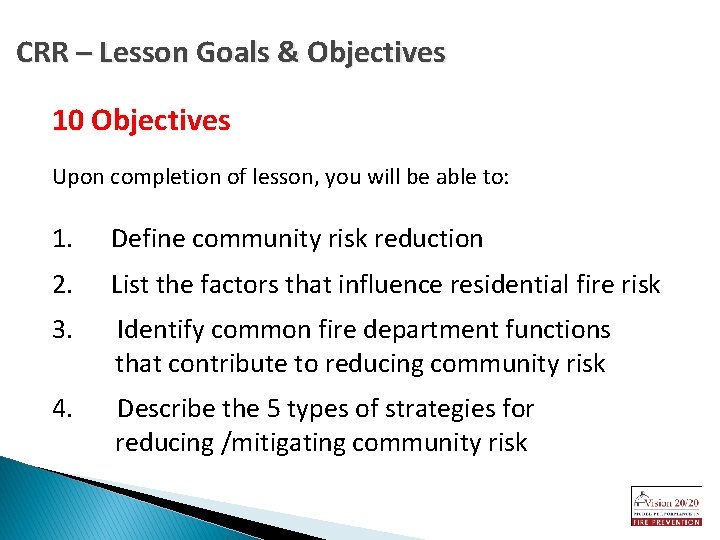
CRR – Lesson Goals & Objectives 10 Objectives Upon completion of lesson, you will be able to: 1. Define community risk reduction 2. List the factors that influence residential fire risk 3. Identify common fire department functions that contribute to reducing community risk 4. Describe the 5 types of strategies for reducing /mitigating community risk
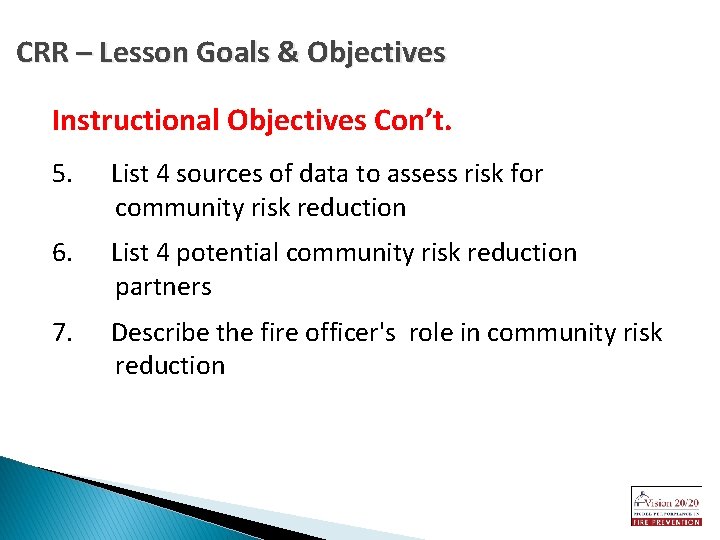
CRR – Lesson Goals & Objectives Instructional Objectives Con’t. 5. List 4 sources of data to assess risk for community risk reduction 6. List 4 potential community risk reduction partners 7. Describe the fire officer's role in community risk reduction
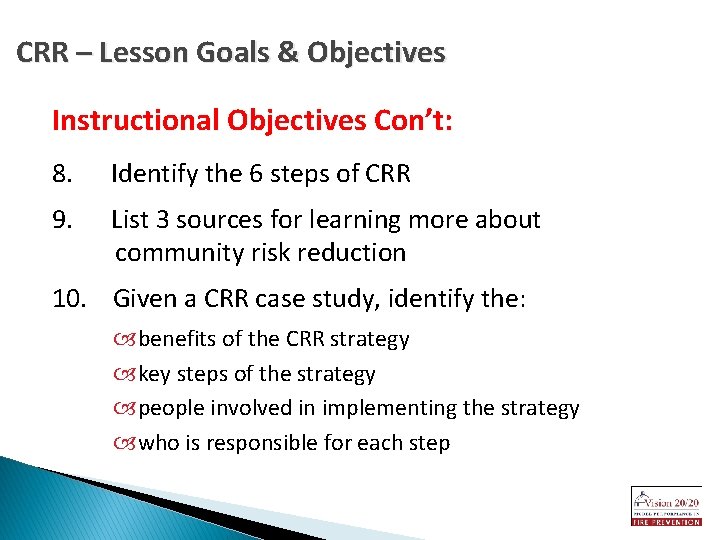
CRR – Lesson Goals & Objectives Instructional Objectives Con’t: 8. Identify the 6 steps of CRR 9. List 3 sources for learning more about community risk reduction 10. Given a CRR case study, identify the: benefits of the CRR strategy key steps of the strategy people involved in implementing the strategy who is responsible for each step
Community Risk Reduction III. CRR Terminology
CRR – Terminology Key Terms: § Prevention § Risk § Loss § Mitigation
CRR - Terminology “Prevention” Definition Bring to an end Keep an event from occurring Synonyms: Avoid, Deter Impede Thwart Anticipate Hinder Halt
CRR - Terminology “Risk” Definition Danger, hazard, and a popular board game (now a pricey Ap for i. Phone and i. Pad!)
CRR - Terminology “Loss” Defintion Death, injury, property damage, or other adverse or unwelcome circumstances.
CRR -Terminology Definition: “Mitigation” ◦Reduce impact of event ◦ The effort to reduce loss of life & property by lessening the impact of natural & human caused disasters/events ◦ Make less severe, serious, or painful Synonyms: ◦ Alleviate Reduce Ease Lessen harm of event ◦ A mitigated risk is a diminished risk. This means the risk has been reduced.
CRR Terminology - Mitigation Example Residents living in an area with many wildfires are advised to: § make their home’s fire resistance § consider the topography of their property § eliminate or reduce vegetation close by the home These actions won’t prevent a wildfire but they will reduce the impact
Community Risk Reduction IV. Identifying and Prioritizing Risks
CRR – Identifying & Prioritizing Risk Each community faces a variety of risks: Some Examples § Residential Fires § Wildland fires § Arson § Falls § Motor Vehicle/traffic accidents §Inadequately managed social and health conditions § Drownings § Pedestrian accidents § Bicycle & skateboard accidents § Firearms §Suffocation §Poisoning §Struck by or against
CRR – Identifying & Prioritizing Risk What are the risks in your particular area? Using data from your fire/EMS calls and incident reports – as well as experience - what seem to be the major risks experienced in your area?
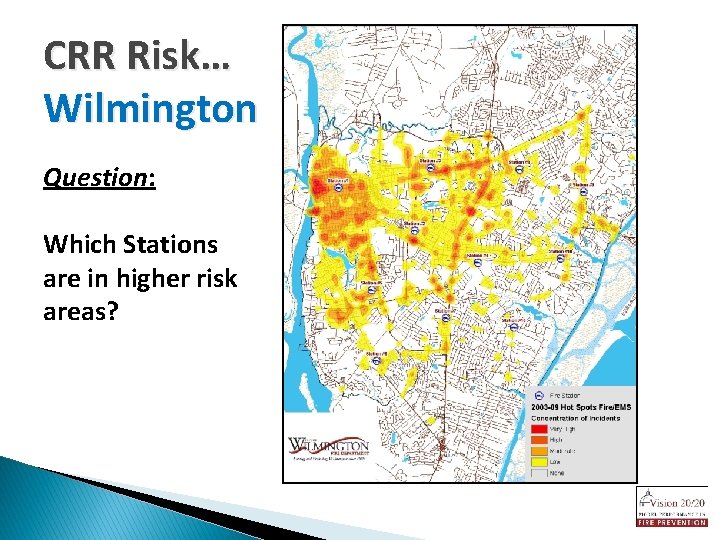
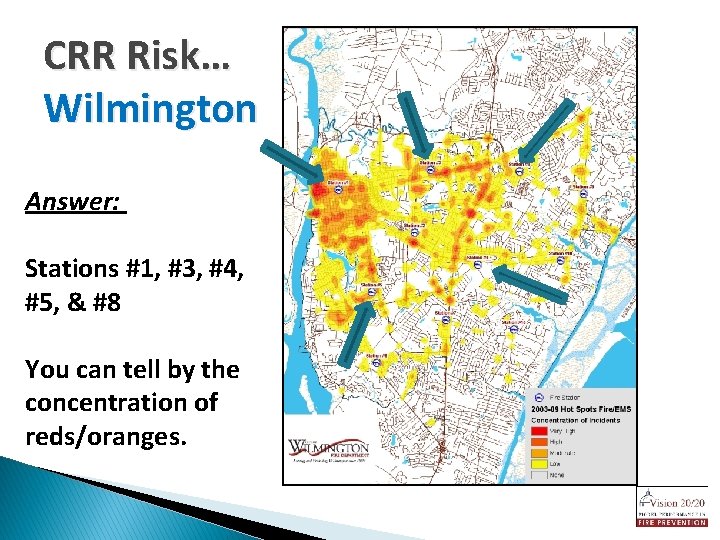
CRR – Identifying & Prioritizing Risk Example – Wilmington NC Data of residential fires & home fire deaths 2003 -2009 data were highlighted with GIS mapping to show “hot spots”
CRR Risk… Wilmington Question: Which Stations are in higher risk areas?
CRR Risk… Wilmington Answer: Stations #1, #3, #4, #5, & #8 You can tell by the concentration of reds/oranges.
CRR - Risk Identified 5 stations with higher fire/EMS risk. Now need to find out: § the type of risk § what causes it § who’s affected which can vary by station. Even stations nearest each other can face very different community risks.
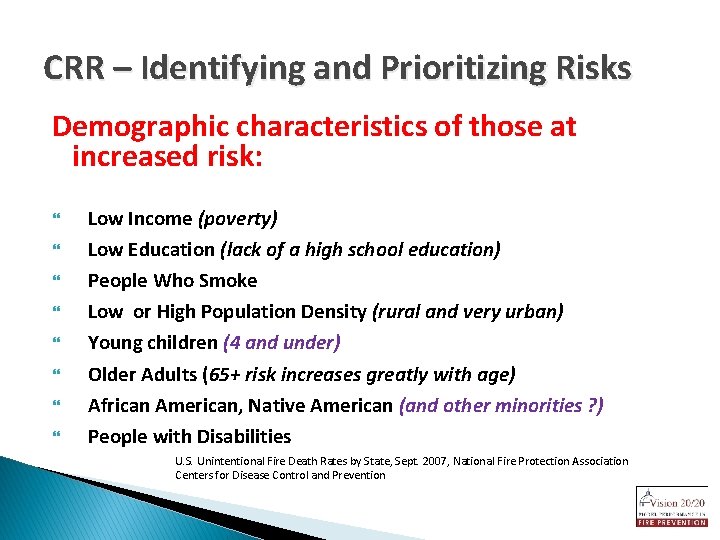
CRR – Identifying and Prioritizing Risks Demographic characteristics of those at increased risk: Low Income (poverty) Low Education (lack of a high school education) People Who Smoke Low or High Population Density (rural and very urban) Young children (4 and under) Older Adults (65+ risk increases greatly with age) African American, Native American (and other minorities ? ) People with Disabilities U. S. Unintentional Fire Death Rates by State, Sept. 2007, National Fire Protection Association Centers for Disease Control and Prevention
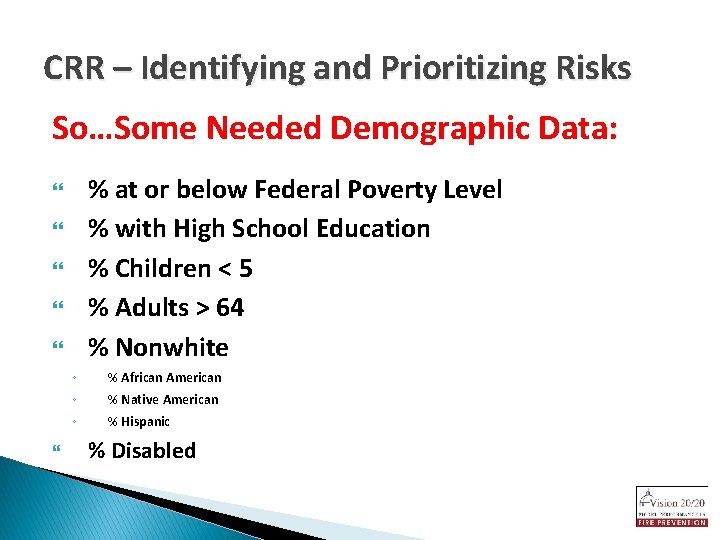
CRR – Identifying and Prioritizing Risks So…Some Needed Demographic Data: % at or below Federal Poverty Level % with High School Education % Children < 5 % Adults > 64 % Nonwhite ◦ % African American ◦ % Native American ◦ % Hispanic % Disabled
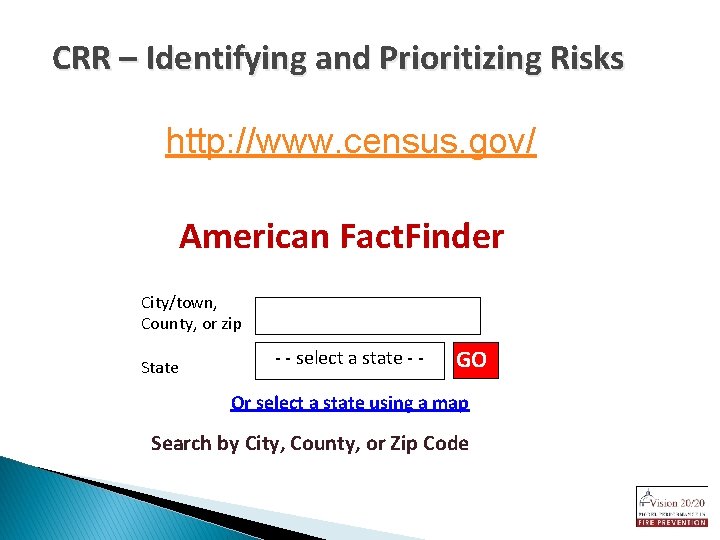
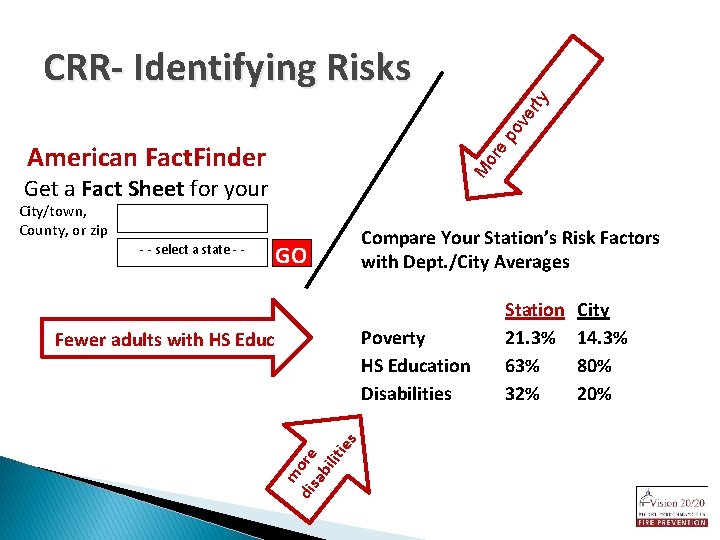
CRR – Identifying and Prioritizing Risks To get demographic data: § Determine the zip codes for each station § Go to American Fact. Finder at http: //www. census. gov/ § Plug in each zip code into Fact. Finder and record data for each desired indicator § Add percents across all zip codes within station’s jurisdiction and divide by number of zip codes in that jurisdiction to come up with average percents.
CRR – Identifying and Prioritizing Risks http: //www. census. gov/ American Fact. Finder City/town, County, or zip State - - select a state - - GO Or select a state using a map Search by City, County, or Zip Code
ve rty CRR- Identifying Risks M or e po American Fact. Finder Get a Fact Sheet for your City/town, County, or zip GO - - select a state - - m dis ore ab ilit ies Fewer adults with HS Educ Compare Your Station’s Risk Factors with Dept. /City Averages Poverty HS Education Disabilities Station 21. 3% 63% 32% City 14. 3% 80% 20%
CRR – Identifying Risks Other sources of Info/Data: Community Planning – predictions for population, business, industry, annexation for growth or decline Community Development – not for profit or government agencies providing programs & services to assist residents Other Municipal Sources – Housing office/bureau, public health, social services, neighborhood centers, parks and recreation depts,
CRR – Identifying & Prioritizing Risks Prioritizing Risk Think about the probability of an event occurring and its potential consequence/impact Solicit input from firefighters, inspectors, investigators, community partners Consider assigning weights and probabilities to come up with a scoring method for prioritizing risks
CRR - Risks “The more we know about which groups are at greatest risk and under what circumstances, the more effective we can be at targeting resources and developing the means to mitigate these risks. ” U. S. Unintentional Fire Death Rates by State John R. Hall, Jr. , May 2010.
Community Risk Reduction IV. Prevention/Mitigation Strategies
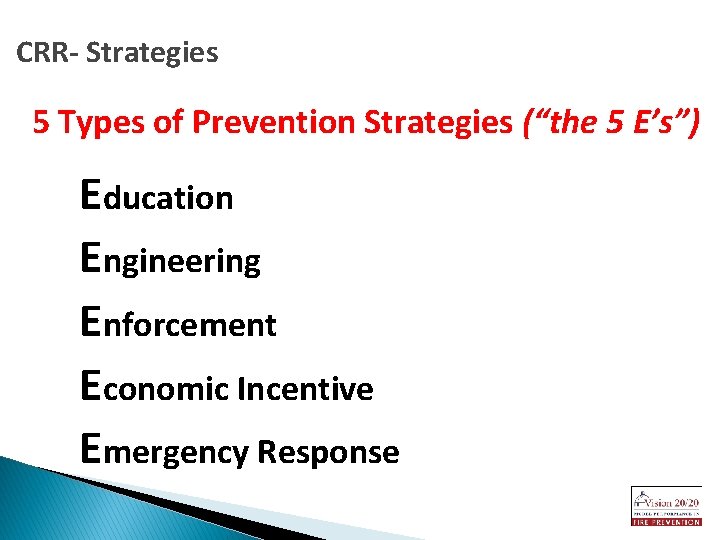
CRR- Strategies 5 Types of Prevention Strategies (“the 5 E’s”) Education Engineering Enforcement Economic Incentive Emergency Response
CRR – Strategies Education raises awareness and knowledge of fire safety, and is the first step of producing desired lowrisk behavior.
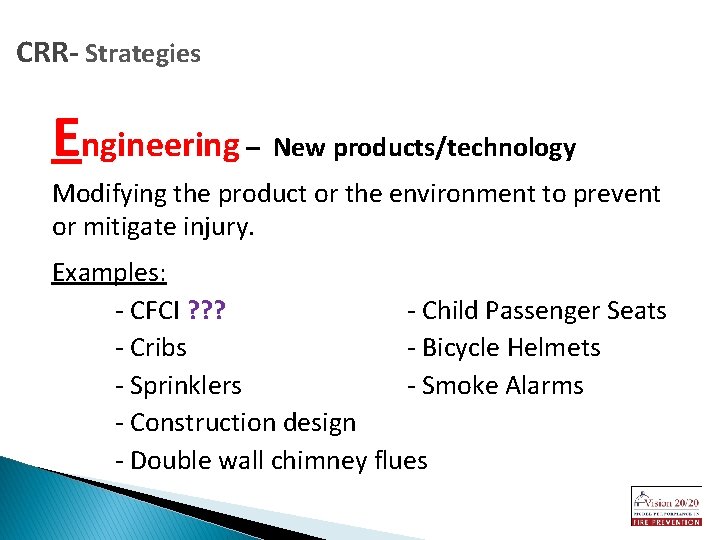
CRR- Strategies Engineering – New products/technology Modifying the product or the environment to prevent or mitigate injury. Examples: - CFCI ? ? ? - Child Passenger Seats - Cribs - Bicycle Helmets - Sprinklers - Smoke Alarms - Construction design - Double wall chimney flues
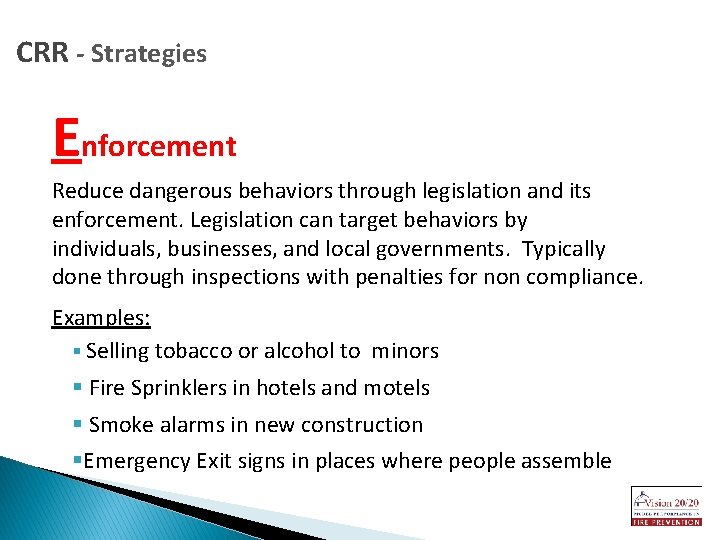
CRR - Strategies Enforcement Reduce dangerous behaviors through legislation and its enforcement. Legislation can target behaviors by individuals, businesses, and local governments. Typically done through inspections with penalties for non compliance. Examples: § Selling tobacco or alcohol to minors § Fire Sprinklers in hotels and motels § Smoke alarms in new construction §Emergency Exit signs in places where people assemble
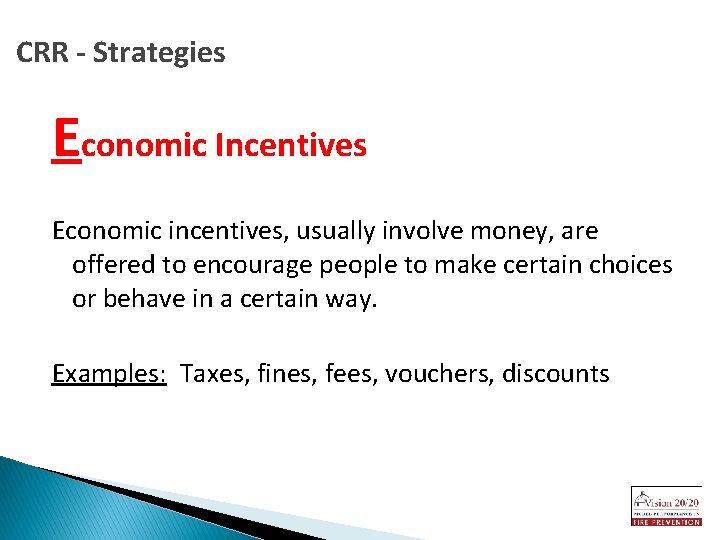
CRR - Strategies Economic Incentives Economic incentives, usually involve money, are offered to encourage people to make certain choices or behave in a certain way. Examples: Taxes, fines, fees, vouchers, discounts
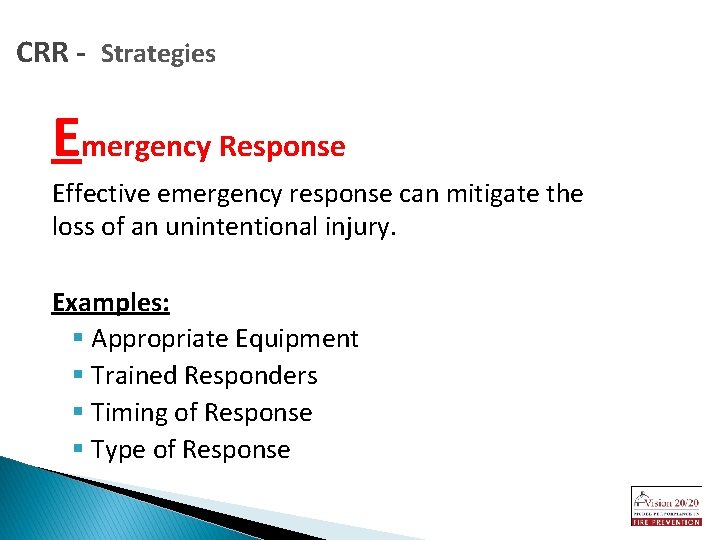
CRR - Strategies Emergency Response Effective emergency response can mitigate the loss of an unintentional injury. Examples: § Appropriate Equipment § Trained Responders § Timing of Response § Type of Response
CRR – Strategies Some Strategies Fit Multiple E’s Example: Seat belts Education: Campaigns to educate the public on how use can save lives Engineering: Technology of lap and cross chest seat belts Enforcement – Manufacturers required to include in all automobiles, Penalties for non use
CRR- Strategies ACTIVITY 3: Participant Exercise – Using Scenarios to enhance understanding of the 5 types of Strategies
CRR- Strategies Instructor Example? ? ? : MGM Grand fire, Las Vegas, Nov 1980 § Losses: • 85 deaths • 650 injuries • $106 M in property § Proposed prevention/mitigation strategies: • Engineering - installation of sprinklers • Enforcement - mandating sprinkler installation in large new construction projects.
CRR –Strategies Another Instructor Example Daycare Fire, Houston – 2/24/11 Losses: 4 deaths, 3 injuries Strategies: None Daycare Fire – Phoenix – 2/25/01 Losses: 0 deaths, 0 injuries Strategies: Engineering – had sprinklers Education: Knew what to do in event of emergency. Waited safely at store next door firefighters to clean up water
CRR – Strategies Participant Exercise Instructions: § Take 3 -5 minutes to read scenario § Discuss how to mitigate risk using at least 2 E strategies § Report back to class the risk/loss scenario, the Es using, and the particular strategy chosen
CRR – Strategies A best practice CRR strategy: § Home Visits– targeting hard to reach households. Opportunity to: § Educate resident about fire safety, smoke alarm testing & maintenance, and escape planning & practicing § Test existing alarms and install new ones as needed § Enhance the positive relationship between residents and the fire service
Community Risk Reduction VI. Developing a CRR Plan
CRR - Plan Purpose of a CRR Plan: § Systematically walks you through the CRR process which enhances your ability to manage risk § Empowers and engages staff § Serves as a vision and a guide for action for at least one year § Documents risk findings and selected strategies and how/why they were selected
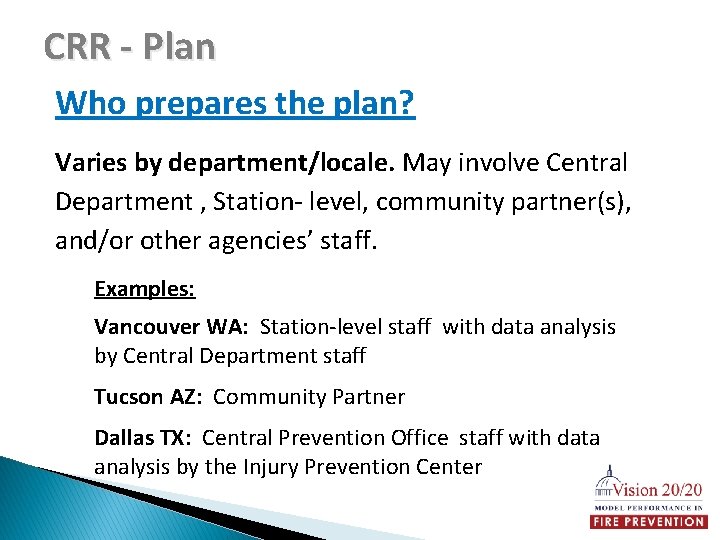
CRR - Plan Who prepares the plan? Varies by department/locale. May involve Central Department , Station- level, community partner(s), and/or other agencies’ staff. Examples: Vancouver WA: Station-level staff with data analysis by Central Department staff Tucson AZ: Community Partner Dallas TX: Central Prevention Office staff with data analysis by the Injury Prevention Center
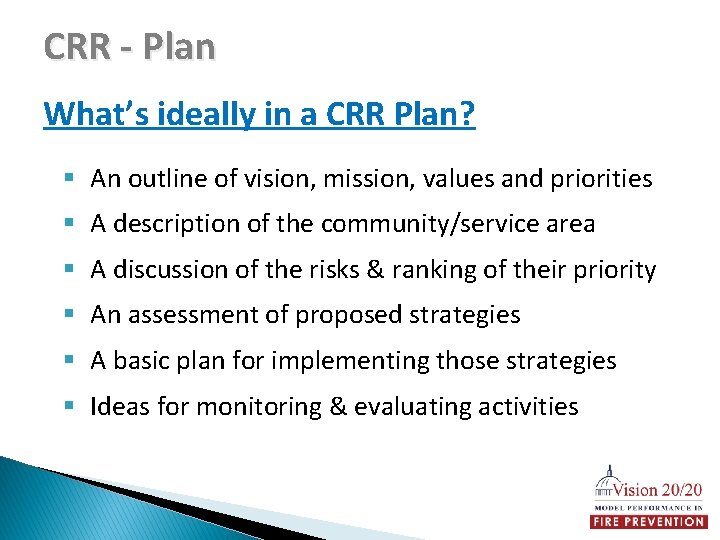
CRR - Plan What’s ideally in a CRR Plan? § An outline of vision, mission, values and priorities § A description of the community/service area § A discussion of the risks & ranking of their priority § An assessment of proposed strategies § A basic plan for implementing those strategies § Ideas for monitoring & evaluating activities
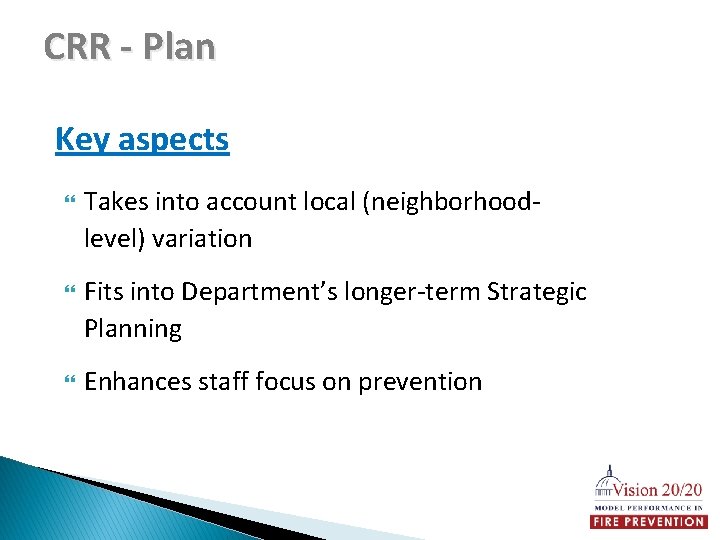
CRR - Plan Key aspects Takes into account local (neighborhoodlevel) variation Fits into Department’s longer-term Strategic Planning Enhances staff focus on prevention
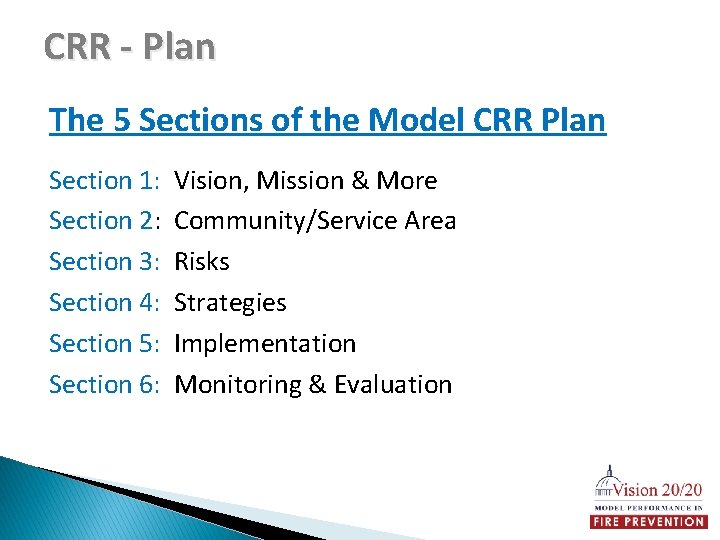
CRR - Plan The 5 Sections of the Model CRR Plan Section 1: Vision, Mission & More Section 2: Community/Service Area Section 3: Risks Section 4: Strategies Section 5: Implementation Section 6: Monitoring & Evaluation
CRR - Plan Section 1: Vision, Mission & More What’s in the section: § An outline of the Department’s vision, mission, & values as well as the station’s priorities. Purpose of section: § Provides the context /foundation for risk identification and strategy development. § Helps identify where changes may be needed to create or maintain alignment.
CRR – Plan Section 2: Community/Service Area At a minimum this section: § Provides a description based on driving through the community and taking a “windshield” approach to identifying what seem to be high risk areas § Identifies areas likely to be high risk using a proxy for high risk areas based on % of children in Free and Reduced School Lunch Programs or high crime areas.
CRR - Plan Community Con’t. Ideally this section: Provides a description of the station’s jurisdiction in terms of it’s: § People – who live and work there § Infrastructure - the buildings/homes, parks/open spaces etc § History of Fire and EMS incidence/Calls § Organizations present - Business, Associations, Community- based , Faith-based, local government clinics/centers, schools, hospitals etc
CRR - Plan Community Con’t. When possible: § Report data at the station- level § Partner with a local college/university for data collection, analysis and reporting assistance. § Use GIS technology - much easier to “see” risks. § Use data from reputable sources that is accurate, valid, reliable and complete.
CRR - Plan? Community Con’t. Purpose of section: Facilitates learning about your community Sets the foundation for the data-driven CRR process Documents the critical information necessary for risk and strategy selection Provides ideas for potential community partners
CRR - Plan Section 3. Risks What’s in this section: § Risks identified based on the community data and experiential input § Prioritization of those risks based on as assessment of probability and impact.
CRR - Plan Risks Con’t. Purpose of this section: § Walks you through the process of identifying and prioritizing risks § Documents the risks selected and why those risks were selected. § Makes it easy to share results and process with other interested parties
CRR - Plan Risks Con’t. Tips § Be inclusive about who looks at the data. § Solicit feedback/input and encourage discussion on what the risks are and their priority § If identify many risks, consider using a model or method for prioritization
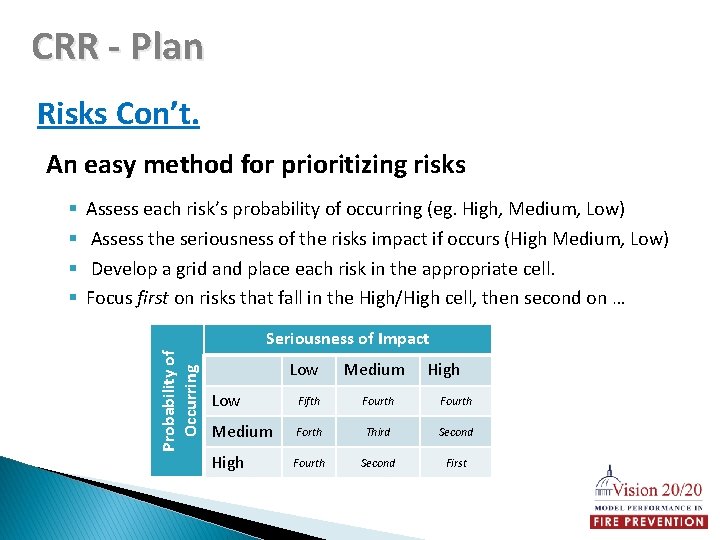
CRR - Plan Risks Con’t. An easy method for prioritizing risks Assess each risk’s probability of occurring (eg. High, Medium, Low) Assess the seriousness of the risks impact if occurs (High Medium, Low) Develop a grid and place each risk in the appropriate cell. Focus first on risks that fall in the High/High cell, then second on … Probability of Occurring § § Seriousness of Impact Low Medium High Low Fifth Fourth Medium Forth Third Second High Fourth Second First
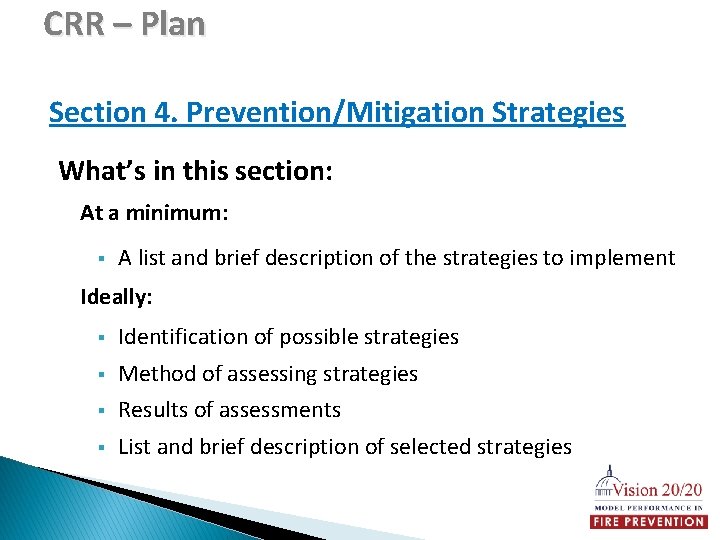
CRR – Plan Section 4. Prevention/Mitigation Strategies What’s in this section: At a minimum: § A list and brief description of the strategies to implement Ideally: § Identification of possible strategies § Method of assessing strategies § Results of assessments § List and brief description of selected strategies
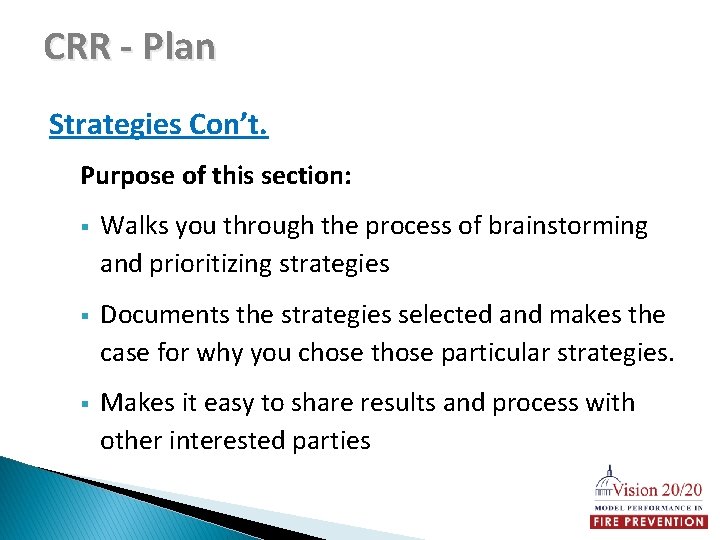
CRR - Plan Strategies Con’t. Purpose of this section: § Walks you through the process of brainstorming and prioritizing strategies § Documents the strategies selected and makes the case for why you chose those particular strategies. § Makes it easy to share results and process with other interested parties
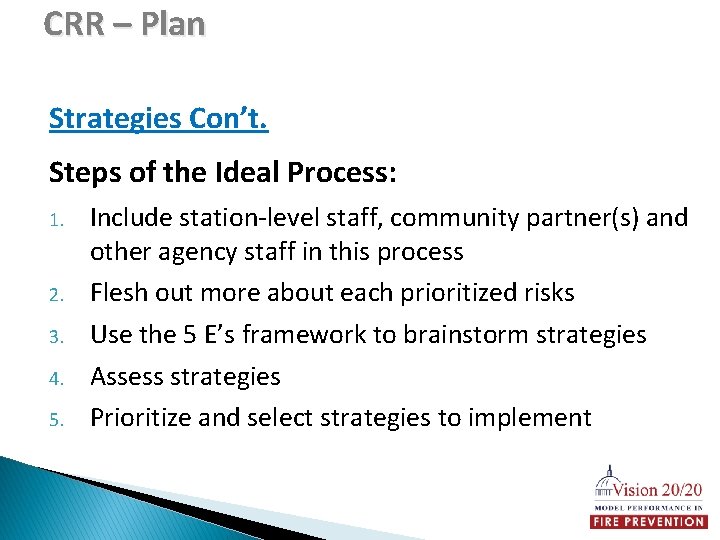
CRR – Plan Strategies Con’t. Steps of the Ideal Process: 1. 2. 3. 4. 5. Include station-level staff, community partner(s) and other agency staff in this process Flesh out more about each prioritized risks Use the 5 E’s framework to brainstorm strategies Assess strategies Prioritize and select strategies to implement
CRR - Plan Strategies Con’t. Ideal Step 1: Involves a mix of station, department and community organization staff. § Solicit feedback/input and encourage discussion on possible strategies and the pros and cons of each § Make it clear that this work requires balancing complex demands and making hard choices about strategies to pursue
CRR – Plan Strategies Con’t. Ideal Step 2: For each prioritized risk, ask: § Why is it occurring? § Who is it affecting? § When is it occurring § Where is it occurring? Answering these questions will help you brainstorm strategies to reduce that particular risk.
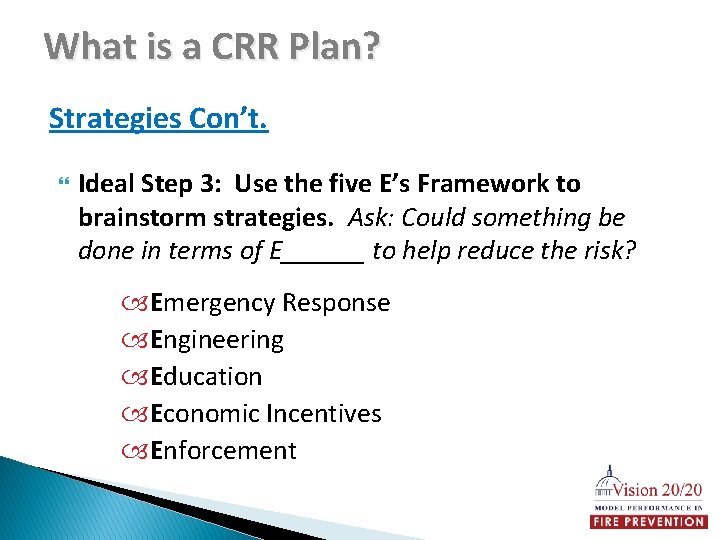
What is a CRR Plan? Strategies Con’t. Ideal Step 3: Use the five E’s Framework to brainstorm strategies. Ask: Could something be done in terms of E______ to help reduce the risk? Emergency Response Engineering Education Economic Incentives Enforcement
What is a CRR Plan? Strategies Con’t. Ideal Step 4: Assess key brainstormed strategies: § Identify pros and cons for each option or identify and use assessment criteria. § Consider feasibility (financial, political, logistical, organizational, and cultural) § Assign a weight or think about the degree of importance of each key point.
CRR - Plan Strategies Con’t. Ideal Steps 5 & 6: Prioritize & Select Strategies: § Assign a weight or think about the degree of importance of each key point. § Rank Strategies § Select top strategies or ones on list have the most agreement/enthusiasm on to pursue
CRR – Plan Section 5: Implementation What’s in this section: At a minimum § Brief identification of resources likely to be required – FTEs, Supplies, Materials Ideally § Resource needs (detailed staff, supplies, equipment) § Timeline of tasks, who is involved, and who’s responsible, start and end dates. § Timeline includes development of training, communication materials, and data collection, storage & reporting
CRR - Plan Implementation Con’t Purpose of this section § Makes you think through and plan how to best implement the strategies § Lets you know what needs to be done by when so you can keep on task and be successful § Enables you to think more about the resources /costs required
CRR - Plan Section 6: Monitoring & Evaluation Ideally: § Define what success would look like § Identify key process/output measures that can be readily collected and used to track progress § Identify key outcome measures Minimally: § Think about how you can track and record activity § Think about what you would expect if this effort were successful
CRR - Plan Monitoring & Evaluation Con’t. ALL: Commit to: § Incorporate lessons learned into the next activity cycle § Share successes with staff and community at large § Build on, expand, and/or try to sustain what works
CRR – Plan Monitoring and Evaluation Con’t. Purpose of this section: § Enable you to improve your service through timely problem identification and adjustment § Help you develop useful data collection tools, processes & systems § Allow you to determine if are really achieving what you set out to achieve § Document what you accomplished/show your value/success
CRR – Plan Monitoring & Evaluation Con’t. Ideal Step 1: Define Success – Some Examples: 1. For a Home Visit Program: § More high risk households would have smoke alarm protection which would reduce their risk of fire-related injuries, death and loss. They would also know more about preventing fire and what to do in the event of a fire. 2. For a Social and Health Referral System: § More high risk residents would be hooked up with needed social and health services so they would be less dependent on the FD for acute care and would turn to more appropriate providers for service.
CRR - Plan Monitoring & Evaluation Con’t. Ideal Step 2: Identify Outcome Measures: Definition: Measures that let you know if you achieved your goal. Often long-term, may take years to see true impact. Examples: § Reduction in residential fires per 1000 citizens § Reduction in fire fatalities per 1000 citizens § Reduction in estimated property loss per 1000 citizens
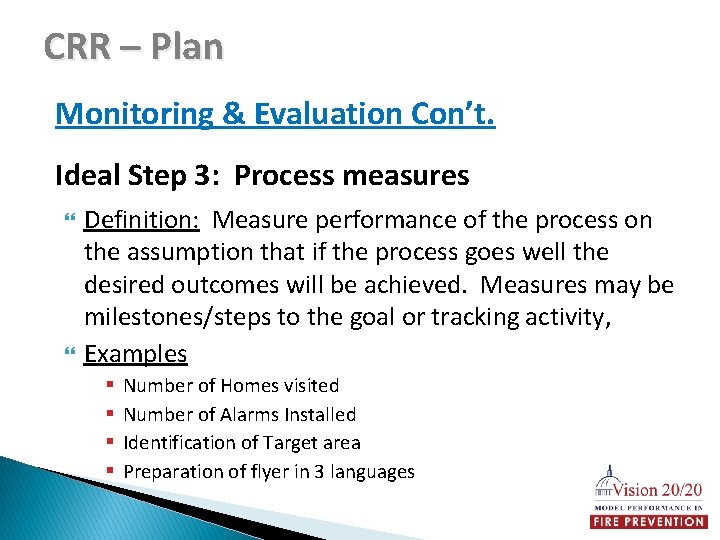
CRR – Plan Monitoring & Evaluation Con’t. Ideal Step 3: Process measures Definition: Measure performance of the process on the assumption that if the process goes well the desired outcomes will be achieved. Measures may be milestones/steps to the goal or tracking activity, Examples § § Number of Homes visited Number of Alarms Installed Identification of Target area Preparation of flyer in 3 languages
CRR - Plan Summary of CRR Plans What’s the same across all CRR planning: §Focuses locally – at the neighborhood level §Determines what is going to be done and why §Seeks to reduce fire and EMS risk What varies across CRR planning: § Content –ability to include all model sections § Level of sophistication reg. steps in each section § Who’s involved in the planning
Community Risk Reduction VI. Implementation
CRR -Implementation Key Elements of Implemention: § Identify & allocate/purchase necessary resources § Identify, develop & arrange for any necessary training § Identify, develop & arrange for the distribution of communication materials § Keep on schedule § Remember to revise plan as needed – be open to continuous improvement
Community Risk Reduction Activities 4 & 5: Participant Exercises – Putting it all together
The Benefits of Community Risk Reduction Exercise #4 Instructions: 1. Break up into groups 2. Read the case study 3. Complete the Participant Case Study Worksheet 4. Work as a team to “sell” the CRR strategies to the person/group randomly selected. 5. Present your persuasive presentation to the class. You have 3 minutes.
Community Risk Reduction – GO! Exercise #5 Instructions 1. Stay in the same group 2. Read the SCENARIO 3. List information/data needed 4. Identify (potential? ) community partners 5. How would you measure outcomes?
Community Risk Reduction IX. So you want to know more?
CRR - Resources to turn to Tridata Reports Vision 20/29 Website with Case Studies NFA Courses Other?
CRR - Resources US Fire Departments already doing some CRR: Chicago, IL - ? ? ? Dallas, TX – partnership with Injury Prevention Center Madison, WI –? ? Oklahoma City, OK Philidelphia, PA - ? ? Tualapin? ? Valley, OR -? ? Tucson, AZ – community partner CRR program Vancouver, WA – station based CRR Wilmington, NC – pilot station based CRR
Community Risk Reduction Conclusion “Any person who is at all conversant with fire safety knows that at least 85% of [fires] could be prevented. It is the duty of the Fire Chief to assume leadership… he must be up and doing and prevent fires from starting, if he is to be successful in reducing the loss. ” Chief W. D. Brosnan of Albany, Georgia, First Annual Meeting, Southeastern Association of Fire Chiefs 1928
Community Risk Reduction Let each of us be UP and DOING – Community Risk Reduction and preventing loss…
Community Risk Reduction The End