
COMMUNITY MANAGEMENT OF RURAL WATER SUPPLY SYSTEMS Community
- Slides: 23
COMMUNITY MANAGEMENT OF RURAL WATER SUPPLY SYSTEMS (Community Water Plus) Dr. V. Kurian Baby, India Country Director, IRC National Stakeholder workshop New Delhi 20 September 2013
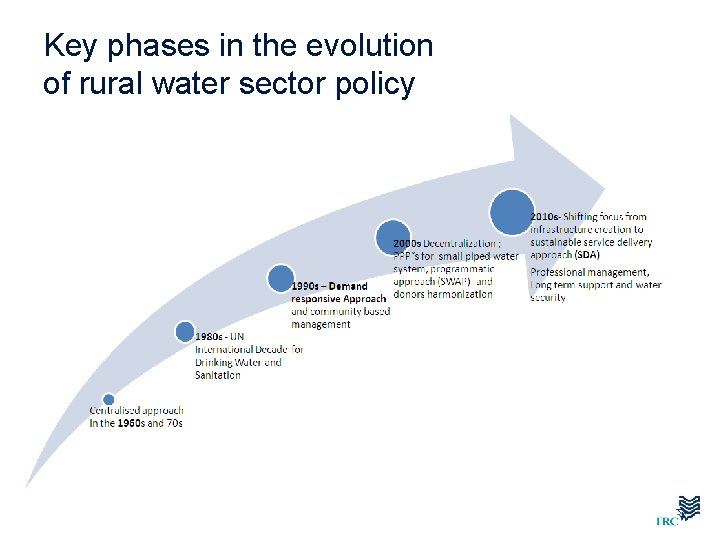
Key phases in the evolution of rural water sector policy
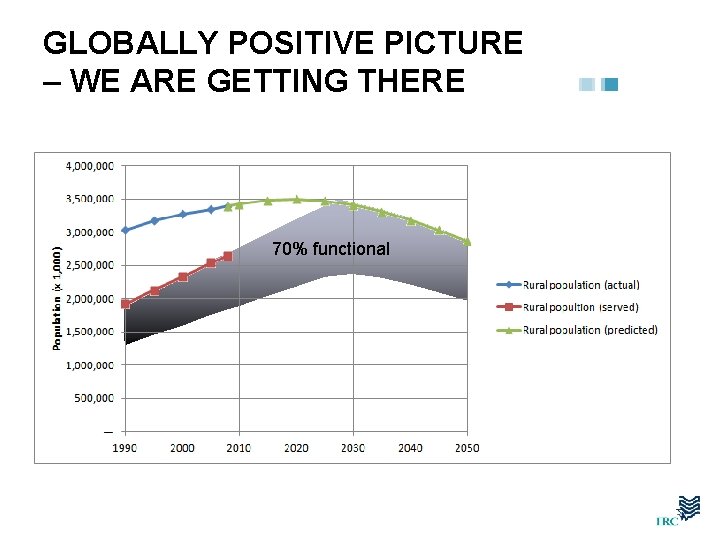
GLOBALLY POSITIVE PICTURE – WE ARE GETTING THERE 70% functional
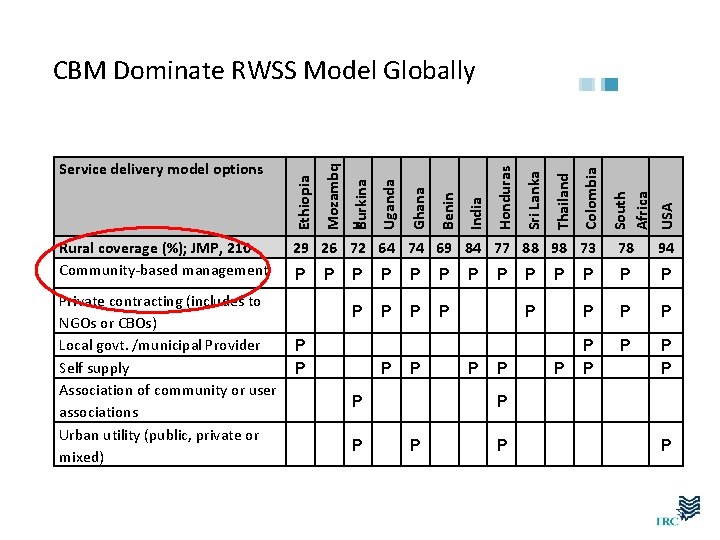
Rural coverage (%); JMP, 210 Community-based management USA South Africa Colombia Thailand Sri Lanka Honduras India Benin Ghana Uganda Mozambq u Burkina Service delivery model options Ethiopia CBM Dominate RWSS Model Globally 29 26 72 64 74 69 84 77 88 98 73 78 94 P P P Private contracting (includes to NGOs or CBOs) Local govt. /municipal Provider P Self supply P Association of community or user associations Urban utility (public, private or mixed) P P P P P P P
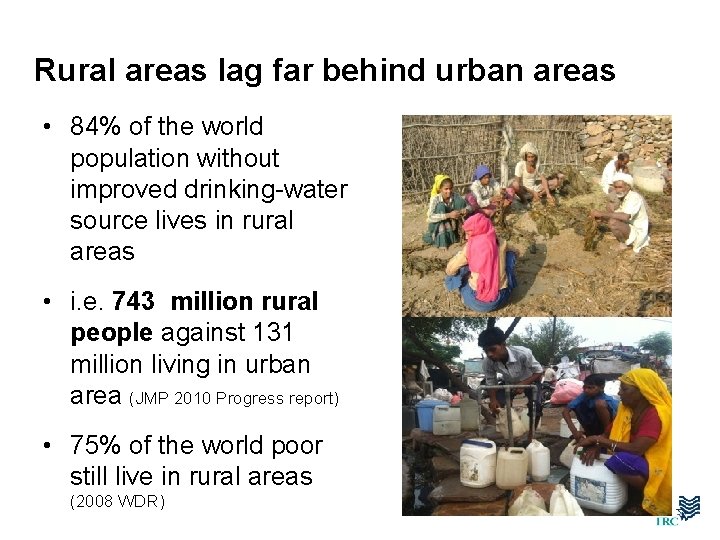
Rural areas lag far behind urban areas • 84% of the world population without improved drinking-water source lives in rural areas • i. e. 743 million rural people against 131 million living in urban area (JMP 2010 Progress report) • 75% of the world poor still live in rural areas (2008 WDR)
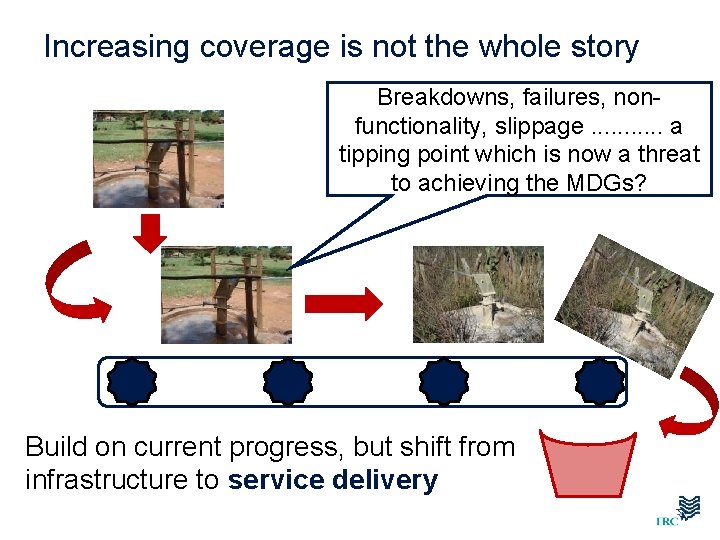
Increasing coverage is not the whole story Breakdowns, failures, nonfunctionality, slippage. . . a tipping point which is now a threat to achieving the MDGs? Build on current progress, but shift from infrastructure to service delivery
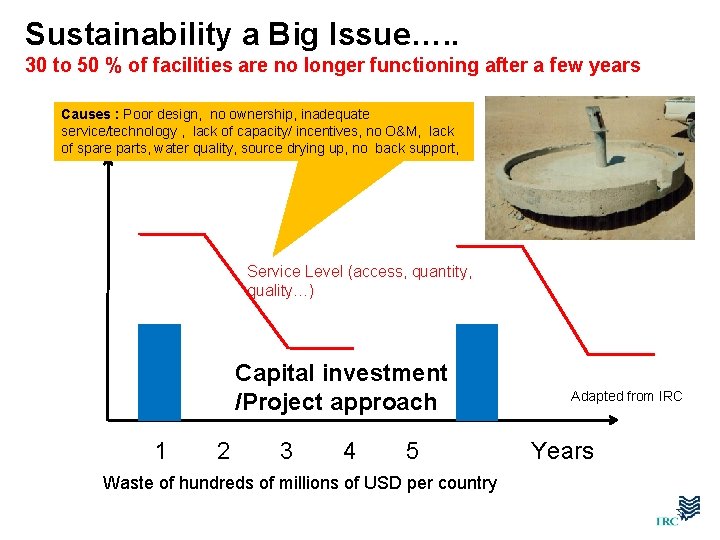
Sustainability a Big Issue…. . 30 to 50 % of facilities are no longer functioning after a few years Causes : Poor design, no ownership, inadequate service/technology , lack of capacity/ incentives, no O&M, lack of spare parts, water quality, source drying up, no back support, Service Level (access, quantity, quality…) Capital investment /Project approach 1 2 3 4 5 Waste of hundreds of millions of USD per country Adapted from IRC Years
Recent Evidences • CBM emerged as a dominant rural service delivery model enhancing coverage globally • Large Number of best practice CBM models across the world and in India • However sustainability is a serious concern - critical post construction (PCS) gaps in service delivery 8
Whither CBM or Emerge CBM +? • Sceptics argue against CBM as a means to attain sustainable service delivery • Others argue for a community plus model for improving sustainability where – Governments to continue a critical role in providing predictable post construction support and professionalize CBM 9
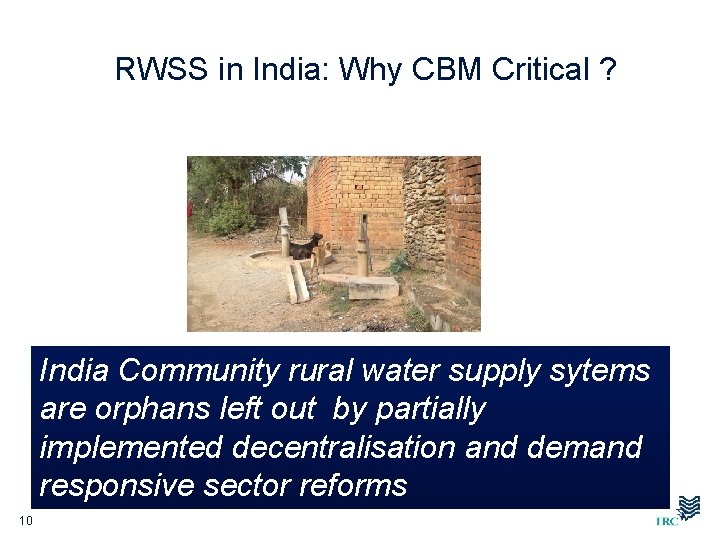
RWSS in India: Why CBM Critical ? India Community rural water supply sytems are orphans left out by partially implemented decentralisation and demand responsive sector reforms 10
RWSS in India: Why CBM Critical ? • CBM has emerged as a dominant model of RWSS service delivery in India • XII plan target 60% of RWSS operated and managed by LSGs and communities with at least 50% cost recovery • Wash is constitutional mandate of PRIs (73 rd and 74 th amendment) • Monolithic water boards and departments plan, design and construct schemes and hand over to PRIs/VWSCs de jure responsible yet de facto NOT-empowered • CBM is critical for equity and subsidiarity 11
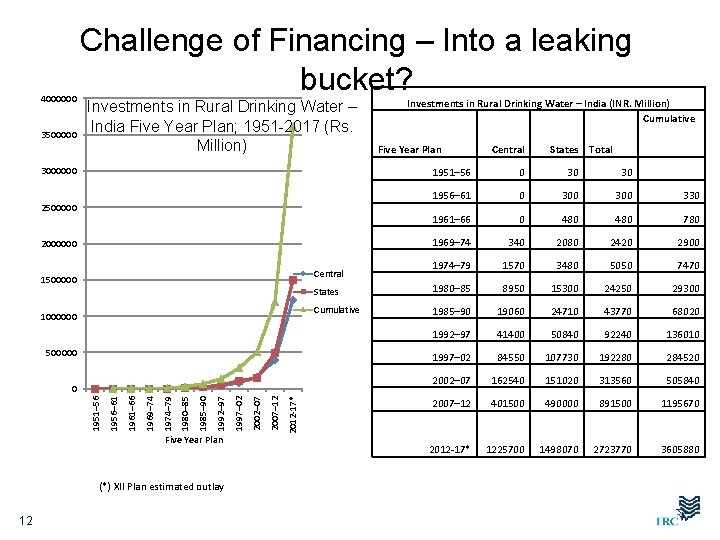
4000000 3500000 Challenge of Financing – Into a leaking bucket? Investments in Rural Drinking Water – India Five Year Plan; 1951 -2017 (Rs. Million) 3000000 (*) XII Plan estimated outlay 12 2007– 12 2002– 07 2012 -17* Five Year Plan 1997– 02 1992– 97 1985– 90 1980– 85 1974– 79 1969– 74 1961– 66 1956– 61 1951– 56 0 States Total 30 30 1956– 61 0 300 330 1961– 66 0 480 780 1969– 74 340 2080 2420 2900 1974– 79 1570 3480 5050 7470 States 1980– 85 8950 15300 24250 29300 Cumulative 1985– 90 19060 24710 43770 68020 1992– 97 41400 50840 92240 136010 1997– 02 84550 107730 192280 284520 2002– 07 162540 151020 313560 505840 2007– 12 401500 490000 891500 1195670 2012 -17* 1225700 1498070 2723770 3605880 Central 500000 Central 0 2000000 1000000 Five Year Plan 1951– 56 2500000 1500000 Investments in Rural Drinking Water – India (INR. Million) Cumulative
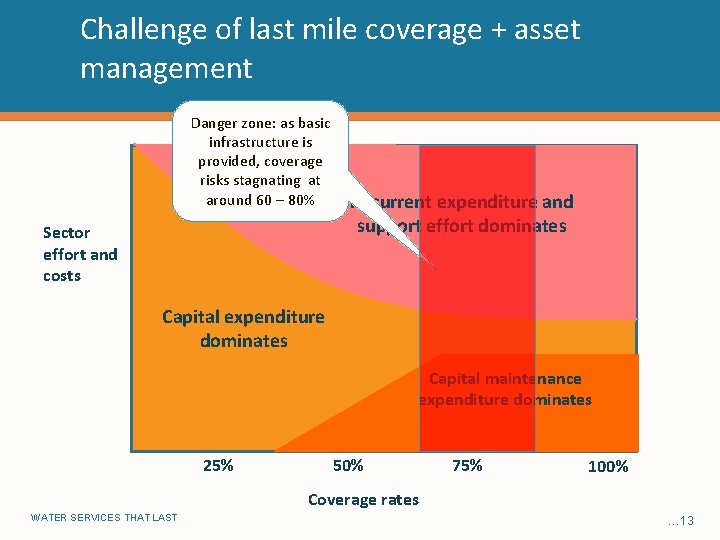
Challenge of last mile coverage + asset management Danger zone: as basic infrastructure is provided, coverage risks stagnating at around 60 – 80% Sector effort and costs Recurrent expenditure and support effort dominates Capital expenditure dominates Capital maintenance expenditure dominates 25% 50% 75% 100% Coverage rates WATER SERVICES THAT LAST … 13
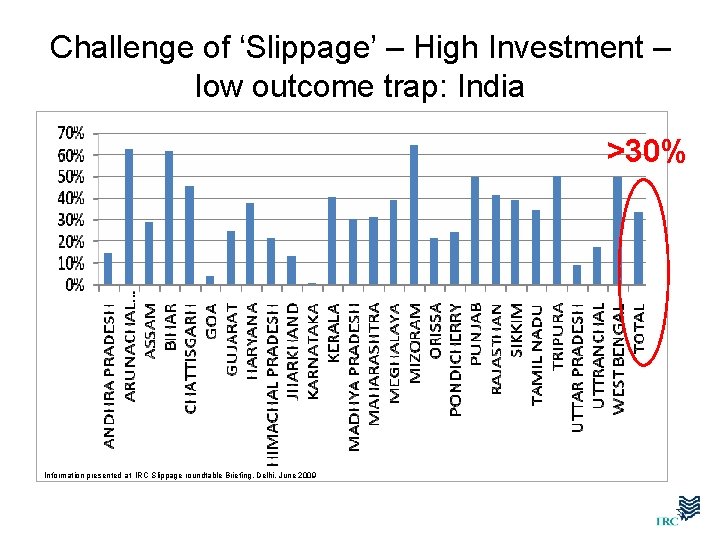
Challenge of ‘Slippage’ – High Investment – low outcome trap: India >30% Information presented at IRC Slippage roundtable Briefing, Delhi, June 2009
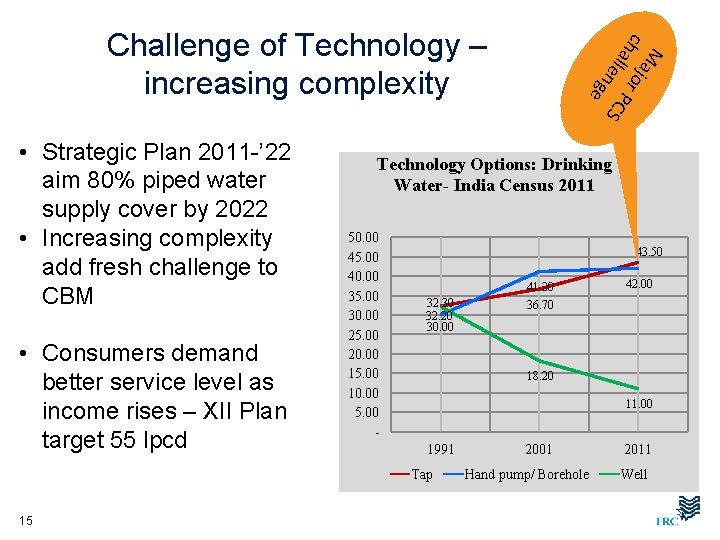
• Strategic Plan 2011 -’ 22 aim 80% piped water supply cover by 2022 • Increasing complexity add fresh challenge to CBM • Consumers demand better service level as income rises – XII Plan target 55 lpcd Technology Options: Drinking Water- India Census 2011 50. 00 45. 00 40. 00 35. 00 30. 00 25. 00 20. 00 15. 00 10. 00 5. 00 - 43. 50 32. 30 32. 20 30. 00 41. 20 36. 70 42. 00 18. 20 11. 00 1991 Tap 15 M ch ajor a lle PCS n ge Challenge of Technology – increasing complexity 2001 Hand pump/ Borehole 2011 Well
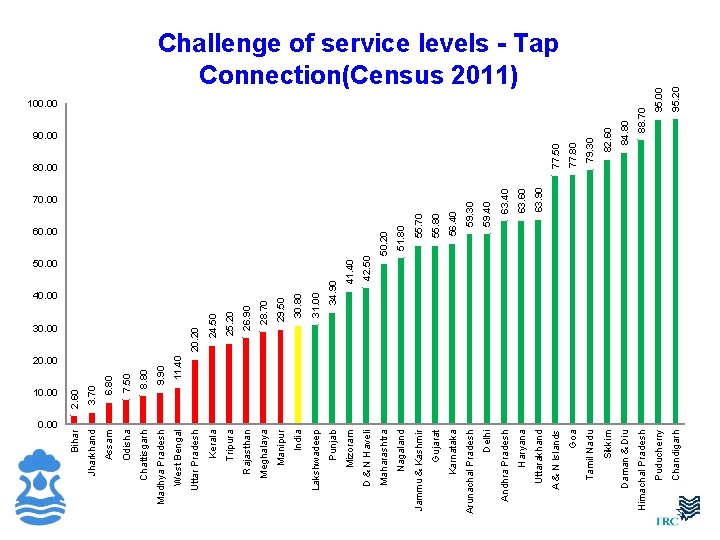
8. 80 9. 90 Chattisgarh Madhya Pradesh 30. 80 31. 00 India Lakshwadeep 95. 00 95. 20 Puducherry Chandigarh 88. 70 84. 80 100. 00 Himachal Pradesh Daman & Diu 82. 60 79. 30 Tamil Nadu Sikkim 77. 80 Goa 63. 90 Uttarakhand 80. 00 77. 50 63. 60 Haryana 90. 00 A & N Islands 63. 40 Andhra Pradesh 59. 40 Delhi 56. 40 Karnataka 59. 30 55. 80 Gujarat 70. 00 Arunachal Pradesh 55. 70 51. 80 Jammu & Kashmir Nagaland 50. 20 42. 50 D & N Haveli 60. 00 Maharashtra 41. 40 50. 00 Mizoram 34. 90 29. 50 Manipur Punjab 28. 70 40. 00 Meghalaya 26. 90 25. 20 Tripura Rajasthan 24. 50 Kerala 20. 20 30. 00 Uttar Pradesh 11. 40 7. 50 Odisha 20. 00 West Bengal 6. 80 Assam 3. 70 Jharkhand 0. 00 2. 60 10. 00 Bihar Challenge of service levels - Tap Connection(Census 2011)
India has many CBM success stories…. • CBM best practices across India – (Maharashtra, Karnataka, Kerala, Gujarat, Punjab, UP etc. ) • Many non-documented models even in low performing states – however; • Replicability and scaling up a are critical limitations • There are critical post construction support gaps • Cracks are seen in CBM questioning rationale/ sustainability • We need to identify the limiting factors and evolve context specific modalities for sustainable CBM in India 17
Community Management Plus • Support agency functions --- water quality, technical advice , capital maintenance, risk financing, tariff setting, training, monitoring etc. • Service authority– adequate fulfilment of function • Water security and source sustainability • Adequate financing of different costs - Life cycle costs • Transparency, governance and provider accountability • External agency on-going support to community + enabling environment • CBM + is Professionalization or professionalised support of community management 18
Research Objectives • Investigate functioning, successful, community managed rural water supply programmes in India • Determine the extent of support required to sustain services while retaining a valid level of community engagement. • Analyse and categorize the different levels of support required for different types of rural water supply 19
Research Approach • Research best practice/ successful 18 community based RWSS systems in India • Assess how the level of community management impacts on indicators such as service levels, service provider performance and equity • Collaborative - Consultative and Participatory Engage with policy makers at national and State level for strategic guidance, validation and policies 20
Research Outputs • Series of working papers and 18 case studies with • Report on the successful models for management and support to rural water supply in India • Policy briefs with the highlight findings of the research • Guideline document with proposed categories of management models and support entities fit to different contexts in India • Evidences for most applicable trajectories for development of CBM 21
Partners • Consortium lead: Cranfield University, United Kingdom • Members: – IRC International Water and Sanitation Centre (from the Netherlands), – Administrative Staff College of India (based in Hyderabad), – Centre for Excellence in Change (based in Chennai) – Malawya National Institute of Technology (based in Jaipur) – ? ? • Work closely with national and State government agencies. 22
Thank You 23