
Community Living for People with Intellectual Disabilities Paradise
Community Living for People with Intellectual Disabilities Paradise Postponed
Introduction Since the 1970 s a variety of jurisdictions have moved to deinstitutionalise support for children, people with intellectual disabilities and people with mental illness. This has led to the closing or downsizing of orphanages, institutions and asylums, and the development of community supports for these groups of people.
Throughout History People with an Intellectual Disability have been described as: • • Fools Idiots Retards Imbeciles
Their experiences have included being: • • • Victimised Locked in cages Placed in Freak Shows Tormented in public places Violated in privates spaces
Today People with an Intellectual Disability: • Face an extremely high unemployment. • Are three times more likely than the national average to be victims of reported sexual assault, physical violence or fraud. • Are over-represented by a factor of 4 in the correctional system and are twice as likely to be recidivist.
• Between 40% - 60% experience serious mental illness. • By a factor of 4, they are more likely to have been put under the care of Department of Child Safety. • Mothers with Intellectual Disability are twice as likely to lose their children to Department of Child Safety • By a factor of 4 are more likely to be homeless
Their socialisation remains challenging and ‘Community Living’ has not been Paradise attained because: • Society finds it difficult to understand Intellectual Disability. • They are a small part of the population – 3%. • They don’t have a group identity and therefore don’t advocate for themselves.
• They see themselves as being like everyone else and try to fit in, by for example saying ‘yes’ to things they don’t understand or going along with things other people suggest. • They are blamed for their condition and seen as fair game. • They are disadvantaged in our society by the fact that true value is attained through economic contribution and participation, which they find difficult. The greatest mitigater for people to not become disadvantaged by their intellectual disability, is a supportive family and other supportive relationships.
Community Living Program • CLP was established in 1989 to support people with Intellectual Disability to live ‘independently’ in the community. The majority – though not all – the people who have been referred to CLA have: • Exited Department of Child Safety • Come from families that have broken down • May have come from the mental health or the corrections system • May have experience youth homelessness and/or forced to live in hostels or boarding houses.
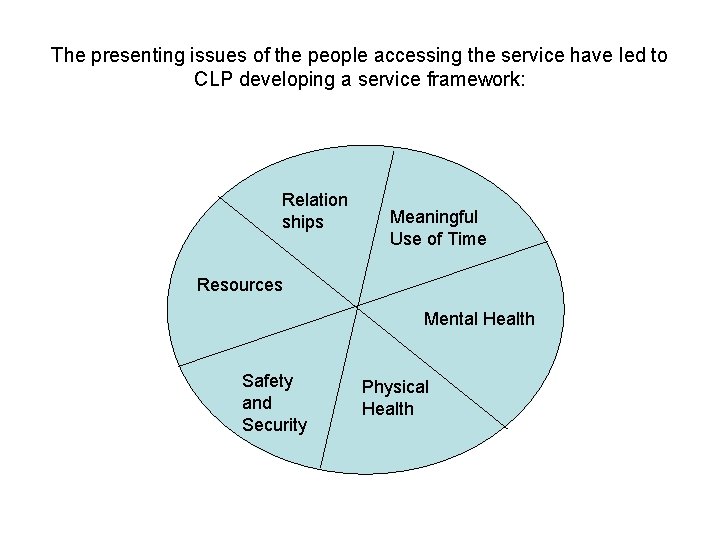
The presenting issues of the people accessing the service have led to CLP developing a service framework: Relation ships Meaningful Use of Time Resources Mental Health Safety and Security Physical Health
However the development of an organisational practice framework has been fraught with dilemmas, doubts, contradictions and ethical questions. The following is CLP’s organisational practice framework at this time.
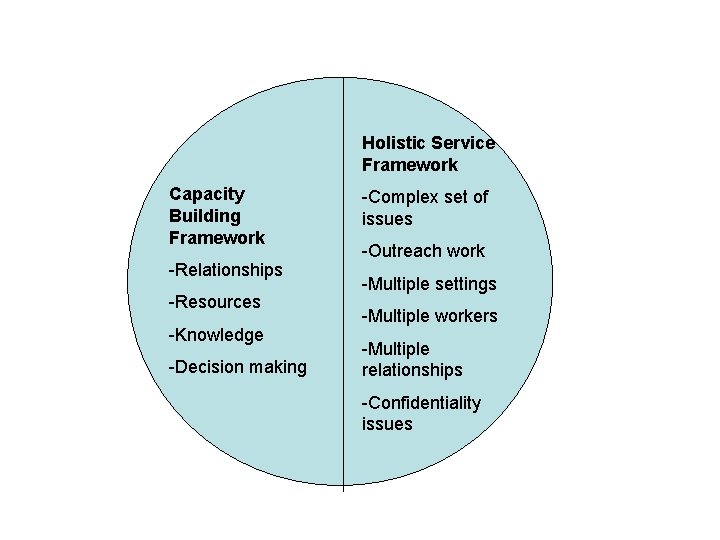
Holistic Service Framework Capacity Building Framework -Relationships -Resources -Knowledge -Decision making -Complex set of issues -Outreach work -Multiple settings -Multiple workers -Multiple relationships -Confidentiality issues
Focus on RELATIONSHIPS • • Work with people and their relationships To repair and renew To build new To assist exit
For example, Homeless Young Man with an Intellectual Disability Work involves: • Repair family relationship • Assist to leave criminal relationship • Development of musical buddies • Development of volunteers around work • Negotiate family issues • Network support around housing/neighbourhoods
Focus on relationships has consequences for the work: • Need to negotiate process for sharing information between people (either completely closed or sign documents allowing disclosure to everyone). • Extended sets of relationships for worker to hold and different hats for different relationships. • Other parties may become secondary client or fully fledged second client. • May need to engage more than one worker in relationships’ sets of great complexity. • Potential for engagement in relationship conflict.
Building KNOWLEDGE People with an Intellectual Disability generally have difficulty in: • Absorbing knowledge • Linking knowledge • Retaining knowledge • May not learn from experience or consequences. Often their experience of teaching is people “telling them things/banking knowledge” which doesn’t work well.
More effective methodologies include: • Showing people – getting them to learn by doing • Repetition drawing links between action and consequence • Building on what people know • Building on interests.
Example: CLP Literacy Group – Literacy for Everyday • Builds curricula from people’s interests/what they want to do for e. g. organising a birthday party • Building on what people know their own language e. g. person’s way of describing deteriorating mental health may be “thinking too much”. This can be used to help them monitor mental health. • Reminding of what happened before/drawing the links – when that happened this happened.
Building DECISION MAKING • A group of people for who decisions can be difficult to make. • A group of people where decisions made can lead to negative consequences. • A group decision can be made at the behest of others and against the person’s interests. • A group of people who have often been criticised and made to feel guilty and bad about the decisions they make.
RESOURCES • External/Internal Resources • CLP has supported constituents to Individually and Collectively access External and Internal resources. • Importantly hold principles of looking to gifts, abilities, underutilised resources and also the need for social equity.
Examples • Collective/External Resources - IYHG - NCEC - Holiday Group • Individual/External Resources - Funding Packages
• Individual/Internal Resources - Budgeting - Saving - Volunteering gifts - Small enterprises • Collective/Internal Resources - Savings Group/Savings Systems - NCEC work opportunities - Holiday Group
What can YOU do to HELP Some things you can do if you want to assist people with an Intellectual Disability in their struggle for a better life: • Help us to spread the message about the situation of people with an Intellectual Disability – We are happy to present anywhere, anytime, to anyone.
• Volunteer your support to people with an Intellectual Disability • Volunteer with CLP or contact Volunteer Queensland for other opportunities • Contacts – Richard Warner at CLP – Ph – 07 -32665633 – Email – volunteers@communityliving. org. au – Website – www. communityliving. org. au - Volunteer Queensland www. volqld. org. au
Support out Research Projects • Sandy Seymour from WWILD’s Victim of Crime program is seeking child safety officers and family members to assist her in the research into how to support children’s service workers and parents with an intellectual disability who have children in care. • Contact – Ph – 07 -32624066/ email sandi. voc@wwild. org
• CLP is conducting research into people with intellectual disability who have experiences with the Department of Child Safety and the foster care system, mental health system, and the Correctional system in a study conducted with the University of Queensland. If you know anyone who could participate in that study, please contact Morrie O’Connor on 32665633 or email moconnor@communityliving. org. au
Join Discussions • Paperbag Lunches discussions (see attached flyer) • Join CLP in a Blue Skies Discussion – “Why are people with intellectual disability over represented in a wide variety of social disadvantages? ” - Contact – Richard Warner (CLA) on ph 07 -32665633 or rwarner@communityliving. org. au
- Slides: 27