
Community Interactions Food Chains Food Webs Classroom Rules
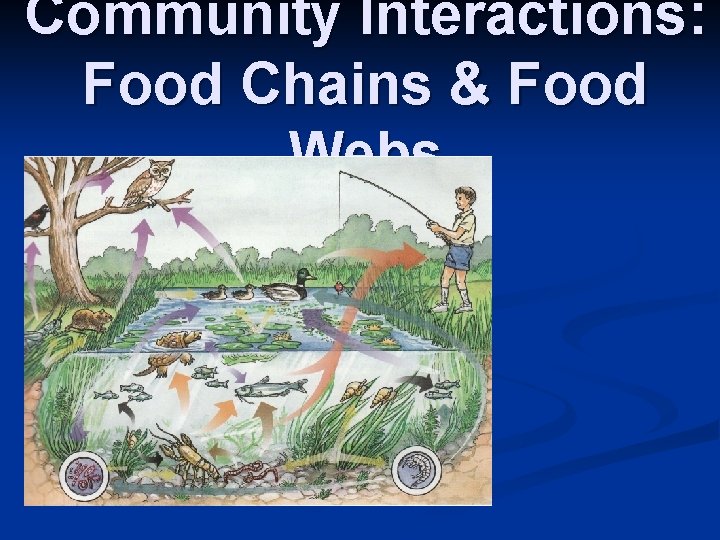
Community Interactions: Food Chains & Food Webs
Classroom Rules Be respectful. To me, classmates, the room. n Be prepared for class by being on time, being present, being focused and mindful. n Be considerate to take off and store all electronics in your backpack. n Be respectful by not eating or drinking in the classroom, except water. n Follow school rules and policies! n
Expectations n I expect you… n To work hard and to the best of your ability. n To come to class prepared to learn and with a positive attitude. n To come to class with your materials. and complete assignments on time.
Review-What is Ecology? n Ecology n The study of interactions of organisms and the physical environment. n All about interactions and interdependence between organisms and their environment n Encompasses a variety of topics ranging from food webs and energy
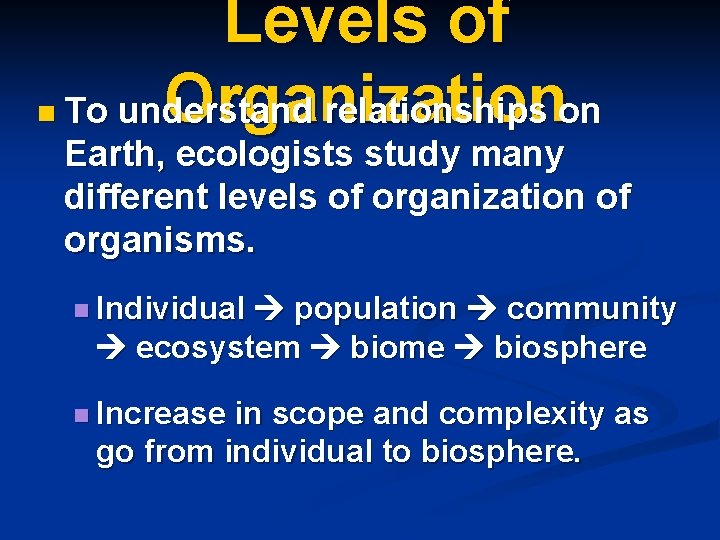
n Levels of Organization To understand relationships on Earth, ecologists study many different levels of organization of organisms. n Individual population community ecosystem biome biosphere n Increase in scope and complexity as go from individual to biosphere.
Individual n Individual = a single organism; a member of a population n All organisms occupy a specific habitat and niche. n Niche = organism’s job or role n Habitat = where the organism lives (think of it as an organism’s address)
Population – Community n Population = a group of individuals that belong to the same species & live in the same general area n Community populations = an assemblage of
Ecosystem – Biome n Ecosystem = biological community together with the associated abiotic (non-living) environment n Biome = a geographical region containing several ecosystems that have the same climate & dominate communities * We live in the Temperate Deciduous Forest Biome
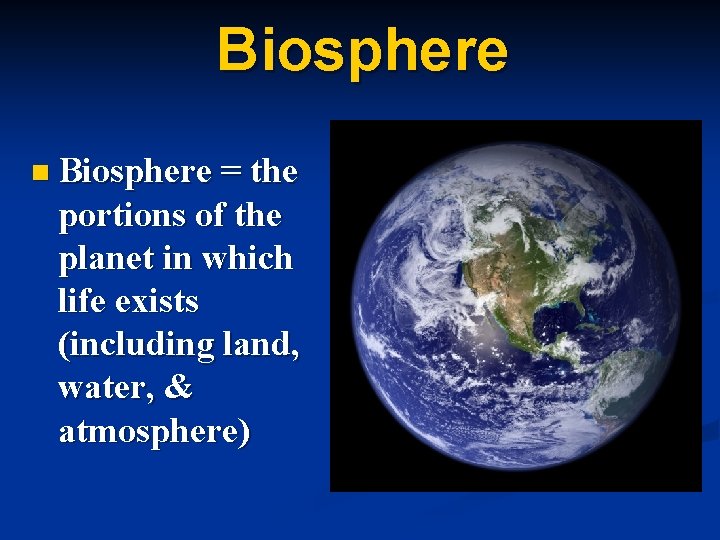
Biosphere n Biosphere = the portions of the planet in which life exists (including land, water, & atmosphere)
How do nutrients and energy flow in an ecosystem? Food chains are representations of the order in which one population feeds on another in an ecosystem. Example: Algae Fish Humans n Food webs are complex patterns of energy flow in an ecosystem represented by several interconnected food chains. n
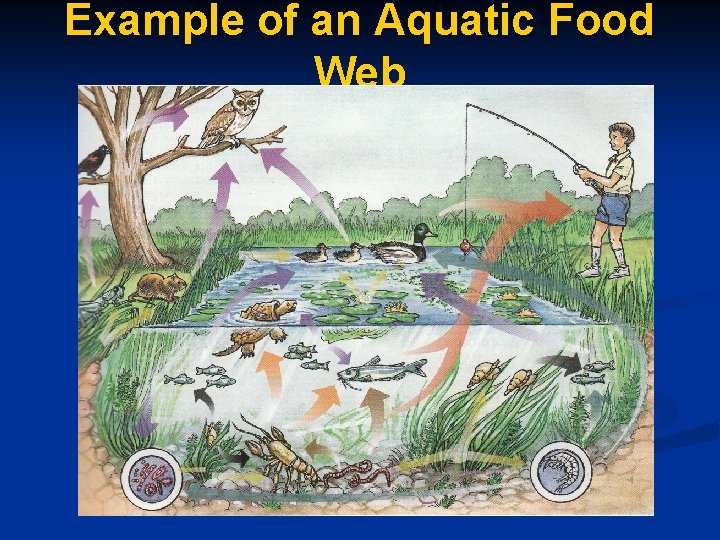
Example of an Aquatic Food Web
3 Major Trophic Levels– Level 1 n Autotrophs Ø Also referred to as producers Ø Require only inorganic nutrients and an outside energy source to produce organic nutrients Ø Includes: Ø Primarily photosynthetic organisms which are organisms that convert the sun’s energy into food (ex: plants) Ø Other types exist
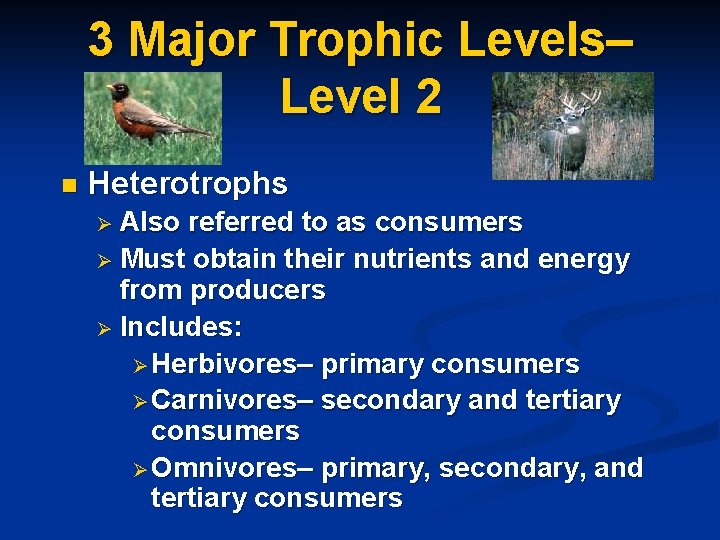
3 Major Trophic Levels– Level 2 n Heterotrophs Ø Also referred to as consumers Ø Must obtain their nutrients and energy from producers Ø Includes: Ø Herbivores– primary consumers Ø Carnivores– secondary and tertiary consumers Ø Omnivores– primary, secondary, and tertiary consumers
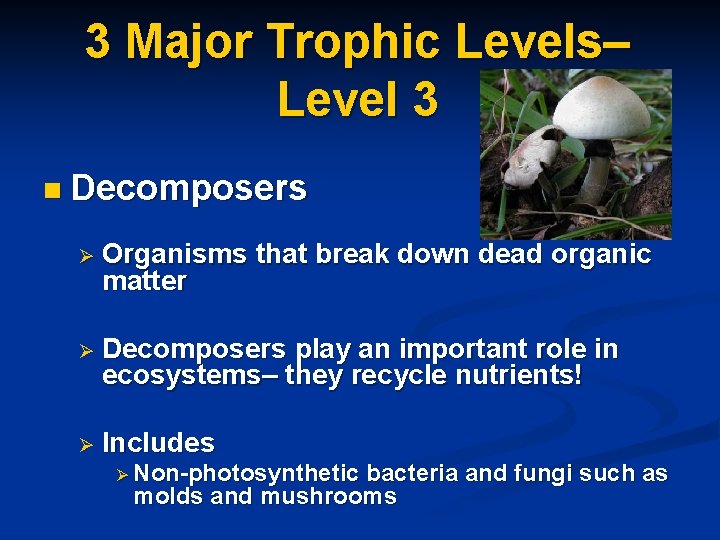
3 Major Trophic Levels– Level 3 n Decomposers Ø Organisms matter that break down dead organic Ø Decomposers play an important role in ecosystems– they recycle nutrients! Ø Includes Ø Non-photosynthetic bacteria and fungi such as molds and mushrooms
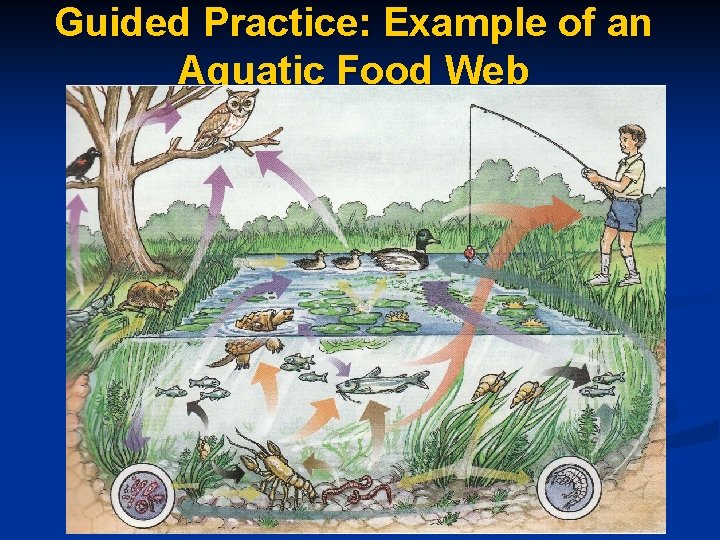
Guided Practice: Example of an Aquatic Food Web
It’s your turn to try… n n Can you apply the concepts that we’ve discussed today? Please partner with the person sitting next to you. Together, use the following terms to create a food web: - oak tree - hawks - fox - humans - squirrels - berries - blue birds - rabbits - white-tailed deer - mice - fungi - grass Remember to include all the organisms in your food web. Be prepared to explain why you created your food web the way that you did. Put your food web on the large construction paper.
Ticket to Exit n What are some of the foods that you consume everyday? n Based on what we discussed in class, where do you fit into the food web? n Why are food webs considered to be a more accurate picture of what’s happening in ecosystems than food chains?
Bell Activity: Quick Write down an example of a food chain with 4 organisms. Next to each one, write down its niche. (Remember: A niche is its job. )
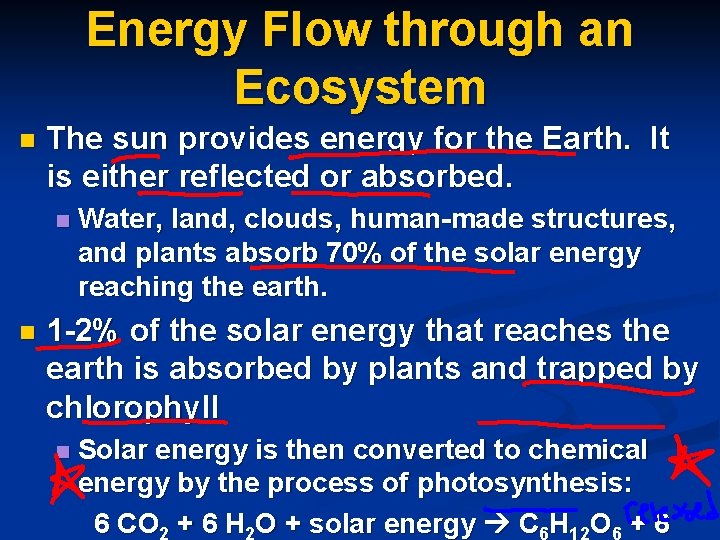
Energy Flow through an Ecosystem n The sun provides energy for the Earth. It is either reflected or absorbed. n n Water, land, clouds, human-made structures, and plants absorb 70% of the solar energy reaching the earth. 1 -2% of the solar energy that reaches the earth is absorbed by plants and trapped by chlorophyll n Solar energy is then converted to chemical energy by the process of photosynthesis: 6 CO 2 + 6 H 2 O + solar energy C 6 H 12 O 6 + 6
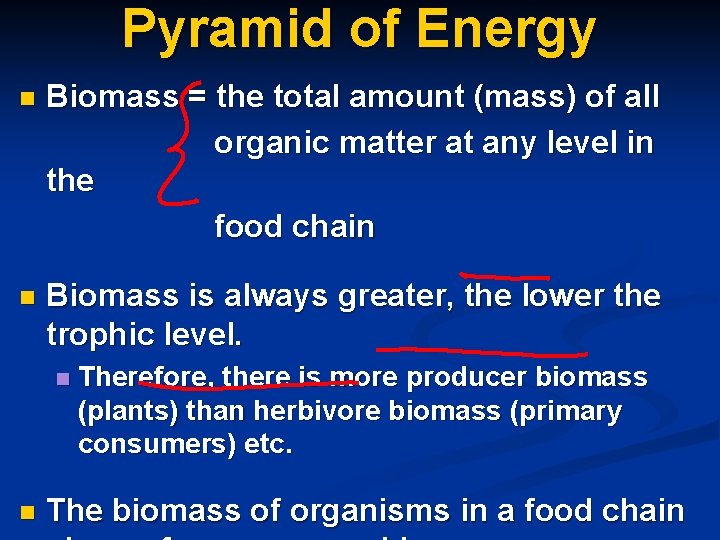
Pyramid of Energy n Biomass = the total amount (mass) of all organic matter at any level in the food chain n Biomass is always greater, the lower the trophic level. n n Therefore, there is more producer biomass (plants) than herbivore biomass (primary consumers) etc. The biomass of organisms in a food chain
Pyramid of Energy (cont. ) n To carry on its life processes, the plant uses most of the energy trapped during photosynthesis. Only a small part of the energy trapped by the plant remains stored in the plant when it is harvested (this is what is available to herbivores). n If a plant receives 1, 000 Calories of energy from the sun, about 5 Calories will be stored in the plant and be available to herbivores. Generally, only about 10% of the biomass at one level is converted to biomass at the next level. So where does
9/9 Question of the day: n How much energy moves from one trophic level to the next? n Where does that “lost” energy go? n Write down one example of a food chain with three to four organisms. Which is a better depiction of energy flow in an ecosystem: food web or food chain?
Pyramid of Energy (cont. ) n Let’s look at an example: If a deer eats a plant, less than one Calorie (less than 20% of the energy stored in the plant) will be converted to body tissue. n 25% of the energy is excreted through waste. n More than half of the energy is changed to heat energy. n
Key Point: Energy is Lost Between Trophic Levels n Food webs are limited in size because energy is lost between trophic levels. n The 10% Rule Ø Only about 10% of the energy is available from one trophic level to the next.
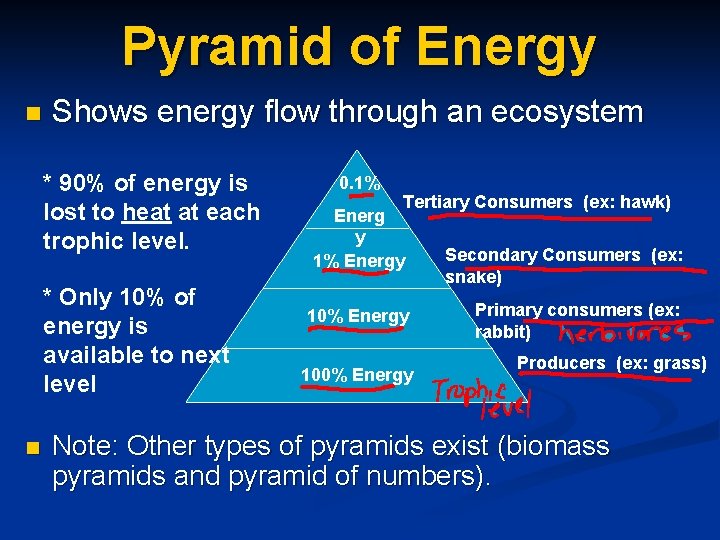
Pyramid of Energy n Shows energy flow through an ecosystem * 90% of energy is lost to heat at each trophic level. * Only 10% of energy is available to next level n 0. 1% Tertiary Consumers (ex: hawk) Energ y Secondary Consumers (ex: 1% Energy snake) 10% Energy 100% Energy Primary consumers (ex: rabbit) Producers (ex: grass) Note: Other types of pyramids exist (biomass pyramids and pyramid of numbers).
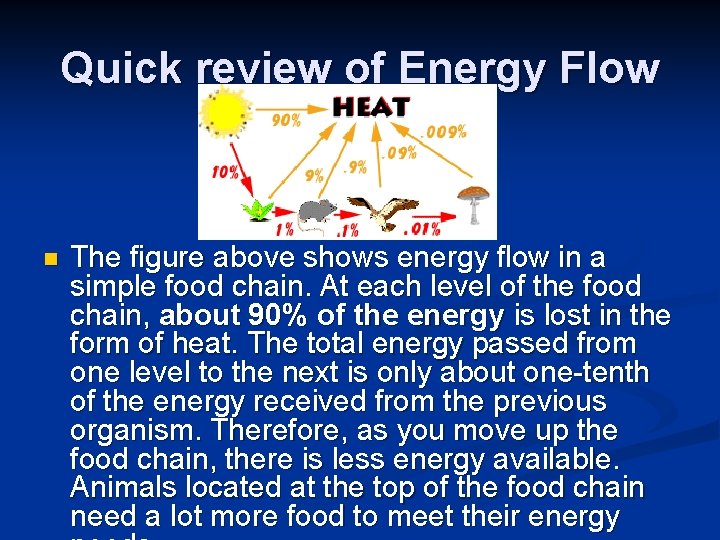
Quick review of Energy Flow n The figure above shows energy flow in a simple food chain. At each level of the food chain, about 90% of the energy is lost in the form of heat. The total energy passed from one level to the next is only about one-tenth of the energy received from the previous organism. Therefore, as you move up the food chain, there is less energy available. Animals located at the top of the food chain need a lot more food to meet their energy
Read the statement below: STATEWIDE ADVISORY n Pennsylvania has issued a general, statewide health advisory for recreationally caught sport fish. The advice is that you eat no more than one meal (one-half pound) per week of sport fish caught in the state’s waterways. This general advice was issued to protect against eating large amounts of fish that have not been tested or that may contain unidentified contaminants.

What does this mean and why does this happen? Think about it…
Terms to describe this: n Bioaccumulation is a general term for the accumulation of substances, such as pesticides (DDT is an example), methylmercury, or other organic chemicals in an organism or part of an organism. n How does this relate to the fish advisory you read earlier?
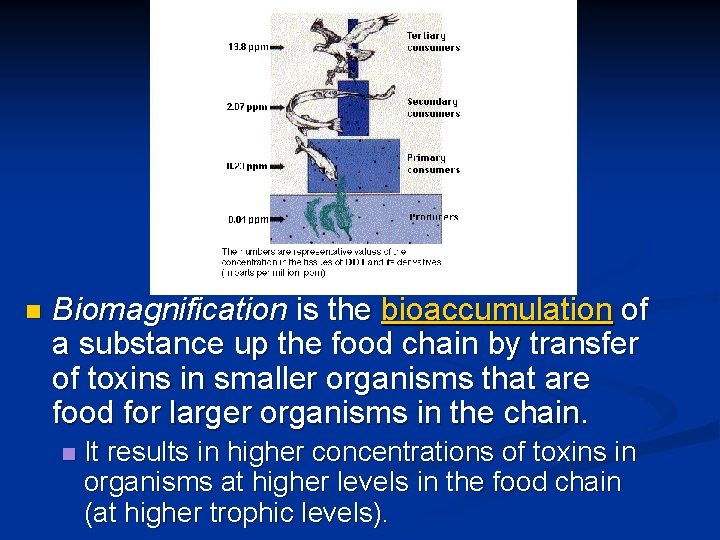
n Biomagnification is the bioaccumulation of a substance up the food chain by transfer of toxins in smaller organisms that are food for larger organisms in the chain. n It results in higher concentrations of toxins in organisms at higher levels in the food chain (at higher trophic levels).
Questions of the day: 9/9 1. 2. 3. 4. Define ecology. How are organisms organized (6 levels)? What is the difference between an organism’s habitat and its niche? What is the difference between a community and an ecosystem?
- Slides: 31