
Community Information System CIS Developed by IRSPUNCEF Community
Community Information System (CIS) Developed by IRSP-UNCEF
Community Information System • Started September 2001 • Cautious start – 5 UCs as a model, heavy time investment On planning • Few select indicators • Limited resources • Scaled up to total 20 UCs 2002 • Still may have short comings • Requires technical inputs and assistance of stakeholders
VISION Community activists collect and manage basic information for local development on a sustainable basis. Aware community makes informed decisions in identifying action at local level. Simultaneously, information is passed upwards to UC & district levels for planning on available data.
Information Flow Community to District level Information is collected at two levels: a. Household level b. Village level
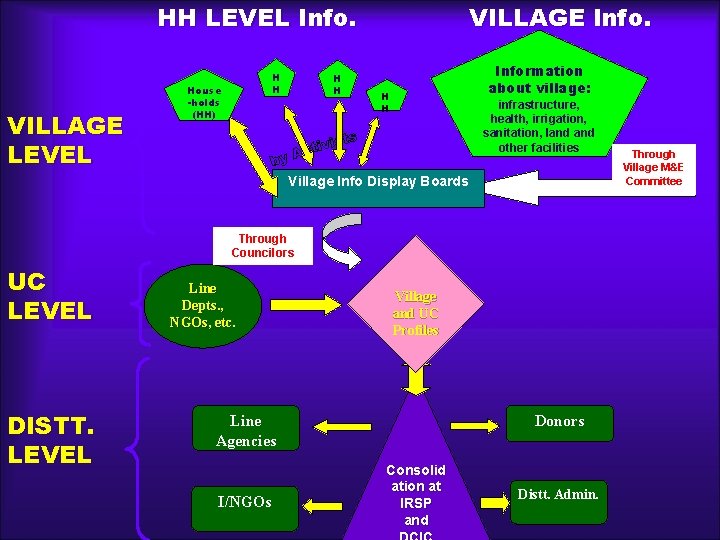
HH LEVEL Info. VILLAGE LEVEL H H House -holds (HH) H H VILLAGE Information about village: H H infrastructure, health, irrigation, sanitation, land other facilities Village Info Display Boards Through Councilors UC LEVEL DISTT. LEVEL Line Depts. , NGOs, etc. Village and UC Profiles Donors Line Agencies I/NGOs Consolid ation at IRSP and Distt. Admin. Through Village M&E Committee
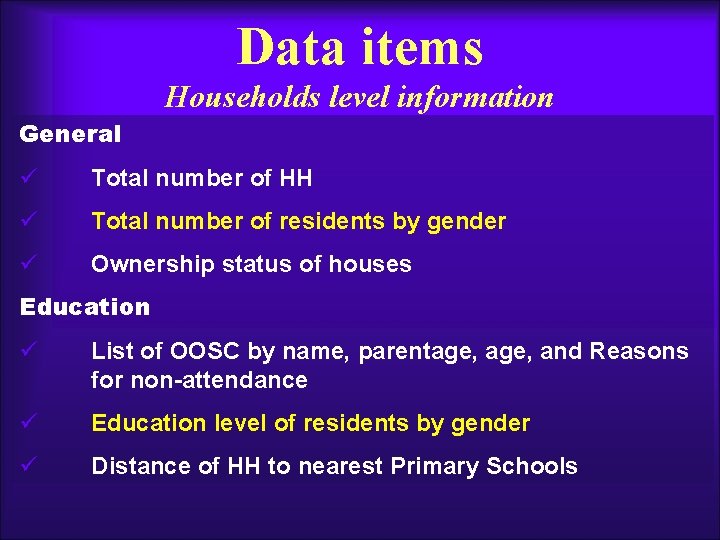
Data items Households level information General ü Total number of HH ü Total number of residents by gender ü Ownership status of houses Education ü List of OOSC by name, parentage, and Reasons for non-attendance ü Education level of residents by gender ü Distance of HH to nearest Primary Schools

Health & Nutrition ü Breast feeding patterns ü Children and infant deaths ü Maternal deaths ü Disease patterns in children and adults ü Use of iodized salt ü Average Distance from HH to nearest BHU
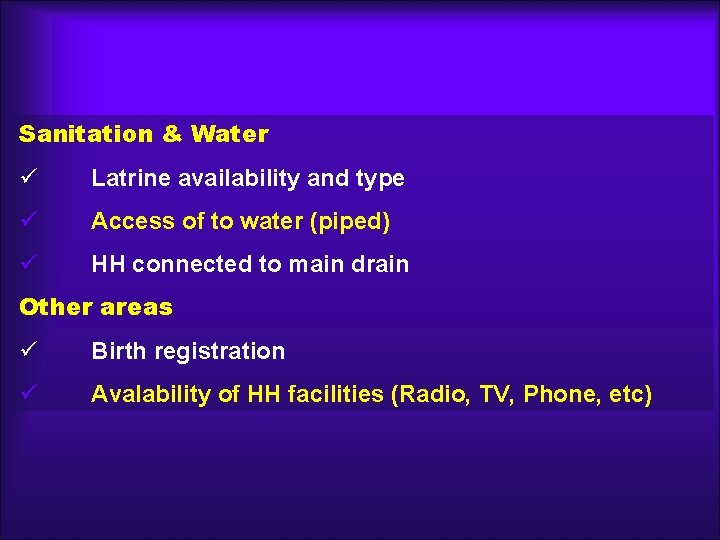
Sanitation & Water ü Latrine availability and type ü Access of to water (piped) ü HH connected to main drain Other areas ü Birth registration ü Avalability of HH facilities (Radio, TV, Phone, etc)
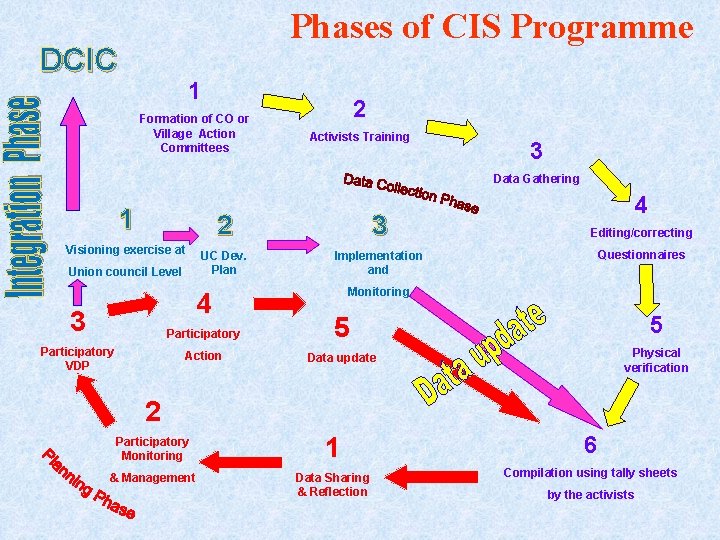
Phases of CIS Programme DCIC 1 Formation of CO or Village Action Committees 2 Activists Training 3 Data Gathering 1 2 3 Visioning exercise at UC Dev. Plan Implementation and Union council Level 4 3 Participatory VDP 4 Editing/correcting Questionnaires Monitoring Participatory 5 5 Action Data update Physical verification 2 Participatory Monitoring 1 6 & Management Data Sharing & Reflection Compilation using tally sheets by the activists
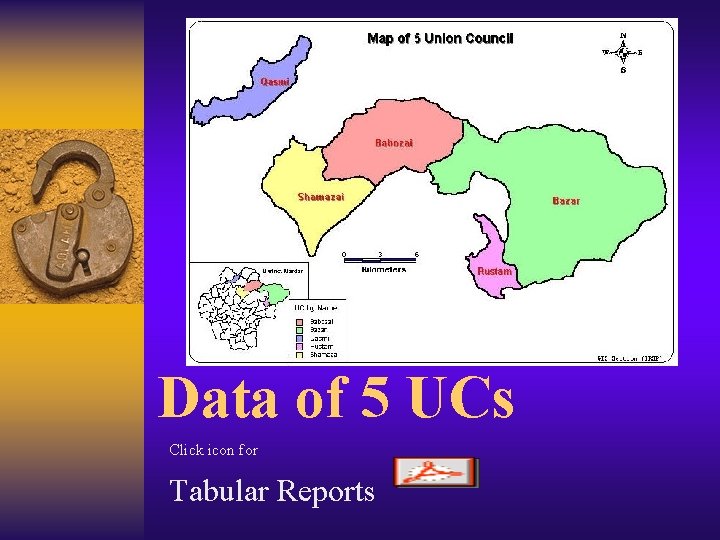
Data of 5 UCs Click icon for Tabular Reports
Population Trend In the coming generation women ratio would be slightly higher than men. ¨ Presently, out of 49 only 6 villages have ≥ 50% adults women population. However, among Children (0 -5 yrs), 19 villages have ≥ 50% girls ¨Only 2 villages have <50% adults men population. Whereas among children (0 -5 yrs), 32 villages have <50% boys
Birth Reg. of girl child ¨ For every girl there are two boys registered within first week ¨ It shows that majority of the unregistered 89% newborns are girls
Women in Education v Out of every four Primary level educated persons, only one is women (ratio 3: 1) v Out of every five Middle passed persons, only one is women (ratio 4: 1) v Out of every ten High School qualified educated persons, only one is women (ratio 9: 1)
Women in Education (cont. ) ¨ In 10 villages, women comprise ≤ 10% of those who have attained Primary level education. ¨ In 28 villages, women comprise ≤ 10% of those who have attained Middle level education. ¨ 31 villages have just ≤ 7% women as High school graduates.
Education ¨ Only half of the boys and girls, who reach High School, get the opportunity to complete a college degree ¨ Focus on technical education is extremely poor. Out of 43, 458 women only 17 (. 03%) have got any kind of technical education. For men this ratio is 0. 28, which means out of about 400 men there is just one who has acquired any kind of technical education.
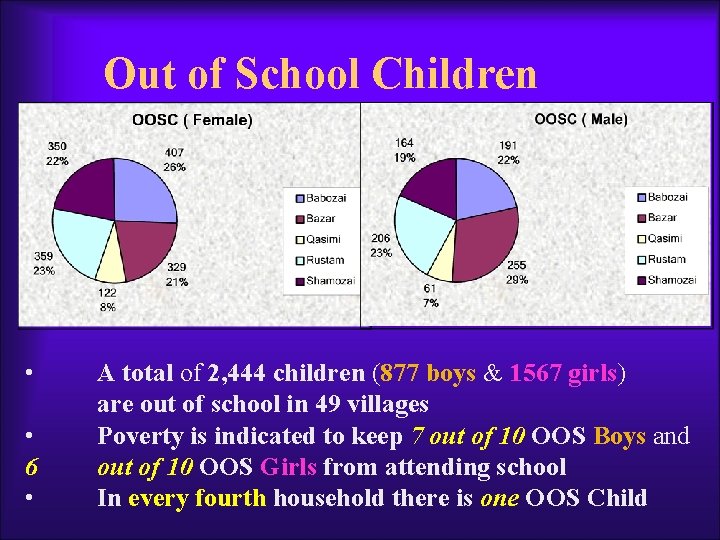
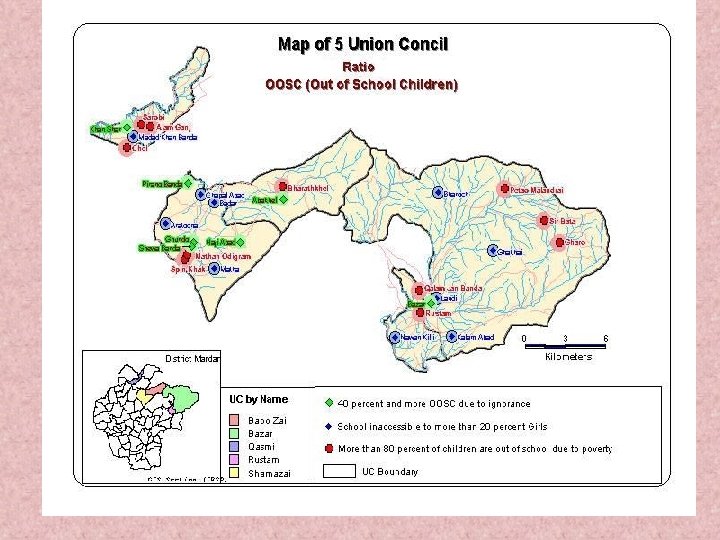
Out of School Children • • 6 • A total of 2, 444 children (877 boys & 1567 girls) are out of school in 49 villages Poverty is indicated to keep 7 out of 10 OOS Boys and out of 10 OOS Girls from attending school In every fourth household there is one OOS Child
Health Status ¨ Out of every 12 newborns, 1 dies during the same year ¨ 4 out of 6 households do not use Iodised salt -- Half due to unawareness. More than one quarter due to unavailability and half-aquarter due to its relatively high cost
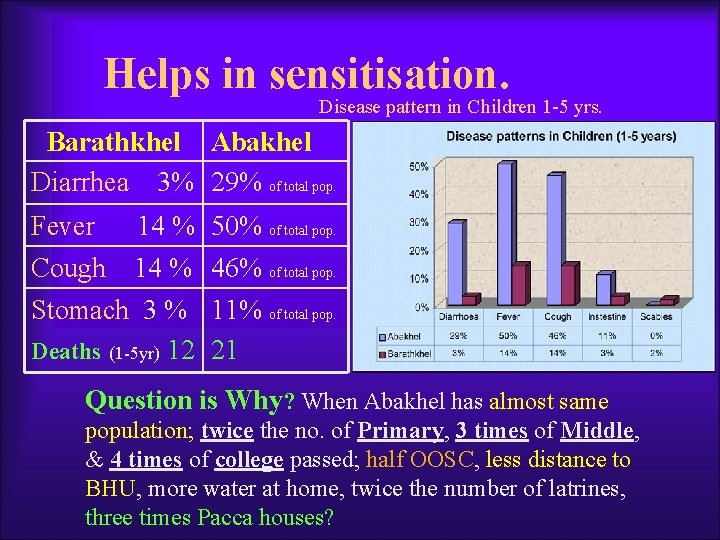
Helps in sensitisation. Disease pattern in Children 1 -5 yrs. Barathkhel Abakhel Diarrhea 3% 29% of total pop. Fever Cough 14 % 50% of total pop. 14 % 46% of total pop. Stomach 3 % 11% of total pop. Deaths (1 -5 yr) 12 21 Question is Why? When Abakhel has almost same population; twice the no. of Primary, 3 times of Middle, & 4 times of college passed; half OOSC, less distance to BHU, more water at home, twice the number of latrines, three times Pacca houses?
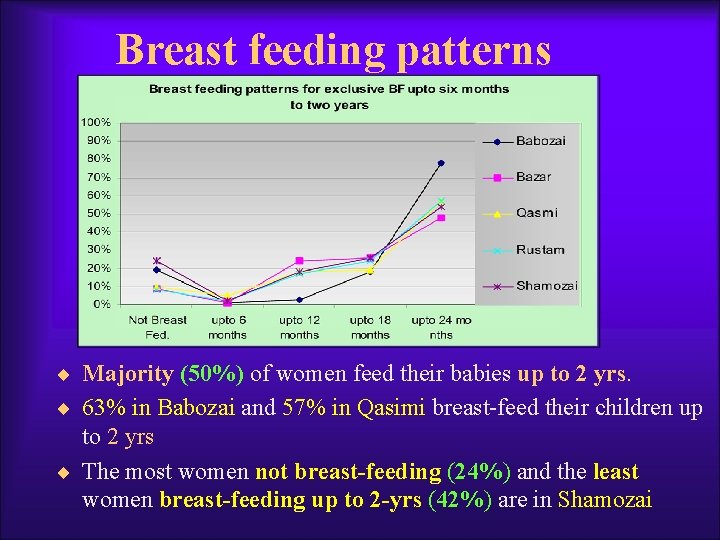
Breast feeding patterns ¨ Majority (50%) of women feed their babies up to 2 yrs. ¨ 63% in Babozai and 57% in Qasimi breast-feed their children up to 2 yrs ¨ The most women not breast-feeding (24%) and the least women breast-feeding up to 2 -yrs (42%) are in Shamozai
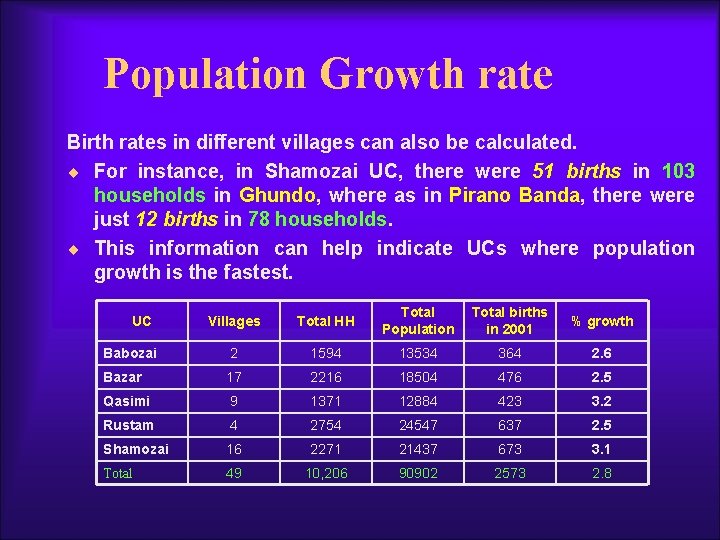
Population Growth rate Birth rates in different villages can also be calculated. ¨ For instance, in Shamozai UC, there were 51 births in 103 households in Ghundo, where as in Pirano Banda, there were just 12 births in 78 households. ¨ This information can help indicate UCs where population growth is the fastest. Villages Total HH Total Population Total births in 2001 % growth Babozai 2 1594 13534 364 2. 6 Bazar 17 2216 18504 476 2. 5 Qasimi 9 1371 12884 423 3. 2 Rustam 4 2754 24547 637 2. 5 Shamozai 16 2271 21437 673 3. 1 Total 49 10, 206 90902 2573 2. 8 UC
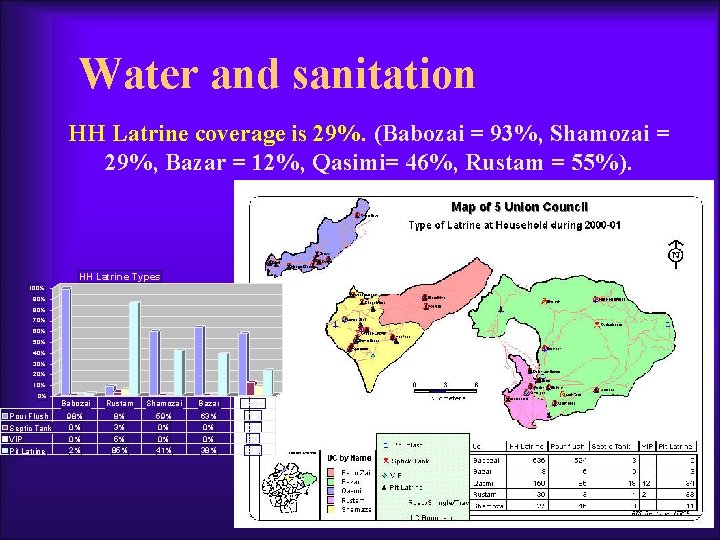
Water and sanitation HH Latrine coverage is 29%. (Babozai = 93%, Shamozai = 29%, Bazar = 12%, Qasimi= 46%, Rustam = 55%). HH Latrine Types 100% 90% 80% 70% 60% 50% 40% 30% 20% 10% 0% Pour Flush Septic Tank VIP Pit Latrine Babozai Rustam Shamozai Bazar Qasimi 98% 0% 0% 2% 8% 3% 5% 85% 59% 0% 0% 41% 63% 0% 0% 38% 57% 12% 8% 23%
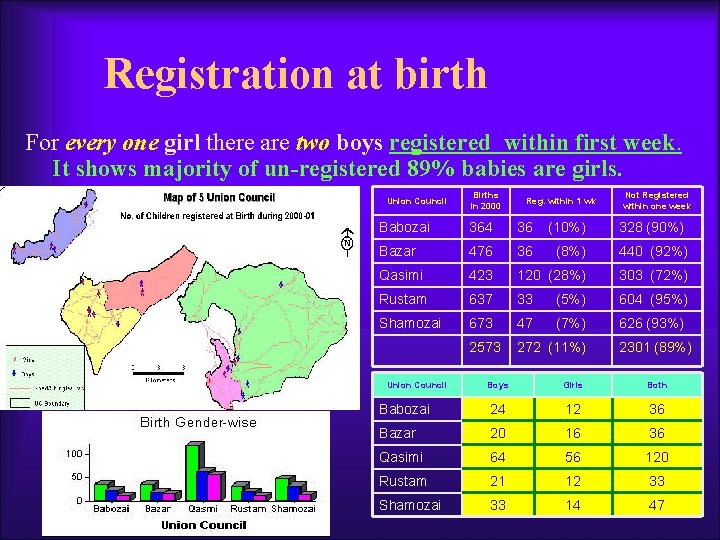
Registration at birth For every one girl there are two boys registered within first week. It shows majority of un-registered 89% babies are girls. Union Council Births in 2000 Reg. within 1 wk Not Registered within one week Babozai 364 36 (10%) 328 (90%) Bazar 476 36 (8%) 440 (92%) Qasimi 423 120 (28%) 303 (72%) Rustam 637 33 (5%) 604 (95%) Shamozai 673 47 (7%) 626 (93%) 2573 272 (11%) Union Council 2301 (89%) Boys Girls Both Babozai 24 12 36 Bazar 20 16 36 Qasimi 64 56 120 Rustam 21 12 33 Shamozai 33 14 47
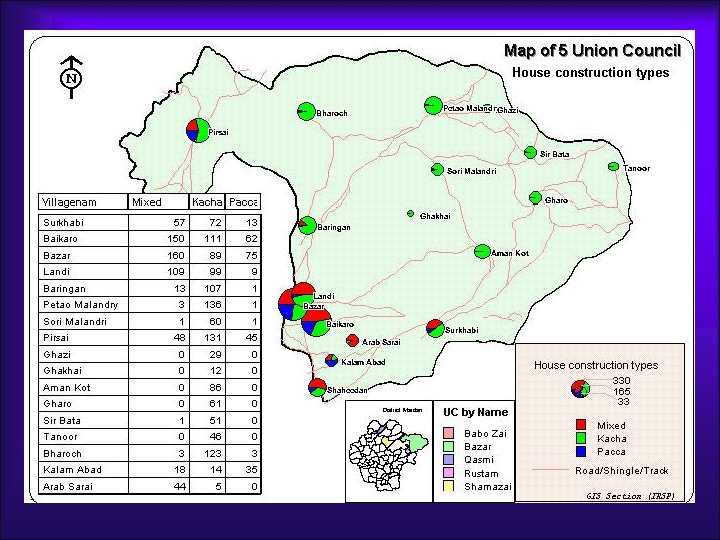
Socio-economic status of HH ¨ One out of every two persons lives in Kacha house. One out of every three persons lives in Mixed Kacha and Pacca house and only one out of six can afford to live in Pacca house ¨ Throughout the area, maximum number of rooms per house is three and four family members share a room ¨ In every 11 households only one has a telephone installed at home. In UC Bazar and Shamozai, there is one phone per 17 HH ¨ Every five HHs have one TV and one Radio.
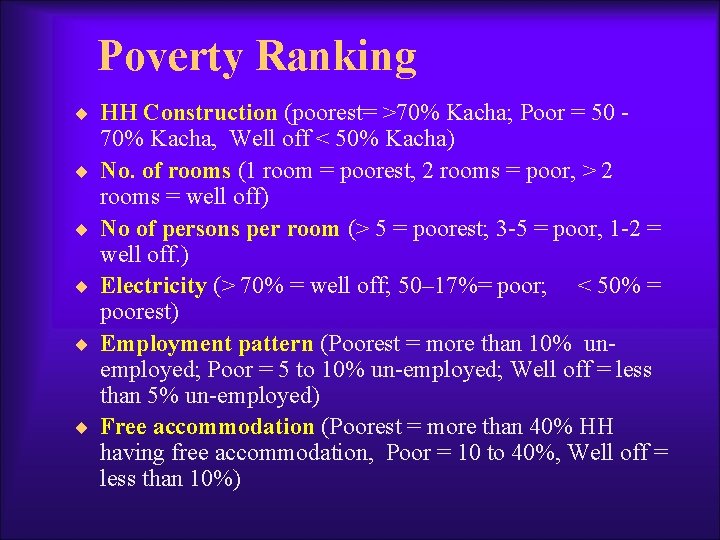
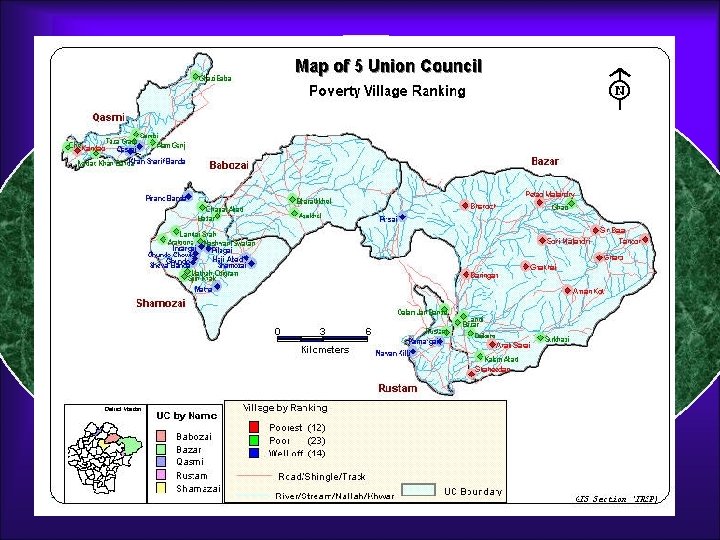
Poverty Ranking ¨ HH Construction (poorest= >70% Kacha; Poor = 50 ¨ ¨ ¨ 70% Kacha, Well off < 50% Kacha) No. of rooms (1 room = poorest, 2 rooms = poor, > 2 rooms = well off) No of persons per room (> 5 = poorest; 3 -5 = poor, 1 -2 = well off. ) Electricity (> 70% = well off; 50– 17%= poor; < 50% = poorest) Employment pattern (Poorest = more than 10% unemployed; Poor = 5 to 10% un-employed; Well off = less than 5% un-employed) Free accommodation (Poorest = more than 40% HH having free accommodation, Poor = 10 to 40%, Well off = less than 10%)
Improvements required in CIS ¨ Evolutionary process so far, has room for refinement (data items/definitions/data sharing with users/tailor made for use. ¨ Staff/activists capacity building required. ¨ Institutionalization would require time till communities start realizing benefits of CIS ¨ It’s a behavioral change process, dependent on the fruit of invested energy/time/effort. ¨ Some villages need time for mobilisation as they look for direct benefits ¨ Linkages with donors/partners for targeted investment ¨ Model test in Urban area would be a challenge
Strengths of CIS • Unique model in Pakistan-based on triple A process • Disaggregated data at sub-district level • In line with theory of development • Support to devolution process/Distt. UC role • Systematic capacity bldg. of Community Reps. • Acts as a leverage – supporting other sectors (health, education, …) • Shows impact of programmatic intervention and indicate where inputs are needed
CIS Future ¨ District government interest -- EDOs offering full assistance ¨ Resolution by District Assembly ¨NCHD expressed keen interest and support ¨NADRA offering linkages with database/sharing of data ¨For UNICEF it points to specific interventions, which would help it design targeted and integrated programmes.
- Slides: 30