
Community Health Nursing Community as Client Applying the
- Slides: 87
Community Health Nursing Community as Client: Applying the Nursing Process Chapter 15
Introduction u Community health nurses work with clients at several levels: as individuals, families, u The care of communities is vital to promoting health and prevention u Community as client: refer to a group or population of people as the focus of nursing services .
What is healthy community u Just as health for individual is relative and will change, all communities exist in relative state of health. u a key vision for healthy communities is presented in health people 2010, the national health promotion and disease prevention agenda 1 - to increase quality and years of healthy life and 2 - to eliminate health disparities u u
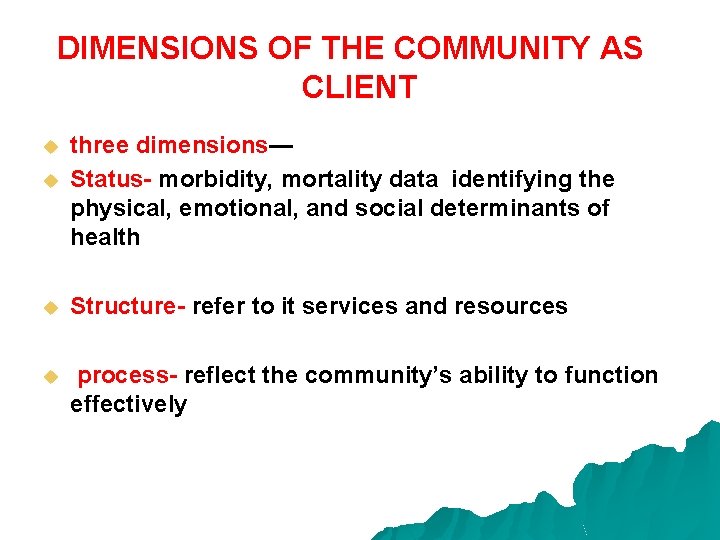
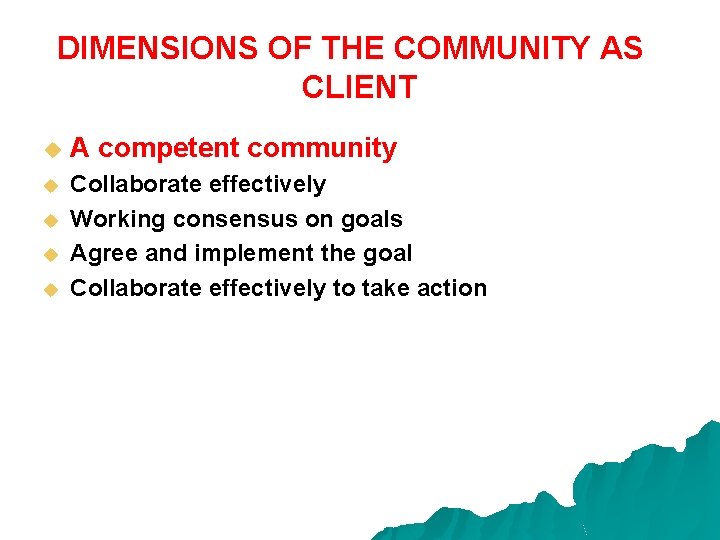
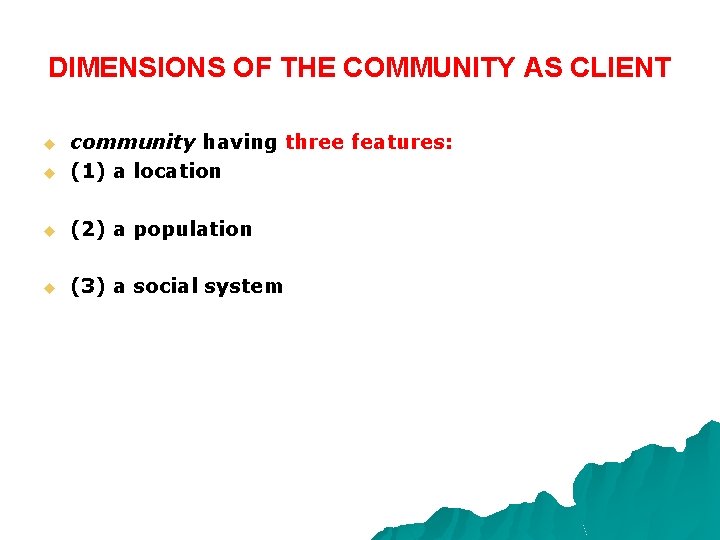
DIMENSIONS OF THE COMMUNITY AS CLIENT u The health of a community can be characterized through a number of perspectives. One perspective is examining three dimensions u Other perspective is A competent community and u Another perspective identified three features u
DIMENSIONS OF THE COMMUNITY AS CLIENT u u three dimensions— Status- morbidity, mortality data identifying the physical, emotional, and social determinants of health u Structure- refer to it services and resources u process- reflect the community’s ability to function effectively
DIMENSIONS OF THE COMMUNITY AS CLIENT u A competent community u Collaborate effectively Working consensus on goals Agree and implement the goal Collaborate effectively to take action u u u
DIMENSIONS OF THE COMMUNITY AS CLIENT u community having three features: (1) a location u (2) a population u (3) a social system u
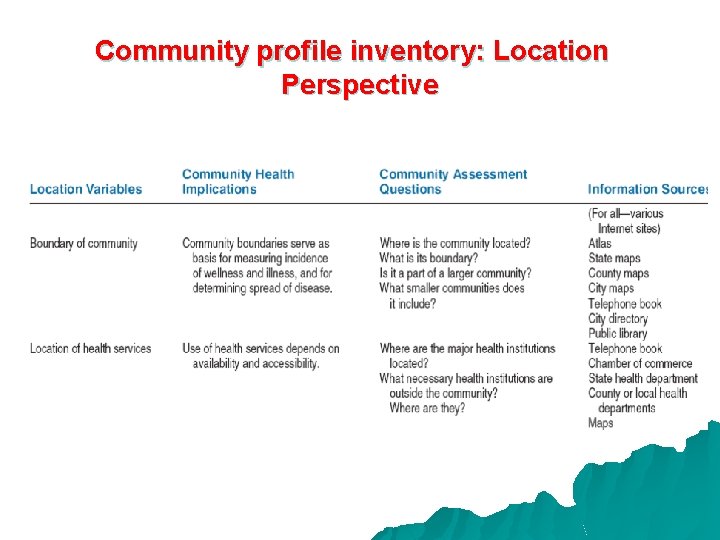
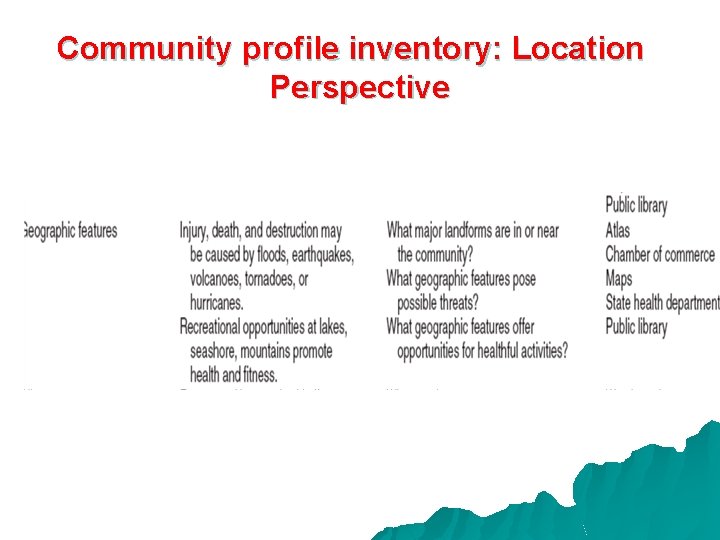
Community profile inventory: Location Perspective
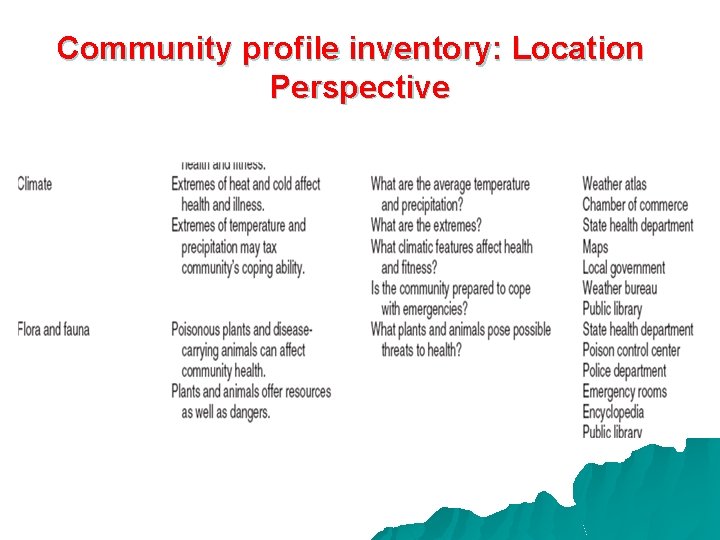
Community profile inventory: Location Perspective
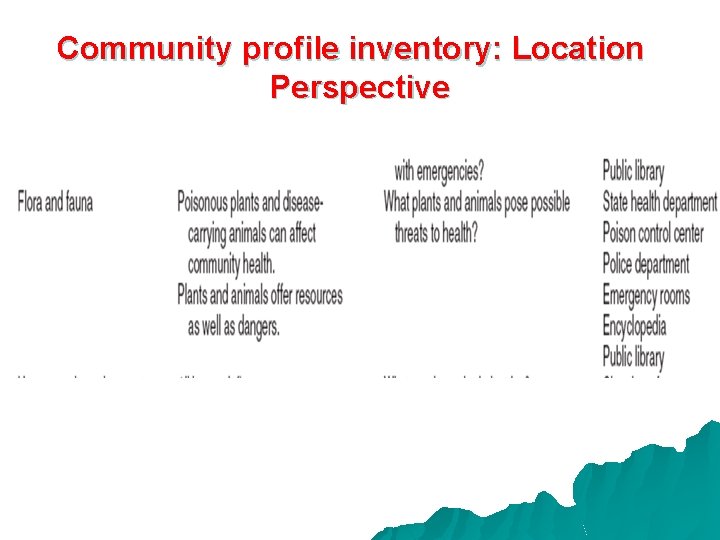
Community profile inventory: Location Perspective
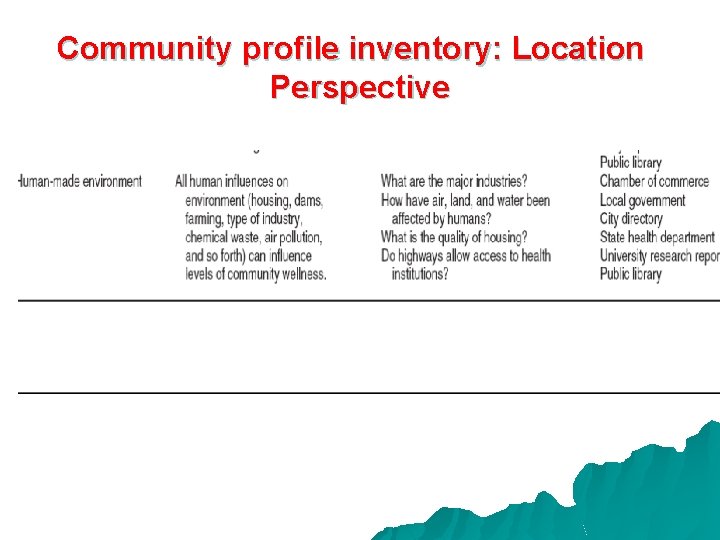
Community profile inventory: Location Perspective
Community profile inventory: Location Perspective
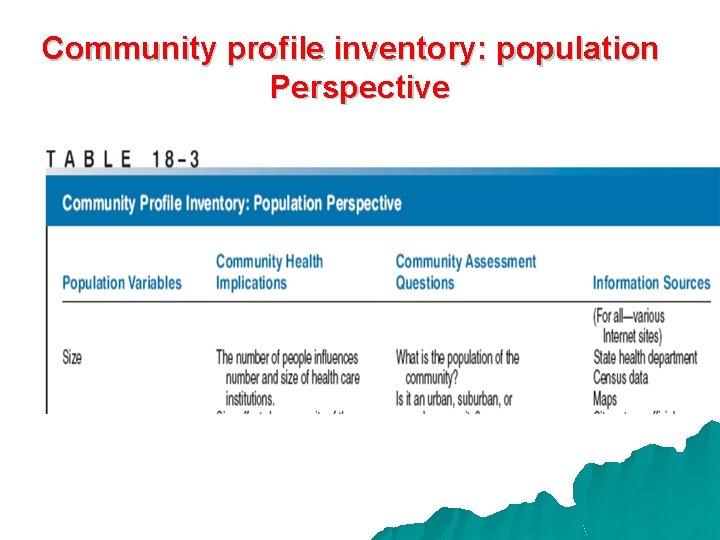
Community profile inventory: population Perspective
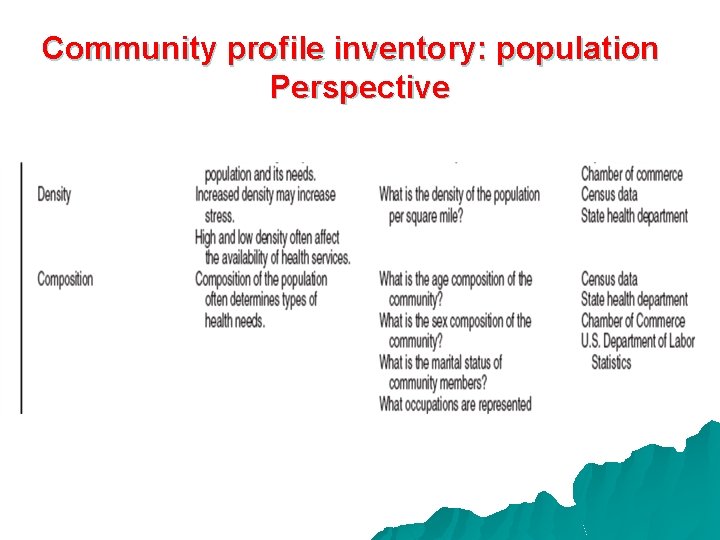
Community profile inventory: population Perspective
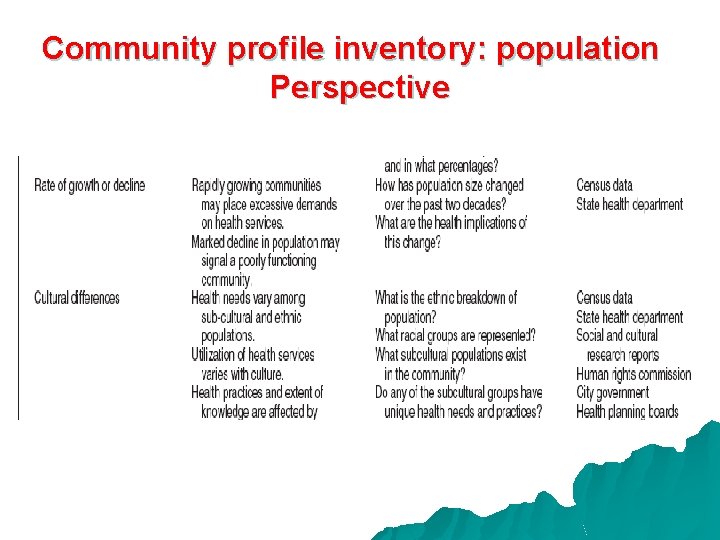
Community profile inventory: population Perspective
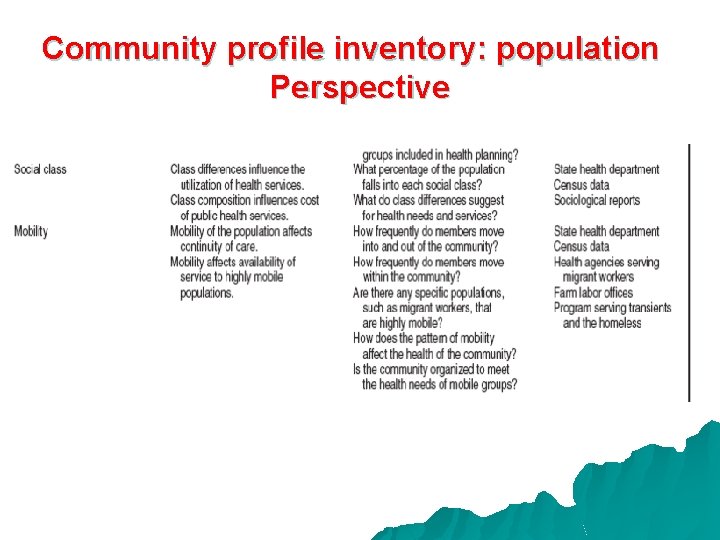
Community profile inventory: population Perspective
The concept of a social system u Is an abstract concept and can be more reality understood by first considering the people who make up the community’s pop. u The various community system have a profound influence on one another.
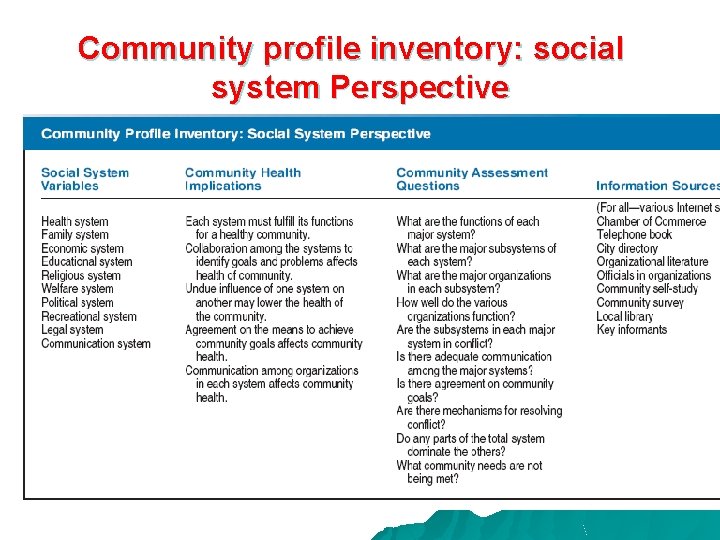
Community profile inventory: social system Perspective
The Nursing Process For The Community As Client u u Consisting of a systematic, purposeful set of interpersonal actions,
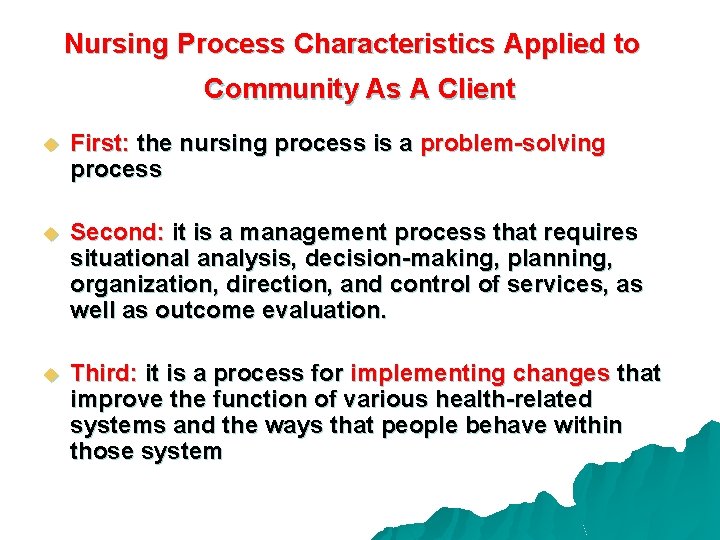
Nursing Process Characteristics Applied to Community As A Client u First: the nursing process is a problem-solving process u Second: it is a management process that requires situational analysis, decision-making, planning, organization, direction, and control of services, as well as outcome evaluation. u Third: it is a process for implementing changes that improve the function of various health-related systems and the ways that people behave within those system
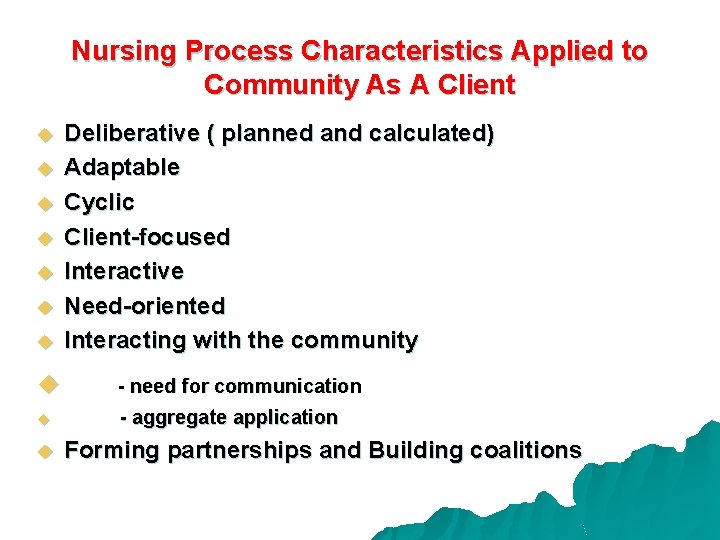
Nursing Process Characteristics Applied to Community As A Client u u u u Deliberative ( planned and calculated) Adaptable Cyclic Client-focused Interactive Need-oriented Interacting with the community u - need for communication u - aggregate application u Forming partnerships and Building coalitions
TYPES OF COMMUNITY NEEDS ASSESSMENT u Community needs assessment is the process of determining the real or perceived needs of a defined community.
Familiarization or “Windshield Survey” u is a common starting place in evaluation of a community. u Familiarization assessment involves studying data already available on a community, and gathering certain amount of firsthand data, to gain a working knowledge of the community
Familiarization or “Windshield Survey” u Windshield survey-- is used by nursing students in community health courses and by new staff members in community health agencies. u It provides a knowledge of the context in which these aggregates live and may enable the nurse to better connect clients with community resources.
Familiarization or “Windshield Survey” u Nurses drive (or walk) around the community; find health, social, and governmental services u obtain literature; introduce themselves and explain that they are working in the area; and generally become familiar with the community
Familiarization or “Windshield Survey” u This type of assessment is u needed whenever the community health nurse works with families, groups, organizations, or populations.
Problem-Oriented Assessment u u assessment, begins with a single problem and assesses the community in terms of that problem. E. g. deaf children problem-oriented assessment is commonly used when familiarization is not sufficient and a comprehensive assessment is too expensive. This type of assessment is responsive to a particular need. The data collected will be useful in any kind of planning for a community response to the problem
Community Subsystem Assessment u Community health nurse focuses on a single dimension of community life. u For example, the nurse might decide to survey churches and religious organizations to discover their roles in the community.
Community Subsystem Assessment u Community subsystem assessment can be a useful way for a team to conduct a more thorough community assessment.
Comprehensive assessment u Comprehensive assessment seeks to discover all relevant community health information. u It begins with a review of existing studies and all the data presently available on the community u Key informants are interviewed in every major system—education, health, religious, economic, and others.
Comprehensive assessment u Because the assessment is an expensive, time-consuming process, it is not often performed.
Community Assets Assessment u u It is The final form of assessment Which focus on the strength and capacities of a community rather than its problems.
Community Assets Assessment Assets assessment has three levels: 1 - specific skills, talents, interests, and experiences 2 - local citizen associations, organizations, and institutions controlled largely by the community such as libraries. 3 - Local institutions originating outside the community controlled largely outside the community such as welfare and public capital expenditures
COMMUNITY ASSESSMENT METHODS u 1 - survey u is an assessment method in which a series of questions is used to collect data for analysis of a specific group or area. u Surveys are commonly used to provide a broad range of data that will be helpful when used in conjunction with other sources or if other sources are not available.
COMMUNITY ASSESSMENTMETHODS The nurse may choose to conduct a survey to determine such things as health care patterns and needs, immunization levels, u u u The survey method involves three phases 1. Planning Phase 2. Data Collection Phase 3. Data Analysis and Presentation Phase
COMMUNITY ASSESSMENT METHODS u 2 - descriptive epidemiologic study u which examines the amount and distribution of a disease or health condition in a population by: Person (Who is affected? ) place (Where does the condition occur? ) time (When do the cases occur? ). 1. 2. 3.
COMMUNITY ASSESSMENT METHODS u u u 3 - Community Forums or Town Hall Meetings is a qualitative assessment method designed to obtain community opinions. It takes place in the neighborhood of the people involved, perhaps in a school exercise room or an hall The participants are selected to participate by invitation from the group organizing the forum. For instance if a community is contemplating ( planning) building a swimming pool, the people invited to the community forum might include potential users of the pool
COMMUNITY ASSESSMENTMETHODS u 4 - focus groups u is similar to the community forum or town hall meeting in that it is designed to obtain grassroots opinion. u it has some differences First, there is only a small group of participants, usually 5 to 15 people The members chosen for the group are with homogeneous respect to specific demographic variables. Ex. Women in first pregnancy u u
SOURCES OF COMMUNITY DATA u u u u Data sources can be primary – talking to people (directly) Secondary – client record, community health statistics and they can be from international, state, or local sources.
SOURCES OF COMMUNITY DATA u u u International Sources data are collected by several agencies, including (WHO) and its six regional offices and health organizations,
SOURCES OF COMMUNITY DATA u National Sources There are official and nonofficial sources u Official sources develop documents based on data compiled by the government E. g. Jordan department of statistics
SOURCES OF COMMUNITY DATA u u u State and local Sources State sources The most significant state source of assessment data comes from the state health department. This official agency is responsible for collecting state vital statistics and morbidity data. u Example from Jordan: Ministry oh health
SOURCES OF COMMUNITY DATA u Local Sources health department, hospitals, social service agencies u school districts, universities or colleges, libraries, Example from Jordan: data from the governorates in the cities (Irbid health governorate), from JUST u
DATA ANALYSIS AND DIAGNOSIS u u u analysis of the information gathered inferences or conclusions may be made about its meaning Such inferences must be validated to determine their accuracy
The Analysis Process u First, the data must be validated : (1) data can be rechecked by the community assessment team, u (2) data can be rechecked by others, u (3) subjective and objective data can be compared, u (4) community members can consider the findings and verify them u
The Analysis Process u Second, each category is examined to determine it significance. u Data collection, data interpretation, and nursing diagnosis are sequential activities, with validation serving as the bridges between them.
Community Diagnosis Formation u “Community diagnoses clarify who gets the care (the community as opposed to the individual), u provide a statement identifying problems faced by who is getting care and identify the factors contributing to the identified problem”
Community Diagnosis Formation u Some authors define nursing diagnosis is: u The statement of a [client’s] response which is actually or potentially unhealthful and which nursing intervention can help to change in the direction of health. u It should also identify essential factors related to the unhealthful response
Community Diagnosis Formation u u u Neufeld and Harrison work to form a wellness diagnosis by using the phrase healthful response instead of unhealthful response. The definition of wellness is: The statement of a client’s [community’s] healthful response which nursing intervention can support or strengthen. It should also identify the essential factors related to healthful response.
Community Diagnoses u refer to nursing diagnoses about a community’s ineffective coping ability and potential for enhanced coping.
Community Diagnoses u The statements about the community should include the u strengths of the community and possible sources for community solutions, as well as the community’s weaknesses or problem areas. u Using the standard nursing diagnosis format, community-level diagnoses can be developed
Community Diagnoses u Nursing diagnosis changes overtime because it reflects changes in health status of the community; therefore diagnosis need to be periodically reevaluated and redefined.
PLANNING TO MEET THE HEALTH NEEDS OF THE COMMUNITY u Planning is the logical decision-making process used to design an orderly, detailed series of actions for accomplishing specific goals and objectives. u is based on assessment of the community and the nursing diagnoses formulated u
Tools to Assist With Planning u u Planning can be enhanced by the use of a variety of tools, including operational definitions of objectives and activities, conceptual frameworks, and models
Tools to Assist With Planning u Such tools help to identify target population, characteristics, clarify program goals specify nursing interventions, and anticipate client outcomes.
Tools to Assist With Planning u also enable the nurse to test ideas and adjust solutions before actual implementation u Finally, use of tools enhances the planning process and promotes effectiveness of services, as well as professional standards of practice
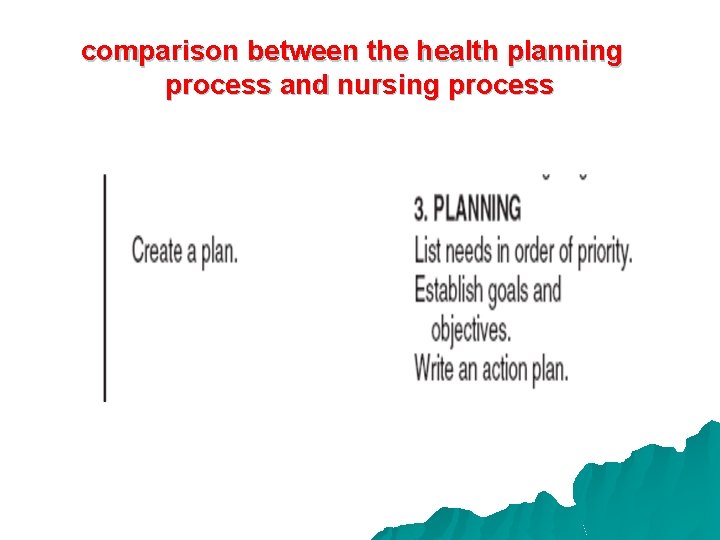
Tools to Assist With Planning u u u a systematic approach to planning guides the community health nurse to (1) list needs in order of priority (2) establish goals and objectives (3) record the plan. community health nurses collaborate with clients and other appropriate professionals in each of these planning activities
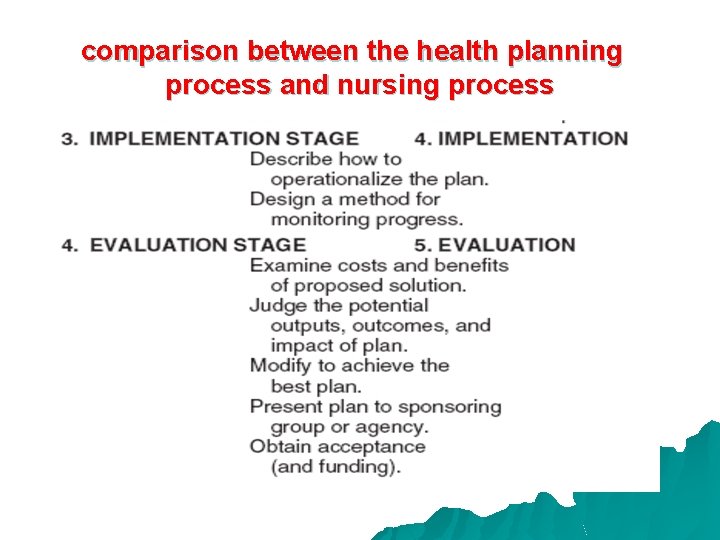
The Health Planning Process u is a four-stage system used to design new healthrelated programs or services in the community.
The Health Planning Process u u It is used by health educators when designing educational programs, by administrators in community health agencies when initiating new services, by other people who are not nurses when developing services.
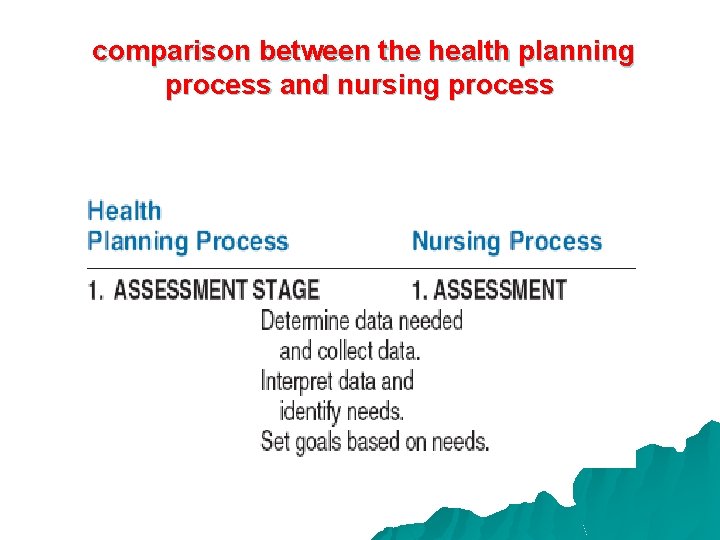
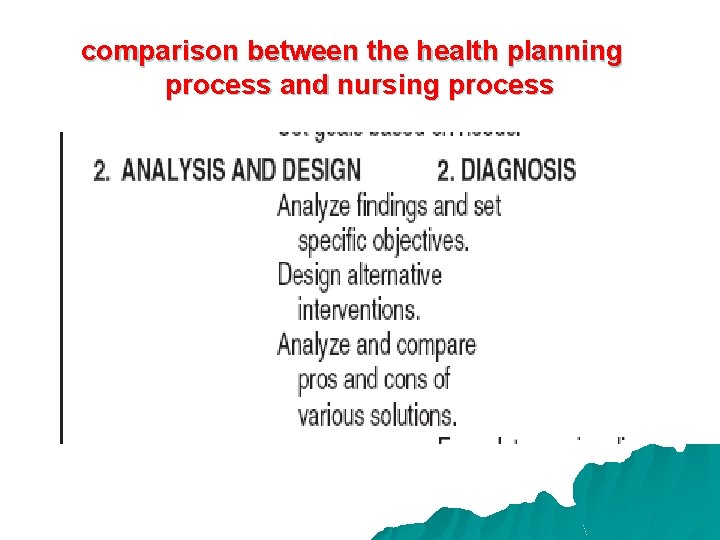
The Health Planning Process u u The nursing process is very similar to the health planning process Each model helps to promote service effectiveness in addition to maintaining standards of practice
The Health Planning Process The nursing process u Community health nurses familiar with both the health planning process and the nursing process should be able to work collaboratively with community health professionals using model
comparison between the health planning process and nursing process
comparison between the health planning process and nursing process
comparison between the health planning process and nursing process
comparison between the health planning process and nursing process
Setting priorities u involves assigning rank or importance to clients’ needs to determine the order in which goals should be addressed.
Setting priorities u The criteria of how to set the priorities in the planning process
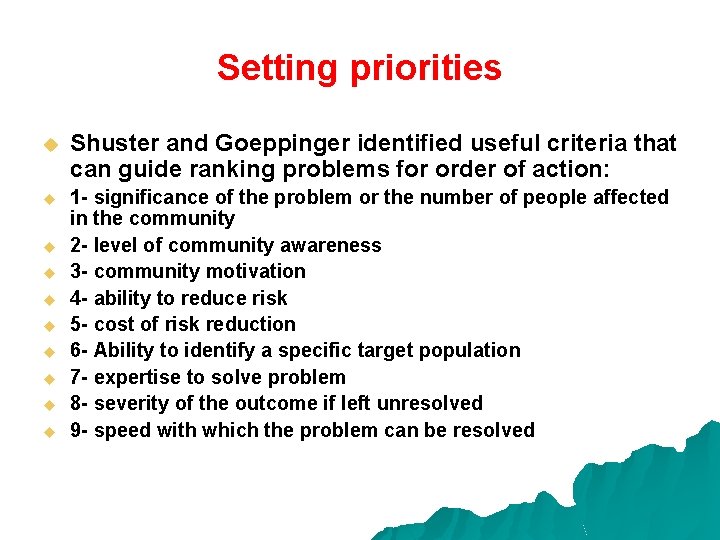
Setting priorities u Shuster and Goeppinger identified useful criteria that can guide ranking problems for order of action: u 1 - significance of the problem or the number of people affected in the community 2 - level of community awareness 3 - community motivation 4 - ability to reduce risk 5 - cost of risk reduction 6 - Ability to identify a specific target population 7 - expertise to solve problem 8 - severity of the outcome if left unresolved 9 - speed with which the problem can be resolved u u u u
Establishing Goals and Objectives u Goals and objectives are crucial to planning and should be accomplishable and specific , u The diagnosis that identifies needs must be translated into goals to give focus and meaning to the nursing plan.
Establishing Goals and Objectives u u Goals are broad statements of desired end results.
Establishing Goals and Objectives u Objectives are specific statements of desired outcomes, phrased in behavioral terms that can be measured. u target dates for expected completion of each objective are also stated u are the stepping-stones to help one reach the end results of the larger goal.
Establishing Goals and Objectives u Development of objectives depends on a careful analysis of all the ways in which one could accomplish the larger goal. u One should first select the course of action that is best suited to meet the goal and then build objectives
Establishing Goals and Objectives – rules of thumb are helpful when writing objectives. – First, each objective should state a single idea. – When more than one idea is expressed, is much more difficult to measure. – – Second, each objective should describe one specific behavior that can be measured.
Establishing Goals and Objectives u Written measurable objectives makes a tremendous difference in the success of planning u Planning means thinking ahead. Nurse looks ahead toward the desired end u Making decisions is an important part of planning.
Establishing Goals and Objectives u To facilitate planning and decision making, the CHN. Involves other people. u Clients must be included at every step
Implementing plans for promoting the health of the community u u u is putting the plan into action. The activities delineated in the plan must be carried out by the nurse other professionals, or clients. implementation includes not just nursing action or nursing intervention but collaboration with clients and perhaps other professionals
Preparation u The actual course of implementation, outlined in the plan, should be fairly easy to follow if goals, expected outcomes, and planned actions have been designed carefully u Professionals and clients should have a clear idea of the “who, what, why, when, where, and how. ” Who will be involved in carrying out the plan
Activities or Actions u The process of implementation requires a series of nursing actions or activities: u 1. The nurse applies appropriate theories, such as systems theory or change theory u 2. The nurse helps to facilitate an environment that is conducive to carrying out the plan (e. g. a quiet room)
Activities or Actions u 3. The nurse and other health team members prepare clients to receive services by assessing their knowledge, understanding, and attitudes and by carefully interpreting the plan to clients. u This interaction nurtures open communication and trust between nurse and clients. u Professionals form a contractual agreement about the content of the plan and how it is to be carried out
Activities or Actions u 4. The plan is carried out, or modified and then carried out, u Modification requires constant u observation and interchange during implementation, because these actions determine the success of the plan and the nature of needed changes.
Activities or Actions u 5. The nurse and the team monitor and document the progress of the implementation phase by process evaluation,
Evaluating implemented community health plan u the final component of the nursing process, but since the nursing process is cyclic in nature, the nurse is constantly evaluating throughout the entire process u Evaluation refers to measuring and judging the effectiveness of goal or outcome attainment
Evaluating implemented community health plan u Evaluation requires a stated purpose, specific standards and criteria by which to judge, and judgment skills.
Purpose of evaluation u is to determine whether the planned actions met the client’s needs. u If so, how well were they met, and if not, why not? Were there any unexpected outcomes? Has the client’s competence increased? u u
Criteria u u Sometimes, plans include individual goals and criteria as well as group goals and criteria Goals are statements of desired outcomes, and criteria are the smaller steps that must be taken to achieve the goals.
Judgment Skills u Evaluation requires judgment skills that the nurse uses to compare real outcomes with expected outcomes so that discrepancies may be identified
Types of Evaluations u u Formative evaluation: is on process during the actual interventions. Summative evaluation: focuses on the outcome of the interventions (did you meet your goals)