
Community Ecology Chapters 54 PART 2 Concept 4
- Slides: 26
Community Ecology Chapters 54 PART 2
Concept 4: Community Ecology – Analyzing the interactions and relationships within and between species and the effects of environmental factors on species diversity and composition. Community Ecology (Ch 54) The difference between a fundamental niche and a realized niche The role of competitive exclusion in interspecific competition The symbiotic relationships of parasitism, mutualism, and commensalism The impact of keystone species on community structure The difference between primary and secondary succession
Community Structure How do the following principles relate to each other? What are some examples? Trophic Structure Food Chain Food Web Species Diversity Dominant Species Invasive Species Keystone Species Foundation Species
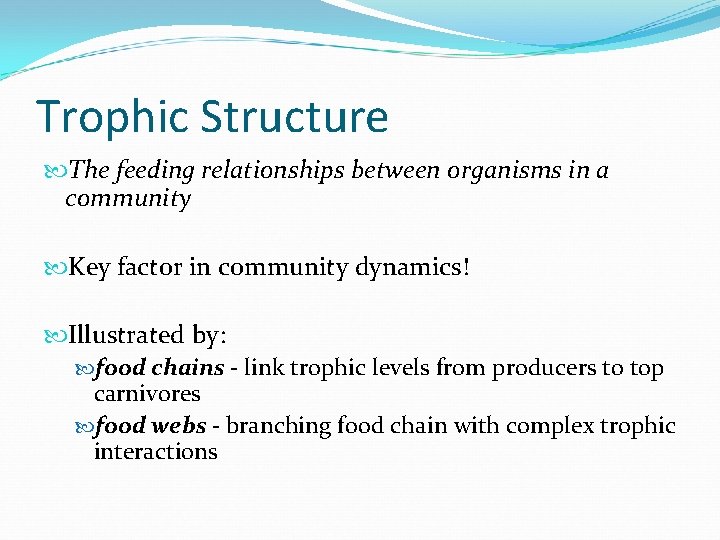
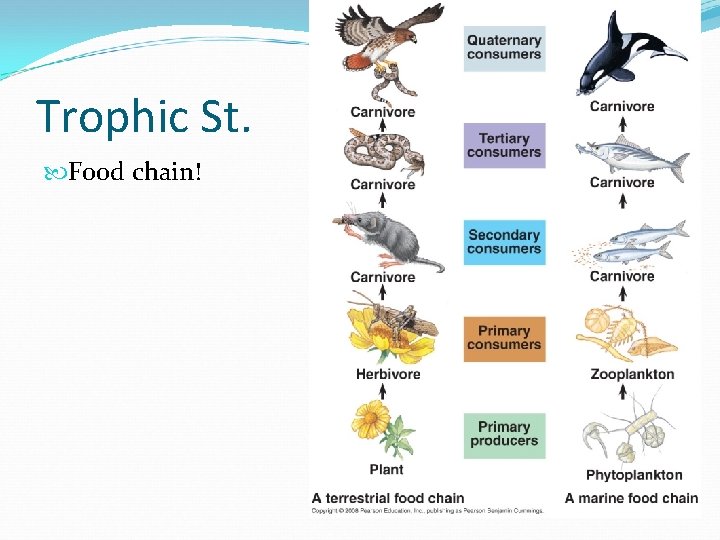
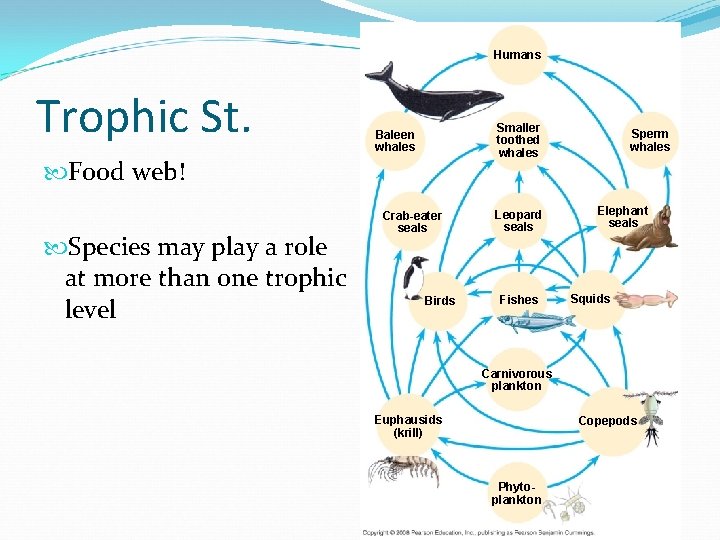
Trophic Structure The feeding relationships between organisms in a community Key factor in community dynamics! Illustrated by: food chains - link trophic levels from producers to top carnivores food webs - branching food chain with complex trophic interactions
Trophic St. Food chain!
Humans Trophic St. Smaller toothed whales Baleen whales Food web! Species may play a role at more than one trophic level Crab-eater seals Birds Leopard seals Fishes Sperm whales Elephant seals Squids Carnivorous plankton Euphausids (krill) Copepods Phytoplankton
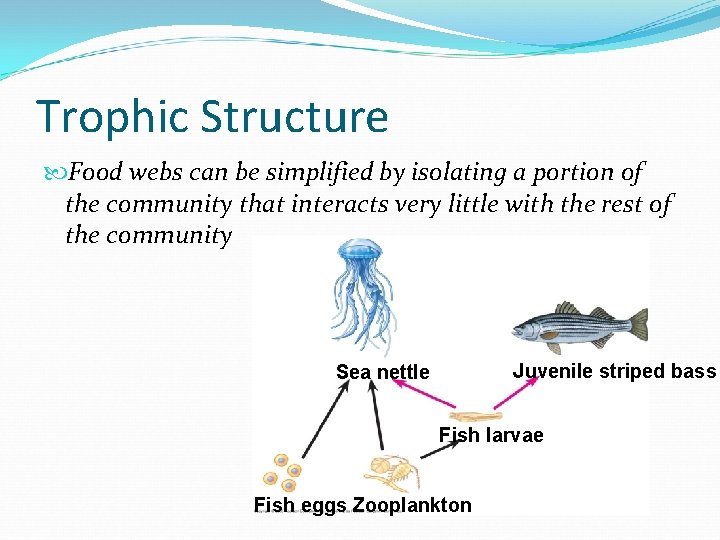
Trophic Structure Food webs can be simplified by isolating a portion of the community that interacts very little with the rest of the community Juvenile striped bass Sea nettle Fish larvae Fish eggs Zooplankton
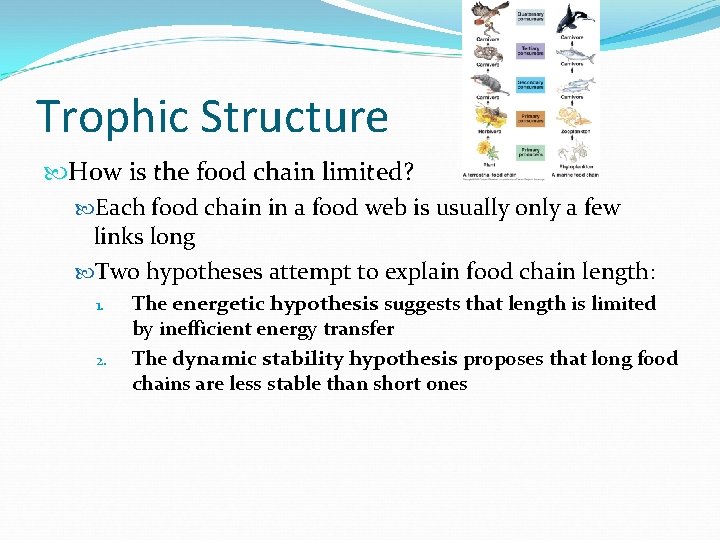
Trophic Structure How is the food chain limited? Each food chain in a food web is usually only a few links long Two hypotheses attempt to explain food chain length: 1. 2. The energetic hypothesis suggests that length is limited by inefficient energy transfer The dynamic stability hypothesis proposes that long food chains are less stable than short ones
Try This Which of the following organisms and trophic levels is mismatched? A) algae – producer B) phytoplankton – primary consumer C) fungi – decomposer D) carnivorous fish larvae – secondary consumer E) eagle – tertiary or quaternary consumer
Try This Which of the following organisms and trophic levels is mismatched? A) algae – producer B) phytoplankton – primary consumer C) fungi – decomposer D) carnivorous fish larvae – secondary consumer E) eagle – tertiary or quaternary consumer
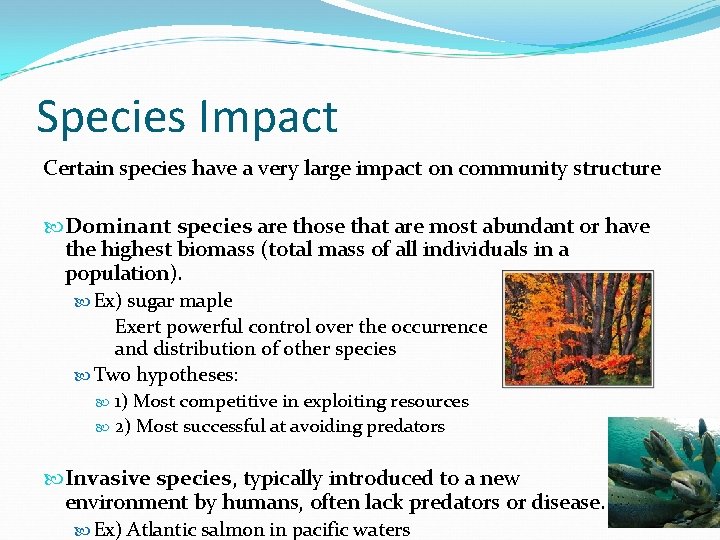
Species Impact Certain species have a very large impact on community structure Dominant species are those that are most abundant or have the highest biomass (total mass of all individuals in a population). Ex) sugar maple Exert powerful control over the occurrence and distribution of other species Two hypotheses: 1) Most competitive in exploiting resources 2) Most successful at avoiding predators Invasive species, typically introduced to a new environment by humans, often lack predators or disease. Ex) Atlantic salmon in pacific waters
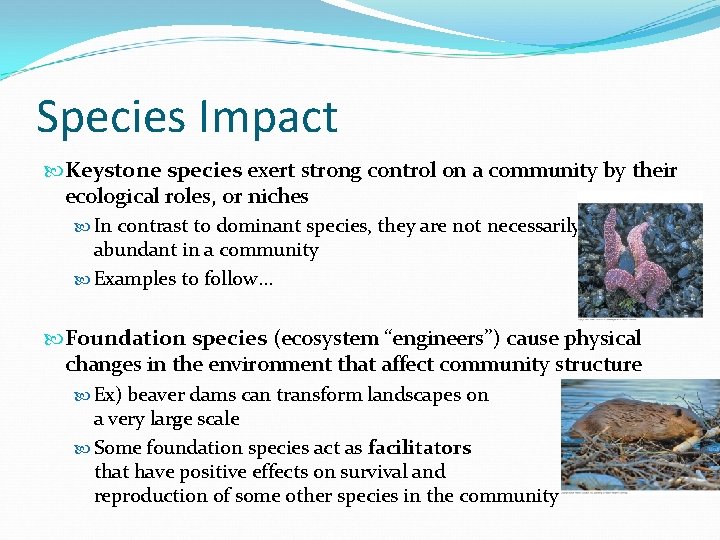
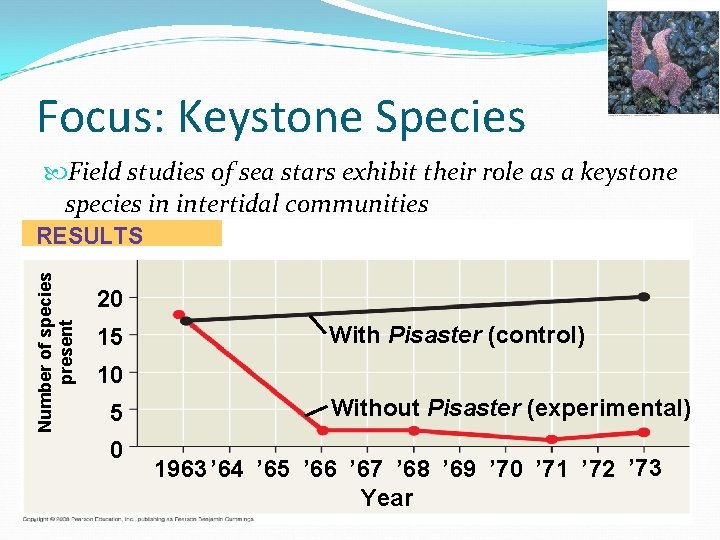
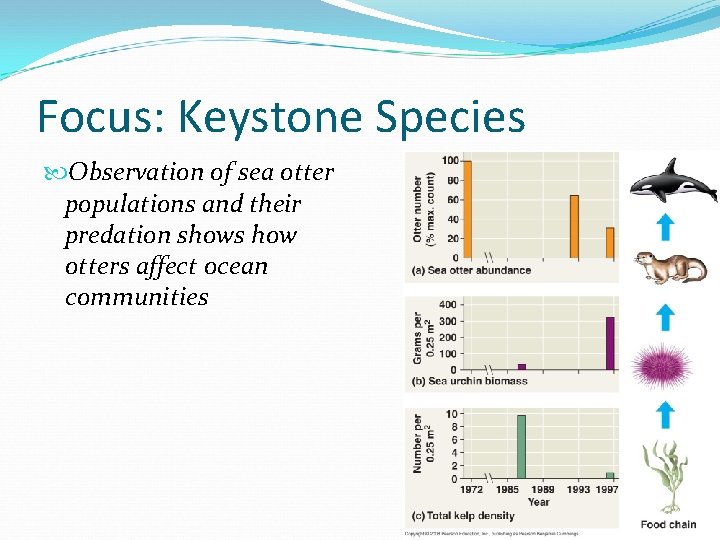
Species Impact Keystone species exert strong control on a community by their ecological roles, or niches In contrast to dominant species, they are not necessarily abundant in a community Examples to follow… Foundation species (ecosystem “engineers”) cause physical changes in the environment that affect community structure Ex) beaver dams can transform landscapes on a very large scale Some foundation species act as facilitators that have positive effects on survival and reproduction of some other species in the community
Focus: Keystone Species Field studies of sea stars exhibit their role as a keystone species in intertidal communities Number of species present RESULTS 20 15 With Pisaster (control) 10 5 0 Without Pisaster (experimental) 1963 ’ 64 ’ 65 ’ 66 ’ 67 ’ 68 ’ 69 ’ 70 ’ 71 ’ 72 ’ 73 Year
Focus: Keystone Species Observation of sea otter populations and their predation shows how otters affect ocean communities
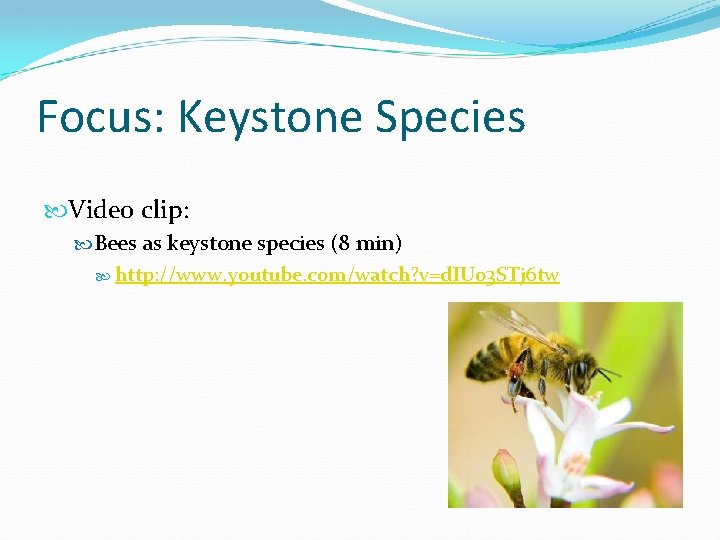
Focus: Keystone Species Video clip: Bees as keystone species (8 min) http: //www. youtube. com/watch? v=d. IUo 3 STj 6 tw
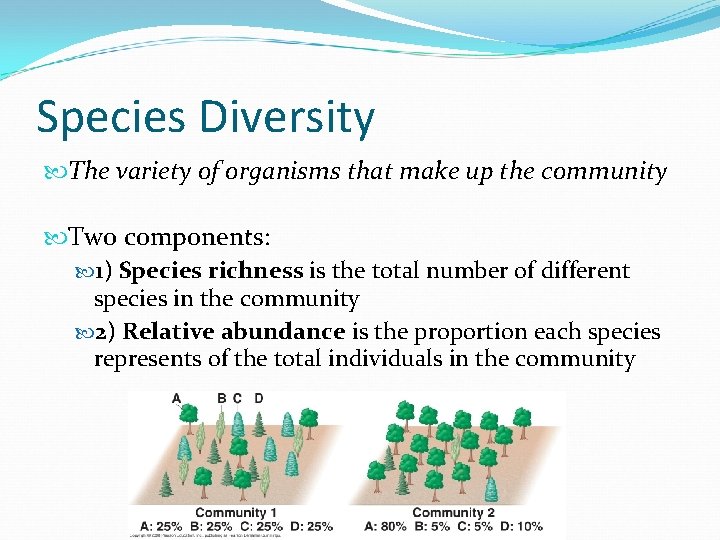
Species Diversity The variety of organisms that make up the community Two components: 1) Species richness is the total number of different species in the community 2) Relative abundance is the proportion each species represents of the total individuals in the community
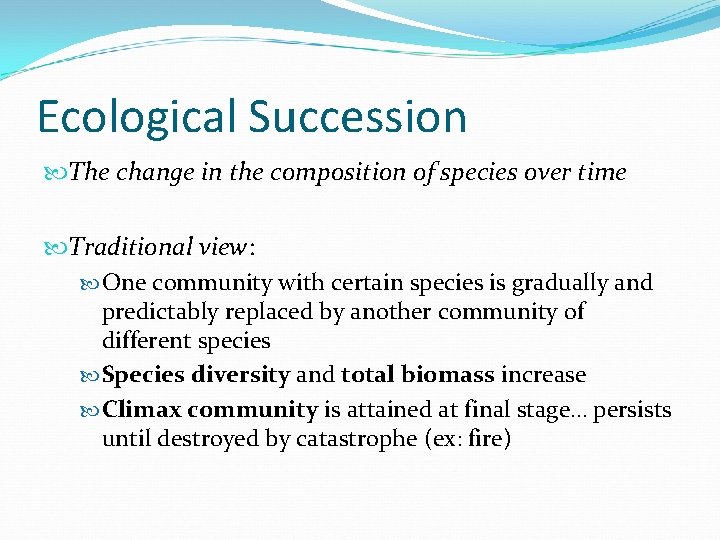
Ecological Succession The change in the composition of species over time Traditional view: One community with certain species is gradually and predictably replaced by another community of different species Species diversity and total biomass increase Climax community is attained at final stage… persists until destroyed by catastrophe (ex: fire)
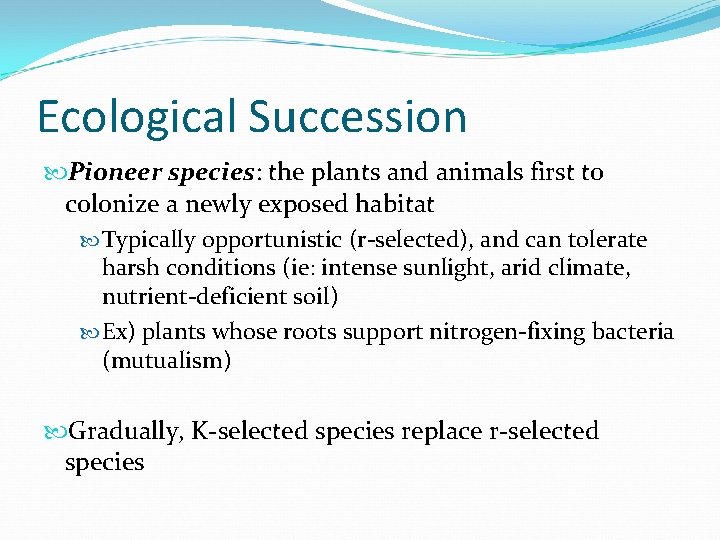
Ecological Succession Pioneer species: the plants and animals first to colonize a newly exposed habitat Typically opportunistic (r-selected), and can tolerate harsh conditions (ie: intense sunlight, arid climate, nutrient-deficient soil) Ex) plants whose roots support nitrogen-fixing bacteria (mutualism) Gradually, K-selected species replace r-selected species
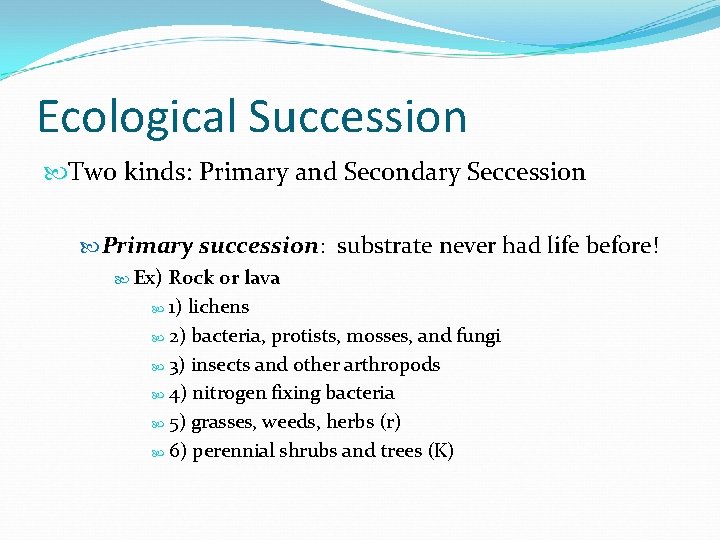
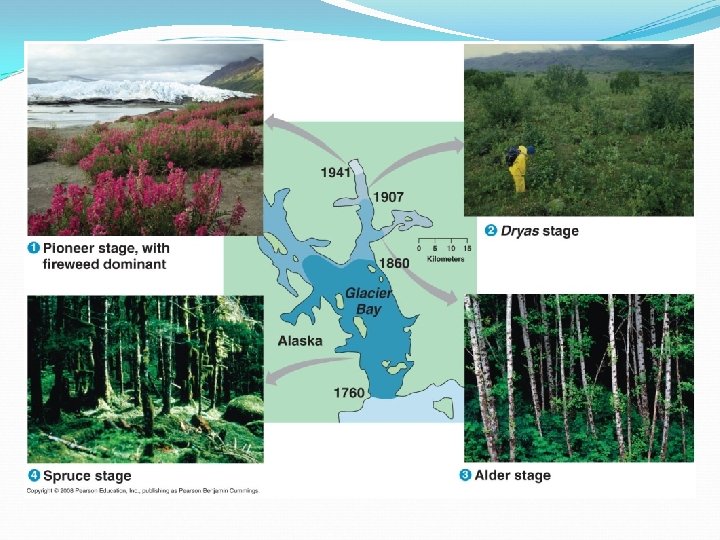
Ecological Succession Two kinds: Primary and Secondary Seccession Primary succession: substrate never had life before! Ex) Rock or lava 1) lichens 2) bacteria, protists, mosses, and fungi 3) insects and other arthropods 4) nitrogen fixing bacteria 5) grasses, weeds, herbs (r) 6) perennial shrubs and trees (K)
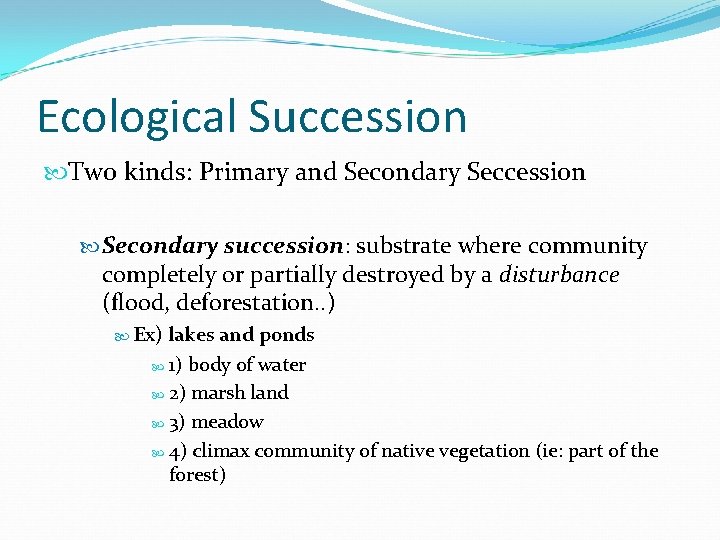
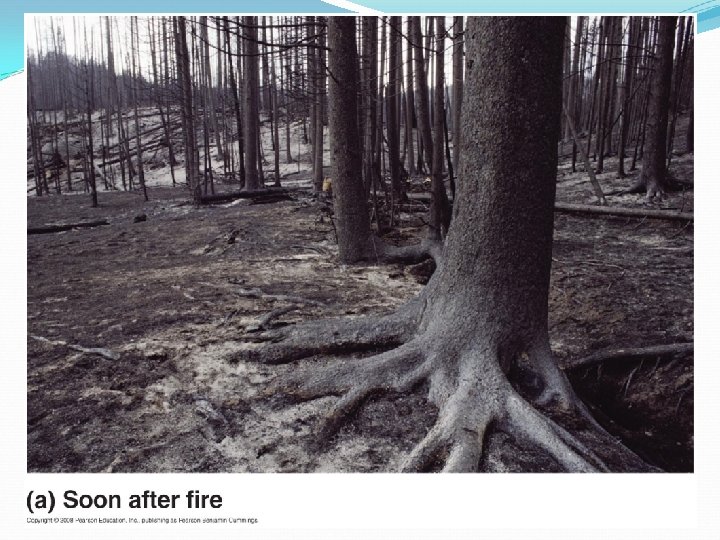
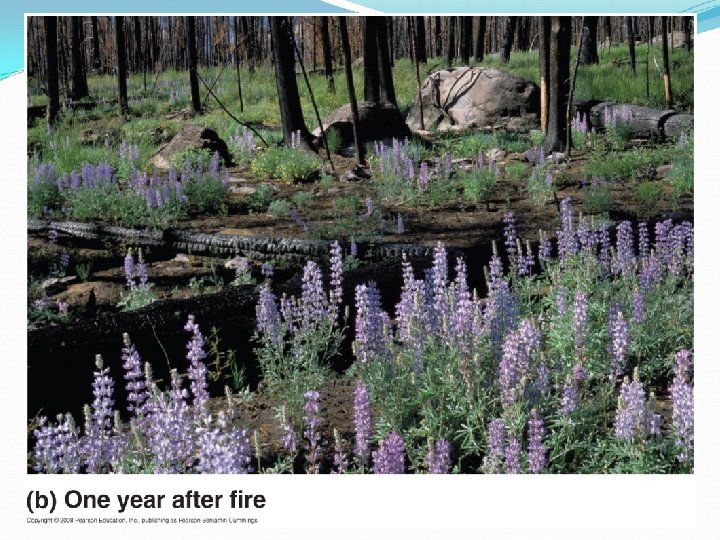
Ecological Succession Two kinds: Primary and Secondary Seccession Secondary succession: substrate where community completely or partially destroyed by a disturbance (flood, deforestation. . ) Ex) lakes and ponds 1) body of water 2) marsh land 3) meadow 4) climax community of native vegetation (ie: part of the forest)
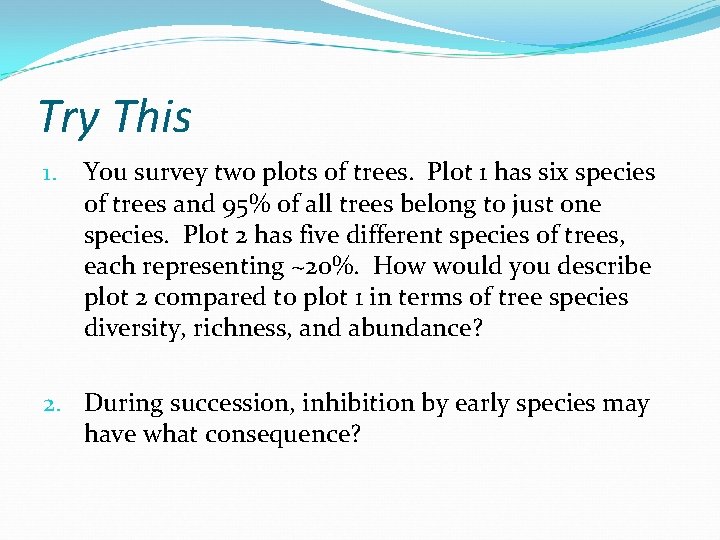
Try This 1. You survey two plots of trees. Plot 1 has six species of trees and 95% of all trees belong to just one species. Plot 2 has five different species of trees, each representing ~20%. How would you describe plot 2 compared to plot 1 in terms of tree species diversity, richness, and abundance? 2. During succession, inhibition by early species may have what consequence?
Try This! (Answer) 1) Plot 2 has a lower richness (lower number of species), but exhibits relatively equal abundance of species, and therefore has a higher species diversity 2)Slow down the successful colonization of other species. . . Will take longer to reach climax community
Concept 4: Community Ecology – Analyzing the interactions and relationships within and between species and the effects of environmental factors on species diversity and composition. Community Ecology (Ch 54) The difference between a fundamental niche and a realized niche The role of competitive exclusion in interspecific competition The symbiotic relationships of parasitism, mutualism, and commensalism The impact of keystone species on community structure The difference between primary and secondary succession