
Community Development Department House Colors a private sector
- Slides: 9
Community Development Department House Colors (a private sector initiative)
Why Are House Colors Regulated? ITT created master planned community deed restricted all lands, including 47, 000+ residential lots to ensure character, nature and general scheme of development: – – Minimum lot size; Minimum square footage of house; Land Use -one house per lot; Community-wide maintenance of infrastructure and environment; – Water and sewer hook up; – Architectural consistency. Community Development Department
Palm Coast Experience 1972 – ITT sold deed restricted residential lots “to provide for the preservation of the values and amenities thus established or to be established in the Palm Coast Community. ” 1992 - Palm Coast Community Service Corporation (PCCSC) created, including Architectural Review Committee; Noteworthy: PCCSC existed for 13 years after its creation; therefore 33 yrs. of development history exists using deed restrictions to control community character Community Development Department
Palm Coast Experience, cont. 1999 - City of Palm Coast incorporated; 2004 – Ord. 2004 -08 – Adopted Comprehensive Plan (Policy 3. 3. 1. 3. To Promote high quality housing, the City shall enforce architectural and aesthetic regulations. These regulations shall be reviewed on a continual basis and updated as needed. ) 2005 – Ord. 2005 -16 – Created ARC; transferred PCCSC ARC personnel and functions to City; 2006 – Ord. 2006 -15 – Dissolved PCCSC; transferred functions and personnel to City; 2008 – Ord. 2008 -16 - ULDC adopted, codified community appearance standards for all development; Community Development Department
Palm Coast Experience, cont. 2008 – 2012 - Palm Coast Vision Statement - A great place to live, work & play! 2012 -2013 – To be recognized as one of Florida’s premiere cities in which to live, work and play. 2011 - Prosperity 2021 – Keep Palm Coast Beautiful: “Everyone wants to live in a “nice” neighborhood where residents maintain their property and the City maintains the common areas and necessary infrastructure. Efforts to encourage and/or enforce minimal maintenance standards of our neighborhoods can go a long way in maintaining/raising property values. ” Community Development Department
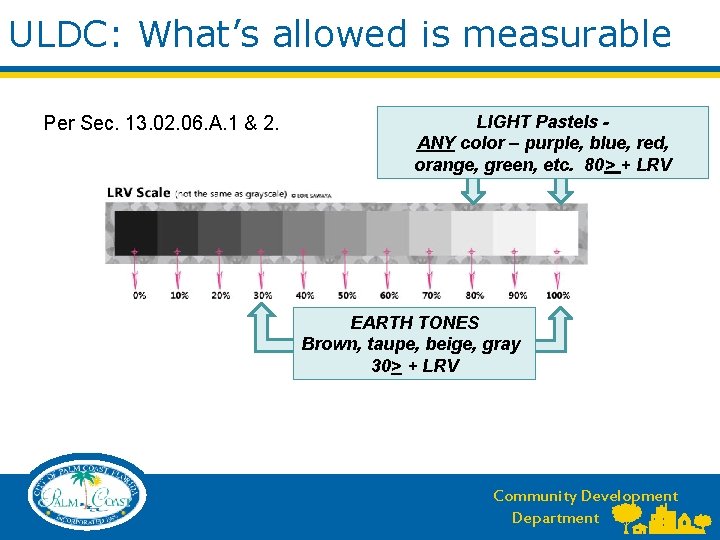
ULDC: What’s allowed is measurable Per Sec. 13. 02. 06. A. 1 & 2. LIGHT Pastels ANY color – purple, blue, red, orange, green, etc. 80> + LRV EARTH TONES Brown, taupe, beige, gray 30> + LRV Community Development Department
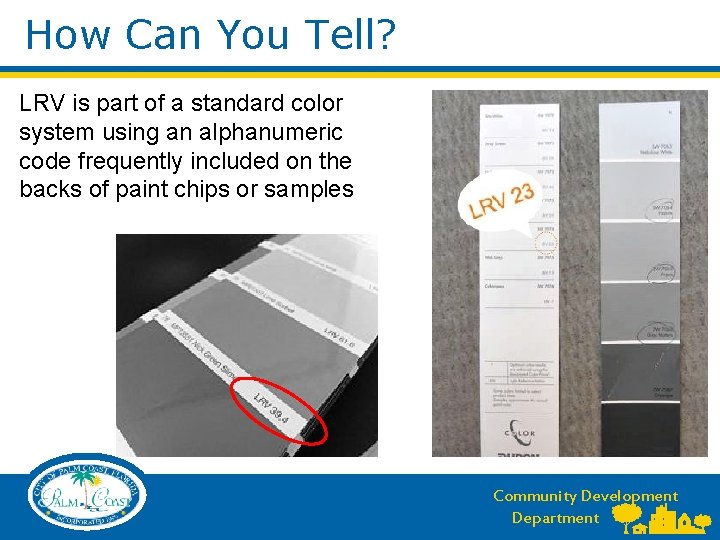
How Can You Tell? LRV is part of a standard color system using an alphanumeric code frequently included on the backs of paint chips or samples Community Development Department
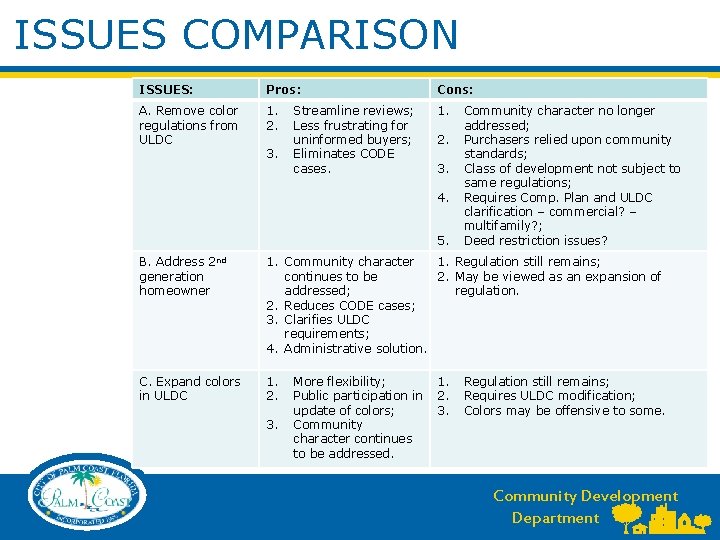
Issues that need to be addressed 1. Should City continue to regulate colors? 2. Current process (color reviewed at time building permit) works; but 2 nd generation homeowner difficult to reach. 3. Some homeowners/builders desire for darker/deeper colors outside of ULDC allowance (purples, blues, reds, oranges, yellows, greens, Black+) Community Development Department
ISSUES COMPARISON ISSUES: Pros: Cons: A. Remove color regulations from ULDC 1. 2. 1. 3. Streamline reviews; Less frustrating for uninformed buyers; Eliminates CODE cases. 2. 3. 4. 5. Community character no longer addressed; Purchasers relied upon community standards; Class of development not subject to same regulations; Requires Comp. Plan and ULDC clarification – commercial? – multifamily? ; Deed restriction issues? B. Address 2 nd generation homeowner 1. Community character 1. Regulation still remains; continues to be 2. May be viewed as an expansion of addressed; regulation. 2. Reduces CODE cases; 3. Clarifies ULDC requirements; 4. Administrative solution. C. Expand colors in ULDC 1. 2. 3. More flexibility; Public participation in update of colors; Community character continues to be addressed. 1. 2. 3. Regulation still remains; Requires ULDC modification; Colors may be offensive to some. Community Development Department