
COMMUNITY COLLEGE RESEARCH CENTER Lessons from Scaling Innovation
- Slides: 26
COMMUNITY COLLEGE RESEARCH CENTER Lessons from Scaling Innovation June 07, 2012 Building Momentum for Pedagogical Improvement: Lessons from Scaling Innovation Melissa Barragan, Community College Research Center Peter Adams, Community College of Baltimore County Susan Bickerstaff, Community College Research Center Annual Conference on Acceleration in Developmental Education Baltimore, MD 1
COMMUNITY COLLEGE RESEARCH CENTER Lessons from Scaling Innovation We conduct quantitative and qualitative research on • • • Teaching and learning in higher education Access to and success in postsecondary education High school to college transition Missions, governance, and accountability Workforce education 2
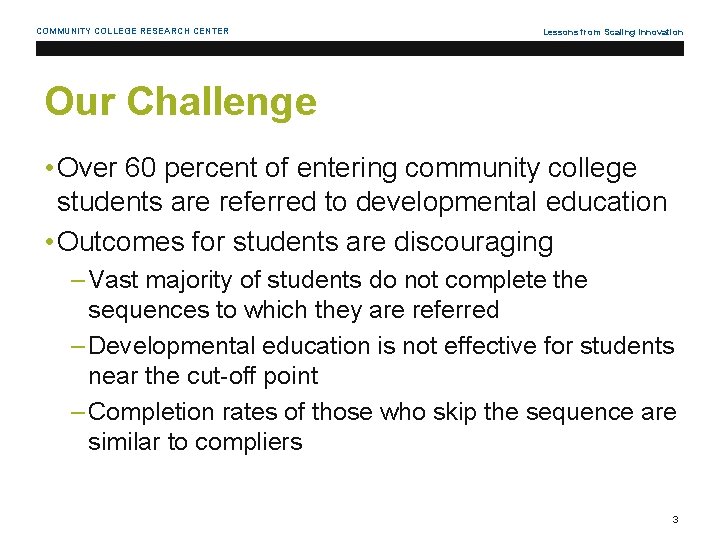
COMMUNITY COLLEGE RESEARCH CENTER Lessons from Scaling Innovation Our Challenge • Over 60 percent of entering community college students are referred to developmental education • Outcomes for students are discouraging – Vast majority of students do not complete the sequences to which they are referred – Developmental education is not effective for students near the cut-off point – Completion rates of those who skip the sequence are similar to compliers 3
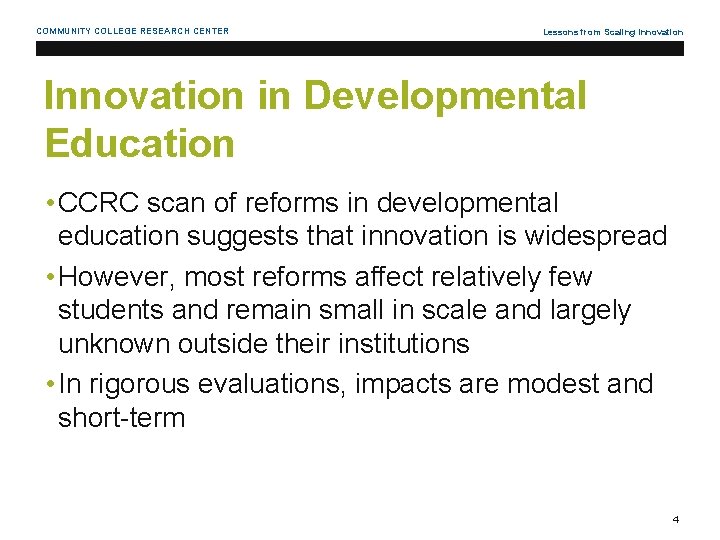
COMMUNITY COLLEGE RESEARCH CENTER Lessons from Scaling Innovation in Developmental Education • CCRC scan of reforms in developmental education suggests that innovation is widespread • However, most reforms affect relatively few students and remain small in scale and largely unknown outside their institutions • In rigorous evaluations, impacts are modest and short-term 4
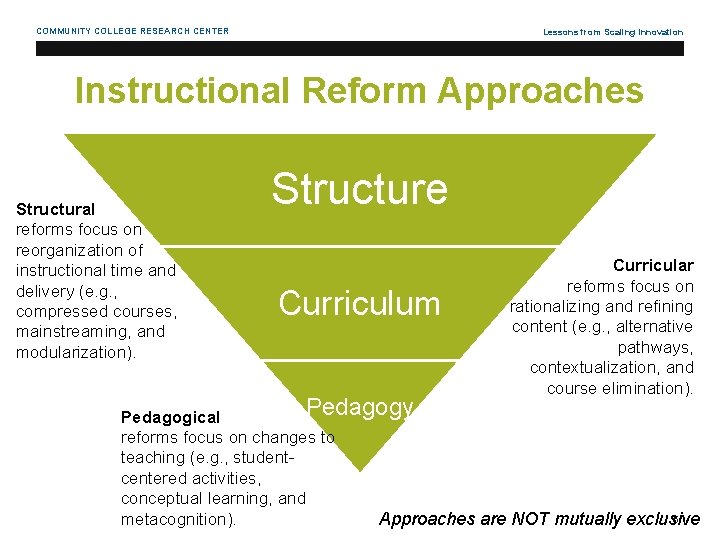
COMMUNITY COLLEGE RESEARCH CENTER Lessons from Scaling Innovation Instructional Reform Approaches Structural reforms focus on reorganization of instructional time and delivery (e. g. , compressed courses, mainstreaming, and modularization). Structure Curriculum Curricular reforms focus on rationalizing and refining content (e. g. , alternative pathways, contextualization, and course elimination). Pedagogy Pedagogical reforms focus on changes to teaching (e. g. , studentcentered activities, conceptual learning, and 5 metacognition). Approaches are NOT mutually exclusive
COMMUNITY COLLEGE RESEARCH CENTER Lessons from Scaling Innovation • CCRC and partner colleges work to scale promising reforms at new institutions. – Faculty-driven effort, with intentional focus on classroom practice • CCRC researchers document the implementation process and evaluate the impact of reforms on student success. – How can promising innovations in developmental education be introduced, sustained and scaled to enhance student learning, persistence and academic progression? • Funded by the William and Flora Hewlett Foundation 6
COMMUNITY COLLEGE RESEARCH CENTER Lessons from Scaling Innovation • Our partners: – Accelerated Learning Program from Community College of Baltimore County – Concepts of Numbers from Montgomery County Community College – California Acceleration Project, led by faculty from Chabot College and Los Medanos College • For more information, read Inside Out or visit www. scalinginnovation. org 7
COMMUNITY COLLEGE RESEARCH CENTER Lessons from Scaling Innovation Presentation Goals • Describe the evolution of ALP faculty engagement and learning at CCBC • Highlight the ALP Inquiry Network (ALPIN) as a structure for sustained professional learning • Share preliminary findings from Scaling Innovation research on how structures for faculty learning can create opportunities for pedagogical improvement 8
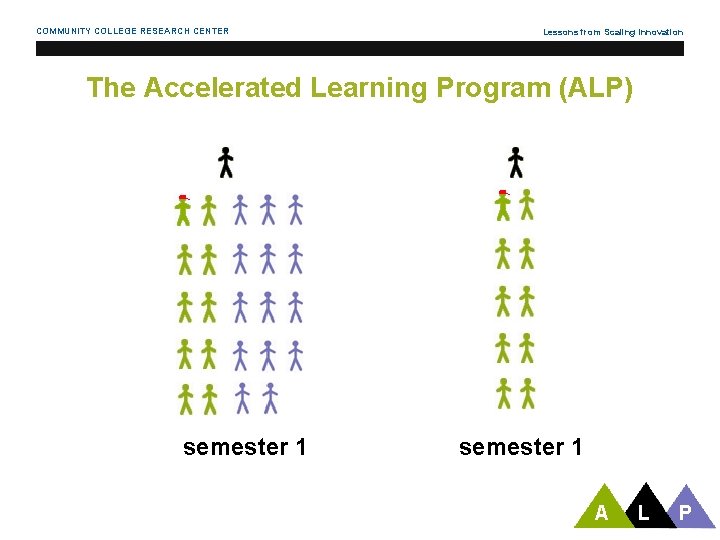
COMMUNITY COLLEGE RESEARCH CENTER Lessons from Scaling Innovation The Accelerated Learning Program (ALP) ENG 101 semester 1 ENG 052 semester 1 A L 9 P
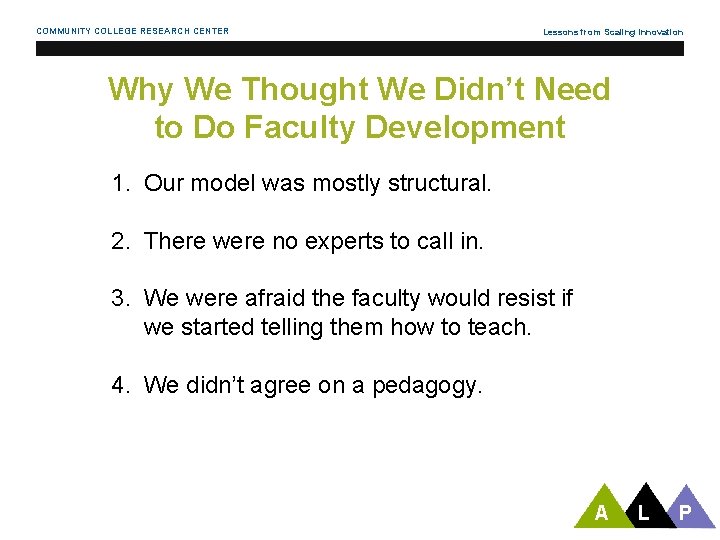
COMMUNITY COLLEGE RESEARCH CENTER Lessons from Scaling Innovation Why We Thought We Didn’t Need to Do Faculty Development 1. Our model was mostly structural. 2. There were no experts to call in. 3. We were afraid the faculty would resist if we started telling them how to teach. 4. We didn’t agree on a pedagogy. A L P 10
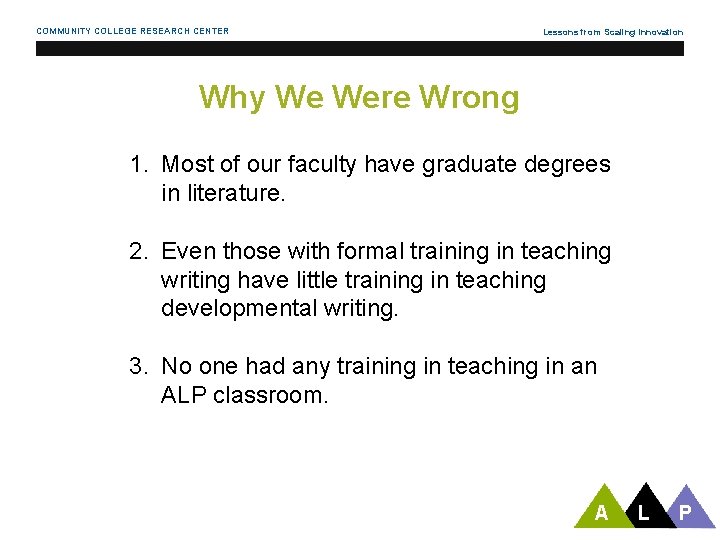
COMMUNITY COLLEGE RESEARCH CENTER Lessons from Scaling Innovation Why We Were Wrong 1. Most of our faculty have graduate degrees in literature. 2. Even those with formal training in teaching writing have little training in teaching developmental writing. 3. No one had any training in teaching in an ALP classroom. A L P 11
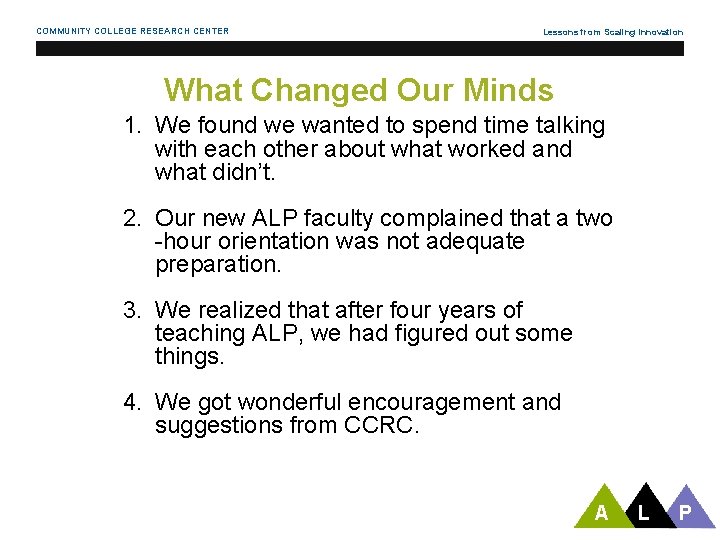
COMMUNITY COLLEGE RESEARCH CENTER Lessons from Scaling Innovation What Changed Our Minds 1. We found we wanted to spend time talking with each other about what worked and what didn’t. 2. Our new ALP faculty complained that a two -hour orientation was not adequate preparation. 3. We realized that after four years of teaching ALP, we had figured out some things. 4. We got wonderful encouragement and suggestions from CCRC. A L P 12
COMMUNITY COLLEGE RESEARCH CENTER Lessons from Scaling Innovation Faculty Development for 2012 -2013 We’ve arrived at a different concept of faculty development. Rather than experts teaching novices how to teach. We now see faculty development as a group of teachers seeking answers to important questions. A L P 13
COMMUNITY COLLEGE RESEARCH CENTER Lessons from Scaling Innovation Faculty Development for 2012 -2013 We also recognized how hard it is to do faculty development at a community college. • Everyone is teaching five courses • and serving on committtees • and we’re spread over three campuses • so we’ve concluded that there is no silver bullet. Faculty development has to be multi -faceted. A L P 14
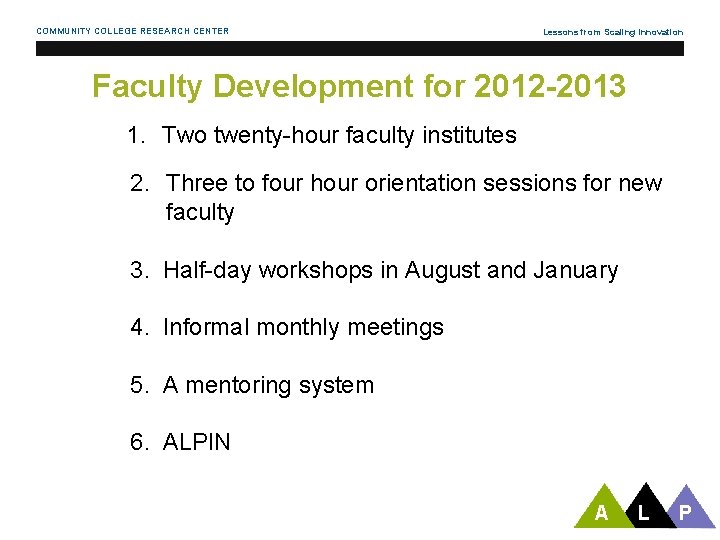
COMMUNITY COLLEGE RESEARCH CENTER Lessons from Scaling Innovation Faculty Development for 2012 -2013 1. Two twenty-hour faculty institutes 2. Three to four hour orientation sessions for new faculty 3. Half-day workshops in August and January 4. Informal monthly meetings 5. A mentoring system 6. ALPIN A L P 15
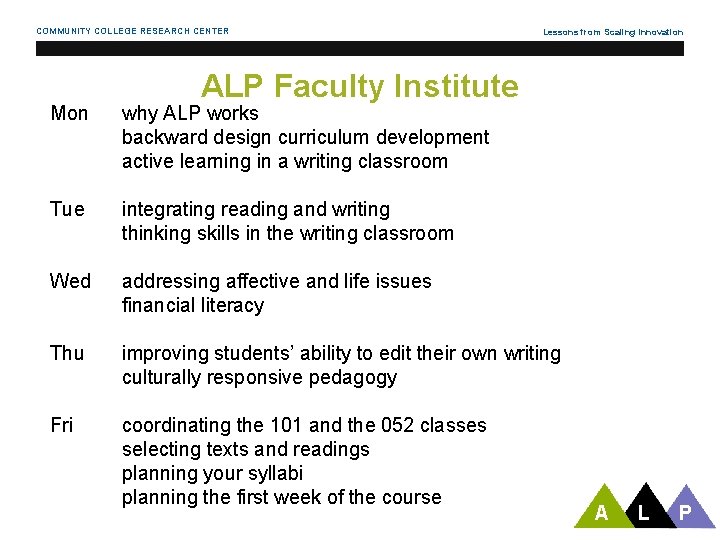
COMMUNITY COLLEGE RESEARCH CENTER Lessons from Scaling Innovation ALP Faculty Institute Mon why ALP works backward design curriculum development active learning in a writing classroom Tue integrating reading and writing thinking skills in the writing classroom Wed addressing affective and life issues financial literacy Thu improving students’ ability to edit their own writing culturally responsive pedagogy Fri coordinating the 101 and the 052 classes selecting texts and readings planning your syllabi planning the first week of the course A L P 16
COMMUNITY COLLEGE RESEARCH CENTER Lessons from Scaling Innovation Preliminary Findings from Scaling Innovation Research 17
COMMUNITY COLLEGE RESEARCH CENTER Lessons from Scaling Innovation 1. Infrastructure for collaboration and refinement is important, but challenging to implement and sustain. 2. Instructors’ questions about teaching in innovative courses vary over time and according to their personal and professional dispositions and identities. 3. Professional learning activities and venues should be responsive to faculty needs. 18
COMMUNITY COLLEGE RESEARCH CENTER Lessons from Scaling Innovation Collaborative Infrastructure • Diverse coalitions build buy-in and ensure sustainability – Full-time and adjunct faculty – Administrators – Counselors and advisors – Instructional support staff – Institutional researchers – Students • By reviewing data, the coalition can create processes for ongoing refinement ‒ Course grades, student persistence to subsequent courses, student success in subsequent courses ‒ Artifacts of practice 19
COMMUNITY COLLEGE RESEARCH CENTER Lessons from Scaling Innovation Challenges to Collaborative Work • Antithetical to professional culture and structure of higher education – Institutional culture – Individual dispositions toward collaborative work • Skills required are different from those typically associated with faculty role – Leadership, management, coaching • Successful structures are contextually specific and challenging to sustain (e. g. , curriculum writing team) 20
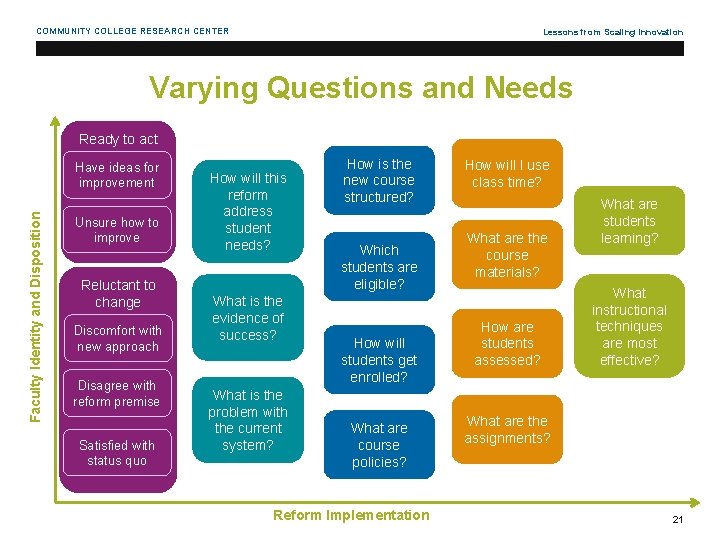
COMMUNITY COLLEGE RESEARCH CENTER Lessons from Scaling Innovation Varying Questions and Needs Ready to act Faculty Identity and Disposition Have ideas for improvement Unsure how to improve Reluctant to change Discomfort with new approach Disagree with reform premise Satisfied with status quo How will this reform address student needs? What is the evidence of success? What is the problem with the current system? How is the new course structured? Which students are eligible? How will students get enrolled? What are course policies? Reform Implementation How will I use class time? What are the course materials? How are students assessed? What are students learning? What instructional techniques are most effective? What are the assignments? 21
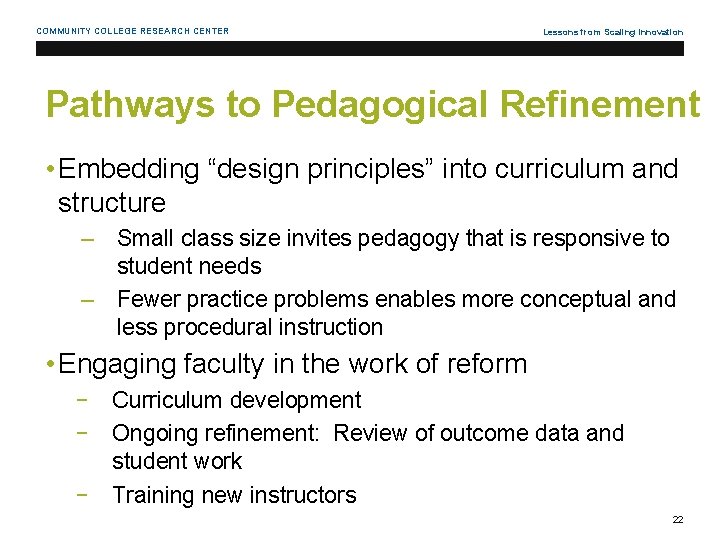
COMMUNITY COLLEGE RESEARCH CENTER Lessons from Scaling Innovation Pathways to Pedagogical Refinement • Embedding “design principles” into curriculum and structure ‒ Small class size invites pedagogy that is responsive to student needs ‒ Fewer practice problems enables more conceptual and less procedural instruction • Engaging faculty in the work of reform − Curriculum development − Ongoing refinement: Review of outcome data and student work − Training new instructors 22
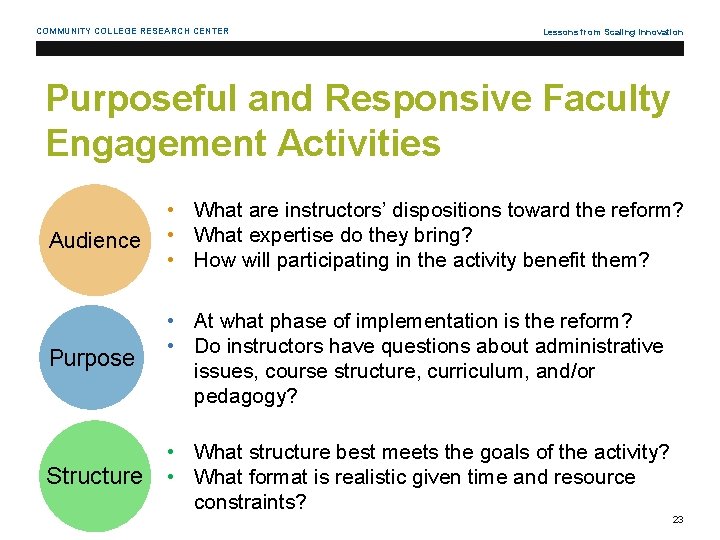
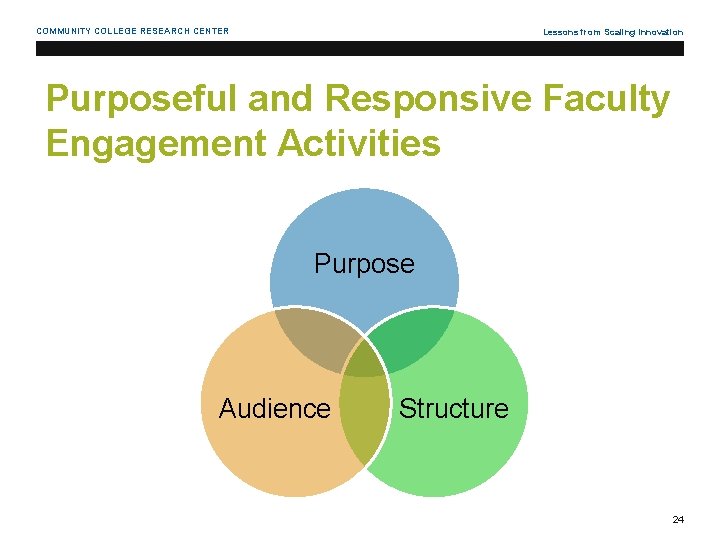
COMMUNITY COLLEGE RESEARCH CENTER Lessons from Scaling Innovation Purposeful and Responsive Faculty Engagement Activities Audience • What are instructors’ dispositions toward the reform? • What expertise do they bring? • How will participating in the activity benefit them? Purpose • At what phase of implementation is the reform? • Do instructors have questions about administrative issues, course structure, curriculum, and/or pedagogy? Structure • What structure best meets the goals of the activity? • What format is realistic given time and resource constraints? 23
COMMUNITY COLLEGE RESEARCH CENTER Lessons from Scaling Innovation Purposeful and Responsive Faculty Engagement Activities Purpose Audience Structure 24
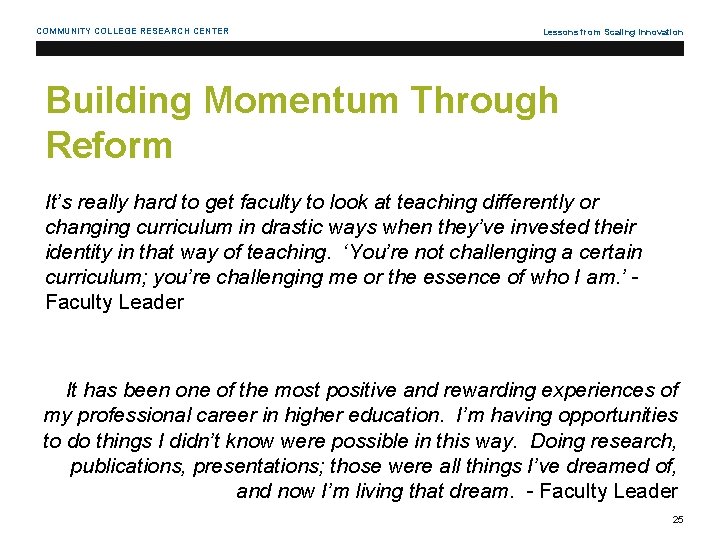
COMMUNITY COLLEGE RESEARCH CENTER Lessons from Scaling Innovation Building Momentum Through Reform It’s really hard to get faculty to look at teaching differently or changing curriculum in drastic ways when they’ve invested their identity in that way of teaching. ‘You’re not challenging a certain curriculum; you’re challenging me or the essence of who I am. ’ Faculty Leader It has been one of the most positive and rewarding experiences of my professional career in higher education. I’m having opportunities to do things I didn’t know were possible in this way. Doing research, publications, presentations; those were all things I’ve dreamed of, and now I’m living that dream. - Faculty Leader 25
COMMUNITY COLLEGE RESEARCH CENTER Lessons from Scaling Innovation June 7, 2012 For more information Please visit us on the web at http: //ccrc. tc. columbia. edu where you can download presentations, reports, and briefs, and sign-up for news announcements. We’re also on Facebook and Twitter. Community College Research Center Institute on Education and the Economy, Teachers College, Columbia University 525 West 120 th Street, Box 174, New York, NY 10027 E-mail: ccrc@columbia. edu Telephone: 212. 678. 3091 26