
COMMUNITY COLLEGE RESEARCH CENTER CUNY FACULTY DEVELOPMENT WORKSHOP

- Slides: 26
COMMUNITY COLLEGE RESEARCH CENTER CUNY FACULTY DEVELOPMENT WORKSHOP / JANUARY 13, 2016 Redesigning America’s Community Colleges A Clearer Path to Student Success Thomas Bailey Director Community College Research Center CUNY Faculty Development Workshop John Jay College of Criminal Justice @Community. CCRC #Redesigning. CCs 1
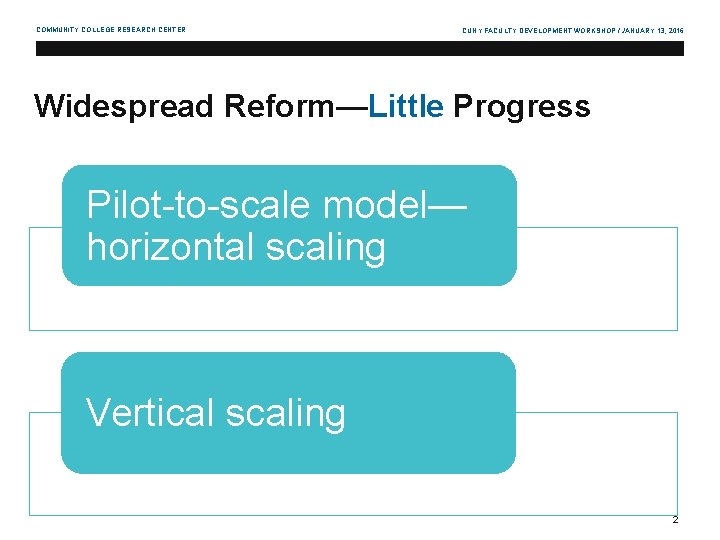
COMMUNITY COLLEGE RESEARCH CENTER CUNY FACULTY DEVELOPMENT WORKSHOP / JANUARY 13, 2016 Widespread Reform—Little Progress Pilot-to-scale model— horizontal scaling Vertical scaling 2
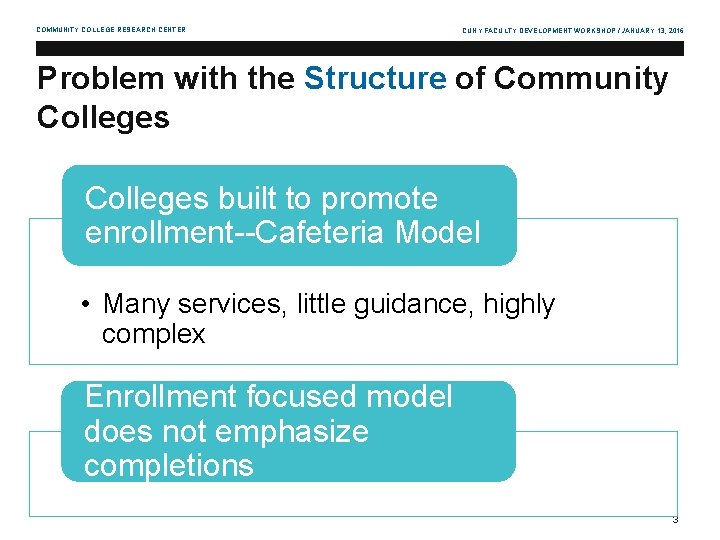
COMMUNITY COLLEGE RESEARCH CENTER CUNY FACULTY DEVELOPMENT WORKSHOP / JANUARY 13, 2016 Problem with the Structure of Community Colleges built to promote enrollment--Cafeteria Model • Many services, little guidance, highly complex Enrollment focused model does not emphasize completions 3
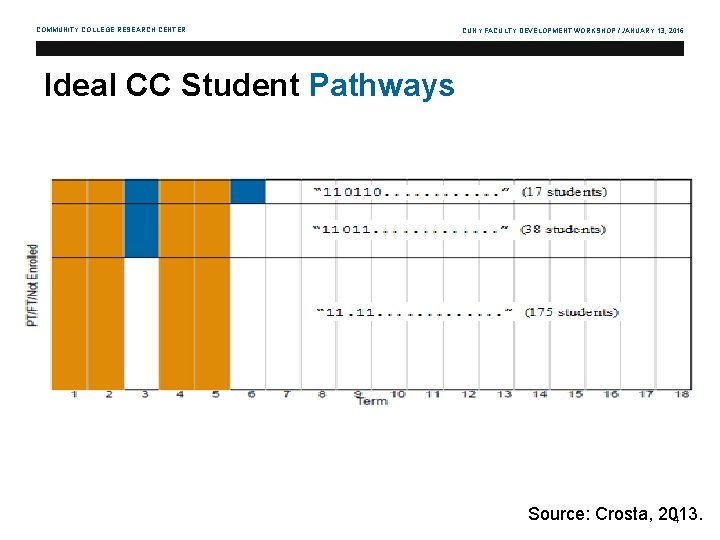
COMMUNITY COLLEGE RESEARCH CENTER CUNY FACULTY DEVELOPMENT WORKSHOP / JANUARY 13, 2016 Ideal CC Student Pathways Source: Crosta, 2013. 4
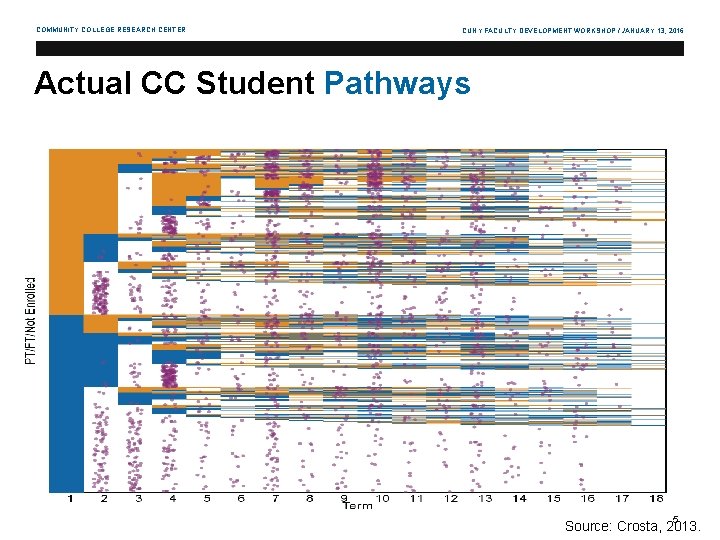
COMMUNITY COLLEGE RESEARCH CENTER CUNY FACULTY DEVELOPMENT WORKSHOP / JANUARY 13, 2016 Actual CC Student Pathways 5 Source: Crosta, 2013.
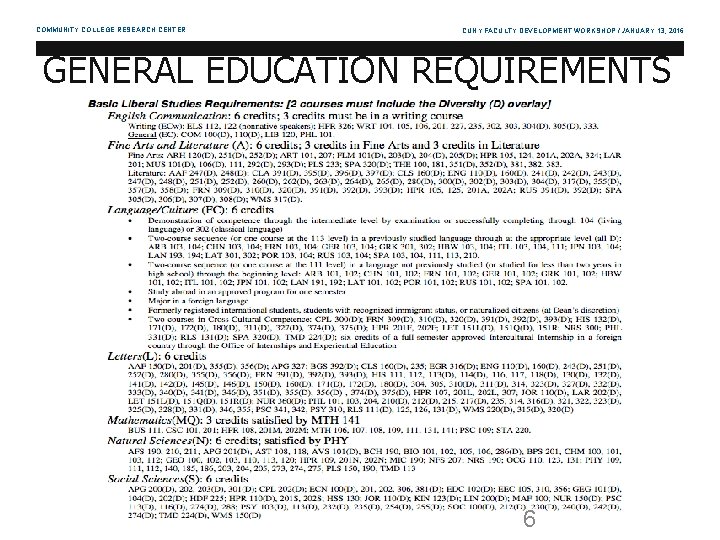
COMMUNITY COLLEGE RESEARCH CENTER CUNY FACULTY DEVELOPMENT WORKSHOP / JANUARY 13, 2016 GENERAL EDUCATION REQUIREMENTS 6 6
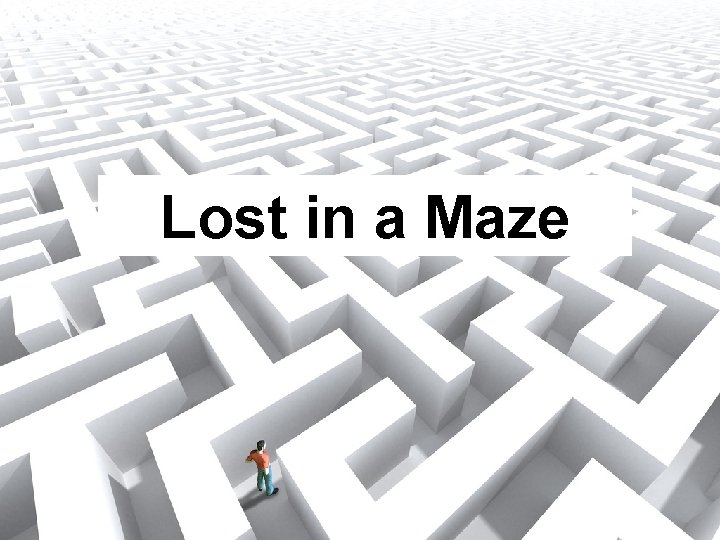
COMMUNITY COLLEGE RESEARCH CENTER CUNY FACULTY DEVELOPMENT WORKSHOP / JANUARY 13, 2016 Lost in a Maze 7
COMMUNITY COLLEGE RESEARCH CENTER CUNY FACULTY DEVELOPMENT WORKSHOP / JANUARY 13, 2016 Pathway Models Compared Cafeteria (Status Quo) Guided Pathways Optional career / college planning Required plans, exploratory majors Paths unclear, too many choices Default, full-program maps Students not building skills across curriculum SLOs aligned with end goals, assessed across each program Assessment used to sort students Assessment used to diagnose areas where support needed Pre-requisite remediation focused on Algebra & English composition Integrated, contextualized academic support for program “gateway” courses Students’ progress not monitored, limited feedback Proactive progress tracking, feedback, support 8
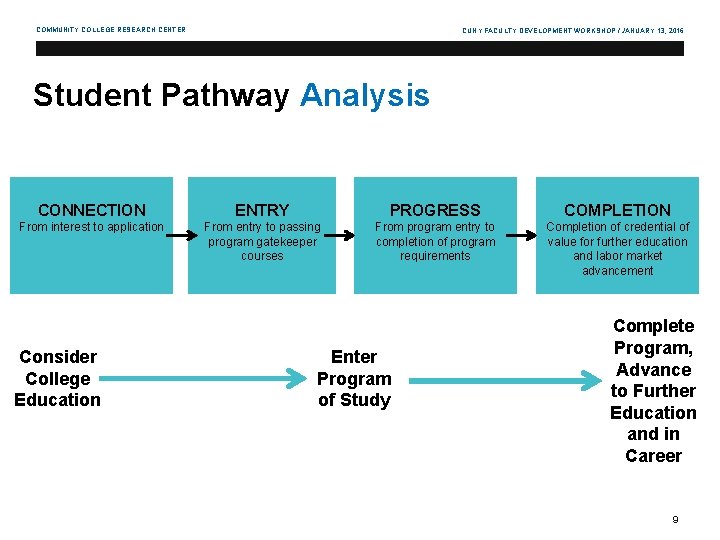
COMMUNITY COLLEGE RESEARCH CENTER CUNY FACULTY DEVELOPMENT WORKSHOP / JANUARY 13, 2016 Student Pathway Analysis CONNECTION ENTRY PROGRESS COMPLETION From interest to application From entry to passing program gatekeeper courses From program entry to completion of program requirements Completion of credential of value for further education and labor market advancement Consider College Education Enter Program of Study Complete Program, Advance to Further Education and in Career 9
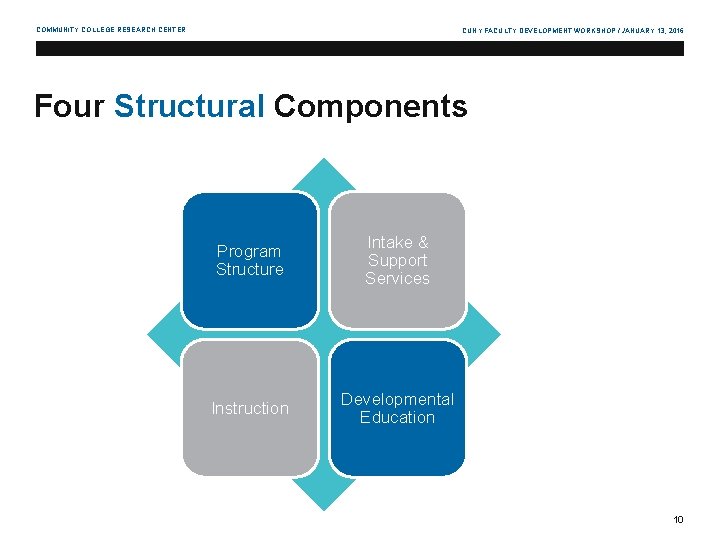
COMMUNITY COLLEGE RESEARCH CENTER CUNY FACULTY DEVELOPMENT WORKSHOP / JANUARY 13, 2016 Four Structural Components Program Structure Intake & Support Services Instruction Developmental Education 10
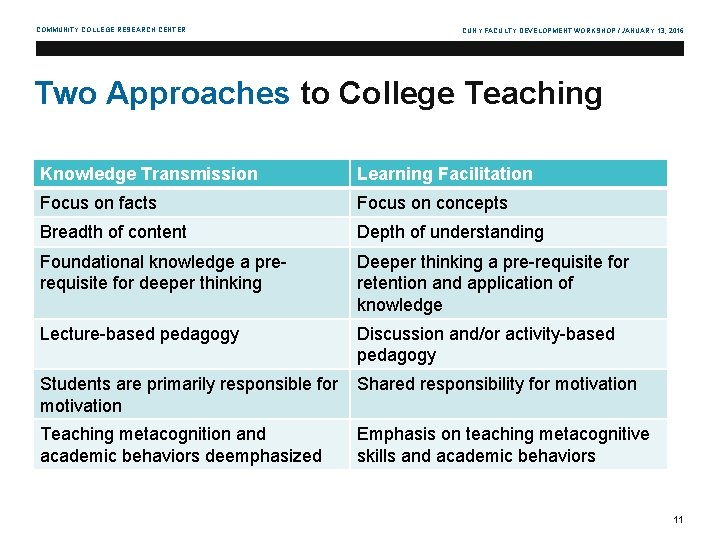
COMMUNITY COLLEGE RESEARCH CENTER CUNY FACULTY DEVELOPMENT WORKSHOP / JANUARY 13, 2016 Two Approaches to College Teaching Knowledge Transmission Learning Facilitation Focus on facts Focus on concepts Breadth of content Depth of understanding Foundational knowledge a prerequisite for deeper thinking Deeper thinking a pre-requisite for retention and application of knowledge Lecture-based pedagogy Discussion and/or activity-based pedagogy Students are primarily responsible for motivation Shared responsibility for motivation Teaching metacognition and academic behaviors deemphasized Emphasis on teaching metacognitive skills and academic behaviors 11
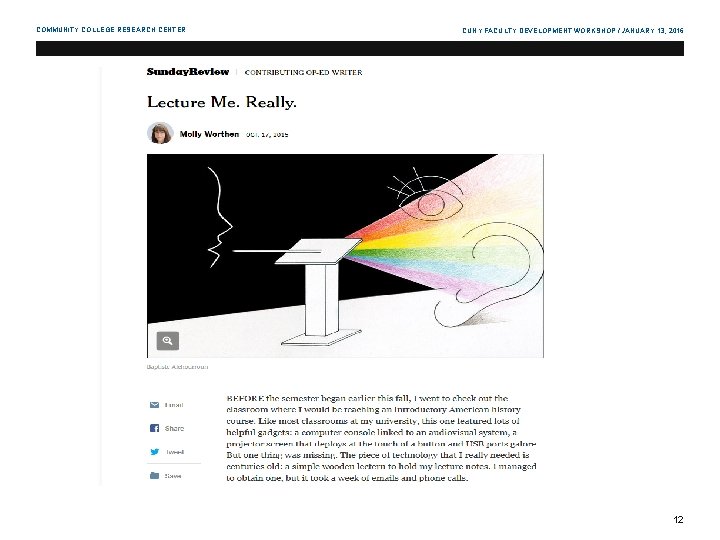
COMMUNITY COLLEGE RESEARCH CENTER CUNY FACULTY DEVELOPMENT WORKSHOP / JANUARY 13, 2016 12
COMMUNITY COLLEGE RESEARCH CENTER CUNY FACULTY DEVELOPMENT WORKSHOP / JANUARY 13, 2016 What makes it difficult to promote and adopt new ways of teaching? 13
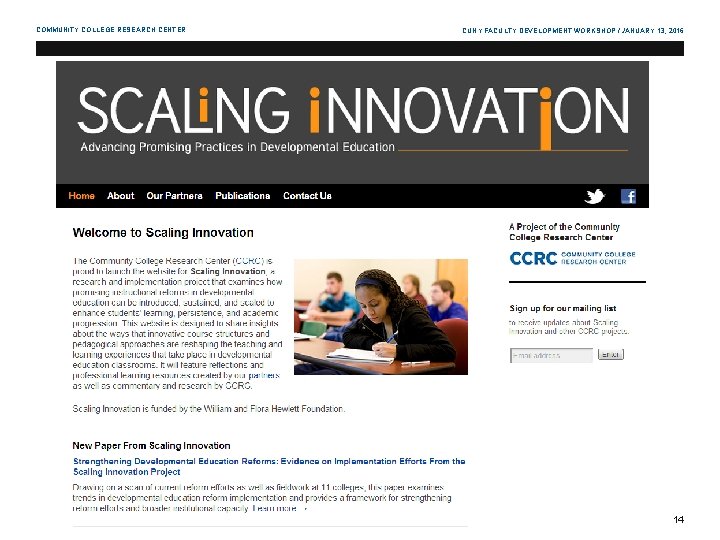
COMMUNITY COLLEGE RESEARCH CENTER CUNY FACULTY DEVELOPMENT WORKSHOP / JANUARY 13, 2016 14
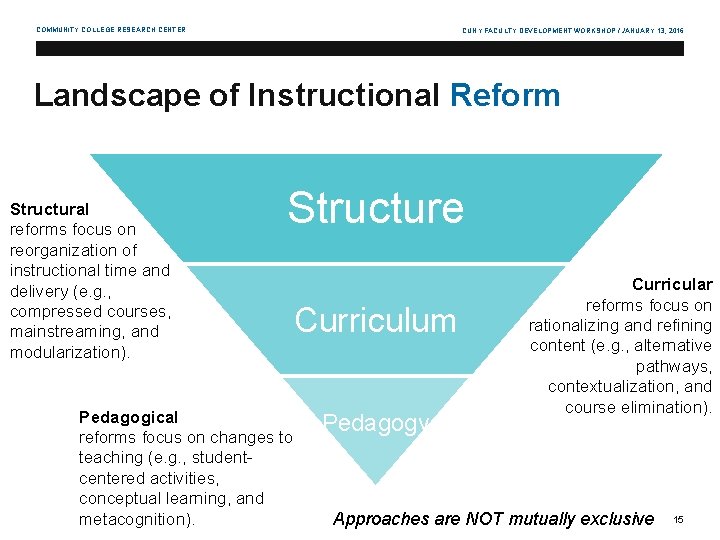
COMMUNITY COLLEGE RESEARCH CENTER CUNY FACULTY DEVELOPMENT WORKSHOP / JANUARY 13, 2016 Landscape of Instructional Reform Structural reforms focus on reorganization of instructional time and delivery (e. g. , compressed courses, mainstreaming, and modularization). Structure Pedagogical reforms focus on changes to teaching (e. g. , studentcentered activities, conceptual learning, and metacognition). Curriculum Pedagogy Curricular reforms focus on rationalizing and refining content (e. g. , alternative pathways, contextualization, and course elimination). Approaches are NOT mutually exclusive 15
COMMUNITY COLLEGE RESEARCH CENTER CUNY FACULTY DEVELOPMENT WORKSHOP / JANUARY 13, 2016 What role can professional development play in improving classroom instruction? 16
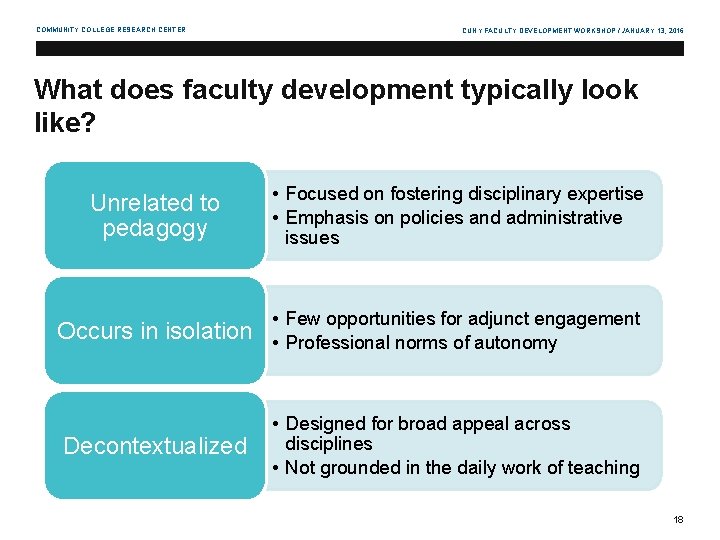
COMMUNITY COLLEGE RESEARCH CENTER CUNY FACULTY DEVELOPMENT WORKSHOP / JANUARY 13, 2016 What does faculty development typically look like? Unrelated to pedagogy • Focused on fostering disciplinary expertise • Emphasis on policies and administrative issues • Few opportunities for adjunct engagement Occurs in isolation • Professional norms of autonomy Decontextualized • Designed for broad appeal across disciplines • Not grounded in the daily work of teaching 18
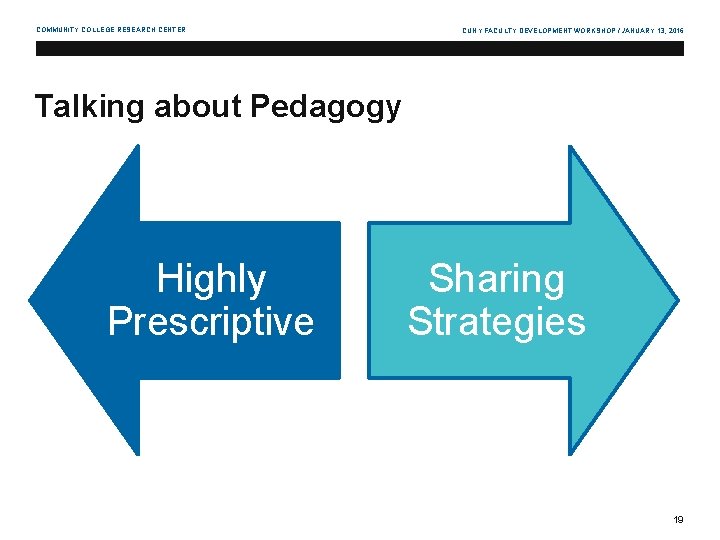
COMMUNITY COLLEGE RESEARCH CENTER CUNY FACULTY DEVELOPMENT WORKSHOP / JANUARY 13, 2016 Talking about Pedagogy Highly Prescriptive Sharing Strategies 19
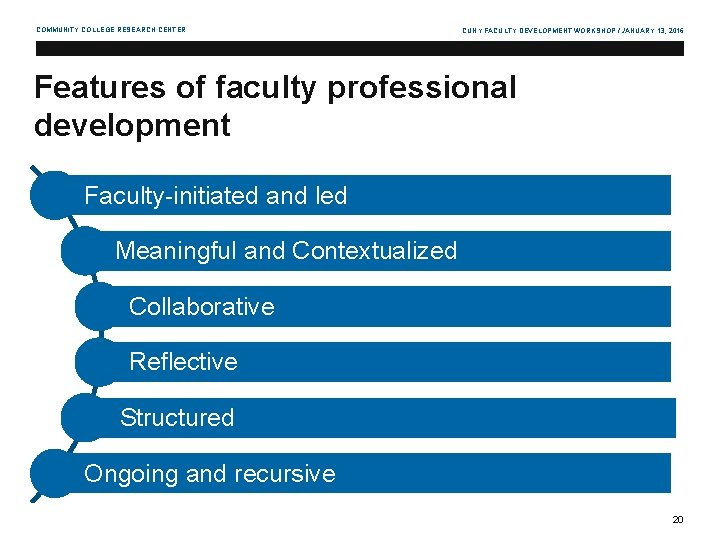
COMMUNITY COLLEGE RESEARCH CENTER CUNY FACULTY DEVELOPMENT WORKSHOP / JANUARY 13, 2016 Features of faculty professional development Faculty-initiated and led Meaningful and Contextualized Collaborative Reflective Structured Ongoing and recursive 20
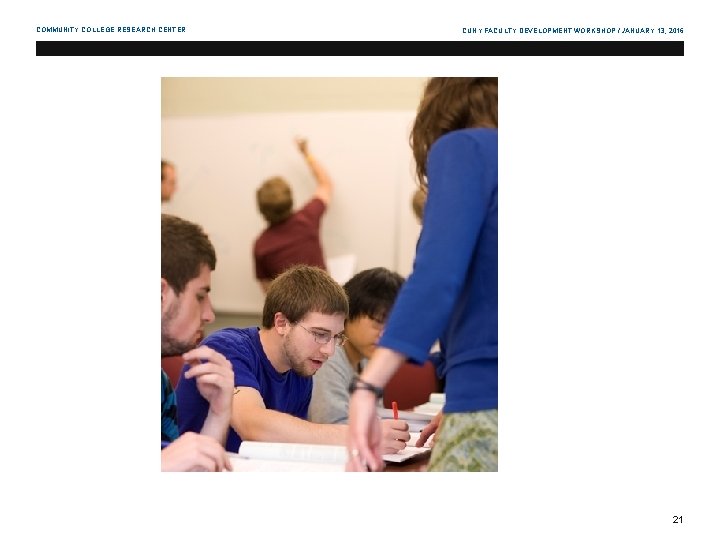
COMMUNITY COLLEGE RESEARCH CENTER CUNY FACULTY DEVELOPMENT WORKSHOP / JANUARY 13, 2016 21
COMMUNITY COLLEGE RESEARCH CENTER CUNY FACULTY DEVELOPMENT WORKSHOP / JANUARY 13, 2016 Example: Guttman’s Instructional Teams • Students enrolled in LCs nested within houses • Each house taught by an “instructional team”: – Cross-disciplinary group of faculty – Advisor (teaches required success course) – Librarian (creates info literacy materials to support curricular content) – CUNY grad student (“Studio” supplemental instruction) • In weekly meetings, team discusses curricular, pedagogical, and support students for their shared students. 22
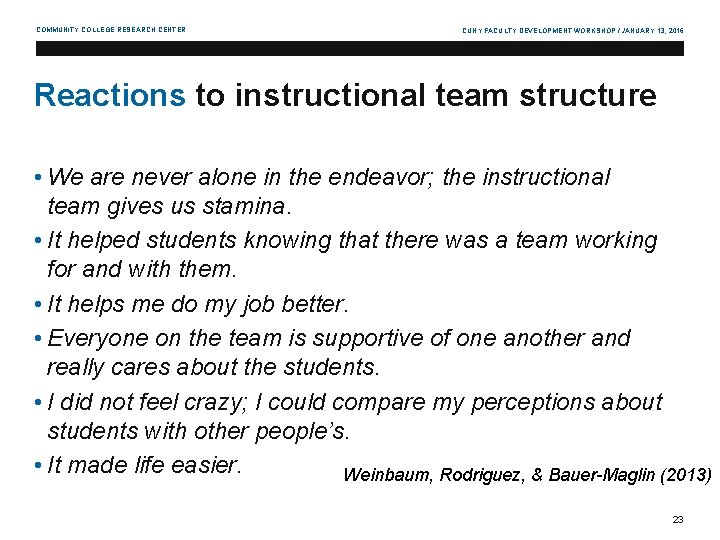
COMMUNITY COLLEGE RESEARCH CENTER CUNY FACULTY DEVELOPMENT WORKSHOP / JANUARY 13, 2016 Reactions to instructional team structure • We are never alone in the endeavor; the instructional team gives us stamina. • It helped students knowing that there was a team working for and with them. • It helps me do my job better. • Everyone on the team is supportive of one another and really cares about the students. • I did not feel crazy; I could compare my perceptions about students with other people’s. • It made life easier. Weinbaum, Rodriguez, & Bauer-Maglin (2013) 23
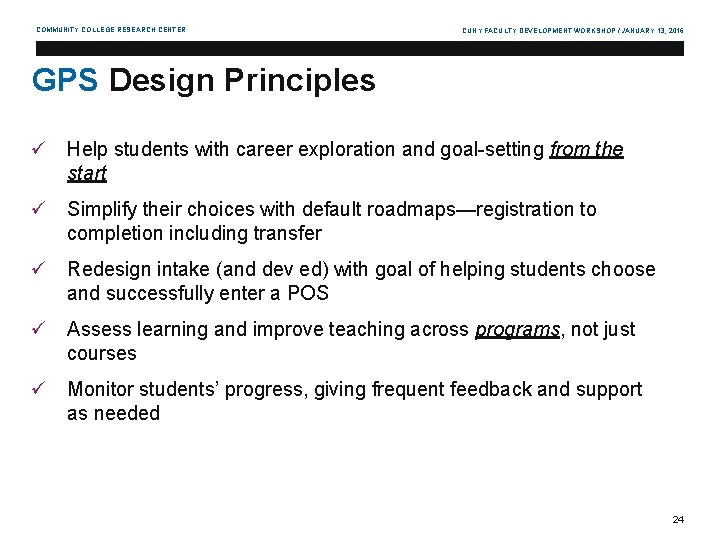
COMMUNITY COLLEGE RESEARCH CENTER CUNY FACULTY DEVELOPMENT WORKSHOP / JANUARY 13, 2016 GPS Design Principles ü Help students with career exploration and goal-setting from the start ü Simplify their choices with default roadmaps—registration to completion including transfer ü Redesign intake (and dev ed) with goal of helping students choose and successfully enter a POS ü Assess learning and improve teaching across programs, not just courses ü Monitor students’ progress, giving frequent feedback and support as needed 24
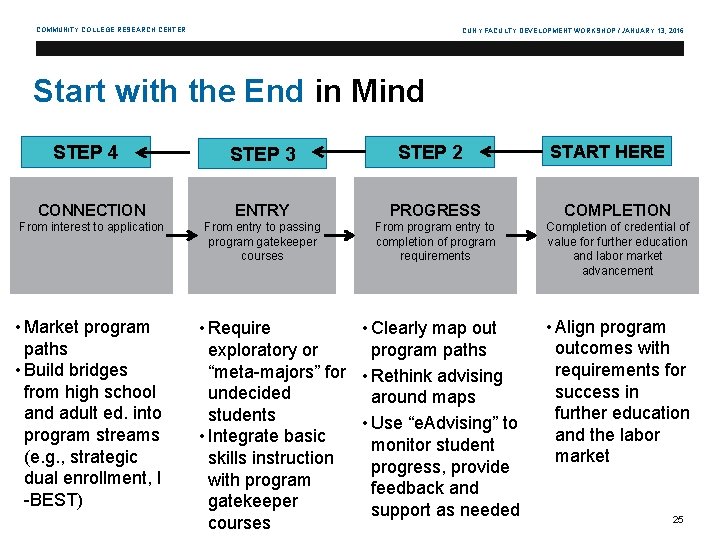
COMMUNITY COLLEGE RESEARCH CENTER CUNY FACULTY DEVELOPMENT WORKSHOP / JANUARY 13, 2016 Start with the End in Mind STEP 4 STEP 3 STEP 2 START HERE CONNECTION ENTRY PROGRESS COMPLETION From interest to application From entry to passing program gatekeeper courses From program entry to completion of program requirements Completion of credential of value for further education and labor market advancement • Market program paths • Build bridges from high school and adult ed. into program streams (e. g. , strategic dual enrollment, I -BEST) • Clearly map out • Require program paths exploratory or “meta-majors” for • Rethink advising undecided around maps students • Use “e. Advising” to • Integrate basic monitor student skills instruction progress, provide with program feedback and gatekeeper support as needed courses • Align program outcomes with requirements for success in further education and the labor market 25
COMMUNITY COLLEGE RESEARCH CENTER CUNY FACULTY DEVELOPMENT WORKSHOP / JANUARY 13, 2016 Redesigning America’s Community Colleges A Clearer Path to Student Success • Thomas Bailey, Director, CCRC • Shanna Jaggars, Asst. Director, CCRC • Davis Jenkins, Sr. Research Associate, CCRC 26
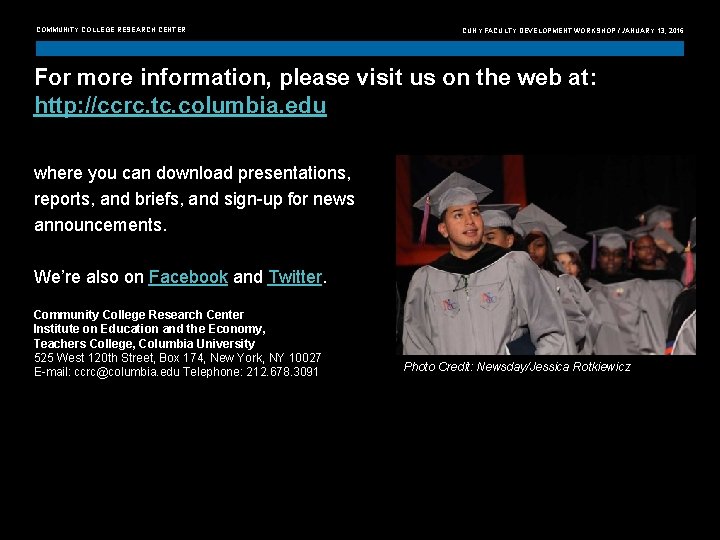
COMMUNITY COLLEGE RESEARCH CENTER CUNY FACULTY DEVELOPMENT WORKSHOP / JANUARY 13, 2016 For more information, please visit us on the web at: http: //ccrc. tc. columbia. edu where you can download presentations, reports, and briefs, and sign-up for news announcements. We’re also on Facebook and Twitter. Community College Research Center Institute on Education and the Economy, Teachers College, Columbia University 525 West 120 th Street, Box 174, New York, NY 10027 E-mail: ccrc@columbia. edu Telephone: 212. 678. 3091 Photo Credit: Newsday/Jessica Rotkiewicz 27