
Community Choice Aggregation Development and Implementation Update City
- Slides: 29
Community Choice Aggregation Development and Implementation Update City of Solana Beach City Council Meeting 10/11/17
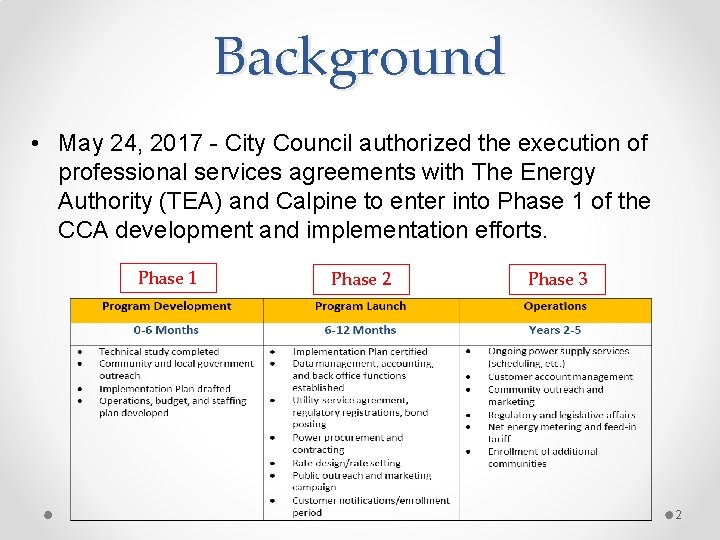
Background • May 24, 2017 - City Council authorized the execution of professional services agreements with The Energy Authority (TEA) and Calpine to enter into Phase 1 of the CCA development and implementation efforts. Phase 1 Phase 2 Phase 3 2
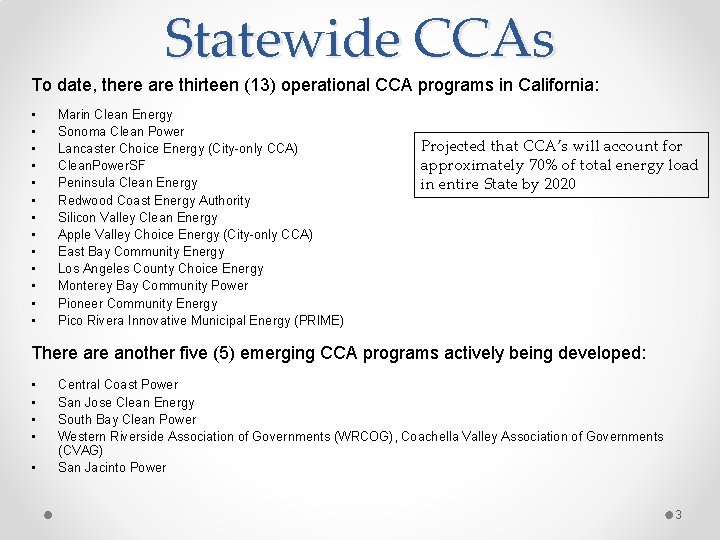
Statewide CCAs To date, there are thirteen (13) operational CCA programs in California: • • • • Marin Clean Energy Sonoma Clean Power Lancaster Choice Energy (City-only CCA) Clean. Power. SF Peninsula Clean Energy Redwood Coast Energy Authority Silicon Valley Clean Energy Apple Valley Choice Energy (City-only CCA) East Bay Community Energy Los Angeles County Choice Energy Monterey Bay Community Power Pioneer Community Energy Pico Rivera Innovative Municipal Energy (PRIME) Projected that CCA’s will account for approximately 70% of total energy load in entire State by 2020 There another five (5) emerging CCA programs actively being developed: • • • Central Coast Power San Jose Clean Energy South Bay Clean Power Western Riverside Association of Governments (WRCOG), Coachella Valley Association of Governments (CVAG) San Jacinto Power 3
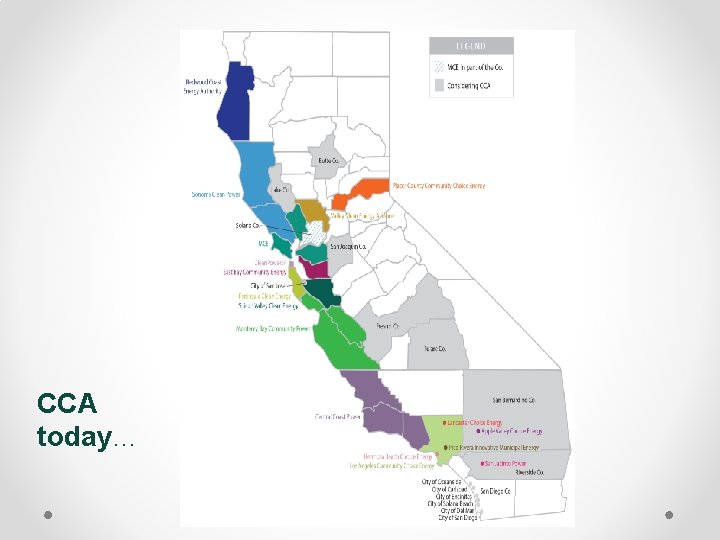
CCA today…
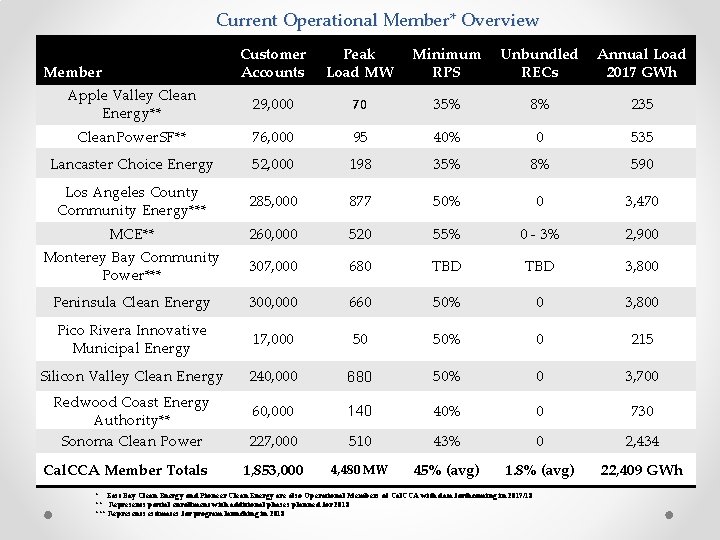
Current Operational Member* Overview Customer Accounts Peak Load MW Minimum RPS Unbundled RECs Annual Load 2017 GWh Apple Valley Clean Energy** 29, 000 70 35% 8% 235 Clean. Power. SF** 76, 000 95 40% 0 535 Lancaster Choice Energy 52, 000 198 35% 8% 590 Los Angeles County Community Energy*** 285, 000 877 50% 0 3, 470 MCE** 260, 000 520 55% 0 - 3% 2, 900 Monterey Bay Community Power*** 307, 000 680 TBD 3, 800 Peninsula Clean Energy 300, 000 660 50% 0 3, 800 Pico Rivera Innovative Municipal Energy 17, 000 50 50% 0 215 Silicon Valley Clean Energy 240, 000 680 50% 0 3, 700 60, 000 140 40% 0 730 227, 000 510 43% 0 2, 434 1, 853, 000 4, 480 MW 45% (avg) 1. 8% (avg) 22, 409 GWh Member Redwood Coast Energy Authority** Sonoma Clean Power Cal. CCA Member Totals * East Bay Clean Energy and Pioneer Clean Energy are also Operational Members of Cal. CCA with data forthcoming in 2017/18 ** Represents partial enrollment with additional phases planned for 2018 *** Represents estimates for program launching in 2018
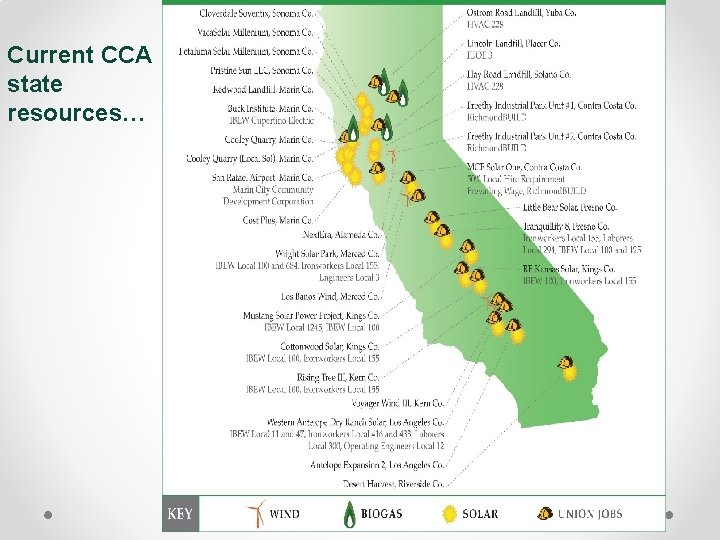
Current CCA state resources…
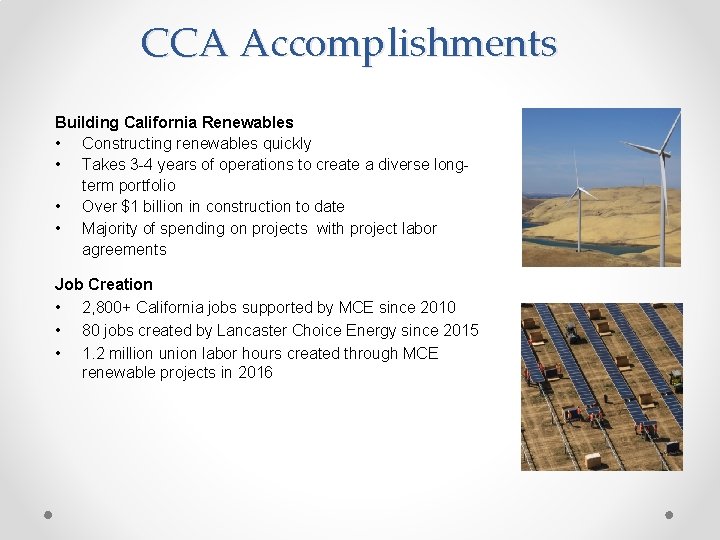
CCA Accomplishments Building California Renewables • Constructing renewables quickly • Takes 3 -4 years of operations to create a diverse longterm portfolio • Over $1 billion in construction to date • Majority of spending on projects with project labor agreements Job Creation • 2, 800+ California jobs supported by MCE since 2010 • 80 jobs created by Lancaster Choice Energy since 2015 • 1. 2 million union labor hours created through MCE renewable projects in 2016
Lock Box Account • Lock Box Pledge Account & Reserve Account o These are primary components of the Credit Support and financial backing for both TEA and the CCA itself. o The Lock Box would be the account into which all customer payments would be placed. • The CCA would grant to TEA a first priority security interest in and lien upon the funds and payments made by the CCA customers. • These funds would provide operational security as well as funding for ongoing energy purchases made by TEA on behalf of the CCA. • The Lock Box would accumulate funding over time for a Reserve Account and Rate Stabilization Fund for any unforeseen changes to future costs. o The Lock Box and its reserve requirement is the vehicle that protects the City’s General Fund from the operations of the CCA. • If, for whatever reason, the CCA is disbanded, only the money in the Lock Box is at risk, not the General Fund. 8
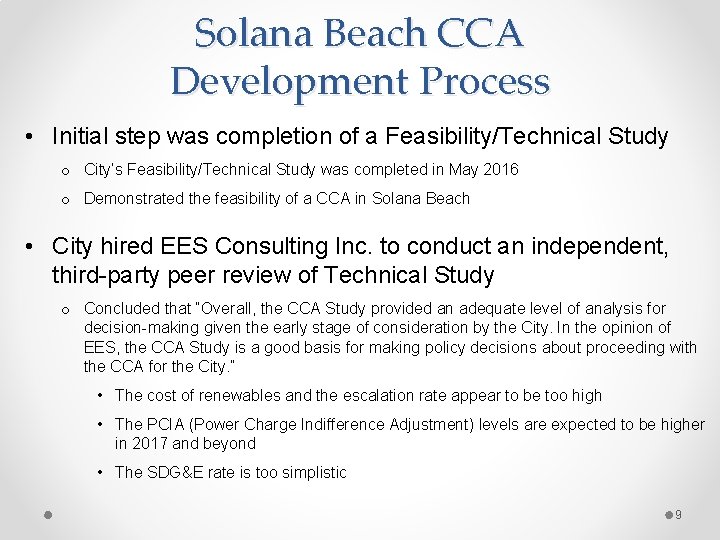
Solana Beach CCA Development Process • Initial step was completion of a Feasibility/Technical Study o City’s Feasibility/Technical Study was completed in May 2016 o Demonstrated the feasibility of a CCA in Solana Beach • City hired EES Consulting Inc. to conduct an independent, third-party peer review of Technical Study o Concluded that “Overall, the CCA Study provided an adequate level of analysis for decision-making given the early stage of consideration by the City. In the opinion of EES, the CCA Study is a good basis for making policy decisions about proceeding with the CCA for the City. ” • The cost of renewables and the escalation rate appear to be too high • The PCIA (Power Charge Indifference Adjustment) levels are expected to be higher in 2017 and beyond • The SDG&E rate is too simplistic 9
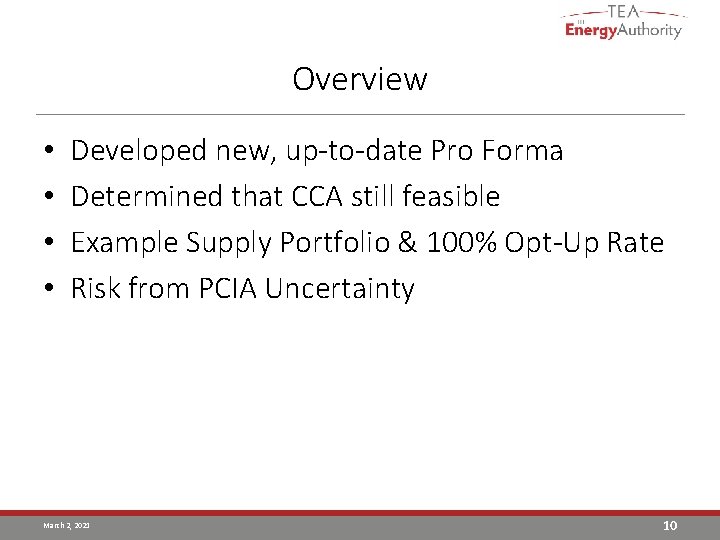
Overview • • Developed new, up-to-date Pro Forma Determined that CCA still feasible Example Supply Portfolio & 100% Opt-Up Rate Risk from PCIA Uncertainty March 2, 2021 10
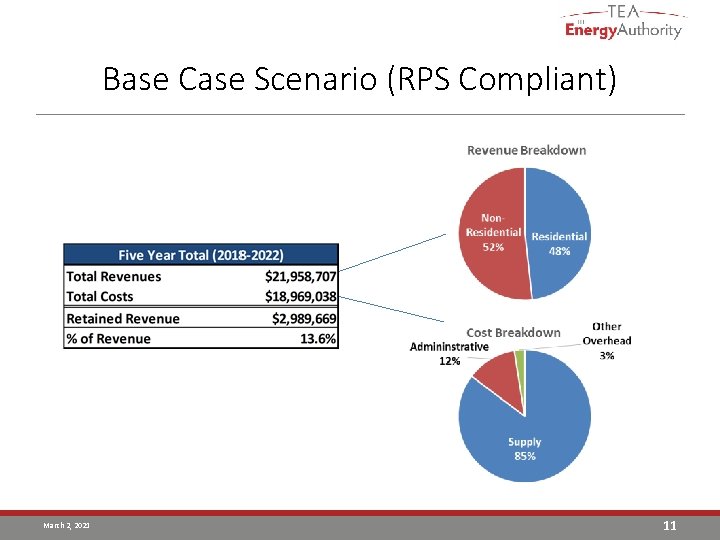
Base Case Scenario (RPS Compliant) March 2, 2021 11
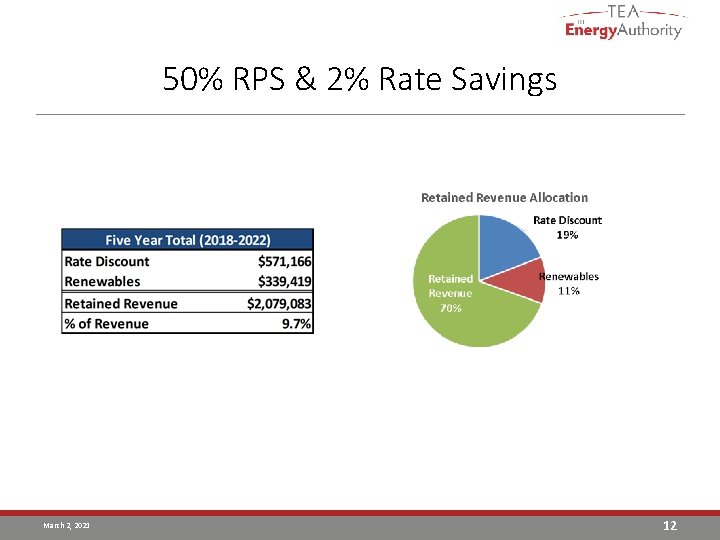
50% RPS & 2% Rate Savings March 2, 2021 12
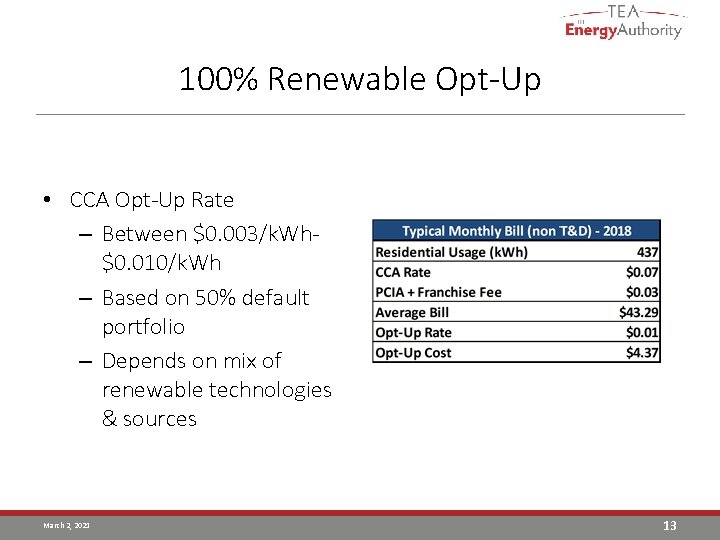
100% Renewable Opt-Up • CCA Opt-Up Rate – Between $0. 003/k. Wh$0. 010/k. Wh – Based on 50% default portfolio – Depends on mix of renewable technologies & sources March 2, 2021 13
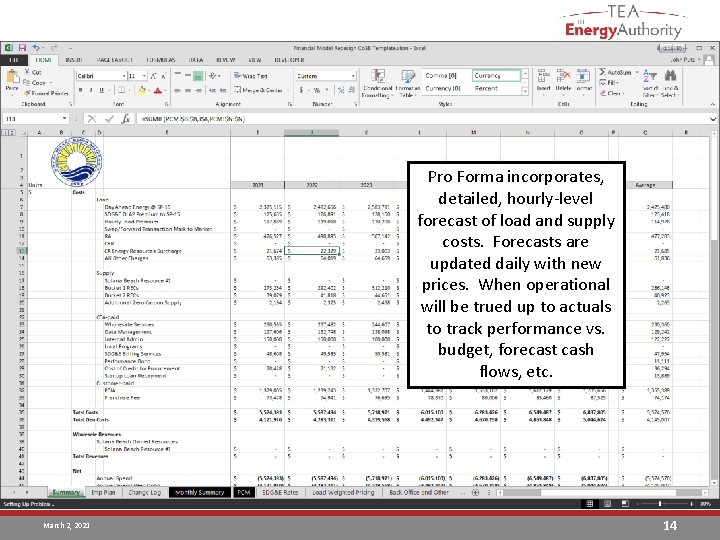
Pro Forma incorporates, detailed, hourly-level forecast of load and supply costs. Forecasts are updated daily with new prices. When operational will be trued up to actuals to track performance vs. budget, forecast cash flows, etc. March 2, 2021 14
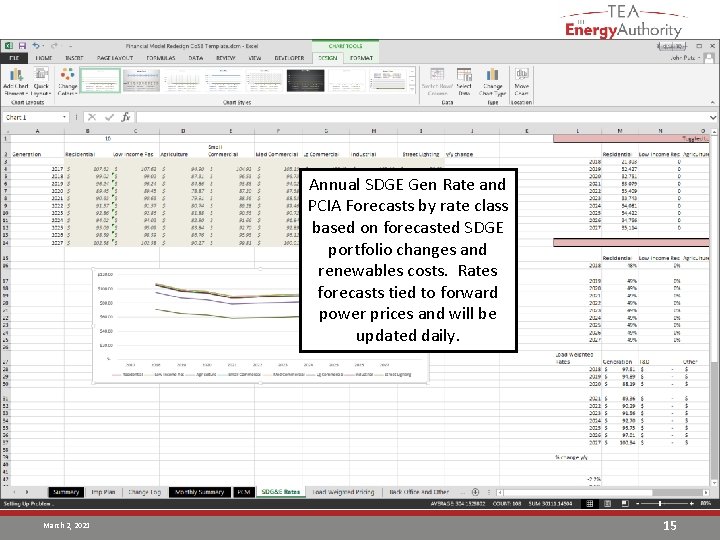
Annual SDGE Gen Rate and PCIA Forecasts by rate class based on forecasted SDGE portfolio changes and renewables costs. Rates forecasts tied to forward power prices and will be updated daily. March 2, 2021 15
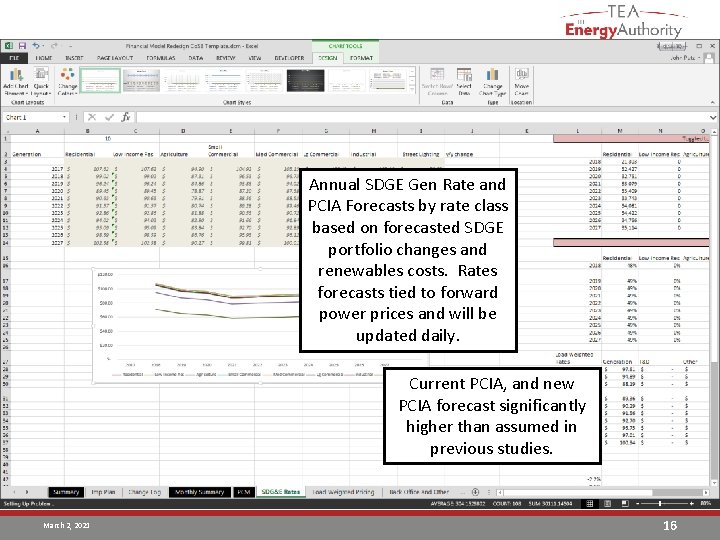
Annual SDGE Gen Rate and PCIA Forecasts by rate class based on forecasted SDGE portfolio changes and renewables costs. Rates forecasts tied to forward power prices and will be updated daily. Current PCIA, and new PCIA forecast significantly higher than assumed in previous studies. March 2, 2021 16
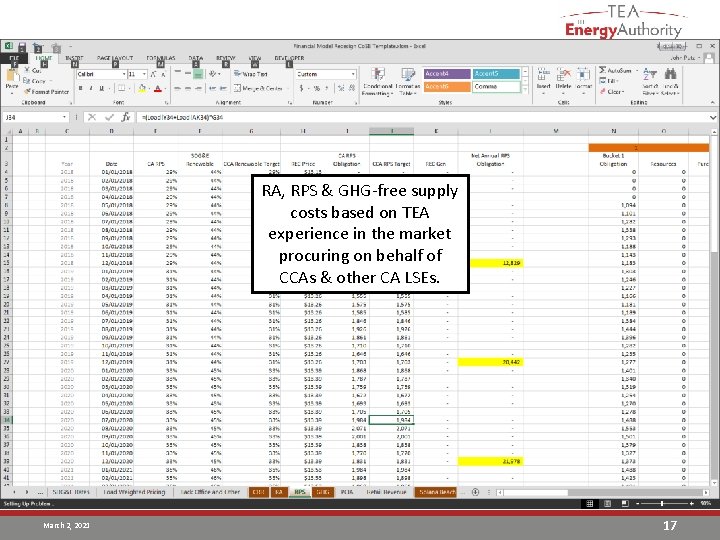
RA, RPS & GHG-free supply costs based on TEA experience in the market procuring on behalf of CCAs & other CA LSEs. March 2, 2021 17
PCIA Status • New CPUC Rulemaking on PCIA initiated this summer – Review, Revise & Consider Alternatives • IOUs contend not being fairly compensated for procurements made on behalf of departing load • CCAs contend process does not account for IOUs poor management of contracts/resources • Workshops begin in October • Decision targeted for July, 2018 March 2, 2021 18
Possible Outcomes • Status Quo or Reduced PCIA CCA continues to be feasible meeting all objectives • Somewhat Higher PCIA Manage by cutting costs; accruing reserves; raising rates but keeping competitive with SDG&E • Much higher PCIA CCA’s find it hard to maintain competitive rates; community determines if willing to pay more for local control & higher renewables March 2, 2021 19
CCA Outreach Efforts • Climate Action Plan Workshop #1 – Nov 2016 • Climate Action Plan Workshop #2 – May 2017 • Climate Action Commission Meetings – Standing monthly Agenda Item for CCA Discussion/Update • Developed a CCA Specific Website • Climate Action Commission Special CCA Presentation – July 19, 2017 • Civic and Historical Society Annual Meetings – 2016 and 2017 • Solana Eastside Community Group HOA Meetings – various monthly meetings and annual “General Meeting” in 2016 and 2017 20
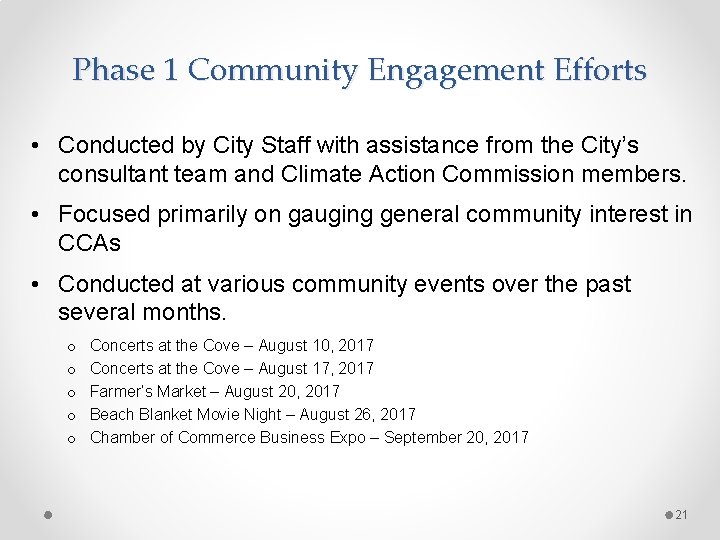
Phase 1 Community Engagement Efforts • Conducted by City Staff with assistance from the City’s consultant team and Climate Action Commission members. • Focused primarily on gauging general community interest in CCAs • Conducted at various community events over the past several months. o o o Concerts at the Cove – August 10, 2017 Concerts at the Cove – August 17, 2017 Farmer’s Market – August 20, 2017 Beach Blanket Movie Night – August 26, 2017 Chamber of Commerce Business Expo – September 20, 2017 21
Community Engagement Survey • Developed a basic survey to gauge community interest in implementing a CCA and, if interested, to assess the respondents’ priorities in developing the program. • Respondents not in favor of a CCA were asked to state their reasons for opposing a CCA. • To date, the City has received 108 responses 22
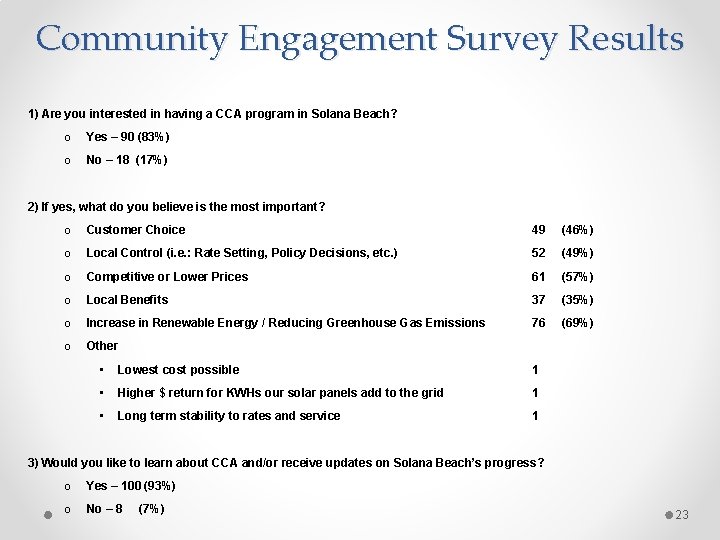
Community Engagement Survey Results 1) Are you interested in having a CCA program in Solana Beach? o Yes – 90 (83%) o No – 18 (17%) 2) If yes, what do you believe is the most important? o Customer Choice 49 (46%) o Local Control (i. e. : Rate Setting, Policy Decisions, etc. ) 52 (49%) o Competitive or Lower Prices 61 (57%) o Local Benefits 37 (35%) o Increase in Renewable Energy / Reducing Greenhouse Gas Emissions 76 (69%) o Other • Lowest cost possible 1 • Higher $ return for KWHs our solar panels add to the grid 1 • Long term stability to rates and service 1 3) Would you like to learn about CCA and/or receive updates on Solana Beach’s progress? o Yes – 100 (93%) o No – 8 (7%) 23
Community Engagement – Next Steps • If Council authorizes the City to move into Phases 2 and 3 of CCA development, many of the technical questions can be addressed including: o Potential rates o How the CCA might affect current solar customers (net energy metering) o Determining the renewable energy content options • A major focus of the Phases 2 and 3 outreach efforts will be engaging the business community. • At least one community workshop will be held to gather input from the community on CCA priorities 24
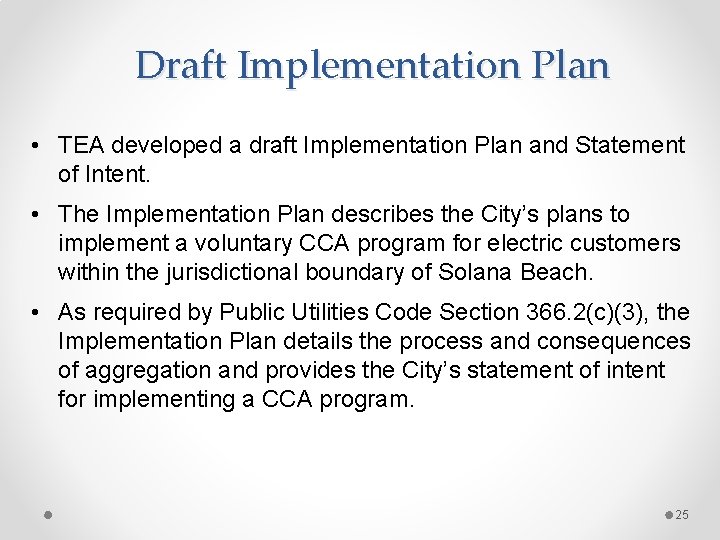
Draft Implementation Plan • TEA developed a draft Implementation Plan and Statement of Intent. • The Implementation Plan describes the City’s plans to implement a voluntary CCA program for electric customers within the jurisdictional boundary of Solana Beach. • As required by Public Utilities Code Section 366. 2(c)(3), the Implementation Plan details the process and consequences of aggregation and provides the City’s statement of intent for implementing a CCA program. 25
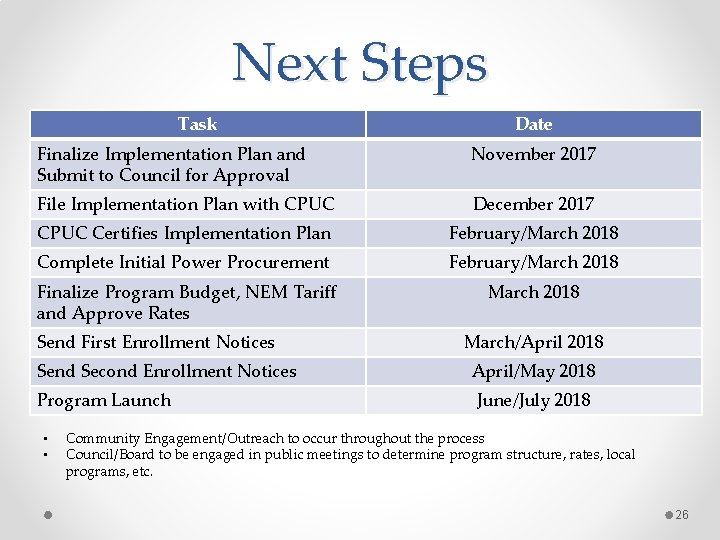
Next Steps Task Date Finalize Implementation Plan and Submit to Council for Approval November 2017 File Implementation Plan with CPUC December 2017 CPUC Certifies Implementation Plan February/March 2018 Complete Initial Power Procurement February/March 2018 Finalize Program Budget, NEM Tariff and Approve Rates March 2018 Send First Enrollment Notices March/April 2018 Send Second Enrollment Notices April/May 2018 Program Launch June/July 2018 • • Community Engagement/Outreach to occur throughout the process Council/Board to be engaged in public meetings to determine program structure, rates, local programs, etc. 26
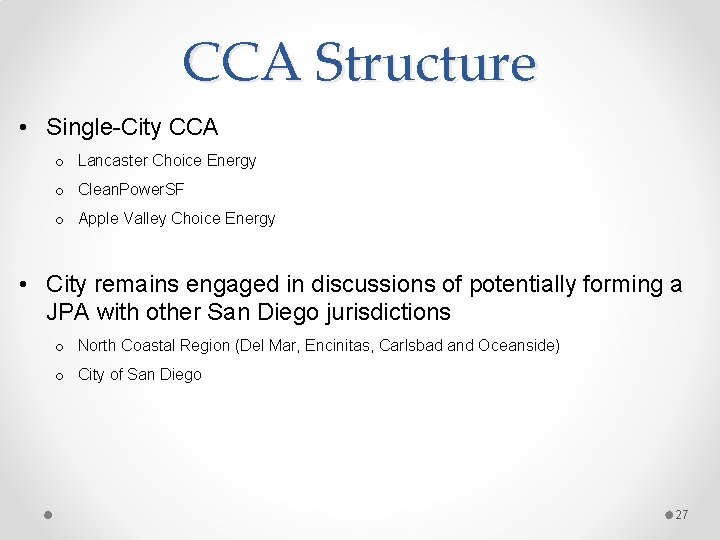
CCA Structure • Single-City CCA o Lancaster Choice Energy o Clean. Power. SF o Apple Valley Choice Energy • City remains engaged in discussions of potentially forming a JPA with other San Diego jurisdictions o North Coastal Region (Del Mar, Encinitas, Carlsbad and Oceanside) o City of San Diego 27
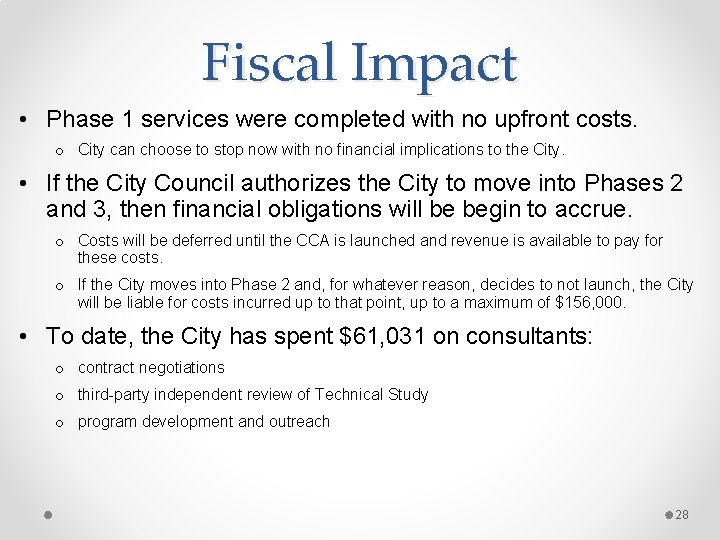
Fiscal Impact • Phase 1 services were completed with no upfront costs. o City can choose to stop now with no financial implications to the City. • If the City Council authorizes the City to move into Phases 2 and 3, then financial obligations will be begin to accrue. o Costs will be deferred until the CCA is launched and revenue is available to pay for these costs. o If the City moves into Phase 2 and, for whatever reason, decides to not launch, the City will be liable for costs incurred up to that point, up to a maximum of $156, 000. • To date, the City has spent $61, 031 on consultants: o contract negotiations o third-party independent review of Technical Study o program development and outreach 28
Staff Recommendation • Staff recommends the City Council consider authorizing the City to move into Phases 2 and 3 of CCA program development and implementation 29