
Community Cat Program Humane Society of Huron Valleys



- Slides: 55
Community Cat Program Humane Society of Huron Valley’s Trap-Neuter-Return(TNR) Program Cheryl Szkutnicki cheryls@hshv. org or (734) 661 -3523 Humane Society of Huron Valley
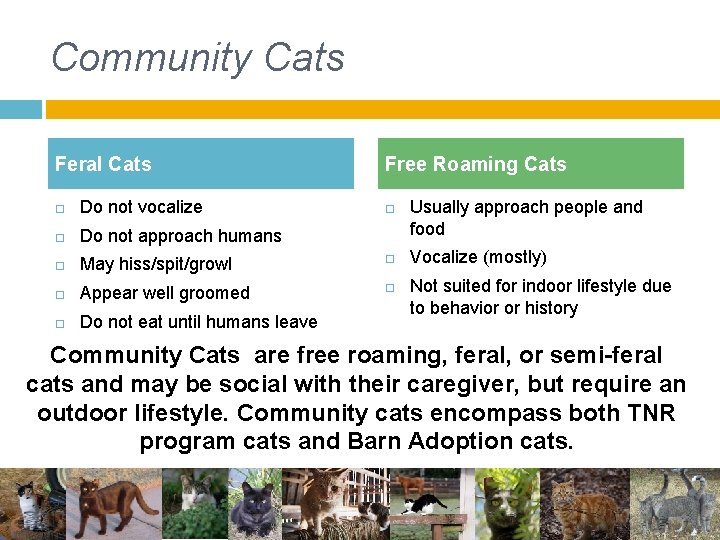
Community Cats Feral Cats Free Roaming Cats Do not vocalize Do not approach humans May hiss/spit/growl Appear well groomed Do not eat until humans leave Usually approach people and food Vocalize (mostly) Not suited for indoor lifestyle due to behavior or history Community Cats are free roaming, feral, or semi-feral cats and may be social with their caregiver, but require an outdoor lifestyle. Community cats encompass both TNR program cats and Barn Adoption cats.
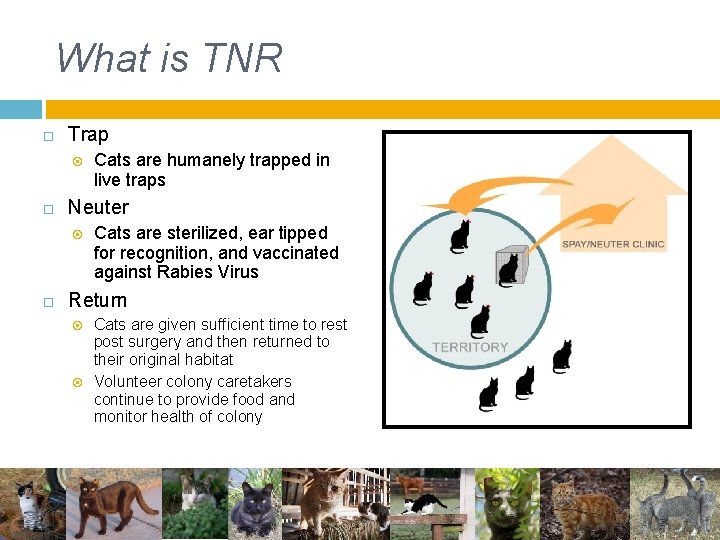
What is TNR Trap Neuter Cats are humanely trapped in live traps Cats are sterilized, ear tipped for recognition, and vaccinated against Rabies Virus Return Cats are given sufficient time to rest post surgery and then returned to their original habitat Volunteer colony caretakers continue to provide food and monitor health of colony
No Effective Alternatives Trap & Kill Does Not Work! The leading cause of cat death in shelters is euthanasia. Education of Community Education of Staff Do Nothing Does Not Work! Cats will continue to breed Lack of food, cats start to become destructive Cats and their offspring become very ill
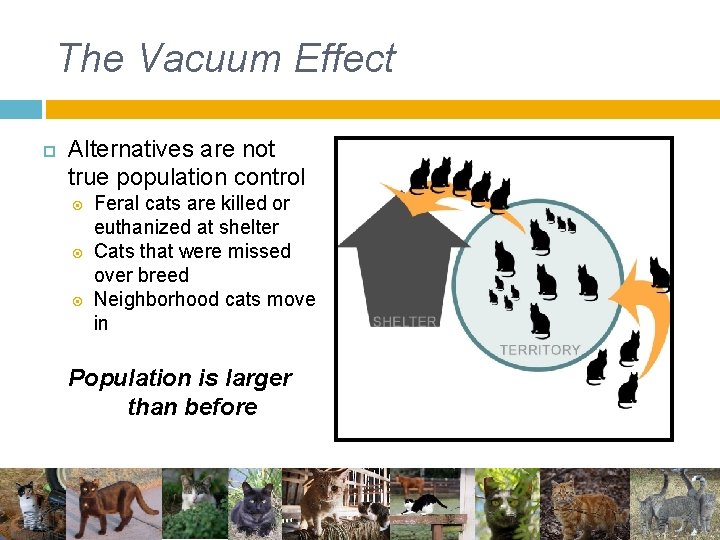
The Vacuum Effect Alternatives are not true population control Feral cats are killed or euthanized at shelter Cats that were missed over breed Neighborhood cats move in Population is larger than before
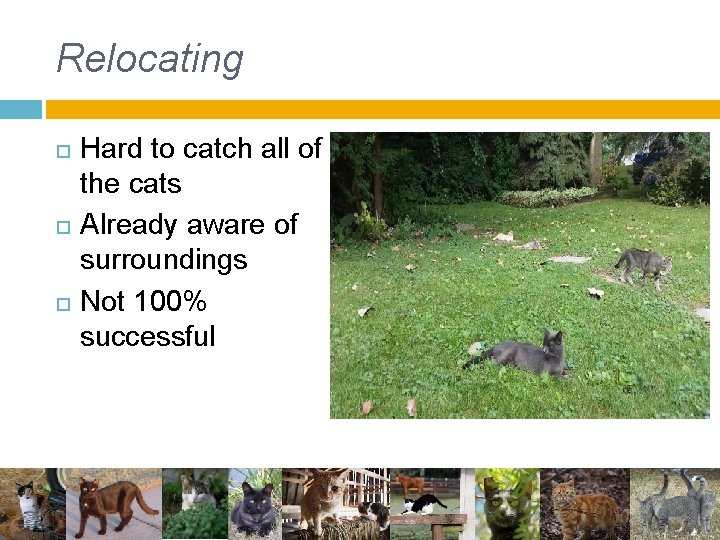
Relocating Hard to catch all of the cats Already aware of surroundings Not 100% successful
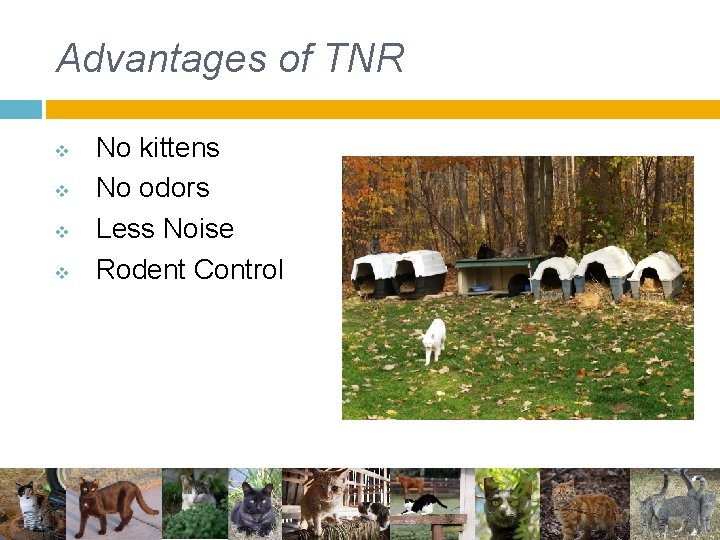
Advantages of TNR v v No kittens No odors Less Noise Rodent Control
HSHV’s Policy Evolution Like many shelters, we used to accept feral cats for euthanasia. Created the TNR program in 2007. In 2007 we accepted over 1, 200 feral cats for euthanasia, in 2008 we accepted over 500, and in 2009 we accepted 2. We no longer accept free roaming cats for euthanasia. Since 2007 we have sterilized nearly 10, 000 community cats!!
5 Steps to TNR 1. 2. 3. 4. 5. Build community relations Prepare for trapping Trap Surgery Recovery and release
The First Step Build community Relations
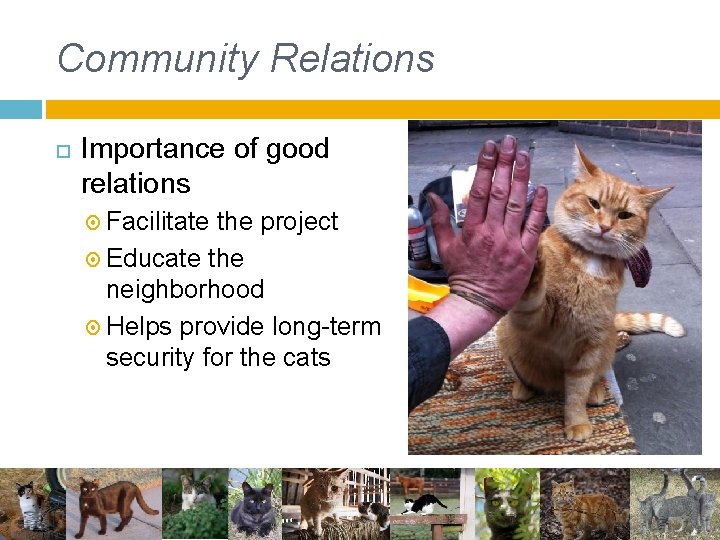
Community Relations Importance of good relations Facilitate the project Educate the neighborhood Helps provide long-term security for the cats
Achieve Good Relations Educate yourself on TNR Gather information Get to know your neighbors and who feeds the cats Post flyers announcing the program and seeking help Repeat the mantra: no kittens, no noise, less smell, rodent control
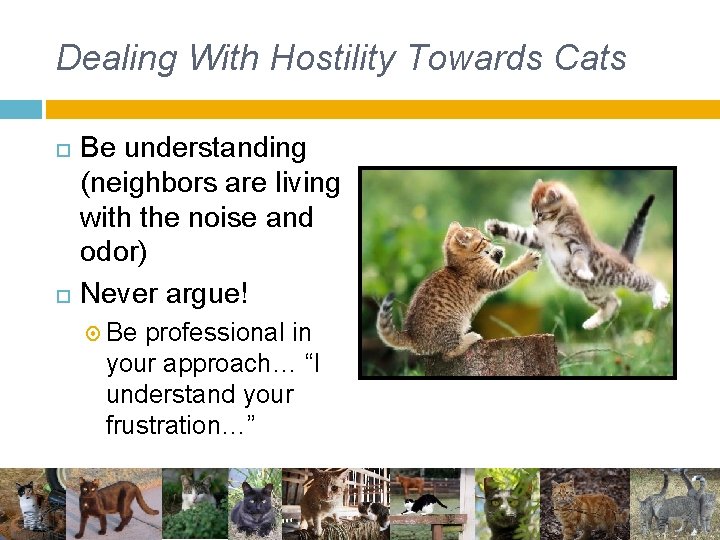
Dealing With Hostility Towards Cats Be understanding (neighbors are living with the noise and odor) Never argue! Be professional in your approach… “I understand your frustration…”
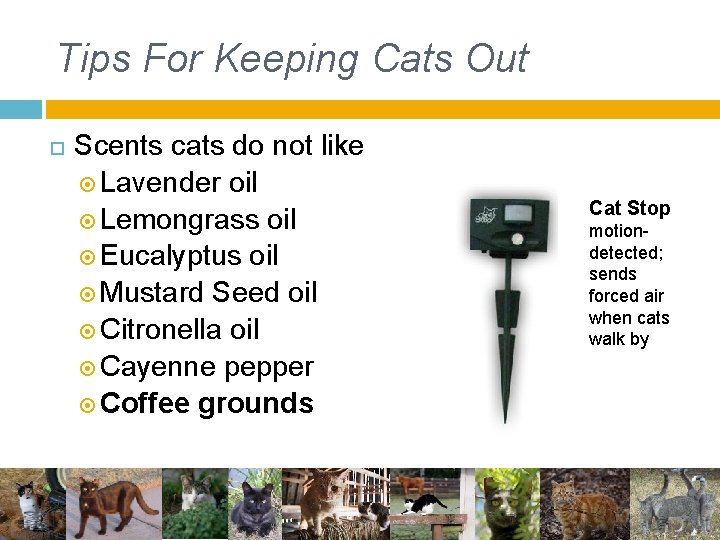
Tips For Keeping Cats Out Scents cats do not like Lavender oil Lemongrass oil Eucalyptus oil Mustard Seed oil Citronella oil Cayenne pepper Coffee grounds Cat Stop motiondetected; sends forced air when cats walk by
Tips For Keeping Cats Out, Cont. Cover up cat urine smells with white vinegar or with non-toxic products available at pet supply stores Textural deterrents: rough rocks, chicken wire Once you are certain the cats are not inside, physically block or seal the location the cats are entering with chicken wire or lattice Be sure to search for kittens before confirming the cats have left
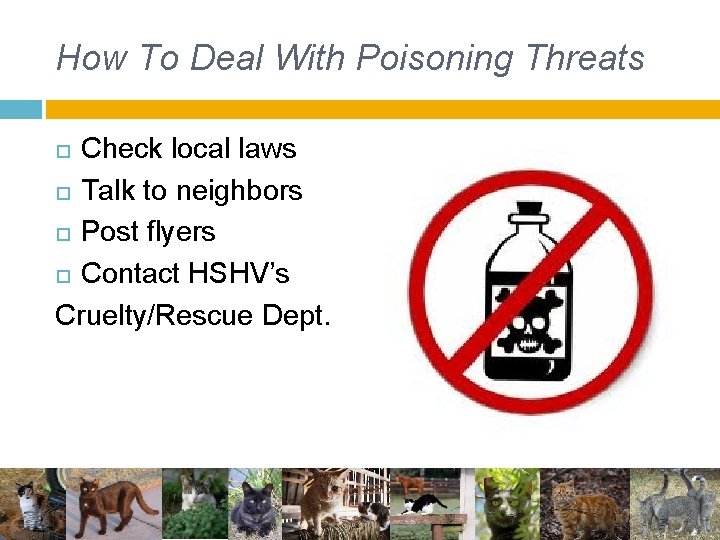
How To Deal With Poisoning Threats Check local laws Talk to neighbors Post flyers Contact HSHV’s Cruelty/Rescue Dept.
The Second Step Prepare For Trapping
Different Types Of Trappings Private Trapping Volunteer Trapping Caregiver rents trap or use their own, catch cats, bring in on their own Volunteers are scheduled to assist with private trappings of 1 -10 cats Coordinator Trapping Community Cat Coordinator (with caretaker and/or volunteer assistance) performs large scale trappings
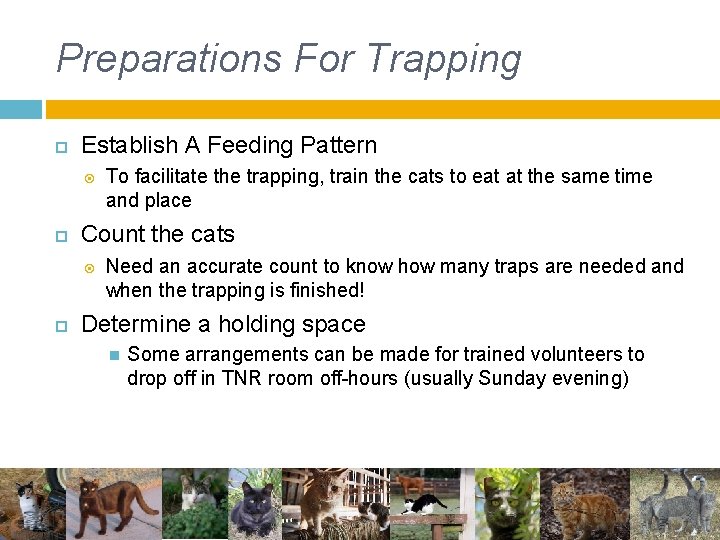
Preparations For Trapping Establish A Feeding Pattern Count the cats To facilitate the trapping, train the cats to eat at the same time and place Need an accurate count to know how many traps are needed and when the trapping is finished! Determine a holding space Some arrangements can be made for trained volunteers to drop off in TNR room off-hours (usually Sunday evening)
Spay/Neuter Info All cats must be brought in humane traps and covered Clinic drop off times are Monday- Thursday from 8 am 7 pm No appointment needed but notify Coordinator ahead of time if bringing in several cats Trap rentals are $75 ($65 refundable) Sterilization and vaccination fee $20 per cat for Washtenaw County residents $75 per cat for out of county
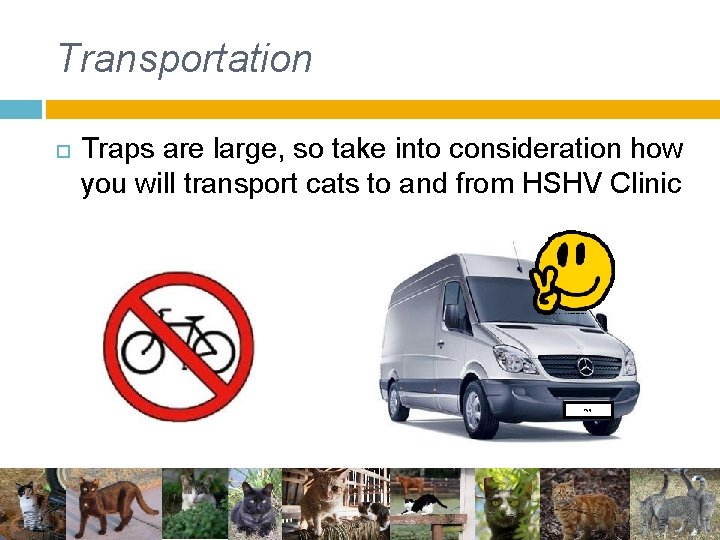
Transportation Traps are large, so take into consideration how you will transport cats to and from HSHV Clinic TNR
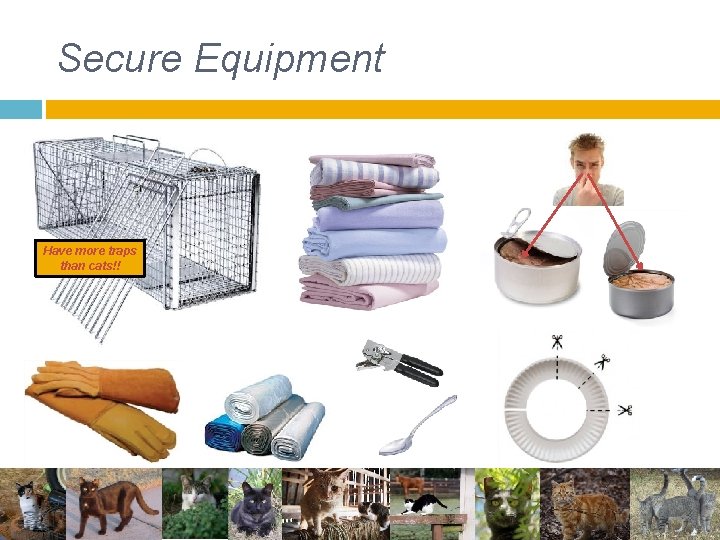
Secure Equipment Have more traps than cats!!
The Third Step Trap
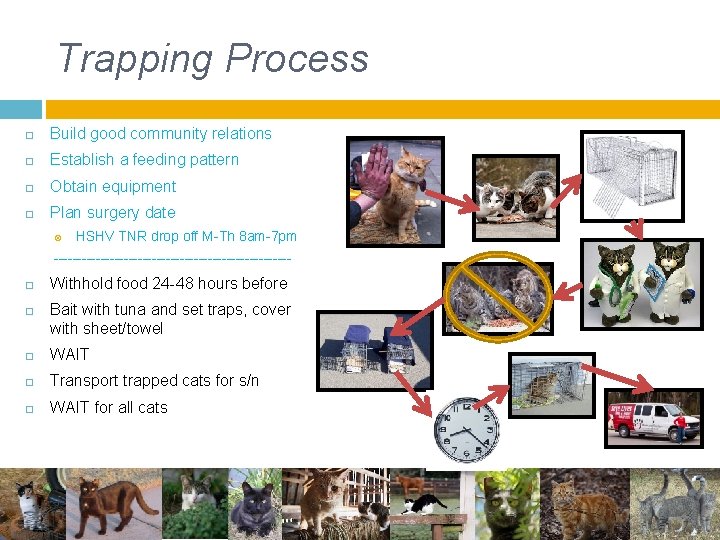
Trapping Process Build good community relations Establish a feeding pattern Obtain equipment Plan surgery date HSHV TNR drop off M-Th 8 am-7 pm ------------------------- Withhold food 24 -48 hours before Bait with tuna and set traps, cover with sheet/towel WAIT Transport trapped cats for s/n WAIT for all cats
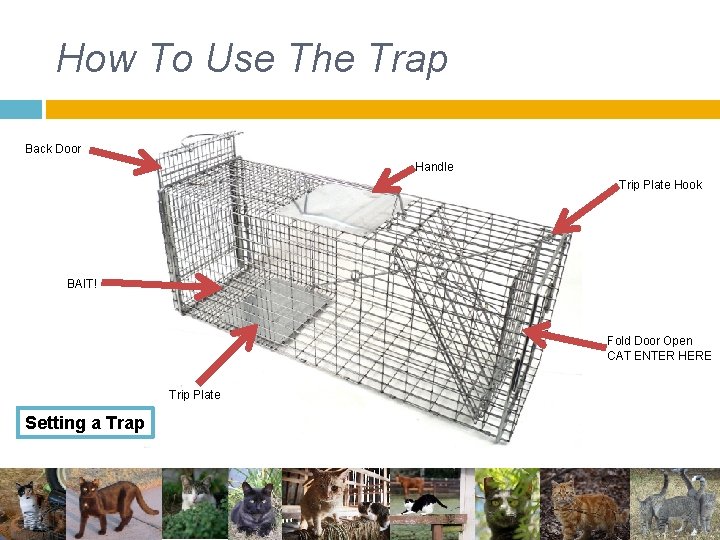
How To Use The Trap Back Door Handle Trip Plate Hook BAIT! Fold Door Open CAT ENTER HERE Trip Plate Setting a Trap
So You Trapped A Cat? If the cat becomes frantic, cover and move the trap out of sight of the other cats (dark, quiet place) If the cat is calm, leave the trap alone while trapping is underway Place a new trap where the old trap was Hot spots
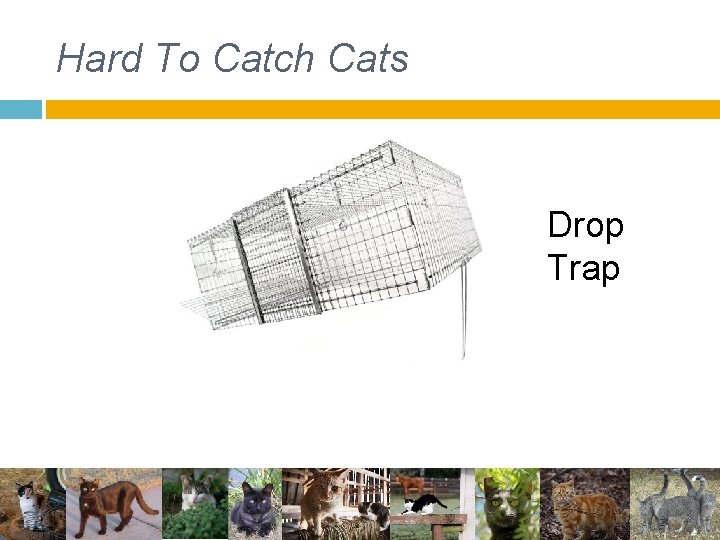
Hard To Catch Cats Drop Trap
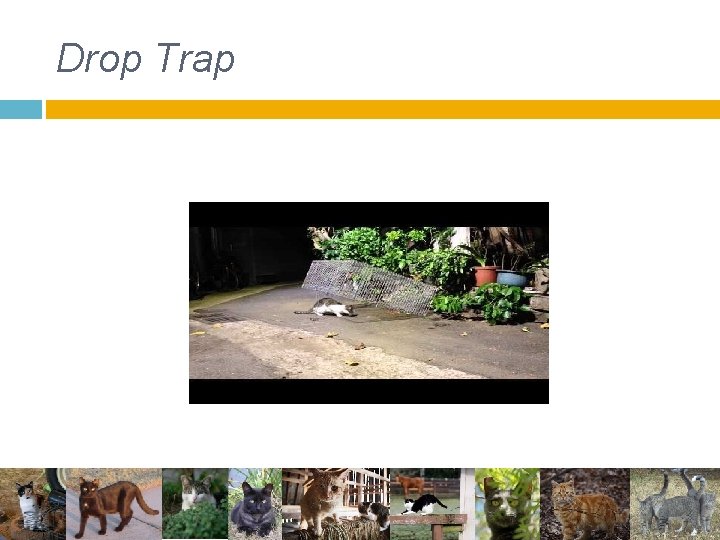
Drop Trap
How To Handle Escape & Injuries Never attempt to recapture a cat with your bare hands Consult a medical doctor for bites and scratches Bacteria
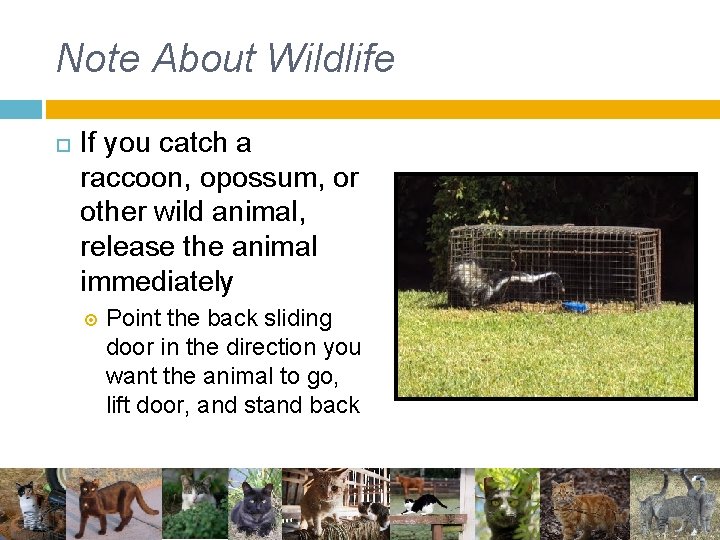
Note About Wildlife If you catch a raccoon, opossum, or other wild animal, release the animal immediately Point the back sliding door in the direction you want the animal to go, lift door, and stand back
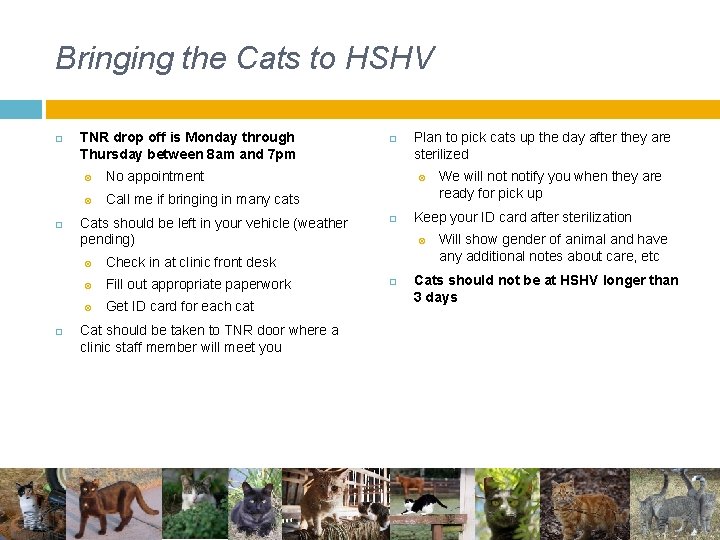
Bringing the Cats to HSHV TNR drop off is Monday through Thursday between 8 am and 7 pm No appointment Call me if bringing in many cats Cats should be left in your vehicle (weather pending) Check in at clinic front desk Fill out appropriate paperwork Get ID card for each cat Cat should be taken to TNR door where a clinic staff member will meet you Plan to pick cats up the day after they are sterilized Keep your ID card after sterilization We will notify you when they are ready for pick up Will show gender of animal and have any additional notes about care, etc Cats should not be at HSHV longer than 3 days
The Fourth Step Surgery
Sterilization Spay Neuter Female cats More invasive so penicillin injection administered to help with healing Male cats Less invasive Both Males and Females get Metacam injection to help with pain.
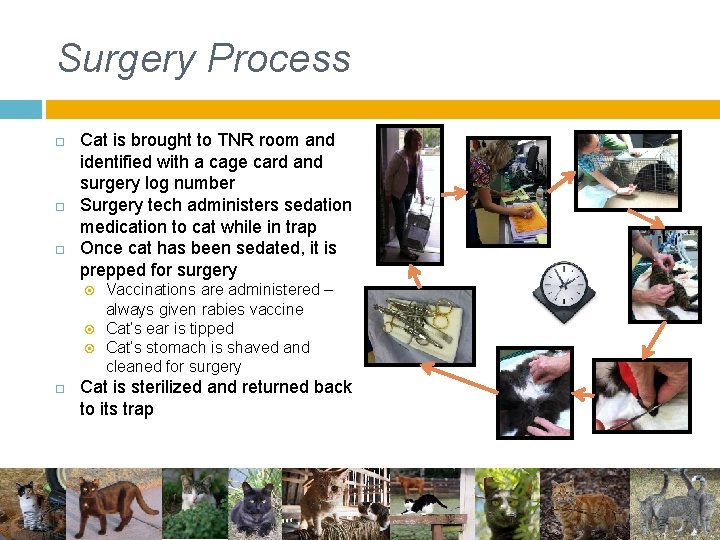
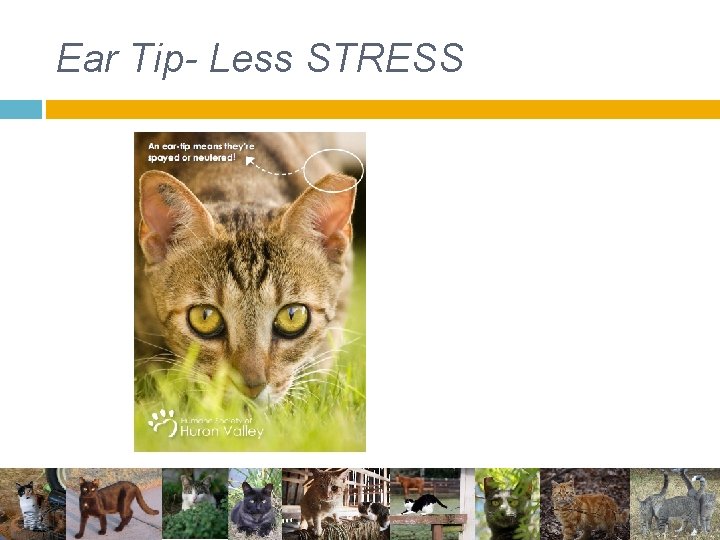
Surgery Process Cat is brought to TNR room and identified with a cage card and surgery log number Surgery tech administers sedation medication to cat while in trap Once cat has been sedated, it is prepped for surgery Vaccinations are administered – always given rabies vaccine Cat’s ear is tipped Cat’s stomach is shaved and cleaned for surgery Cat is sterilized and returned back to its trap
Ear Tip- Less STRESS
The Fifth Step Recovery and Release
Recovery Cats do fine with recovering in their trap. Do NOT attempt to transfer any feral cat from a trap into a carrier An absorbent pad is placed under the trap Given food and water once fully awake As always, be careful not to get bitten or scratched. The cat should be left covered, quiet place Any time you are in the TNR room, please respect the dim light and make as little noise as possible. Free roaming cats stress easily.
Release All cats will be held overnight for recovery If awake and alert, cats found lactating will be immediately released Plan on picking cat(s) up the following day, post surgery
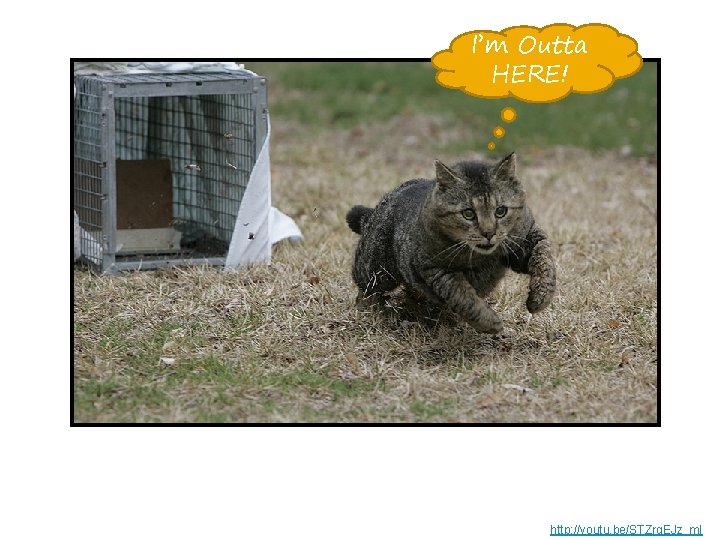
I’m Outta HERE! http: //youtu. be/STZrg. EJz_m. I
Long Term Care Food, Shelter & Weather
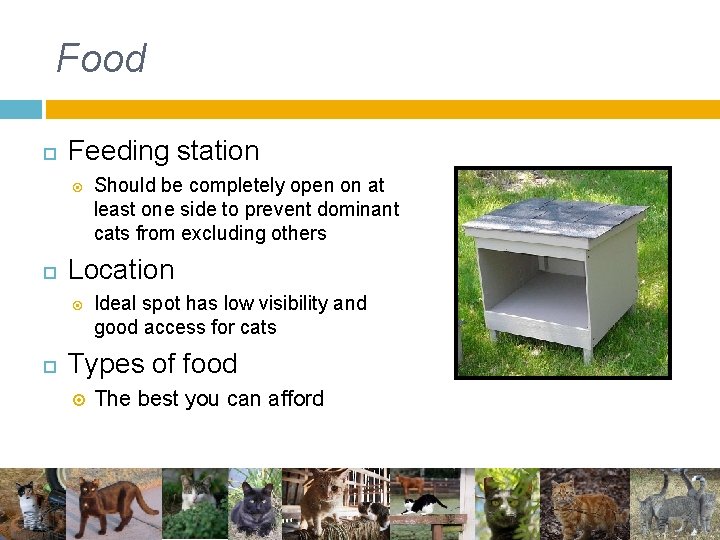
Food Feeding station Location Should be completely open on at least one side to prevent dominant cats from excluding others Ideal spot has low visibility and good access for cats Types of food The best you can afford
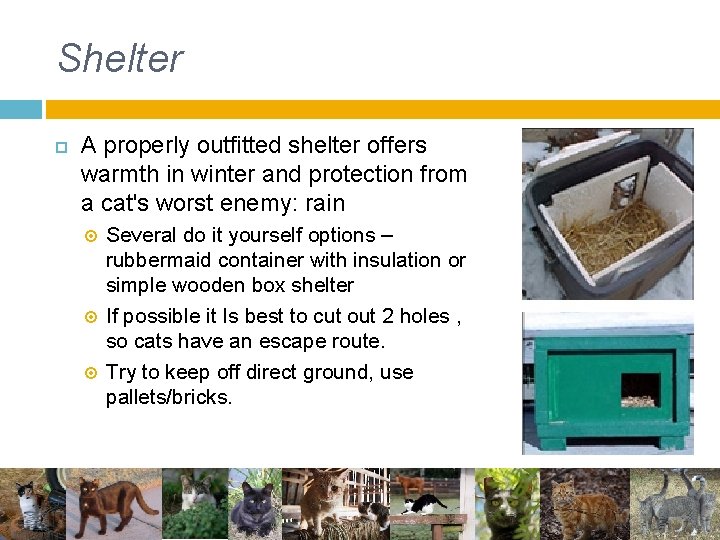
Shelter A properly outfitted shelter offers warmth in winter and protection from a cat's worst enemy: rain Several do it yourself options – rubbermaid container with insulation or simple wooden box shelter If possible it Is best to cut out 2 holes , so cats have an escape route. Try to keep off direct ground, use pallets/bricks.
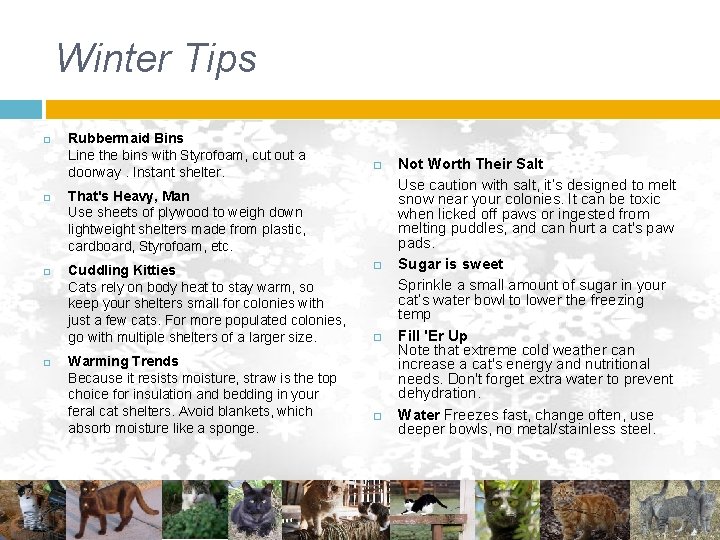
Winter Tips Rubbermaid Bins Line the bins with Styrofoam, cut out a doorway. Instant shelter. That's Heavy, Man Use sheets of plywood to weigh down lightweight shelters made from plastic, cardboard, Styrofoam, etc. Cuddling Kitties Cats rely on body heat to stay warm, so keep your shelters small for colonies with just a few cats. For more populated colonies, go with multiple shelters of a larger size. Warming Trends Because it resists moisture, straw is the top choice for insulation and bedding in your feral cat shelters. Avoid blankets, which absorb moisture like a sponge. Not Worth Their Salt Use caution with salt, it’s designed to melt snow near your colonies. It can be toxic when licked off paws or ingested from melting puddles, and can hurt a cat's paw pads. Sugar is sweet Sprinkle a small amount of sugar in your cat’s water bowl to lower the freezing temp Fill 'Er Up Note that extreme cold weather can increase a cat's energy and nutritional needs. Don't forget extra water to prevent dehydration. Water Freezes fast, change often, use deeper bowls, no metal/stainless steel.
A Note About Wildlife To deter wildlife from cat feeding stations, only feed at set times of the day and remove cat food at other times. For the health and safety of wild animals, it’s best not to habituate them to cat food handouts Feeding in the morning only can help deter wildlife as well, as they usually feed at night
FIV/Fe. LV Humans cannot catch or transmit these viruses. Not all cats that become infected will develop disease. FIV- Feline Immunodeficiency Virus Progresses very slowly, gradually affecting a cat's immune system It is passed through blood transfusions and through serious, penetrating bite wounds - mainly by stray, intact tom cats Once cat is fixed, little to no chance of transfer Fe. LV- Feline Leukemia Virus Causes anemia and lymphoma Can also suppress the cat’s immune system, affecting his/her ability to fight off bacteria, viruses and fungi that contribute to other serious health problems. It is passed through urine, feces, milk from mother, bite wounds, and very large quantities of saliva. HSHV does not test for FIV/Fe. LV in community cats.
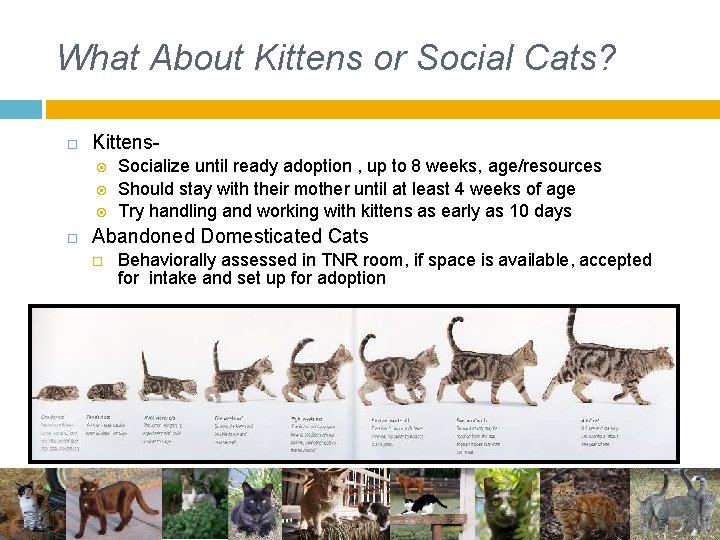
What About Kittens or Social Cats? Kittens Socialize until ready adoption , up to 8 weeks, age/resources Should stay with their mother until at least 4 weeks of age Try handling and working with kittens as early as 10 days Abandoned Domesticated Cats Behaviorally assessed in TNR room, if space is available, accepted for intake and set up for adoption
More about Kittens should stay will mom until weaned, around 6 weeks. 6 -8 weeks is best time to try to socialize , if seen at that time. Longer outside , the more acclimated to outdoors.
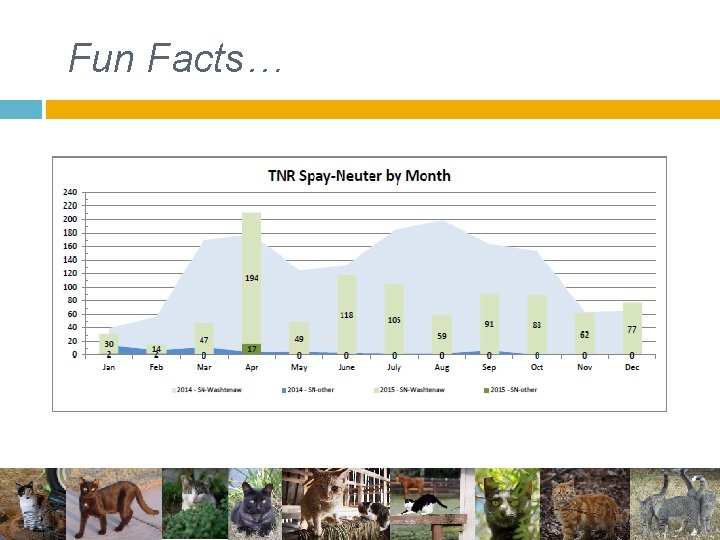
Fun Facts…
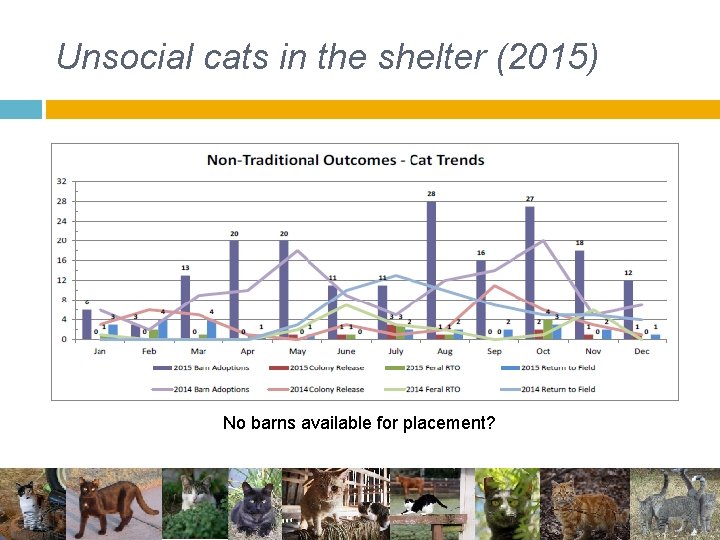
Unsocial cats in the shelter (2015) No barns available for placement?
HSHV HAPPENINGS!
2016 Pet. Smart Charities “Community Catch” blitz: April 2016 Sterilize 200 community cats through HSHV’s TNR program for FREE- All areas Met our goal with 211 in 2015
WE WANT YOU!
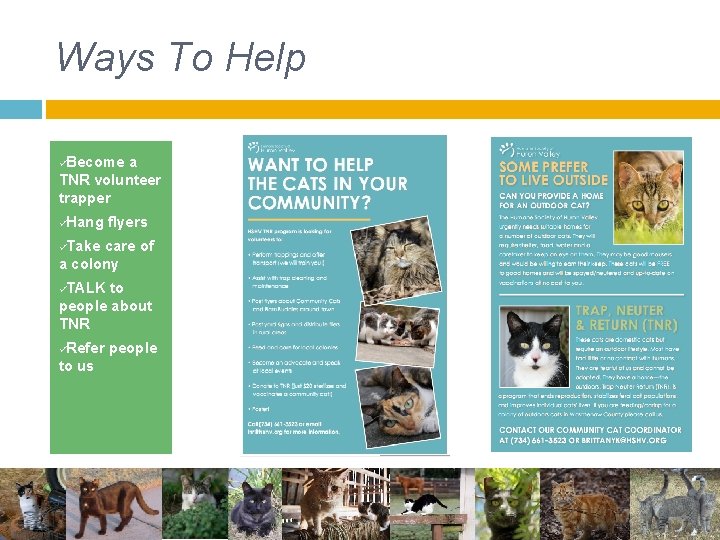
Ways To Help üBecome a TNR volunteer trapper üHang flyers üTake care of a colony üTALK to people about TNR üRefer to us people
Questions?