
Community Capacity Building Program Leadership and Motivation Learning
Community Capacity Building Program Leadership and Motivation
Learning Objectives • Understanding the relationship between leadership and motivation • Motivation through a psychological framework • Leadership theories/styles • Participative leadership • Qualities of successful leaders
Introduction 2 major influences affect how individuals perform: 1. The type of leadership that exists 2. Personal motivation • Important to look at these two concepts as interconnected and dependent on individual situations
What is motivation? • Motivation is defined as “the extent to which persistent effort is directed toward a goal” 1. Effort - must be defined in relation to its appropriateness to the objectives being pursued. 2. Persistence - relates to the willingness of the individual to stay with a task until it is complete 3. Direction - measured in terms of how persistent effort is applied in relation to the goals being pursued 4. Goals - individual goals and organizational goals (must be compatible)
Types of motivation • Extrinsic Motivation - Factors in the external environment such as pay, supervision, benefits, and job perks • Intrinsic Motivation - Relationship between the worker and the task
5 Ways to Motivate a Team 1. Figure out what makes them tick (individual needs) 2. Give clear expectations 3. Consistent reinforcement and consequences 4. Healthy competition 5. Change out team members
Activity 1 – Identifying Goals • Create a thought web linking current and future goals of the organization to internal or external motivators • Example: Goal: Increase sales by 10% Motivators: Top seller receives financial bonus if goal is reached (extrinsic) Top seller gets to choose their next project (allowing seller to pursue work-based interest would increase intrinsic motivation)
Needs-based Motivation • Maslow’s Hierarchy of Needs: Ø Ø Ø Physiological Safety Relationship Esteem Self-actualization • The more you move from basic to higher level needs, the more motivation depends on internal factors • Important that organizations present opportunities to satisfy such needs
Needs-based Motivation • Alderfer’s ERG Theory: Ø Existence Ø Relatedness Ø Growth • Similar to Maslow’s Hierarchy in that it focuses on a differing levels of needs, which are usually satisfied in order of importance • Unlike Maslow’s theory in that it allows for higher needs to be met before lower-level needs under certain circumstances
Needs-based Motivation • Mc. Clelland’s Theory of Needs: Ø Achievement Ø Affiliation Ø Power • Concerned with the behavioral consequences of need • Non-hierarchical
Needs-based Motivation • These three theories present a useful approach for thinking about organizational behavior • One is not inherently better than the other; The point is to apply the concepts of internal/external motivation to individual situations
Motivational Goals Most goals fall within two categories: • Performance goal - individual is concerned with acquiring favorable judgment from his or her peers, supervisors, or authority figures (extrinsic) • Learning goal - individual uses feedback to increase his or her competence (intrinsic)
Activity 2 – Needs and Motivation • In small groups, answer the following questions: 1. Whose needs are satisfied through my organization? (Owners, employees, clients, etc. ) 2. What are some needs of each group? (Relatedness? Achievement? ) 3. What is the best way to address those needs to reach goals?
Leadership • Once it is known what motivates people, leadership can be thought of in relation to individual situations • Two main types of leaders: Ø Emergent Ø Assigned
Leadership – Shaping Behavior • Rewards – the most effective type of reinforcement Ø E. g. Compliments, tangible benefits, etc. • Punishments – have minimal impact on behaviour Ø E. g. Reprimands, withholding of raises, unfavorable task assignments, etc.
Leadership Styles • Directive - includes scheduling work, maintaining performance standards, and letting subordinates know what is expected from them • Supportive - friendly, approachable, and concerned with pleasant interpersonal relationships. • Participative – leaders will consult with their subordinates, and consider their opinions. • Achievement-oriented - encourages subordinates to exert higher efforts and strive for a higher level of goal accomplishment.
Situational Factors • 2 major situational factors affecting leader success: Ø Subordinate Characteristics – aptitude, individual needs Ø Environmental factors – task urgency, clarity, appropriateness of leader’s style to the situation, timing
Participative Leadership • Has a wide range of applications – Can have total involvement of subordinates in implementation, planning, etc. • Possible benefits of participation: Ø Motivation Ø Quality Ø Acceptance • Possible Pitfalls Ø Requires a lot of time and energy Ø Resentment • Best to use this style when employees are part of a team for an extended period and are knowledgeable/proficient
Leadership Styles • Vroom and Jago’s styles: Ø Autocratic Ø Consultative Ø Group
Qualities of Successful Leaders • • Intellectual Stimulation Energy Self-confidence Assertiveness Dominance Motivation Honesty and Integrity Charisma
Final Activity – Leadership Considerations • Through other activities, goals, needs, and possible motivators were identified. Now, take time in groups to discuss the best leadership style for one’s own situation. • Questions to consider: Ø How involved do others need or want to be? Ø Is participative leadership an option? Why or why not? Ø What environmental considerations are there? Are there external influences? Ø Is it possible to adapt your leadership style to different situations? Give examples
Participants’ Input
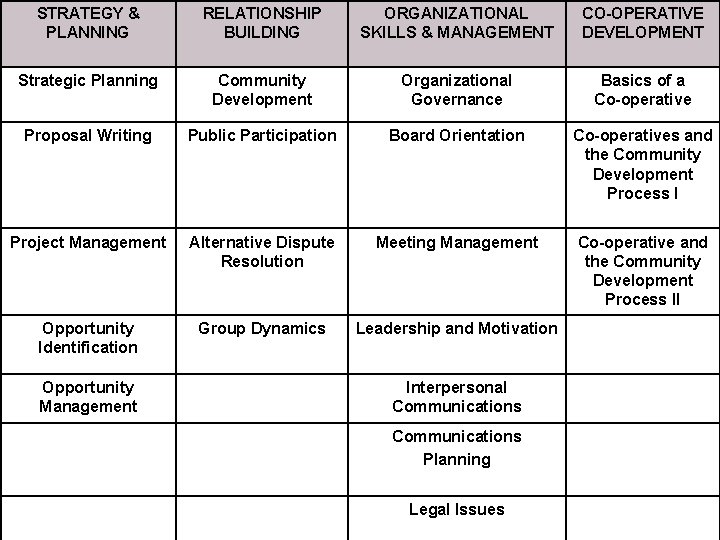
STRATEGY & PLANNING RELATIONSHIP BUILDING ORGANIZATIONAL SKILLS & MANAGEMENT CO-OPERATIVE DEVELOPMENT Strategic Planning Community Development Organizational Governance Basics of a Co-operative Proposal Writing Public Participation Board Orientation Co-operatives and the Community Development Process I Project Management Alternative Dispute Resolution Meeting Management Co-operative and the Community Development Process II Opportunity Identification Group Dynamics Leadership and Motivation Opportunity Management Interpersonal Communications Planning Legal Issues
Conclusion and Evaluation • • • Review objectives Review any additional expectations Review Parking Lot Point out Certificates of Participation Complete evaluation Thank you! Community Capacity Building Program http: //www. ibrd. gov. nl. ca/regionaldev/capacitybuilding. html
- Slides: 24