
COMMUNITY BASED MONITORING SYSTEM Project Title CBMS EDUCATION
COMMUNITY BASED MONITORING SYSTEM Project Title : CBMS – EDUCATION SYSTEM IN PROJECT PRESENTATION ZAMBIA– the Case of Lunchu Ward in kapirimposhi Name: KABUNGO JUSTINE SIN: 1505225015 Programme : MASTERS IN EDUCATION 1
PROJECT DETAILS Study type § Initiators § Year § § § GEOGRAPHICAL Location District Constituency Ward : CBMS SCHOOLS Survey : ICU and ZRDC : 2016 CHARACTERISTICS : Central Province : KAPIRIMPOSHI : LUNCHU 2
INTRODUCTION � KAPIRIMPOSHI is the largest town in terms of size and population in Zambia. With a population of 54, 194 (2010 census provisional) KAPIRIMPOSHI is one of the most developed commercial and industrial areas in the nation, alongside Ndola and livingstone. It is where Kapiri glass factory is situated. KAPIRIMPOSHI is made up of townships and suburban areas including Lubuto, Fitalo, Chankomo, Kmbosha, Matuka, kanendele, lunchu and Yongwe, to mention a few. 1. 3(CSO 2000)
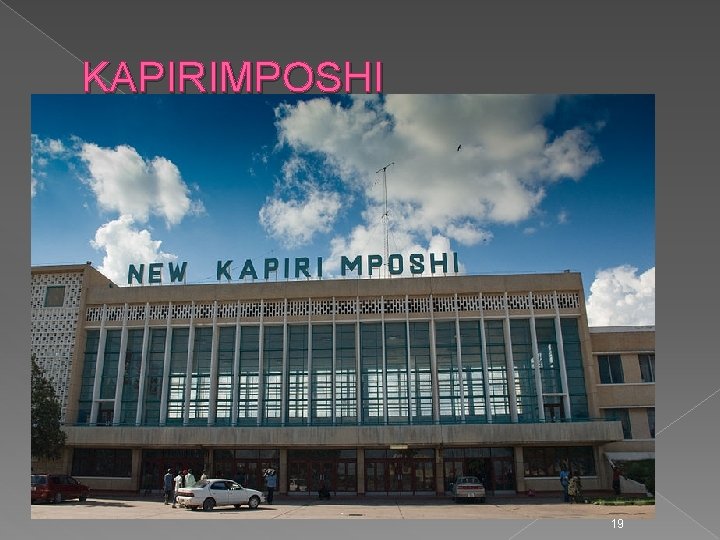
Kapiri Mposhi is a town Zambian town, seat of the Kapiri Mposhi District, Central Province. Located north of Lusaka, it stands on the Great North Road and is significant for the railway connection between Zambia Railways line from Kitwe to Lusaka and Livingstone and western terminal (New Kapiri Mposhi) of the Tanzania-Zambia Railway Authority from Dar es Salaam since 1976. � The town lies in the middle of Zambia, next to the borders with Copperbelt Province. The homonym district borders with the ones of Chibombo, Chisamba, Kabwe, Luano, Masaiti, Mkushi, Mpongwe and Ngabwe. � 4
Transport Kapiri Mposhi has two railways stations, a TAZARA Railway station that connects it to Dar-es-Salaam and a Zambia Railways stations that connects it to Lusaka and Livingstone. The TAZARA Railway station is considerably larger and more modern than the Zambia Railways station. Just north of the town, there is a major junction, with the road north to Mkushi, Serene, and the Tanzanian border going north-eastwards, and the road to the Copperbelt heading to the north west. This, combined with the railway links, makes Kapiri Mposhi an important point in the regional freight network. 5
INTRODUCTION CONT. � KAPIRIMPOSHI has both Private and Public schools which include Lubuto, Fitalo, Chankomo, Kmbosha, Matuka, kanendele, lunchu and Yongwe School. 6
INTROD…. . � KAPIRIMPOSHI was founded in 1935 in north-central Zambia as the railway was being built by Cecil Rhodes' company. It was first established as an adjunct, non-mining-related but supportive part of an expanding copper-mining centre at Nkana. The expanding copper mines at Nkana made it the dominant centre in the region and KAPIRIMPOSHI started building up its size and significance over the years, finally surpassing Nkana as the main centre. The Rhodesia Railways main line reached the town in 1937, providing passenger services as far south as Bulawayo, with connections to Cape Town. The line was extended into DR Congo, and from there eventually linked to the Benguela Railway to the Atlantic port of Lobito, which used to take some of Zambia's copper exports but is currently closed. 7
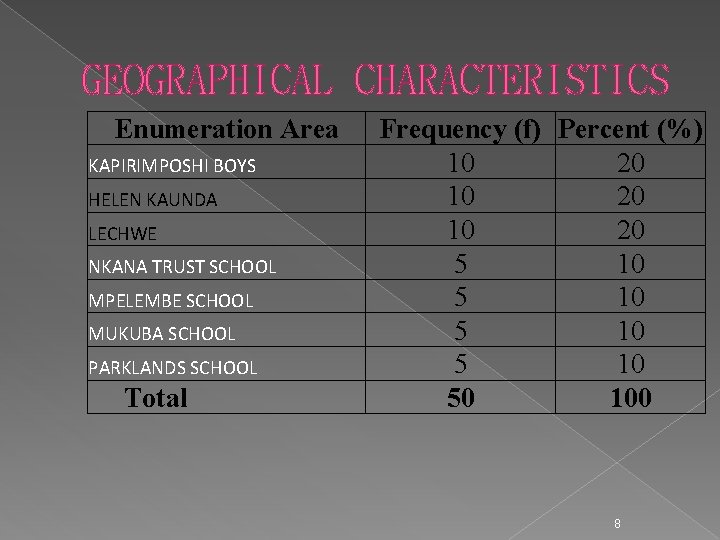
GEOGRAPHICAL CHARACTERISTICS Enumeration Area KAPIRIMPOSHI BOYS HELEN KAUNDA LECHWE NKANA TRUST SCHOOL MPELEMBE SCHOOL MUKUBA SCHOOL PARKLANDS SCHOOL Total Frequency (f) Percent (%) 10 20 5 10 50 100 8
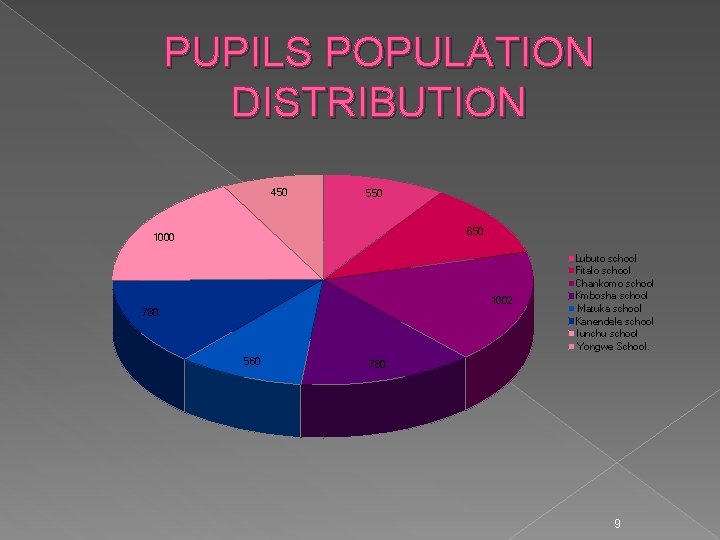
PUPILS POPULATION DISTRIBUTION 450 550 650 1002 780 560 Lubuto school Fitalo school Chankomo school Kmbosha school Matuka school Kanendele school lunchu school Yongwe School. 780 9
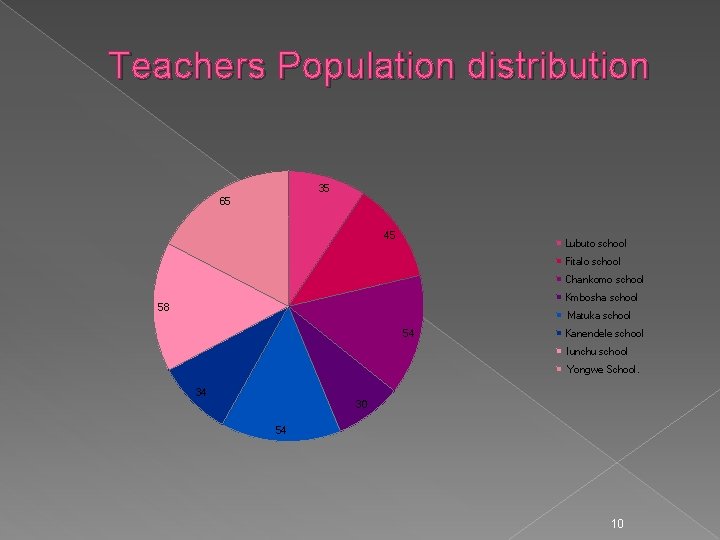
Teachers Population distribution 35 65 45 Lubuto school Fitalo school Chankomo school Kmbosha school 58 Matuka school 54 Kanendele school lunchu school Yongwe School. 34 30 54 10
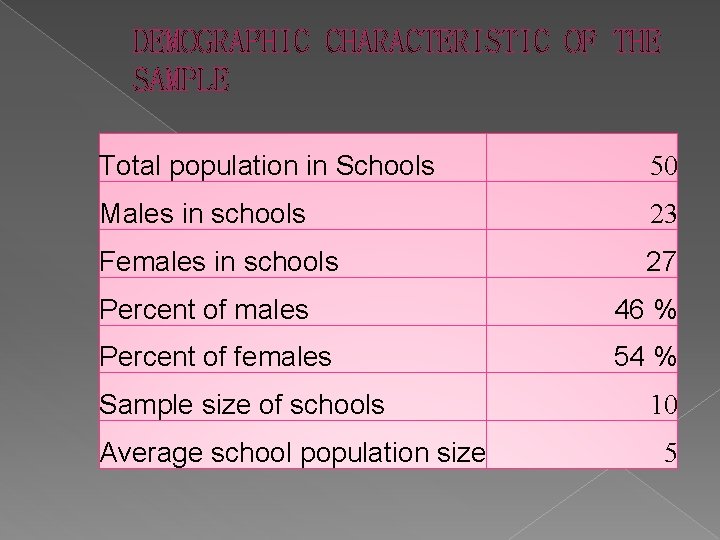
DEMOGRAPHIC CHARACTERISTIC OF THE SAMPLE Total population in Schools 50 Males in schools 23 Females in schools 27 Percent of males 46 % Percent of females 54 % Sample size of schools Average school population size 10 5
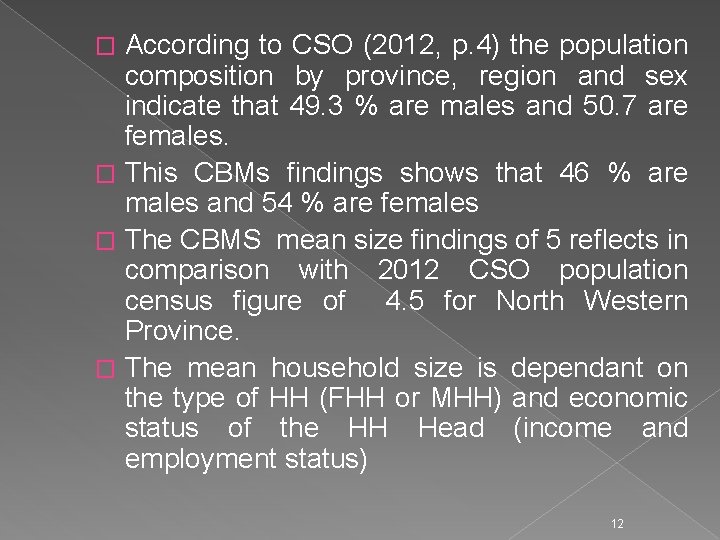
According to CSO (2012, p. 4) the population composition by province, region and sex indicate that 49. 3 % are males and 50. 7 are females. � This CBMs findings shows that 46 % are males and 54 % are females � The CBMS mean size findings of 5 reflects in comparison with 2012 CSO population census figure of 4. 5 for North Western Province. � The mean household size is dependant on the type of HH (FHH or MHH) and economic status of the HH Head (income and employment status) � 12
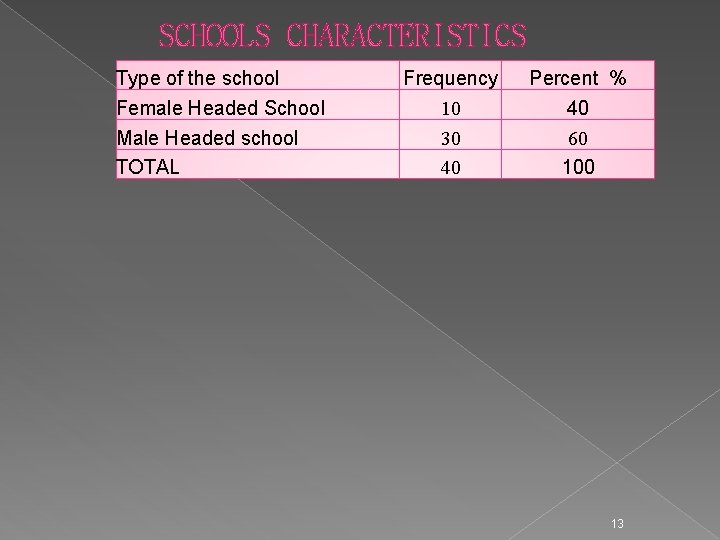
SCHOOLS CHARACTERISTICS Type of the school Female Headed School Male Headed school TOTAL Frequency 10 30 40 Percent % 40 60 100 13
� The respondents indicated that Production industries is source of employment. The most well known industry in Kapirimposhi is Kapiri glass factory which is the main employer and supply the whole zambia with glass products. The Main employing industry is government, followed by glass factory then agriculture, trading and construction sector and lastly bricklaying as a form of self employment. 14
75% of the respondents indicated that recruitment an deployment of teachers in rural areas is going on very well even though 25% said that the recruitment stoppage from 2005 to 2010 affected the number of teachers in the area. There is a correlation between children's teacher ratio and the level of teachers recruitment. § It also came out clear that women are not motivated to participate in technical programmes. From the responses only 25% level was given as being attained. § 15
CHALLENGES AND CONSTRAINTS The survey of pupils in the local area was enriched by the field data, collected primarily from the respondents. § The time allocated to do research was a constraint. Since the researcher was a full time employee with a lot of responsibilities such that it was difficltuty to assist the respondents closely § Many of school respondents were not very accessible and available at the time required for interviews, questionnaires were left to be filled § limited by inadequate funds for transport and logistics to support respondents. § 16
CONCLUSION � The findings indicate that the enrolment rates are 100% but completion rate is 35% meaning that alot of pupils drop out on the way. � The gender parity index is 1 boy to 3 girls meaning that we are on course to meet SNDP � The provision of training materials to schools is 55% showing that we are half way to meet SNDP � The promotion of women in technical programs is 76% indicating that we are on course to the attainment of this sixth National Development plan 17
RECOMMENDATIONS � The government should build other new school to meet the demand reduce the teacher pupil ratio. � Both rural and urban infrastructure investment in education, and agriculture (markets, roads, energy, skills development for women and young men) can enhance productivity and job creation for quality jobs and incomes � Training materials should also be supplied to all schools to improve the academic results. 18
KAPIRIMPOSHI 19
REFERENCES § § § Central Statistics Office (CSO) 2010 living conditions of people in Northwestern Province, Lusaka Central Statistics Office (CSO) 2012 2010 Census of Population and Housing, Lusaka Government of Zambia (2012) Statutory Instrument No. 47 of 2012, The Minimum Wages and Conditions of Employment Act (Laws, Volume 15, Cap. 276). Government Printer. Lusaka. http: //www. zambialii. org/zm/legislation/statutoryinstrument/2012/47. Accessed 3 rd July 2014 http: //www. jctr. org. zm/index. php? option=com_content&view=arti cle&id=61&Itemid=27. Accessed 23 rd July 2014 UNDP (2013) Progress Report on Zambia 2013 New Horizons Printing Press, Lusaka 20
- Slides: 20