
Community as the client Approaches to analyzing data

- Slides: 48
Community as the client
Approaches to analyzing data about families Systems theory – Includes structural and functional components of the family as a system – Structural Family Assessment: considers family’s composition; roles and relationships – Functional Family Assessment: nurse collects info re: how well family is fulfilling basic functions in the context of continual change in the system as information and energy are exchanged between the family and the environment
Approaches to data analysis continued Developmental theory – Approaches family from tasks and stages of progression through its life cycle and tasks that need to be accomplished – The stages of family development are used as a guide to categorize and analyze the baseline data Risk factor assessment – Identify family’s risk factors based on Healthy People 2010 criteria
The Family from a Risk Factor Perspective In the risk factor theory, the family is the most important social support system involved in lowering risks for its members Risk factors can be estimated for death or diseases by comparing a group that has been exposed to a risk factor with a group that hasn’t been exposed to the risk factor, and comparing rates of death or disease in the two groups
Risk & families continued Probabilities of risk change throughout the life cycle The stages of family development are used to classify risk factors Many chronic health problems are related to behavioral excesses that are learned through the family
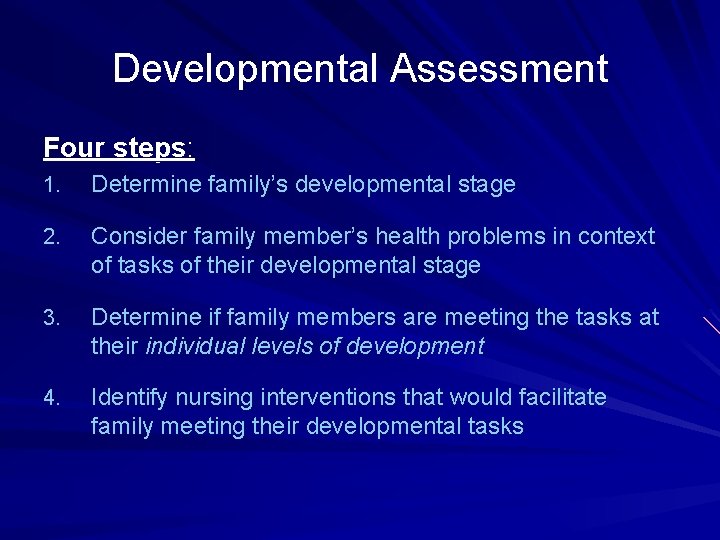
Developmental Assessment Four steps: 1. Determine family’s developmental stage 2. Consider family member’s health problems in context of tasks of their developmental stage 3. Determine if family members are meeting the tasks at their individual levels of development 4. Identify nursing interventions that would facilitate family meeting their developmental tasks
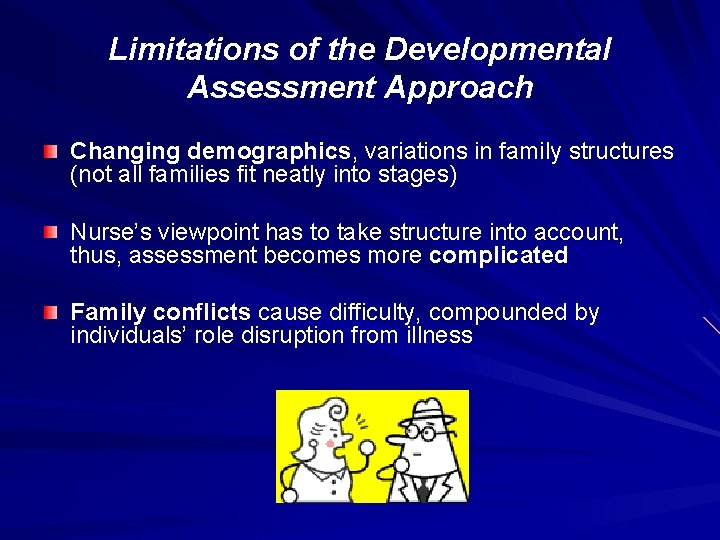
Limitations of the Developmental Assessment Approach Changing demographics, variations in family structures (not all families fit neatly into stages) Nurse’s viewpoint has to take structure into account, thus, assessment becomes more complicated Family conflicts cause difficulty, compounded by individuals’ role disruption from illness
Structural Family Assessment Considers composition of family Can be very helpful to nurse in many situations May be a good assessment to start with
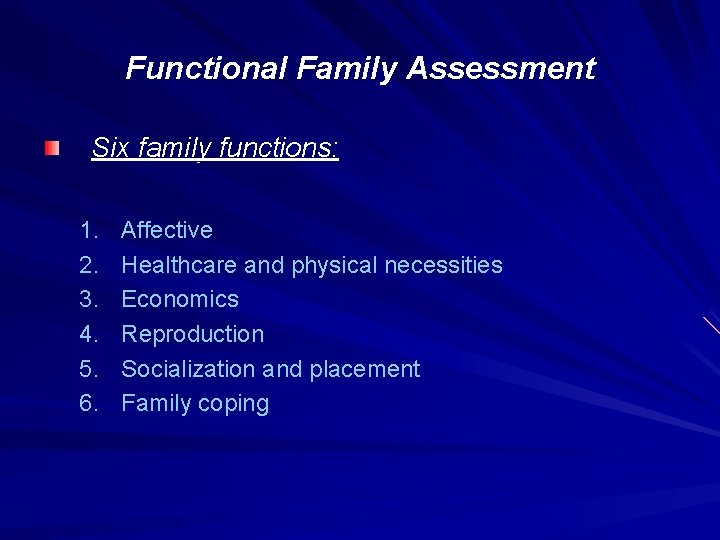
Functional Family Assessment Six family functions: 1. 2. 3. 4. 5. 6. Affective Healthcare and physical necessities Economics Reproduction Socialization and placement Family coping
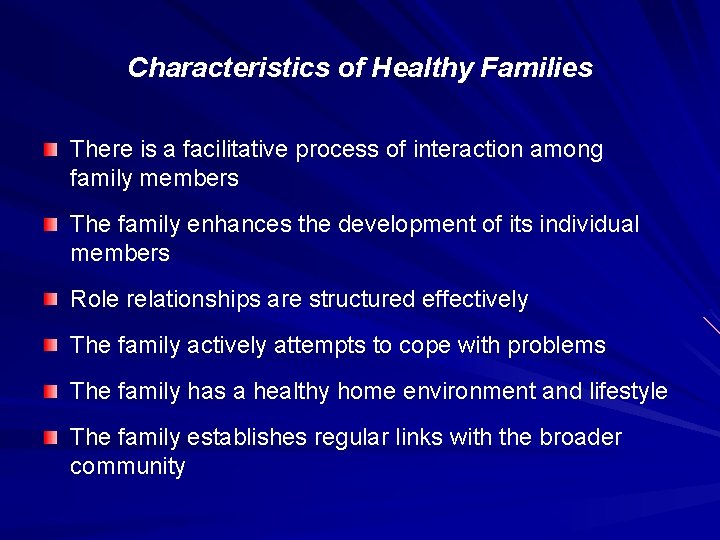
Characteristics of Healthy Families There is a facilitative process of interaction among family members The family enhances the development of its individual members Role relationships are structured effectively The family actively attempts to cope with problems The family has a healthy home environment and lifestyle The family establishes regular links with the broader community
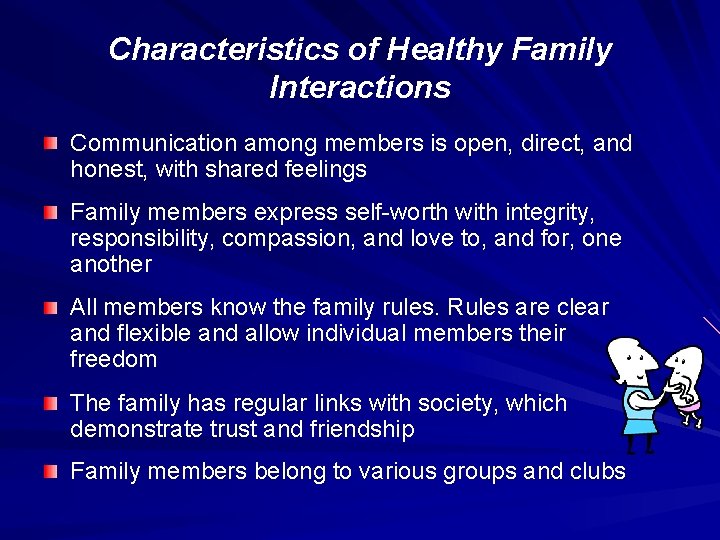
Characteristics of Healthy Family Interactions Communication among members is open, direct, and honest, with shared feelings Family members express self-worth with integrity, responsibility, compassion, and love to, and for, one another All members know the family rules. Rules are clear and flexible and allow individual members their freedom The family has regular links with society, which demonstrate trust and friendship Family members belong to various groups and clubs
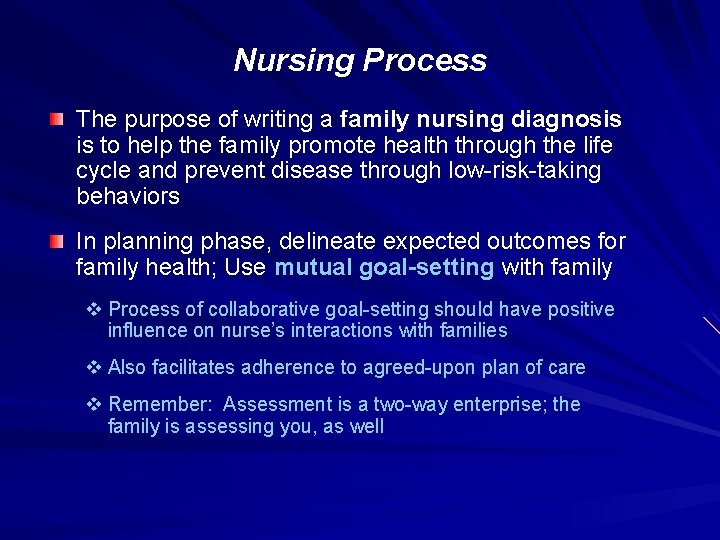
Nursing Process The purpose of writing a family nursing diagnosis is to help the family promote health through the life cycle and prevent disease through low-risk-taking behaviors In planning phase, delineate expected outcomes for family health; Use mutual goal-setting with family v Process of collaborative goal-setting should have positive influence on nurse’s interactions with families v Also facilitates adherence to agreed-upon plan of care v Remember: Assessment is a two-way enterprise; the family is assessing you, as well
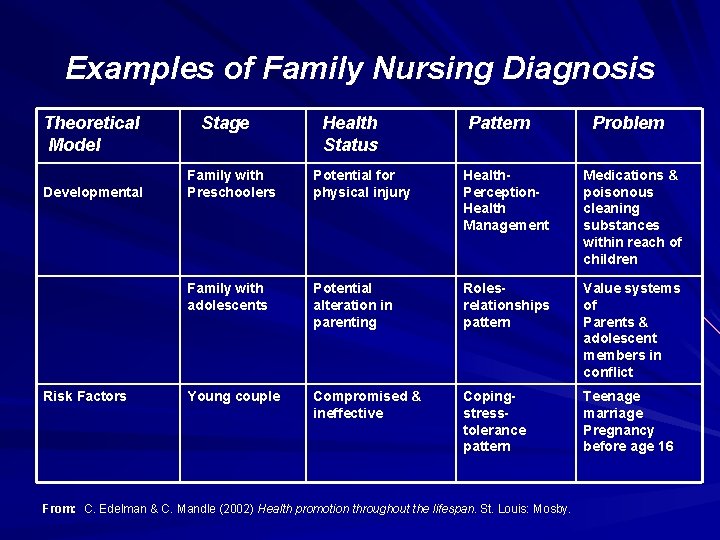
Examples of Family Nursing Diagnosis Theoretical Model Developmental Risk Factors Stage Health Status Pattern Problem Family with Preschoolers Potential for physical injury Health. Perception. Health Management Medications & poisonous cleaning substances within reach of children Family with adolescents Potential alteration in parenting Rolesrelationships pattern Value systems of Parents & adolescent members in conflict Young couple Compromised & ineffective Copingstresstolerance pattern Teenage marriage Pregnancy before age 16 From: C. Edelman & C. Mandle (2002) Health promotion throughout the lifespan. St. Louis: Mosby.
Steps in the Planning Process 1. Prioritize problems & potential problems 2. Determine which items can be handled by the nurse and the family, and items that must be referred to others 3. Decide on actions and expected outcomes
Goals describe a desired outcome Goal statements include: – The expected behaviors of the family – The circumstances under which the behaviors will be demonstrated – Criteria by which to determine when and how the behaviors will be performed Health promotion goals reflect a desire to function at a higher level of health and to grow beyond maintaining health or preventing disease
Implementation With The Family nursing interventions aim to assist family members in carrying out functions that the members cannot perform for themselves – Health promotion: the nurse assists the family in improving their capacity to act on its own behalf Three Broad Categories of Interventions with Families – Cognitive interventions – Affective interventions – Behavioral interventions
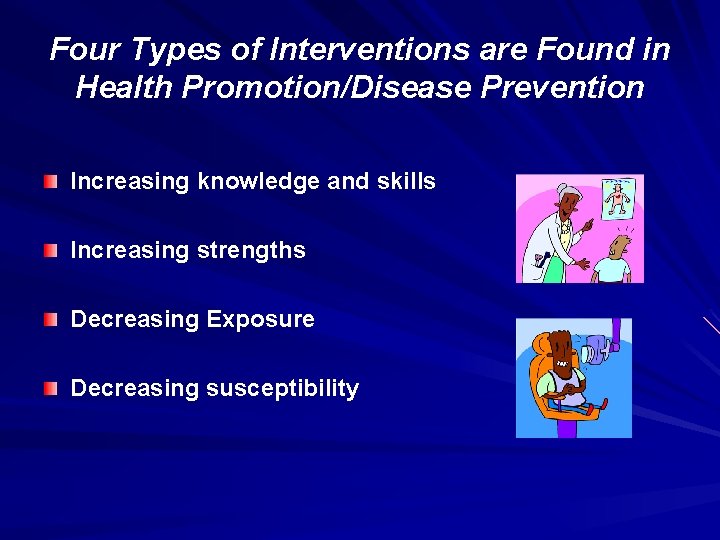
Four Types of Interventions are Found in Health Promotion/Disease Prevention Increasing knowledge and skills Increasing strengths Decreasing Exposure Decreasing susceptibility
Evaluation With The Family Purpose of evaluation is to determine how the family has responded to the planned interventions. Concrete objectives are easier to measure Family’s baseline data needs to be used as comparative criteria in evaluation Five measures of family functioning that can be used to determine effectiveness of interventions 1. Changes in interaction patterns 2. Effective communication 3. Ability to express emotion 4. Responsiveness to needs of members as individuals 5. Problem-solving ability If goals are not met, review process
Health Promotion/Prevention Strategies as Applied to the Family Primary Prevention Completing a family genogram and assessing health risks with the family to contract for family health activities to prevent diseases from developing Secondary Prevention Using a behavioral health risk survey and identifying the factors leading to obesity in the family Tertiary Prevention Developing a contract with the family to change nutritional patterns to reduce further complications from obesity
STRESS AND COPING
Management of Stress and Crisis “Family health” defined in terms of framework (e. g. , developmental, systems, etc. ) Normative events (birth of a child, death of a grandparent, etc. ) can be stressors Non-normative events (e. g. death of a child) cause added stress for families; stress that is different from stress experienced with normative events
Theoretical Frameworks for Family Stress and Coping ABC-X model most common Systems model challenged Hill’s model
ABC-X Model Crisis=X Event=A Family’s definition of event=B Resources available to family=C v Crisis (X) was proposed to be the product of A, B, & C
Double ABC-X Model extended to encompass the period right after the initial crisis Introduced the idea of “pile-up” of stress Adaptation or maladaptation by the family determined by the “pile-up” of stressors, (Aa), the family’s perception of the crisis, (Bb), and new resources and coping strategies, (Cc)
Systems Framework of Family Stress and Coping Families develop a series of processes to manage or transform “inputs” to the system (e. g. , time, energy) to outputs (e. g. , cohesion, growth, love), known as rules of transformation With time, families develop these patterns in enough quantity and variety to handle most changes and challenges; called requisite variety of rules of transformation
Systems Framework Continued When families don’t have adequate variety of rules to respond to an event, the event becomes stressful Family then falls into a pattern of trying to figure out what to do; usual tasks of family are then not addressed Implicit family rules are reconsidered and redefined
Interventions: Helping Families Manage Stress/Crisis In general, interventions for helping individuals and families should focus on empowerment rather than enabling, or “doing for” Failure to recognize a family’s competencies and help define an active role for them can lead to dependency and lack of growth Families need to feel a sense of personal competence to become active participants in problem-solving
Characteristics of Empowered Family Seeking Help Access and control over needed resources Decision-making and problem-solving abilities The ability to communicate and to obtain needed resources
Outcomes of Empowerment Positive self-esteem The ability to set and reach goals A sense of control over life and change processes A sense of hope for the future
Empowerment Continued Empowerment assumes a partnership between professional and client Families are assumed to be competent, or capable of becoming empowered Families need to identify that their action results in behavior change (evaluation)
ASSESSMENT: HEALTH PROMOTION FOR THE COMMUNITY
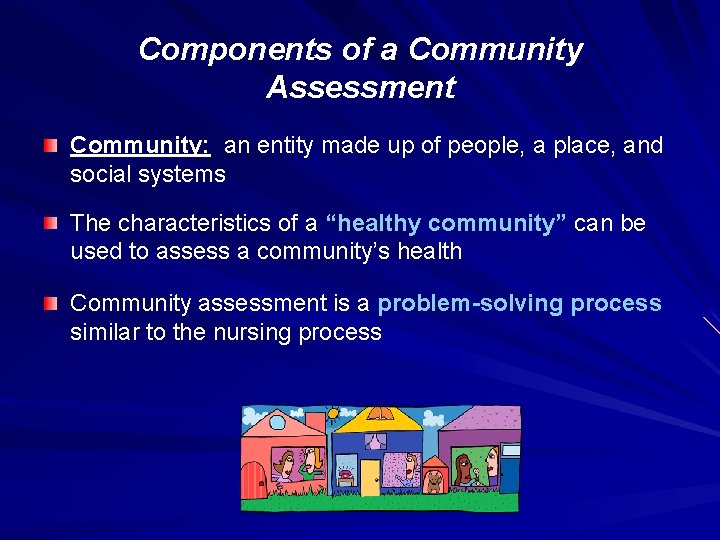
Components of a Community Assessment Community: an entity made up of people, a place, and social systems The characteristics of a “healthy community” can be used to assess a community’s health Community assessment is a problem-solving process similar to the nursing process
Community Assessment Community-based vs community-oriented nursing All three dimensions of community are assessed: – – – The people The place The social systems Community assessments vary in scope and complexity; nurse’s role depends on nurse’s educational preparation and expertise
People Demographic characteristics: number, composition by age, rate of growth and decline, social class and mobility of people in the community Other vital statistics: birth rate, overall death rate, death rate by cause and age, and infant mortality rate • Infant mortality rate is considered to be the most important statistical indicator of maternalinfant health in the community
Place Where the community is located and its boundaries Type of community (e. g. , rural or urban) Location of health services Climate: flora, fauna & topography
Social Systems Economic Legal Educational Human services Religious Recreation Political Communication systems
Power Systems • How decisions are made and how change occurs for planning
Methods of Community Assessment Windshield Survey Ø A motorized equivalent of a simple head-to-toe assessment Ø Observer drives through neighborhood and uses observation skills to conduct a general assessment of the neighborhood Ø E. g. , common characteristics about the way people live, where they live, type of housing, etc
Informant interviews Ø “Key informants” or members of the general public Ø Interviews are usually unstructured and used to collect general information Ø Participant-observation Ø Observe formal and informal community activities to determine significant events and occurrences Ø Formal: government, city council, etc. Ø Informal: gatherings at coffee shop, school, etc. Ø Can help with determining values, norms and concerns of a community
Secondary data Ø Records, documents and other previously collected information Ø Includes databases from schools, departments of health, county data, private foundations and state universities Constructed surveys Ø Usually time-consuming and expensive Ø Survey random sample of a target population asking specific questions Ø Data is analyzed for patterns and trends
Epidemiologic Model Core component of public health Multidisciplinary: Ø Clinical medicine Ø Quantitative methods Ø Public health policy and goals
Epidemiology: “The study of the distribution and determinants of healthrelated states or events in specified populations, and the application of this study to control of health problems”
Descriptive Epidemiology: Study of the distribution of disease and other healthrelated states in terms of: – personal characteristics (person) – geographical distribution (place) – temporal patterns (time)
Analytic epidemiology: Studies the origins and causal factors of disease and other health-related states and events
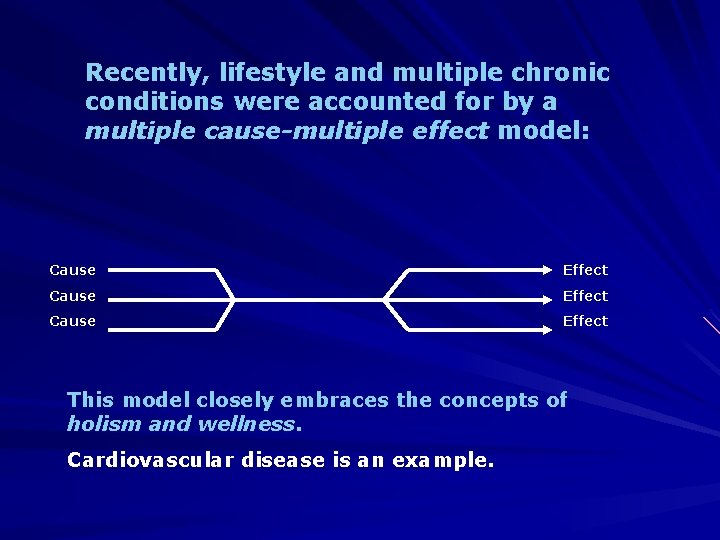
Recently, lifestyle and multiple chronic conditions were accounted for by a multiple cause-multiple effect model: Cause Effect This model closely embraces the concepts of holism and wellness. Cardiovascular disease is an example.
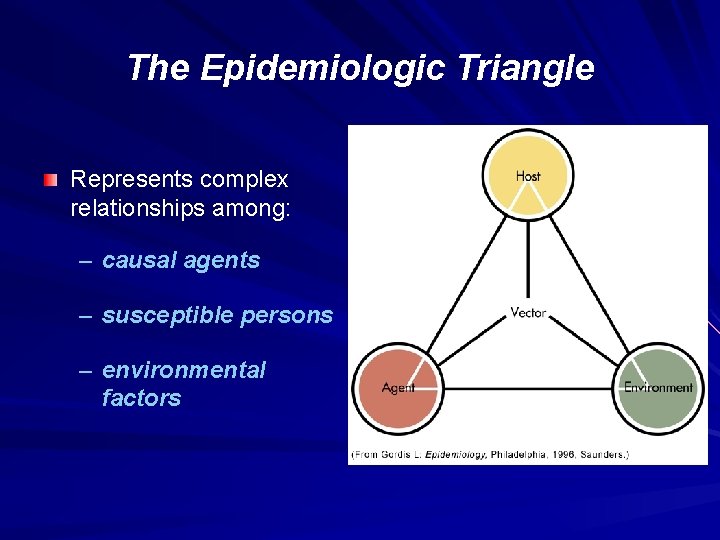
The Epidemiologic Triangle Represents complex relationships among: – causal agents – susceptible persons – environmental factors
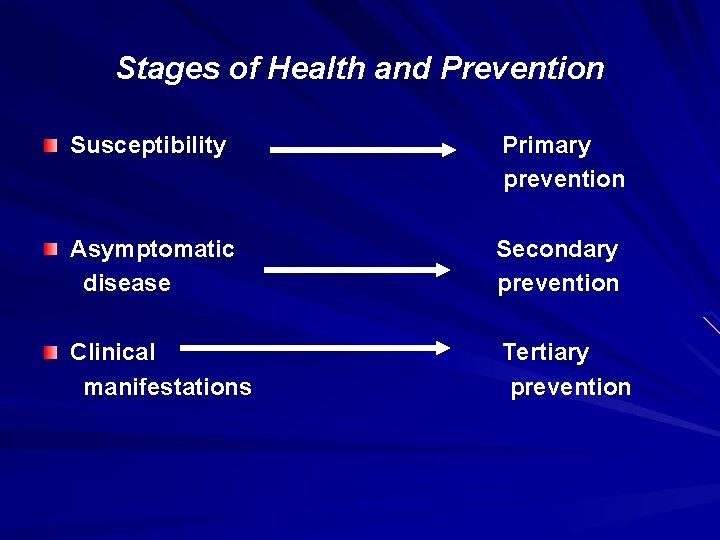
Stages of Health and Prevention Susceptibility Primary prevention Asymptomatic disease Secondary prevention Clinical manifestations Tertiary prevention
Epidemiology and Community-Oriented Nursing The practice of community-oriented nursing is enhanced by understanding and application of epidemiologic concepts and methods Used as one method of assessing the health needs of a community (community assessment)