
Communities of Purpose Creating Inspiration and Commitment Overview




- Slides: 54
Communities of Purpose Creating Inspiration and Commitment
Overview of Our Work Together Find a partner, preferably someone who is not from your school. Create a small group for debriefing conversations. Handout slides will be available at the end of the presentation Other handouts are not provided now. You will receive them at the end. We will create group learning and synergy
Learning Outcomes Participants will: understand that creating unity and commitment around collective purpose is an intentional act that is embedded in the daily work of school. Have an awareness of how to assess school’s current state and to create a plan moving a school community toward a shared vision Work with strategies of how to clarify purpose and develop agreed upon processes.
Why Community… We cannot embrace. . challenge alone, at least not for long: we need trustworthy relationships, if we are to sustain the journey toward an undivided life…it is simply too arduous to take without the assistance of others. --Parker Palmer
School Communities Concept has many names, it is not the name that is important, rather it is the process. Adbundant research base to support the practice of professional learning communities (PLCs), communities of purpose, and collaborative culture.
Summary of Research on Professional Learning Communities The most successful corporation of the future will be a learning organization (Senge, 1990) We have come to realize over the years that the development of a learning community of educators is itself a major cultural change that will spawn many others (Joyce and Showers, 1995).
Summary of Research on Professional Learning Communities Louis and Marks (1998) found that when a school is organized into a PLC, the following occurs: --Teachers set higher expectations for student achievement. --Students can count of the help of teachers and peers in achieving ambitious learning goals--achievement is higher. --The quality of classroom pedagogy is higher.
Why Community Briefly write a short definition of community. Discuss with a partner what it means. Capture on flipchart
Definition of Community Communities spring from common understandings that provide members with a sense of identity, belonging and involvement that results in a web of meaningful relationships with moral overtones. --Thomas Segiovanni, 2005
Definition of Community Communities form around common charteristics, experiences, practices, or beliefs that are important enough to bind members to one another in a kind of fellowship (Carey and Frohnen, 1998)
Definition of Community Successful communities provide members with broadly shared opportunities to participate, promote collective responsibility and foster a strong sense of belonging. --Clinton, 2007
Professional Learning Community Components Shared understanding A sense of identity High levels of involvement Mutual cooperation Collective responsibility Emotional support A strong sense of belonging as they work together to achieve what they could not accomplish alone. --Du. Four, Du. Four and Eaker, 2008
Dialogue Review PLC components With your partner… Discuss the component that will be the most difficult to develop at your campus. What are the barriers? What skills are needed to develop the component?
Predict the rough water and provide time to learn, reflect and shape. Get people to say, “I helped build it. I feel safe here. ” Patrick Dolen
Pair Share--Song Lyrics 1) “Come together right now, over me. ” 2) “Got to be a joker he just do what he please” 3) “Hold you in his armchair you can feel his disease” 4) “He roller coaster he got early warning” 5) “He got muddy water he one mojo filter” --John Lennon
Pair Share Select a phase and discuss it with your partner. What does that phrase mean to you? How might it relate to change and leadership at your school?
Pair Share What exactly are you attempting to accomplish at your school? Each partner will have three minutes to articulate their vision. Partner A will start and talk for three minutes. I will signal when to switch. There is no discussion between partners. Simply listen to the other person’s vision.
Dialogue Pair Share How is vision communicated to school personnel? How often? What conversations are occurring about what we are trying to accomplish? What is the role of accountability in creating our common goals?
Personal Reflection Was this easy to talk about? Why or why not? How did it feel to talk about your school? Are you really clear about what you and your staff are trying to accomplish? Do you really believe it is possible? Why do you think staff members are reluctant to work toward a common vision and goal? What frustrates you about your school?
Reflection Debrief What emerged for you as you did these activities? What have you learned about your school’s vision and purpose? What leadership work do you need to do in order to effectively address vision, purpose and goals?
Role of Trust A substantial barrier is the lack of trust among educators and poor quality relationships that exist in many schools, particularly those most challenged by poverty and social problems. Consequently, it is critical that leaders of learning communities make the establishment of high quality relationships and trust a high priority. --Dennis Sparks
Professional Trust Explicit or implicit norms, principles or understandings of how to work together and what to expect of each other as fellow professionals or members of the same organization. Trust here is a process not a state--something people work toward as a matter of principle and of professional commitment even if they have little personal relationship. --Andy Hargroves, 2002
Lack of clarity around what is to be accomplished is the biggest barrier to making the vision a reality.
Using behavioral descriptions to clarify purpose “ Improve learning for all students” Becomes: “Each teacher commits to planning engaging lessons for all students using the district curriculum standards and by implementing agreed upon high yield instructional strategies from Marzano’s Classrooms that Work book. “
Pair Share With your partner, write one of your desired outcomes in a behavioral statement. As a leader, how might we engage others in writing these behavior outcomes of our mission and goals?
Culture Card Review expected behaviors for Ritz. Carleton Hotel Chains all over the world. Create a draft culture card for your campus. How might you use this culture card or flyer for your school?
Pillars of Organizational Wisdom Values--Self evident truths that drive organization. Example: Students have the right to high expectations, consistent curriculum, and fair assessments. (again clarity in communication) How does the leader identify core values and beliefs and discuss them with staff? --Adapted from Doug Reeves, 2002
Pillars of Organizational Wisdom Evidence--What tells us that we are living out our values. Are there multiple indicators? Do we really find evidence for all underlying assumptions that drive our work? As a principal, how do I monitor and collect evidence to bring forward our current state of performance? ---Adapted from Doug Reeves, 2002
Pillars of Organizational Wisdom Strategies--Specific actions by adults in the system. Strategies are not plans, goals, or good intentions, they are visible, observable behaviors. What are the behaviors that positively impact student learning? Where are those behaviors consistently observed? Where are they absent? --Adapted from Doug Reeves, 2002
Observable Behaviors vs. Desired Behaviors Develop systems that monitor desired behaviors. Compare observable behaviors with desired behaviors. Use this as data to provide feedback and work with staff to continuously improve implementation of desired behaviors.
Design Simple Systems Example Desired behavior: All teachers will clearly articulate the learning goals to all students. Students will be able to also articulate the learning goals. Data Collections System: Walkthrough form to determine if observer understands the learning goal and ask students, “What are you learning? ” Create simple tally sheet of positive responses or negative responses around each walkthrough.
“Principals who desire significant changes in teaching, learning, and relationships within their schools begin by making significant changes in what they think, say and do. ” --Dennis Sparks
Communicate Often and in Varying Formats The specific organizational outcomes must be communicated and modeled to address both the heart and the mind.
Metaphor--Create the following with your partner. School improvement is like:
Metaphor Exercise Identify functions of your school. Brainstorm what items fit into the following categories. --Seeds --Buds --Blooms --Full flower
Metaphor Exercise Withering Flower Compost pile Garbage Pests Energy
Communicating a Compelling Aspiration “It’s not just a picture of what could be, it is an appeal to our better selves, a call to become something more. It reminds us that the future does not just descend like a stage set, we construct the future from our own history, desires, and decisions. ” Rosabeth Kanter, 1999
Inspirational Leadership What is inspiring about what we are to do? What kinds of things inspire us? What specifically do I need to think about and be learning in order to do my part in creating the vision of our school?
Inspiration Poems, music, videos and stories provide inspiration. Example: Music used at beginning of presentation. Poem or story example
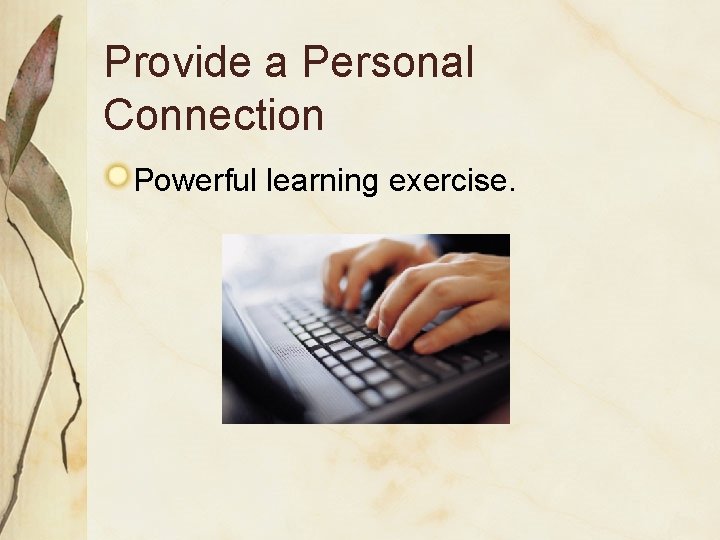
Provide a Personal Connection Powerful learning exercise.
Modeling by Leaders Principals model what they expect from others. What leadership behaviors positively model “engaging a school staff in improving teaching and learning for all students”? How can I know I am consistently modeling the right thing?
Reflective Conversations and Practice Model in daily exchanges with teachers. Craft good questions that deepen thinking around shared work. Take time to deeply listen to the responses from others.
Reflective Practice Reflective questions may engage feelings as well as thoughts. Look at the questions you have been asked to reflect upon. How could you use some of these same questions with teachers? What other questions might you use to engage teachers?
Move to Action “Principals must create situations that lead people to act, helping them do rather than talk about doing. ” ---Becky Du. Four
Move to Action “Once teachers are familiar with and practicing the changes, support will follow. Commitment follows competence. ” ---Michael Fullan
Stay Connected to the Work Many initiatives unravel because, where there is support at the top, those at lower levels are left to resolve tensions, answer questions and fill gaps on their own. What must the leader consider in order to know when there are tensions and questions so that he or she can be proactive in addressing the issues?
Having Hard Conversations What do you confront? What is “the elephant in the room” for your school? It is essential for the leader to ensure that poor or mediocre performance is not tolerated. It is a major factor in the erosion of trust and the closing down of shared accountability.
Having Hard Conversations “Candor means forthrightly discussing “non-discussables” that are barriers to effective teaching and student success…even when that discussion may generate conflict and tension. ” --Dennis Sparks
Steps to Remember: Create clarity of outcomes by defining them in “behavioral terms” Communicate often touching the heart and the mind Craft the art of reflective questioning and dialogue Make personal connections Monitor and seek evidence of “desired behaviors”
Steps to Remember: Provide feedback using data and “evidence” Inspire others using music, stories, poems, art, etc. Create “action-oriented” culture modeled by the leader Have courage and confront those not exemplifying “desired behaviors” Stay connected to the trenches
Learning Outcomes Participants will: understand that creating unity of purpose is an intentional act that is embedded in the daily work of school. Have an awareness of how to assess their current state and to create a plan moving a school community toward a shared vision Work with strategies of how to clarify purpose and develop agreed upon processes.
Out of clutter, find simplicity; from discord, find harmony; and in the middle of difficulty lies opportunity. Albert Einstein
As a result of my learning here today, I commit to:
Rosalyn Bratcher, Ed. D. Bratcher and Associates rosalyn@bratcher. com 830 -620 -8752