
Communist Revolution Chinas Civil War l In 1911
- Slides: 22
Communist Revolution
China’s Civil War l In 1911, after thousands of years of being ruled by emperors, the last of China’s royal dynasty’s was toppled l Over the next 15 -20 years, China was in chaos as different groups struggled to control the country l By the 1930 s, China entered a period of civil war between 2 main political parties to determine who would control the country
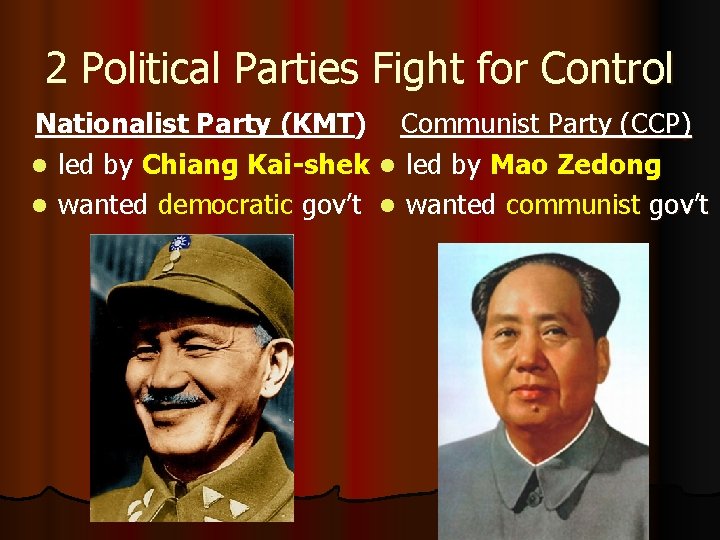
2 Political Parties Fight for Control Nationalist Party (KMT) Communist Party (CCP) l led by Chiang Kai-shek l led by Mao Zedong l wanted democratic gov’t l wanted communist gov’t
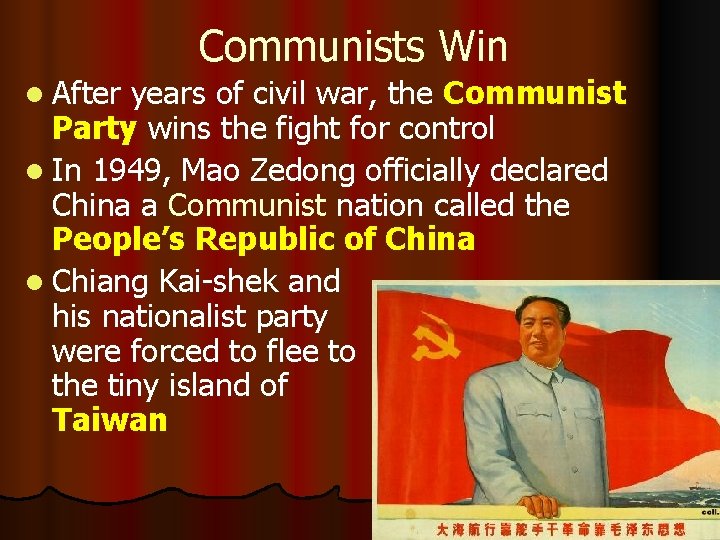
Communists Win l After years of civil war, the Communist Party wins the fight for control l In 1949, Mao Zedong officially declared China a Communist nation called the People’s Republic of China l Chiang Kai-shek and his nationalist party were forced to flee to the tiny island of Taiwan
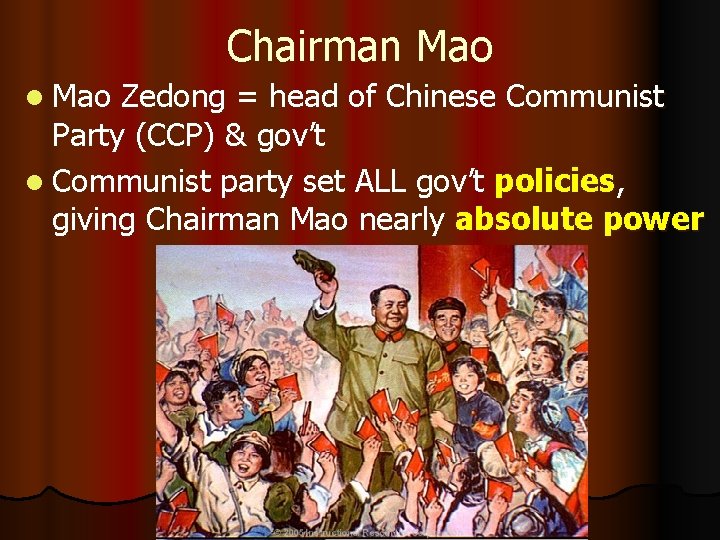
Chairman Mao l Mao Zedong = head of Chinese Communist Party (CCP) & gov’t l Communist party set ALL gov’t policies, giving Chairman Mao nearly absolute power
Communism’s Goal l The goal of communism is to make everyone as equal as possible, to have a “classless” society l There is no private ownership of property (ex. land, businesses) l Everything is run by the gov’t, like factories, schools, hospitals l The gov’t provides jobs for everyone and pays everyone the same amount of money, no matter what their job or how well they do it
The Chinese Communist Party. . . l took land from the wealthy and gave it to the poor l took control over China’s factories and businesses, determining what and how much should be made l forced peasant farmers to combine all their land together into “collective farms” and work together to grow food
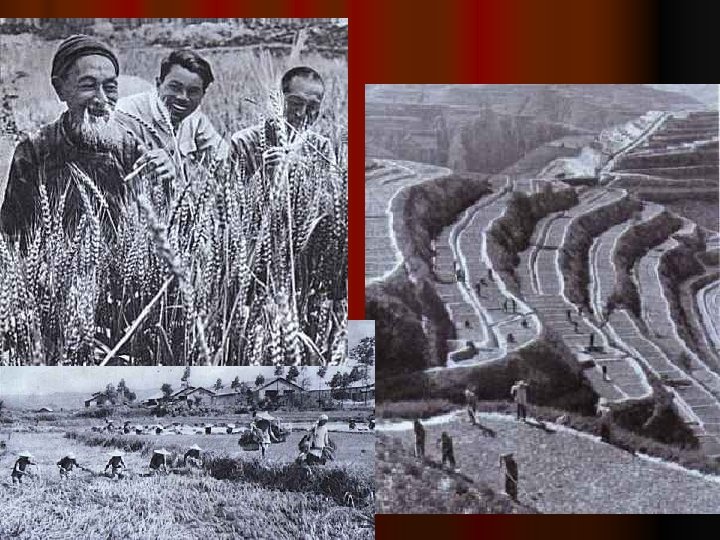
Great Leap Forward (1958) What was it? l. A program meant to speed up China’s economic development l Goals were set for agriculture (farming) and industry (factories) production l All small farms were combined into larger farms called “communes” where all ownership and decisions were in the hands of the gov’t
The Communes l l l l Each contained about 5000 families People gave up their ownership of tools, animals, etc. so that everything was owned by the commune. People now worked for the commune and not for themselves. The life of an individual was controlled by the commune. The commune provided all that was needed – including schools, nurseries, and entertainment. Communist Party members oversaw the work of a commune to ensure that decisions followed the correct party line. Propaganda was everywhere – including in the fields where the workers could listen to political speeches as they worked. Everybody involved in communes was urged not only to meet set targets but to beat them. If the communes lacked machinery, the workers used their bare hands. By the end of 1958, 700 million people had been placed into 26, 578 communes.
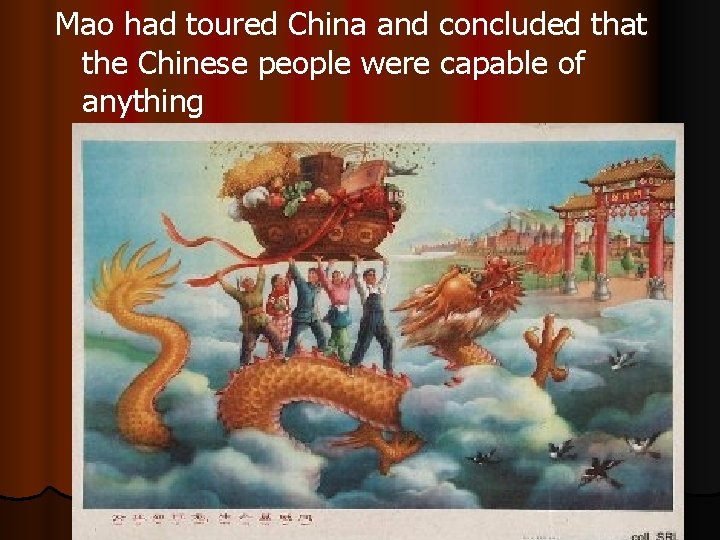
Mao had toured China and concluded that the Chinese people were capable of anything
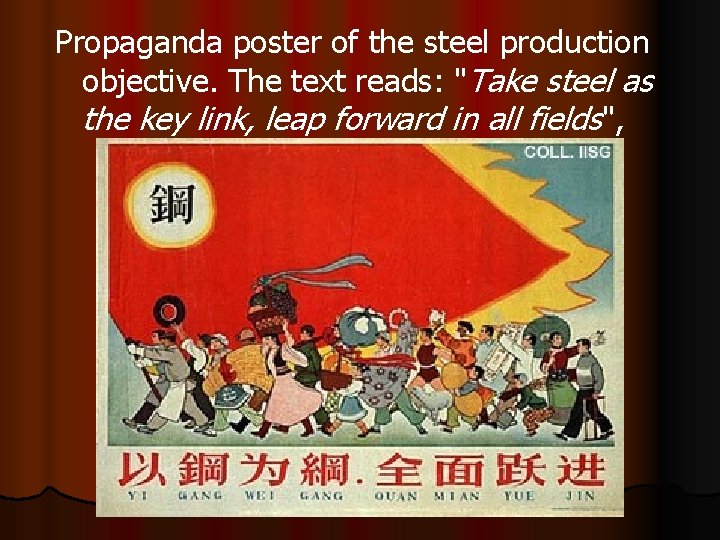
Propaganda poster of the steel production objective. The text reads: "Take steel as the key link, leap forward in all fields",
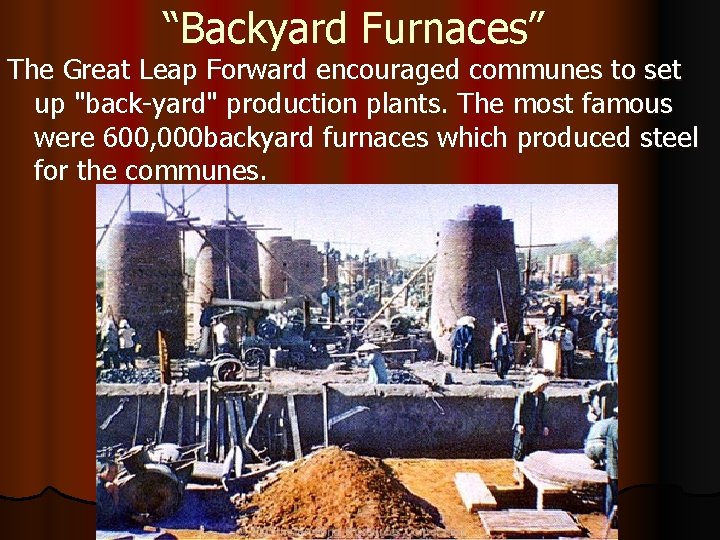
“Backyard Furnaces” The Great Leap Forward encouraged communes to set up "back-yard" production plants. The most famous were 600, 000 backyard furnaces which produced steel for the communes.
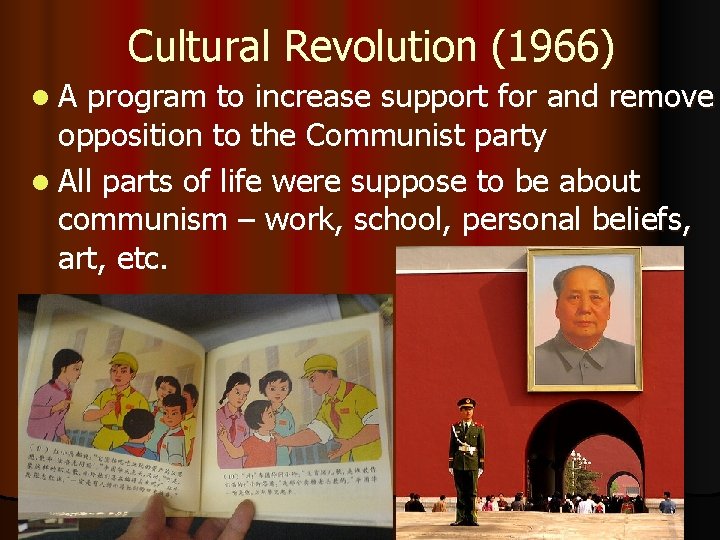
Cultural Revolution (1966) l. A program to increase support for and remove opposition to the Communist party l All parts of life were suppose to be about communism – work, school, personal beliefs, art, etc.
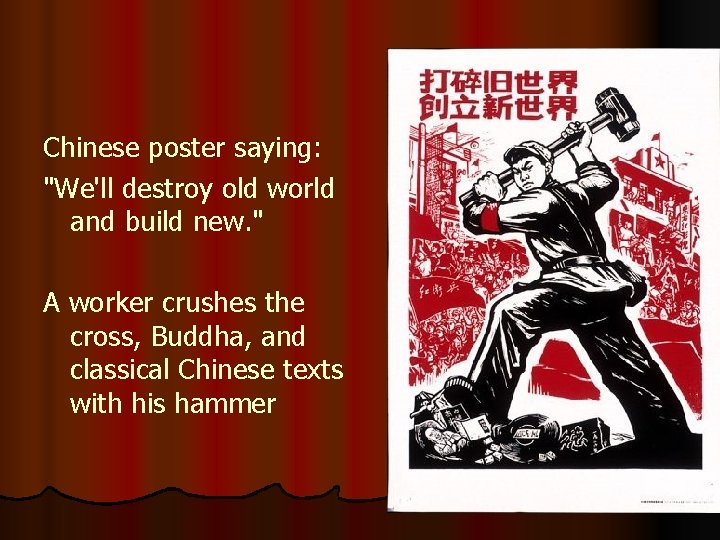
Chinese poster saying: "We'll destroy old world and build new. " A worker crushes the cross, Buddha, and classical Chinese texts with his hammer
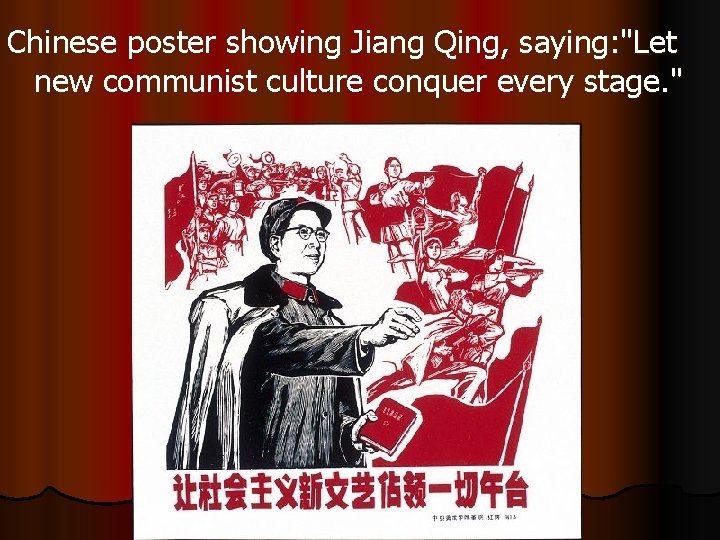
Chinese poster showing Jiang Qing, saying: "Let new communist culture conquer every stage. "
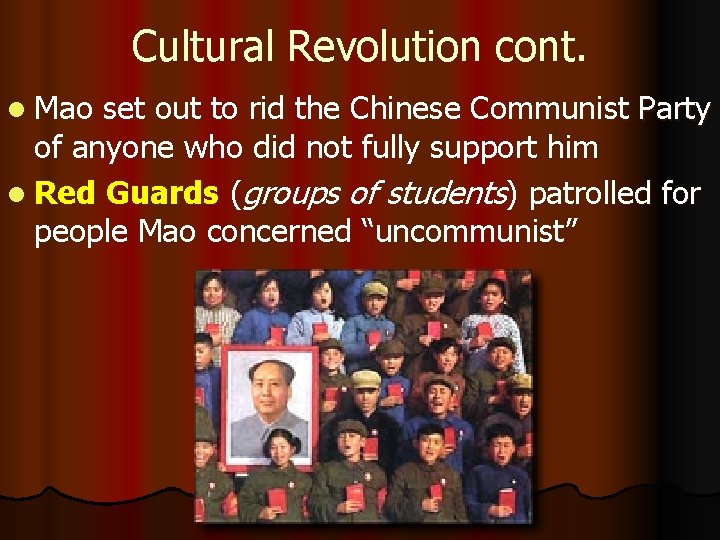
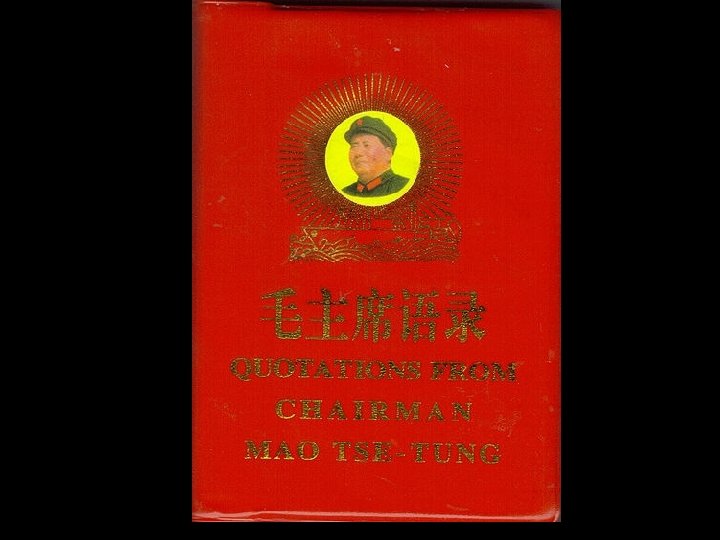
Cultural Revolution cont. l Mao set out to rid the Chinese Communist Party of anyone who did not fully support him l Red Guards (groups of students) patrolled for people Mao concerned “uncommunist”
Cultural Revolution cont. l Anyone who was thought to have developed a superior attitude was considered an enemy of the party and the people l Mao wanted to create a China in which peasants, workers, and educated people worked together – no-one was better than anyone else and all working for the good of China – a classless society
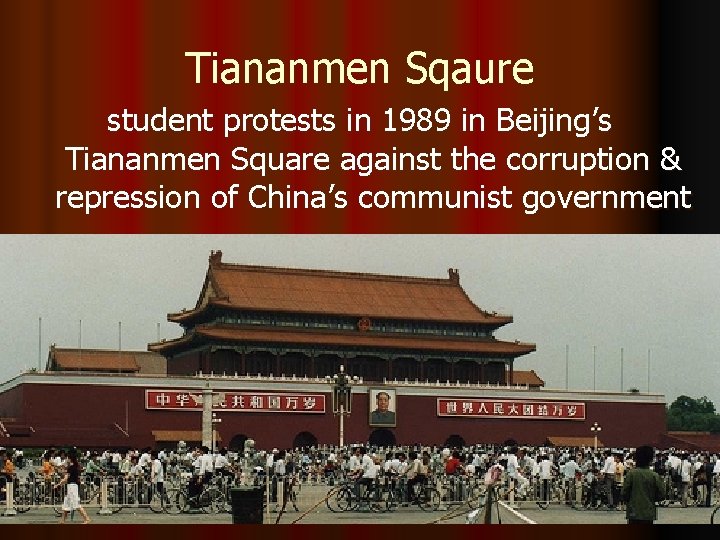
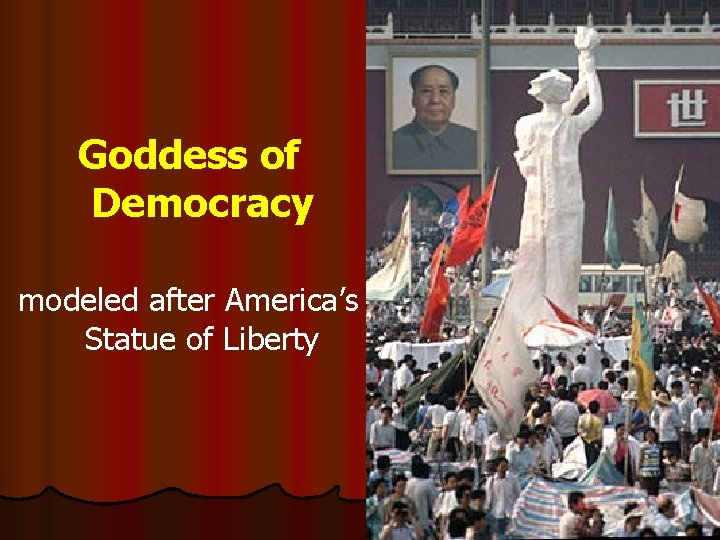
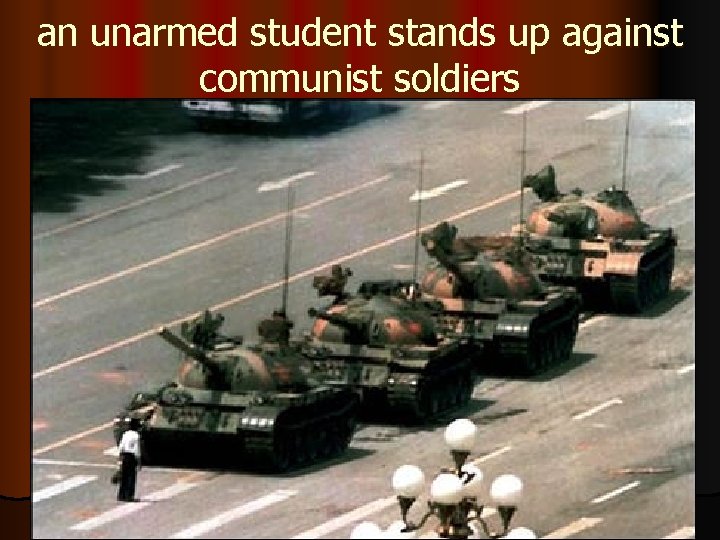
Tiananmen Sqaure student protests in 1989 in Beijing’s Tiananmen Square against the corruption & repression of China’s communist government
Goddess of Democracy modeled after America’s Statue of Liberty
an unarmed student stands up against communist soldiers