
Communism From each according to his ability to
Communism “From each according to his ability, to each according to his needs” Clip Art
Origins • Emerged in 19 th century Europe • Reaction to the excesses of the industrial revolution and free enterprise system • Clip art
Socialist Ideology 1800 to roughly 1850: Utopian Socialists • Replace the free-enterprise system: workers would collectively own all productive enterprises • Common ownership of the economy (communism) • Society based on equality and community • Clip art
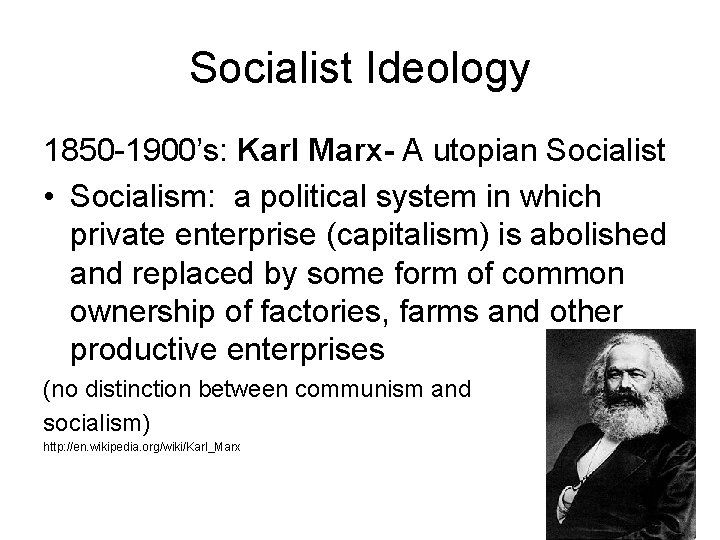
Socialist Ideology 1850 -1900’s: Karl Marx- A utopian Socialist • Socialism: a political system in which private enterprise (capitalism) is abolished and replaced by some form of common ownership of factories, farms and other productive enterprises (no distinction between communism and socialism) http: //en. wikipedia. org/wiki/Karl_Marx
Marxism Karl Marx • Born 1818 -Germany • Bonn University (1835 -36) Law • 1837 Berlin- Georg Wilhem Fredrich Hegel: • Believed history advances through recurring clashes between opposing forces. (religion, philosophy, forms of government and society) these clashes are the “root and movement of all life. ” clip art
Marxism • Hegel: “Humanity would eventually reach a final synthesis, a state of perfection beyond which there would be no more conflicts and is guided to its final destination by God. ” • 1844 Paris, France • Marx: The principle motive forces in society and politics are economic in nature • http: //en. wikipedia. org/wiki/Hegel
Marxism • Friedrich Engels (1820 -1895) son of wealthy German industrialist: popularized Marx • 1847: The Communist Manifesto 1. Economic relations condition everything else that happens in human affairs 2. Class Conflict- Bourgeoisie (factory owners) v Proletariat (workers) “What the bourgeoisie therefore produces, above all, is its own gravediggers” Marx
Marxism • • • Over time: The rich get richer and the poor get poorer Bourgeoisie class shrinks (monopolization) No middle class Unemployment of working class The state becomes an instrument of class domination (“the executive of the modern state is but a committee for managing the common affairs of the bourgeoisie”)
Marxism The Socialist Revolution: • Small bourgeoisie class is unable to stop resentment from the proletariat. • Spontaneous revolution • Proletariat dismantles capitalism • Proletariat controls state power and economy. (“temporary dictatorship of the proletariat”) Control all means of production. • Classless society • Once capitalism is deprived of power, government itself ceases to exist as a political institution • As politics withers, economic conditions improve • Everyone works for society as a whole • Clip Art
Marxism • Marx maintains he had discovered the laws governing humanity’s social evolution • All societies from the dawn of time, were governed by the laws of economic determinism • Under Communism, private property, social classes, conflict, the state, political power, and politics disappear
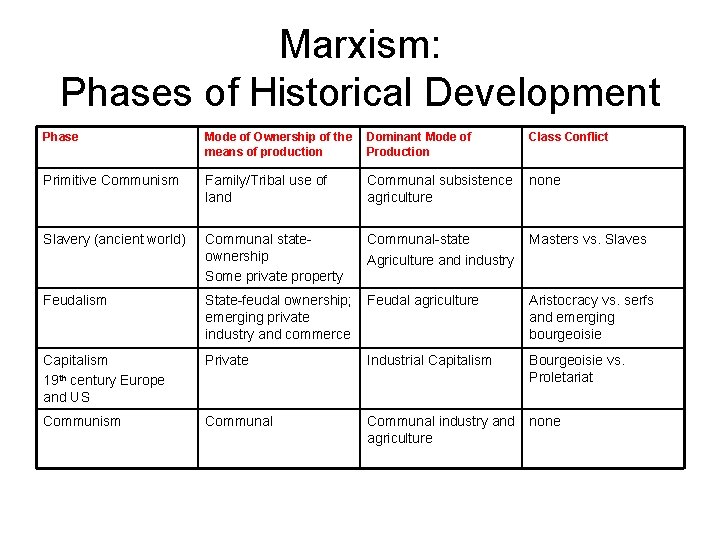
Marxism: Phases of Historical Development Phase Mode of Ownership of the means of production Dominant Mode of Production Class Conflict Primitive Communism Family/Tribal use of land Communal subsistence agriculture none Slavery (ancient world) Communal stateownership Some private property Communal-state Agriculture and industry Masters vs. Slaves Feudalism State-feudal ownership; emerging private industry and commerce Feudal agriculture Aristocracy vs. serfs and emerging bourgeoisie Capitalism 19 th century Europe and US Private Industrial Capitalism Bourgeoisie vs. Proletariat Communism Communal industry and agriculture none
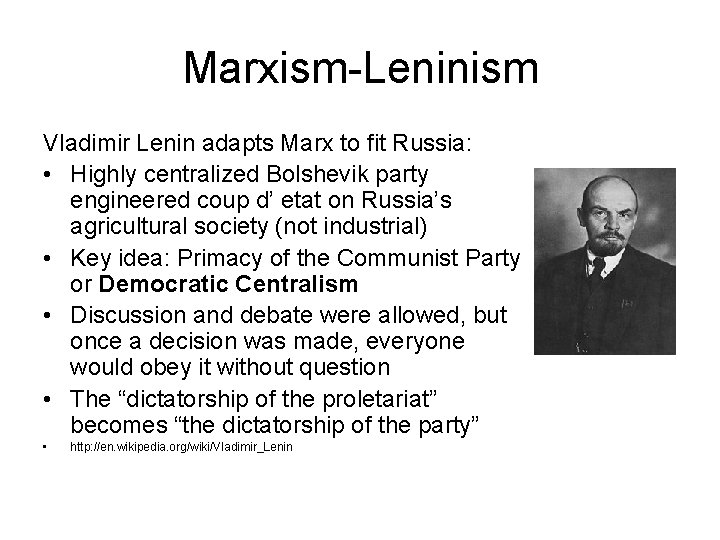
Marxism-Leninism Vladimir Lenin adapts Marx to fit Russia: • Highly centralized Bolshevik party engineered coup d’ etat on Russia’s agricultural society (not industrial) • Key idea: Primacy of the Communist Party or Democratic Centralism • Discussion and debate were allowed, but once a decision was made, everyone would obey it without question • The “dictatorship of the proletariat” becomes “the dictatorship of the party” • http: //en. wikipedia. org/wiki/Vladimir_Lenin
The Marxist-Leninist State Strayed even further from Marx ideology: • Used severe, coercive force to accomplish goals. (Stalin: Mass Murder) • Erected a powerful state which controlled all aspects of society (totalitarian) • The state became a huge bureaucracy, under Communist Party control • Never attained the stateless, egalitarian utopia proposed by Marx
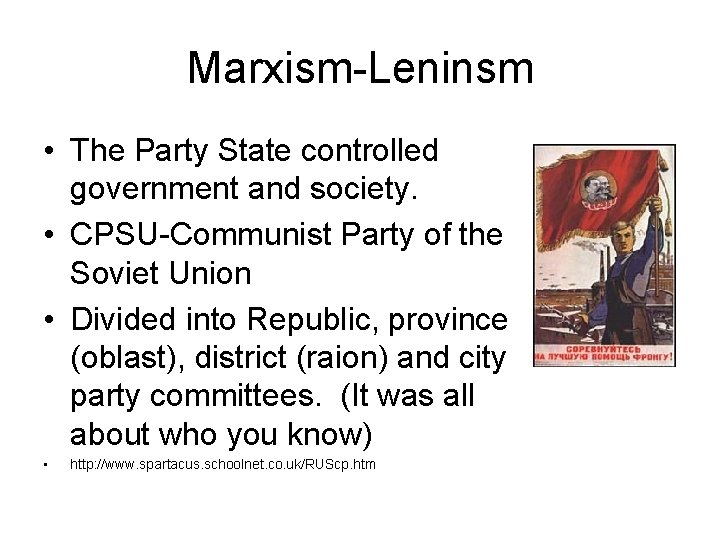
Marxism-Leninsm • The Party State controlled government and society. • CPSU-Communist Party of the Soviet Union • Divided into Republic, province (oblast), district (raion) and city party committees. (It was all about who you know) • http: //www. spartacus. schoolnet. co. uk/RUScp. htm
The Soviet Union • Critical Institutions of the Party 1. Secretariat-headed by the Secretary General- small -administration of various departments of the CPSUoversaw the bureaucracy. Very Powerful. 2. Politburo-small, supreme policy-making body 3. KGB-Secret Police 4. Party Congress elected from members of CPSU 5. Central Committee- parent body, was elected by the Party Congress-5 years, large, elects Secretary General • Most important People 1. Secretary General- Like a Prime Minister 2. Members of the Politburo-Cabinet 3. Nomenklatura- List of important people and positions in CCP http: //www. hoover. org/hila/collections/5677011. html
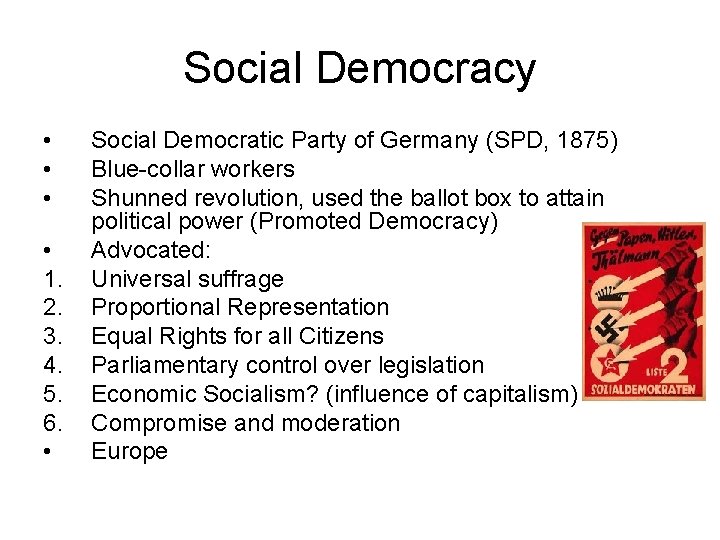
Social Democracy • • 1. 2. 3. 4. 5. 6. • Social Democratic Party of Germany (SPD, 1875) Blue-collar workers Shunned revolution, used the ballot box to attain political power (Promoted Democracy) Advocated: Universal suffrage Proportional Representation Equal Rights for all Citizens Parliamentary control over legislation Economic Socialism? (influence of capitalism) Compromise and moderation Europe
Socialism in the Developing World • Adapts socialism to fit local tradition and custom • Africa: Difficult to institute socialism (corruption) • Middle East: Egypt and “Arab Socialism” uses Islam to reinforce authoritarian control • Latin America: Marxist backgrounds. Revolution to bring about change (Cuba) Social Democratic-Chile 1970. Role of Globalization?
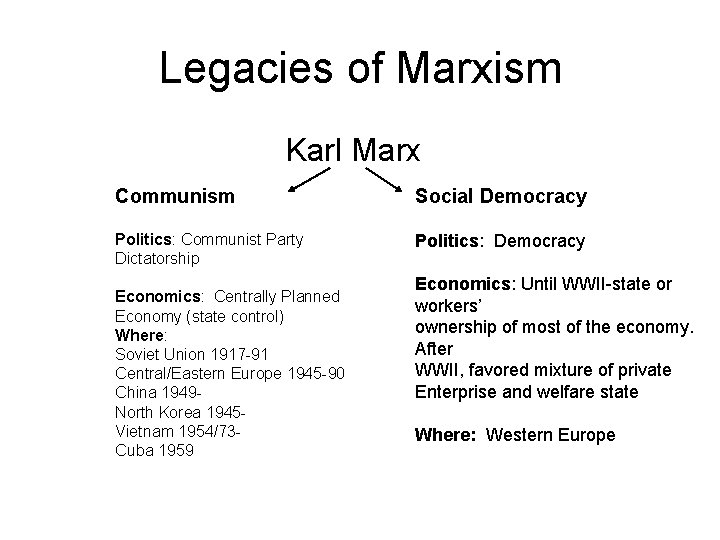
Legacies of Marxism Karl Marx Communism Social Democracy Politics: Communist Party Dictatorship Politics: Democracy Economics: Centrally Planned Economy (state control) Where: Soviet Union 1917 -91 Central/Eastern Europe 1945 -90 China 1949 North Korea 1945 Vietnam 1954/73 Cuba 1959 Economics: Until WWII-state or workers’ ownership of most of the economy. After WWII, favored mixture of private Enterprise and welfare state Where: Western Europe
The End of an Era • Technology has led to the spread of democratic ideas in Communist countries. (Internet, Satellite TV etc) Lessons Learned: 1. The Cold War rivalry played a major role in determining the way Germany, Japan, and the EU evolved. 2. We cannot understand modern communism without understanding its history
- Slides: 19