
Communicative Challenges of Reintegrating Military Veterans Communication in
- Slides: 12
Communicative Challenges of Reintegrating Military Veterans
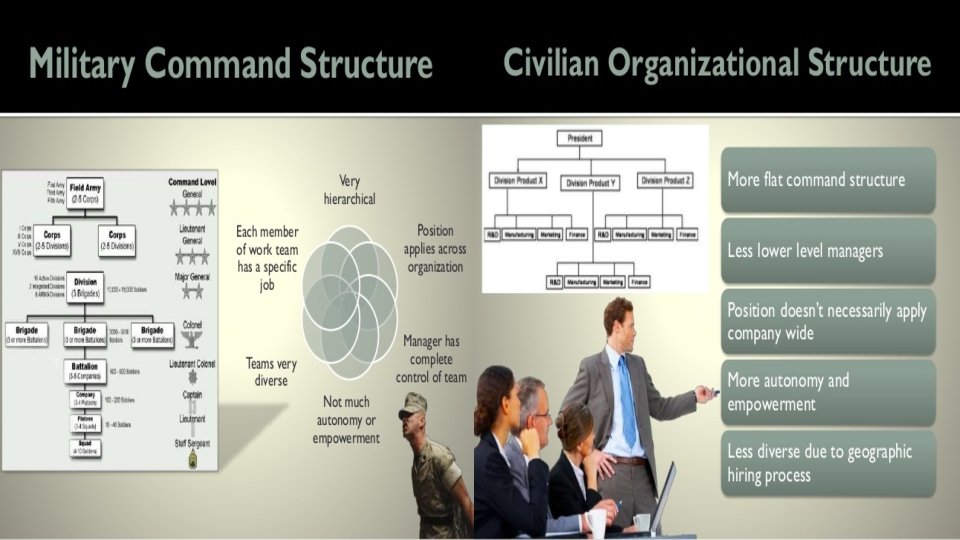
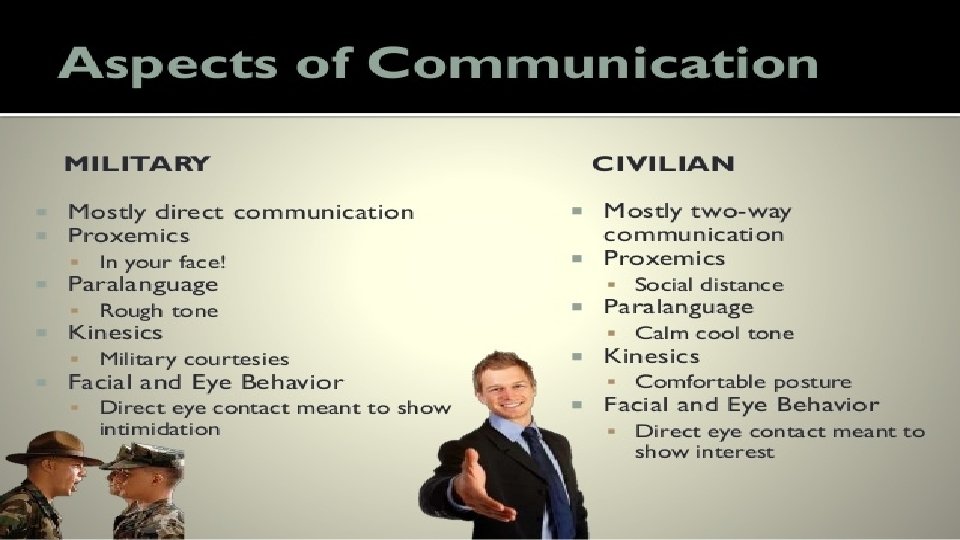
Communication in the Military is Different Example of Communication Introduced in Training (start at 30 secs) Incentive Training Teamwork During Replenishment at Sea (RAS)
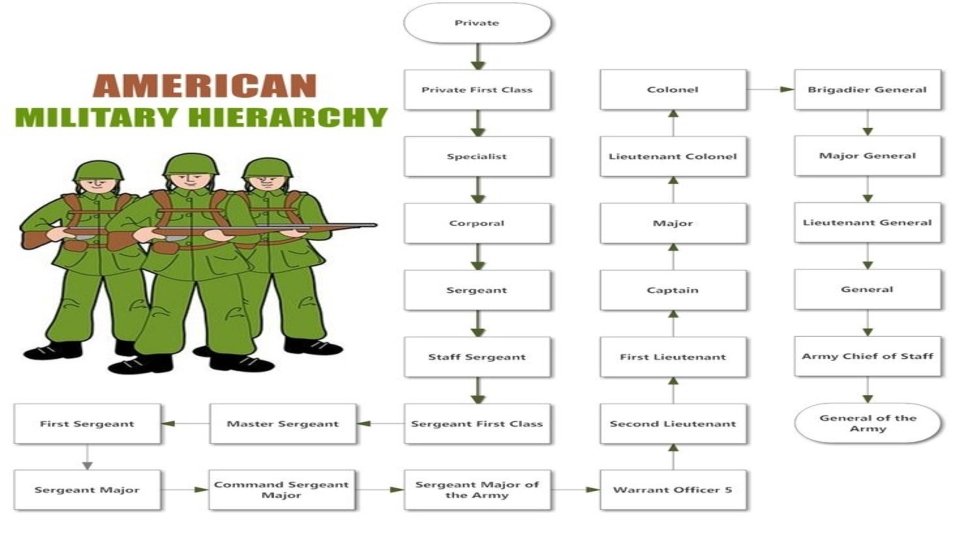
Styles of Communicating Veterans characterize military communication by its clarity, hierarchy, and as a reflection of competence, on which their lives and well-being may depend. Civilian communication may appear “cryptic” as opposed to clear. One participant said, “The rest of the world just kind of leaves you hanging. You don’t really know what they actually want. ”
Communicating about Healthcare On active duty, a service member may rely on the chain of command to ensure that all medical needs are met by the military establishment. Once the veteran is no longer on active duty, the service member must take the initiative, and communicate, to ensure that their healthcare needs are met. Previous research indicates that this can be especially challenging for female veterans (Villagran, Ledford, and Canzona, 2015).
The VA’s perception as less than stellar Jackie Baum (End at 1: 42) Government Watchdog Report (End at 6: 12) Systemic Problems at VA (End at 1: 22)
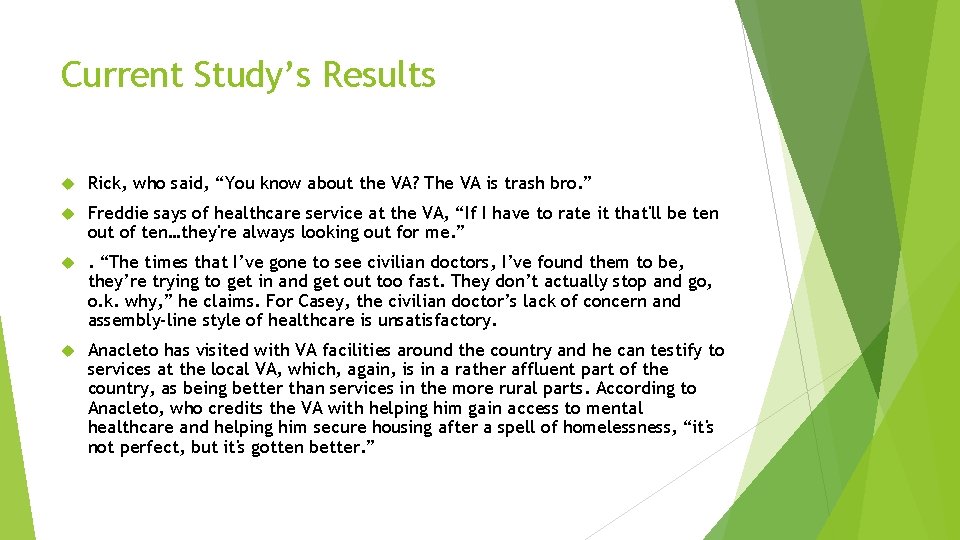
Current Study’s Results Rick, who said, “You know about the VA? The VA is trash bro. ” Freddie says of healthcare service at the VA, “If I have to rate it that'll be ten out of ten…they're always looking out for me. ” . “The times that I’ve gone to see civilian doctors, I’ve found them to be, they’re trying to get in and get out too fast. They don’t actually stop and go, o. k. why, ” he claims. For Casey, the civilian doctor’s lack of concern and assembly-line style of healthcare is unsatisfactory. Anacleto has visited with VA facilities around the country and he can testify to services at the local VA, which, again, is in a rather affluent part of the country, as being better than services in the more rural parts. According to Anacleto, who credits the VA with helping him gain access to mental healthcare and helping him secure housing after a spell of homelessness, “it's not perfect, but it's gotten better. ”
Communicating about Employment It is often a challenge for veterans to write that first resume after leaving the military, especially in regards to describing military experience in terms that civilian employers will understand. According to Jalal, “the things I thought were the coolest things ever was not actually something that [Laugher] they were interested in. Especially the stuff that started with acronyms…I had to translate my experience in a more civilian friendly language. ”
Conclusions Veterans can expect to encounter more cryptic and unclear communication styles, less explicit hierarchies, as well as, an appearance of less competent communicators while adjusting into civilian life. Veterans may also need to rely on Veteran’s Affairs for their healthcare needs, at least at first, and should take the initiative to seek out and advocate for adequate care. Veterans can expect to find something resembling a language barrier when it comes time to communicating about military experience with civilian employers.
References Anderson, M. M. , & Goodman, J. G. (2014). From military to civilian life: Applications of Schlossberg's model for veterans in transition. Career Planning & Adult Development Journal, 30(3), 40 -51. Arendt, C. E. , & Sapp, D. A. (2014). Analyzing résumés of military veterans during transition to post-service. Florida Communication Journal, 42(1), 45 -60. Dey, I. (1995). Reducing fragmentation in qualitative research. In U. Keele (Ed. ), Computer-aided qualitative data analysis (p. 69 -79). Thousand Oaks, CA: Sage. Glaser, B. G. , & Strauss, A. L. (1967). The discovery of grounded theory: Strategies for qualitative research. Chicago, IL: Aldine. Hamiter, J. (2014). About Face: Adapting Military Style Leadership to a Civilian Organization. Retrieved from Slideshare. net: https: //www. slideshare. net Parry, K. , & Thumim, N. (2017). ‘When he’s in Afghanistan it’s like our world/his world’: Mediating military experience. Media, Culture & Society, 39(1), 29 -44. doi: 10. 1177/0163443716672298 Senecal, G. (2018). The social vacuum and the loss of solidarity for veterans experienced in civilian reintegration. New Male Studies, 7(1), 54 -75. Theiss, J. A. , & Knobloch, L. K. (2013). A relational turbulence model of military service members' relational communication during reintegration. Journal of Communication, 64(6), 1109 -1129. doi: 10. 1111/jcom. 12059 Villagran, M. , Ledford, C. J. W. , & Canzona, M. R. (2015). Women’s health identities in the transition from military to service veteran. Journal of Health Communication, 20(10), 1125 -1132. doi: 10. 1080/10810730. 2015. 1018614 Yin, R. K. (2016). Qualitative Research from Start to Finish. New York, New York: The Guilford Press.