
COMMUNICATIONS Part 1 FIRST TELEVISION TELEPHONE In the
- Slides: 11
COMMUNICATIONS Part 1
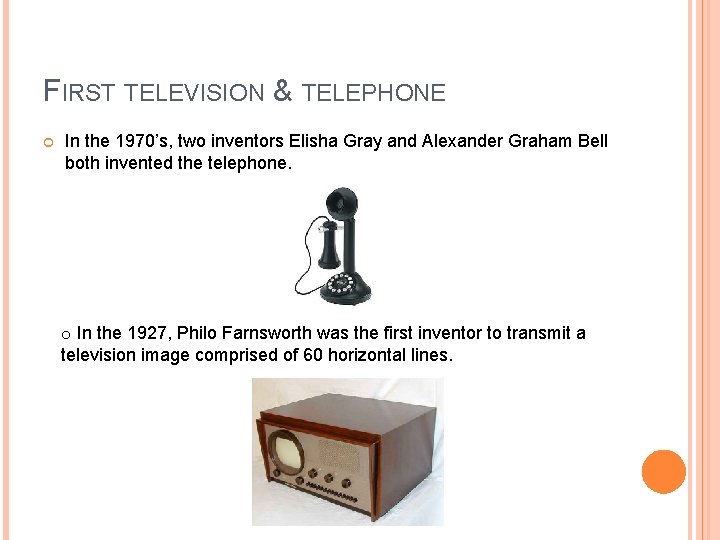
FIRST TELEVISION & TELEPHONE In the 1970’s, two inventors Elisha Gray and Alexander Graham Bell both invented the telephone. o In the 1927, Philo Farnsworth was the first inventor to transmit a television image comprised of 60 horizontal lines.
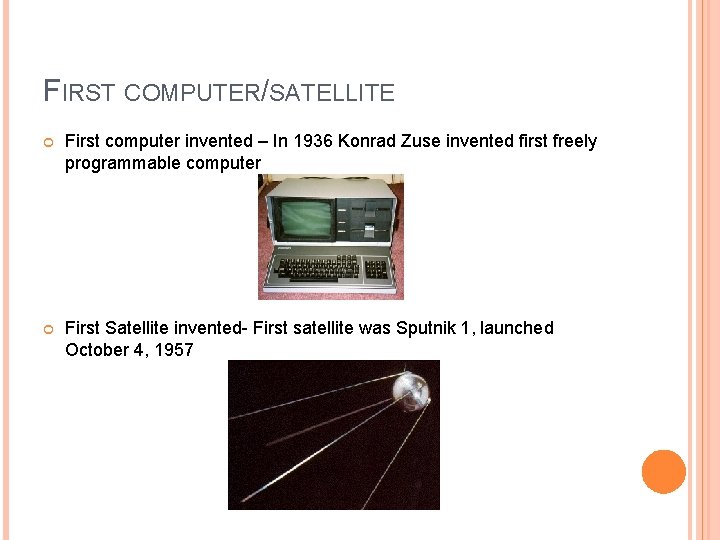
FIRST COMPUTER/SATELLITE First computer invented – In 1936 Konrad Zuse invented first freely programmable computer First Satellite invented- First satellite was Sputnik 1, launched October 4, 1957
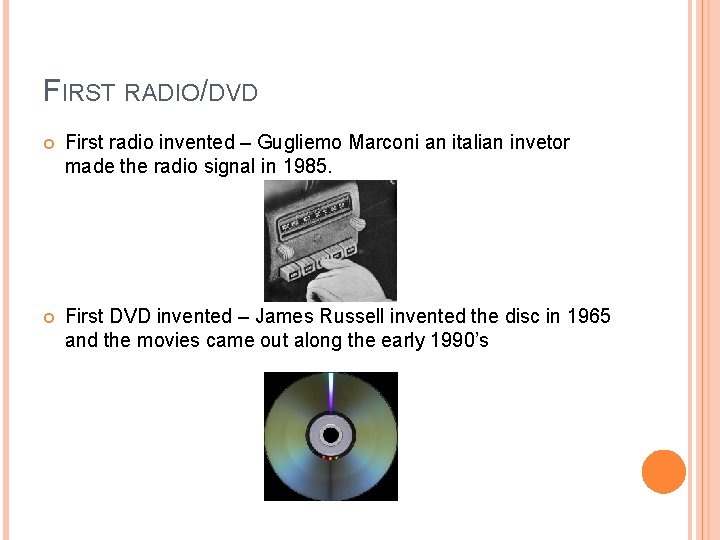
FIRST RADIO/DVD First radio invented – Gugliemo Marconi an italian invetor made the radio signal in 1985. First DVD invented – James Russell invented the disc in 1965 and the movies came out along the early 1990’s
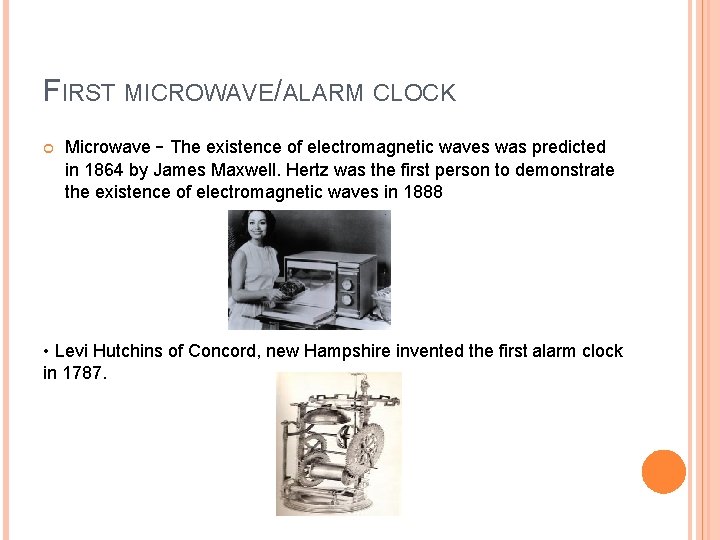
FIRST MICROWAVE/ALARM CLOCK Microwave - The existence of electromagnetic waves was predicted in 1864 by James Maxwell. Hertz was the first person to demonstrate the existence of electromagnetic waves in 1888 • Levi Hutchins of Concord, new Hampshire invented the first alarm clock in 1787.
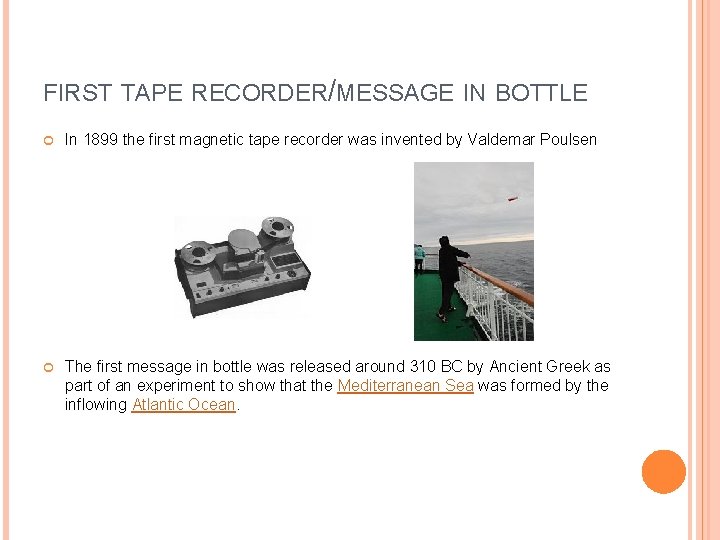
FIRST TAPE RECORDER/MESSAGE IN BOTTLE In 1899 the first magnetic tape recorder was invented by Valdemar Poulsen The first message in bottle was released around 310 BC by Ancient Greek as part of an experiment to show that the Mediterranean Sea was formed by the inflowing Atlantic Ocean.
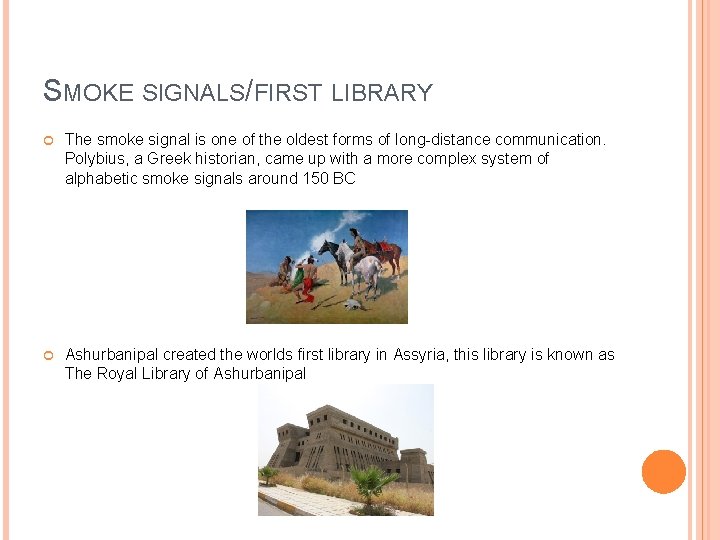
SMOKE SIGNALS/FIRST LIBRARY The smoke signal is one of the oldest forms of long-distance communication. Polybius, a Greek historian, came up with a more complex system of alphabetic smoke signals around 150 BC Ashurbanipal created the worlds first library in Assyria, this library is known as The Royal Library of Ashurbanipal
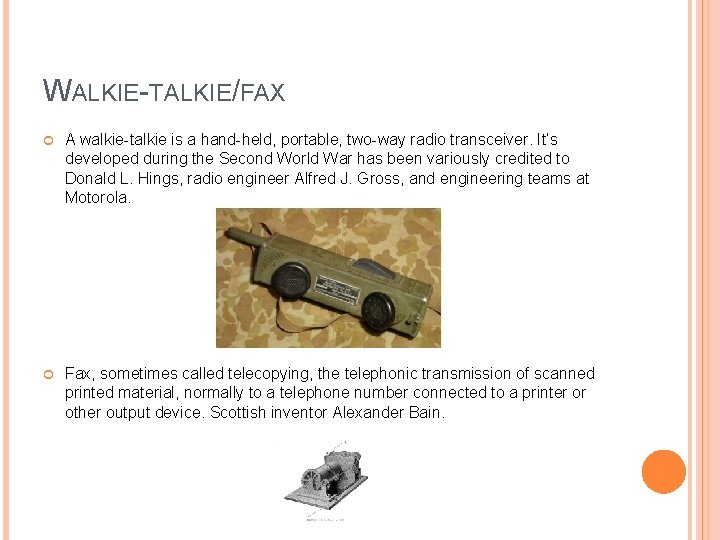
WALKIE-TALKIE/FAX A walkie-talkie is a hand-held, portable, two-way radio transceiver. It’s developed during the Second World War has been variously credited to Donald L. Hings, radio engineer Alfred J. Gross, and engineering teams at Motorola. Fax, sometimes called telecopying, the telephonic transmission of scanned printed material, normally to a telephone number connected to a printer or other output device. Scottish inventor Alexander Bain.
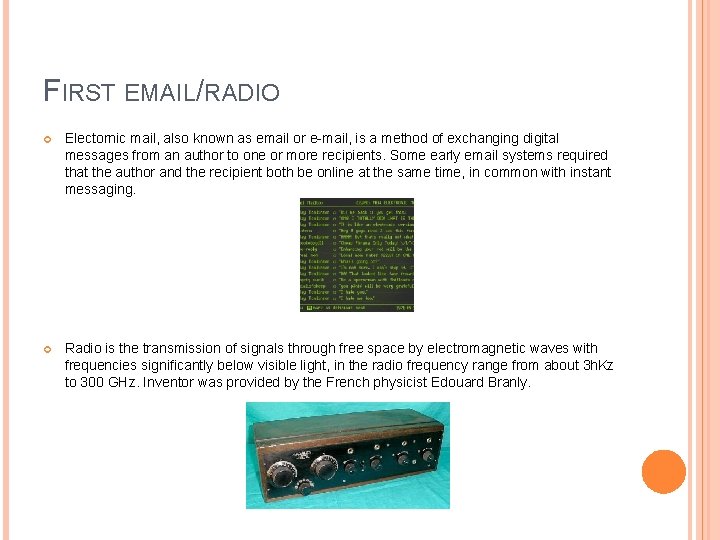
FIRST EMAIL/RADIO Electornic mail, also known as email or e-mail, is a method of exchanging digital messages from an author to one or more recipients. Some early email systems required that the author and the recipient both be online at the same time, in common with instant messaging. Radio is the transmission of signals through free space by electromagnetic waves with frequencies significantly below visible light, in the radio frequency range from about 3 h. Kz to 300 GHz. Inventor was provided by the French physicist Edouard Branly.
INTERNET/COMPACT CASSETTE The internet is a global system of interconnected computer networks that use the standard Internet protocol suite to serve billions of users worldwide. The origins of the Internet reach back to research in the 1960’s commissioned by the United States government in collaboration with private commercial interests to build robust, faulttolerant, and distributed computer networks. A magnetic tape sound recording format. In 1962 Philips invented the compact audio cassette medium for audio storage, introducing it in Europe in August 1963
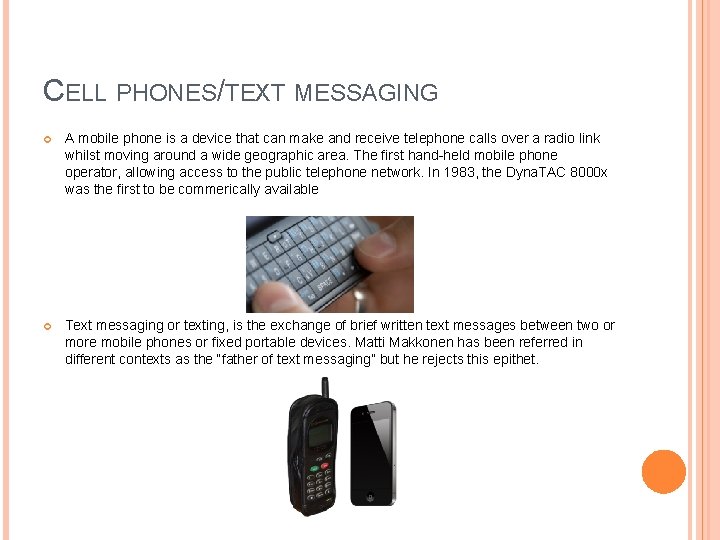
CELL PHONES/TEXT MESSAGING A mobile phone is a device that can make and receive telephone calls over a radio link whilst moving around a wide geographic area. The first hand-held mobile phone operator, allowing access to the public telephone network. In 1983, the Dyna. TAC 8000 x was the first to be commerically available Text messaging or texting, is the exchange of brief written text messages between two or more mobile phones or fixed portable devices. Matti Makkonen has been referred in different contexts as the “father of text messaging” but he rejects this epithet.