
Communications Laboratory Lecture Series Digital television broadcasting Presentation
Communications Laboratory Lecture Series Digital television broadcasting Presentation by: Neil Pickford 1

Digital Television Broadcasting DTB What is digital TV n How was it developed n What are the systems n Enabling technologies n u Transmission technology u Compression technology Content & services n What is happening in australia n The future n 2
Broad Objectives of DTB Overcome limitations of the existing analog television systems n Improved picture n u High quality (no interference) u Resolution (HDTV) u Format (16: 9) Enhanced service related features n Additional data capacity available for other value added services n 3
Digital Media First media systems were analog n Most media are converting to digital n u Computer storage u Music (LP-CD) u Telecommunications u Multimedia u Radio (DAB) 4 u Television
Standard Definition Television SDTV The current television display system n 4: 3 aspect ratio picture, interlace scan n Australia/Europe n u 625 lines - 704 pixels x 576 lines displayed u 50 frames/sec 25 pictures/sec u 405504 pixels total n USA/Japan u 525 lines - 704 pixels x 480 lines displayed u 60 frames/sec 5 30 pictures/sec u 337920 pixels total

Enhanced Definition Television EDTV Intermediate step to HDTV n Doubled scan rate - reduce flicker n Double lines on picture - calculated n Image processing - ghost cancelling n Wider aspect ratio - 16: 9 n Multi-channel sound n 6
High Definition Television HDTV Not exactly defined - number of systems n System with a higher picture resolution n Greater than 1000 lines resolution n Picture with less artefacts or distortions n Bigger picture to give a viewing experience n Wider aspect ratio to use peripheral vision n Progressive instead of interlaced pictures n 7
HDTV - Have We Heard This Before? The first TV system had just 32 lines n When the 405 line system was introduced it was called HDTV! n When 625 line black & white came along it was called HDTV! n When the PAL colour system was introduced it was called HDTV by some people. n Now we have 1000+ line systems and digital television - guess what? Its called HDTV! n 8
Interlaced Vs Progressive Scan Interlaced pictures. - 1/2 the lines presented each scan 1, 3, 5, 7, 9, 11, 13. . . . 623, 625 field 1 2, 4, 6, 8, 10, 12, 14. . . 622, 624 field 2 n Because the fields are recorded at separate times this leads to picture twitter & judder n Progressive pictures - all the lines sent in the one scan. 1, 2, 3, 4, 5, 6, 7, 8. . . . 623, 624, 625 picture n No twitter or judder. n But twice the information rate. n 9
Question - HDTV Have you seen HDTV pictures? 10
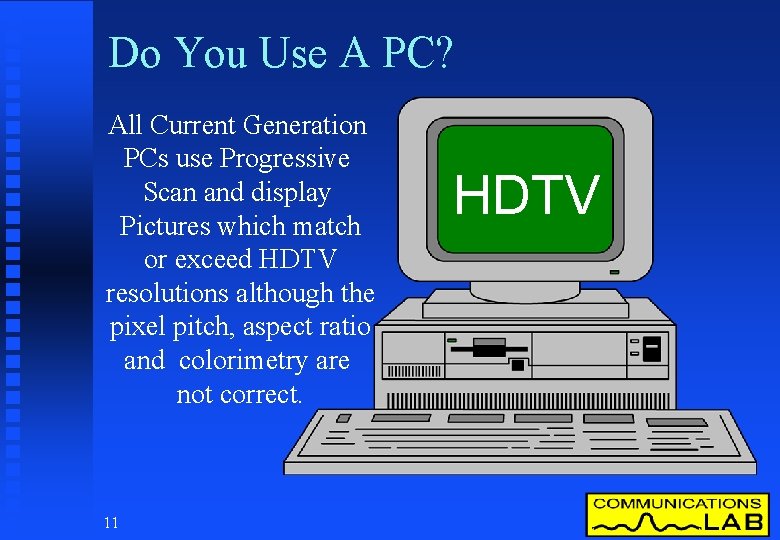
Do You Use A PC? All Current Generation PCs use Progressive Scan and display Pictures which match or exceed HDTV resolutions although the pixel pitch, aspect ratio and colorimetry are not correct. 11 HDTV
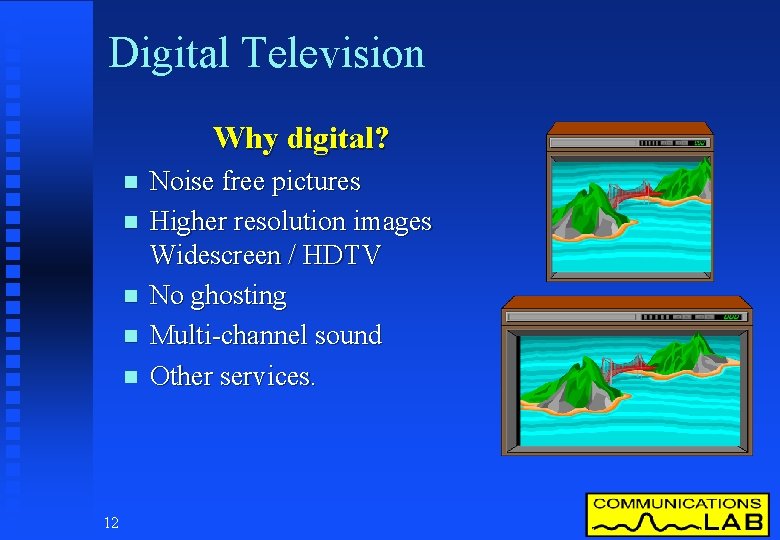
Digital Television Why digital? n n n 12 Noise free pictures Higher resolution images Widescreen / HDTV No ghosting Multi-channel sound Other services.

Digital Television - Types n Satellite (DBS) u DVB-S u Program interchange u Direct view / pay TV u SMATV Uplink 13 Downlink

Digital Television - Types n Cable u HFC - pay TV u MATV Fibre u DVB-C / 16 -VSB Main Coax Tap 14 Spur Tee
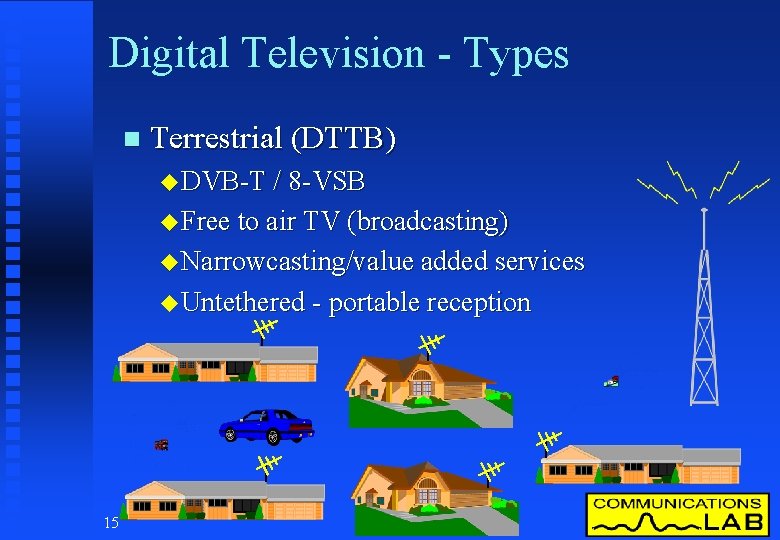
Digital Television - Types n Terrestrial (DTTB) u DVB-T / 8 -VSB u Free to air TV (broadcasting) u Narrowcasting/value added services u Untethered - portable reception 15

Digital Terrestrial Television Broadcasting - DTTB Regional free to air television n Replacement of current analog PAL broadcast television services n Operating in adjacent unused “taboo” channels to analog PAL service n Carries a range of services HDTV, SDTV, audio, teletext, data n Providing portable service n 16
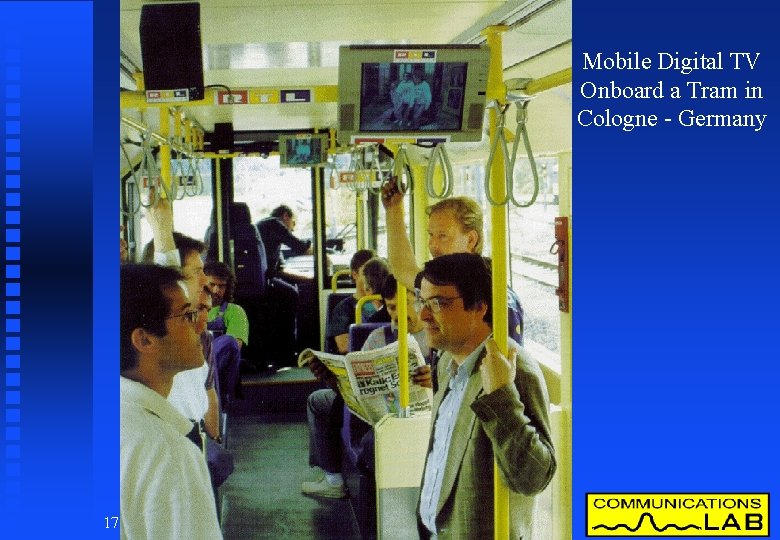
Mobile Digital TV Onboard a Tram in Cologne - Germany 17
How Was Digital TV Developed Japanese & Europeans wanted to improve analog TV - bigger pictures, more resolution n Japanese developed muse 1125 lines 60 Hz n Europeans worked on HD-MAC 1250 lines n Americans broadcasters wanted to protect spare unused TV channels from the land mobile service and told FCC they required the channels for a future analog compatible HDTV system. n 18
Development Race Americans embarked on a HDTV race to develop an analog HDTV system n Digital television was seen as impossible. n General instruments developed first digital TV system for satellite pay TV from experience with NASA deep space probes n HDTV race became a digital HDTV race. n Race outcome - poor performance but demonstrated digital could be done. n 19
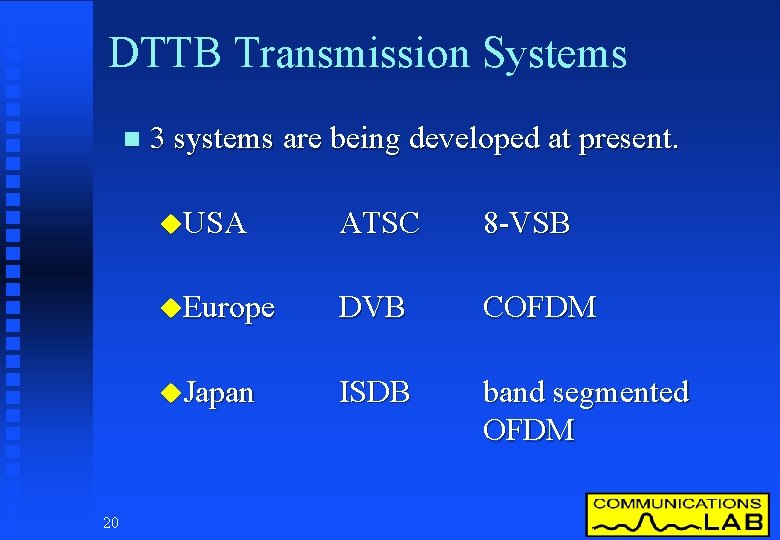
DTTB Transmission Systems n 20 3 systems are being developed at present. u. USA ATSC 8 -VSB u. Europe DVB COFDM u. Japan ISDB band segmented OFDM

8 -VSB - USA n n Developed by the advance television systems committee - ATSC Developed for use in a 6 MHz channel u A 7 MHz variant is possible. n n n 21 Uses a single carrier with pilot tone 8 level amplitude modulation system Payload data rate of 19. 3 Mb/s Relies on adaptive equalisation Existing technology developed to near limit
COFDM - Europe n n n Developed by the digital video broadcasting project group - DVB Uses similar technology to DRB Uses 1705 or 6817 carriers Variable carrier modulation types are defined allowing data rates of 5 -27 Mb/s in 7 MHz Developed for 8 MHz channels u A 7 MHz variant has been produced and tested n n 22 Can use single frequency networks - SFNs New technology with scope for continued improvement & development
ISDB - Japanese are developing integrated services digital broadcasting (ISDB) n System integrates all forms of broadcasting services into one common data channel which can be passed by satellite, cable or terrestrial delivery systems n Video services n u Sound services u Bulk data services u Interactive data services 23
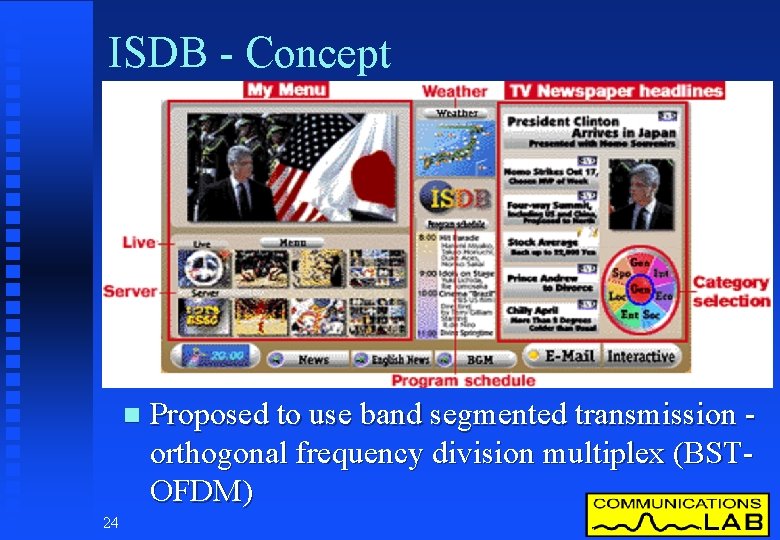
ISDB - Concept n 24 Proposed to use band segmented transmission orthogonal frequency division multiplex (BSTOFDM)
BST-OFDM - Japan BST-OFDM is a variant of the European COFDM system which allows segmenting of the data spectrum into 100 k. Hz blocks. n 2 receiver bandwidths proposed. n u 500 k. Hz portable / mobile for sound and data u 5. 6 MHz fixed / mobile for SDTV and LDTV u 5. 6 MHz fixed for HDTV n 25 Individual band segments can be allocated to separate services which can use different modulation systems

BST-OFDM - Japan Allows separate services to be replaced for local area broadcasting n Allows for variable ruggedness for fixed / mobile / portable reception n Could straddle other existing services. n Primarily being developed for japan as a solution to cluttered broadcasting spectrum. n In early stages of development n No hardware available at this stage n 26
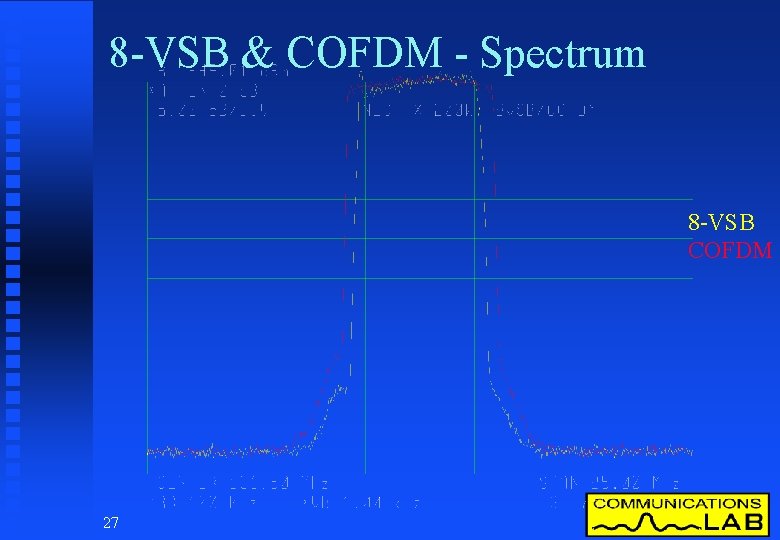
8 -VSB & COFDM - Spectrum 8 -VSB COFDM 27
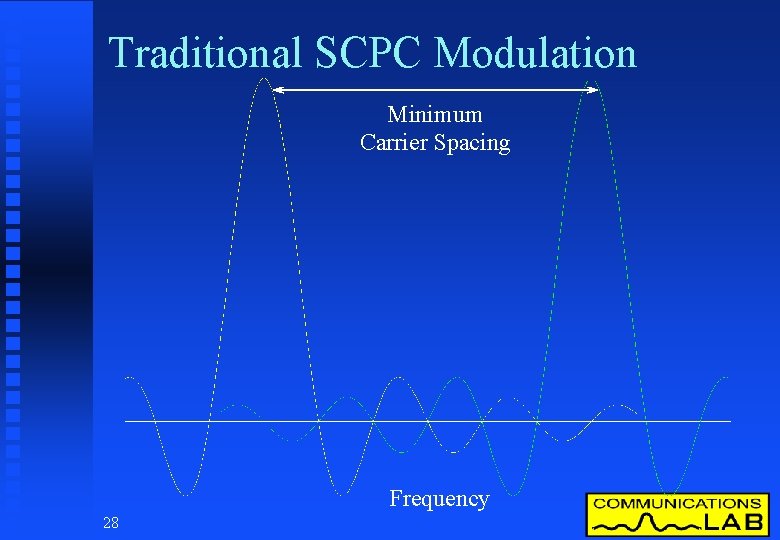
Traditional SCPC Modulation Minimum Carrier Spacing Frequency 28
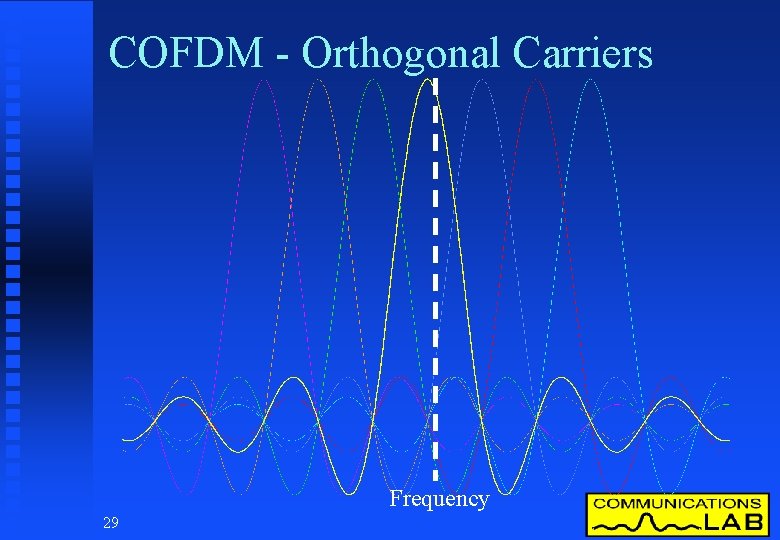
COFDM - Orthogonal Carriers Frequency 29
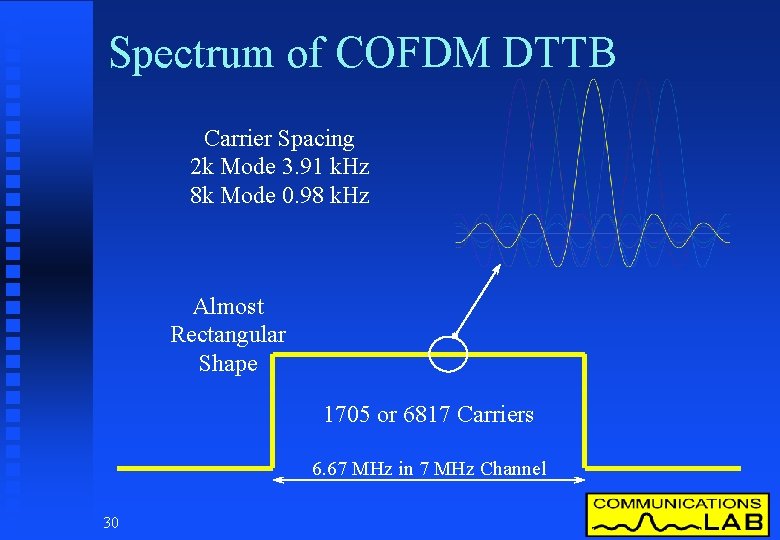
Spectrum of COFDM DTTB Carrier Spacing 2 k Mode 3. 91 k. Hz 8 k Mode 0. 98 k. Hz Almost Rectangular Shape 1705 or 6817 Carriers 6. 67 MHz in 7 MHz Channel 30
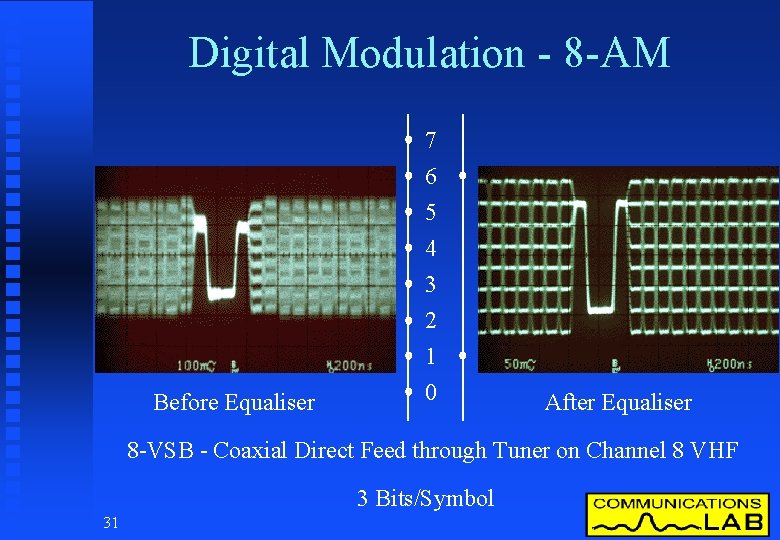
Digital Modulation - 8 -AM 7 Before Equaliser 6 5 4 3 2 1 0 After Equaliser 8 -VSB - Coaxial Direct Feed through Tuner on Channel 8 VHF 3 Bits/Symbol 31
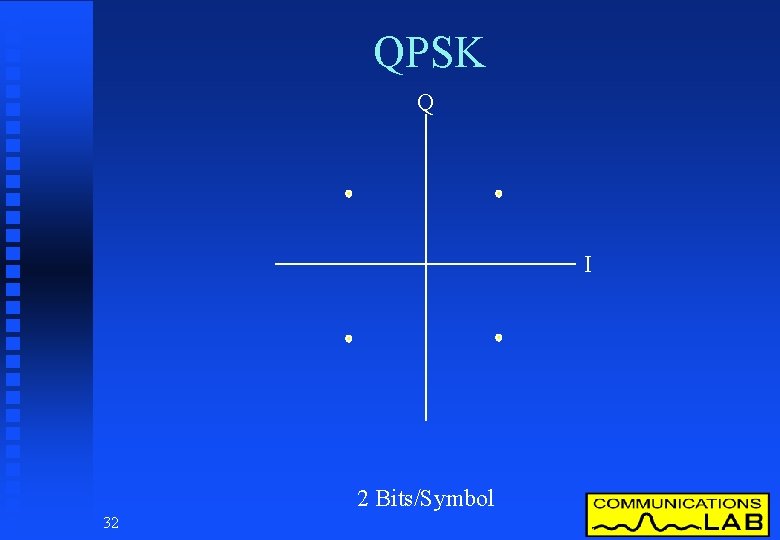
QPSK Q I 2 Bits/Symbol 32
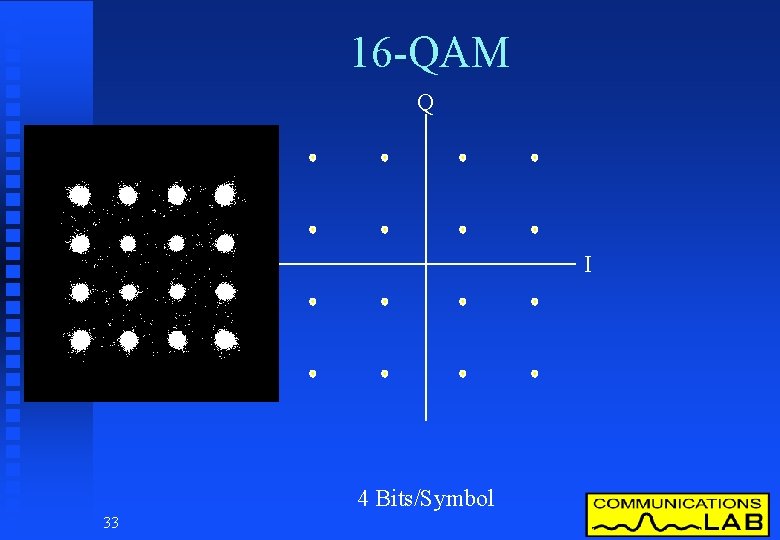
16 -QAM Q I 4 Bits/Symbol 33
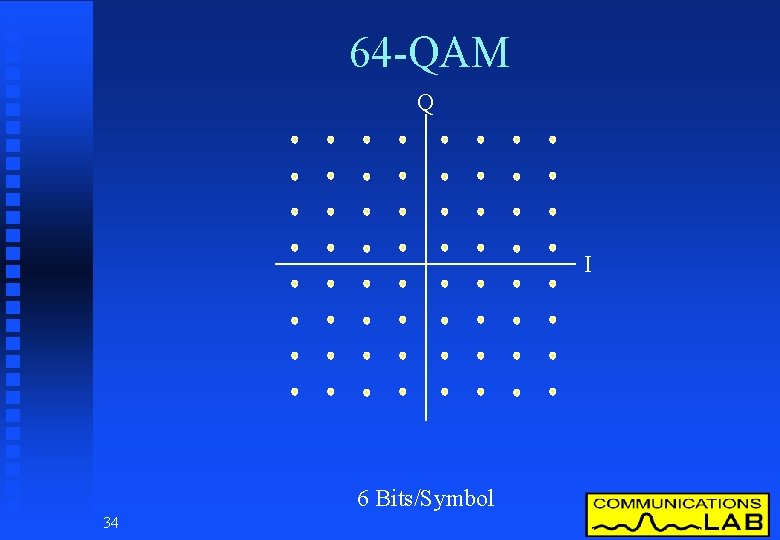
64 -QAM Q I 6 Bits/Symbol 34
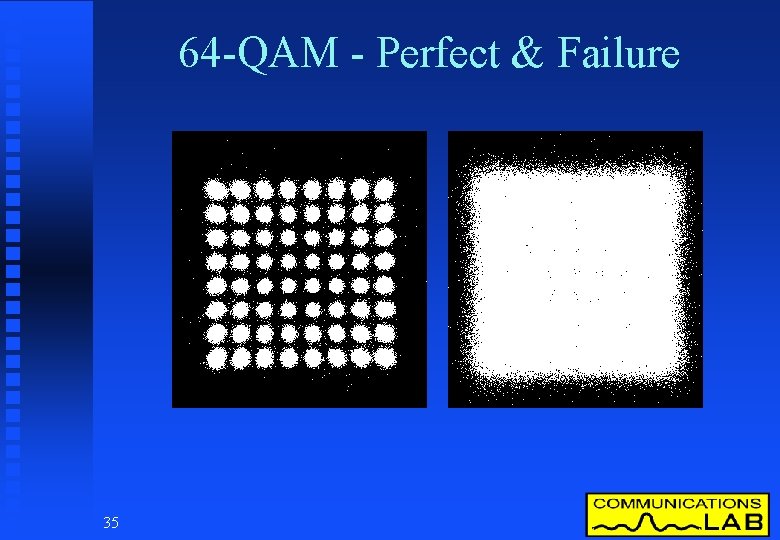
64 -QAM - Perfect & Failure 35
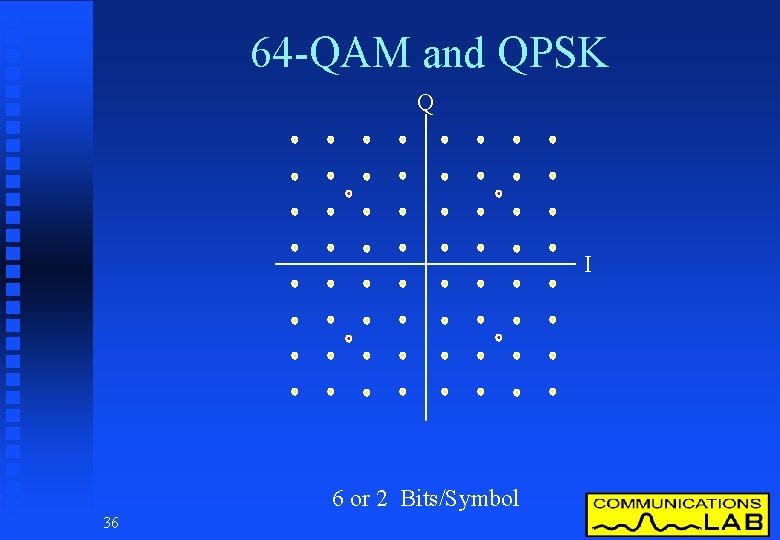
64 -QAM and QPSK Q I 6 or 2 Bits/Symbol 36
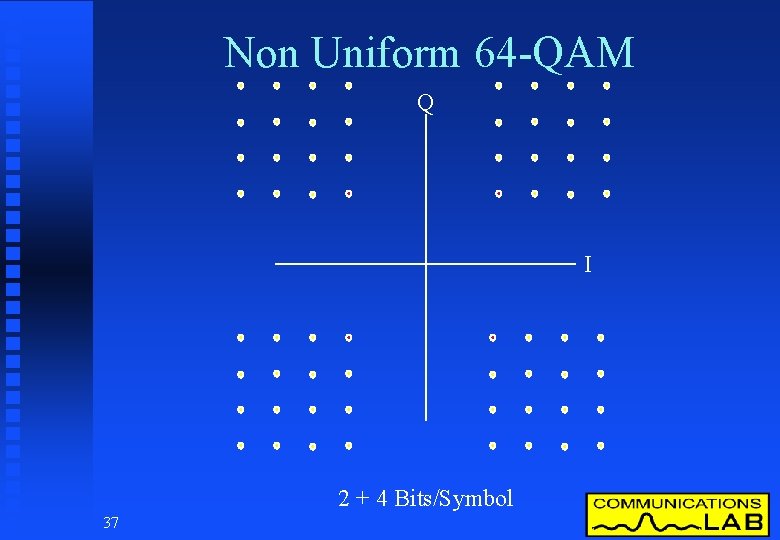
Non Uniform 64 -QAM Q I 2 + 4 Bits/Symbol 37
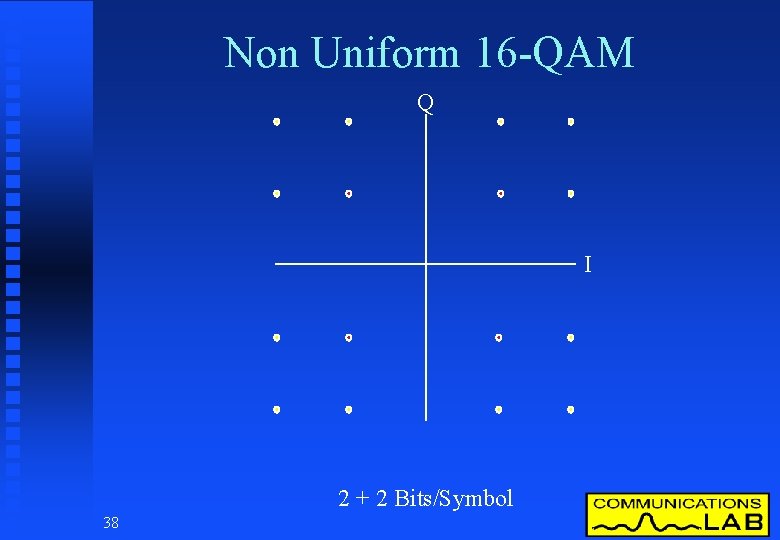
Non Uniform 16 -QAM Q I 2 + 2 Bits/Symbol 38
8 -VSB - DTV - Development 1987 FCC inquiry into future TV systems and advisory committee on ATV service was established - ACATS n 1990 digital TV systems developed n Competitive testing race undertaken n 1993 poor results announced grand alliance (GA) formed by the contestants. - Extra development n 1994 re-testing of GA system n 39

8 -VSB - DTV - Development 1996 FCC adopted ATSC standard n 1997 each full-power broadcaster loaned a second 6 MHz TV channel for simalcasting DTV. n 1997 FCC announced DTV service and mandated 8 year transition schedule n 1997 demonstration, laboratory testing and field trials of 8 -VSB in Australia n 40
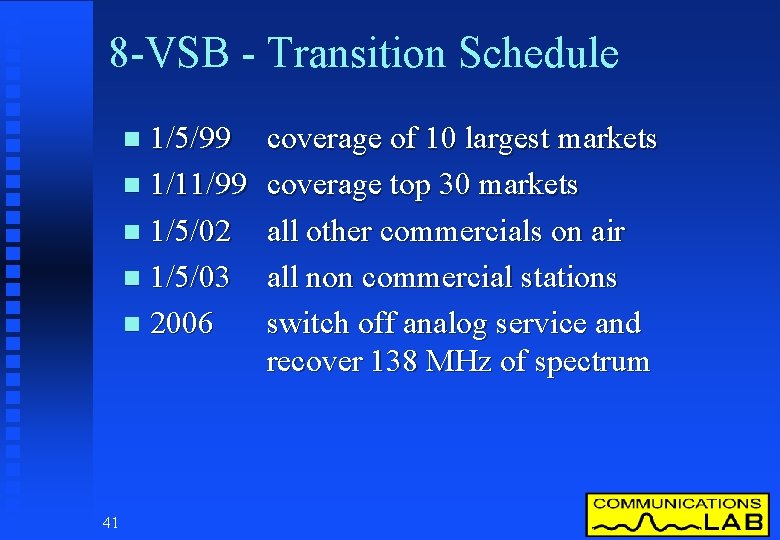
8 -VSB - Transition Schedule 1/5/99 n 1/11/99 n 1/5/02 n 1/5/03 n 2006 n 41 coverage of 10 largest markets coverage top 30 markets all other commercials on air all non commercial stations switch off analog service and recover 138 MHz of spectrum
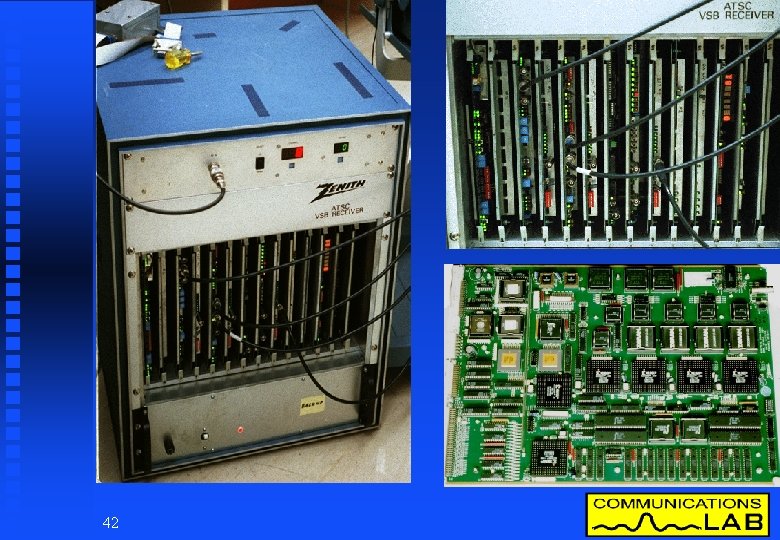
42
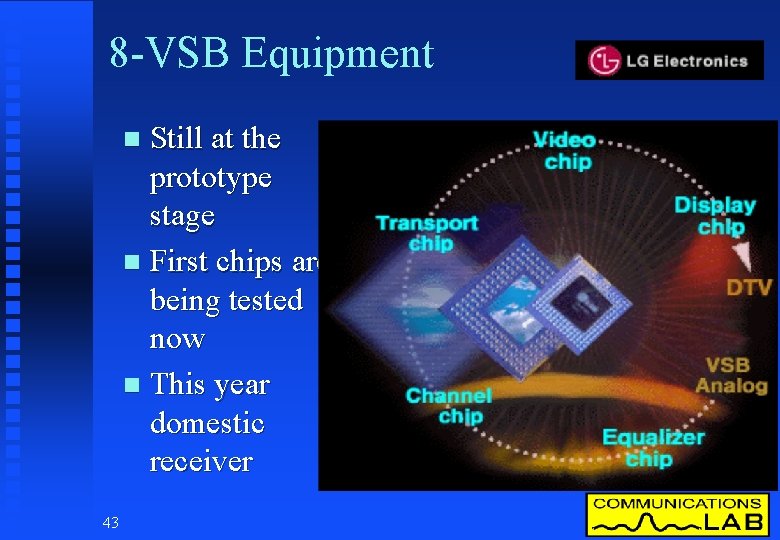
8 -VSB Equipment Still at the prototype stage n First chips are being tested now n This year domestic receiver n 43

European Development - DVB 1991 European launching group (ELG) n 1992 ELG developed Mo. U for cooperation n 1993 ELG became digital video broadcasting (DVB) project - a forum for all interested in digital TV to participate in research and development as a unified group. n DVB is a consortium of over 200 network operators, broadcasters, manufacturers and regulators in 30 countries working together. n 44
DVB Project The DVB philosophy open, interoperable, flexible, market-led, global standards for digital TV n 1980 s MAC systems under development gave way to all digital technology n Based on common MPEG-2 coding system n Integrated set of standards allowing flexible operation across cable, microwave, satellite and terrestrial distribution n 45
DVB - COFDM - Development Easier satellite (DVB-S) & cable (DVB-C) systems were developed first. n DVB-T is the terrestrial member of the DVB family of standards. n OFDM transmission originally developed for cable systems, adapted to digital radio broadcasting, extended by DVB to digital TV n DVB-T based on COFDM technology n 46
COFDM - Transition Schedule DTTB test transmission programs are currently occurring in Denmark, Holland, Finland, France, Germany & Italy n 1998 Britain & Sweden on air with SDTV DTTB system using UHF band. n 2001 Spain plans DTTB to be operational, achieving 100% coverage by 2010. n Simulcasting is expected to be around 20 years in Europe. Focus is SDTV to EDTV n 47
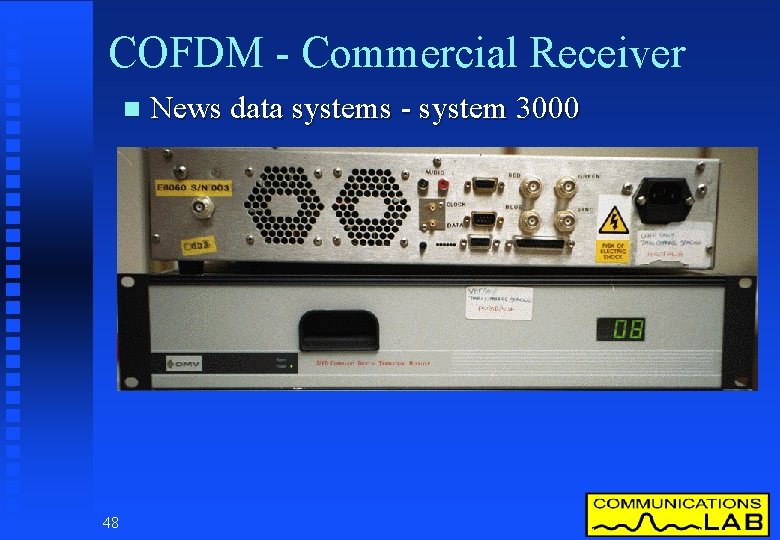
COFDM - Commercial Receiver n 48 News data systems - system 3000
COFDM DTTB Equipment System 3000 - NDS n Project mummy bear - NDS zenith n Dvbird - Thomson SGS Philips n 3 chip receiver - Philips n Test receiver - ITIS Harris n Chip set - Hokia Siemens è Over 20 manufacturers showing hardware n 49
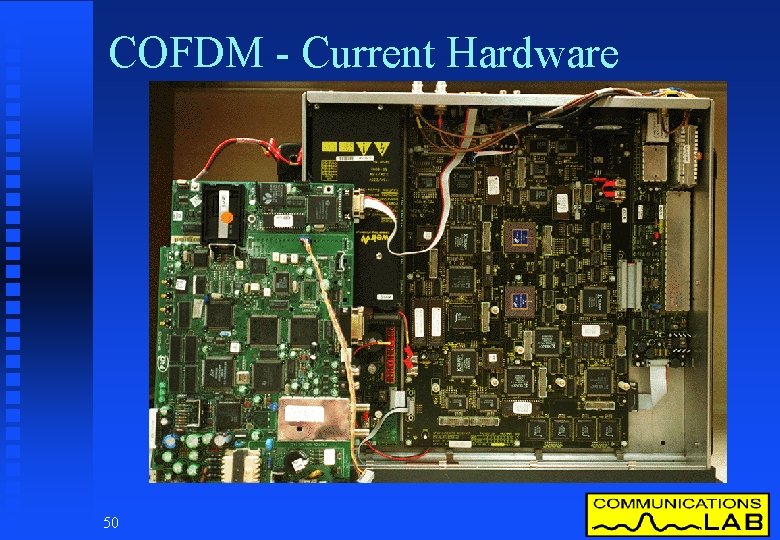
COFDM - Current Hardware 50
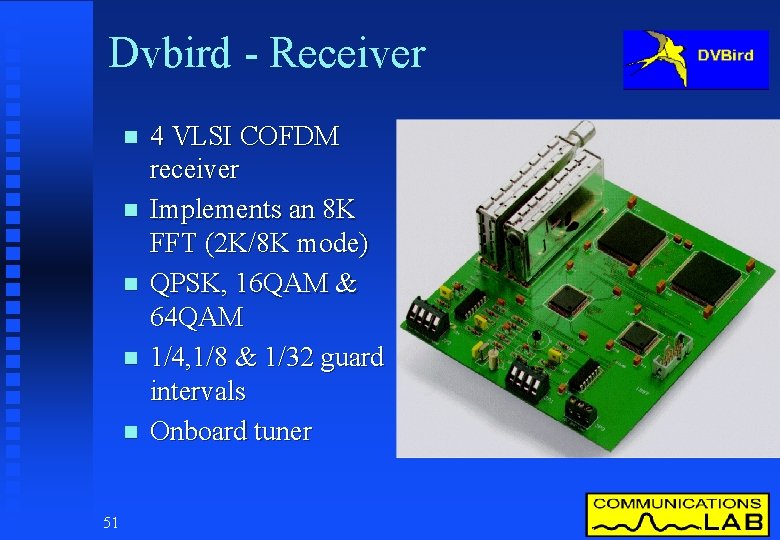
Dvbird - Receiver n n n 51 4 VLSI COFDM receiver Implements an 8 K FFT (2 K/8 K mode) QPSK, 16 QAM & 64 QAM 1/4, 1/8 & 1/32 guard intervals Onboard tuner
Enabling Technologies Source digitisation (Rec 601 digital studio) n Compression technology (MPEG, AC-3) n Data multiplexing (MPEG) n Transmission technology (modulation) n Display technology (large wide screens) n 52
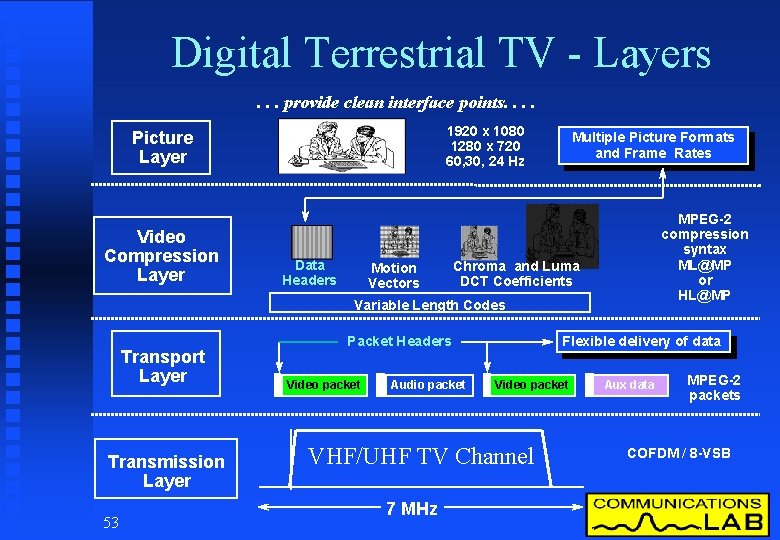
Digital Terrestrial TV - Layers. . . provide clean interface points. . 1920 x 1080 1280 x 720 60, 30, 24 Hz Picture Layer Video Compression Layer Data Headers Motion Vectors Multiple Picture Formats and Frame Rates MPEG-2 compression syntax ML@MP or HL@MP Chroma and Luma DCT Coefficients Variable Length Codes Transport Layer Transmission Layer 53 Flexible delivery of data Packet Headers Video packet Audio packet Video packet VHF/UHF TV Channel 7 MHz Aux data MPEG-2 packets COFDM / 8 -VSB
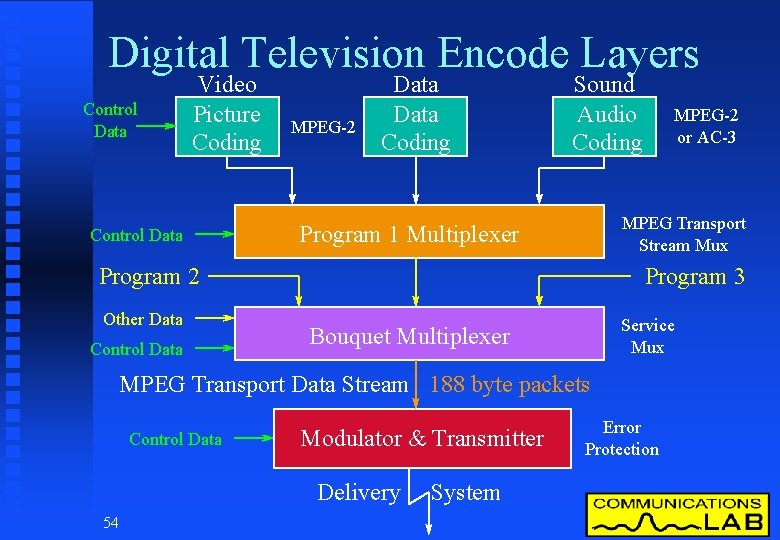
Digital Television Encode Layers Control Data Video Picture Coding Control Data MPEG-2 Data Coding Sound Audio Coding MPEG Transport Stream Mux Program 1 Multiplexer Program 2 Other Data Control Data MPEG-2 or AC-3 Program 3 Service Mux Bouquet Multiplexer MPEG Transport Data Stream 188 byte packets Control Data Modulator & Transmitter Delivery 54 System Error Protection
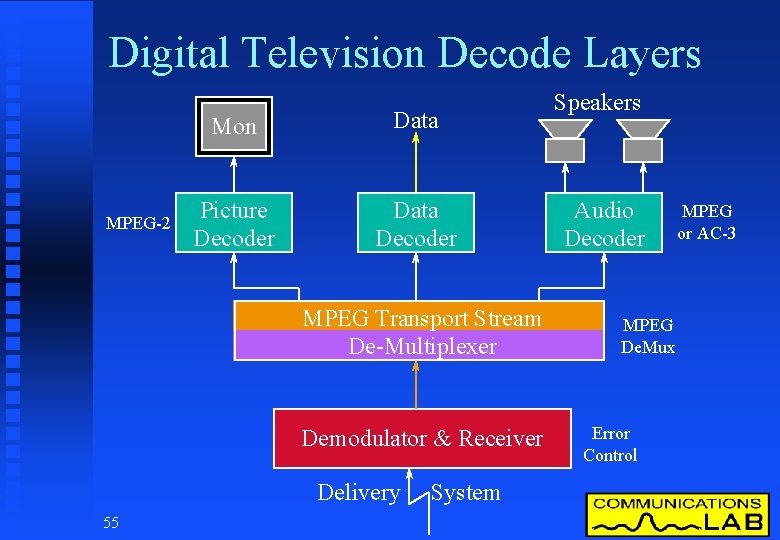
Digital Television Decode Layers MPEG-2 Mon Data Picture Decoder Data Decoder MPEG Transport Stream De-Multiplexer Demodulator & Receiver Delivery 55 System Speakers Audio Decoder MPEG De. Mux Error Control MPEG or AC-3

Transmission Technology The transmission system is used to transport the information to the consumer. n The system protects the information being carried from the transmission environment n Current Australian analog television uses the PAL-B AM modulation system n 56

Digital TV Transmission Technology The transmission system is a “data pipe” n Transports data rates of around 20 Mb/s n Transports data in individual containers called packets n 57
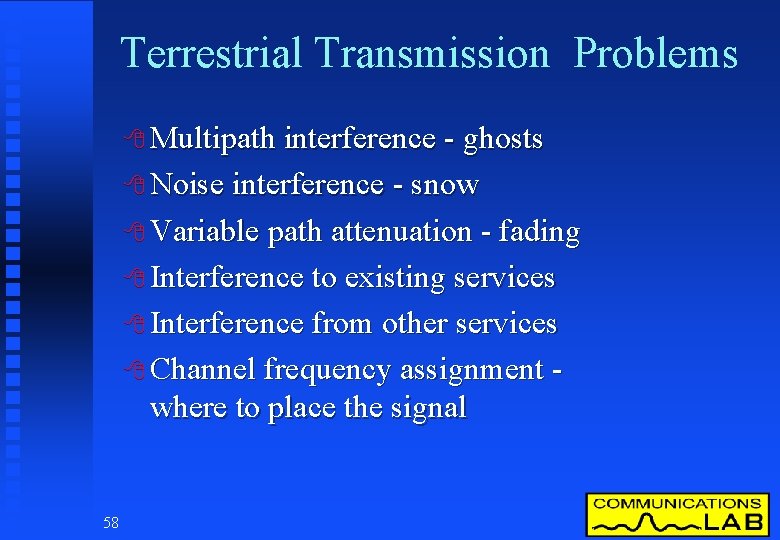
Terrestrial Transmission Problems 8 Multipath interference - ghosts 8 Noise interference - snow 8 Variable path attenuation - fading 8 Interference to existing services 8 Interference from other services 8 Channel frequency assignment - where to place the signal 58
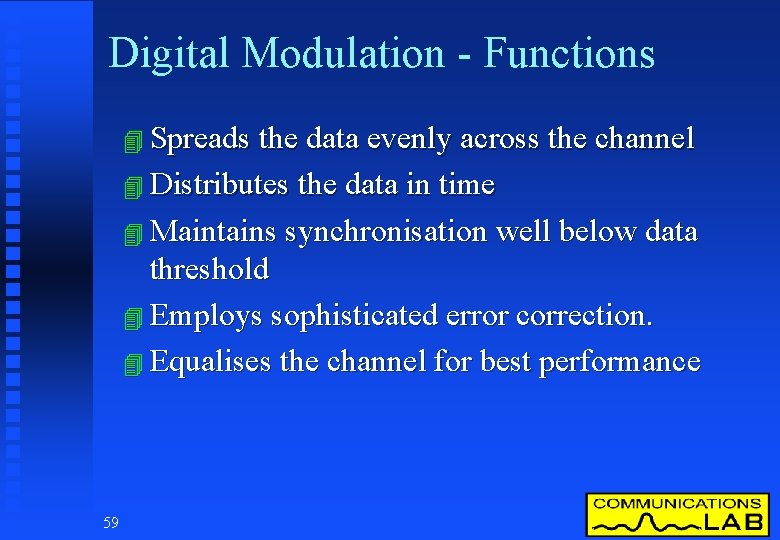
Digital Modulation - Functions 4 Spreads the data evenly across the channel 4 Distributes the data in time 4 Maintains synchronisation well below data threshold 4 Employs sophisticated error correction. 4 Equalises the channel for best performance 59
Digital Has to Fit In With PAL We need a digital system that can co-exist with the existing analog broadcast TV currently in use in Australia n We use the PAL-B with sound system G n Australian TV channels are 7 MHz wide on both VHF & UHF n Australia uses: n u VHF bands I, II & III u UHF bands IV & IV 60
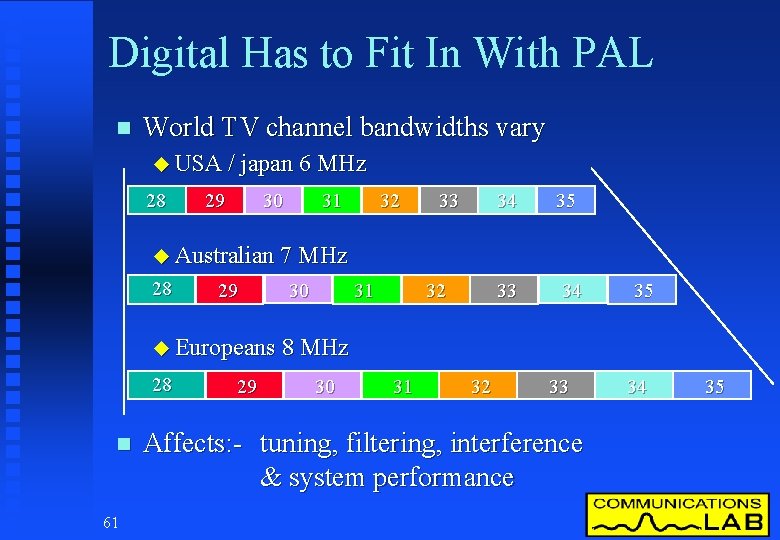
Digital Has to Fit In With PAL n World TV channel bandwidths vary u USA / japan 6 MHz 28 29 30 31 32 33 34 35 u Australian 7 MHz 28 29 30 31 32 33 34 35 u Europeans 8 MHz 28 n 61 29 30 31 32 33 Affects: - tuning, filtering, interference & system performance 34 35
Digital Has to Fit In With PAL n Digital television system development is focused in Europe & USA u The systems standards are designed to meet the needs of the developers u They focus on their countries needs first u Australian input is through standards organisations such as the ITU-R 62
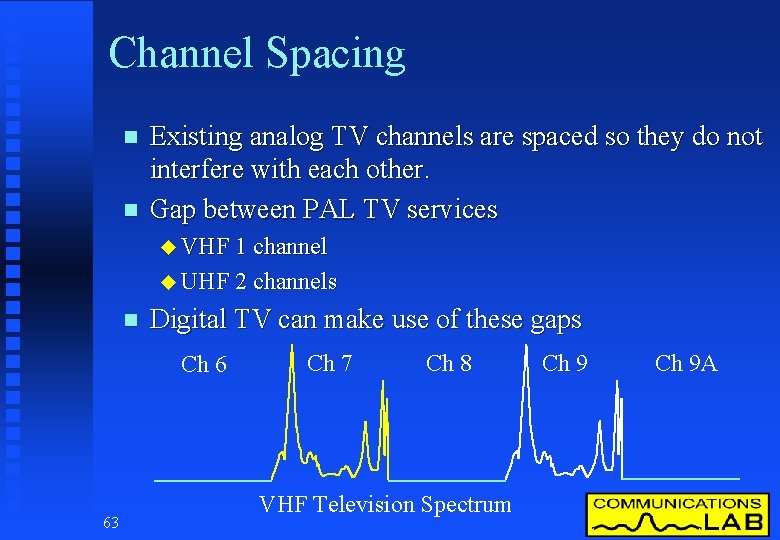
Channel Spacing n n Existing analog TV channels are spaced so they do not interfere with each other. Gap between PAL TV services u VHF 1 channel u UHF 2 channels n Digital TV can make use of these gaps Ch 6 63 Ch 7 Ch 8 VHF Television Spectrum Ch 9 A
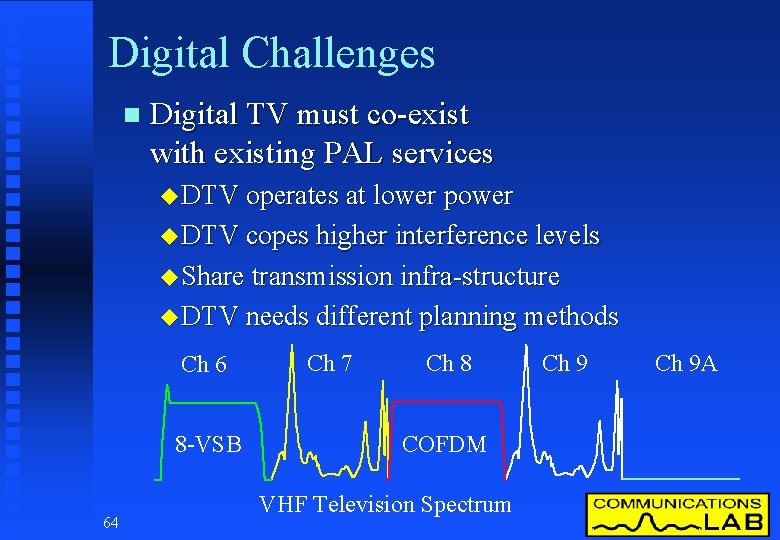
Digital Challenges n Digital TV must co-exist with existing PAL services u DTV operates at lower power u DTV copes higher interference levels u Share transmission infra-structure u DTV needs different planning methods Ch 6 8 -VSB 64 Ch 7 Ch 8 COFDM VHF Television Spectrum Ch 9 A
Digital Service Area Planning n Analog TV has a slow gradual failure u Existing PAL service was planned for: 50 % availability at 50 % of locations n Digital TV has a “cliff edge” failure u Digital TV needs planning for: 90 -99 % availability at 90 -99 % of locations 65
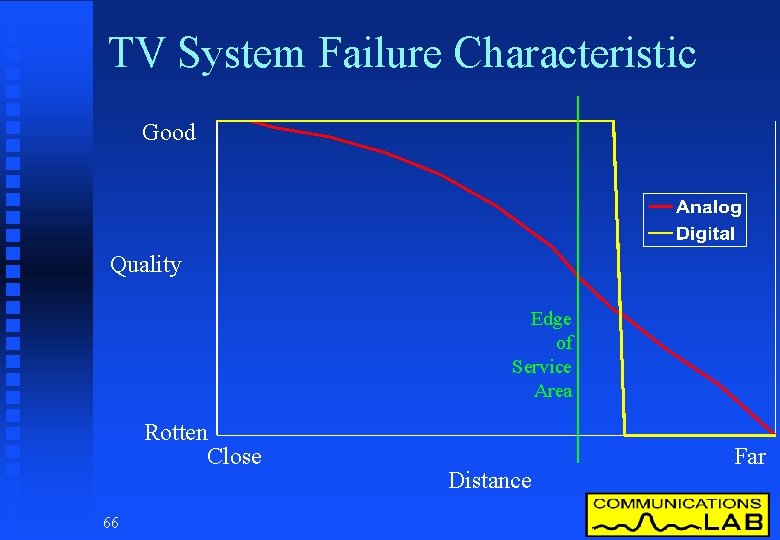
TV System Failure Characteristic Good Quality Edge of Service Area Rotten Close 66 Distance Far
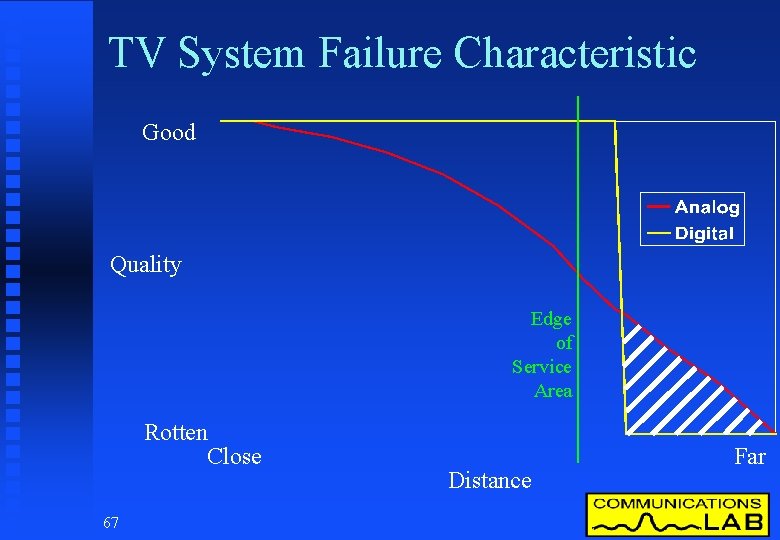
TV System Failure Characteristic Good Quality Edge of Service Area Rotten Close 67 Distance Far
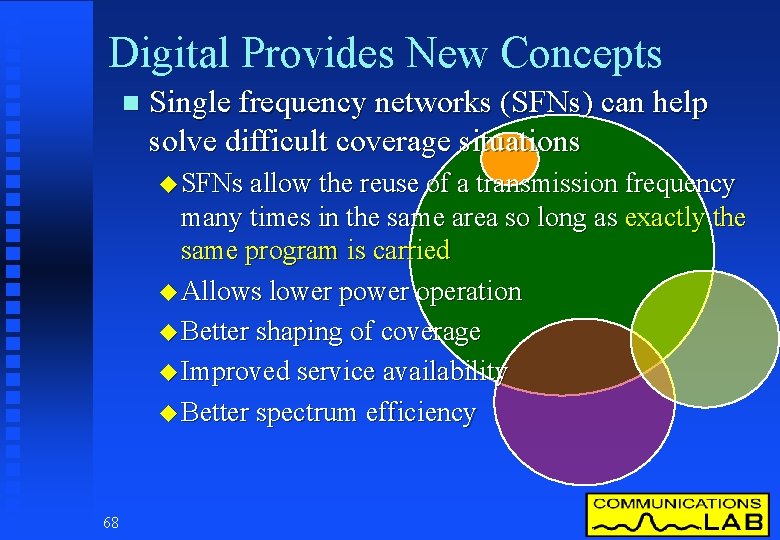
Digital Provides New Concepts n Single frequency networks (SFNs) can help solve difficult coverage situations u SFNs allow the reuse of a transmission frequency many times in the same area so long as exactly the same program is carried u Allows lower power operation u Better shaping of coverage u Improved service availability u Better spectrum efficiency 68
Compression Technology When low bandwidth analog information is digitised the result is high amounts of digital information. 5 MHz bandwidth analog TV picture º 170 - 270 Mb/s digital data stream. n 270 Mb/s would require a bandwidth of at least 140 MHz to transport n Compression of the information is required n 69
Compression - Types n Two types of compression available u. Loss-less compression 2 to 5 times u. Lossy compression 5 to 250 times 70
Compression - Loss-less Types Picture differences - temporal n Run length data coding - GIF n u 1010001001101 = 1 + 4 x 0100 + 1101 u 21 bits source = 12 bits compressed n Huffman coding - PKZIP u Short codes for common blocks u Longer codes for uncommon blocks n 71 Lookup tables
Compression - Lossy Types n Quantisation - rounding n Motion vectors n Prediction & interpolation n Fractal coding n Discrete cosine transform (DCT) 72

Compression - DCT 8 x 8 Pixels 73
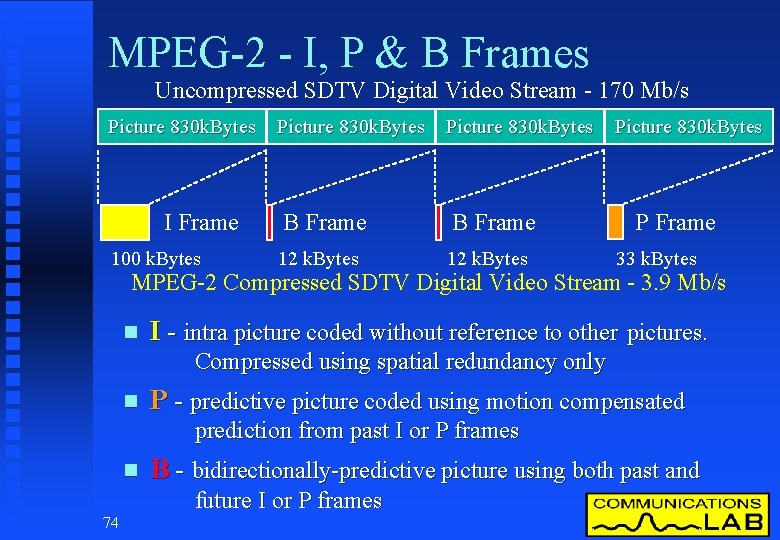
MPEG-2 - I, P & B Frames Uncompressed SDTV Digital Video Stream - 170 Mb/s Picture 830 k. Bytes I Frame 100 k. Bytes Picture 830 k. Bytes B Frame 12 k. Bytes Picture 830 k. Bytes P Frame 33 k. Bytes MPEG-2 Compressed SDTV Digital Video Stream - 3. 9 Mb/s n I - intra picture coded without reference to other pictures. Compressed using spatial redundancy only n P - predictive picture coded using motion compensated prediction from past I or P frames n 74 B - bidirectionally-predictive picture using both past and future I or P frames
MPEG-2 Compresses source video, audio & data n Segments video into I, P & B frames n Generates system control data n Packetises elements into data stream n Multiplexes program elements - services n Multiplexes services - transport stream n Organises transport stream data into 188 byte packets n 75
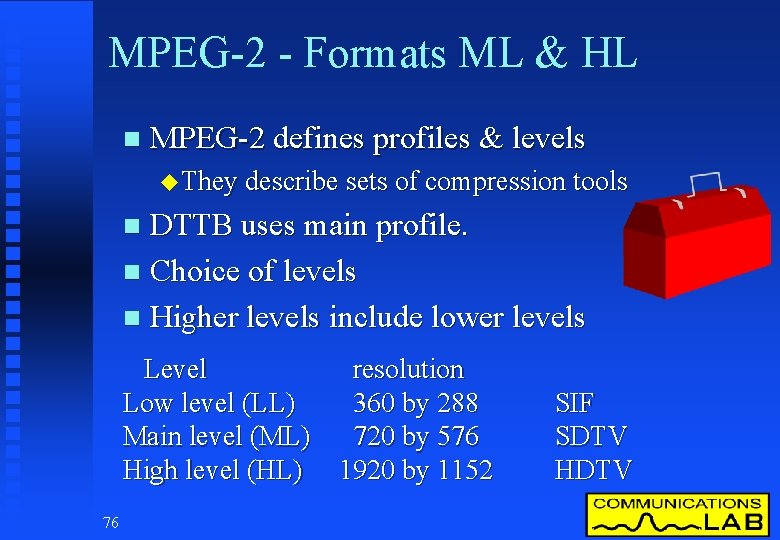
MPEG-2 - Formats ML & HL n MPEG-2 defines profiles & levels u They describe sets of compression tools DTTB uses main profile. n Choice of levels n Higher levels include lower levels n Level resolution Low level (LL) 360 by 288 Main level (ML) 720 by 576 High level (HL) 1920 by 1152 76 SIF SDTV HDTV
Common Image Format CIF 1920 pixels x 1080 lines progressive scan is now being promoted as the world CIF. n All HDTV systems will need to support this image format and then allow conversion to any other display formats that are supported by the equipment. n 79
DTTB - Content & Services DTTB was designed to carry video, audio and program data for television n DTTB can carry much more than just TV n u Electronic program guide, teletext u Best of internet service u Broadband multimedia data, news, weather u Interactive services u Software updates, games n 80 Services can be dynamically reconfigured
Video Program Capacity For a payload of around 19 Mb/s è 1 HDTV service - sport & high action è 2 HDTV services - both film material è 1 HDTV + 1 or 2 SDTV non action/sport è 3 SDTV for high action & sport video è 6 SDTV for film, news & soap operas However you do not get more for nothing. n More services means less quality 81
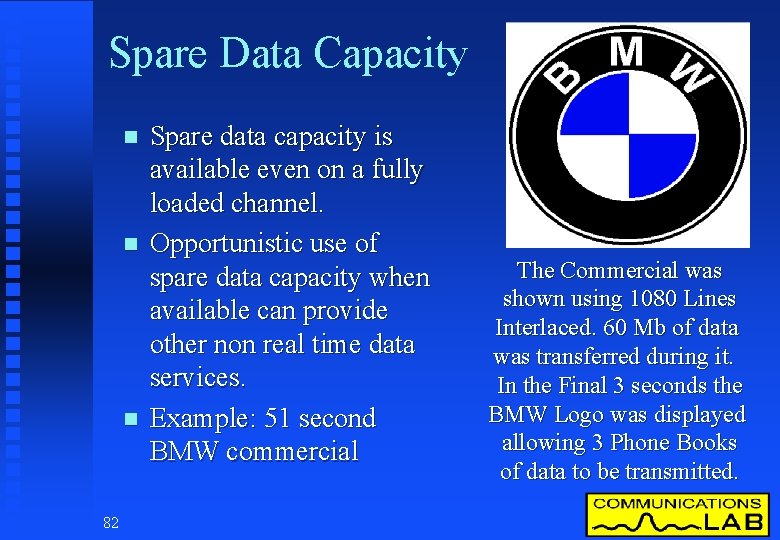
Spare Data Capacity n n n 82 Spare data capacity is available even on a fully loaded channel. Opportunistic use of spare data capacity when available can provide other non real time data services. Example: 51 second BMW commercial The Commercial was shown using 1080 Lines Interlaced. 60 Mb of data was transferred during it. In the Final 3 seconds the BMW Logo was displayed allowing 3 Phone Books of data to be transmitted.
Navigation Systems The concept of channel numbers for networks may disappear with DTV n Television becomes one of a number of services carried within the data pipe. n Users will select what service or program they wish to decode. The box then finds it. n Each digital transmission carry program directories for all service providers n This area is still under heavy development n 83
Australian Activity ABA report on digital television in Australia recommended using HDTV n FACTS have set up a specialists group to advise and direct commercial advanced television development n u Represents commercial television (7, 9, 10) u ABA and communications lab have been assisting this group u NTA, ABC and SBS are not represented 84 n NTA commenced own trials
Laboratory Tests Tested both COFDM & 8 -VSB systems n Investigated operation within the existing Australian broadcasting infrastructure n Systems evaluated as data pipes n Both systems operate satisfactorily with only small operational differences evident n Report on measurements was produced for the FACTS specialists group n 85
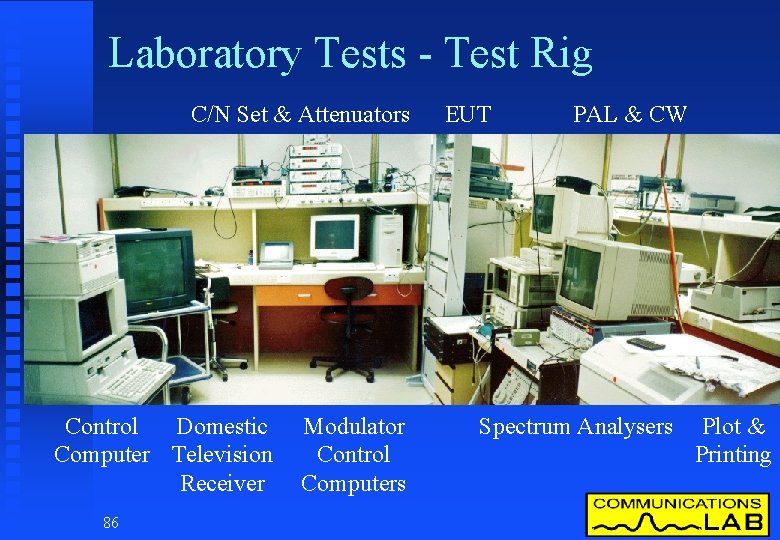
Laboratory Tests - Test Rig C/N Set & Attenuators Control Domestic Computer Television Receiver 86 Modulator Control Computers EUT PAL & CW Spectrum Analysers Plot & Printing
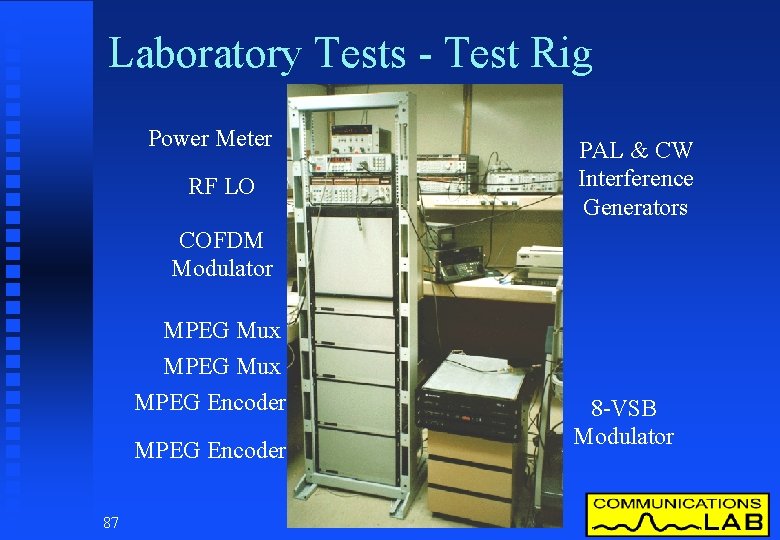
Laboratory Tests - Test Rig Power Meter RF LO PAL & CW Interference Generators COFDM Modulator MPEG Mux MPEG Encoder 87 8 -VSB Modulator
Field Tests Field tests conducted in Sydney on VHF channel 8 during oct-nov 1997 n Both COFDM & 8 -VSB systems evaluated at over 150 sites using an ABA field vehicle n Comparison of the digital and existing PAL systems performance at each site n Concentrating on difficult reception sites n Report on field trials was produced for the FACTS specialists group n 88
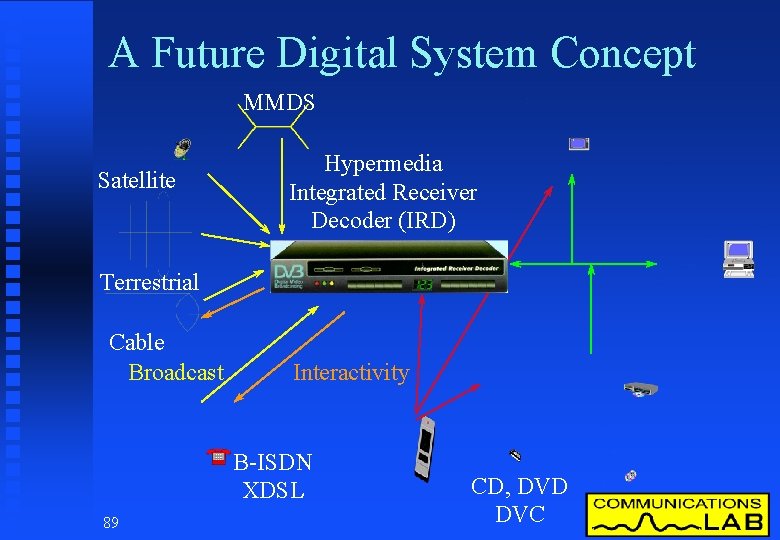
A Future Digital System Concept MMDS Satellite Hypermedia Integrated Receiver Decoder (IRD) Terrestrial Cable Broadcast Interactivity B-ISDN XDSL 89 CD, DVD DVC
Future - Things to Be Done Decide on digital transmission standard n Policy HDTV vs multiple SDTV n Minimum data rates / quality ? n Multiplex / content provider relationships n Pay vs free to air n Sort out service provider issues n Conditional access systems n Ancillary data n 90
The End Thankyou for your attention Any questions? 91
- Slides: 89