
Communications Engineering 1 ANALOG COMMUNICATION SYSTEMS A Baseband
Communications Engineering 1 ANALOG COMMUNICATION SYSTEMS
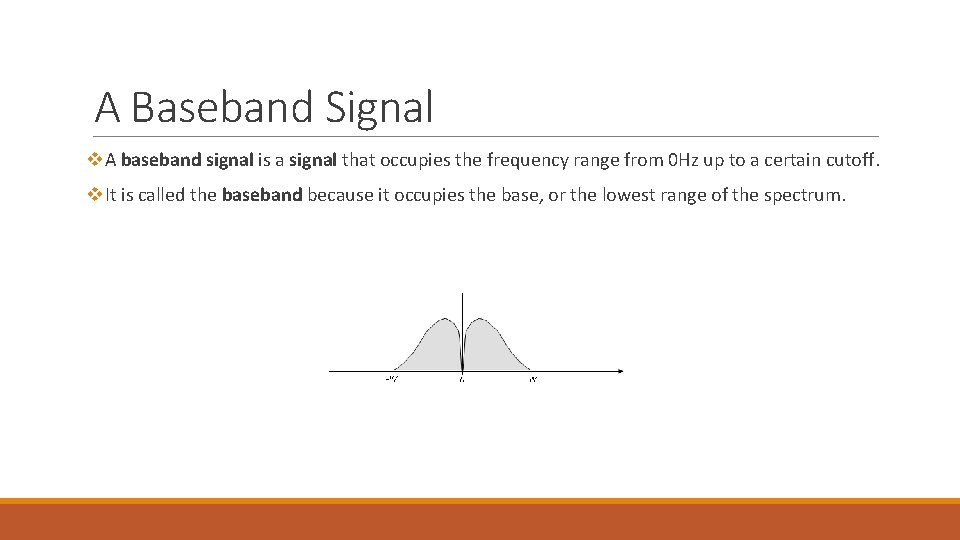
A Baseband Signal v. A baseband signal is a signal that occupies the frequency range from 0 Hz up to a certain cutoff. v. It is called the baseband because it occupies the base, or the lowest range of the spectrum.
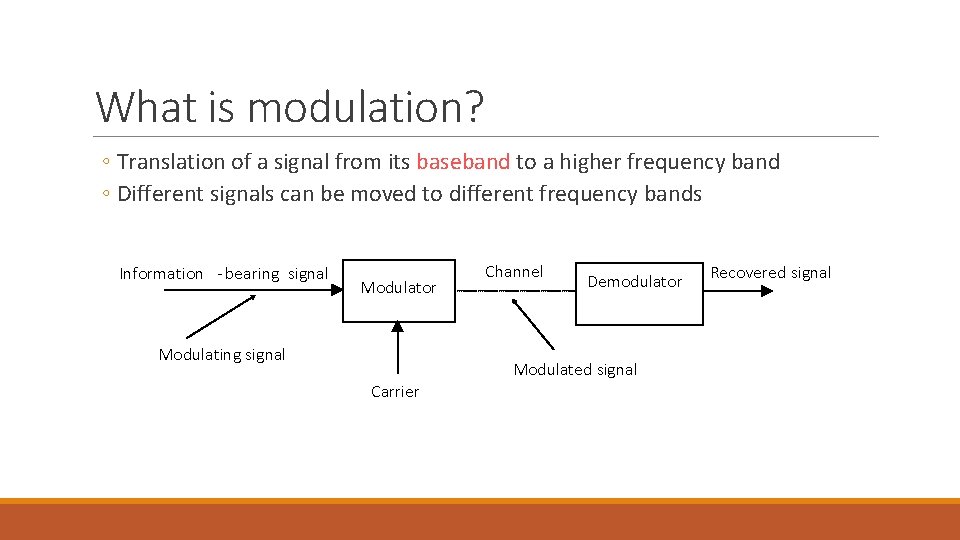
What is modulation? ◦ Translation of a signal from its baseband to a higher frequency band ◦ Different signals can be moved to different frequency bands Information - bearing signal Modulator Modulating signal Channel Demodulator Modulated signal Carrier Recovered signal
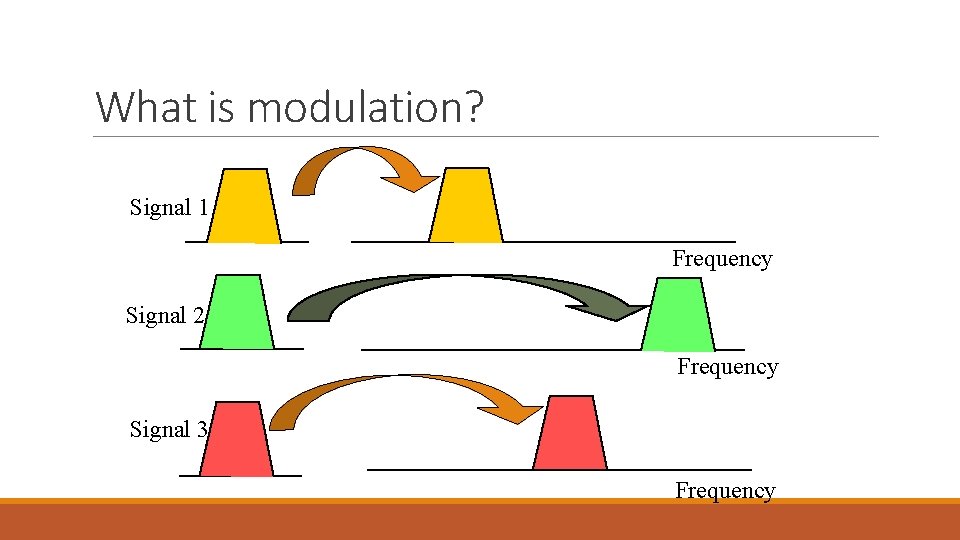
What is modulation? Signal 1 Frequency Signal 2 Frequency Signal 3 Frequency
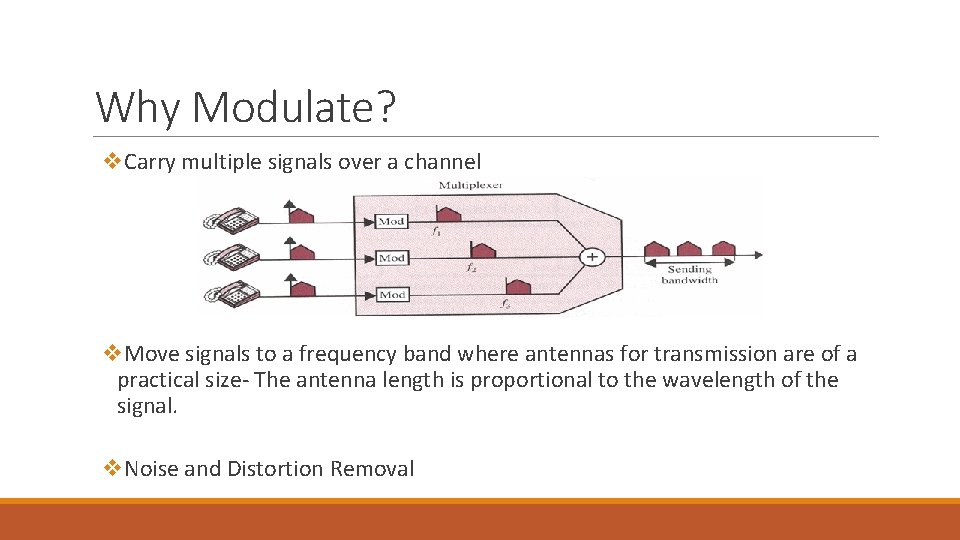
Why Modulate? v. Carry multiple signals over a channel v. Move signals to a frequency band where antennas for transmission are of a practical size- The antenna length is proportional to the wavelength of the signal. v. Noise and Distortion Removal
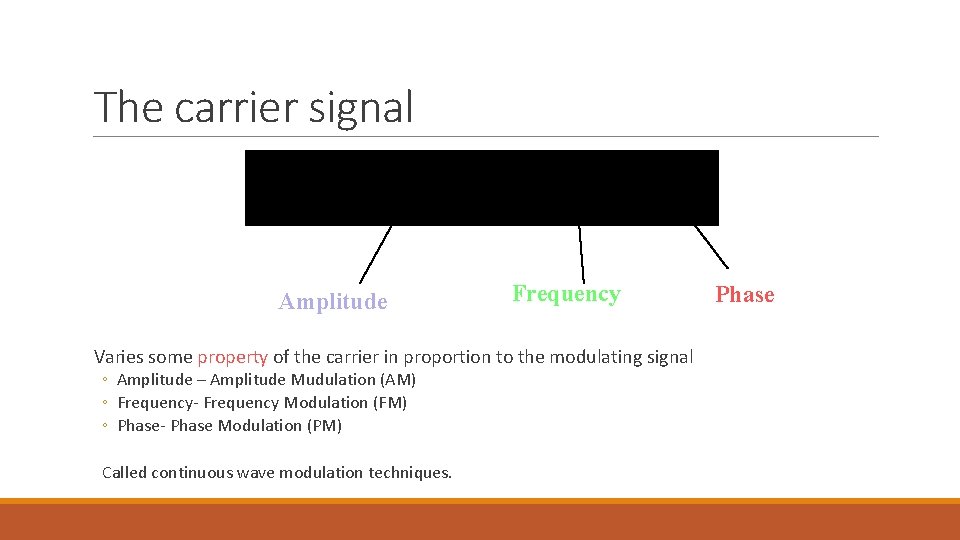
The carrier signal Amplitude Frequency Varies some property of the carrier in proportion to the modulating signal ◦ Amplitude – Amplitude Mudulation (AM) ◦ Frequency- Frequency Modulation (FM) ◦ Phase- Phase Modulation (PM) Called continuous wave modulation techniques. Phase
Amplitude Modulation Techniques q Dual sideband suppressed carrier (DSB-SC) q. Conventional amplitude modulation (AM) q. Single sideband amplitude modulation (SSB) q. Vestigial sideband amplitude modulation (VSB)
Dual sideband suppressed carrier (DSB-SC) Modulation and Demodulation Done in class
AM Modulation Done in class
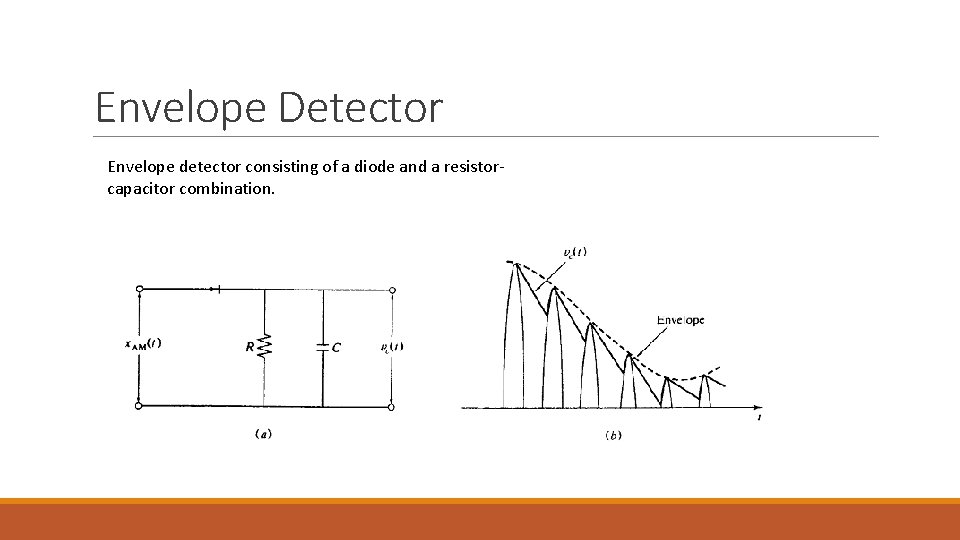
Envelope Detector Envelope detector consisting of a diode and a resistorcapacitor combination.
Envelope Detector v. During the positive half-cycle of the input signal, the diode is forward-biased and the capacitor C charges up rapidly to the peak value of the input signal. v. As the input signal falls below its maximum, the diode turns off. v. This is followed by a slow discharge of the capacitor through resistor R until the next positive half-cycle. v. When the input signal becomes greater than the capacitor voltage and the diode turns on again. v. The capacitor charges to the new peak value, and the process is repeated.
DSB-SC Vs AM v. DSB-SC has a higher power efficiency compared to, but the demodulation is complex compared to AM : The basic difficulty associated with the DSB modulation is that for demodulation, the receiver must generate a local carrier that is in phase and frequency synchronism with the incoming carrier. v. AM has a lower power efficiency, but a remarkably simple demodulator. v. Both techniques utilize twice the bandwidth of the modulating signal.
SSB and VSB- Bandwidth Efficient Modulation Will be explained graphically in class
Frequency Modulation (FM) Modulation Done in class

END
- Slides: 15