
Communications and Networking Simulation Based Network Protocol Design
Communications and Networking Simulation Based Network Protocol Design Timothy Hughes, Peter Do, and Wendell Kishaba 23 -October-2003 Email: thughes@raytheon. com, ptdo@raytheon. com, wykishaba@raytheon. com Copyright © 2003, Raytheon Company An unpublished work. All rights reserved. The contents of this document may not be reproduced in whole or in part without the written consent of the copyright owner.
Agenda Communications and Networking n Introduction n Objectives n Network Protocol Engineering Process n Flexibility n Conclusion n Questions Simulation Based Network Protocol Design 23 October 2003 Copyright © 2003, Raytheon Company An unpublished work. All rights reserved. The contents of this document may not be reproduced in whole or in part without the written consent of the copyright owner. Page-2
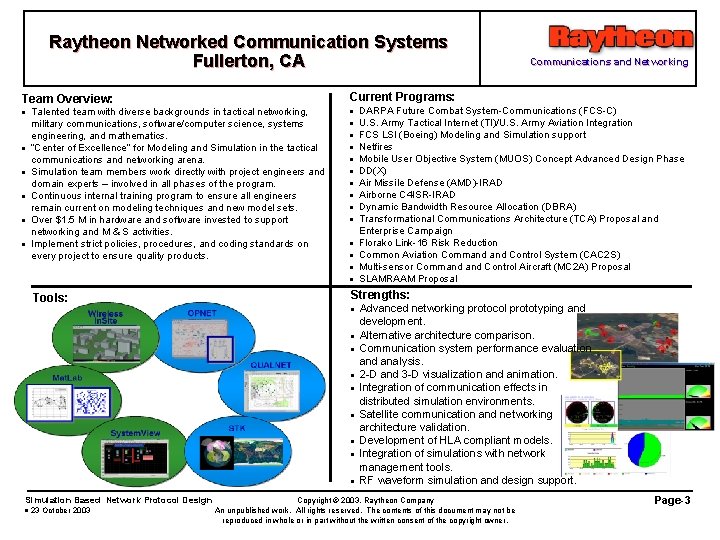
Raytheon Networked Communication Systems Fullerton, CA Current Programs: Team Overview: DARPA Future Combat System-Communications (FCS-C) U. S. Army Tactical Internet (TI)/U. S. Army Aviation Integration FCS LSI (Boeing) Modeling and Simulation support Netfires Mobile User Objective System (MUOS) Concept Advanced Design Phase DD(X) Air Missile Defense (AMD)-IRAD Airborne C 4 ISR-IRAD Dynamic Bandwidth Resource Allocation (DBRA) Transformational Communications Architecture (TCA) Proposal and Enterprise Campaign Florako Link-16 Risk Reduction Common Aviation Command Control System (CAC 2 S) Multi-sensor Command Control Aircraft (MC 2 A) Proposal SLAMRAAM Proposal Talented team with diverse backgrounds in tactical networking, military communications, software/computer science, systems engineering, and mathematics. “Center of Excellence” for Modeling and Simulation in the tactical communications and networking arena. Simulation team members work directly with project engineers and domain experts – involved in all phases of the program. Continuous internal training program to ensure all engineers remain current on modeling techniques and new model sets. Over $1. 5 M in hardware and software invested to support networking and M & S activities. Implement strict policies, procedures, and coding standards on every project to ensure quality products. Tools: Strengths: Simulation Based Network Protocol Design 23 October 2003 Communications and Networking Advanced networking protocol prototyping and development. Alternative architecture comparison. Communication system performance evaluation and analysis. 2 -D and 3 -D visualization and animation. Integration of communication effects in distributed simulation environments. Satellite communication and networking architecture validation. Development of HLA compliant models. Integration of simulations with network management tools. RF waveform simulation and design support. Copyright © 2003, Raytheon Company An unpublished work. All rights reserved. The contents of this document may not be reproduced in whole or in part without the written consent of the copyright owner. Page-3
Objectives Communications and Networking n Accurately represent the effects of communications and networking protocols. n Robust design to allow for the implementation of any communication protocol and networking architecture. n Flexible design. l Adaptable to different simulator configurations. l Adaptable for use throughout all phases of the design process. Simulation Based Network Protocol Design 23 October 2003 Copyright © 2003, Raytheon Company An unpublished work. All rights reserved. The contents of this document may not be reproduced in whole or in part without the written consent of the copyright owner. Page-4
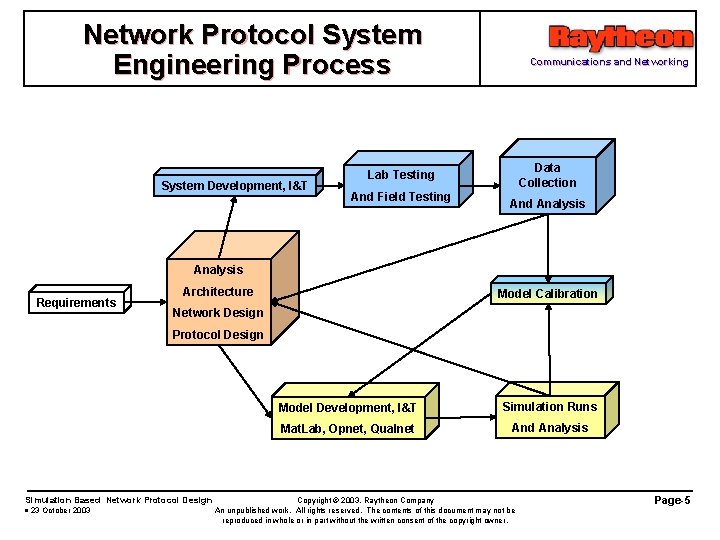
Network Protocol System Engineering Process System Development, I&T Communications and Networking Data Collection Lab Testing And Field Testing And Analysis Requirements Architecture Model Calibration Network Design Protocol Design Simulation Based Network Protocol Design 23 October 2003 Model Development, I&T Simulation Runs Mat. Lab, Opnet, Qualnet And Analysis Copyright © 2003, Raytheon Company An unpublished work. All rights reserved. The contents of this document may not be reproduced in whole or in part without the written consent of the copyright owner. Page-5
Simulation as a Key Tool Communications and Networking n Simulation based protocol development l Mat. Lab algorithm development l Opnet model protocol implementation » » » Message completion rate and latency Scalability Motion Dynamic connectivity RF- Channel model l Simulation based trade studies » Protocol development » Parameter optimization » Feedback results into architecture l Model calibration » Calibrate model against system performance » Verify / Predict system performance Simulation Based Network Protocol Design 23 October 2003 Copyright © 2003, Raytheon Company An unpublished work. All rights reserved. The contents of this document may not be reproduced in whole or in part without the written consent of the copyright owner. Page-6
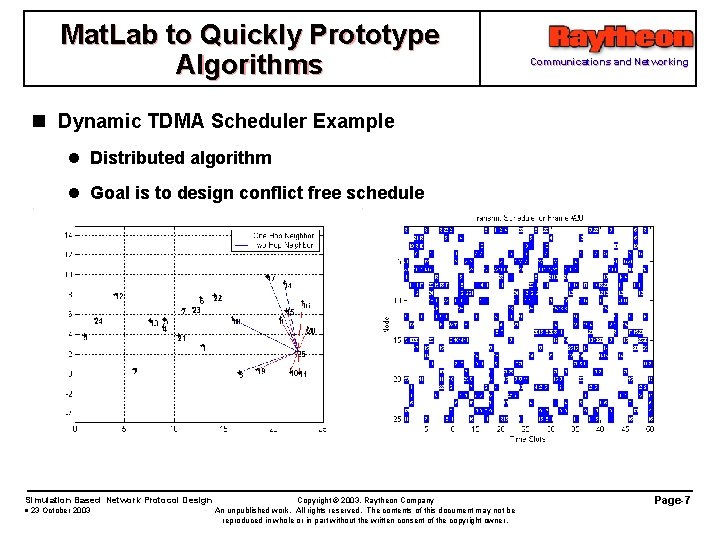
Mat. Lab to Quickly Prototype Algorithms Communications and Networking n Dynamic TDMA Scheduler Example l Distributed algorithm l Goal is to design conflict free schedule Simulation Based Network Protocol Design 23 October 2003 Copyright © 2003, Raytheon Company An unpublished work. All rights reserved. The contents of this document may not be reproduced in whole or in part without the written consent of the copyright owner. Page-7

Opnet Node Model Simulation Based Network Protocol Design 23 October 2003 Communications and Networking l Traffic l TPAL l UDP l IP l unicast routing l multicast routing l Link Manager l Link/ MAC l Neighbor l PHY Copyright © 2003, Raytheon Company An unpublished work. All rights reserved. The contents of this document may not be reproduced in whole or in part without the written consent of the copyright owner. Page-8
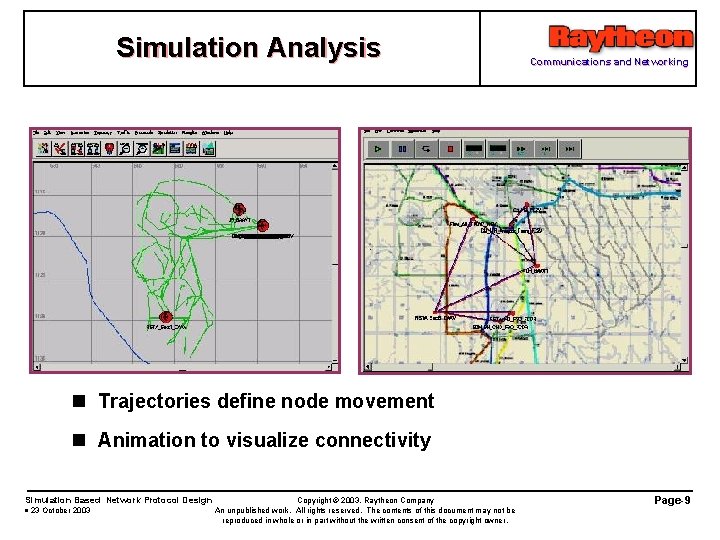
Simulation Analysis Communications and Networking n Trajectories define node movement n Animation to visualize connectivity Simulation Based Network Protocol Design 23 October 2003 Copyright © 2003, Raytheon Company An unpublished work. All rights reserved. The contents of this document may not be reproduced in whole or in part without the written consent of the copyright owner. Page-9
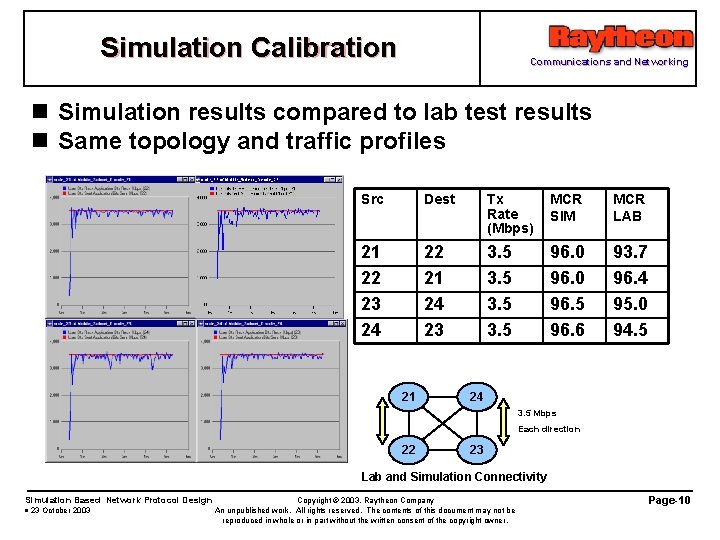
Simulation Calibration Communications and Networking n Simulation results compared to lab test results n Same topology and traffic profiles Src Dest Tx Rate (Mbps) MCR SIM MCR LAB 21 22 23 24 22 21 24 23 3. 5 96. 0 96. 5 96. 6 93. 7 96. 4 95. 0 94. 5 21 24 3. 5 Mbps Each direction 22 23 Lab and Simulation Connectivity Simulation Based Network Protocol Design 23 October 2003 Copyright © 2003, Raytheon Company An unpublished work. All rights reserved. The contents of this document may not be reproduced in whole or in part without the written consent of the copyright owner. Page-10
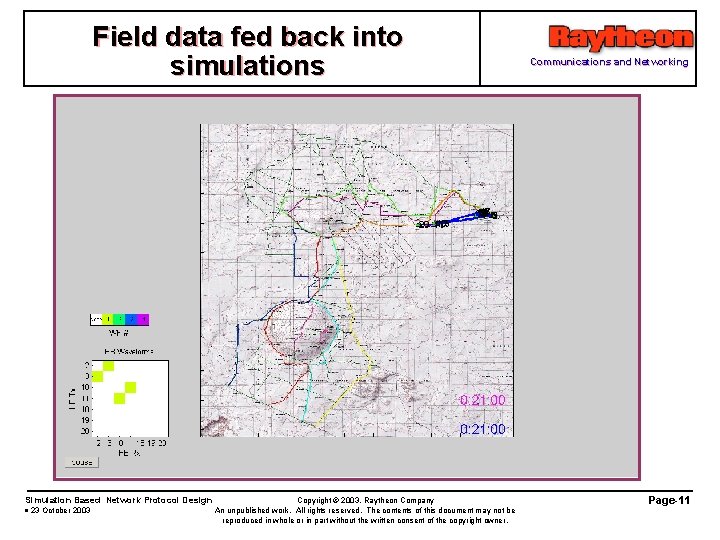
Field data fed back into simulations Simulation Based Network Protocol Design 23 October 2003 Copyright © 2003, Raytheon Company An unpublished work. All rights reserved. The contents of this document may not be reproduced in whole or in part without the written consent of the copyright owner. Communications and Networking Page-11
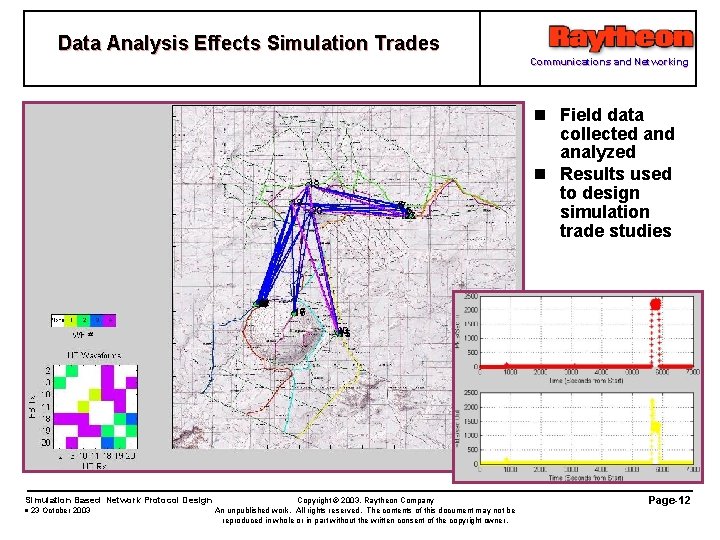
Data Analysis Effects Simulation Trades Communications and Networking n Field data collected analyzed n Results used to design simulation trade studies Simulation Based Network Protocol Design 23 October 2003 Copyright © 2003, Raytheon Company An unpublished work. All rights reserved. The contents of this document may not be reproduced in whole or in part without the written consent of the copyright owner. Page-12
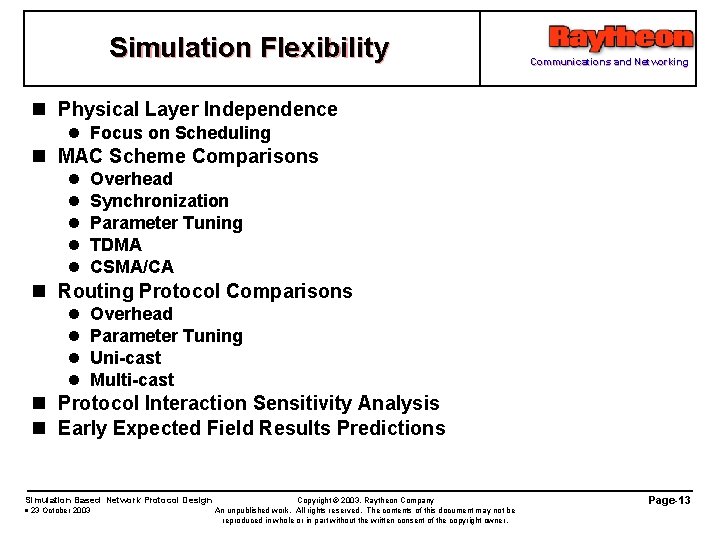
Simulation Flexibility Communications and Networking n Physical Layer Independence l Focus on Scheduling n MAC Scheme Comparisons l l l Overhead Synchronization Parameter Tuning TDMA CSMA/CA n Routing Protocol Comparisons l l Overhead Parameter Tuning Uni-cast Multi-cast n Protocol Interaction Sensitivity Analysis n Early Expected Field Results Predictions Simulation Based Network Protocol Design 23 October 2003 Copyright © 2003, Raytheon Company An unpublished work. All rights reserved. The contents of this document may not be reproduced in whole or in part without the written consent of the copyright owner. Page-13
Conclusions Communications and Networking n Using a combination of simulation and analysis tools is critical to network protocol development n Iterative development and refinement of the protocols and models improves the fidelity and results produced in both the simulated and field environments. n Simulation based protocol development reduces risk throughout the life cycle of a program. Simulation Based Network Protocol Design 23 October 2003 Copyright © 2003, Raytheon Company An unpublished work. All rights reserved. The contents of this document may not be reproduced in whole or in part without the written consent of the copyright owner. Page-14
Questions Communications and Networking Timothy Hughes, Peter Do, Wendell Kishaba Raytheon Company NWCS – Networked Communication Systems Fullerton, California Email: thughes@raytheon. com , ptdo@raytheon. com , wykishaba@raytheon. com Simulation Based Network Protocol Design 23 October 2003 Copyright © 2003, Raytheon Company An unpublished work. All rights reserved. The contents of this document may not be reproduced in whole or in part without the written consent of the copyright owner. Page-15
- Slides: 15