
COMMUNICATION Why do people communicate to understand be
COMMUNICATION
Why do people communicate? - to understand be understood by others What is communication? • exchanging thoughts, ideas, opinions
Communication We distinguish between these forms of communication: • VERBAL - NON-VERBAL • FORMAL – INFORMAL • WRITTEN – ORAL • DIRECT(face to face) – NON-DIRECT communication
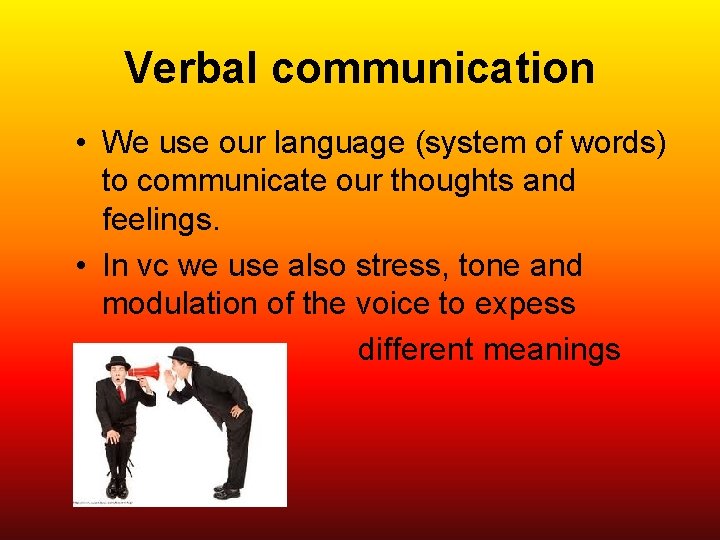
Verbal communication • We use our language (system of words) to communicate our thoughts and feelings. • In vc we use also stress, tone and modulation of the voice to expess different meanings
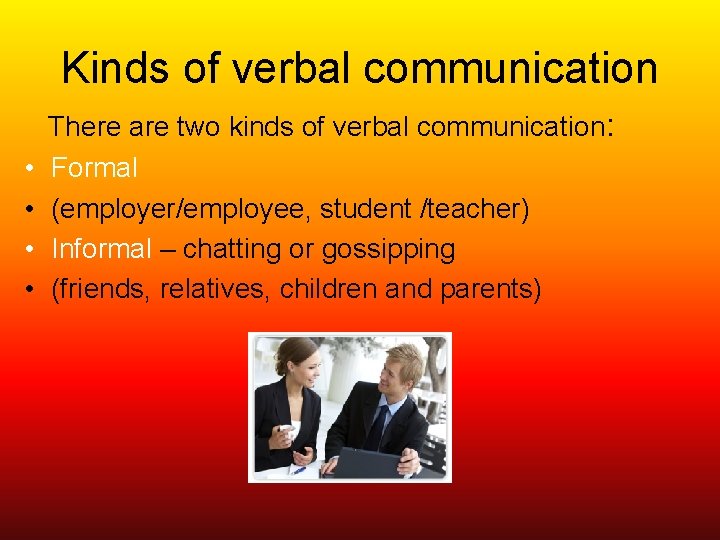
Kinds of verbal communication • • There are two kinds of verbal communication: Formal (employer/employee, student /teacher) Informal – chatting or gossipping (friends, relatives, children and parents)
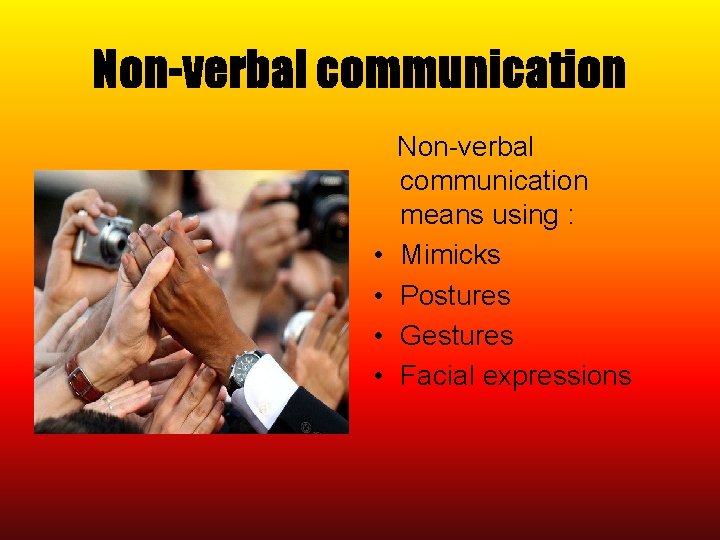
Non-verbal communication • • Non-verbal communication means using : Mimicks Postures Gestures Facial expressions
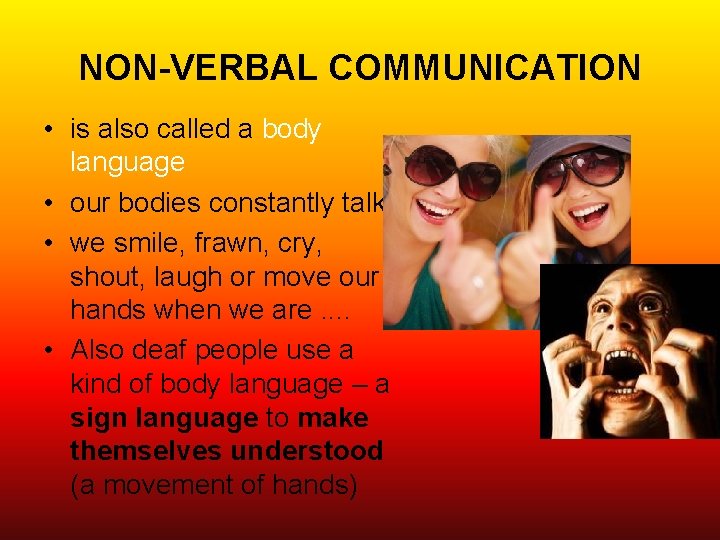
NON-VERBAL COMMUNICATION • is also called a body language • our bodies constantly talk • we smile, frawn, cry, shout, laugh or move our hands when we are. . • Also deaf people use a kind of body language – a sign language to make themselves understood (a movement of hands)
Other kinds of communication • DIRECT / INDIRECT • WRITTEN / ORAL • Many of us prefer talking to others face to face. • It allows the speaker to ask questions or answer them – directly • Written communication includes: • Letters • Text messages • Emails • Indirect com. is through • It can also be formal messages or using pictures and informal
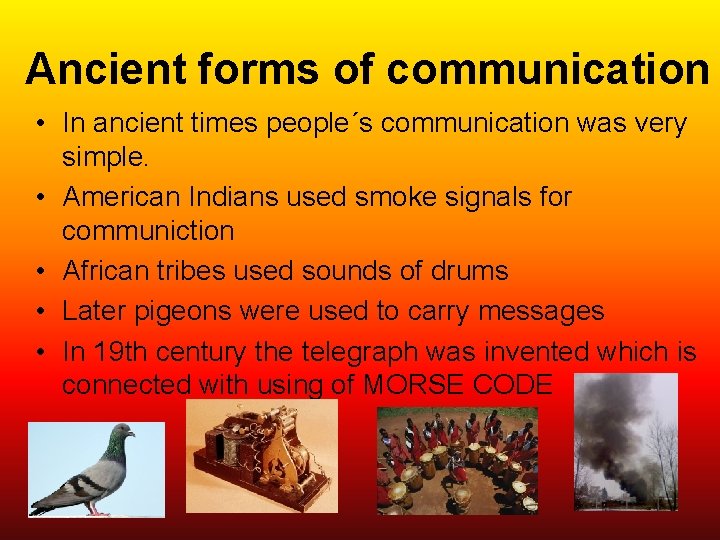
Ancient forms of communication • In ancient times people´s communication was very simple. • American Indians used smoke signals for communiction • African tribes used sounds of drums • Later pigeons were used to carry messages • In 19 th century the telegraph was invented which is connected with using of MORSE CODE
Modern ways of communication • Historically, letters were the only reliable means of communication until the 19 th century • Besides the invention of telegraph also telephone (19 th century) made communication easier • Today, the Internet and mobile phones have become the dominant media in communication
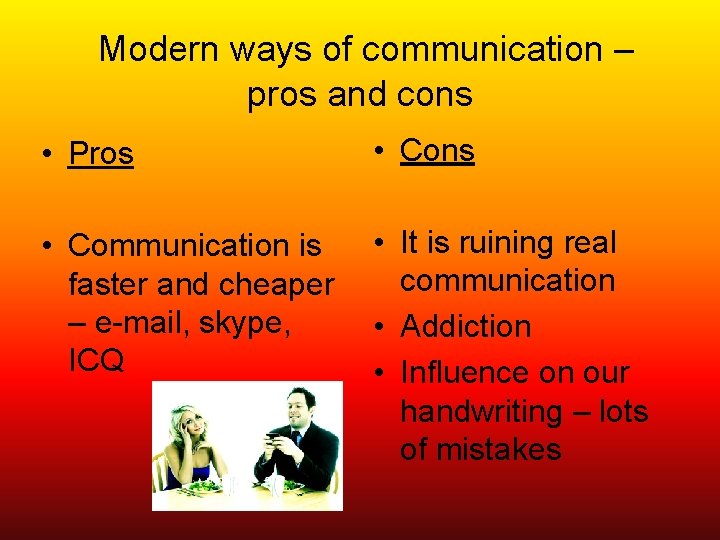
Modern ways of communication – pros and cons • Pros • Cons • Communication is faster and cheaper – e-mail, skype, ICQ • It is ruining real communication • Addiction • Influence on our handwriting – lots of mistakes
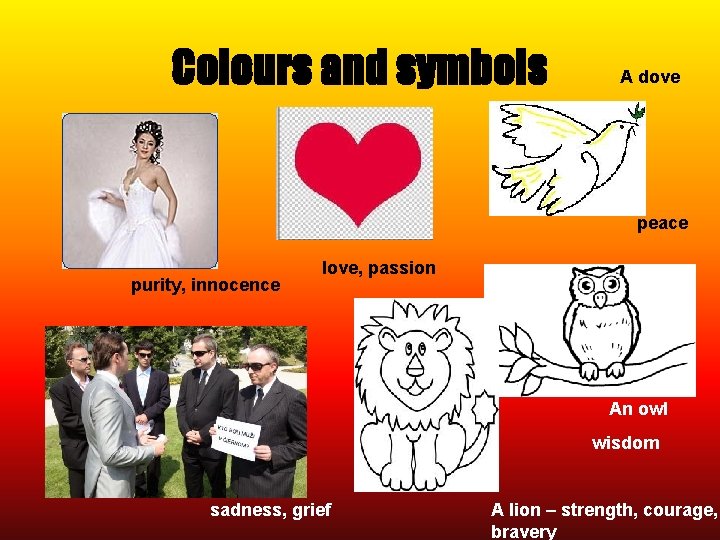
Colours and symbols A dove • wi peace purity, innocence love, passion An owl wisdom sadness, grief A lion – strength, courage, bravery
Communication and society • We learn the basics of communication, how to communicate with other people and our behaviour is formed by: vparentsin the family v. Teachers at school v by massmedia – TV, famous people
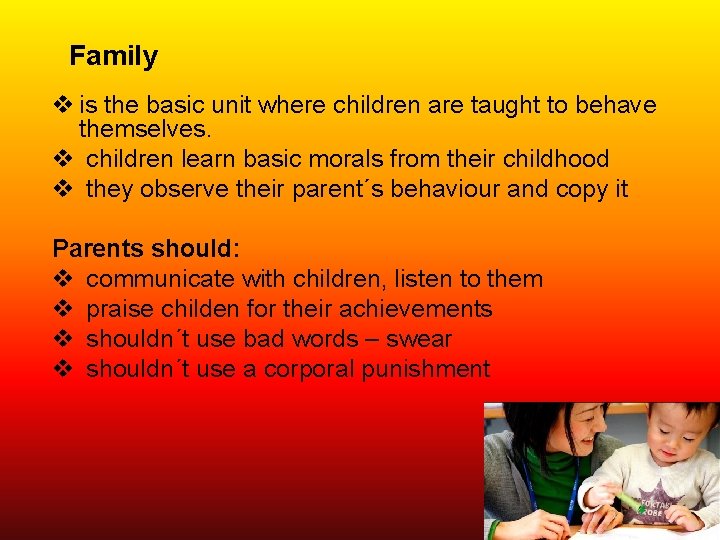
Family v is the basic unit where children are taught to behave themselves. v children learn basic morals from their childhood v they observe their parent´s behaviour and copy it Parents should: v communicate with children, listen to them v praise childen for their achievements v shouldn´t use bad words – swear v shouldn´t use a corporal punishment
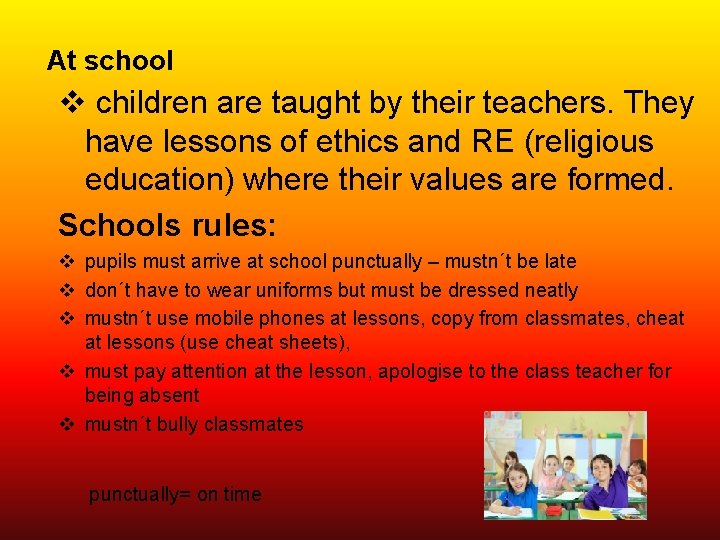
At school v children are taught by their teachers. They have lessons of ethics and RE (religious education) where their values are formed. Schools rules: v pupils must arrive at school punctually – mustn´t be late v don´t have to wear uniforms but must be dressed neatly v mustn´t use mobile phones at lessons, copy from classmates, cheat at lessons (use cheat sheets), v must pay attention at the lesson, apologise to the class teacher for being absent v mustn´t bully classmates punctually= on time
Influence of TV on young people Media strongly affects youth culture. Young people spend lots of free time in front of TV and computer which can influence them negatively. Negative impact: v lots of violence v they are becoming couch potatoes, fat and overweight v they see many negative examples – drug, alcohol abuse, eccentric behaviour Positive impact: v They get new information and widen their horizons
To behave politely we should keep rules of ethiquette in the society Ethiquette - is the rules of correct and polite behaviour in society. (rules about how to behave on special occasions) Etiquette concerns the rules of: 1. greetings 2. dining at particular occasions 3. everyday manners 4. visiting cinemas and theatres Greetings : • men greet women first • children greet adults first • younger people greet older people first
Dining at particular occasions – Table manners It depends on the country – in Europe • you keep the knife in your right hand eat with your fork in your left hand In America – after cutting meat with a knife in the right hand you can swith the fork from the left to the right hand eat just with it • when invited to a party or event, especially at someone's home, an appropriate gift could be a bottle of wine, flowers, or a small item for the home, such as a candle. • during eating don´t talk with your mouth full • use a napkin to wipe out your mouth • don´t put your elbows on the table. • when you finish eating, place your knife and fork together in the centre of the plate
Everyday (polite) manners • You must say „please“ and „thank you“ • You should greet persons when they come over to your house • You shouldn´t interrupt other people when they are speaking • You should always clean up after yourself • You should respect others and help them • You shouldn´t call sb a name because it hurts • Never say any rude comments, be polite
Going to theatre • You should arrive earlier, don´t be late • don´t speak, talk, whisper during the performance • don´t use cameras, mobile phones • Put on smart clothes • Don´t eat/drink during the performance • Don´t use a rest room during the perfomance • Cinema • You can eat or drink – pop corn, coke • You can put on casual clothes
- Slides: 20