
Communication vs Computation Prahladh Harsha Yuval Ishai MIT


- Slides: 28
Communication vs. Computation Prahladh Harsha Yuval Ishai MIT Technion Joe Kilian Kobbi Nissim NEC S Venkatesh Microsoft SVC Univ. Victoria Presentation by Piotr Indyk (MIT)
Main Question • Two important resources (in distributed computing) – Amount of communication between processors – Time spent in local computation by each processor • Main Result: Yes, under certain standard complexity assumptions in the following models • 2 -party randomized communication complexity • Question: Is there a computational task that shows model a strong tradeoff behaviour between these two • Query complexity model resources (communication • Property Testing model and computation)? 2
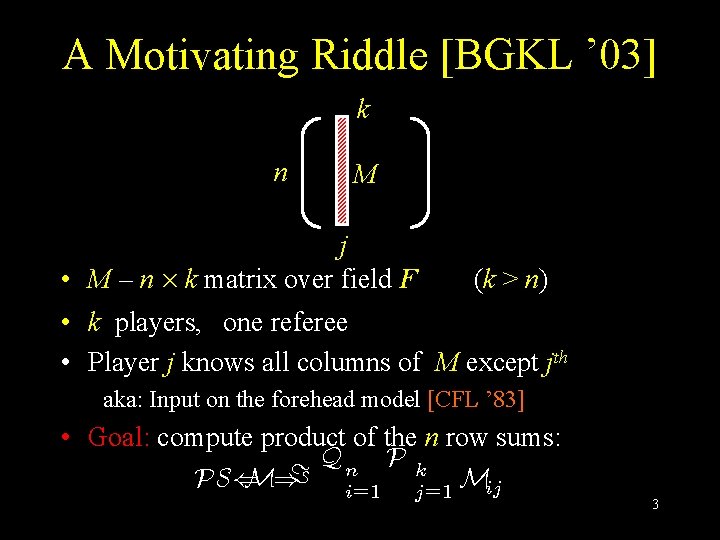
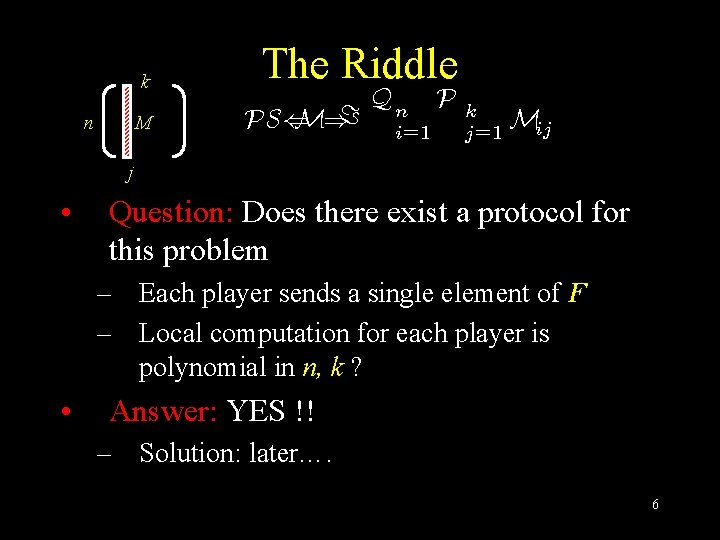
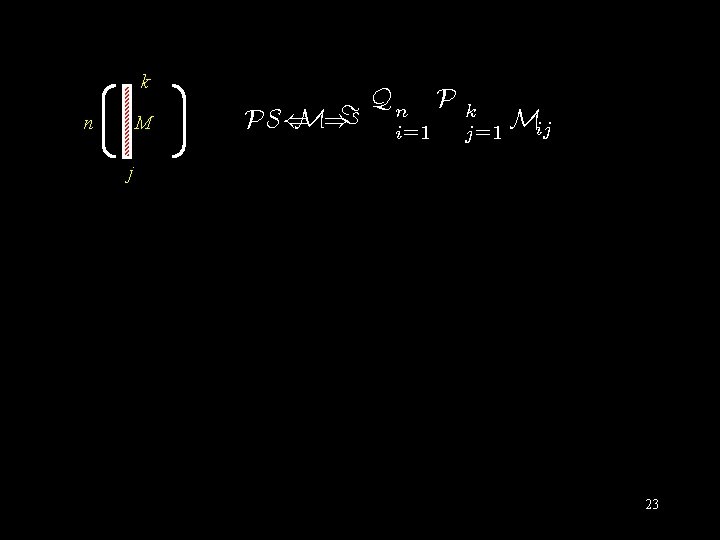
A Motivating Riddle [BGKL ’ 03] k n M j • M – n £ k matrix over field F (k > n) • k players, one referee • Player j knows all columns of M except jth aka: Input on the forehead model [CFL ’ 83] • Goal: compute product of the n row sums: PS( M)= Qn i=1 P k j =1 Mij 3
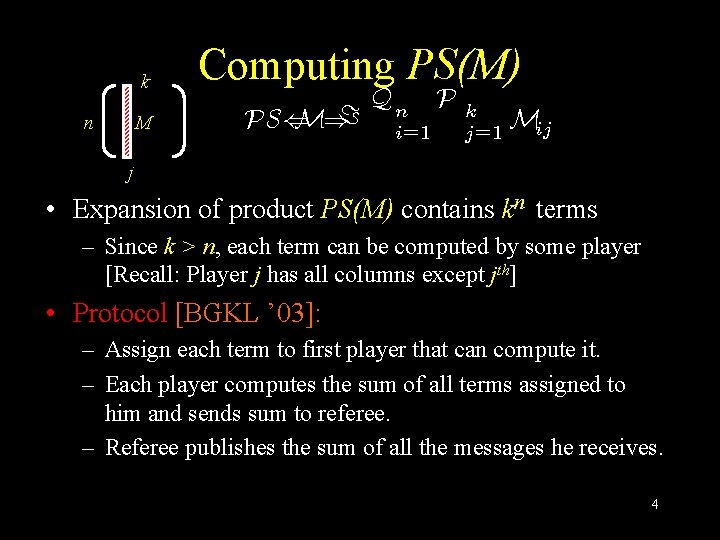
k M n Computing PS(M) PS( M)= Qn i=1 P k j =1 Mij j • Expansion of product PS(M) contains kn terms – Since k > n, each term can be computed by some player [Recall: Player j has all columns except jth] • Protocol [BGKL ’ 03]: – Assign each term to first player that can compute it. – Each player computes the sum of all terms assigned to him and sends sum to referee. – Referee publishes the sum of all the messages he receives. 4
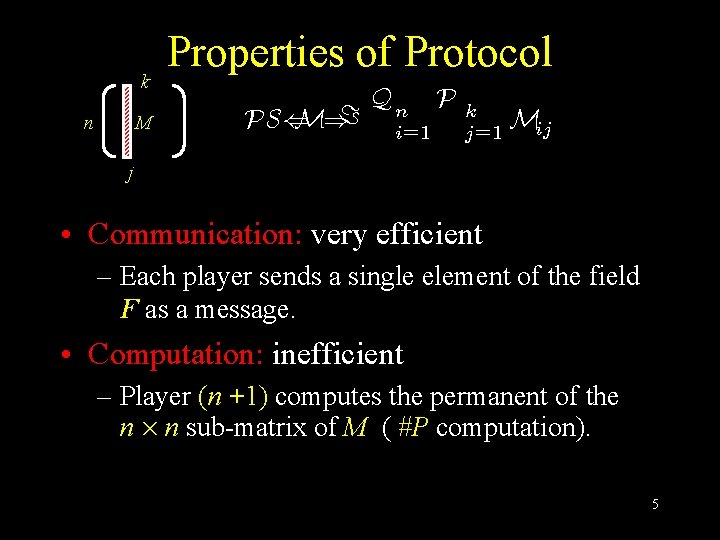
k M n Properties of Protocol PS( M)= Qn i=1 P k j =1 Mij j • Communication: very efficient – Each player sends a single element of the field F as a message. • Computation: inefficient – Player (n +1) computes the permanent of the n £ n sub-matrix of M ( #P computation). 5
k M n The Riddle PS( M)= Qn i=1 P k j =1 Mij j • Question: Does there exist a protocol for this problem – Each player sends a single element of F – Local computation for each player is polynomial in n, k ? • Answer: YES !! – Solution: later…. 6
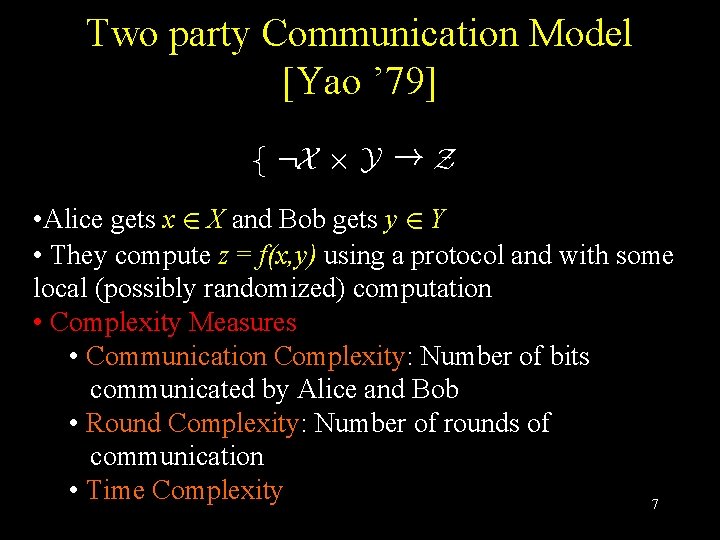
Two party Communication Model [Yao ’ 79] f : X £ Y ! Z • Alice gets x 2 X and Bob gets y 2 Y • They compute z = f(x, y) using a protocol and with some local (possibly randomized) computation • Complexity Measures • Communication Complexity: Number of bits communicated by Alice and Bob • Round Complexity: Number of rounds of communication • Time Complexity 7
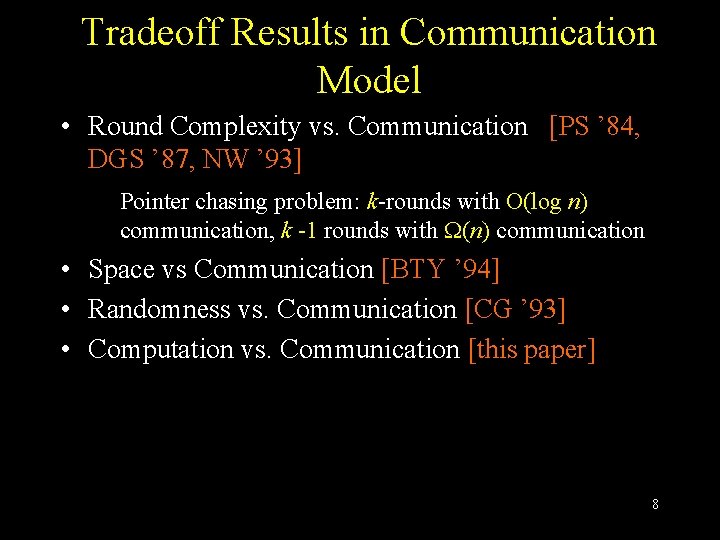
Tradeoff Results in Communication Model • Round Complexity vs. Communication [PS ’ 84, DGS ’ 87, NW ’ 93] Pointer chasing problem: k-rounds with O(log n) communication, k -1 rounds with (n) communication • Space vs Communication [BTY ’ 94] • Randomness vs. Communication [CG ’ 93] • Computation vs. Communication [this paper] 8
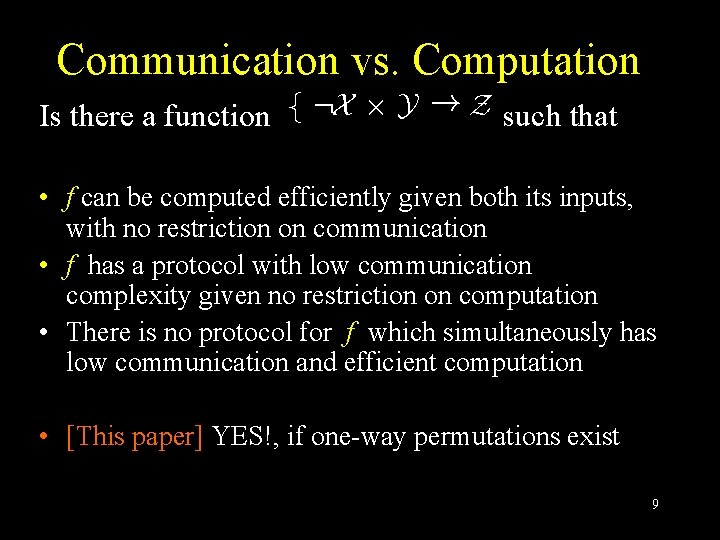
Communication vs. Computation ! £ : X Y Z such that f Is there a function • f can be computed efficiently given both its inputs, with no restriction on communication • f has a protocol with low communication complexity given no restriction on computation • There is no protocol for f which simultaneously has low communication and efficient computation • [This paper] YES!, if one-way permutations exist 9
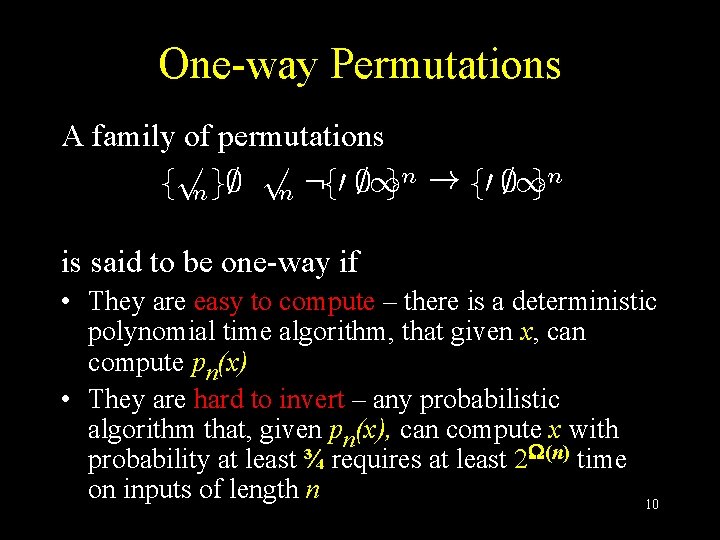
One-way Permutations A family of permutations fpn g; pn : f 0 ; 1 gn ! f 0 ; 1 gn is said to be one-way if • They are easy to compute – there is a deterministic polynomial time algorithm, that given x, can compute pn(x) • They are hard to invert – any probabilistic algorithm that, given pn(x), can compute x with probability at least ¾ requires at least 2 (n) time on inputs of length n 10
Main Theorem Assuming one-way permutations exist, there is a boolean function f : X £ Y ! {0, 1} such that – f is computable in polynomial time – There exists a randomized protocol that computes f with just O(log n) bits of communication – If Alice and Bob are computationally bounded (i. e. , prob. poly-time machines), then any randomized protocol for f (even with multiple rounds) requires (n) bits of communication 11
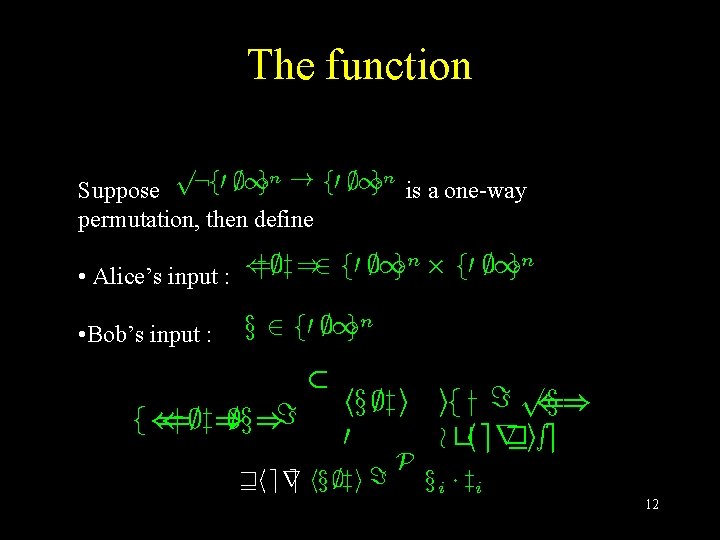
The function n ! f 0 ; 1 n g g p: f 0 ; 1 Suppose is a one-way permutation, then define n £ f 0 ; 1 n 2 y; z) ( f 0 ; 1 g g • Alice’s input : • Bob’s input : x 2 f 0 ; 1 gn ½ f( y; z) ; x )= ( hx ; zi 0 wh ere hx ; zi = P x) if y = p( o th erwise x i ¢ zi 12
Proof of Main Theorem: Upper Bounds • f ((y, z), x) is computable in polynomial time with O(n) of communication – Bob sends x to Alice checks if p(x)=y and if so outputs h x, z i else outputs 0. • One-round randomized protocol computing f ((y, z), x) with O(log n) communication with unbounded Alice: – (unbounded) Alice computes w = p-1(x) and sends b = h w, z i to Bob – Alice and Bob engage in equality test protocol comparing w and x • – One round protocol -- O(log n) communication If comparison succeeds Bob outputs b, otherwise outputs 0 13
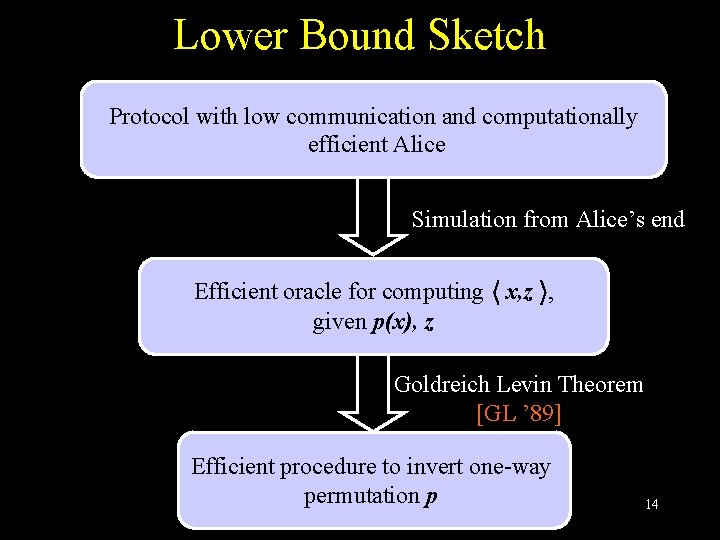
Lower Bound Sketch Protocol with low communication and computationally efficient Alice Simulation from Alice’s end Efficient oracle for computing h x, z i, given p(x), z Goldreich Levin Theorem [GL ’ 89] Efficient procedure to invert one-way permutation p 14
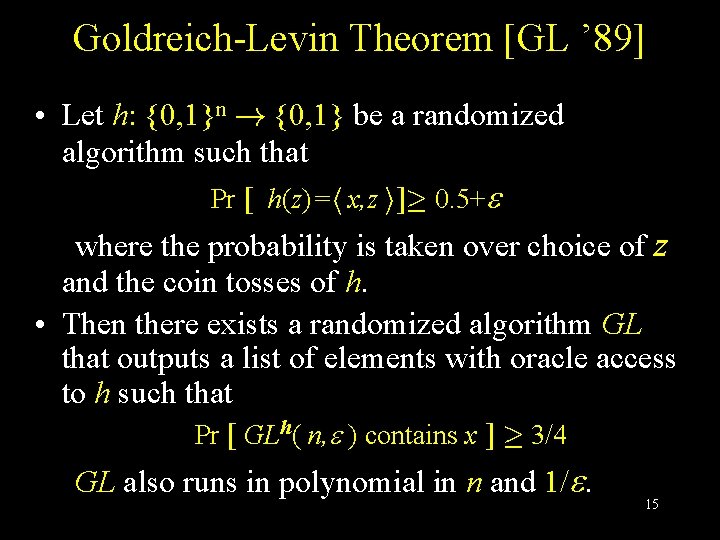
Goldreich-Levin Theorem [GL ’ 89] • Let h: {0, 1}n ! {0, 1} be a randomized algorithm such that Pr [ h(z)=h x, z i]¸ 0. 5+ where the probability is taken over choice of z and the coin tosses of h. • Then there exists a randomized algorithm GL that outputs a list of elements with oracle access to h such that Pr [ GLh( n, ) contains x ] ¸ 3/4 GL also runs in polynomial in n and 1/. 15
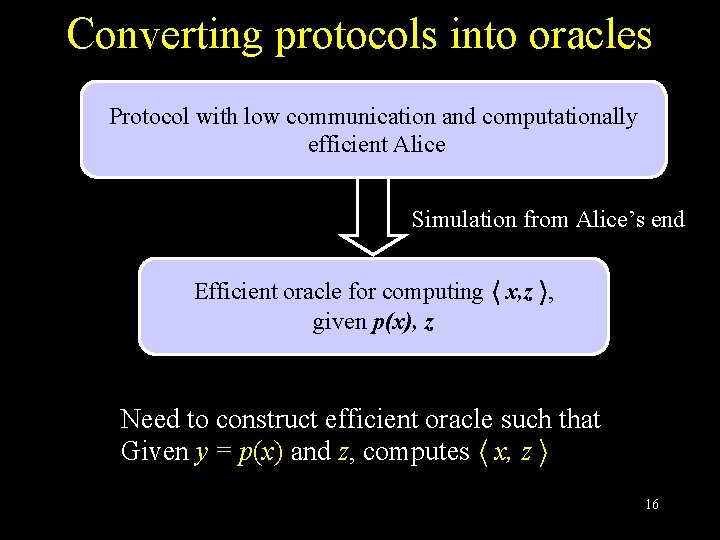
Converting protocols into oracles Protocol with low communication and computationally efficient Alice Simulation from Alice’s end Efficient oracle for computing h x, z i, given p(x), z Need to construct efficient oracle such that Given y = p(x) and z, computes h x, z i 16
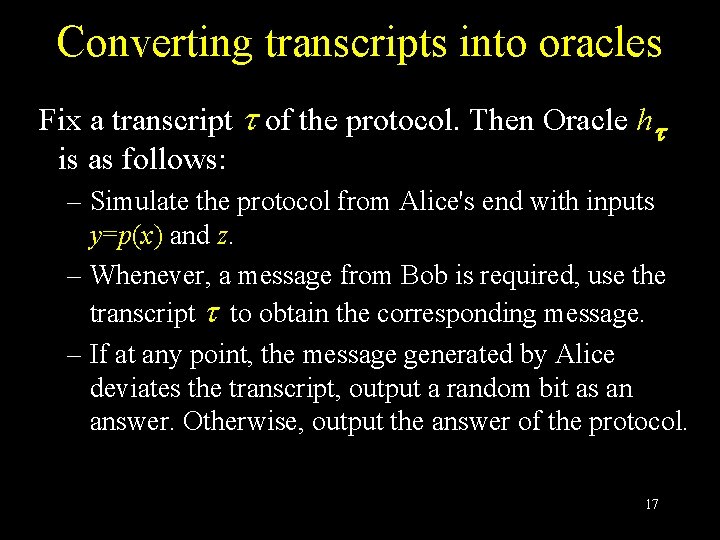
Converting transcripts into oracles Fix a transcript of the protocol. Then Oracle h is as follows: – Simulate the protocol from Alice's end with inputs y=p(x) and z. – Whenever, a message from Bob is required, use the transcript to obtain the corresponding message. – If at any point, the message generated by Alice deviates the transcript, output a random bit as an answer. Otherwise, output the answer of the protocol. 17
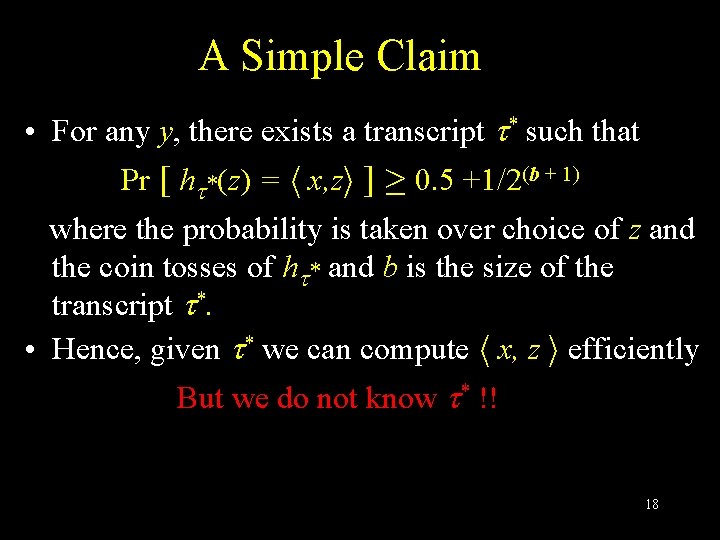
A Simple Claim • For any y, there exists a transcript * such that Pr [ h *(z) = h x, zi ] ¸ 0. 5 +1/2(b + 1) where the probability is taken over choice of z and the coin tosses of h * and b is the size of the transcript *. • Hence, given * we can compute h x, z i efficiently But we do not know * !! 18
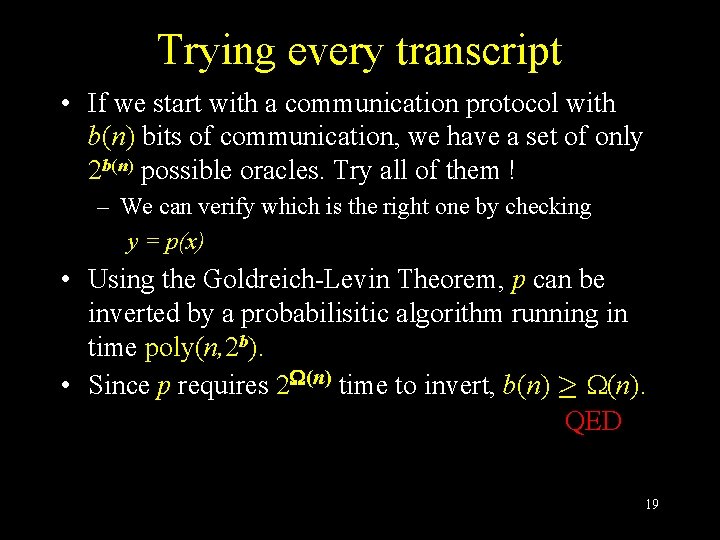
Trying every transcript • If we start with a communication protocol with b(n) bits of communication, we have a set of only 2 b(n) possible oracles. Try all of them ! – We can verify which is the right one by checking y = p(x) • Using the Goldreich-Levin Theorem, p can be inverted by a probabilisitic algorithm running in time poly(n, 2 b). • Since p requires 2 (n) time to invert, b(n) ¸ (n). QED 19
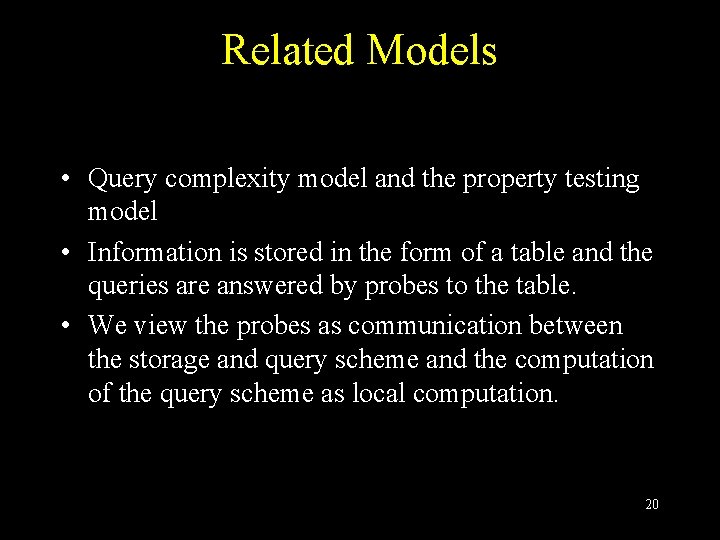
Related Models • Query complexity model and the property testing model • Information is stored in the form of a table and the queries are answered by probes to the table. • We view the probes as communication between the storage and query scheme and the computation of the query scheme as local computation. 20
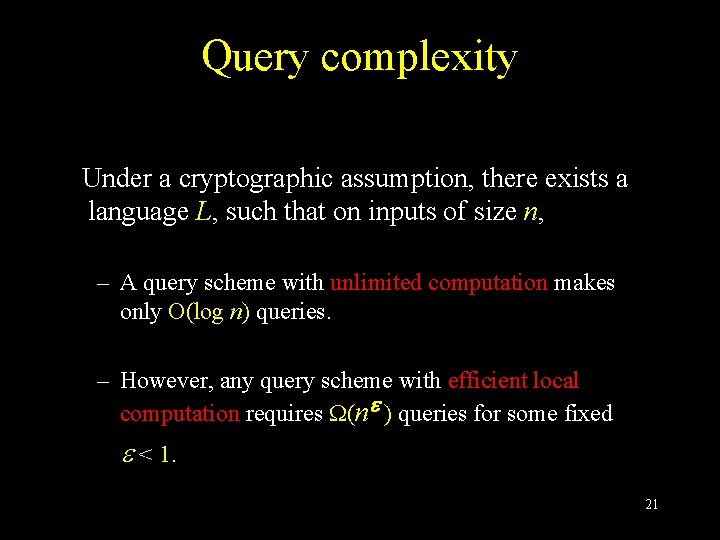
Query complexity Under a cryptographic assumption, there exists a language L, such that on inputs of size n, – A query scheme with unlimited computation makes only O(log n) queries. – However, any query scheme with efficient local computation requires (n ) queries for some fixed < 1. 21
Property testing Assuming NP is not contained in BPP, given any > 0, there exists a property P such that on inputs of size n, – A tester with unlimited computation makes only O( n ) queries. – However, a tester with efficient local computation requires (n 1 - ) queries. 22
k M n PS( M)= Qn i=1 P k j =1 Mij j 23
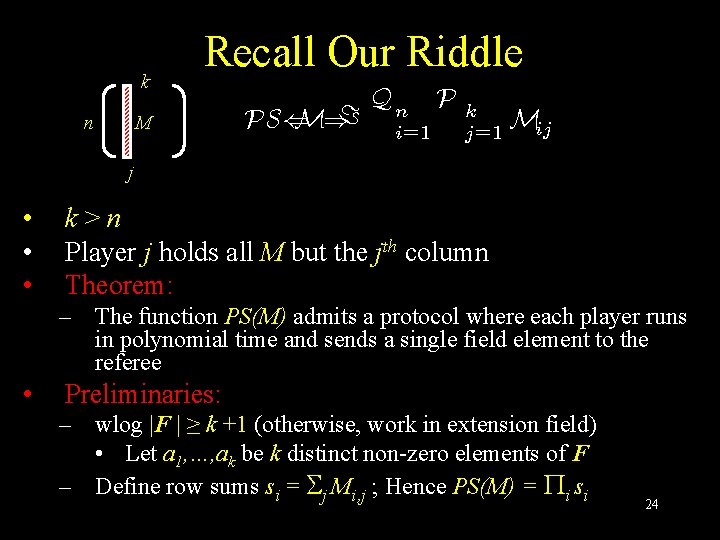
k Recall Our Riddle M n PS( M)= Qn i=1 P k j =1 Mij j • • • k>n Player j holds all M but the jth column Theorem: – The function PS(M) admits a protocol where each player runs in polynomial time and sends a single field element to the referee • Preliminaries: – wlog |F | ≥ k +1 (otherwise, work in extension field) • Let a 1, …, ak be k distinct non-zero elements of F – Define row sums si = j Mi, j ; Hence PS(M) = i si 24
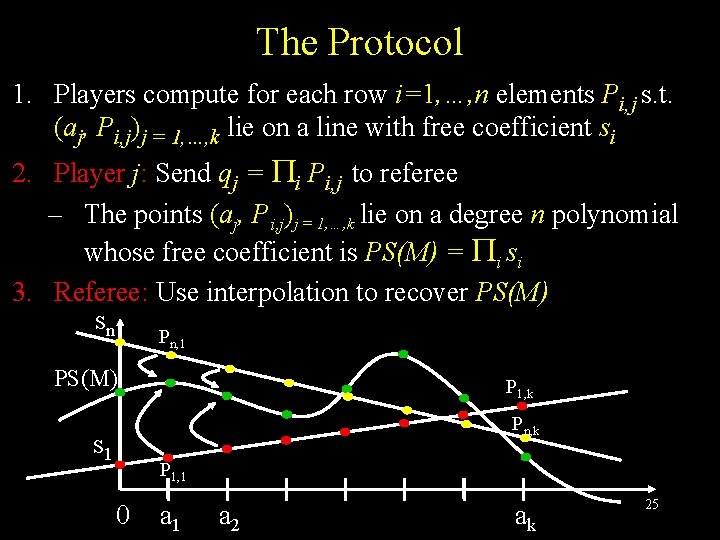
The Protocol 1. Players compute for each row i=1, …, n elements Pi, j s. t. (aj, Pi, j)j = 1, …, k lie on a line with free coefficient si 2. Player j: Send qj = i Pi, j to referee – The points (aj, Pi, j)j = 1, …, k lie on a degree n polynomial whose free coefficient is PS(M) = i si 3. Referee: Use interpolation to recover PS(M) sn P n, 1 PS(M) P 1, k Pn, k s 1 P 1, 1 0 a 1 a 2 ak 25
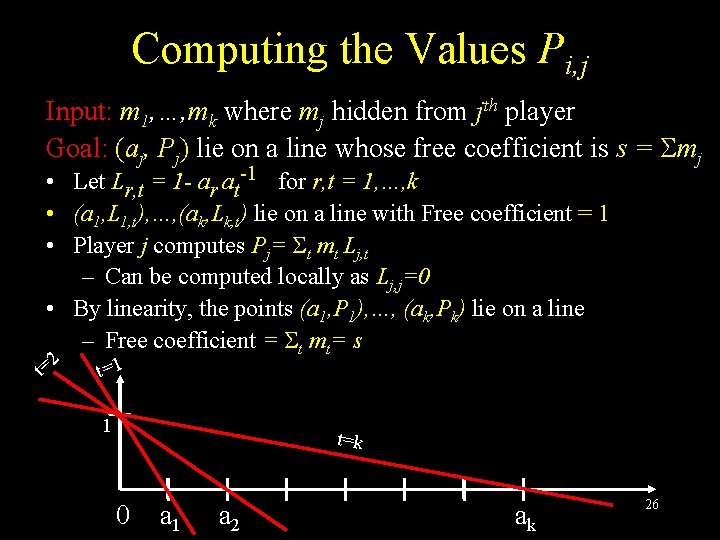
Computing the Values Pi, j Input: m 1, …, mk where mj hidden from jth player Goal: (aj, Pj) lie on a line whose free coefficient is s = mj • Let Lr, t = 1 - ar at-1 for r, t = 1, …, k • (a 1, L 1, t), …, (ak, Lk, t) lie on a line with Free coefficient = 1 • Player j computes Pj= t mt Lj, t – Can be computed locally as Lj, j=0 • By linearity, the points (a 1, P 1), …, (ak, Pk) lie on a line – Free coefficient = t mt= s 2 t= t=1 1 t=k 0 a 1 a 2 ak 26
Summarizing…. • Communication vs. Computation tradeoffs in several communication models • Open Questions: – Can we prove a strong tradeoff result in the two -party communication model under a weaker complexity assumption? – Can we show that unconditional results are not possible? – Can we prove unconditional results for restricted models of communication and computation? 27
The End 28