
Communication Systems in Power Applications Overview n Introduction




- Slides: 48
Communication Systems in Power Applications
Overview n Introduction n Communication Needs of Power System n Communication Technologies n Existing Communication Systems n Challenges n Future Trends 2
Introduction Communications is the enabling technology for Power System n No single communication technology as being best suited for all power system needs n Requirements must consider type, source, amount, frequency, and delivery requirements of data/voice transmitted n 3
Communication Needs of Power System n n n 4 n Reliability Cost effectiveness Capacity to handle data rates Adequate to meet response requirements Ability to reach identified areas of power system Ease of operation and maintenance Security (of data and of control actions)
Communication Reliability Reliable communication with respect to: n Exposure to severe environment n Electromagnetic Interference (EMI) n Transient EMI (lightning, faults) n Outage of transmission lines n Power outages n Radio paths obstructed or attenuated (by buildings or foliage) 5
Cost Effectiveness Communication system costs are significant n High cost of communication system may become an impediment n Evaluate both first cost and lifetime operation and maintenance costs n Look for best trade-off between total costs and overall performance n 6
Capacity to handle data rates n Perform data rate audit of present & upcoming schemes v v Consider worst case scenarios n Each communications system has a bandwidth limit n There should be at least enough bandwidth along each path to meet data requirements n A good margin allows for future growth and increased system flexibility n 7 Analyze each function Determine bit rate required to perform the function
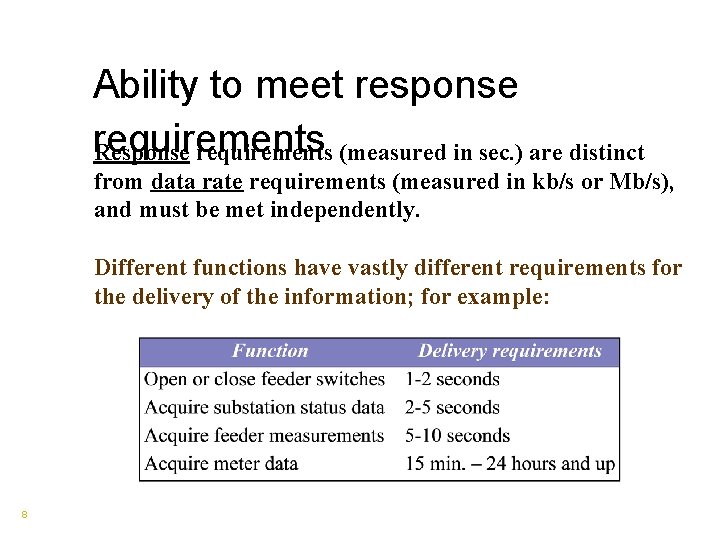
Ability to meet response requirements Response requirements (measured in sec. ) are distinct from data rate requirements (measured in kb/s or Mb/s), and must be met independently. Different functions have vastly different requirements for the delivery of the information; for example: 8
Ability to Reach Areas of Power n Difficult Terrain System n Communications that rely on the power line may have difficulty v v n 9 During outage of line Extreme weather conditions Terminal equipment in outage areas may require backup power for long durations
Ease of Operation and Maintenance n A communications system is a complex combination of transmitters, receivers, and data links n Manpower not trained and not familiar with communications equipment v v n 10 Personnel trained for new skills involved ? New tools acquired ? Use standardized components and communication protocols
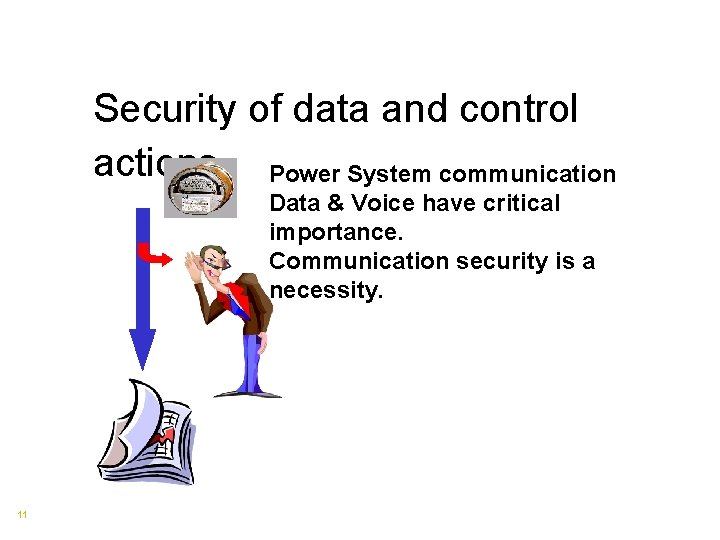
Security of data and control actions Power System communication Data & Voice have critical importance. Communication security is a necessity. 11
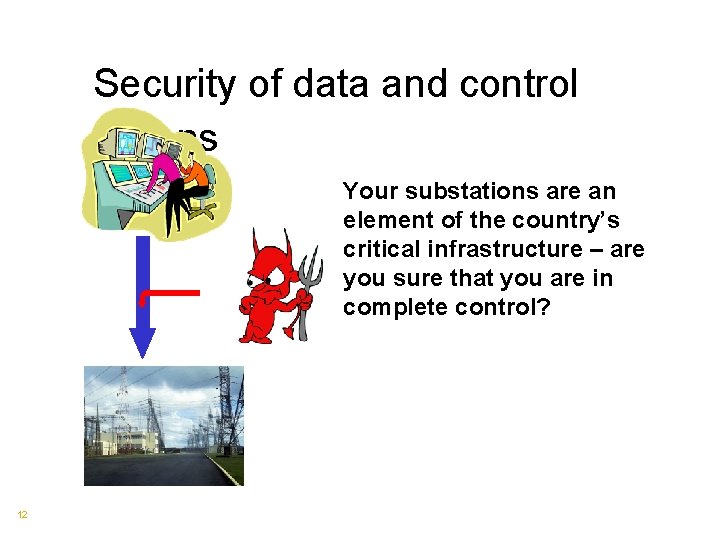
Security of data and control actions Your substations are an element of the country’s critical infrastructure – are you sure that you are in complete control? 12
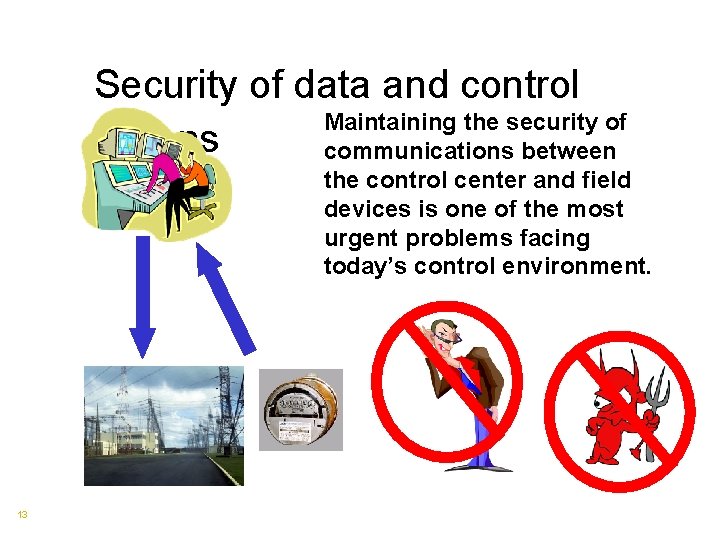
Security of data and control Maintaining the security of actions communications between the control center and field devices is one of the most urgent problems facing today’s control environment. 13
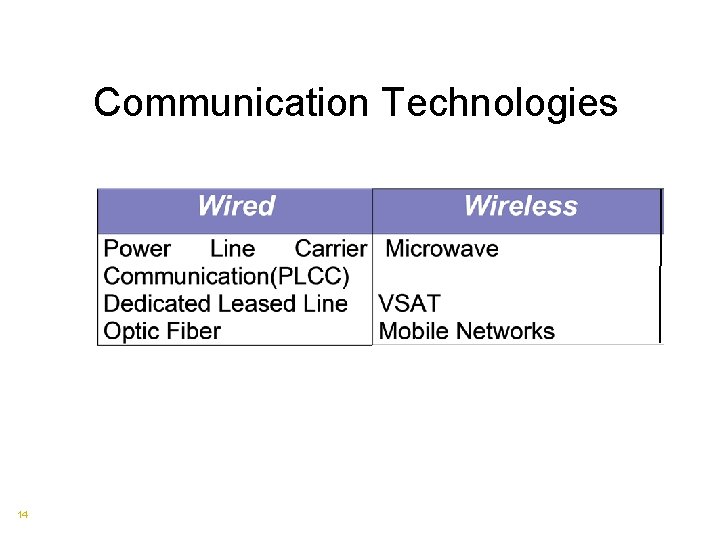
Communication Technologies 14
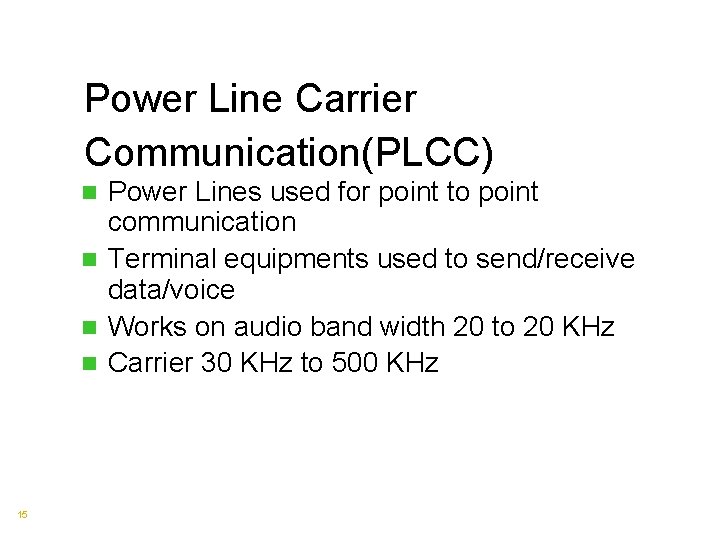
Power Line Carrier Communication(PLCC) Power Lines used for point to point communication n Terminal equipments used to send/receive data/voice n Works on audio band width 20 to 20 KHz n Carrier 30 KHz to 500 KHz n 15
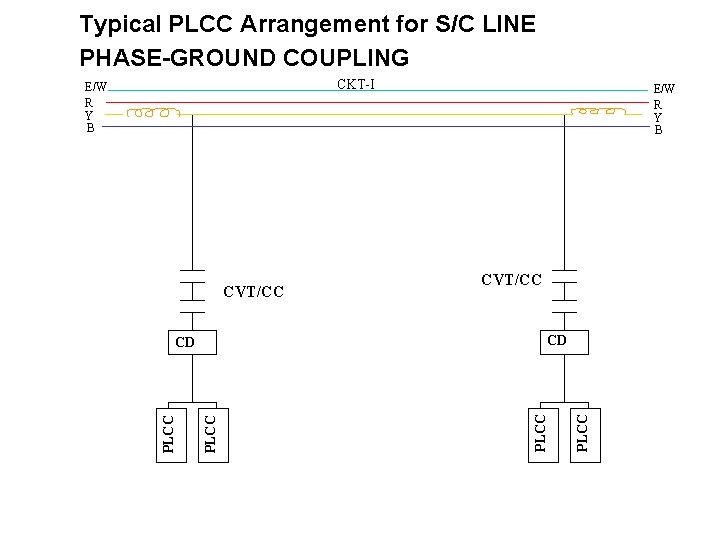
Typical PLCC Arrangement for S/C LINE PHASE-GROUND COUPLING CKT-I E/W R Y B CVT/CC PLCC CD CD PLCC E/W R Y B
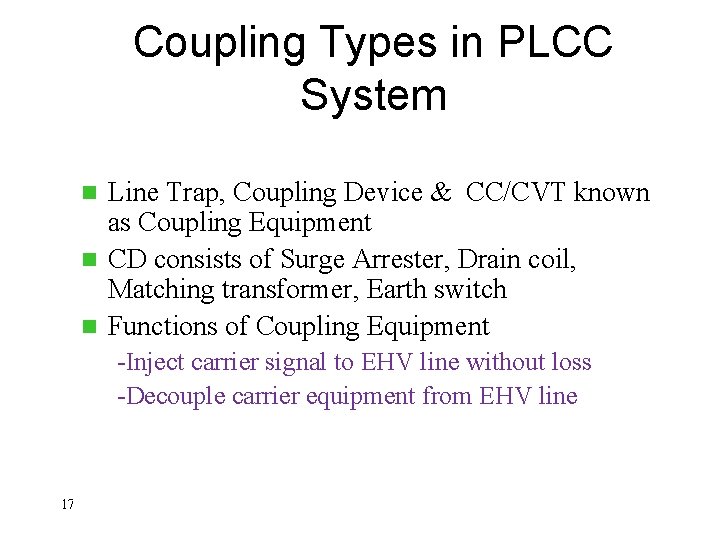
Coupling Types in PLCC System Line Trap, Coupling Device & CC/CVT known as Coupling Equipment n CD consists of Surge Arrester, Drain coil, Matching transformer, Earth switch n Functions of Coupling Equipment n -Inject carrier signal to EHV line without loss -Decouple carrier equipment from EHV line 17
PLCC---Uses Voice communication n Tele-control n Tele-protection n SCADA data from RTU n 18
PLCC---Pros Easy availability n Cost effective n Ease of operation & maintenance n 19
PLCC--- Cons n n n n 20 Limited bandwidth(4 KHz) Data speeds up to only 1200 Bauds possible Prone to Noise & Interference Effect of weather conditions-frost, high pollution etc Depends on physical connectivity of power lines Needs government approval for carrier freq selection Not suitable for today’s needs of automation like SAS, remote control etc.
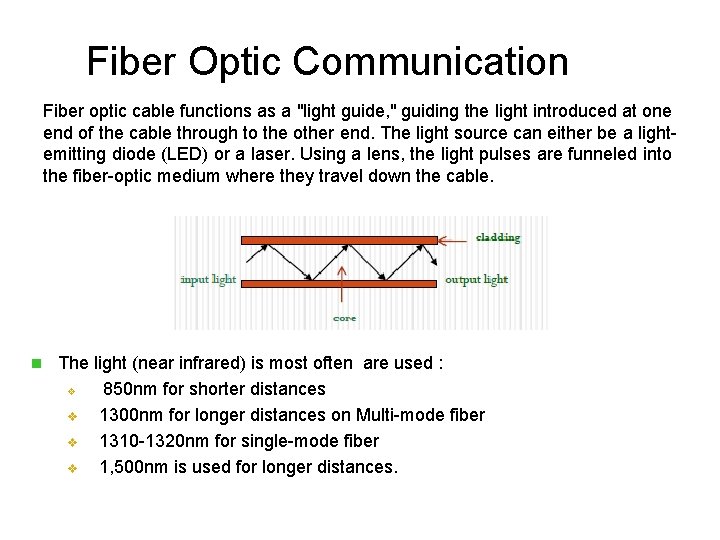
Fiber Optic Communication Fiber optic cable functions as a "light guide, " guiding the light introduced at one end of the cable through to the other end. The light source can either be a lightemitting diode (LED) or a laser. Using a lens, the light pulses are funneled into the fiber-optic medium where they travel down the cable. n The light (near infrared) is most often are used : v 850 nm for shorter distances v 1300 nm for longer distances on Multi-mode fiber v 1310 -1320 nm for single-mode fiber v 1, 500 nm is used for longer distances.
n 22 Fiber Optic Communication(Contd. . ) Two types of fibre. Multi mode > 50 micron core– Upto 2 Kms Single mode < 10 micron core—more than 20 Kms n Selected on the basis of distance & bandwidth needs n Wave Division Multiplexing Used
Fiber Optic (Contd. . ) Pros: n Fast becoming common in utilities for voice and data transmission n Offer many advantages extremely high data transmission rates v immunity from electromagnetic interference v Free from licensing requirements v n Cost 23 effective for very high data transmission rates in a point-to-point configuration
Fiber Optic (contd. . ) Cons n Not as cost effective for applications, with v v point-to-multipoint configuration Modest data transmission speed requirements Prone to cable cut in underground configuration n Repair & restoration specialized work n 24
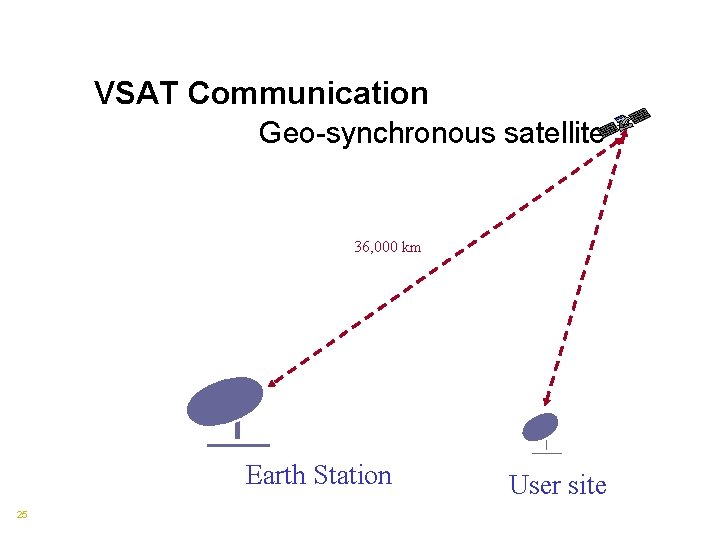
VSAT Communication Geo-synchronous satellite 36, 000 km Earth Station 25 User site
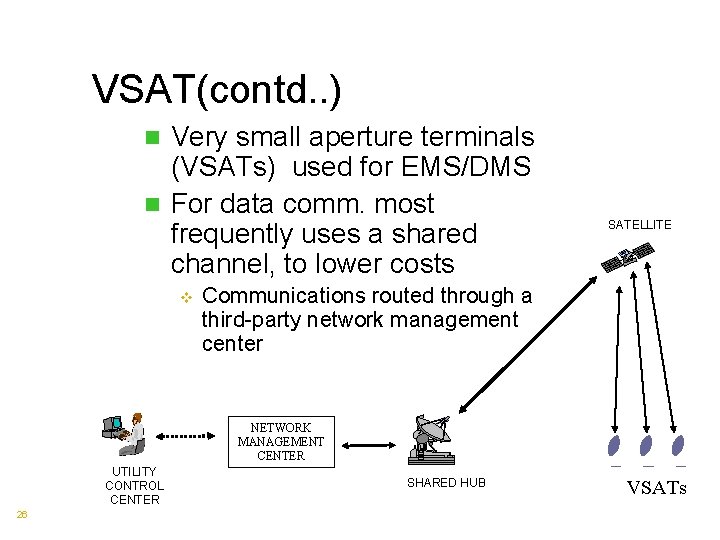
VSAT(contd. . ) Very small aperture terminals (VSATs) used for EMS/DMS n For data comm. most frequently uses a shared channel, to lower costs n v SATELLITE Communications routed through a third-party network management center NETWORK MANAGEMENT CENTER UTILITY CONTROL CENTER 26 SHARED HUB VSATs
VSAT (contd. . ) n Various frequency bands: v C-band (4/6 GHz), Ku-band (12/14 GHz), Kaband(30/20 GHz) n Advantages v Near-universal coverage v Good reliability v Fast installation 27 n Disadvantages v Cost v Transmission delays v Blackout periods due to eclipses v Attenuation in heavy rain (Ku band)
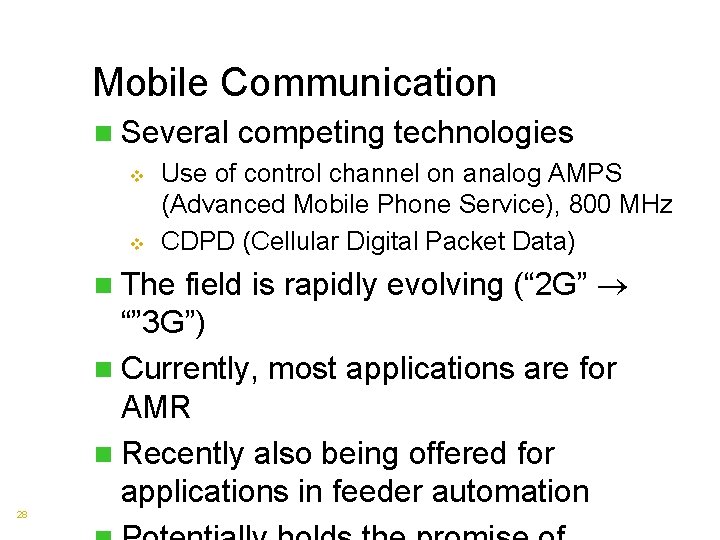
Mobile Communication n Several competing technologies v Use of control channel on analog AMPS (Advanced Mobile Phone Service), 800 MHz v CDPD (Cellular Digital Packet Data) field is rapidly evolving (“ 2 G” “” 3 G”) n Currently, most applications are for AMR n Recently also being offered for applications in feeder automation n The 28
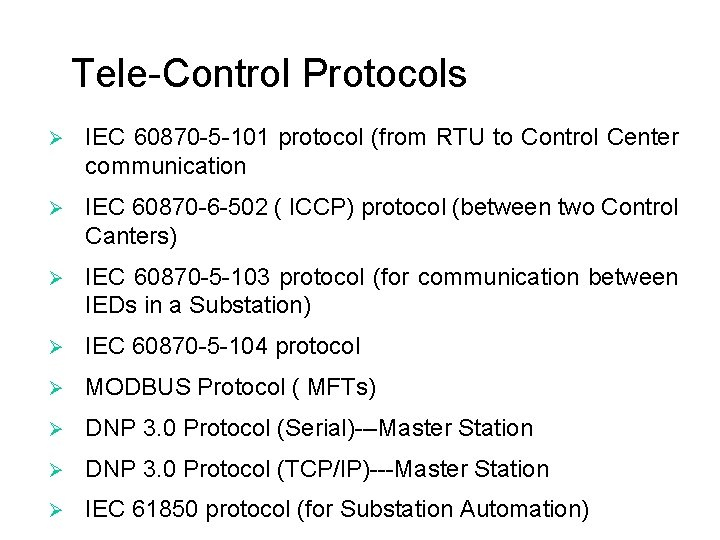
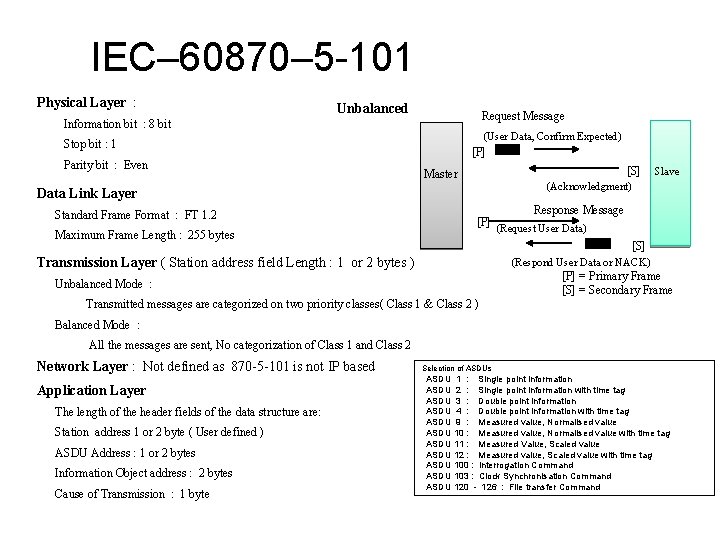
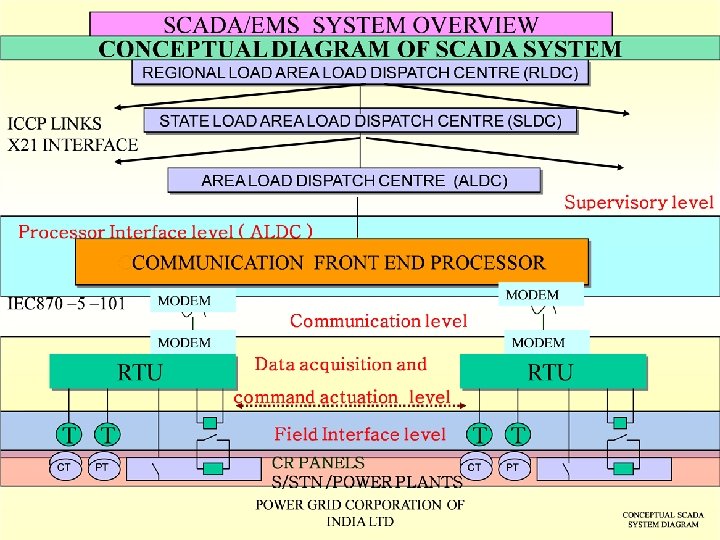
Tele-Control Protocols Ø IEC 60870 -5 -101 protocol (from RTU to Control Center communication Ø IEC 60870 -6 -502 ( ICCP) protocol (between two Control Canters) Ø IEC 60870 -5 -103 protocol (for communication between IEDs in a Substation) Ø IEC 60870 -5 -104 protocol Ø MODBUS Protocol ( MFTs) Ø DNP 3. 0 Protocol (Serial)---Master Station Ø DNP 3. 0 Protocol (TCP/IP)---Master Station Ø IEC 61850 protocol (for Substation Automation)
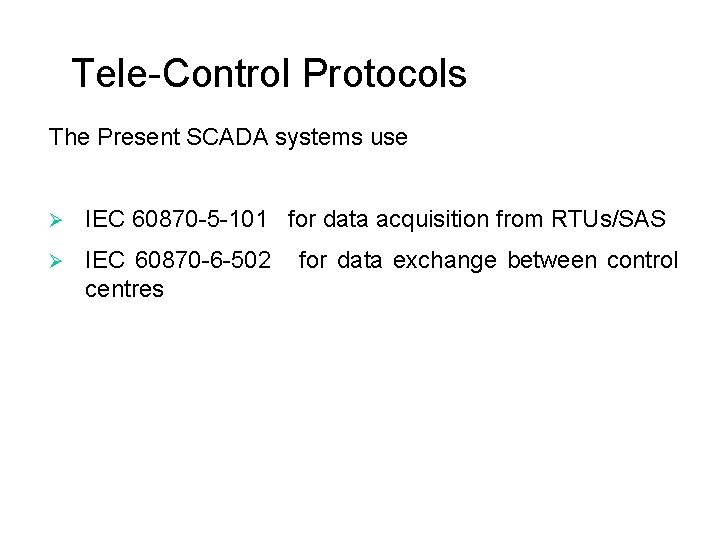
Tele-Control Protocols The Present SCADA systems use Ø IEC 60870 -5 -101 for data acquisition from RTUs/SAS Ø IEC 60870 -6 -502 centres for data exchange between control
IEC– 60870– 5 -101 Physical Layer : Unbalanced Request Message Information bit : 8 bit (User Data, Confirm Expected) Stop bit : 1 Parity bit : Even [P] [S] Master (Acknowledgment) Data Link Layer Standard Frame Format : FT 1. 2 Slave [P] Maximum Frame Length : 255 bytes Response Message (Request User Data) [S] Transmission Layer ( Station address field Length : 1 or 2 bytes ) (Respond User Data or NACK) [P] = Primary Frame [S] = Secondary Frame Unbalanced Mode : Transmitted messages are categorized on two priority classes( Class 1 & Class 2 ) Balanced Mode : All the messages are sent, No categorization of Class 1 and Class 2 Network Layer : Not defined as 870 -5 -101 is not IP based Application Layer The length of the header fields of the data structure are: Station address 1 or 2 byte ( User defined ) ASDU Address : 1 or 2 bytes Information Object address : 2 bytes Cause of Transmission : 1 byte Selection of ASDUs ASDU 1 : Single point information ASDU 2 : Single point information with time tag ASDU 3 : Double point information ASDU 4 : Double point information with time tag ASDU 9 : Measured value, Normalised value ASDU 10 : Measured value, Normalised value with time tag ASDU 11 : Measured Value, Scaled value ASDU 12 : Measured value, Scaled value with time tag ASDU 100 : Interrogation Command ASDU 103 : Clock Synchronisation Command ASDU 120 - 126 : File transfer Command
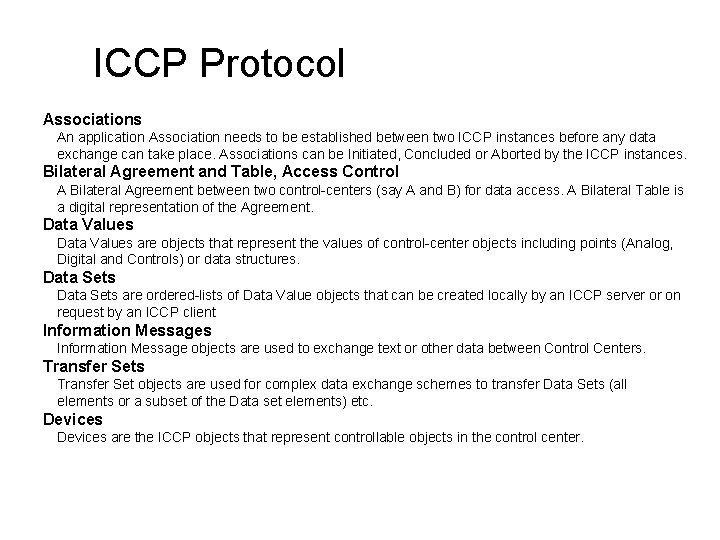
ICCP Protocol Associations An application Association needs to be established between two ICCP instances before any data exchange can take place. Associations can be Initiated, Concluded or Aborted by the ICCP instances. Bilateral Agreement and Table, Access Control A Bilateral Agreement between two control-centers (say A and B) for data access. A Bilateral Table is a digital representation of the Agreement. Data Values are objects that represent the values of control-center objects including points (Analog, Digital and Controls) or data structures. Data Sets are ordered-lists of Data Value objects that can be created locally by an ICCP server or on request by an ICCP client Information Messages Information Message objects are used to exchange text or other data between Control Centers. Transfer Sets Transfer Set objects are used for complex data exchange schemes to transfer Data Sets (all elements or a subset of the Data set elements) etc. Devices are the ICCP objects that represent controllable objects in the control center.
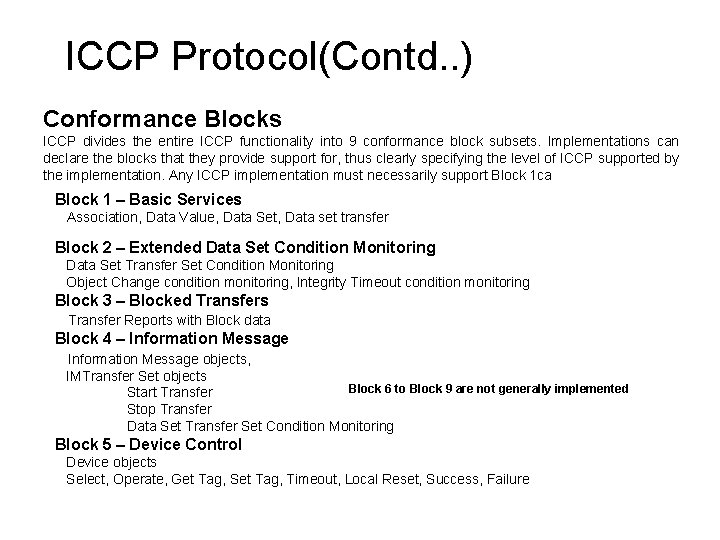
ICCP Protocol(Contd. . ) Conformance Blocks ICCP divides the entire ICCP functionality into 9 conformance block subsets. Implementations can declare the blocks that they provide support for, thus clearly specifying the level of ICCP supported by the implementation. Any ICCP implementation must necessarily support Block 1 ca Block 1 – Basic Services Association, Data Value, Data Set, Data set transfer Block 2 – Extended Data Set Condition Monitoring Data Set Transfer Set Condition Monitoring Object Change condition monitoring, Integrity Timeout condition monitoring Block 3 – Blocked Transfers Transfer Reports with Block data Block 4 – Information Message objects, IMTransfer Set objects Block 6 to Block 9 are not generally implemented Start Transfer Stop Transfer Data Set Transfer Set Condition Monitoring Block 5 – Device Control Device objects Select, Operate, Get Tag, Set Tag, Timeout, Local Reset, Success, Failure
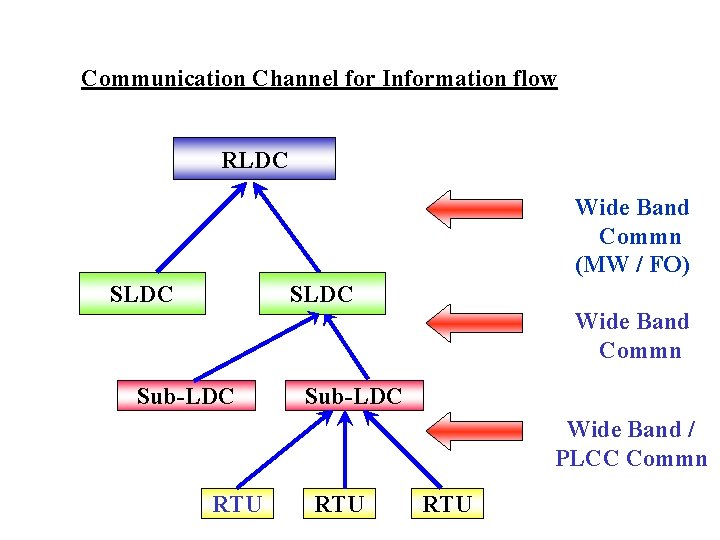
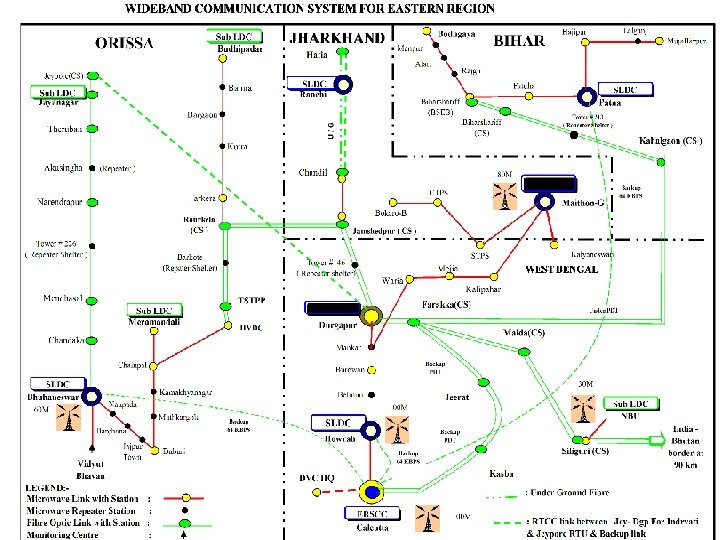
Communication Channel for Information flow RLDC Wide Band Commn (MW / FO) SLDC Wide Band Commn Sub-LDC Wide Band / PLCC Commn RTU RTU
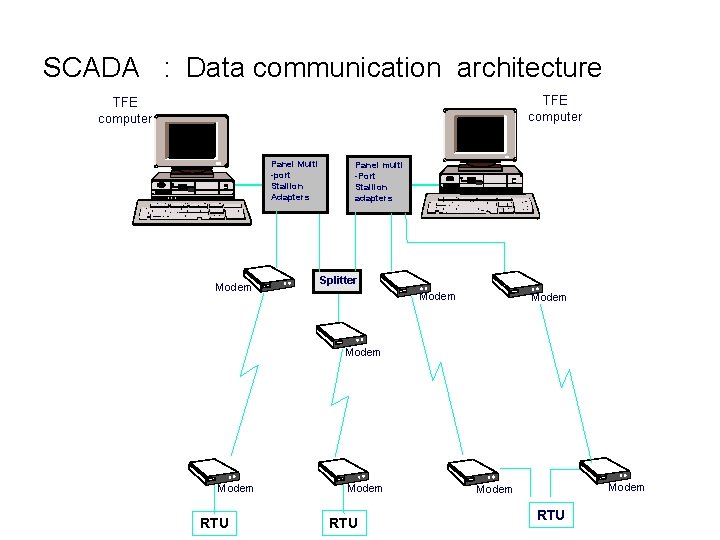
SCADA : Data communication architecture TFE computer Panel Multi -port Stallion Adapters Modem Panel multi -Port Stallion adapters Splitter Modem Modem RTU
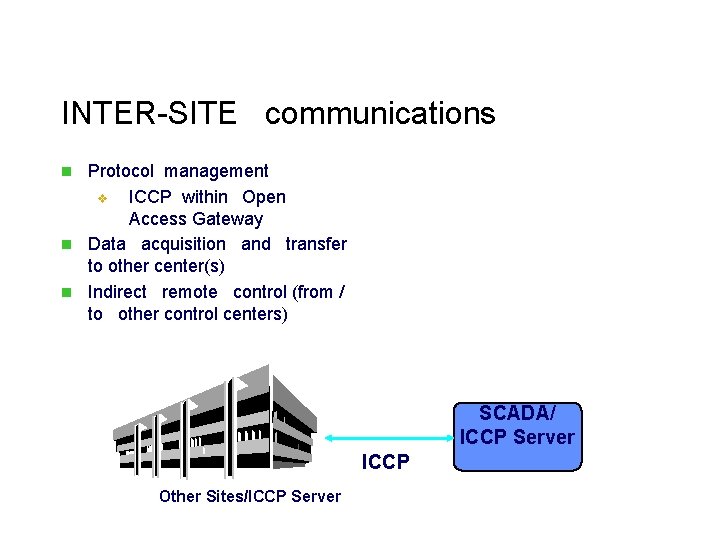
INTER-SITE communications Protocol management v ICCP within Open Access Gateway n Data acquisition and transfer to other center(s) n Indirect remote control (from / to other control centers) n SCADA/ ICCP Server ICCP Other Sites/ICCP Server
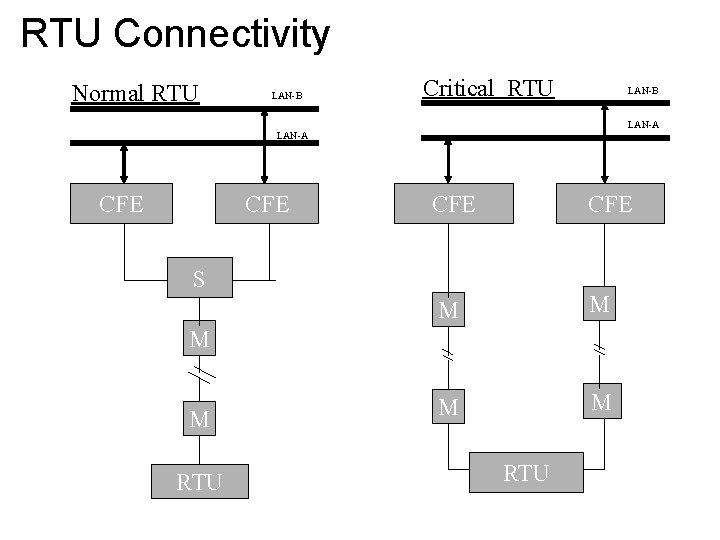
RTU Connectivity Normal RTU LAN-B Critical RTU LAN-B LAN-A CFE CFE M M S M M RTU
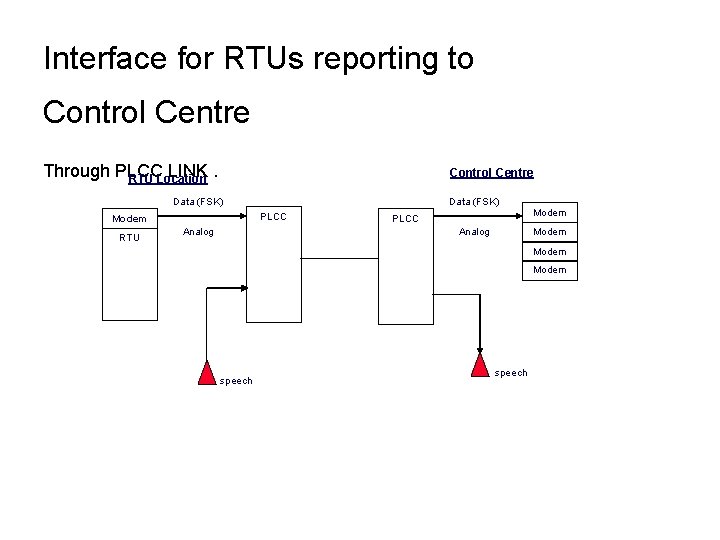
Interface for RTUs reporting to Control Centre Through PLCC LINK. RTU Location Control Centre Data (FSK) Modem RTU Data (FSK) PLCC Analog Modem speech
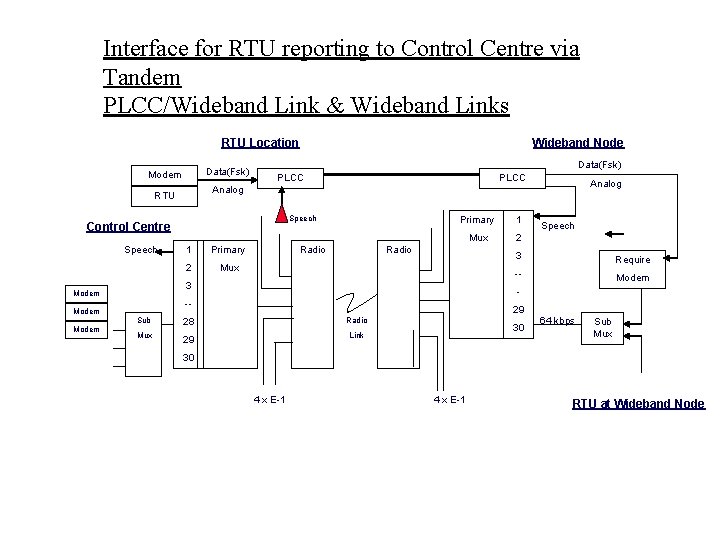
Interface for RTU reporting to Control Centre via Tandem PLCC/Wideband Link & Wideband Links RTU Location Data(Fsk) Modem Data(Fsk) PLCC Speech Control Centre 1 Primary 2 Mux Radio Primary 1 Mux 2 Radio 3 Modem Sub Mux Analog Speech 3 Require -- Modem - -- Modem PLCC Analog RTU Speech Wideband Node 29 28 Radio 29 Link 30 64 kbps Sub Mux 30 4 x E-1 RTU at Wideband Node
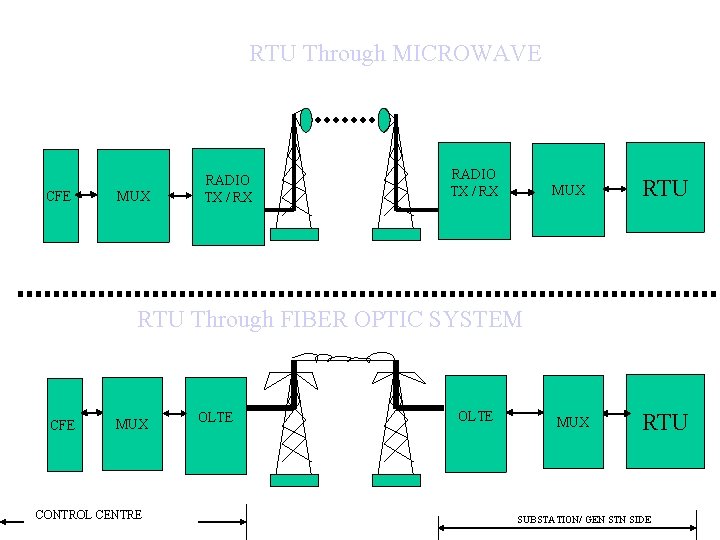
RTU Through MICROWAVE CFE MUX RADIO TX / RX MUX RTU Through FIBER OPTIC SYSTEM CFE MUX CONTROL CENTRE OLTE MUX RTU SUBSTATION/ GEN STN SIDE
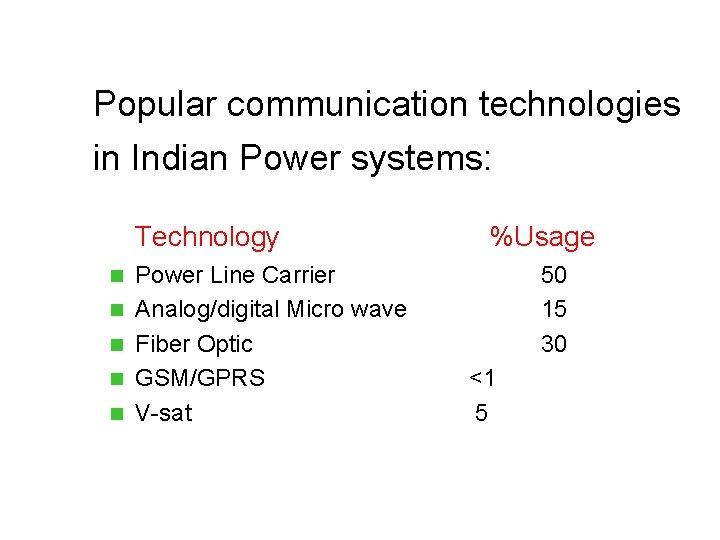
Popular communication technologies in Indian Power systems: Technology n n n Power Line Carrier Analog/digital Micro wave Fiber Optic GSM/GPRS V-sat %Usage 50 15 30 <1 5
Challenges Indian Power networks growing faster, larger & more complex. n Data communication needs to be much faster catering to smart grid initiatives being taken up. n With faster, smarter & innovative technologies, data security to be addressed adequately. n All radio communication to be replaced with fibre optic network by Dec. , 2011 as per GOI decision. n 45
Future Trends n n n 46 Smart grid technologies driving communication needs. High speed fibre optic networks need of the hour. Increasing use of internet as the mechanism for data communication. Main thrust on security issues with use of web based technologies. Introduction of Service oriented architecture(SOA) will need high band width networks.
Future Trends (contd. . ) n Growing insistence on adherence to communication standards. n Possible application of cellular digital packet data radio technologies. 47
Thank You Devendra Kumar DGM, ERLDC