
Communication Systems 5 e Chapter 5 Angle CW

- Slides: 80
Communication Systems, 5 e Chapter 5: Angle CW Modulation A. Bruce Carlson Paul B. Crilly (modified by J. H. Cho using Prof. W. J. Song’s lecture note) © 2010 The Mc. Graw-Hill Companies
Chapter 5: Angle CW Modulatation o Phase and frequency modulation o Transmission bandwidth and distortion o Generation and detection of FM and PM o Interference © 2010 The Mc. Graw-Hill Companies
5. 1 Phase and frequency modulation © 2010 The Mc. Graw-Hill Companies
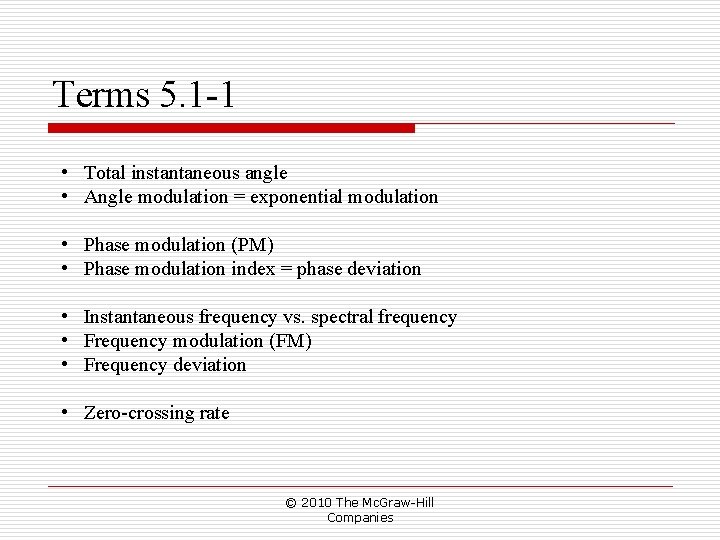
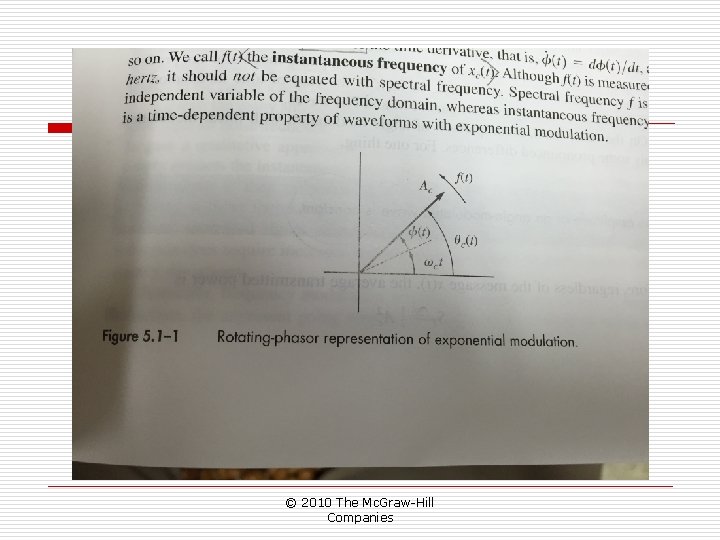
Terms 5. 1 -1 • Total instantaneous angle • Angle modulation = exponential modulation • Phase modulation (PM) • Phase modulation index = phase deviation • Instantaneous frequency vs. spectral frequency • Frequency modulation (FM) • Frequency deviation • Zero-crossing rate © 2010 The Mc. Graw-Hill Companies
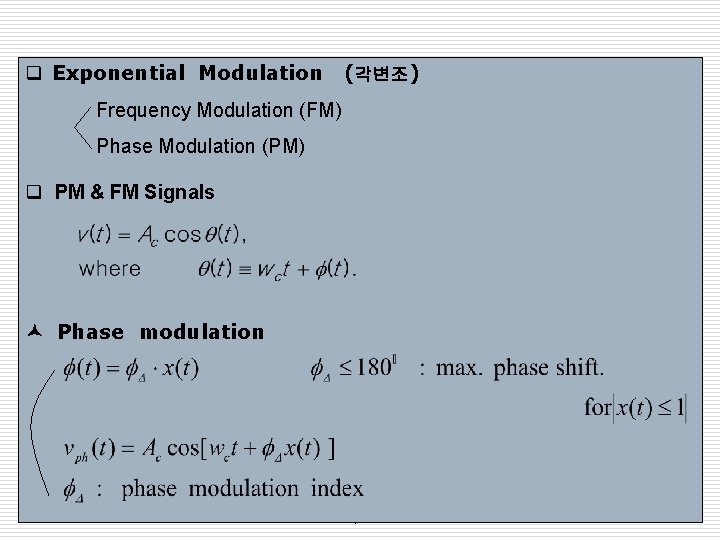
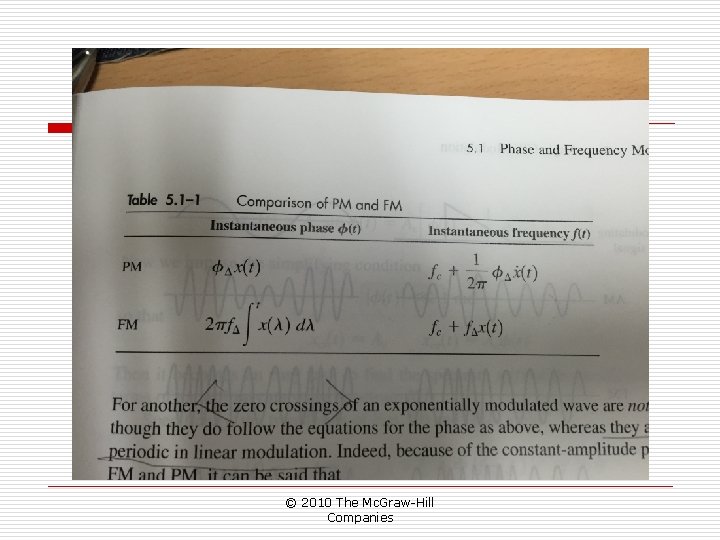
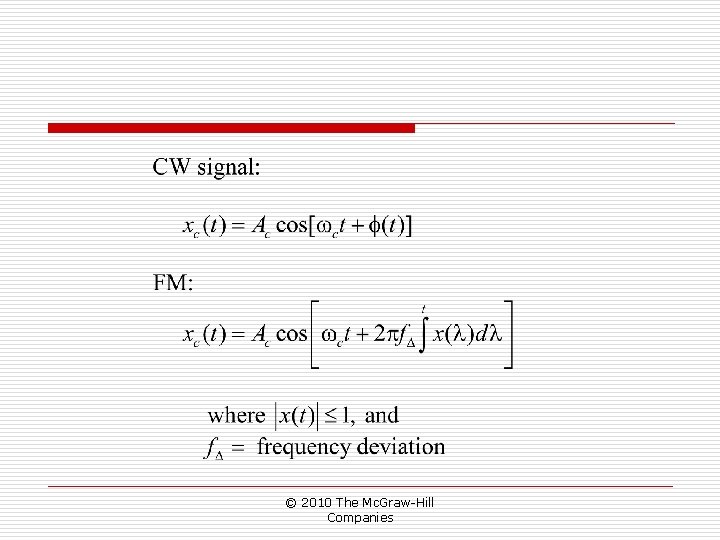
q Exponential Modulation (각변조) Frequency Modulation (FM) Phase Modulation (PM) q PM & FM Signals Phase modulation © 2010 The Mc. Graw-Hill Companies
© 2010 The Mc. Graw-Hill Companies
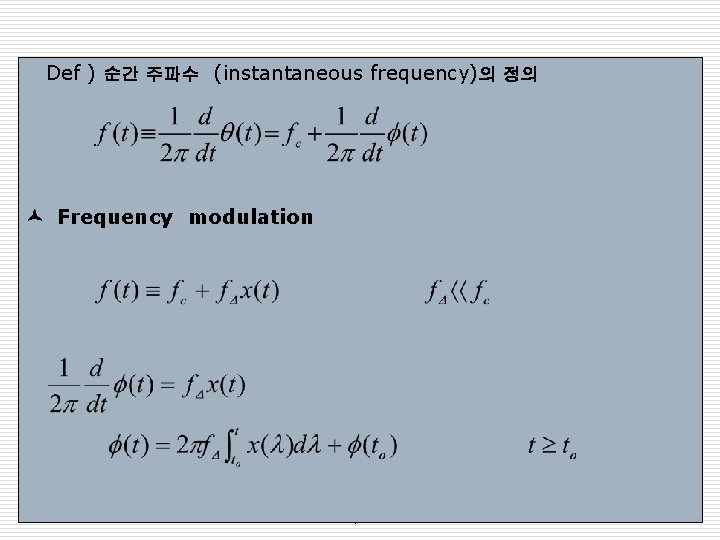
Def ) 순간 주파수 (instantaneous frequency)의 정의 Frequency modulation © 2010 The Mc. Graw-Hill Companies
© 2010 The Mc. Graw-Hill Companies
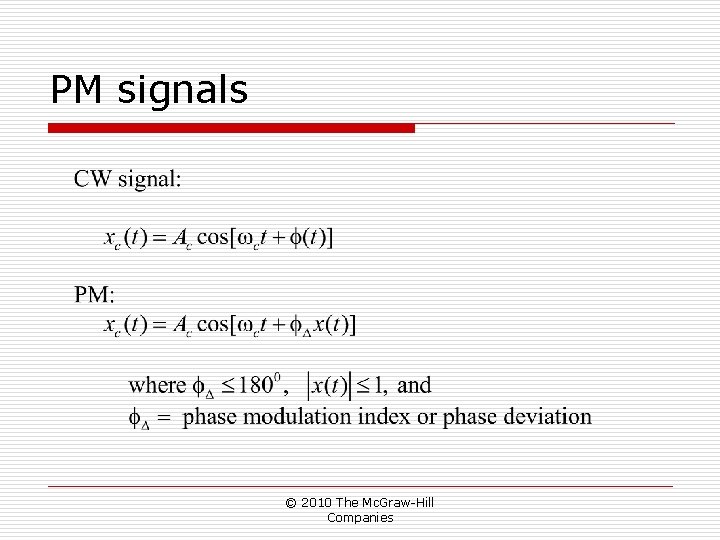
PM signals © 2010 The Mc. Graw-Hill Companies
© 2010 The Mc. Graw-Hill Companies
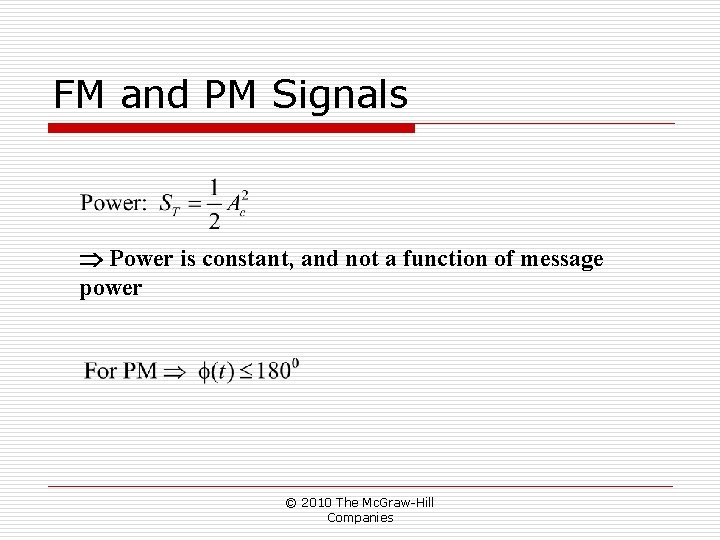
FM and PM Signals Power is constant, and not a function of message power © 2010 The Mc. Graw-Hill Companies
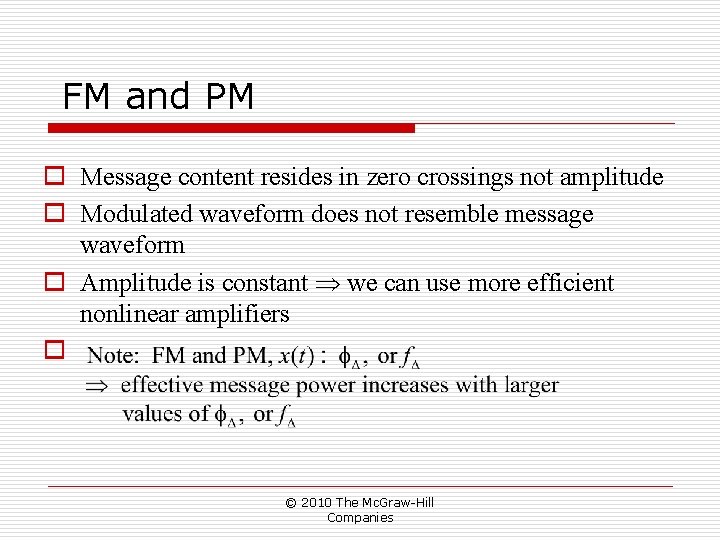
FM and PM o Message content resides in zero crossings not amplitude o Modulated waveform does not resemble message waveform o Amplitude is constant we can use more efficient nonlinear amplifiers o © 2010 The Mc. Graw-Hill Companies
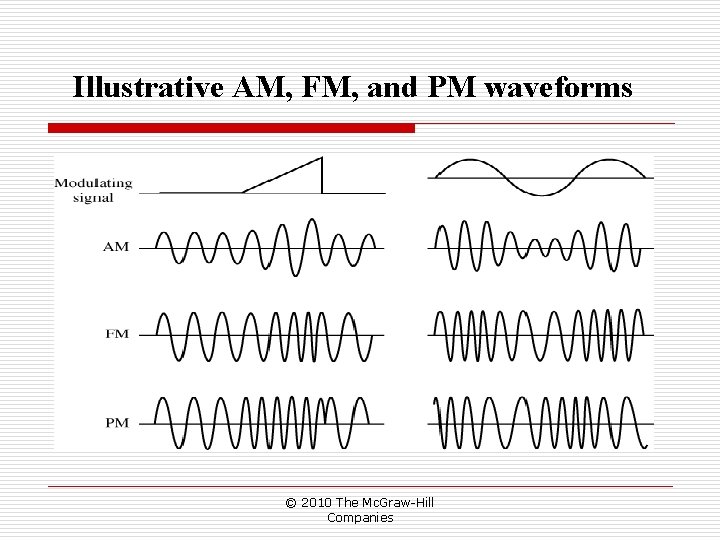
Illustrative AM, FM, and PM waveforms © 2010 The Mc. Graw-Hill Companies
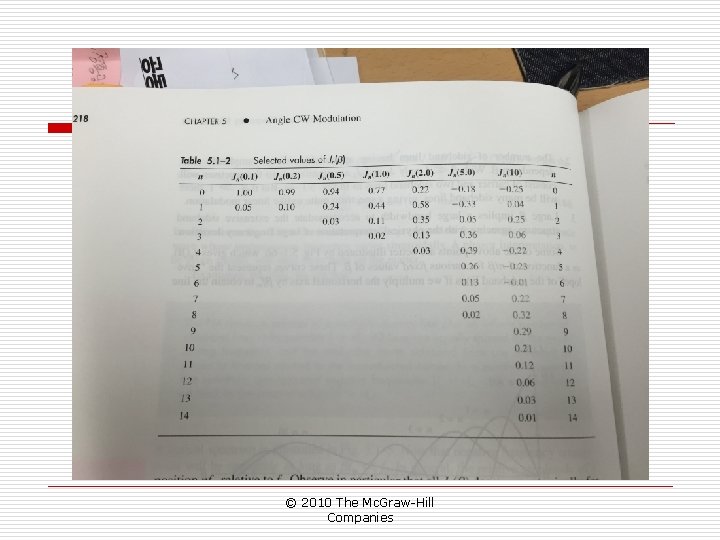
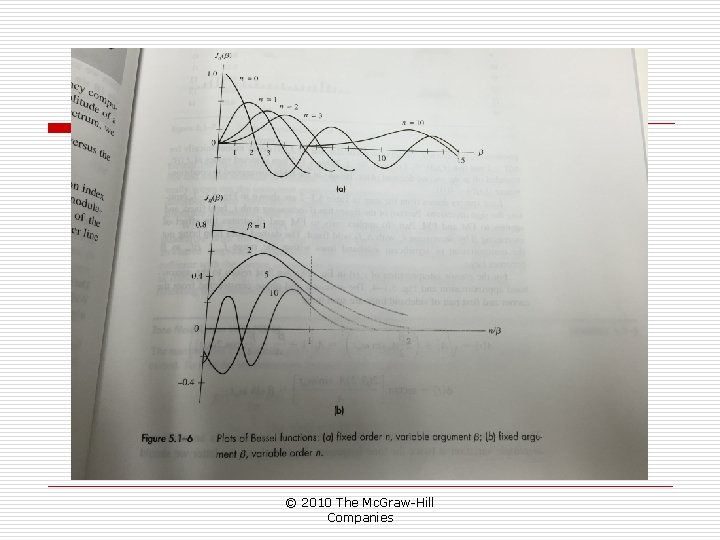
Terms 5. 1 -2 • Narrowband PM and FM (NBPM and NBFM) • Single-tone modulation • Bessel function of the first kind of order n and argument beta • Multitone modulation • Periodic modulation © 2010 The Mc. Graw-Hill Companies
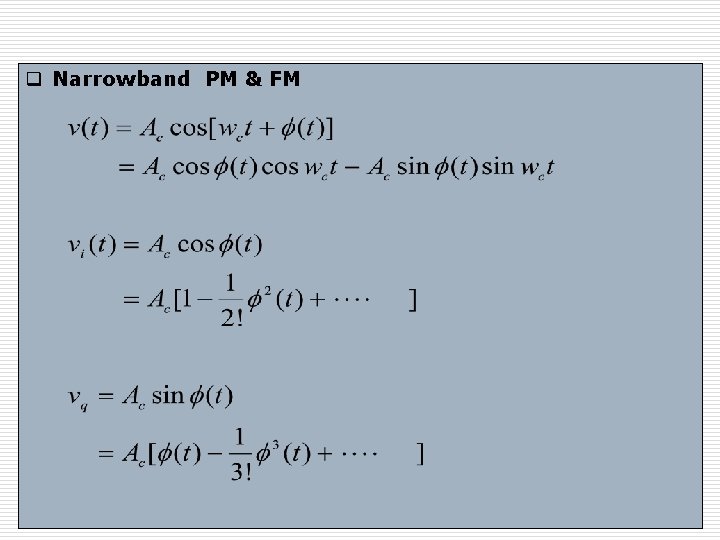
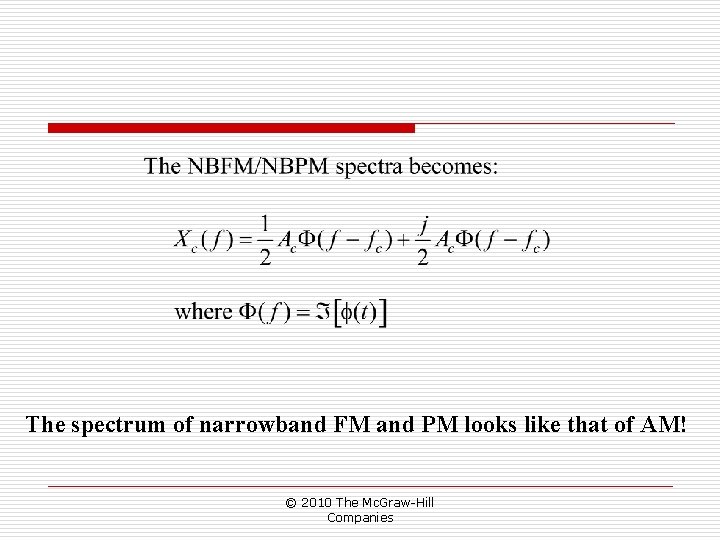
q Narrowband PM & FM © 2010 The Mc. Graw-Hill Companies
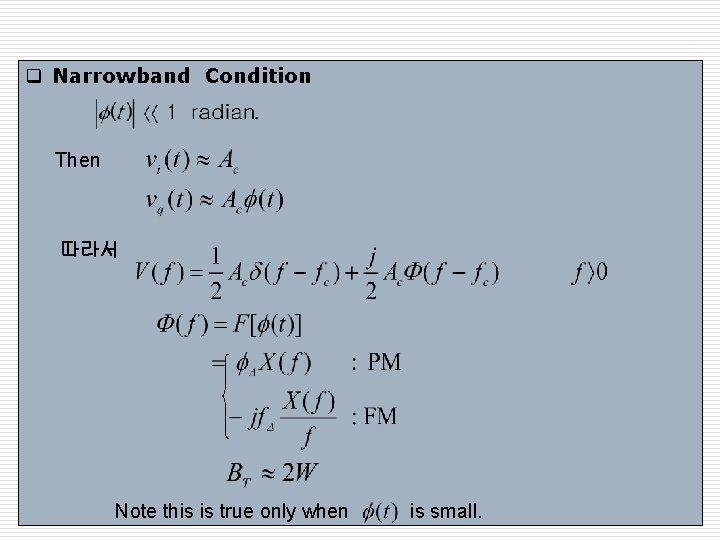
q Narrowband Condition Then 따라서 © 2010 The Mc. Graw-Hill Note this is true only when Companies is small.
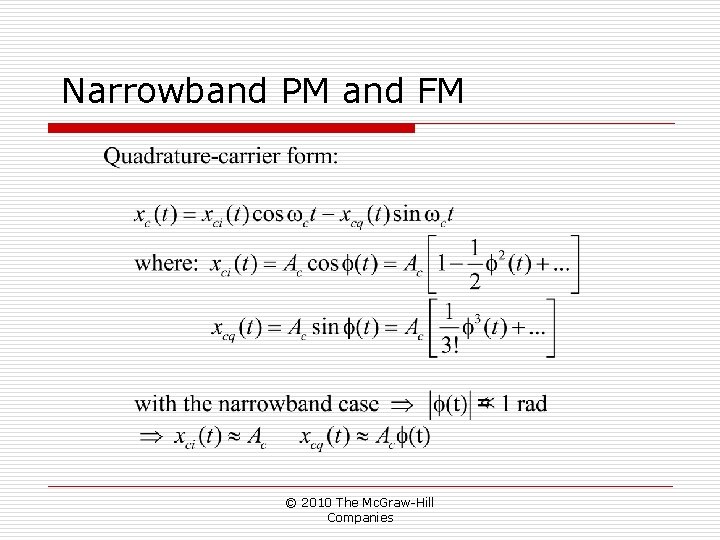
Narrowband PM and FM © 2010 The Mc. Graw-Hill Companies
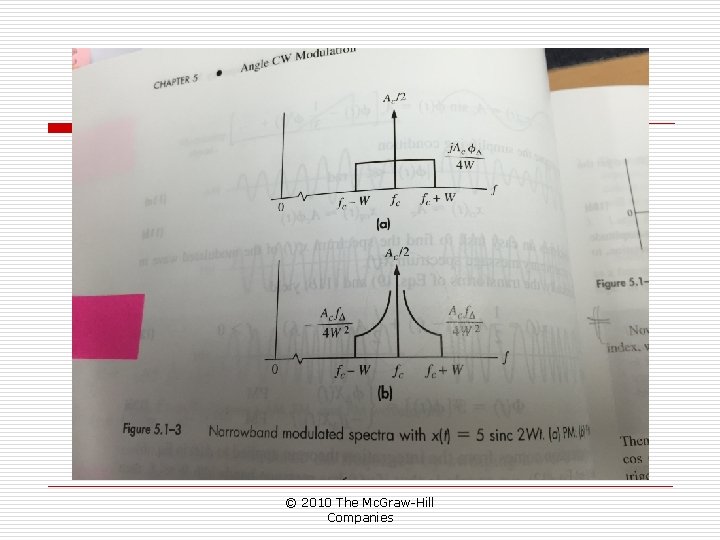
The spectrum of narrowband FM and PM looks like that of AM! © 2010 The Mc. Graw-Hill Companies
© 2010 The Mc. Graw-Hill Companies
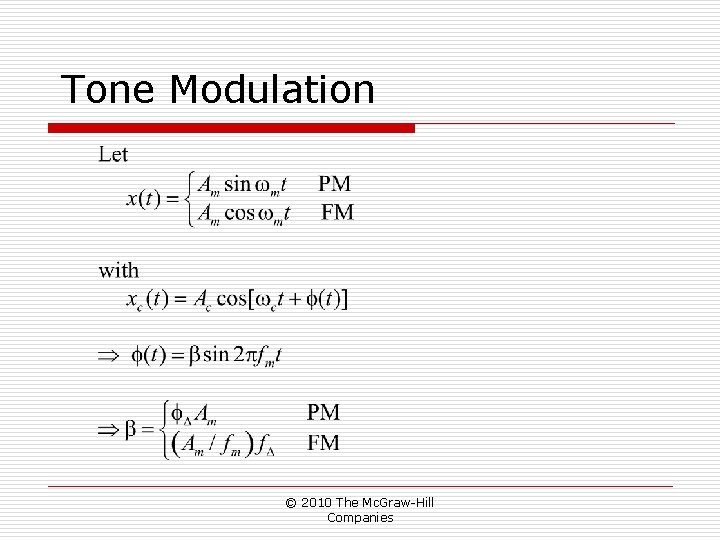
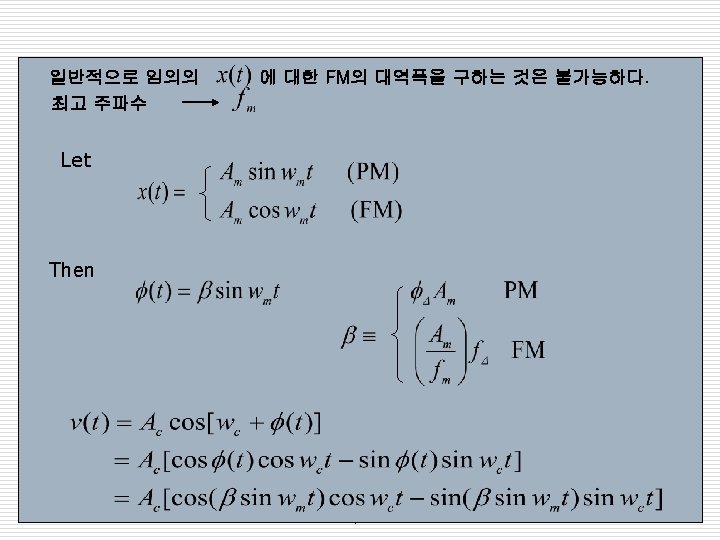
Tone Modulation © 2010 The Mc. Graw-Hill Companies
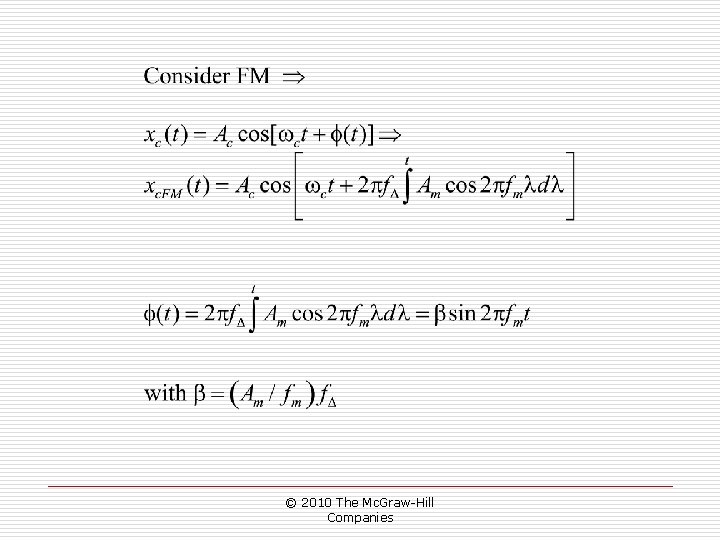
© 2010 The Mc. Graw-Hill Companies
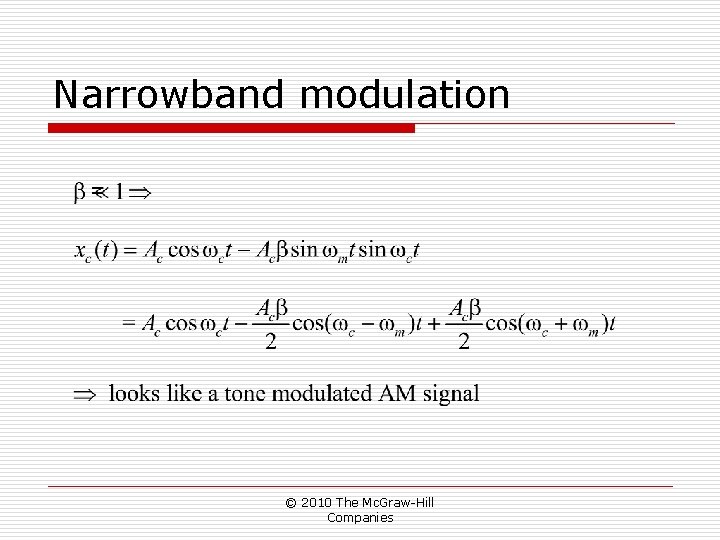
Narrowband modulation © 2010 The Mc. Graw-Hill Companies
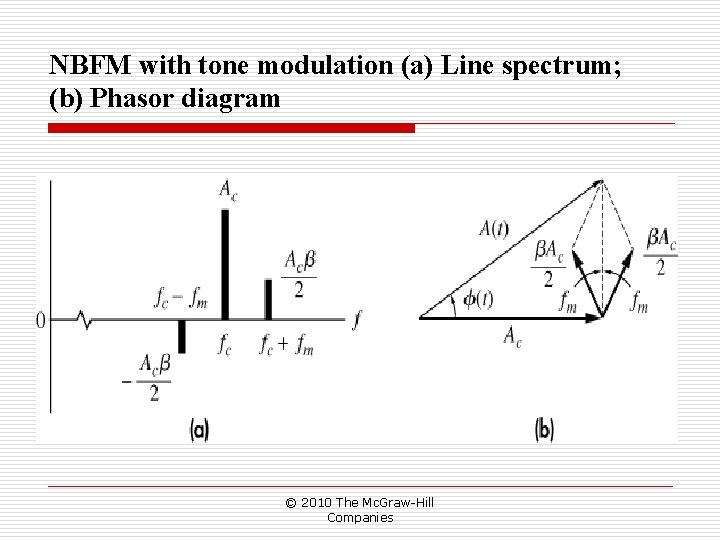
NBFM with tone modulation (a) Line spectrum; (b) Phasor diagram © 2010 The Mc. Graw-Hill Companies
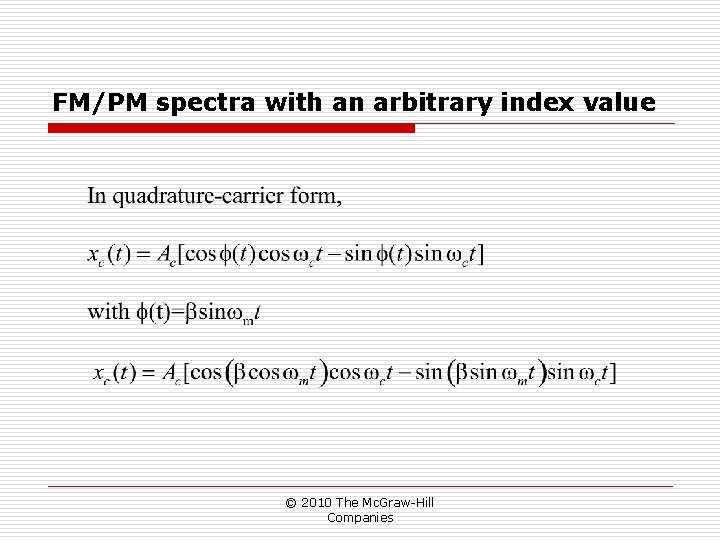
FM/PM spectra with an arbitrary index value © 2010 The Mc. Graw-Hill Companies
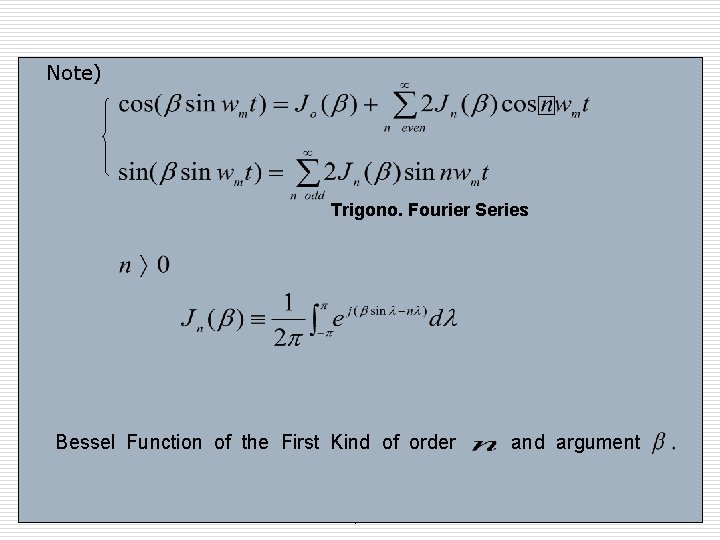
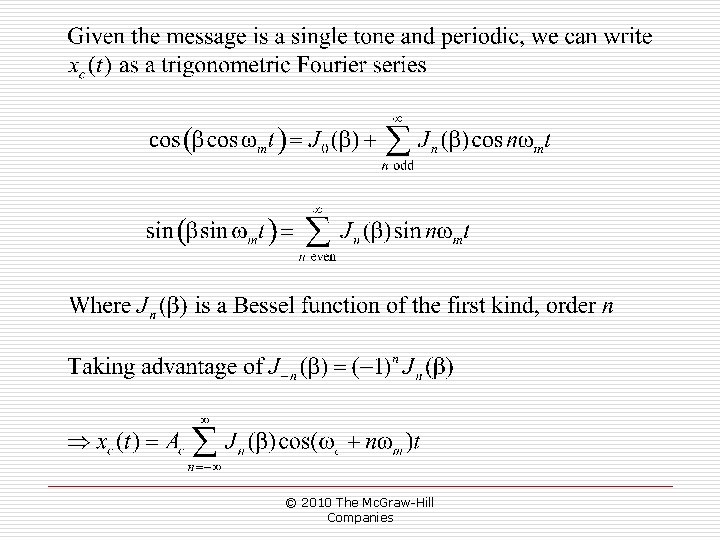
Note) Trigono. Fourier Series Bessel Function of the First Kind of order © 2010 The Mc. Graw-Hill Companies and argument
© 2010 The Mc. Graw-Hill Companies
© 2010 The Mc. Graw-Hill Companies
© 2010 The Mc. Graw-Hill Companies
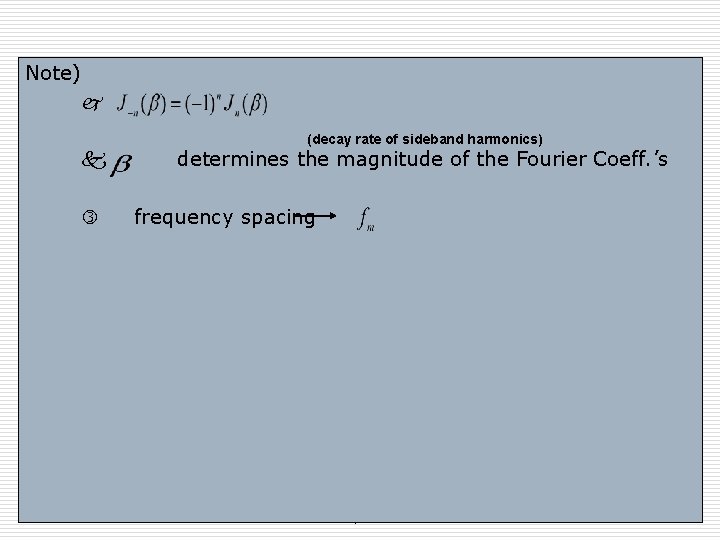
Note) (decay rate of sideband harmonics) determines the magnitude of the Fourier Coeff. ’s frequency spacing © 2010 The Mc. Graw-Hill Companies
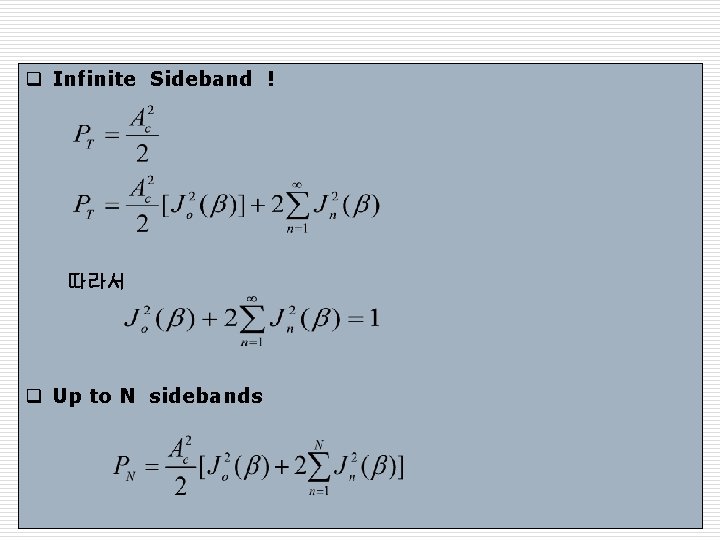
q Infinite Sideband ! 따라서 q Up to N sidebands © 2010 The Mc. Graw-Hill Companies
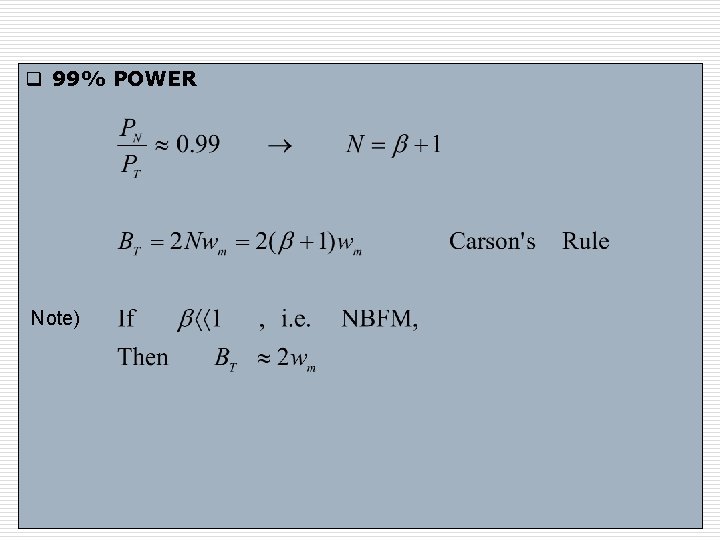
q 99% POWER Note) © 2010 The Mc. Graw-Hill Companies
© 2010 The Mc. Graw-Hill Companies
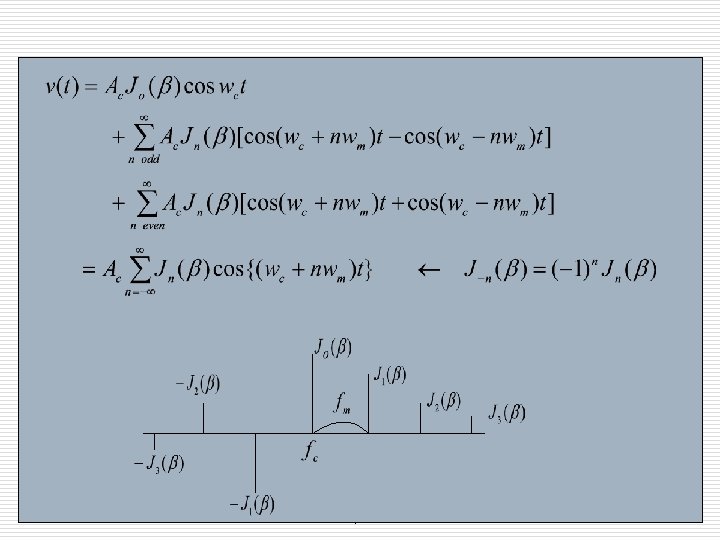
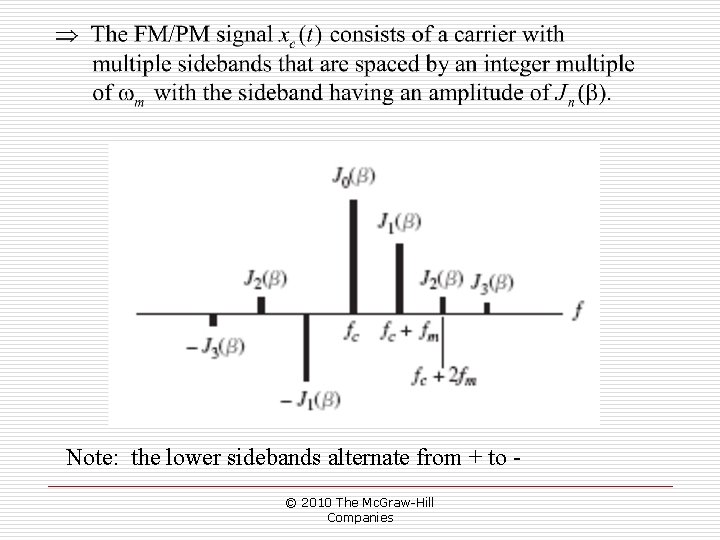
Note: the lower sidebands alternate from + to © 2010 The Mc. Graw-Hill Companies
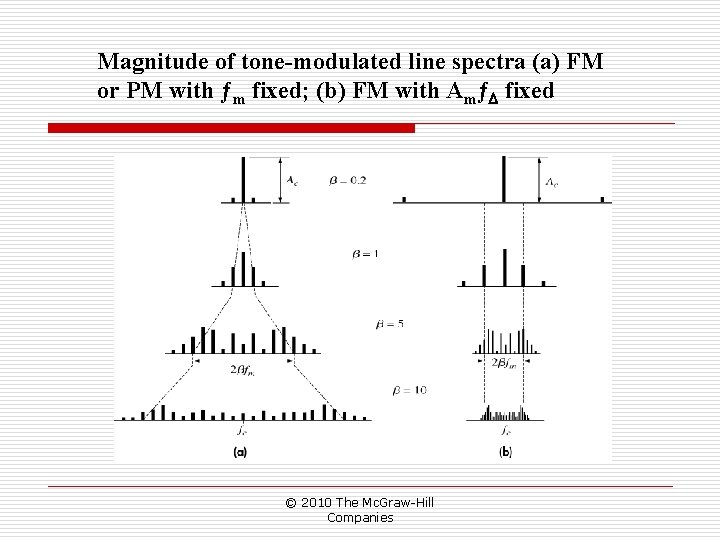
Magnitude of tone-modulated line spectra (a) FM or PM with ƒm fixed; (b) FM with Amƒ fixed © 2010 The Mc. Graw-Hill Companies
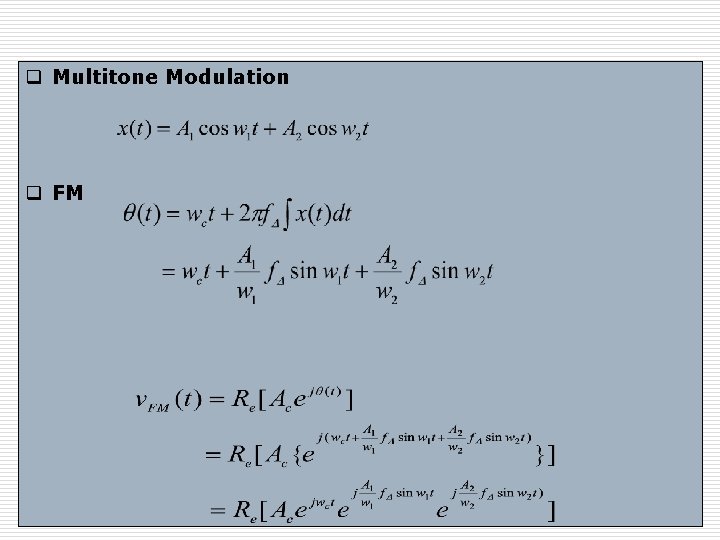
q Multitone Modulation q FM © 2010 The Mc. Graw-Hill Companies
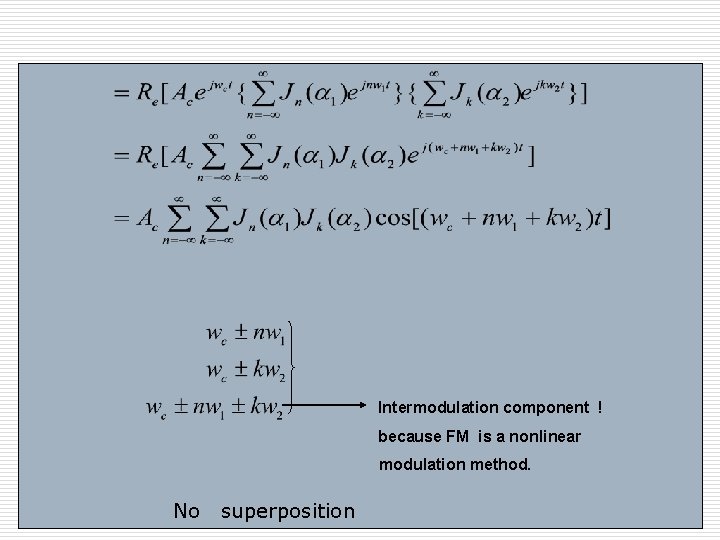
Intermodulation component ! because FM is a nonlinear modulation method. © 2010 The Mc. Graw-Hill No superposition Companies
Chapter 5: Angle CW Modulatation o Phase and frequency modulation o Transmission bandwidth and distortion o Generation and detection of FM and PM o Interference © 2010 The Mc. Graw-Hill Companies
5. 2 Transmission bandwidth and distortion © 2010 The Mc. Graw-Hill Companies
Bandwidth of Narrowband FM o Approximate spectrum of narrowband FM o Message bandwidth vs. transmission bandwidth © 2010 The Mc. Graw-Hill Companies
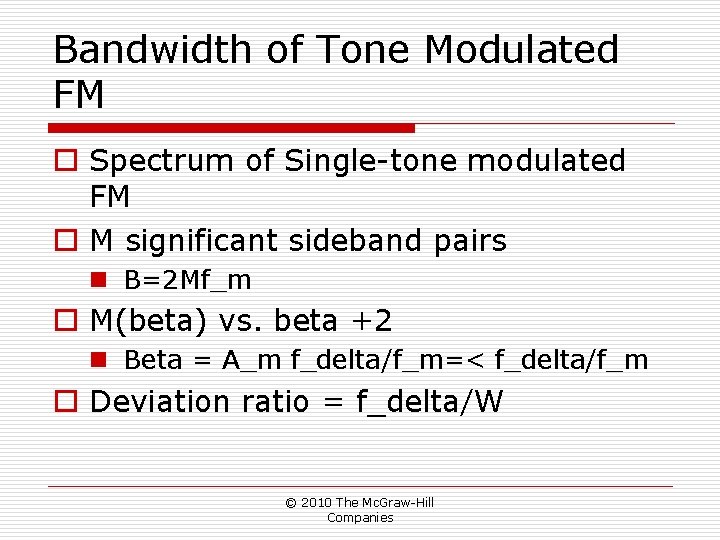
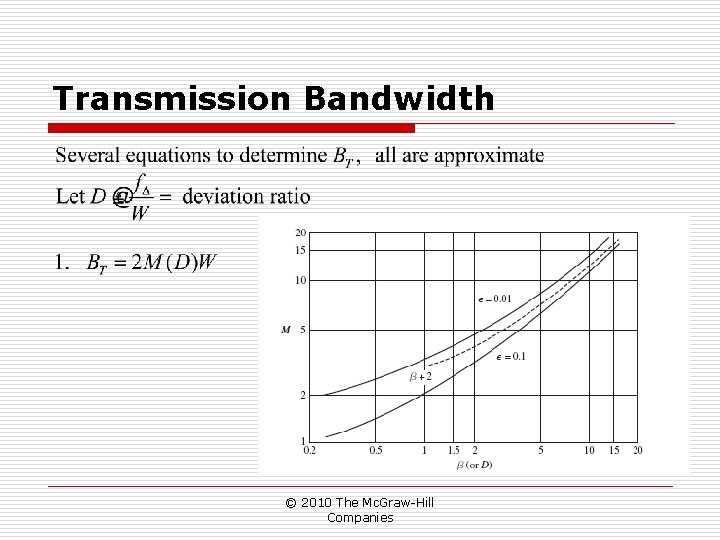
Bandwidth of Tone Modulated FM o Spectrum of Single-tone modulated FM o M significant sideband pairs n B=2 Mf_m o M(beta) vs. beta +2 n Beta = A_m f_delta/f_m=< f_delta/f_m o Deviation ratio = f_delta/W © 2010 The Mc. Graw-Hill Companies
Transmission Bandwidth © 2010 The Mc. Graw-Hill Companies
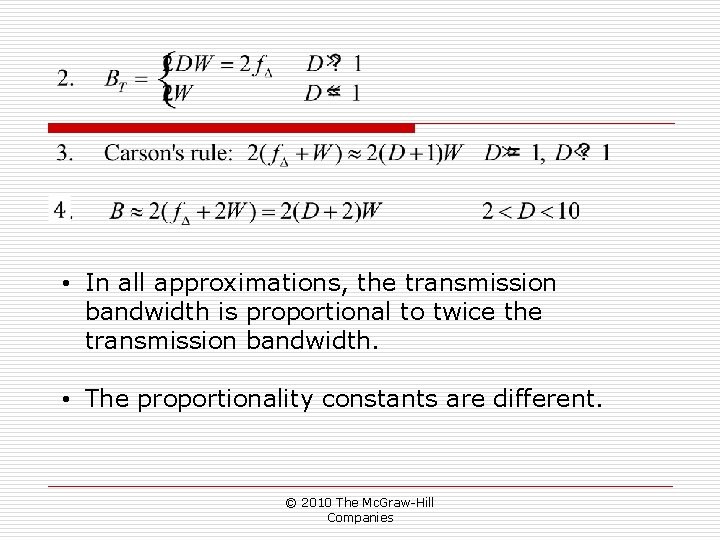
• In all approximations, the transmission bandwidth is proportional to twice the transmission bandwidth. • The proportionality constants are different. © 2010 The Mc. Graw-Hill Companies
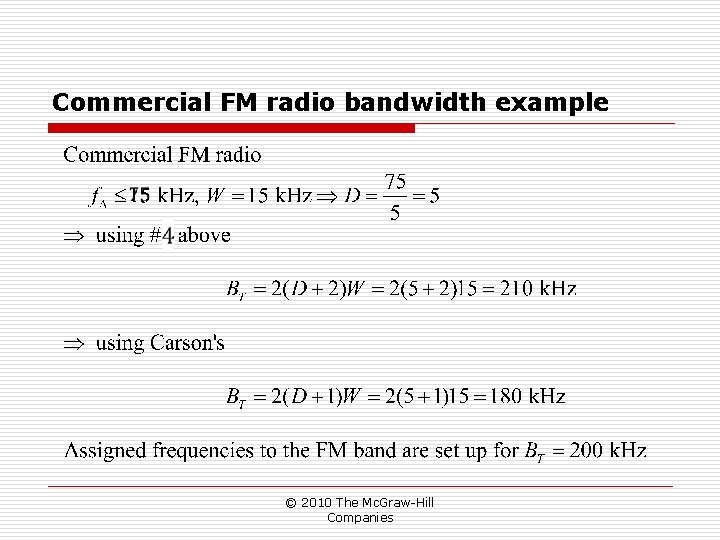
Commercial FM radio bandwidth example © 2010 The Mc. Graw-Hill Companies
Station engineer has set constants so BT conforms to the FCC limits dictated by their license © 2010 The Mc. Graw-Hill Companies
5. 2. 2 Linear and Nonlinear Distortion o Wireless channel as an LTI system o FM-to-AM conversion o Controlled nonlinear distortion and filtering to remove unwanted amplitude variation o Memoryless nonlinear system © 2010 The Mc. Graw-Hill Companies
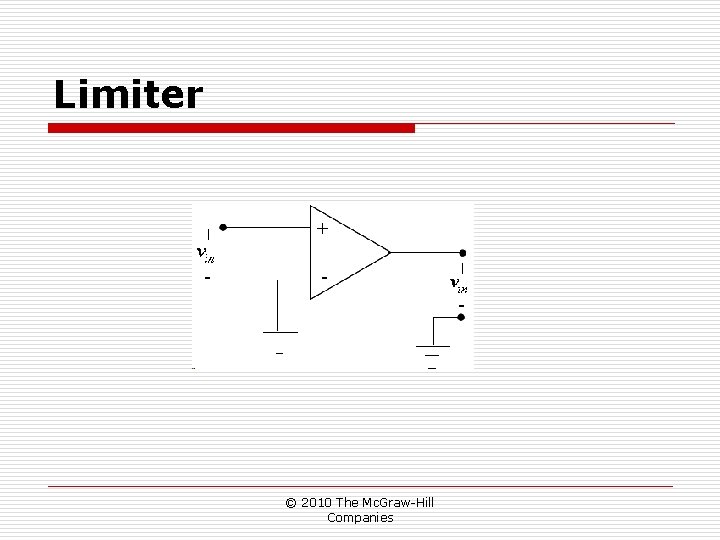
Limiter © 2010 The Mc. Graw-Hill Companies
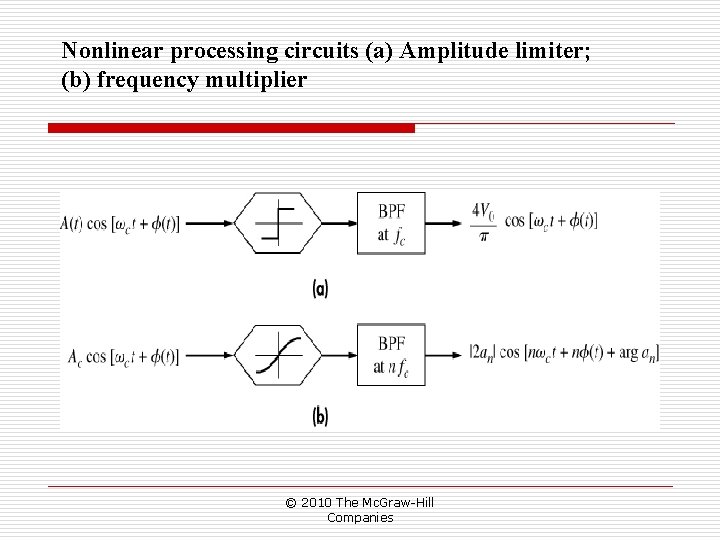
Nonlinear processing circuits (a) Amplitude limiter; (b) frequency multiplier © 2010 The Mc. Graw-Hill Companies
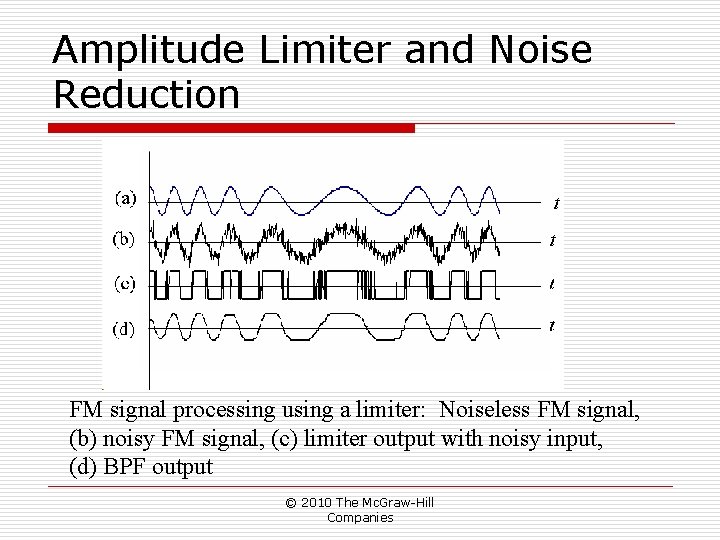
Amplitude Limiter and Noise Reduction FM signal processing using a limiter: Noiseless FM signal, (b) noisy FM signal, (c) limiter output with noisy input, (d) BPF output © 2010 The Mc. Graw-Hill Companies
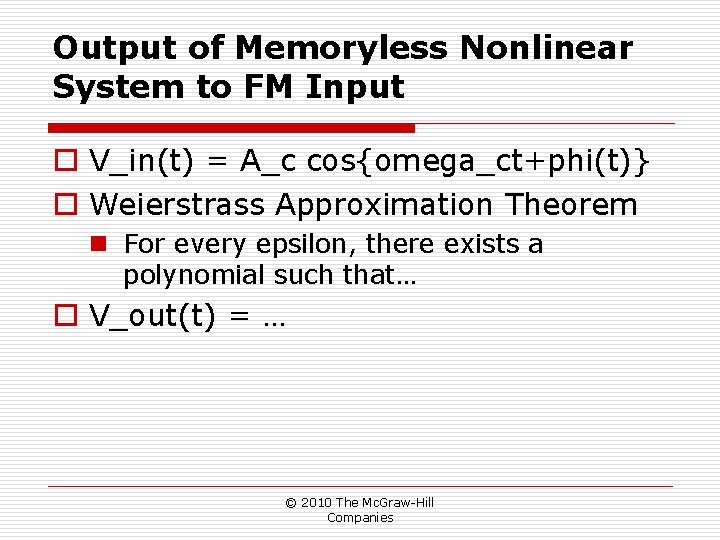
Output of Memoryless Nonlinear System to FM Input o V_in(t) = A_c cos{omega_ct+phi(t)} o Weierstrass Approximation Theorem n For every epsilon, there exists a polynomial such that… o V_out(t) = … © 2010 The Mc. Graw-Hill Companies
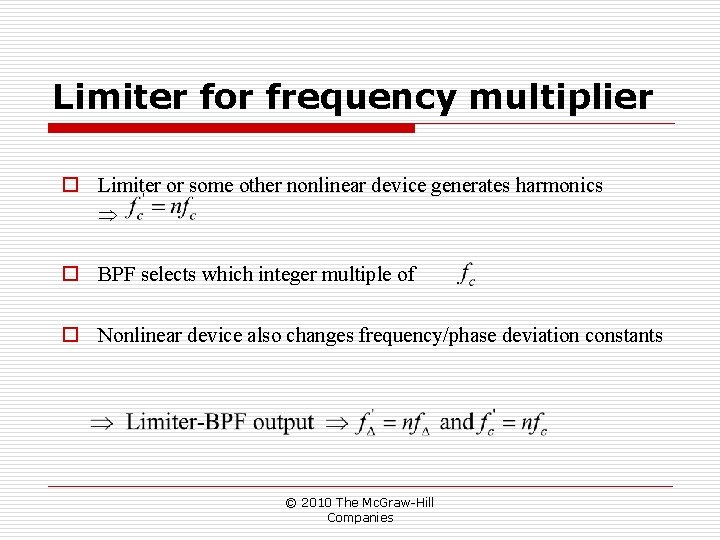
Limiter for frequency multiplier o Limiter or some other nonlinear device generates harmonics o BPF selects which integer multiple of o Nonlinear device also changes frequency/phase deviation constants © 2010 The Mc. Graw-Hill Companies
Chapter 5: Angle CW Modulatation o Phase and frequency modulation o Transmission bandwidth and distortion o Generation and detection of FM and PM o Interference © 2010 The Mc. Graw-Hill Companies
5. 3 Generation and detection of FM and PM © 2010 The Mc. Graw-Hill Companies
Generation of FM and PM signals o Pros. Constant envelope more power efficient nonlinear methods can be used longer battery life o Cons. Required to have frequency vary linearly with the message amplitude. Not straightforward. © 2010 The Mc. Graw-Hill Companies
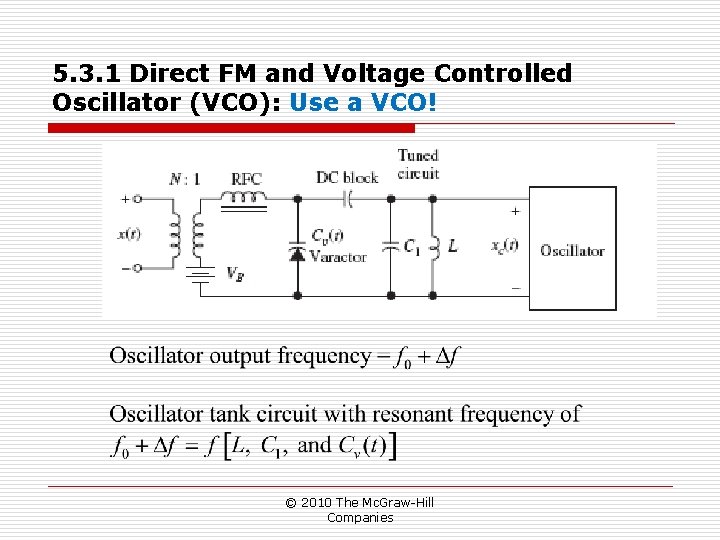
5. 3. 1 Direct FM and Voltage Controlled Oscillator (VCO): Use a VCO! © 2010 The Mc. Graw-Hill Companies
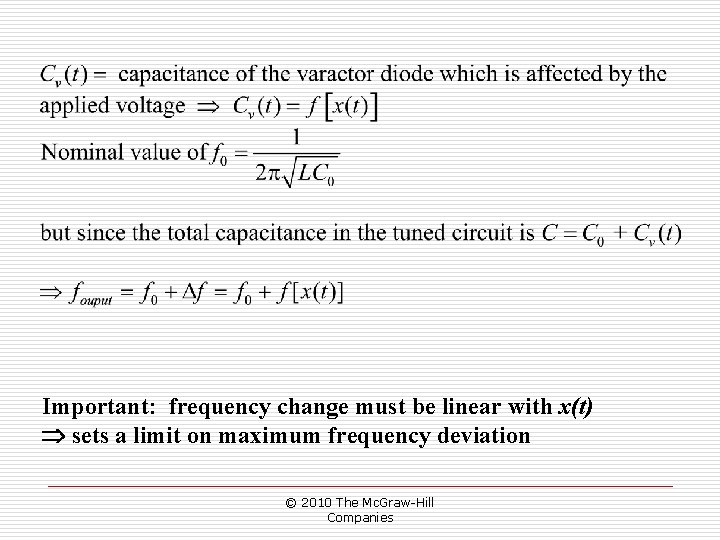
Important: frequency change must be linear with x(t) sets a limit on maximum frequency deviation © 2010 The Mc. Graw-Hill Companies
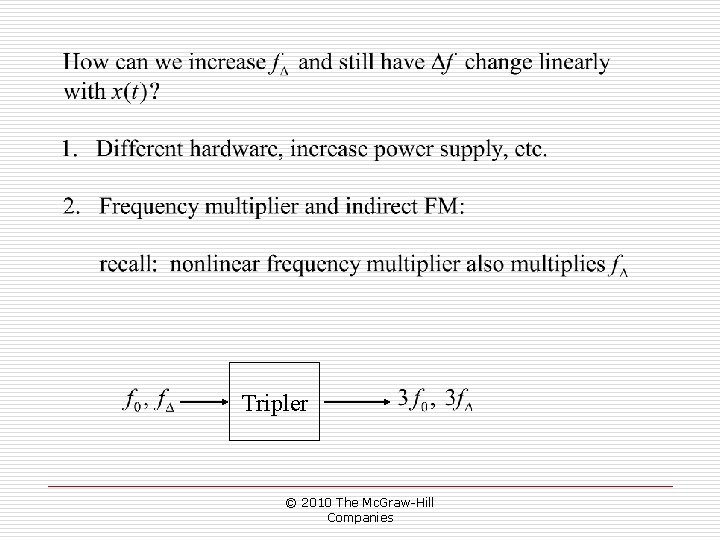
Tripler © 2010 The Mc. Graw-Hill Companies
Important: Frequency multiplication is not the same as hetrodyning Hetrodyning is a linear process and does not affect the frequency or phase deviation constants © 2010 The Mc. Graw-Hill Companies
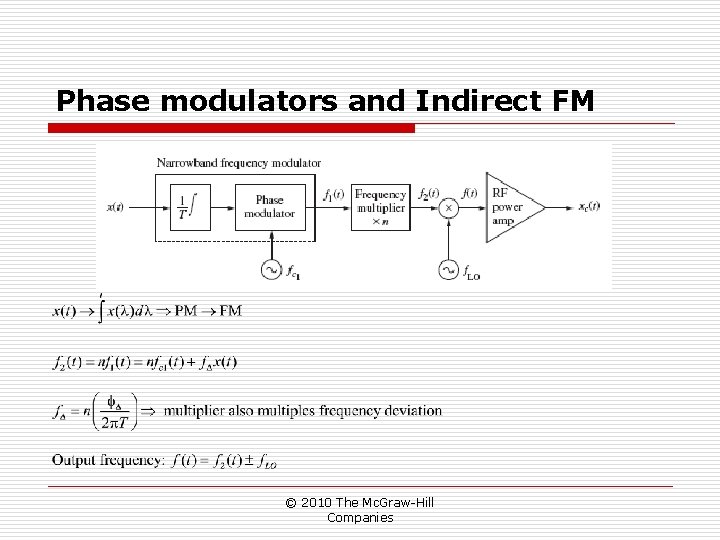
5. 3. 2 Phase modulators and indirect FM: Generate a NBFM, use frequency multiplier, and down-convert! Convert a PM signal to an FM one by integrating The message signal © 2010 The Mc. Graw-Hill Companies
Phase modulators and Indirect FM © 2010 The Mc. Graw-Hill Companies
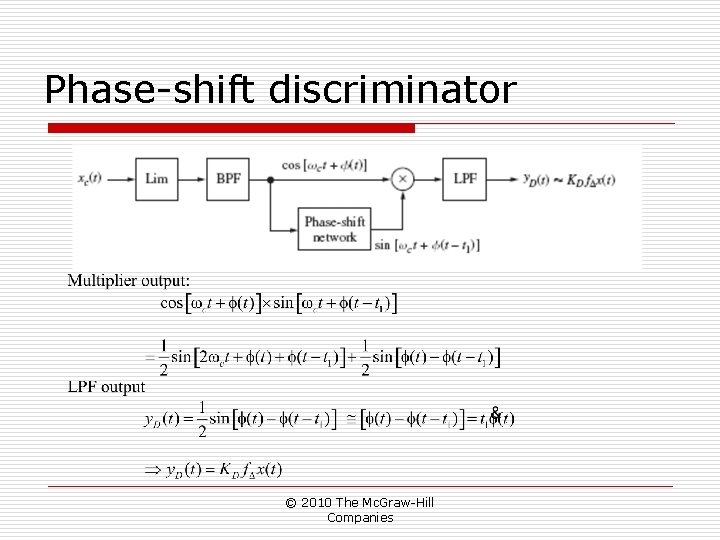
5. 3. 4 Frequency detection Produces output voltage that is proportional to the instantaneous frequency of the input the message x(t). © 2010 The Mc. Graw-Hill Companies
Frequency detector = Discriminator 1. FM-to-AM conversion 2. Phase-shift discrimination 3. Zero-crossing detection 4. Frequency feedback→ phase locked loops (Chap 7) © 2010 The Mc. Graw-Hill Companies
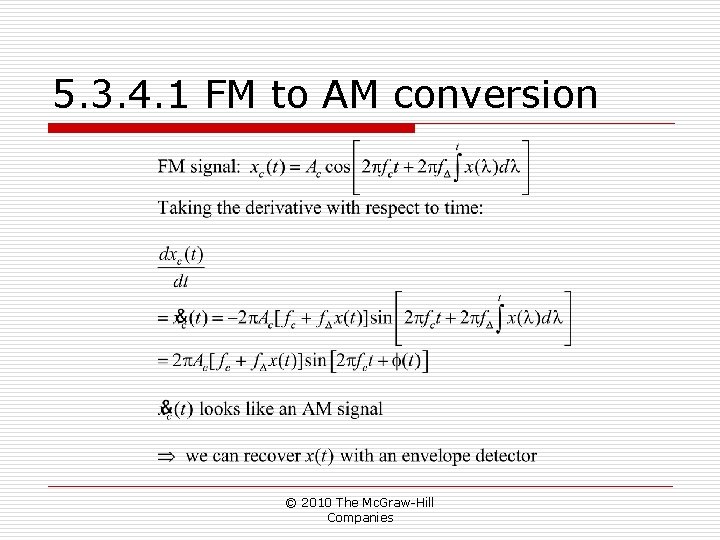
5. 3. 4. 1 FM to AM conversion © 2010 The Mc. Graw-Hill Companies
FM to AM conversion o Take derivative of FM signal o Use an envelope detector © 2010 The Mc. Graw-Hill Companies
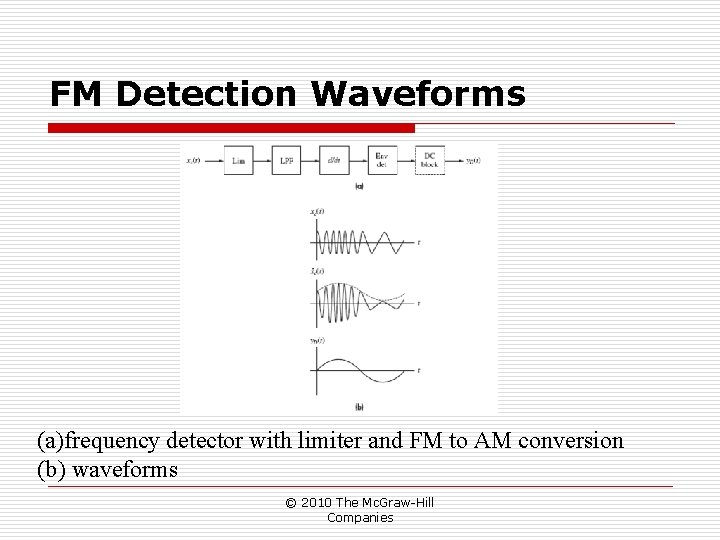
FM Detection Waveforms (a)frequency detector with limiter and FM to AM conversion (b) waveforms © 2010 The Mc. Graw-Hill Companies
FM to AM methods - Derivative o Slope detector via a BPF o Balanced discriminator © 2010 The Mc. Graw-Hill Companies
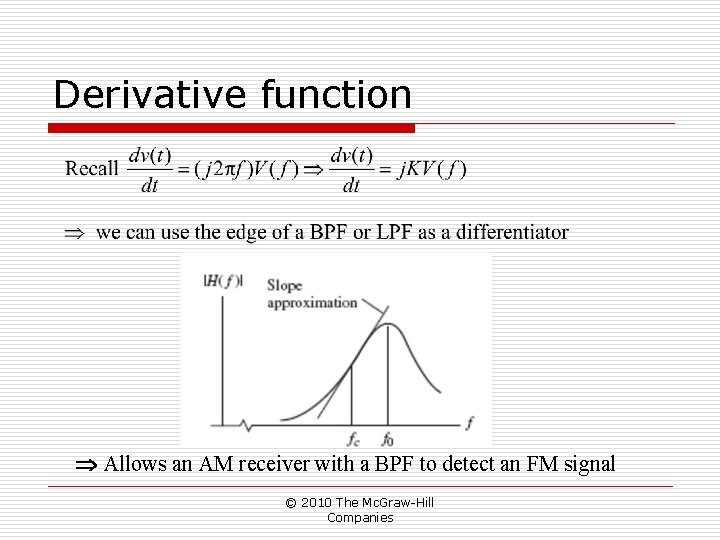
Derivative function Allows an AM receiver with a BPF to detect an FM signal © 2010 The Mc. Graw-Hill Companies
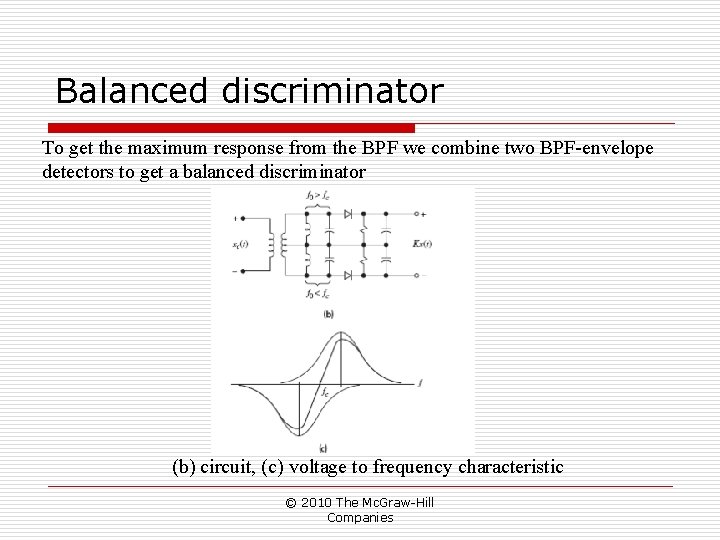
Balanced discriminator To get the maximum response from the BPF we combine two BPF-envelope detectors to get a balanced discriminator (b) circuit, (c) voltage to frequency characteristic © 2010 The Mc. Graw-Hill Companies
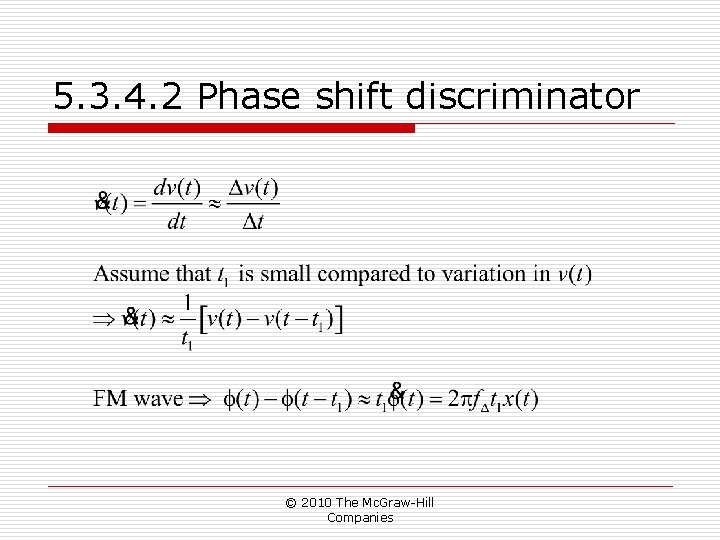
5. 3. 4. 2 Phase shift discriminator © 2010 The Mc. Graw-Hill Companies
Phase-shift discriminator © 2010 The Mc. Graw-Hill Companies
Chapter 5: Angle CW Modulatation o Phase and frequency modulation o Transmission bandwidth and distortion o Generation and detection of FM and PM o Interference © 2010 The Mc. Graw-Hill Companies
5. 4 Interference o Occurs when another signal is received concurrently in the receiver’s bandpass o Multipath: multiple versions of the transmitted signal with different delays can cause interference o Effects can be affected by the types of modulation and detectors used. o Interference: generally not random n Sometimes can be canceled out n Is not the same as random noise © 2010 The Mc. Graw-Hill Companies
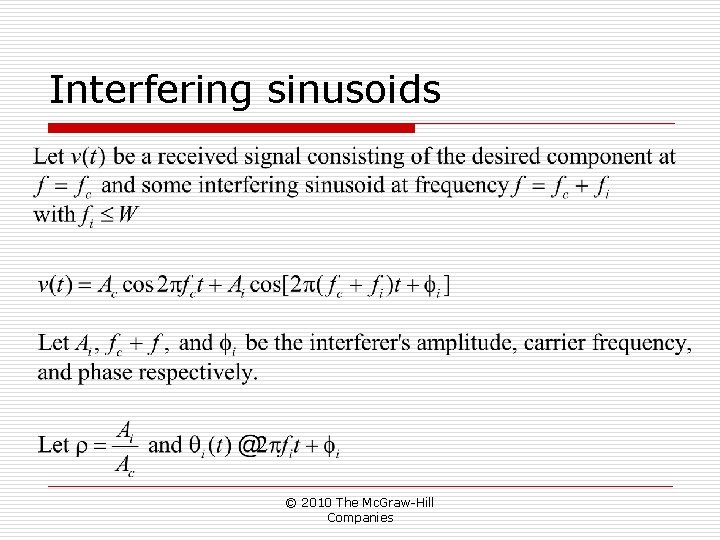
Interfering sinusoids © 2010 The Mc. Graw-Hill Companies
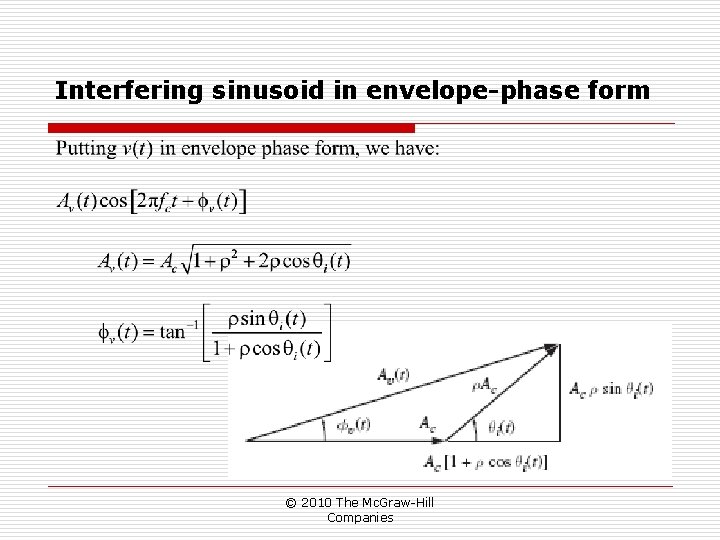
Interfering sinusoid in envelope-phase form © 2010 The Mc. Graw-Hill Companies
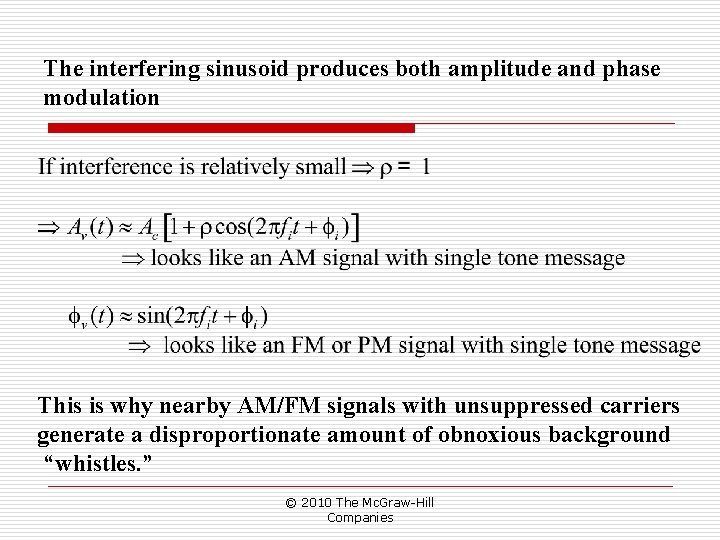
The interfering sinusoid produces both amplitude and phase modulation This is why nearby AM/FM signals with unsuppressed carriers generate a disproportionate amount of obnoxious background “whistles. ” © 2010 The Mc. Graw-Hill Companies
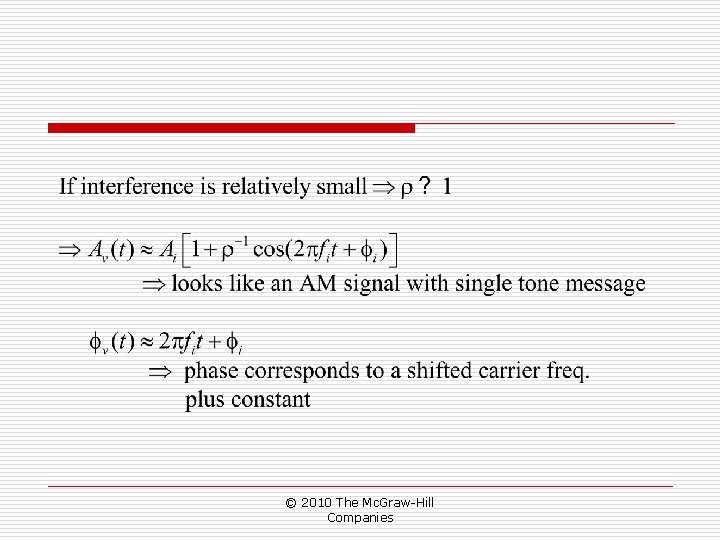
© 2010 The Mc. Graw-Hill Companies
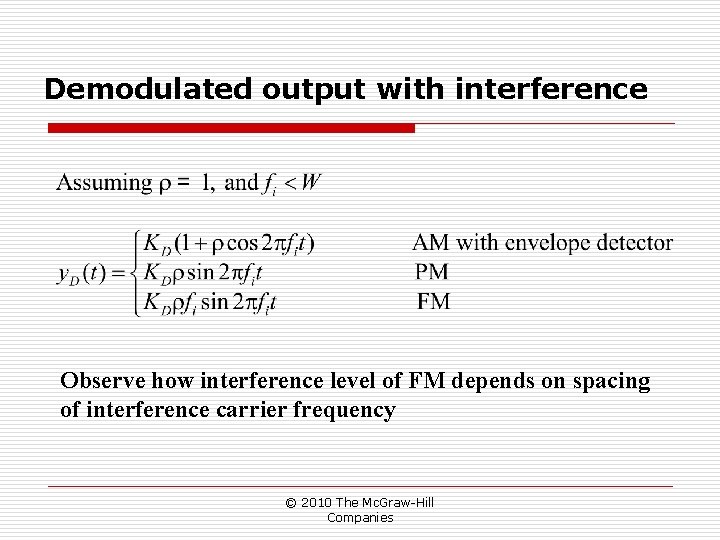
Demodulated output with interference Observe how interference level of FM depends on spacing of interference carrier frequency © 2010 The Mc. Graw-Hill Companies
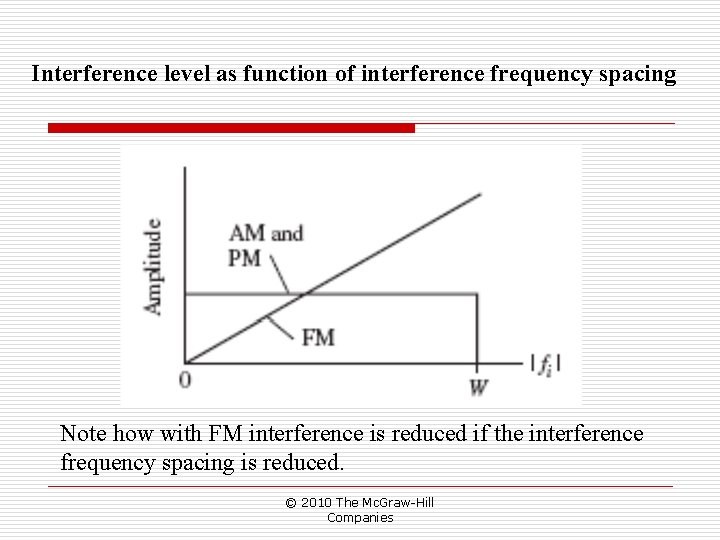
Interference level as function of interference frequency spacing Note how with FM interference is reduced if the interference frequency spacing is reduced. © 2010 The Mc. Graw-Hill Companies
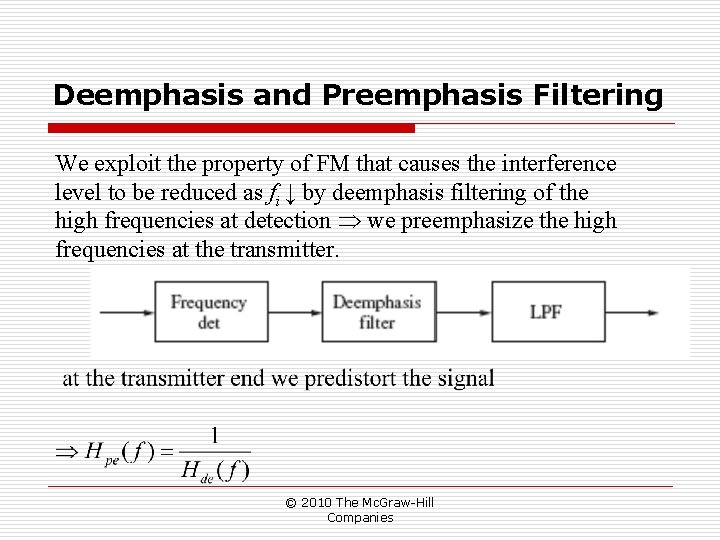
Deemphasis and Preemphasis Filtering We exploit the property of FM that causes the interference level to be reduced as fi ↓ by deemphasis filtering of the high frequencies at detection we preemphasize the high frequencies at the transmitter. © 2010 The Mc. Graw-Hill Companies
Chapter 5: Angle CW Modulatation o Phase and frequency modulation o Transmission bandwidth and distortion o Generation and detection of FM and PM o Interference © 2010 The Mc. Graw-Hill Companies