
Communication Synthesis und Management Rammig TUM Ecosystems biodiversity
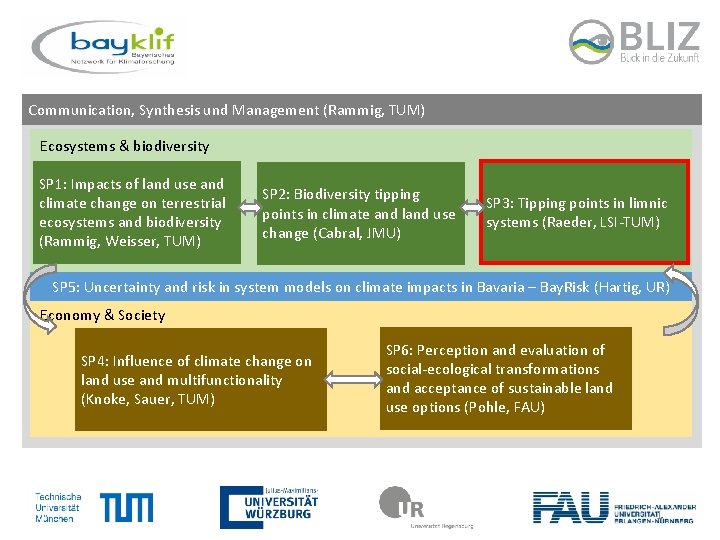
Communication, Synthesis und Management (Rammig, TUM) Ecosystems & biodiversity SP 1: Impacts of land use and climate change on terrestrial ecosystems and biodiversity (Rammig, Weisser, TUM) SP 2: Biodiversity tipping points in climate and land use change (Cabral, JMU) SP 3: Tipping points in limnic systems (Raeder, LSI-TUM) SP 5: Uncertainty and risk in system models on climate impacts in Bavaria – Bay. Risk (Hartig, UR) Economy & Society SP 4: Influence of climate change on land use and multifunctionality (Knoke, Sauer, TUM) SP 6: Perception and evaluation of social-ecological transformations and acceptance of sustainable land use options (Pohle, FAU) 1
BLIZ SP 3: Tipping points in limnic systems Dr. Markus Hoffmann & Dr. Uta Raeder
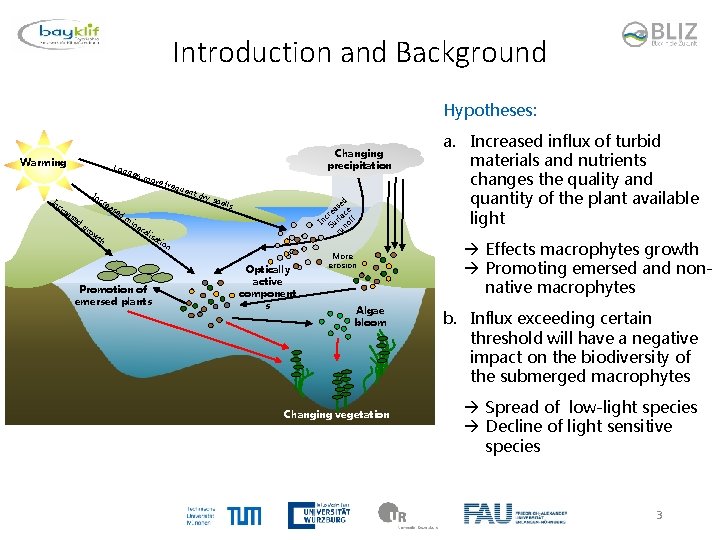
Introduction and Background Hypotheses: Warming Lon ger, In c In re Changing precipitation mor e fre que cr as ed ea se d gr ow th m in er ali s Promotion of emersed plants at nt d ry s pell ed as ce e cr fa f In ur of S un r s io n Optically active component s More erosion Algae bloom Changing vegetation a. Increased influx of turbid materials and nutrients changes the quality and quantity of the plant available light Effects macrophytes growth Promoting emersed and nonnative macrophytes b. Influx exceeding certain threshold will have a negative impact on the biodiversity of the submerged macrophytes Spread of low-light species Decline of light sensitive species 3
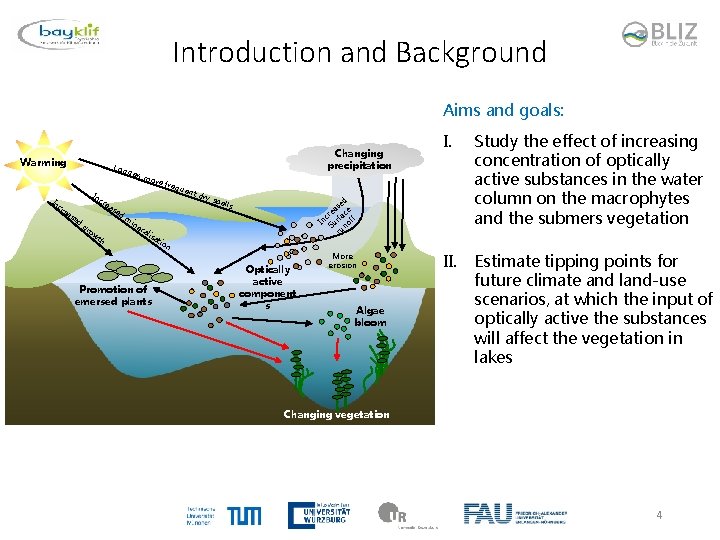
Introduction and Background Aims and goals: Warming Lon ger, In c In re Changing precipitation mor e fre que cr as ed ea se d gr ow th m in er ali s Promotion of emersed plants at nt d ry s pell I. Study the effect of increasing concentration of optically active substances in the water column on the macrophytes and the submers vegetation II. Estimate tipping points for future climate and land-use scenarios, at which the input of optically active the substances will affect the vegetation in lakes ed as ce e cr fa f In ur of S un r s io n Optically active component s More erosion Algae bloom Changing vegetation 4
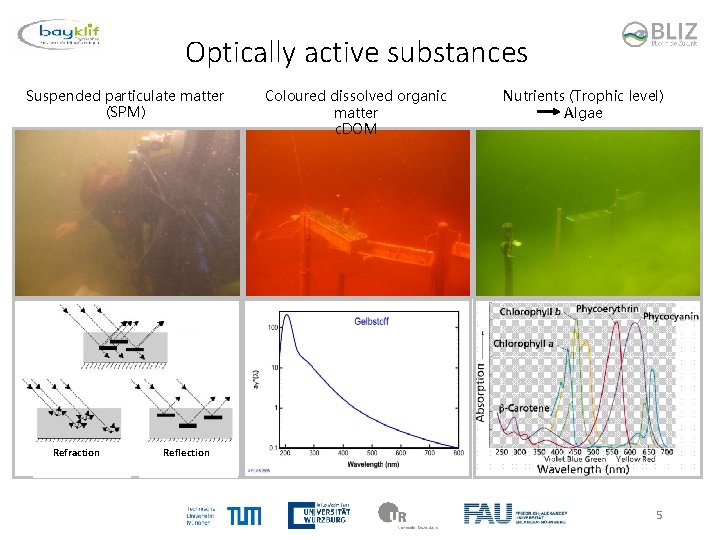
Optically active substances Suspended particulate matter (SPM) Refraction Streuung Absorption Coloured dissolved organic matter c. DOM Nutrients (Trophic level) Algae Reflection Reflektion 5
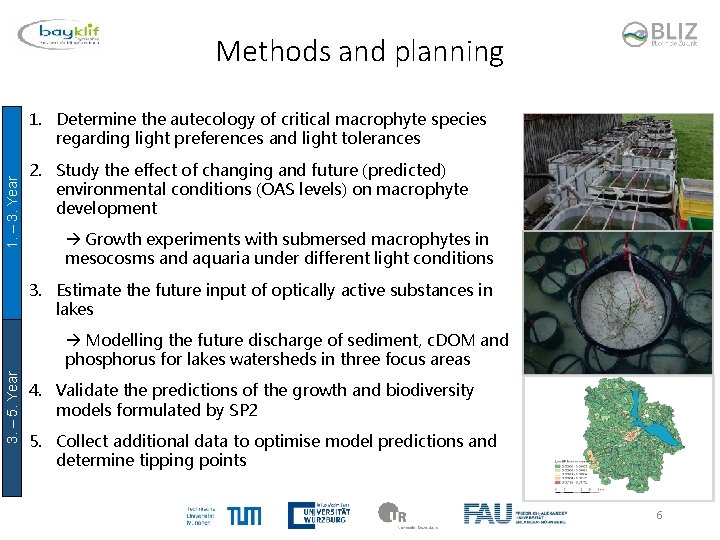
Methods and planning 1. – 3. Year 1. Determine the autecology of critical macrophyte species regarding light preferences and light tolerances 2. Study the effect of changing and future (predicted) environmental conditions (OAS levels) on macrophyte development Growth experiments with submersed macrophytes in mesocosms and aquaria under different light conditions 3. Estimate the future input of optically active substances in lakes 3. – 5. Year Modelling the future discharge of sediment, c. DOM and phosphorus for lakes watersheds in three focus areas 4. Validate the predictions of the growth and biodiversity models formulated by SP 2 5. Collect additional data to optimise model predictions and determine tipping points 6

Impact of OAS on macrophyte growth Mesocosm experiment with macrophytes under natural conditions Aims and goals 1. – 2. Year § Study the effect of increased OAS on plant growth § Estimate survivability under changing light conditions § Compare reactions of native and non-native species Experimental setup § § 1000 L tanks filled with a mix of lake and ground water Tanks interconnected via circulatory system UV Treatment to reduce algae growth Macrophytes planted in separate pots filled with lake sediment Treatments I. II. Light intensity: Increased concentrations of suspended particulate matter (SPM) Light quality: Addition of humic substances (c. DOM) 7
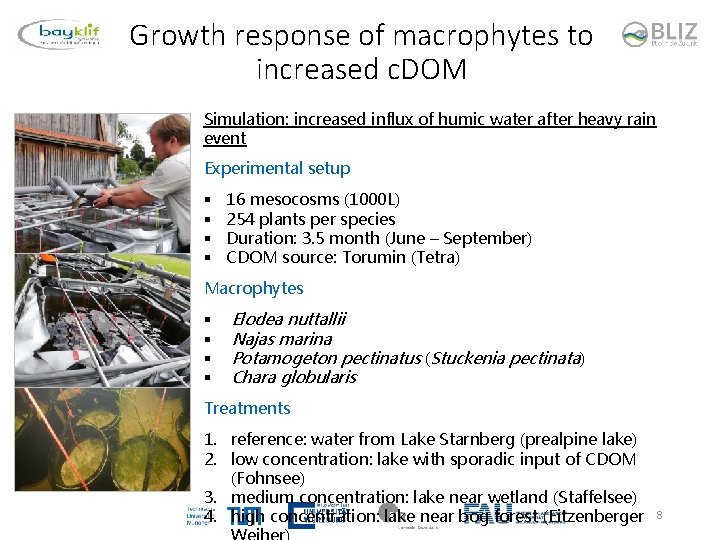
Growth response of macrophytes to increased c. DOM Simulation: increased influx of humic water after heavy rain event Experimental setup § § 16 mesocosms (1000 L) 254 plants per species Duration: 3. 5 month (June – September) CDOM source: Torumin (Tetra) Macrophytes § § Elodea nuttallii Najas marina Potamogeton pectinatus (Stuckenia pectinata) Chara globularis Treatments 1. reference: water from Lake Starnberg (prealpine lake) 2. low concentration: lake with sporadic input of CDOM (Fohnsee) 3. medium concentration: lake near wetland (Staffelsee) 4. high concentration: lake near bog forest (Eitzenberger 8
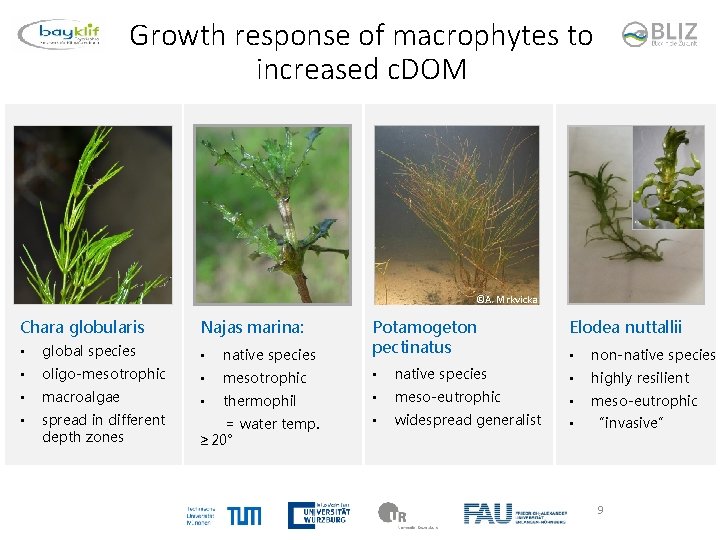
Growth response of macrophytes to increased c. DOM ©A. Mrkvicka Chara globularis Najas marina: Potamogeton pectinatus • global species • native species • oligo-mesotrophic • • macroalgae • thermophil • spread in different depth zones = water temp. ≥ 20° Elodea nuttallii • non-native species • highly resilient • meso-eutrophic • widespread generalist • “invasive” 9
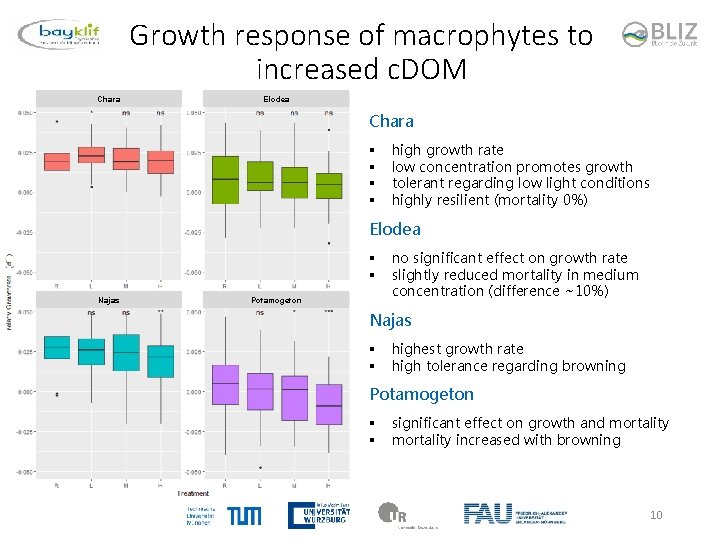
Growth response of macrophytes to increased c. DOM Chara Elodea Chara § § high growth rate low concentration promotes growth tolerant regarding low light conditions highly resilient (mortality 0%) Elodea § § Najas Potamogeton no significant effect on growth rate slightly reduced mortality in medium concentration (difference ~10%) Najas § § highest growth rate high tolerance regarding browning Potamogeton § § significant effect on growth and mortality increased with browning 10
Thank you for your attention
- Slides: 11